COMMUNITY OF
PRACTICE
Mohammad hossein sharifi
PHD student , Ferdowsi university
April , 2023
• A community of practice (CoP) is a group of people who share a common concern, a
set of problems, or an interest in a topic and who come together to fulfill both individual
fulfill both individual and group goals
• Communities of practice often focus on sharing best practices and creating new
knowledge to advance a domain of professional practice. Interaction on an ongoing
Interaction on an ongoing basis is an important part of this.
• Many communities of practice rely on face-to-face meetings as well as web-based
collaborative environments to communicate, connect and conduct community activities.
• https://www.engagingalllearners.ca/ip/literacy-for-all/index.php?id=5
• The first community of practice supported by Alberta Regional Professional
Development Consortia (ARPD) was a group of committed K to 6 teachers
from across the province
WHAT ARE THE CHARACTERISTICS OF A COMMUNITY OF PRACTICE?
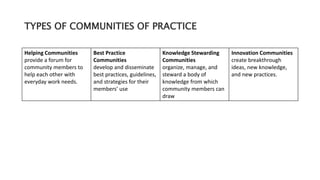
TYPES OF COMMUNITIES OF PRACTICE
Helping Communities
provide a forum for
community members to
help each other with
everyday work needs.
Best Practice
Communities
develop and disseminate
best practices, guidelines,
and strategies for their
members’ use
Knowledge Stewarding
Communities
organize, manage, and
steward a body of
knowledge from which
community members can
draw
Innovation Communities
create breakthrough
ideas, new knowledge,
and new practices.
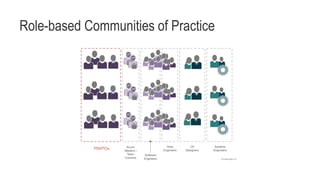
Role-based Communities of Practice
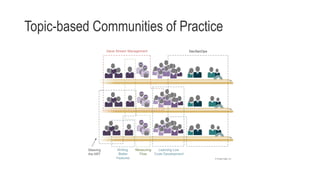
Topic-based Communities of Practice
Organizing a Community of Practice
• CoPs are highly organic, and like most living organisms, they have a natural
life cycle, beginning with an idea for a new community and ending when the
community members feel the group has achieved its objectives or is no longer
providing value.
shows the typical life cycle of a CoP
COP Members
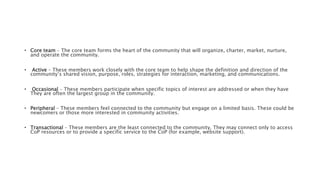
• Core team – The core team forms the heart of the community that will organize, charter, market, nurture,
and operate the community.
• Active – These members work closely with the core team to help shape the definition and direction of the
community’s shared vision, purpose, roles, strategies for interaction, marketing, and communications.
• Occasional – These members participate when specific topics of interest are addressed or when they have
They are often the largest group in the community.
• Peripheral – These members feel connected to the community but engage on a limited basis. These could be
newcomers or those more interested in community activities.
• Transactional – These members are the least connected to the community. They may connect only to access
CoP resources or to provide a specific service to the CoP (for example, website support).
• https://hbr.org/2000/01/communities-of-practice-the-organizational-
frontier

COMMUNITY OF PRACTICE.pptx

  • 1.
    COMMUNITY OF PRACTICE Mohammad hosseinsharifi PHD student , Ferdowsi university April , 2023
  • 2.
    • A communityof practice (CoP) is a group of people who share a common concern, a set of problems, or an interest in a topic and who come together to fulfill both individual fulfill both individual and group goals • Communities of practice often focus on sharing best practices and creating new knowledge to advance a domain of professional practice. Interaction on an ongoing Interaction on an ongoing basis is an important part of this. • Many communities of practice rely on face-to-face meetings as well as web-based collaborative environments to communicate, connect and conduct community activities.
  • 3.
    • https://www.engagingalllearners.ca/ip/literacy-for-all/index.php?id=5 • Thefirst community of practice supported by Alberta Regional Professional Development Consortia (ARPD) was a group of committed K to 6 teachers from across the province
  • 4.
    WHAT ARE THECHARACTERISTICS OF A COMMUNITY OF PRACTICE?
  • 5.
    TYPES OF COMMUNITIESOF PRACTICE Helping Communities provide a forum for community members to help each other with everyday work needs. Best Practice Communities develop and disseminate best practices, guidelines, and strategies for their members’ use Knowledge Stewarding Communities organize, manage, and steward a body of knowledge from which community members can draw Innovation Communities create breakthrough ideas, new knowledge, and new practices.
  • 6.
  • 7.
  • 8.
    Organizing a Communityof Practice • CoPs are highly organic, and like most living organisms, they have a natural life cycle, beginning with an idea for a new community and ending when the community members feel the group has achieved its objectives or is no longer providing value.
  • 9.
    shows the typicallife cycle of a CoP
  • 10.
  • 11.
    • Core team– The core team forms the heart of the community that will organize, charter, market, nurture, and operate the community. • Active – These members work closely with the core team to help shape the definition and direction of the community’s shared vision, purpose, roles, strategies for interaction, marketing, and communications. • Occasional – These members participate when specific topics of interest are addressed or when they have They are often the largest group in the community. • Peripheral – These members feel connected to the community but engage on a limited basis. These could be newcomers or those more interested in community activities. • Transactional – These members are the least connected to the community. They may connect only to access CoP resources or to provide a specific service to the CoP (for example, website support).
  • 12.

Editor's Notes

  • #3 تعامل به صورت مستمر بخش مهمی از این امر است