The age of rename() is over*
Steve Loughran
stevel@hortonworks.com
@steveloughran
December 2018 (*mostly)
Me: stevel@apache.org
• Hadoop committer ~10
years
• Object storage
• The lower bits of your stack
traces belong to me
Why do we save data?
• Publish data for other applications
• Process data published by other applications
• Persist state for future instances of an application
• Work with more data than fits into RAM
• Share data with other instances of same application
• Save things people care about & want to get back
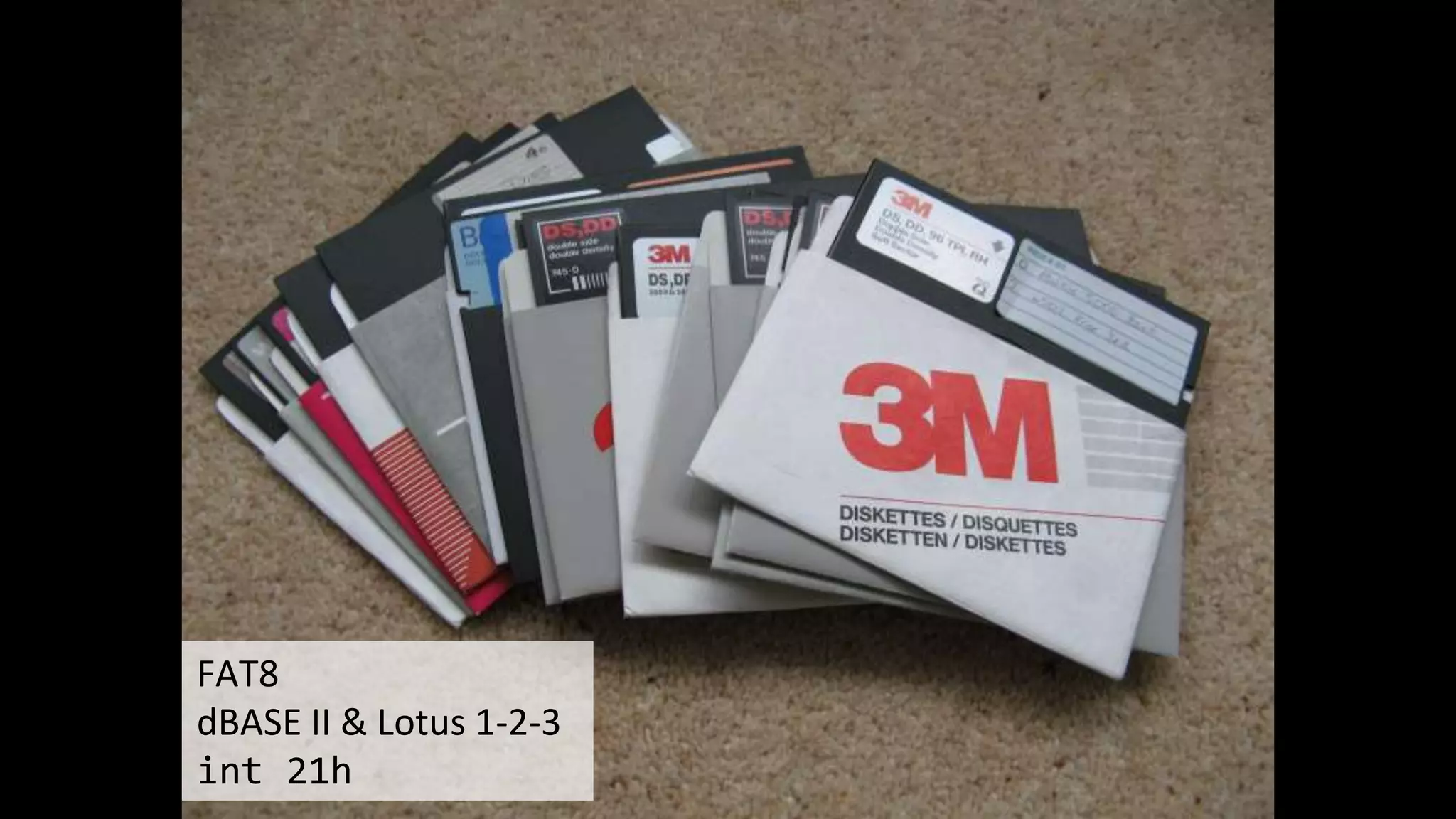
FAT8
dBASE II & Lotus 1-2-3
int 21h
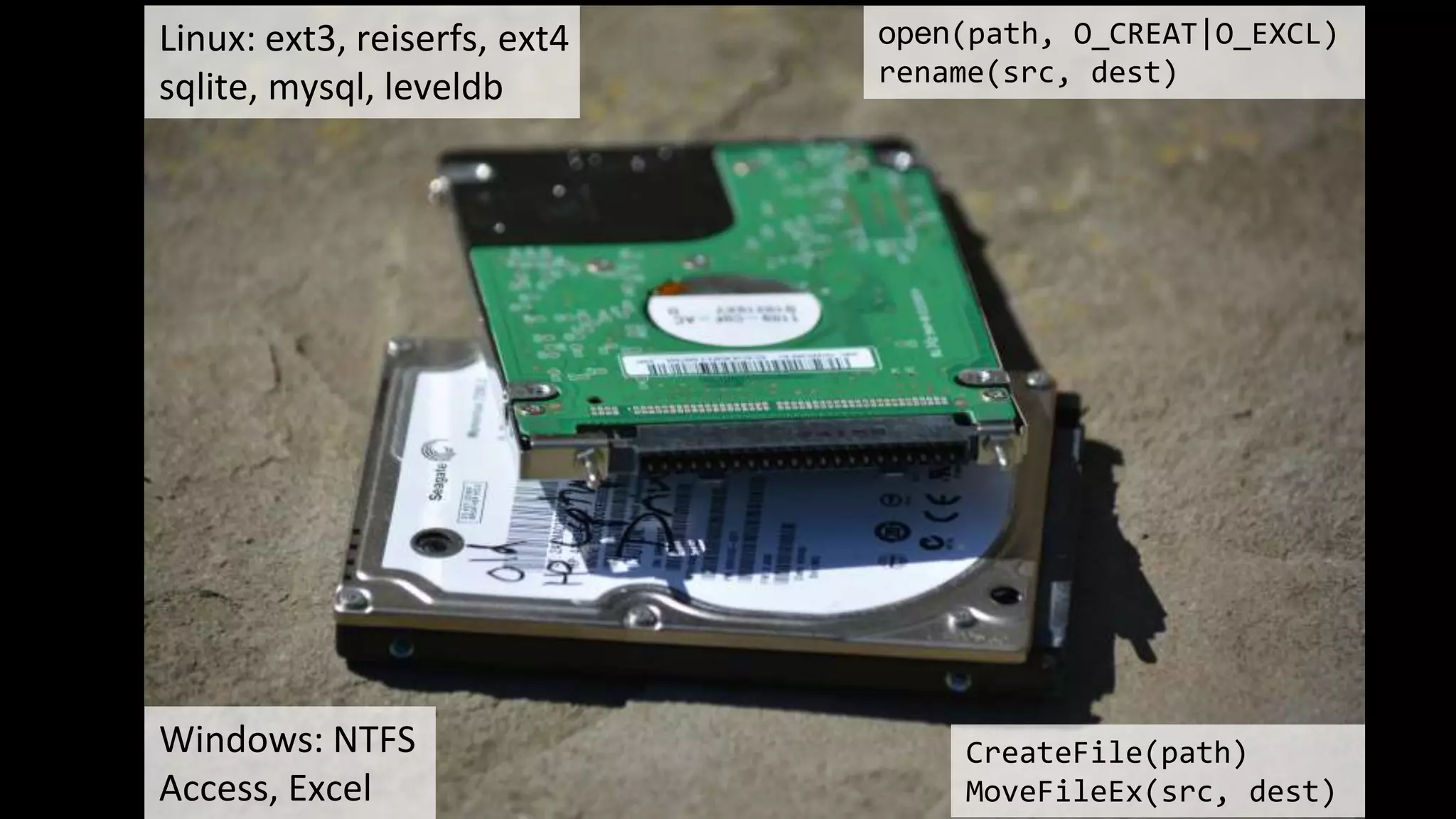
Linux: ext3, reiserfs, ext4
sqlite, mysql, leveldb
open(path, O_CREAT|O_EXCL)
rename(src, dest)
Windows: NTFS
Access, Excel
CreateFile(path)
MoveFileEx(src, dest)
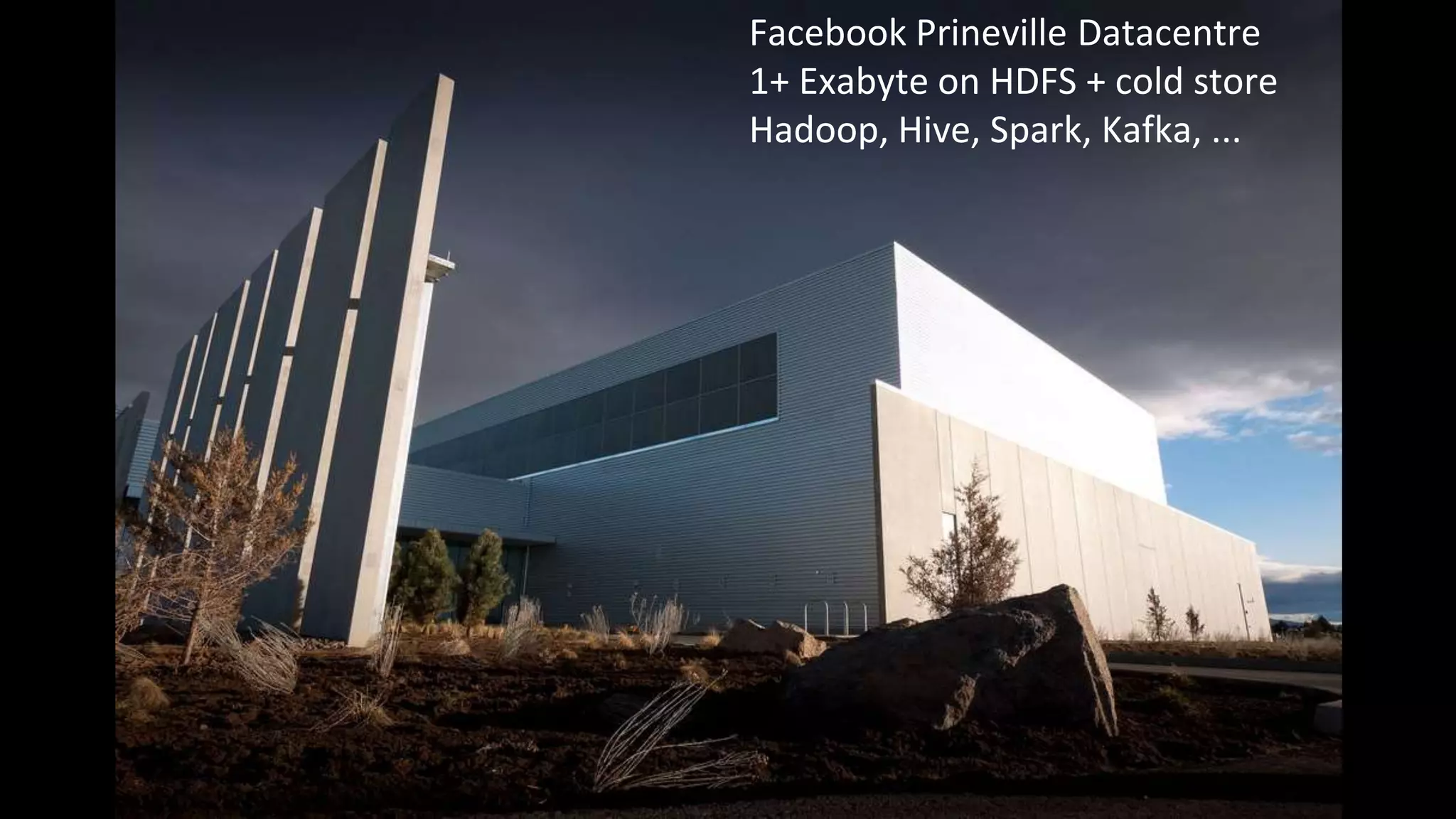
Facebook Prineville Datacentre
1+ Exabyte on HDFS + cold store
Hadoop, Hive, Spark, Kafka, ...
Model and APIs
Model #1: File-System
Directories and files
Posix with stream metaphor
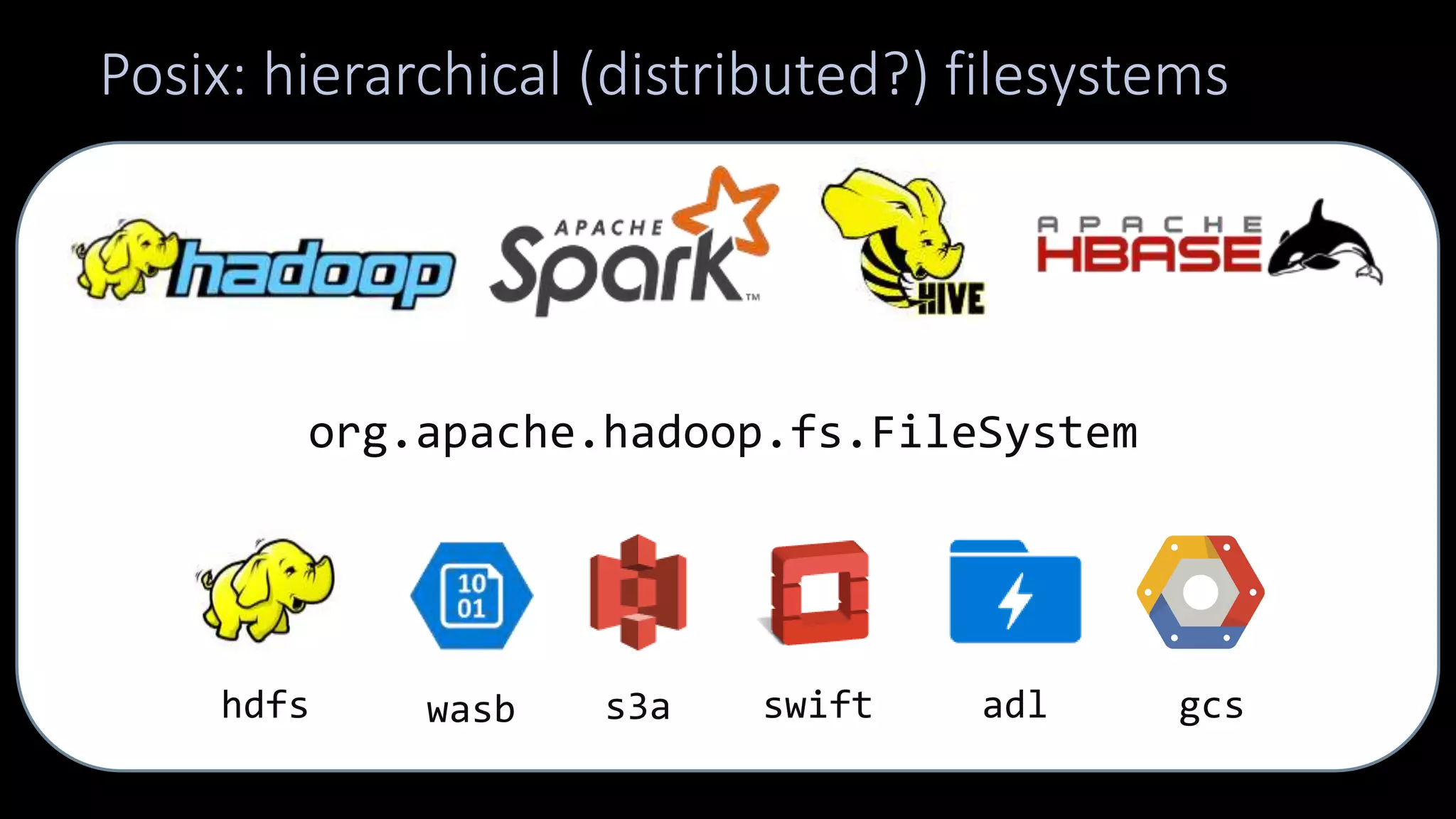
org.apache.hadoop.fs.FileSystem
hdfs s3awasb adlswift gcs
Posix: hierarchical (distributed?) filesystems
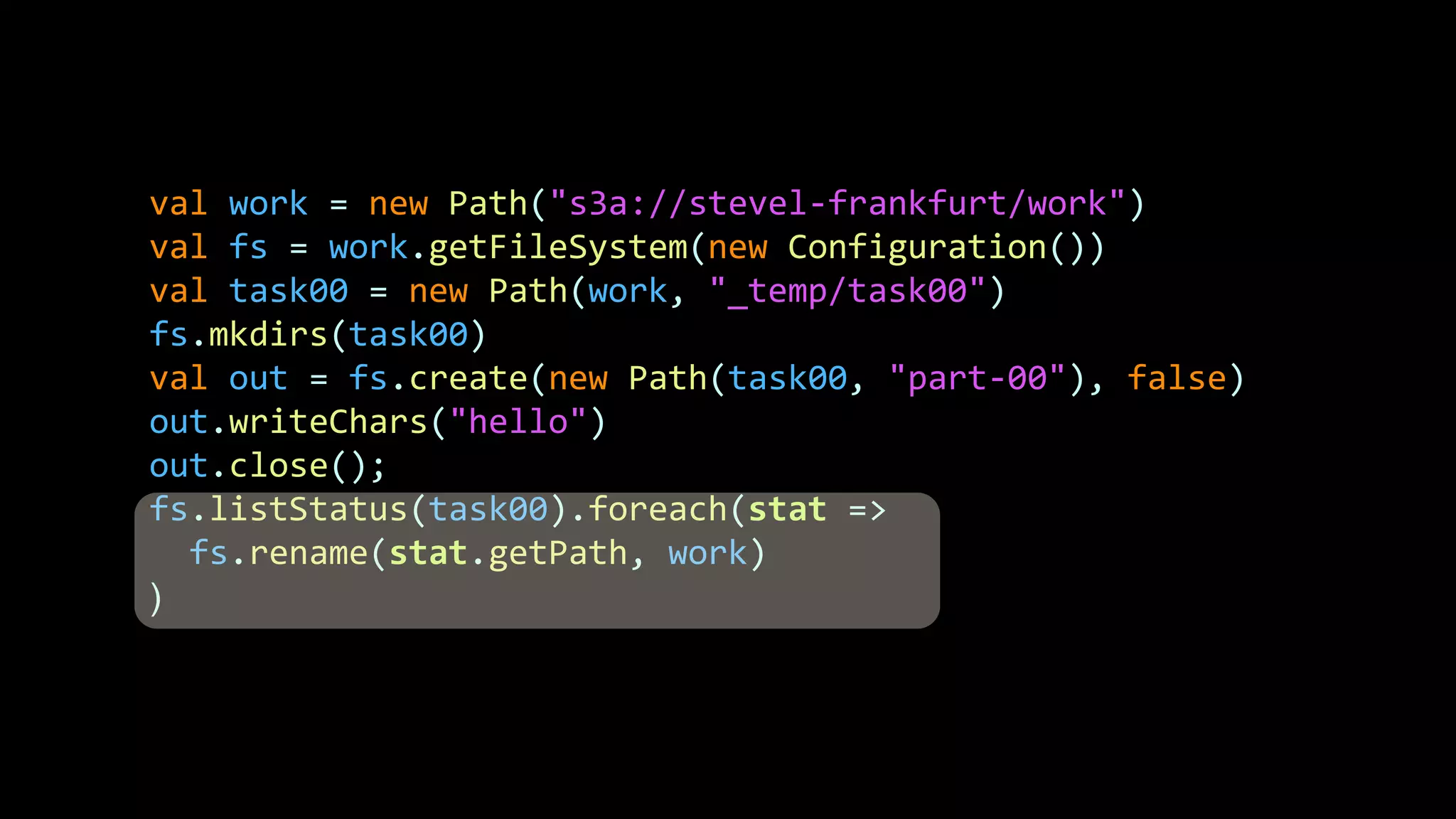
val work = new Path("s3a://stevel-frankfurt/work")
val fs = work.getFileSystem(new Configuration())
val task00 = new Path(work, "_temp/task00")
fs.mkdirs(task00)
val out = fs.create(new Path(task00, "part-00"), false)
out.writeChars("hello")
out.close();
fs.listStatus(task00).foreach(stat =>
fs.rename(stat.getPath, work)
)
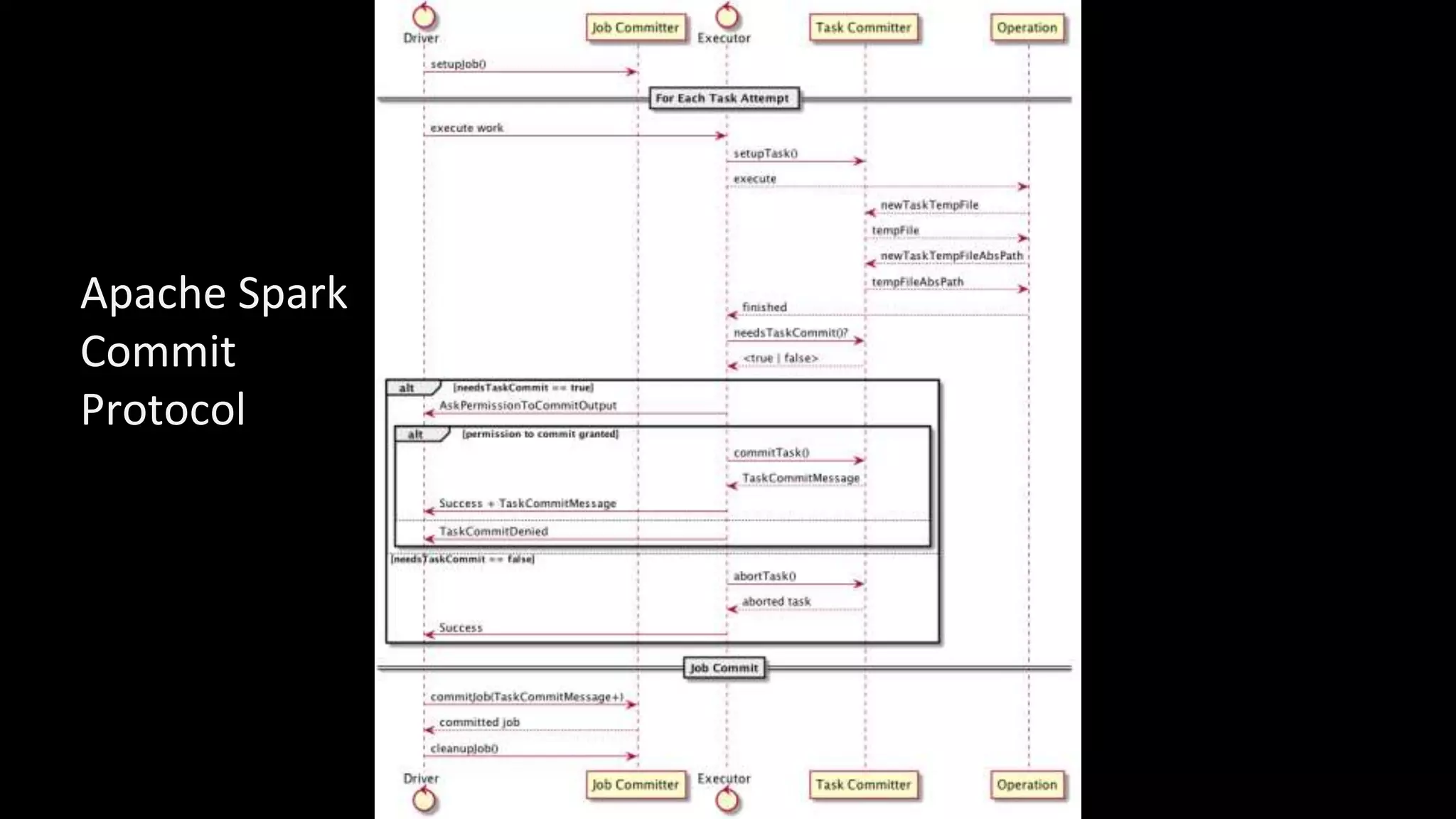
Apache Spark
Commit
Protocol
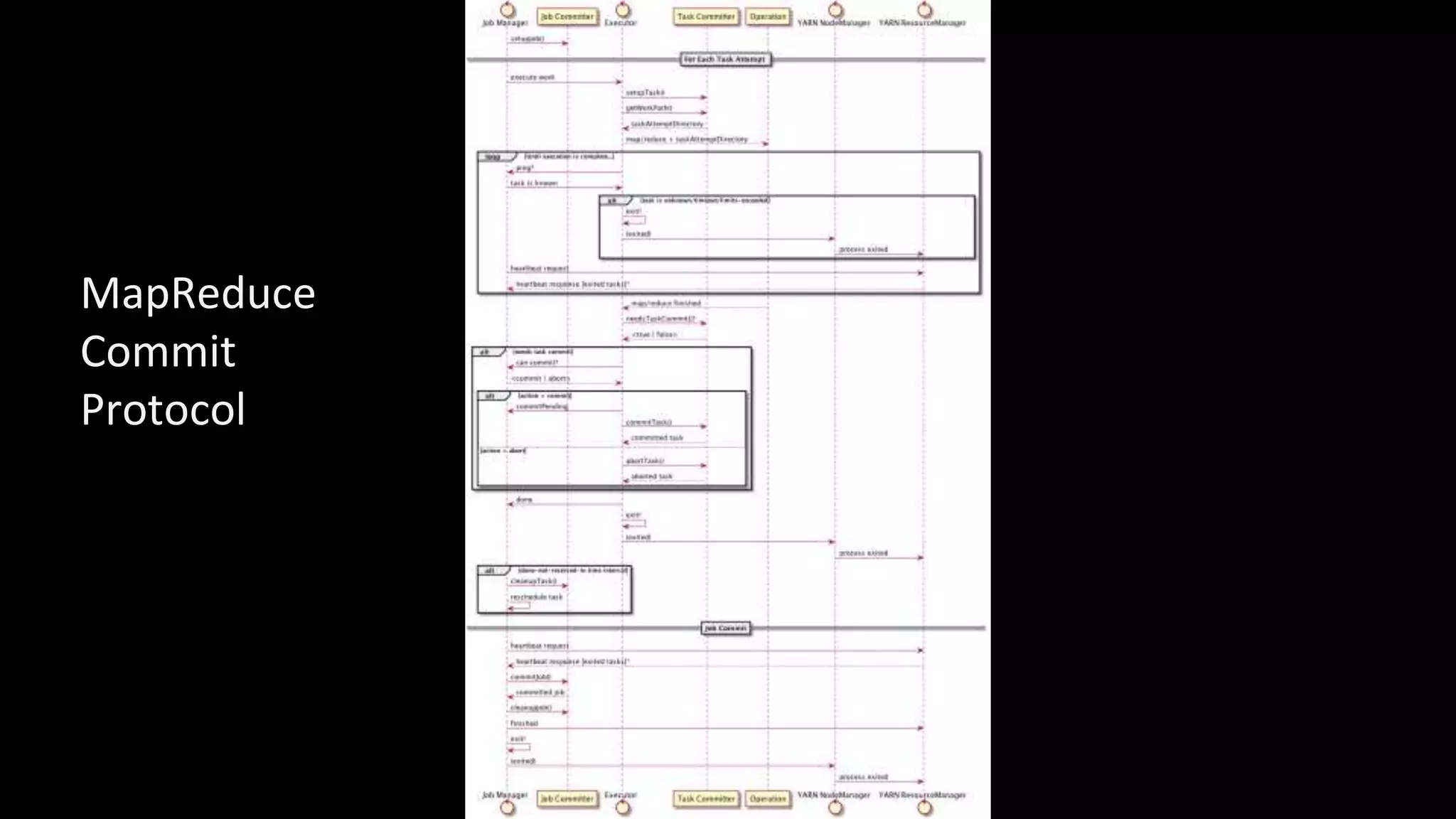
MapReduce
Commit
Protocol
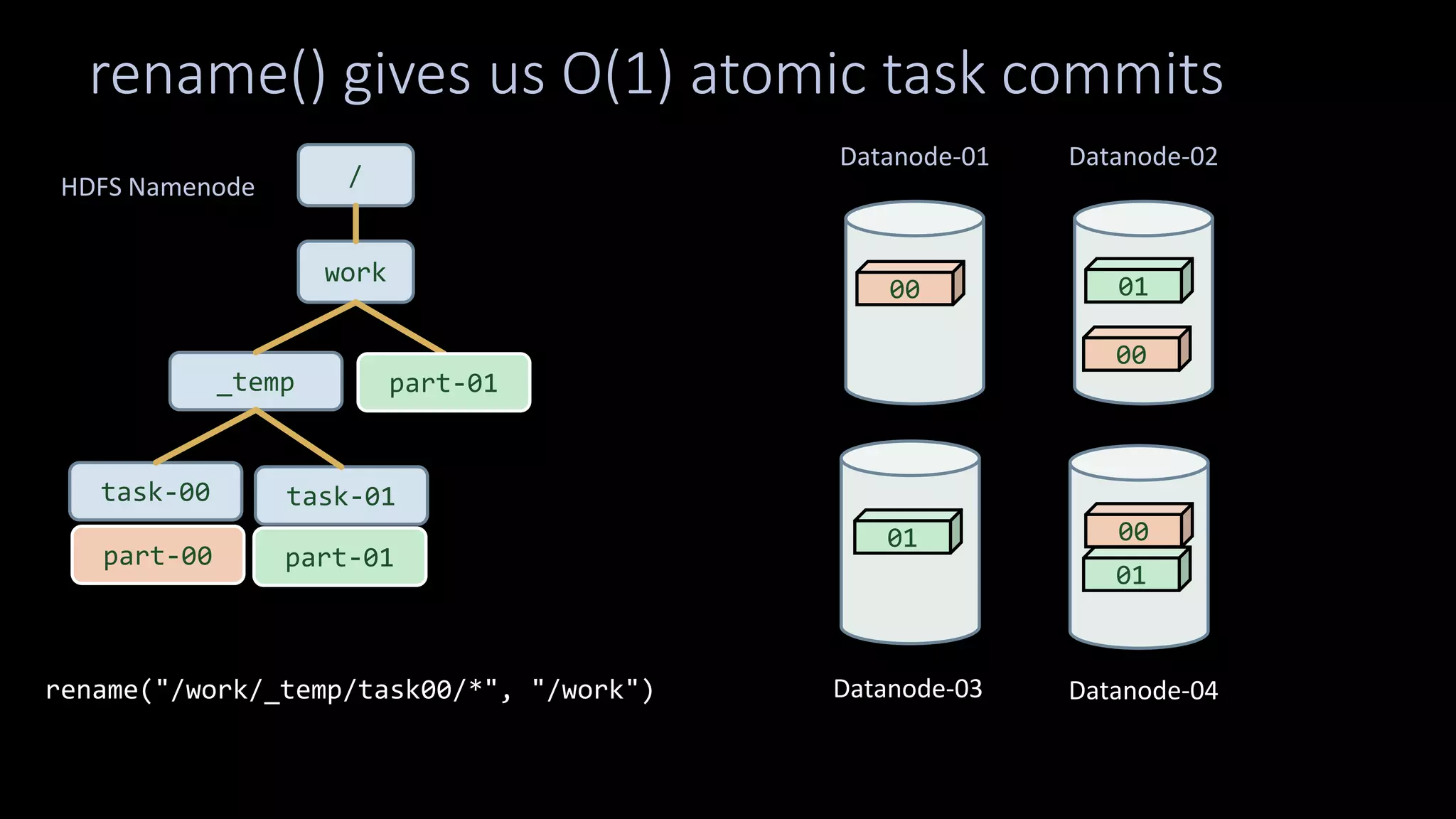
rename() gives us O(1) atomic task commits
/
work
_temp
part-00 part-01
00
00
00
01
01
01
part-01
rename("/work/_temp/task00/*", "/work")
task-00 task-01
HDFS Namenode
Datanode-01
Datanode-03
Datanode-02
Datanode-04
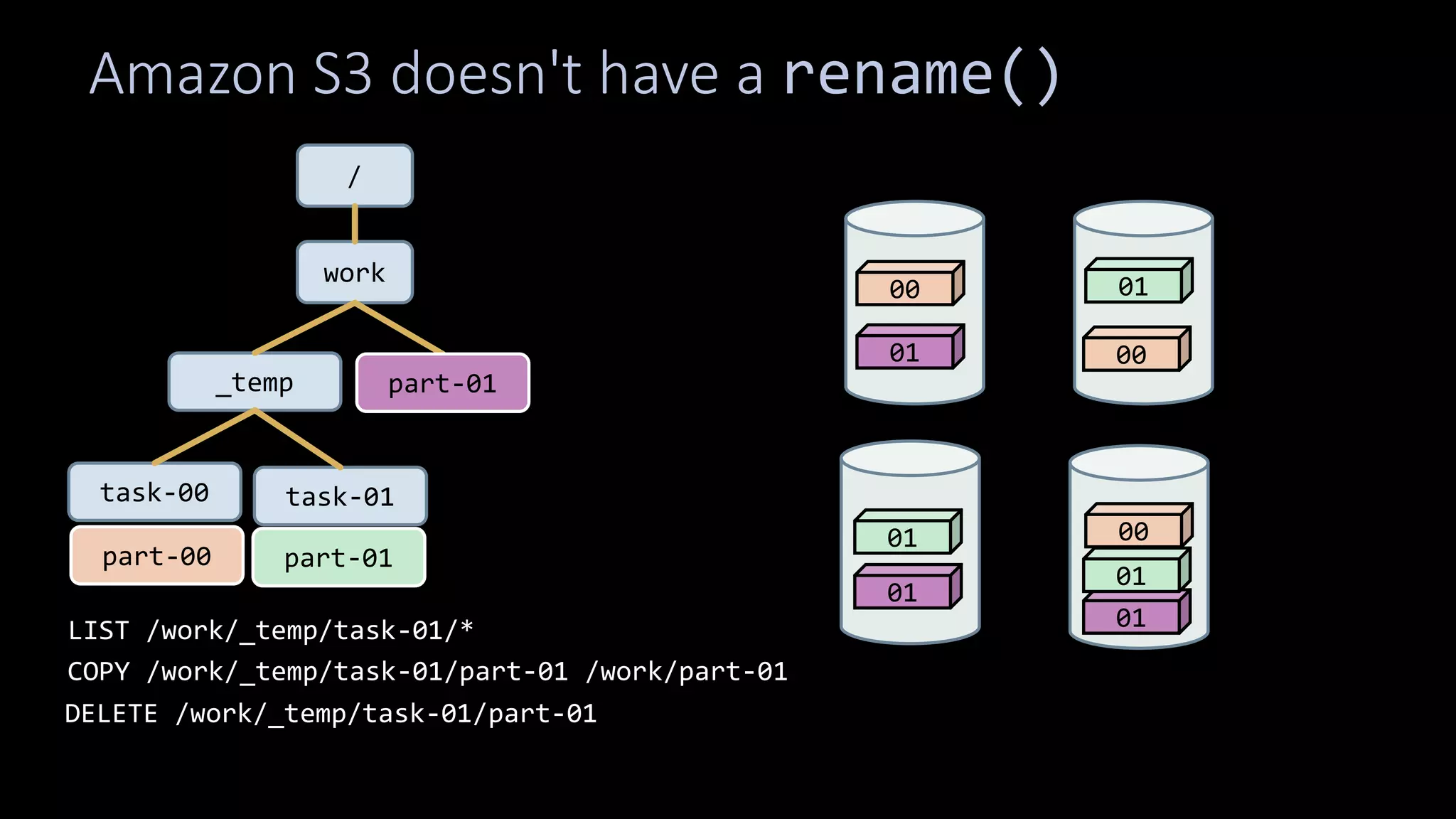
Amazon S3 doesn't have a rename()
/
work
_temp
part-00 part-01
00
00
00
01
01
part-01
LIST /work/_temp/task-01/*
task-00 task-01
01
01
01
COPY /work/_temp/task-01/part-01 /work/part-01
DELETE /work/_temp/task-01/part-01
01
S3 Shards
work/part-01
01
01
01
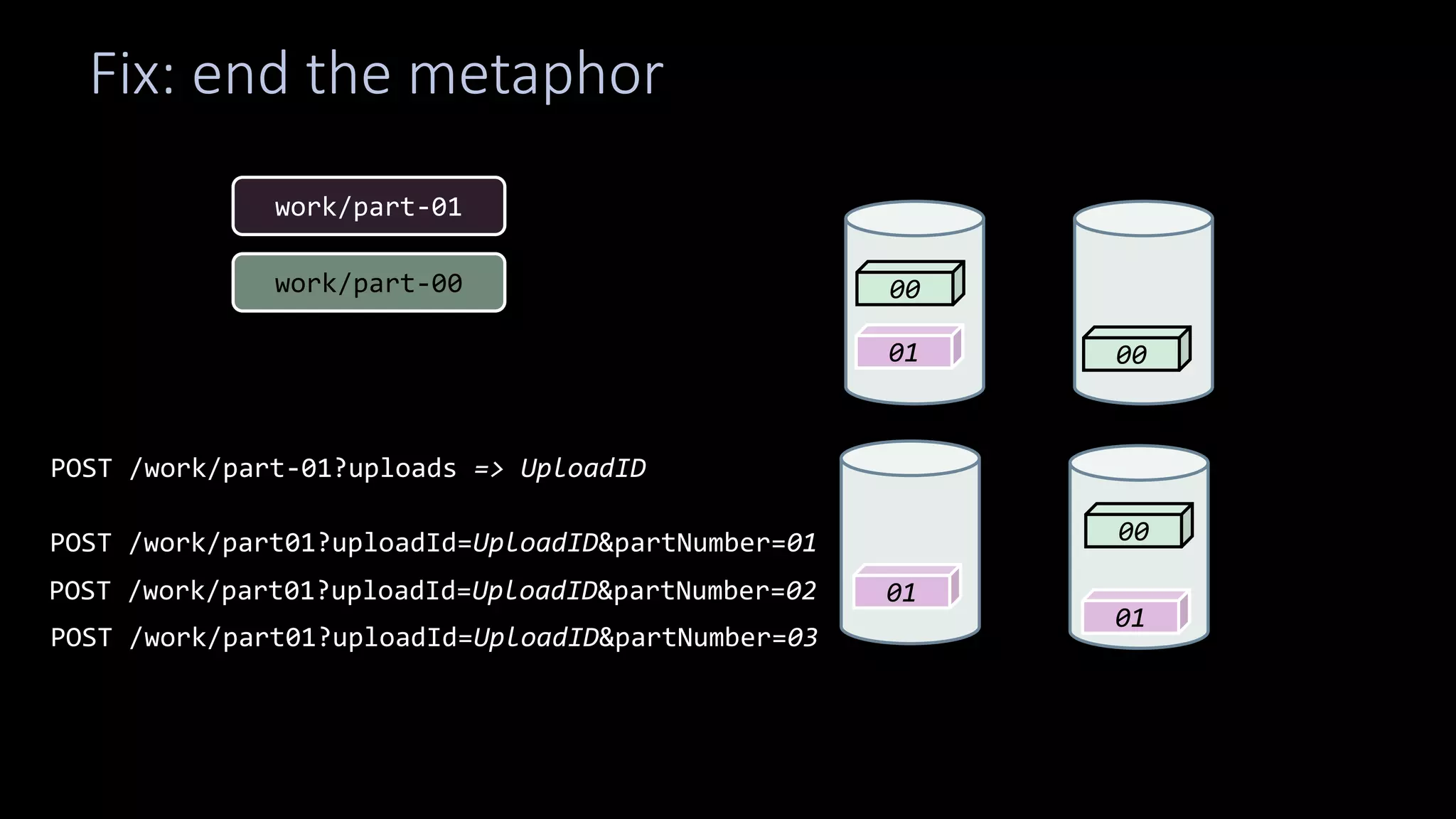
Fix: end the metaphor
00
00
00
POST /work/part-01?uploads => UploadID
POST /work/part01?uploadId=UploadID&partNumber=01
POST /work/part01?uploadId=UploadID&partNumber=02
POST /work/part01?uploadId=UploadID&partNumber=03
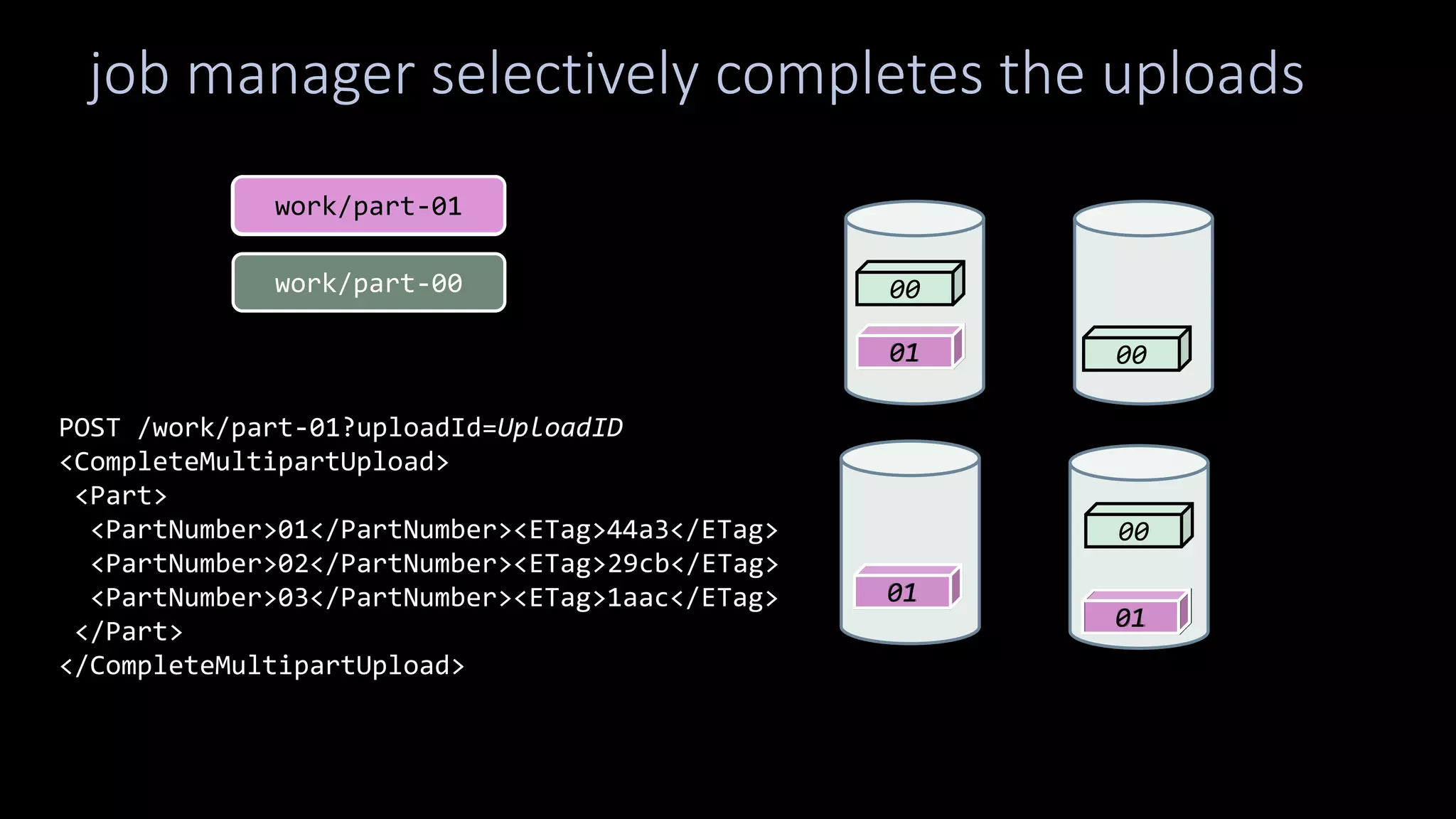
work/part-00
work/part-01
job manager selectively completes the uploads
00
00
00
01
01
01
POST /work/part-01?uploadId=UploadID
<CompleteMultipartUpload>
<Part>
<PartNumber>01</PartNumber><ETag>44a3</ETag>
<PartNumber>02</PartNumber><ETag>29cb</ETag>
<PartNumber>03</PartNumber><ETag>1aac</ETag>
</Part>
</CompleteMultipartUpload>
01
01
01
work/part-01
work/part-00
S3A O(1) zero-rename commit demo!
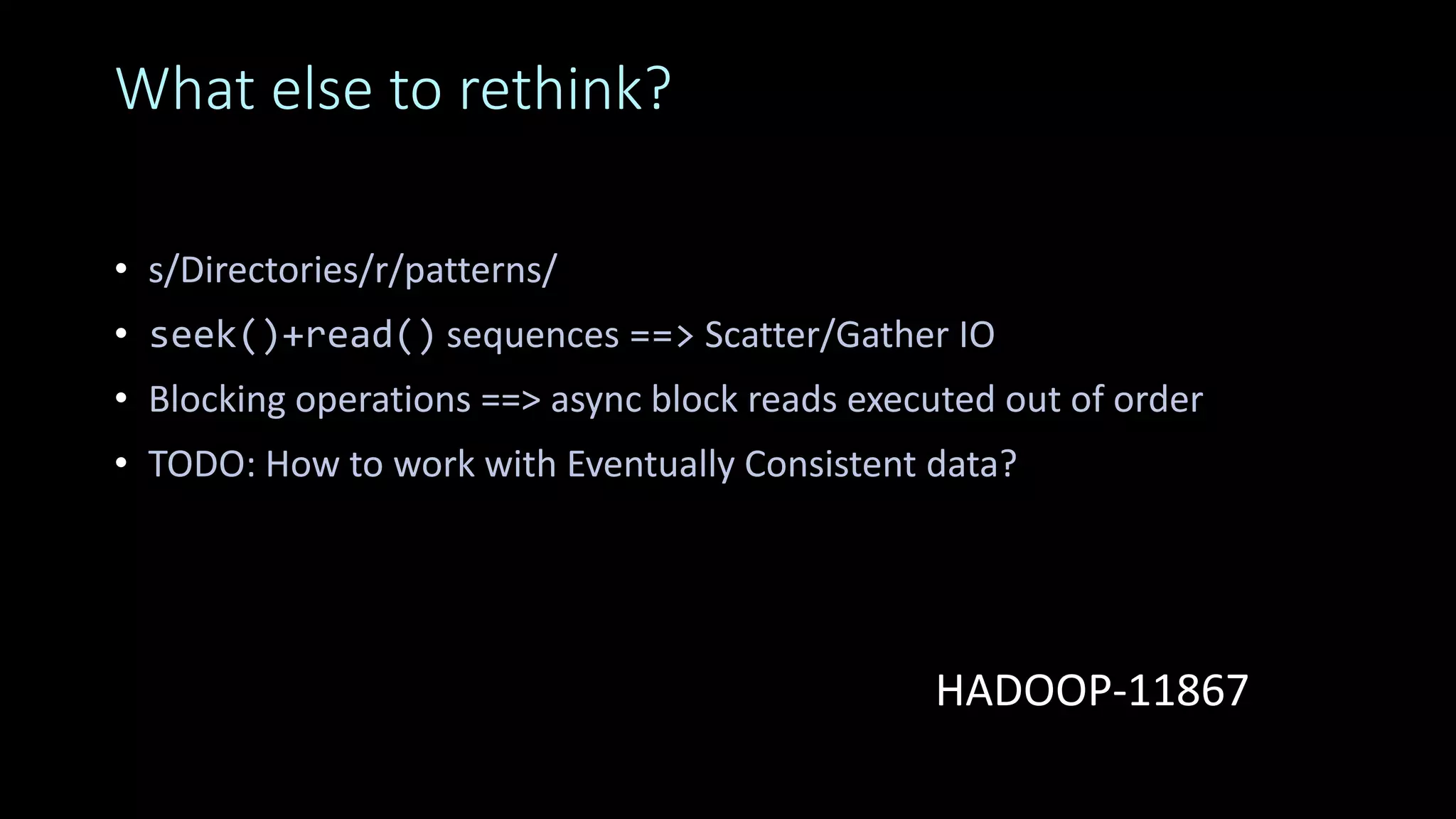
What else to rethink?
• s/Directories/r/patterns/
• seek()+read() sequences ==> Scatter/Gather IO
• Blocking operations ==> async block reads executed out of order
• TODO: How to work with Eventually Consistent data?
HADOOP-11867
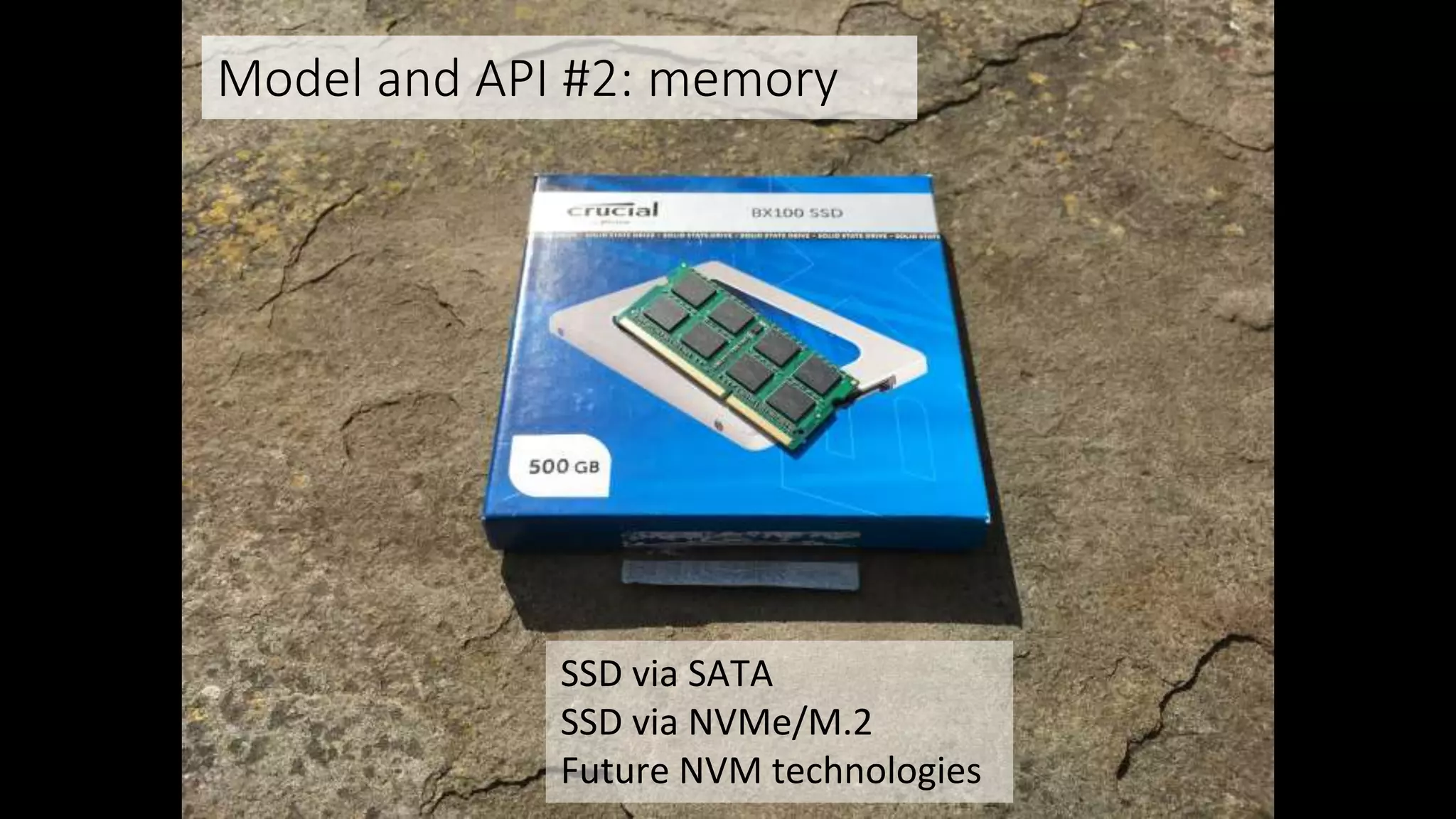
SSD via SATA
SSD via NVMe/M.2
Future NVM technologies
Model and API #2: memory
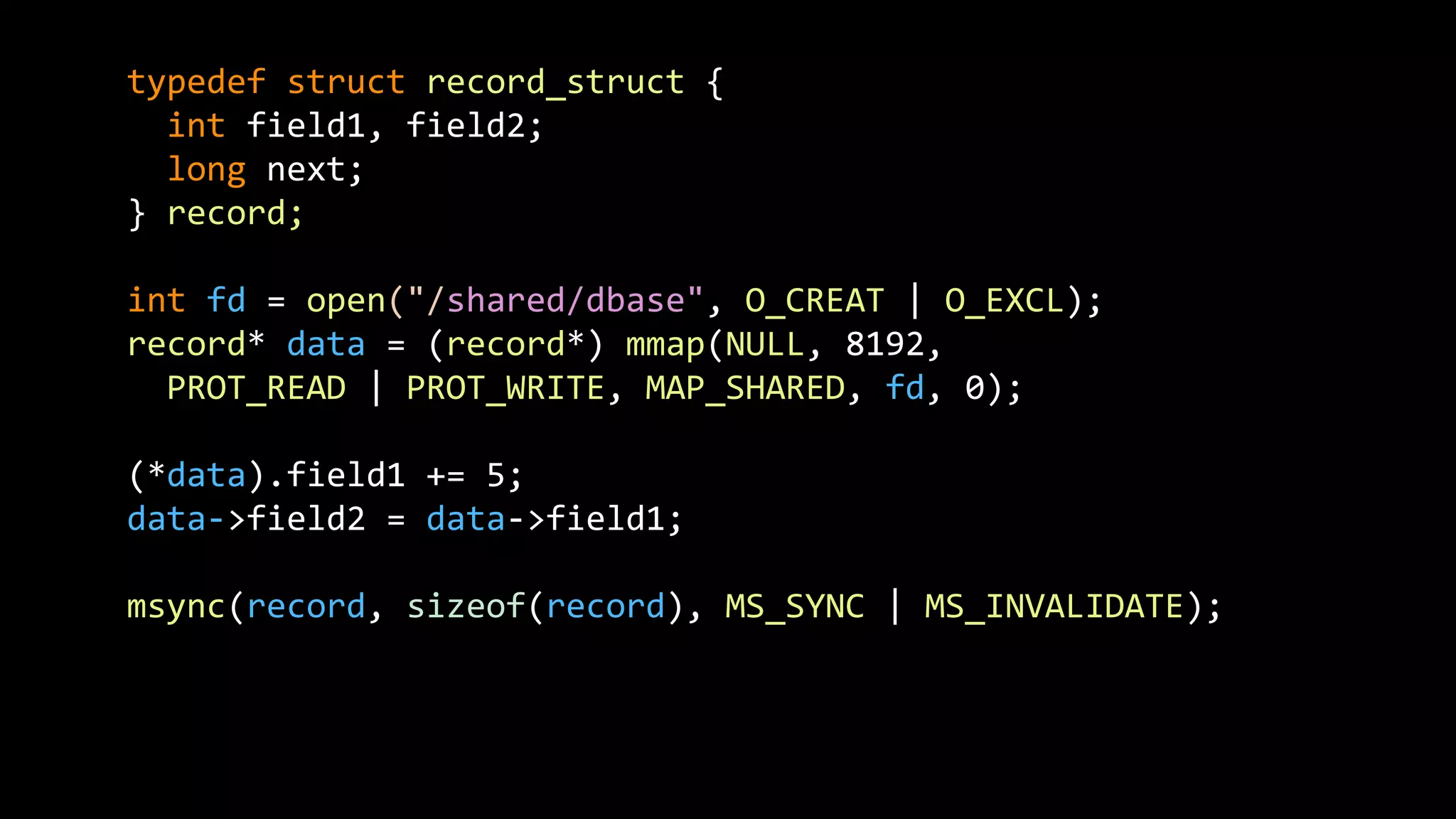
typedef struct record_struct {
int field1, field2;
long next;
} record;
int fd = open("/shared/dbase", O_CREAT | O_EXCL);
record* data = (record*) mmap(NULL, 8192,
PROT_READ | PROT_WRITE, MAP_SHARED, fd, 0);
(*data).field1 += 5;
data->field2 = data->field1;
msync(record, sizeof(record), MS_SYNC | MS_INVALIDATE);
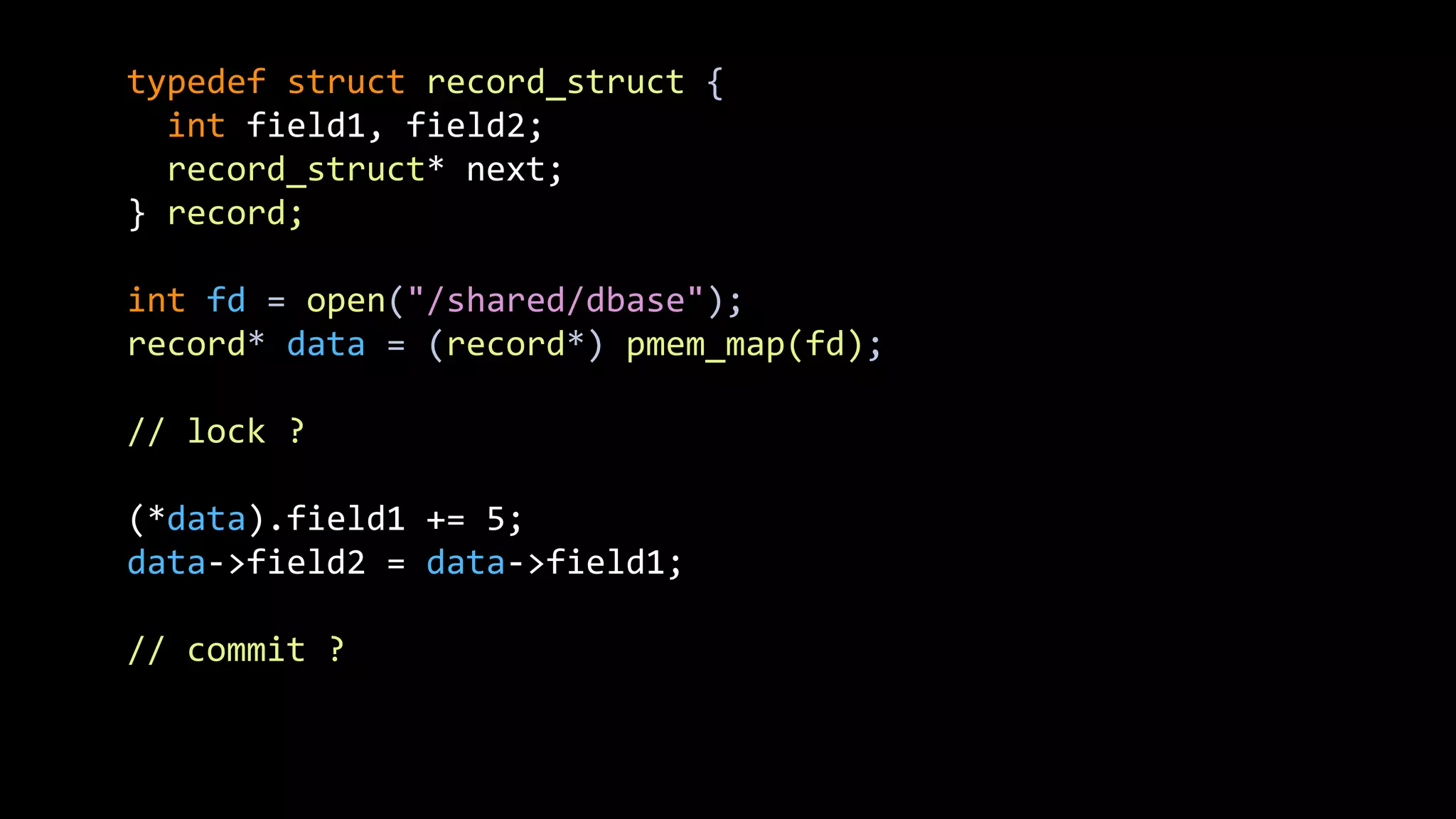
typedef struct record_struct {
int field1, field2;
record_struct* next;
} record;
int fd = open("/shared/dbase");
record* data = (record*) pmem_map(fd);
// lock ?
(*data).field1 += 5;
data->field2 = data->field1;
// commit ?
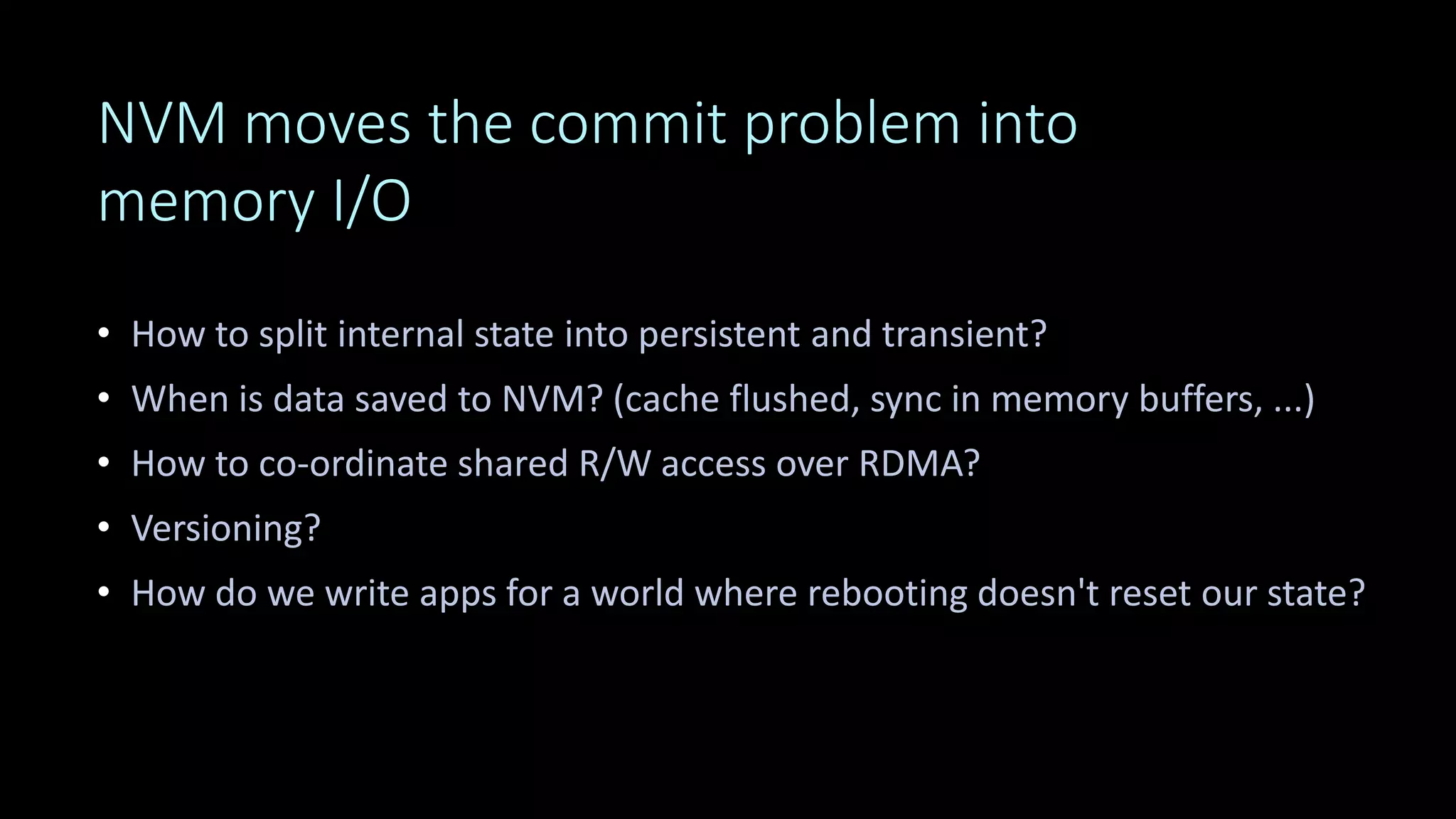
NVM moves the commit problem into
memory I/O
• How to split internal state into persistent and transient?
• When is data saved to NVM? (cache flushed, sync in memory buffers, ...)
• How to co-ordinate shared R/W access over RDMA?
• Versioning?
• How do we write apps for a world where rebooting doesn't reset our state?
Catch up: read "The Morning Paper" summaries of research
Model #3: SQL
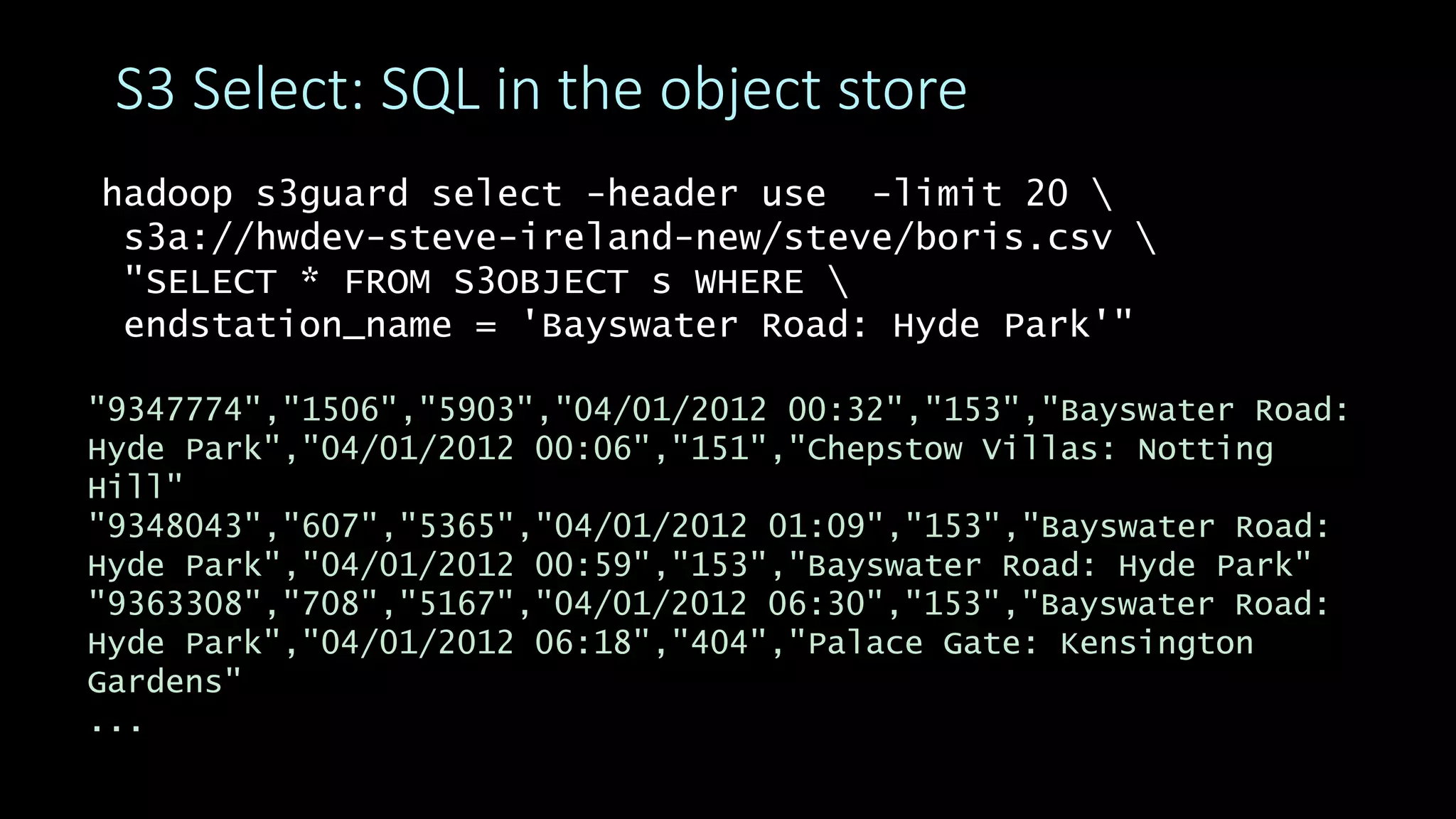
hadoop s3guard select -header use -limit 20 
s3a://hwdev-steve-ireland-new/steve/boris.csv 
"SELECT * FROM S3OBJECT s WHERE 
endstation_name = 'Bayswater Road: Hyde Park'"
S3 Select: SQL in the object store
"9347774","1506","5903","04/01/2012 00:32","153","Bayswater Road:
Hyde Park","04/01/2012 00:06","151","Chepstow Villas: Notting
Hill"
"9348043","607","5365","04/01/2012 01:09","153","Bayswater Road:
Hyde Park","04/01/2012 00:59","153","Bayswater Road: Hyde Park"
"9363308","708","5167","04/01/2012 06:30","153","Bayswater Road:
Hyde Park","04/01/2012 06:18","404","Palace Gate: Kensington
Gardens"
...
Summary:
As storage changes so must the models
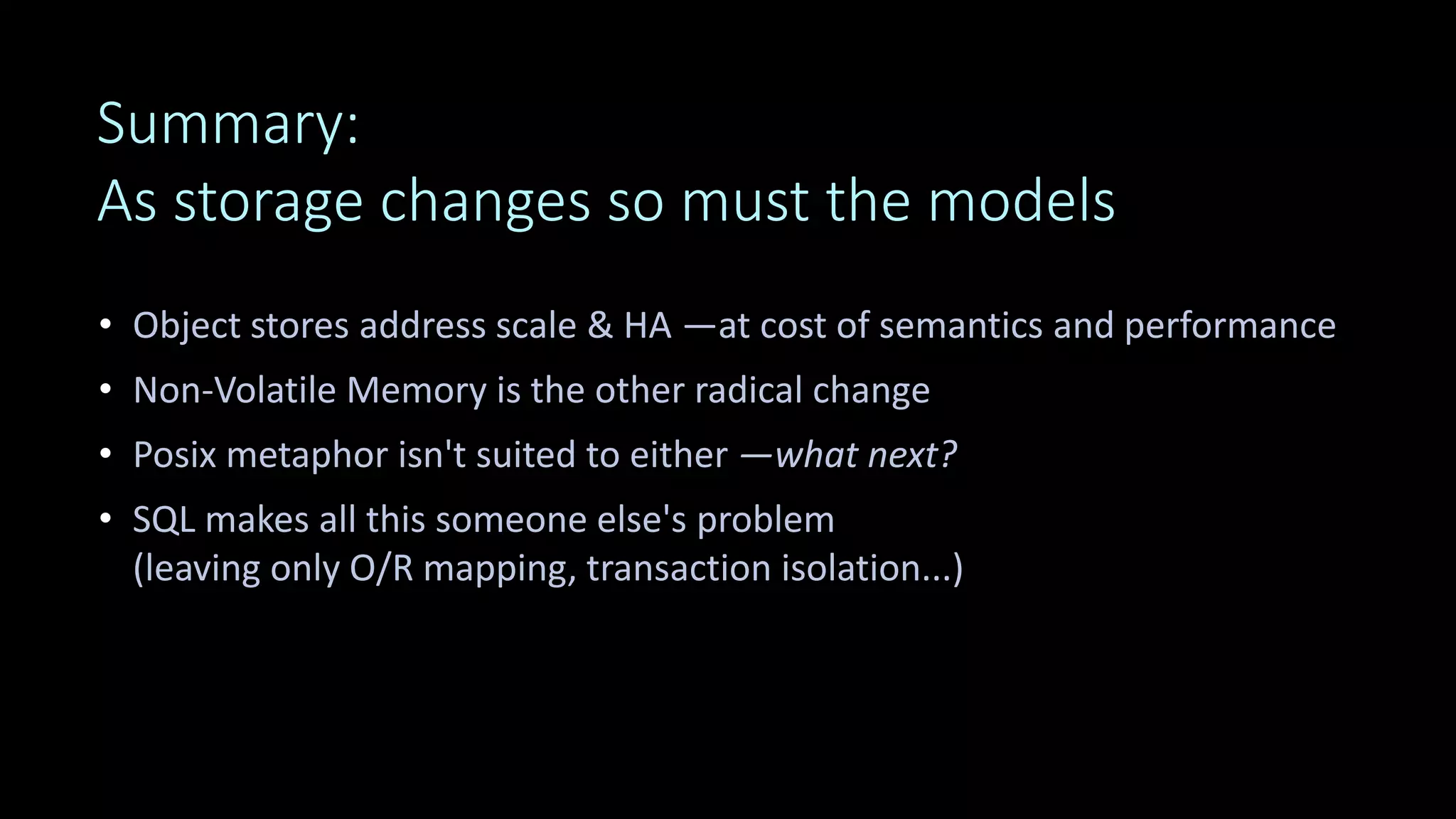
• Object stores address scale & HA —at cost of semantics and performance
• Non-Volatile Memory is the other radical change
• Posix metaphor isn't suited to either —what next?
• SQL makes all this someone else's problem
(leaving only O/R mapping, transaction isolation...)
Questions?

The age of rename() is over

  • 1.
    The age ofrename() is over* Steve Loughran stevel@hortonworks.com @steveloughran December 2018 (*mostly)
  • 2.
    Me: stevel@apache.org • Hadoopcommitter ~10 years • Object storage • The lower bits of your stack traces belong to me
  • 3.
    Why do wesave data?
  • 4.
    • Publish datafor other applications • Process data published by other applications • Persist state for future instances of an application • Work with more data than fits into RAM • Share data with other instances of same application • Save things people care about & want to get back
  • 5.
    FAT8 dBASE II &Lotus 1-2-3 int 21h
  • 6.
    Linux: ext3, reiserfs,ext4 sqlite, mysql, leveldb open(path, O_CREAT|O_EXCL) rename(src, dest) Windows: NTFS Access, Excel CreateFile(path) MoveFileEx(src, dest)
  • 7.
    Facebook Prineville Datacentre 1+Exabyte on HDFS + cold store Hadoop, Hive, Spark, Kafka, ...
  • 8.
  • 9.
    Model #1: File-System Directoriesand files Posix with stream metaphor
  • 10.
    org.apache.hadoop.fs.FileSystem hdfs s3awasb adlswiftgcs Posix: hierarchical (distributed?) filesystems
  • 11.
    val work =new Path("s3a://stevel-frankfurt/work") val fs = work.getFileSystem(new Configuration()) val task00 = new Path(work, "_temp/task00") fs.mkdirs(task00) val out = fs.create(new Path(task00, "part-00"), false) out.writeChars("hello") out.close(); fs.listStatus(task00).foreach(stat => fs.rename(stat.getPath, work) )
  • 12.
  • 13.
  • 14.
    rename() gives usO(1) atomic task commits / work _temp part-00 part-01 00 00 00 01 01 01 part-01 rename("/work/_temp/task00/*", "/work") task-00 task-01 HDFS Namenode Datanode-01 Datanode-03 Datanode-02 Datanode-04
  • 15.
    Amazon S3 doesn'thave a rename() / work _temp part-00 part-01 00 00 00 01 01 part-01 LIST /work/_temp/task-01/* task-00 task-01 01 01 01 COPY /work/_temp/task-01/part-01 /work/part-01 DELETE /work/_temp/task-01/part-01 01 S3 Shards
  • 16.
    work/part-01 01 01 01 Fix: end themetaphor 00 00 00 POST /work/part-01?uploads => UploadID POST /work/part01?uploadId=UploadID&partNumber=01 POST /work/part01?uploadId=UploadID&partNumber=02 POST /work/part01?uploadId=UploadID&partNumber=03 work/part-00
  • 17.
    work/part-01 job manager selectivelycompletes the uploads 00 00 00 01 01 01 POST /work/part-01?uploadId=UploadID <CompleteMultipartUpload> <Part> <PartNumber>01</PartNumber><ETag>44a3</ETag> <PartNumber>02</PartNumber><ETag>29cb</ETag> <PartNumber>03</PartNumber><ETag>1aac</ETag> </Part> </CompleteMultipartUpload> 01 01 01 work/part-01 work/part-00
  • 18.
  • 19.
    What else torethink? • s/Directories/r/patterns/ • seek()+read() sequences ==> Scatter/Gather IO • Blocking operations ==> async block reads executed out of order • TODO: How to work with Eventually Consistent data? HADOOP-11867
  • 20.
    SSD via SATA SSDvia NVMe/M.2 Future NVM technologies Model and API #2: memory
  • 21.
    typedef struct record_struct{ int field1, field2; long next; } record; int fd = open("/shared/dbase", O_CREAT | O_EXCL); record* data = (record*) mmap(NULL, 8192, PROT_READ | PROT_WRITE, MAP_SHARED, fd, 0); (*data).field1 += 5; data->field2 = data->field1; msync(record, sizeof(record), MS_SYNC | MS_INVALIDATE);
  • 22.
    typedef struct record_struct{ int field1, field2; record_struct* next; } record; int fd = open("/shared/dbase"); record* data = (record*) pmem_map(fd); // lock ? (*data).field1 += 5; data->field2 = data->field1; // commit ?
  • 23.
    NVM moves thecommit problem into memory I/O • How to split internal state into persistent and transient? • When is data saved to NVM? (cache flushed, sync in memory buffers, ...) • How to co-ordinate shared R/W access over RDMA? • Versioning? • How do we write apps for a world where rebooting doesn't reset our state? Catch up: read "The Morning Paper" summaries of research
  • 24.
  • 26.
    hadoop s3guard select-header use -limit 20 s3a://hwdev-steve-ireland-new/steve/boris.csv "SELECT * FROM S3OBJECT s WHERE endstation_name = 'Bayswater Road: Hyde Park'" S3 Select: SQL in the object store "9347774","1506","5903","04/01/2012 00:32","153","Bayswater Road: Hyde Park","04/01/2012 00:06","151","Chepstow Villas: Notting Hill" "9348043","607","5365","04/01/2012 01:09","153","Bayswater Road: Hyde Park","04/01/2012 00:59","153","Bayswater Road: Hyde Park" "9363308","708","5167","04/01/2012 06:30","153","Bayswater Road: Hyde Park","04/01/2012 06:18","404","Palace Gate: Kensington Gardens" ...
  • 27.
    Summary: As storage changesso must the models • Object stores address scale & HA —at cost of semantics and performance • Non-Volatile Memory is the other radical change • Posix metaphor isn't suited to either —what next? • SQL makes all this someone else's problem (leaving only O/R mapping, transaction isolation...)
  • 28.

Editor's Notes

  • #6 Trivia: dir rename only came with DOS 3.0
  • #8 Facebook prineville photo store is probably at the far end of the spectrum
  • #11 Everything usies the Hadoop APIs to talk to both HDFS, Hadoop Compatible Filesystems and object stores; the Hadoop FS API. There's actually two: the one with a clean split between client side and "driver side", and the older one which is a direct connect. Most use the latter and actually, in terms of opportunities for object store integration tweaking, this is actually the one where can innovate with the most easily. That is: there's nothing in the way. Under the FS API go filesystems and object stores. HDFS is "real" filesystem; WASB/Azure close enough. What is "real?". Best test: can support HBase.
  • #15 This is how we commit work in Hadoop FileOutputFormat, and so, transitively, how Spark does it too (Hive does some other things, which I'm ignoring, but are more manifest file driven)
  • #22 This is my rough guess at a C-level operation against mmaped data today. Ignoringthe open/sync stuff, then the writes in the middle are the operations we need to worry about, as they update the datastructures in-situ. Nonatomically.
  • #23 This is my rough guess at a C-level operation against mmaped data today. Ignoringthe open/sync stuff, then the writes in the middle are the operations we need to worry about, as they update the datastructures in-situ. Nonatomically.
  • #24 Work like RAMCloud has led the way here, go look at the papers. But that was at RAM, not NVM, where we have the persistence problem Some form of LSF model tends to be used, which ties in well with raw SSD (don't know about other techs, do know that non-raw SSD doesn't really suit LFS) If you look at code, we generally mix persisted (and read back) data with transient; load/save isn't so much seriaiizing out data structures as marshalling the persistent parts to a form we think they will be robust over time, unmarshalling them later (exceptions: Java Serialization, which is notoriously brittle and insecure) What apps work best here? Could you extend Spark to make RDDs persistent & shared, so you can persist them simply by copying to part of cluster memory?, e.g a "NVMOutputFormat"