Efficient Data Storage for Analytics
with Apache Parquet 2.0
Julien Le Dem @J_
Processing tools tech lead, Data Platform at Twitter
Nong Li nong@cloudera.com
Software engineer, Cloudera Impala
@ApacheParquet
Outline
2
- Why we need efficiency
- Properties of efficient algorithms
- Enabling efficiency
- Efficiency in Apache Parquet
Why we need efficiency
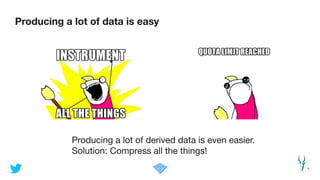
Producing a lot of data is easy
4
Producing a lot of derived data is even easier.

Solution: Compress all the things!
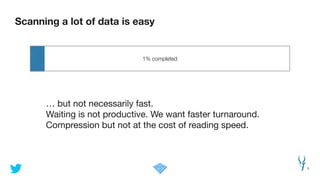
Scanning a lot of data is easy
5
1% completed
… but not necessarily fast.

Waiting is not productive. We want faster turnaround.

Compression but not at the cost of reading speed.
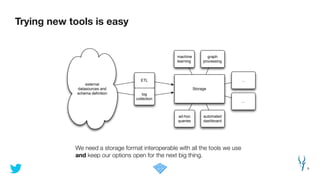
Trying new tools is easy
6
ETL
Storage
ad-hoc
queries
log
collection
automated
dashboard
machine
learning
graph
processing
external
datasources and
schema definition
...
...
We need a storage format interoperable with all the tools we use
and keep our options open for the next big thing.
Enter Apache Parquet
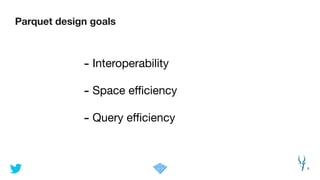
Parquet design goals
8
- Interoperability

- Space efficiency

- Query efficiency
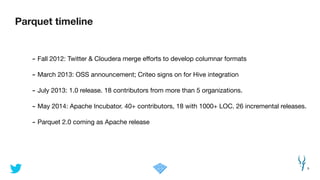
Parquet timeline
9
- Fall 2012: Twitter & Cloudera merge efforts to develop columnar formats

- March 2013: OSS announcement; Criteo signs on for Hive integration

- July 2013: 1.0 release. 18 contributors from more than 5 organizations.

- May 2014: Apache Incubator. 40+ contributors, 18 with 1000+ LOC. 26 incremental releases.

- Parquet 2.0 coming as Apache release
Interoperability
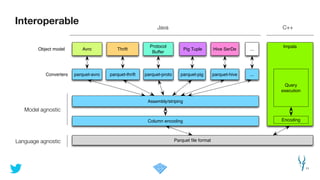
Interoperable
11
Model agnostic
Language agnostic
Java C++
Avro Thrift
Protocol
Buffer
Pig Tuple Hive SerDe
Assembly/striping
Parquet file format
Object model
parquet-avroConverters parquet-thrift parquet-proto parquet-pig parquet-hive
Column encoding
Impala
...
...
Encoding
Query
execution
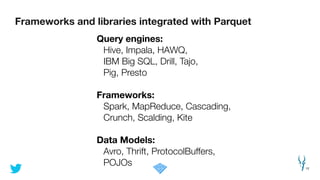
Frameworks and libraries integrated with Parquet
12
Query engines:
Hive, Impala, HAWQ,
IBM Big SQL, Drill, Tajo,
Pig, Presto
!
Frameworks:
Spark, MapReduce, Cascading,
Crunch, Scalding, Kite
!
Data Models:
Avro, Thrift, ProtocolBuffers,
POJOs
Enabling efficiency
Columnar storage
14
Logical table
representation
Row layout
Column layout
encoding
Nested schema
a b c
a b c
a1 b1 c1
a2 b2 c2
a3 b3 c3
a4 b4 c4
a5 b5 c5
a1 b1 c1 a2 b2 c2 a3 b3 c3 a4 b4 c4 a5 b5 c5
a1 b1 c1a2 b2 c2a3 b3 c3a4 b4 c4a5 b5 c5
encoded chunk encoded chunk encoded chunk
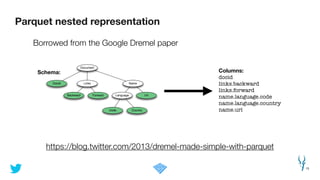
Parquet nested representation
15
Document
DocId Links Name
Backward Forward Language Url
Code Country
Columns:
docid
links.backward
links.forward
name.language.code
name.language.country
name.url
Schema:
Borrowed from the Google Dremel paper
https://blog.twitter.com/2013/dremel-made-simple-with-parquet
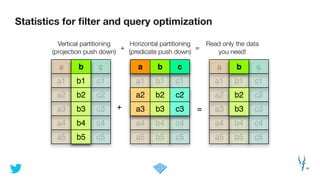
Statistics for filter and query optimization
16
Vertical partitioning
(projection push down)
Horizontal partitioning
(predicate push down)
Read only the data
you need!
+ =
a b c
a1 b1 c1
a2 b2 c2
a3 b3 c3
a4 b4 c4
a5 b5 c5
a b c
a1 b1 c1
a2 b2 c2
a3 b3 c3
a4 b4 c4
a5 b5 c5
a b c
a1 b1 c1
a2 b2 c2
a3 b3 c3
a4 b4 c4
a5 b5 c5
+ =
Properties of efficient algorithms
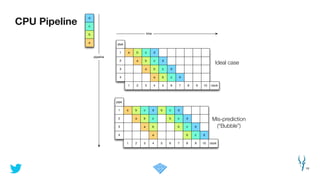
CPU Pipeline
18
pipe
1 a b c d
2 a b c d
3 a b c d
4 a b c
1 2 3 4 5 6
1 a b c d
2 a b c
3 a b
4 a
clock1 2 3 4 5 6
7
d
7 8
b
b
b
b
c d
c d
c d
c d
9 10
clock
pipe
pipeline
time
8 9 10
d
c
b
a
Mis-prediction
(“Bubble”)
Ideal case
Optimize for the processor pipeline
19
ifs
“Bubbles” can be caused by:
loops
virtual
calls
data
dependency
cost ~ 12 cycles
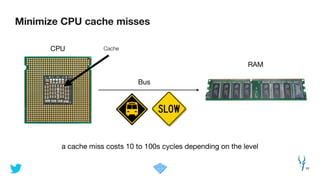
Minimize CPU cache misses
20
a cache miss costs 10 to 100s cycles depending on the level
RAM
Bus
CPU Cache
Encodings in Apache Parquet 2.0
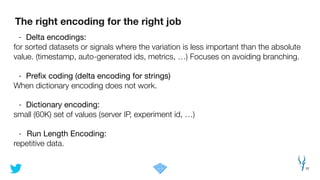
The right encoding for the right job
22
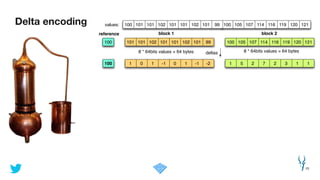
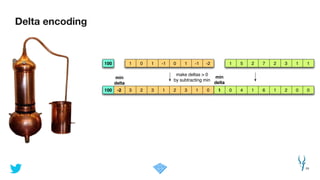
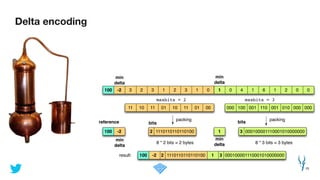
- Delta encodings:

for sorted datasets or signals where the variation is less important than the absolute
value. (timestamp, auto-generated ids, metrics, …) Focuses on avoiding branching.
!
- Prefix coding (delta encoding for strings)

When dictionary encoding does not work.
!
- Dictionary encoding: 

small (60K) set of values (server IP, experiment id, …)
!
- Run Length Encoding:

repetitive data.
Delta encoding
23
8 * 64bits values = 64 bytes 8 * 64bits values = 64 bytes
101 100101 105102 107101 11499 116101 102 101 119 120 121
values:
deltas
1 10 51 2-1 7-2 20 1 -1 3 1 1100
100
101 100101 105102 107101 11499 116101 102 101 119 120 121100
reference block 1 block 2
Delta encoding
24
3 02 43 11 60 12 3 1 2 0 0100 -2
min
delta
1 10 51 2-1 7-2 20 1 -1 3 1 1100
1
min
delta
make deltas > 0
by subtracting min
3 02 43 11 60 12 3 1 2 0 0
maxbits = 2
11 10 11 01 0010 11 01
1110110110110100
maxbits = 3
8 * 2 bits = 2 bytes
000 100 001 110 001 010 000 000
000100001110001010000000
8 * 3 bits = 3 bytes
2 3
bits bits
100 -2
100 -2
1
1
min
delta
min
delta
reference
packing packing
1110110110110100 0001000011100010100000002 3100 -2 1result:
min
delta
min
delta
Delta encoding
25
Delta encoding
26
3 02 43 11 60 12 3 1 2 0 0
maxbits = 2
11 10 11 01 0010 11 01
1110110110110100
8 * 64bits values = 64 bytes 8 * 64bits values = 64 bytes
maxbits = 3
8 * 2 bits = 2 bytes
000 100 001 110 001 010 000 000
000100001110001010000000
8 * 3 bits = 3 bytes
2 3
bits bits
101 100101 105102 107101 11499 116101 102 101 119 120 121
100
values:
-2
min
delta
100 -2
deltas
1 10 51 2-1 7-2 20 1 -1 3 1 1100
1
min
delta
make deltas > 0
by subtracting min
1
min
delta
min
delta
100
101 100101 105102 107101 11499 116101 102 101 119 120 121100
reference block 1 block 2
reference
packing packing
1110110110110100 0001000011100010100000002 3100 -2 1result:
Binary packing designed for CPU efficiency
27
better:
orvalues = 0!
for (int i = 0; i<values.length; ++i) {!
orvalues |= values[i]!
}!
max = maxbit(orvalues)!
see paper: 

“Decoding billions of integers per second through vectorization” 

by Daniel Lemire and Leonid Boytsov
Unpredictable branch! Loop => Very predictable branch
naive maxbit:
max = 0!
for (int i = 0; i<values.length; ++i) {!
current = maxbit(values[i])!
if (current > max) max = current!
}!
even better:
orvalues = 0!
orvalues |= values[0]!
…!
orvalues |= values[32]!
max = maxbit(orvalues)
no branching at all!
Binary unpacking designed for CPU efficiency
28
!
int j = 0!
while (int i = 0; i < output.length; i += 32) {!
maxbit = input[j]!
unpack_32_values(values, i, out, j + 1, maxbit);!
j += 1 + maxbit!
}!
Compression comparison
29
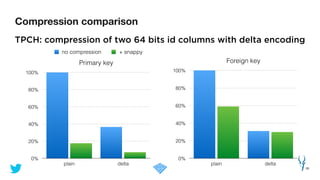
TPCH: compression of two 64 bits id columns with delta encoding
Primary key
0%
20%
40%
60%
80%
100%
plain delta
no compression + snappy
Compression comparison
30
TPCH: compression of two 64 bits id columns with delta encoding
Primary key
0%
20%
40%
60%
80%
100%
plain delta
no compression + snappy
Foreign key
0%
20%
40%
60%
80%
100%
plain delta
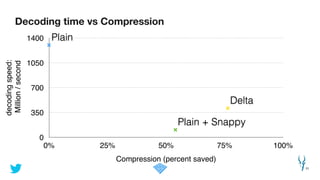
Decoding time vs Compression
31
decodingspeed:!
Million/second
0
350
700
1050
1400
Compression (percent saved)
0% 25% 50% 75% 100%
Delta
Plain + Snappy
Plain
Performance
Size comparison
33
TPCDS 100GB scale factor (+ Snappy unless otherwise specified)
Store salesLineitem
Text uncompressed
Seq Avro Text + LZO
RC
Parquet 1
Parquet 2
The area of the circle is proportional to the file size
Text uncompressed
Seq
RC Avro Parquet 1
Parquet 2
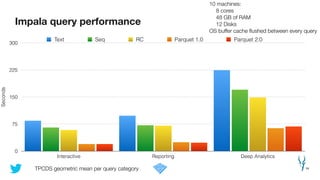
Impala query performance
34
Seconds
0
75
150
225
300
Interactive Reporting Deep Analytics
Text Seq RC Parquet 1.0 Parquet 2.0
10 machines:
8 cores
48 GB of RAM
12 Disks
OS buffer cache flushed between every query
TPCDS geometric mean per query category
Roadmap 2.x
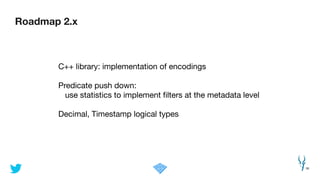
Roadmap 2.x
36
C++ library: implementation of encodings

!
Predicate push down: 

use statistics to implement filters at the metadata level

!
Decimal, Timestamp logical types
Community
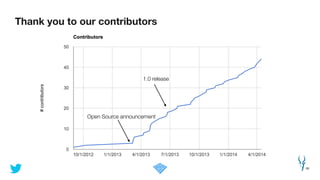
Thank you to our contributors
38
Open Source announcement
1.0 release
Get involved
39
Mailing lists:
- dev@parquet.incubator.apache.org
!
Parquet sync ups:
- Regular meetings on google hangout
Questions
40
Questions.foreach( answer(_) )
@ApacheParquet