How to use Parquet
as a basis for ETL and analytics
Julien Le Dem @J_
Analytics Data Pipeline tech lead, Data Platform
@ApacheParquet
Outline
2
- Instrumentation and data collection
- Storing data efficiently for analysis
- Openness and Interoperability
Instrumentation and data collection
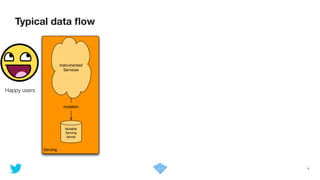
Typical data flow
4
Serving
Instrumented
Services
Mutable
Serving
stores
mutation
Happy users
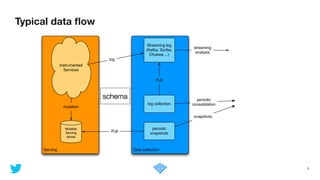
Typical data flow
5
Serving
Instrumented
Services
Mutable
Serving
stores
mutation
Data collection
log collection
Streaming log
(Kafka, Scribe,
Chukwa ...)
periodic
snapshots
log
Pull
Pull
streaming
analysis
periodic
consolidation
snapshots
schema
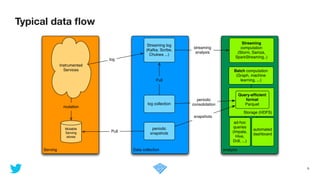
Typical data flow
6
Serving
Instrumented
Services
Mutable
Serving
stores
mutation
Data collection
log collection
Streaming log
(Kafka, Scribe,
Chukwa ...)
periodic
snapshots
log
Pull
Pull
analysis
Storage (HDFS)
ad-hoc
queries
(Impala,
Hive,
Drill, ...)
automated
dashboard
Batch computation
(Graph, machine
learning, ...)
Streaming
computation
(Storm, Samza,
SparkStreaming..)
Query-efficient
format
Parquet
streaming
analysis
periodic
consolidation
snapshots
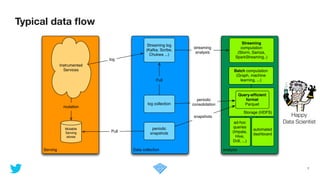
Typical data flow
7
Happy
Data Scientist
Serving
Instrumented
Services
Mutable
Serving
stores
mutation
Data collection
log collection
Streaming log
(Kafka, Scribe,
Chukwa ...)
periodic
snapshots
log
Pull
Pull
analysis
Storage (HDFS)
ad-hoc
queries
(Impala,
Hive,
Drill, ...)
automated
dashboard
Batch computation
(Graph, machine
learning, ...)
Streaming
computation
(Storm, Samza,
SparkStreaming..)
Query-efficient
format
Parquet
streaming
analysis
periodic
consolidation
snapshots
Storing data for analysis
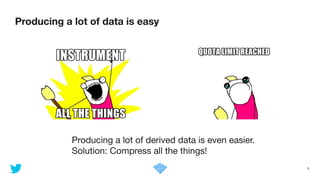
Producing a lot of data is easy
9
Producing a lot of derived data is even easier.

Solution: Compress all the things!
Scanning a lot of data is easy
10
1% completed
… but not necessarily fast.

Waiting is not productive. We want faster turnaround.

Compression but not at the cost of reading speed.
Interoperability not that easy
11
We need a storage format interoperable with all the tools we use
and
keep our options open for the next big thing.
Enter Apache Parquet
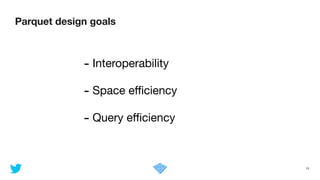
Parquet design goals
13
- Interoperability

- Space efficiency

- Query efficiency
Efficiency
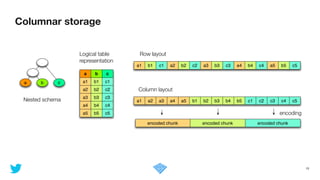
Columnar storage
15
Logical table
representation
Row layout
Column layout
encoding
Nested schema
a b c
a b c
a1 b1 c1
a2 b2 c2
a3 b3 c3
a4 b4 c4
a5 b5 c5
a1 b1 c1 a2 b2 c2 a3 b3 c3 a4 b4 c4 a5 b5 c5
a1 b1 c1a2 b2 c2a3 b3 c3a4 b4 c4a5 b5 c5
encoded chunk encoded chunk encoded chunk
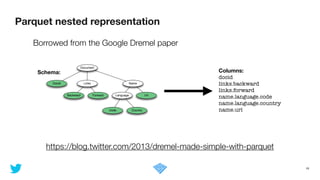
Parquet nested representation
16
Document
DocId Links Name
Backward Forward Language Url
Code Country
Columns:
docid
links.backward
links.forward
name.language.code
name.language.country
name.url
Schema:
Borrowed from the Google Dremel paper
https://blog.twitter.com/2013/dremel-made-simple-with-parquet
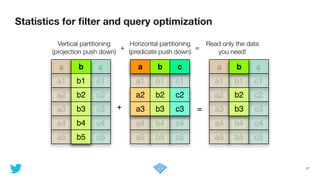
Statistics for filter and query optimization
17
Vertical partitioning
(projection push down)
Horizontal partitioning
(predicate push down)
Read only the data
you need!
+ =
a b c
a1 b1 c1
a2 b2 c2
a3 b3 c3
a4 b4 c4
a5 b5 c5
a b c
a1 b1 c1
a2 b2 c2
a3 b3 c3
a4 b4 c4
a5 b5 c5
a b c
a1 b1 c1
a2 b2 c2
a3 b3 c3
a4 b4 c4
a5 b5 c5
+ =
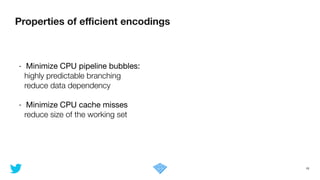
Properties of efficient encodings
18
- Minimize CPU pipeline bubbles:

	 highly predictable branching
	 reduce data dependency
!
- Minimize CPU cache misses

	 reduce size of the working set
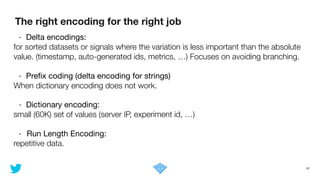
The right encoding for the right job
19
- Delta encodings:

for sorted datasets or signals where the variation is less important than the absolute
value. (timestamp, auto-generated ids, metrics, …) Focuses on avoiding branching.
!
- Prefix coding (delta encoding for strings)

When dictionary encoding does not work.
!
- Dictionary encoding: 

small (60K) set of values (server IP, experiment id, …)
!
- Run Length Encoding:

repetitive data.
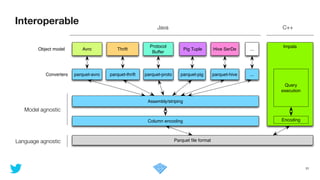
Interoperability
Interoperable
21
Model agnostic
Language agnostic
Java C++
Avro Thrift
Protocol
Buffer
Pig Tuple Hive SerDe
Assembly/striping
Parquet file format
Object model
parquet-avroConverters parquet-thrift parquet-proto parquet-pig parquet-hive
Column encoding
Impala
...
...
Encoding
Query
execution
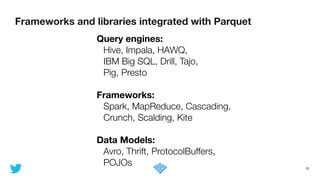
Frameworks and libraries integrated with Parquet
22
Query engines:
Hive, Impala, HAWQ,
IBM Big SQL, Drill, Tajo,
Pig, Presto
!
Frameworks:
Spark, MapReduce, Cascading,
Crunch, Scalding, Kite
!
Data Models:
Avro, Thrift, ProtocolBuffers,
POJOs
Schema management
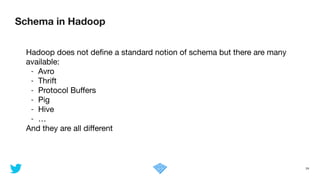
Schema in Hadoop
24
Hadoop does not define a standard notion of schema but there are many
available:

- Avro

- Thrift

- Protocol Buffers

- Pig

- Hive

- …

And they are all different
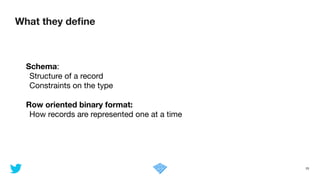
What they define
25
Schema:

Structure of a record

Constraints on the type

!
Row oriented binary format:
How records are represented one at a time
What they *do not* define
26
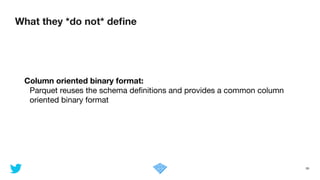
	 Column oriented binary format:
Parquet reuses the schema definitions and provides a common column
oriented binary format
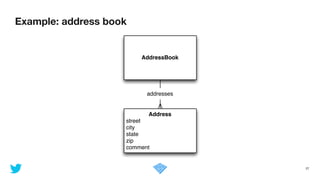
Example: address book
27
AddressBook
Address
street
city
state
zip
comment
addresses
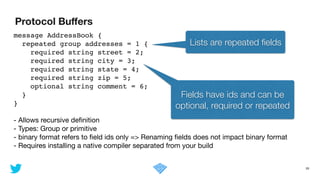
Protocol Buffers
28
message AddressBook {!
repeated group addresses = 1 {!
required string street = 2;!
required string city = 3;!
required string state = 4;!
required string zip = 5;!
optional string comment = 6;!
}!
}!
!
- Allows recursive definition

- Types: Group or primitive

- binary format refers to field ids only => Renaming fields does not impact binary format

- Requires installing a native compiler separated from your build
Fields have ids and can be
optional, required or repeated
Lists are repeated fields
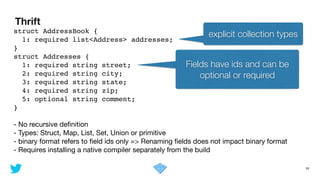
Thrift
29
struct AddressBook {!
1: required list<Address> addresses;!
}!
struct Addresses {!
1: required string street;!
2: required string city;!
3: required string state;!
4: required string zip;!
5: optional string comment;!
}!
!
- No recursive definition

- Types: Struct, Map, List, Set, Union or primitive

- binary format refers to field ids only => Renaming fields does not impact binary format

- Requires installing a native compiler separately from the build
Fields have ids and can be
optional or required
explicit collection types
Avro
30
{!
"type": "record", !
"name": "AddressBook",!
"fields" : [{ !
"name": "addresses", !
"type": "array", !
"items": { !
“type”: “record”,!
“fields”: [!
{"name": "street", "type": “string"},!
{"name": "city", "type": “string”}!
{"name": "state", "type": “string"}!
{"name": "zip", "type": “string”}!
{"name": "comment", "type": [“null”, “string”]}!
] !
}!
}]!
}
explicit collection types
- Allows recursive definition

- Types: Records, Arrays, Maps, Unions or primitive

- Binary format requires knowing the write-time schema

➡ more compact but not self descriptive

➡ renaming fields does not impact binary format

- generator in java (well integrated in the build)
null is a type
Optional is a union
Write to Parquet
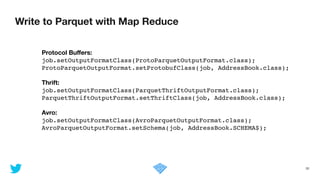
Write to Parquet with Map Reduce
32
Protocol Buffers:
job.setOutputFormatClass(ProtoParquetOutputFormat.class);!
ProtoParquetOutputFormat.setProtobufClass(job, AddressBook.class);!
!
Thrift:
job.setOutputFormatClass(ParquetThriftOutputFormat.class);!
ParquetThriftOutputFormat.setThriftClass(job, AddressBook.class);!
!
Avro:
job.setOutputFormatClass(AvroParquetOutputFormat.class);!
AvroParquetOutputFormat.setSchema(job, AddressBook.SCHEMA$);
Write to Parquet with Scalding
33
// define the Parquet source!
case class AddressBookParquetSource(override implicit val dateRange: DateRange)!
extends HourlySuffixParquetThrift[AddressBook](“/my/data/address_book", dateRange)!
// load and transform data!
…!
pipe.write(ParquetSource())!
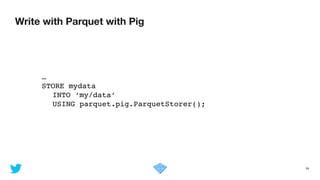
Write with Parquet with Pig
34
…!
STORE mydata !
! INTO ‘my/data’ !
! USING parquet.pig.ParquetStorer();
Query engines
Scalding
36
	 loading:
new FixedPathParquetThrift[AddressBook](“my”, “data”) {!
val city = StringColumn("city")!
override val withFilter: Option[FilterPredicate] = !
Some(city === “San Jose”)!
}!
!
operations:
p.map( (r) => r.a + r.b )!
p.groupBy( (r) => r.c )!
p.join !
…
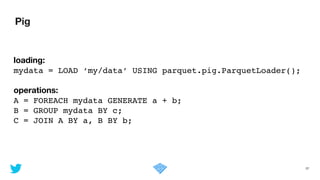
Pig
37
loading:
mydata = LOAD ‘my/data’ USING parquet.pig.ParquetLoader();!
!
operations:
A = FOREACH mydata GENERATE a + b;!
B = GROUP mydata BY c;!
C = JOIN A BY a, B BY b;
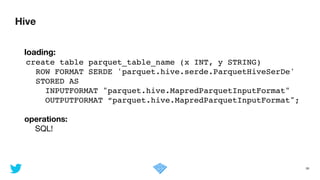
Hive
38
	 loading:
create table parquet_table_name (x INT, y STRING)!
ROW FORMAT SERDE 'parquet.hive.serde.ParquetHiveSerDe'!
STORED AS !
INPUTFORMAT "parquet.hive.MapredParquetInputFormat"!
OUTPUTFORMAT “parquet.hive.MapredParquetInputFormat";!
!
	 operations:

	 	 SQL!
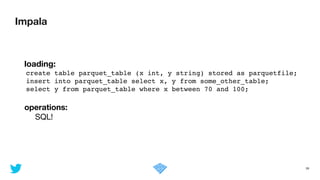
Impala
39
	 loading:
create table parquet_table (x int, y string) stored as parquetfile;!
insert into parquet_table select x, y from some_other_table;!
select y from parquet_table where x between 70 and 100;!
	 

	 operations:

	 	 SQL!
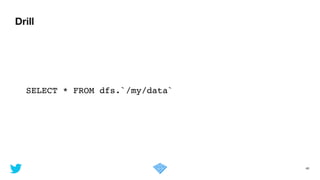
Drill
40
SELECT * FROM dfs.`/my/data`
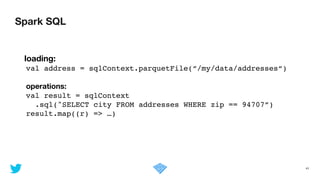
Spark SQL
41
	 loading:
val address = sqlContext.parquetFile(“/my/data/addresses“)!
!
operations:
val result = sqlContext!
! .sql("SELECT city FROM addresses WHERE zip == 94707”)!
result.map((r) => …)!
Community
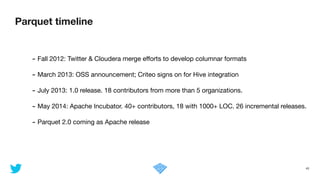
Parquet timeline
43
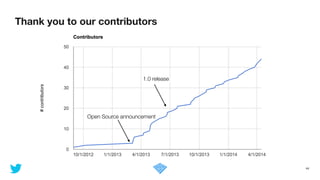
- Fall 2012: Twitter & Cloudera merge efforts to develop columnar formats

- March 2013: OSS announcement; Criteo signs on for Hive integration

- July 2013: 1.0 release. 18 contributors from more than 5 organizations.

- May 2014: Apache Incubator. 40+ contributors, 18 with 1000+ LOC. 26 incremental releases.

- Parquet 2.0 coming as Apache release
Thank you to our contributors
44
Open Source announcement
1.0 release
Get involved
45
Mailing lists:
- dev@parquet.incubator.apache.org
!
Parquet sync ups:
- Regular meetings on google hangout
Questions
46
Questions.foreach( answer(_) )
@ApacheParquet

How to use Parquet as a basis for ETL and analytics

  • 1.
    How to useParquet as a basis for ETL and analytics Julien Le Dem @J_ Analytics Data Pipeline tech lead, Data Platform @ApacheParquet
  • 2.
    Outline 2 - Instrumentation anddata collection - Storing data efficiently for analysis - Openness and Interoperability
  • 3.
  • 4.
  • 5.
    Typical data flow 5 Serving Instrumented Services Mutable Serving stores mutation Datacollection log collection Streaming log (Kafka, Scribe, Chukwa ...) periodic snapshots log Pull Pull streaming analysis periodic consolidation snapshots schema
  • 6.
    Typical data flow 6 Serving Instrumented Services Mutable Serving stores mutation Datacollection log collection Streaming log (Kafka, Scribe, Chukwa ...) periodic snapshots log Pull Pull analysis Storage (HDFS) ad-hoc queries (Impala, Hive, Drill, ...) automated dashboard Batch computation (Graph, machine learning, ...) Streaming computation (Storm, Samza, SparkStreaming..) Query-efficient format Parquet streaming analysis periodic consolidation snapshots
  • 7.
    Typical data flow 7 Happy DataScientist Serving Instrumented Services Mutable Serving stores mutation Data collection log collection Streaming log (Kafka, Scribe, Chukwa ...) periodic snapshots log Pull Pull analysis Storage (HDFS) ad-hoc queries (Impala, Hive, Drill, ...) automated dashboard Batch computation (Graph, machine learning, ...) Streaming computation (Storm, Samza, SparkStreaming..) Query-efficient format Parquet streaming analysis periodic consolidation snapshots
  • 8.
  • 9.
    Producing a lotof data is easy 9 Producing a lot of derived data is even easier. Solution: Compress all the things!
  • 10.
    Scanning a lotof data is easy 10 1% completed … but not necessarily fast. Waiting is not productive. We want faster turnaround. Compression but not at the cost of reading speed.
  • 11.
    Interoperability not thateasy 11 We need a storage format interoperable with all the tools we use and keep our options open for the next big thing.
  • 12.
  • 13.
    Parquet design goals 13 -Interoperability - Space efficiency - Query efficiency
  • 14.
  • 15.
    Columnar storage 15 Logical table representation Rowlayout Column layout encoding Nested schema a b c a b c a1 b1 c1 a2 b2 c2 a3 b3 c3 a4 b4 c4 a5 b5 c5 a1 b1 c1 a2 b2 c2 a3 b3 c3 a4 b4 c4 a5 b5 c5 a1 b1 c1a2 b2 c2a3 b3 c3a4 b4 c4a5 b5 c5 encoded chunk encoded chunk encoded chunk
  • 16.
    Parquet nested representation 16 Document DocIdLinks Name Backward Forward Language Url Code Country Columns: docid links.backward links.forward name.language.code name.language.country name.url Schema: Borrowed from the Google Dremel paper https://blog.twitter.com/2013/dremel-made-simple-with-parquet
  • 17.
    Statistics for filterand query optimization 17 Vertical partitioning (projection push down) Horizontal partitioning (predicate push down) Read only the data you need! + = a b c a1 b1 c1 a2 b2 c2 a3 b3 c3 a4 b4 c4 a5 b5 c5 a b c a1 b1 c1 a2 b2 c2 a3 b3 c3 a4 b4 c4 a5 b5 c5 a b c a1 b1 c1 a2 b2 c2 a3 b3 c3 a4 b4 c4 a5 b5 c5 + =
  • 18.
    Properties of efficientencodings 18 - Minimize CPU pipeline bubbles: highly predictable branching reduce data dependency ! - Minimize CPU cache misses reduce size of the working set
  • 19.
    The right encodingfor the right job 19 - Delta encodings: for sorted datasets or signals where the variation is less important than the absolute value. (timestamp, auto-generated ids, metrics, …) Focuses on avoiding branching. ! - Prefix coding (delta encoding for strings) When dictionary encoding does not work. ! - Dictionary encoding: small (60K) set of values (server IP, experiment id, …) ! - Run Length Encoding: repetitive data.
  • 20.
  • 21.
    Interoperable 21 Model agnostic Language agnostic JavaC++ Avro Thrift Protocol Buffer Pig Tuple Hive SerDe Assembly/striping Parquet file format Object model parquet-avroConverters parquet-thrift parquet-proto parquet-pig parquet-hive Column encoding Impala ... ... Encoding Query execution
  • 22.
    Frameworks and librariesintegrated with Parquet 22 Query engines: Hive, Impala, HAWQ, IBM Big SQL, Drill, Tajo, Pig, Presto ! Frameworks: Spark, MapReduce, Cascading, Crunch, Scalding, Kite ! Data Models: Avro, Thrift, ProtocolBuffers, POJOs
  • 23.
  • 24.
    Schema in Hadoop 24 Hadoopdoes not define a standard notion of schema but there are many available: - Avro - Thrift - Protocol Buffers - Pig - Hive - … And they are all different
  • 25.
    What they define 25 Schema: Structureof a record Constraints on the type ! Row oriented binary format: How records are represented one at a time
  • 26.
    What they *donot* define 26 Column oriented binary format: Parquet reuses the schema definitions and provides a common column oriented binary format
  • 27.
  • 28.
    Protocol Buffers 28 message AddressBook{! repeated group addresses = 1 {! required string street = 2;! required string city = 3;! required string state = 4;! required string zip = 5;! optional string comment = 6;! }! }! ! - Allows recursive definition - Types: Group or primitive - binary format refers to field ids only => Renaming fields does not impact binary format - Requires installing a native compiler separated from your build Fields have ids and can be optional, required or repeated Lists are repeated fields
  • 29.
    Thrift 29 struct AddressBook {! 1:required list<Address> addresses;! }! struct Addresses {! 1: required string street;! 2: required string city;! 3: required string state;! 4: required string zip;! 5: optional string comment;! }! ! - No recursive definition - Types: Struct, Map, List, Set, Union or primitive - binary format refers to field ids only => Renaming fields does not impact binary format - Requires installing a native compiler separately from the build Fields have ids and can be optional or required explicit collection types
  • 30.
    Avro 30 {! "type": "record", ! "name":"AddressBook",! "fields" : [{ ! "name": "addresses", ! "type": "array", ! "items": { ! “type”: “record”,! “fields”: [! {"name": "street", "type": “string"},! {"name": "city", "type": “string”}! {"name": "state", "type": “string"}! {"name": "zip", "type": “string”}! {"name": "comment", "type": [“null”, “string”]}! ] ! }! }]! } explicit collection types - Allows recursive definition - Types: Records, Arrays, Maps, Unions or primitive - Binary format requires knowing the write-time schema ➡ more compact but not self descriptive ➡ renaming fields does not impact binary format - generator in java (well integrated in the build) null is a type Optional is a union
  • 31.
  • 32.
    Write to Parquetwith Map Reduce 32 Protocol Buffers: job.setOutputFormatClass(ProtoParquetOutputFormat.class);! ProtoParquetOutputFormat.setProtobufClass(job, AddressBook.class);! ! Thrift: job.setOutputFormatClass(ParquetThriftOutputFormat.class);! ParquetThriftOutputFormat.setThriftClass(job, AddressBook.class);! ! Avro: job.setOutputFormatClass(AvroParquetOutputFormat.class);! AvroParquetOutputFormat.setSchema(job, AddressBook.SCHEMA$);
  • 33.
    Write to Parquetwith Scalding 33 // define the Parquet source! case class AddressBookParquetSource(override implicit val dateRange: DateRange)! extends HourlySuffixParquetThrift[AddressBook](“/my/data/address_book", dateRange)! // load and transform data! …! pipe.write(ParquetSource())!
  • 34.
    Write with Parquetwith Pig 34 …! STORE mydata ! ! INTO ‘my/data’ ! ! USING parquet.pig.ParquetStorer();
  • 35.
  • 36.
    Scalding 36 loading: new FixedPathParquetThrift[AddressBook](“my”,“data”) {! val city = StringColumn("city")! override val withFilter: Option[FilterPredicate] = ! Some(city === “San Jose”)! }! ! operations: p.map( (r) => r.a + r.b )! p.groupBy( (r) => r.c )! p.join ! …
  • 37.
    Pig 37 loading: mydata = LOAD‘my/data’ USING parquet.pig.ParquetLoader();! ! operations: A = FOREACH mydata GENERATE a + b;! B = GROUP mydata BY c;! C = JOIN A BY a, B BY b;
  • 38.
    Hive 38 loading: create tableparquet_table_name (x INT, y STRING)! ROW FORMAT SERDE 'parquet.hive.serde.ParquetHiveSerDe'! STORED AS ! INPUTFORMAT "parquet.hive.MapredParquetInputFormat"! OUTPUTFORMAT “parquet.hive.MapredParquetInputFormat";! ! operations: SQL!
  • 39.
    Impala 39 loading: create tableparquet_table (x int, y string) stored as parquetfile;! insert into parquet_table select x, y from some_other_table;! select y from parquet_table where x between 70 and 100;! operations: SQL!
  • 40.
    Drill 40 SELECT * FROMdfs.`/my/data`
  • 41.
    Spark SQL 41 loading: valaddress = sqlContext.parquetFile(“/my/data/addresses“)! ! operations: val result = sqlContext! ! .sql("SELECT city FROM addresses WHERE zip == 94707”)! result.map((r) => …)!
  • 42.
  • 43.
    Parquet timeline 43 - Fall2012: Twitter & Cloudera merge efforts to develop columnar formats - March 2013: OSS announcement; Criteo signs on for Hive integration - July 2013: 1.0 release. 18 contributors from more than 5 organizations. - May 2014: Apache Incubator. 40+ contributors, 18 with 1000+ LOC. 26 incremental releases. - Parquet 2.0 coming as Apache release
  • 44.
    Thank you toour contributors 44 Open Source announcement 1.0 release
  • 45.
    Get involved 45 Mailing lists: -dev@parquet.incubator.apache.org ! Parquet sync ups: - Regular meetings on google hangout
  • 46.