Jeff Mather & Alec Rogers
The MathWorks, Inc.
29 November 2006

© 2006 The MathWorks, Inc.

Implementing HDF5 in MATLAB
HDF4
1-1 mapping of C API first. (1998)

Customer requests for high-level functions.

HDFREAD, HDFWRITE, HDFINFO. (2000)

2
HDF5
High-level first. (2003)

Customer requests for lower-level functionality.

1-1 mapping of C API. (2006)

3
The World of HDF Applications

HDF4 / HDF5 APIs

API Supported by MATLAB
High-level access functions

Customer
application
Customer
application

Customer
application

Customer
application

4
HDF5READ
DATA = HDF5READ(FILENAME,DATASETNAME) returns
in the variable DATA all data from the file FILENAME for the
data set named DATASETNAME.
DATA has to be extremely general
because of the wide variety of
datatypes that HDF5 accomodates.

More control needed to
match the uniqueness of
customer datasets and files.

Simple access only:
● No subsetting.
● Limited datatype control.

5
HDF5INFO
FILEINFO = HDF5INFO(FILENAME) returns a structure
whose fields contain information about the contents of an
HDF5 file. FILENAME is a string that specifies the name of
the HDF file.

6
HDF5WRITE
HDF5WRITE(FILENAME, LOCATION, DATASET) adds
the data in DATASET to the HDF5 file named FILENAME.
LOCATION defines where to write the DATASET in the file
and resembles a Unix-style path. The data in DATASET is
mapped to HDF5 datatypes using the rules below. . . .
HDF5WRITE is completely
symmetric with HDF5READ.

Objects disambiguate datatypes.

The values in DATASET are cumbersome
for non-native MATLAB types (e.g., arrays,
compound, and references).
7
Customer HDF5 Requests









Library upgrades (1.4.5, 1.6.4, 1.6.5, 1.8)
Better support for large data
Hyperselection, chunking
New platform support (Solaris 64, MacIntel)
GZIP, SZIP compression
HDF5 file interrogation
Bitfield, date/time datatypes
Data translators: HDF5 --> MATLAB

8
Use Cases
Read parts of an HDF5 dataset (a hyperslab).

9
Use Cases
Read complicated datatypes without the overhead of
MATLAB objects for datasets.

mydata(1).Data(1).Data(1)

10
Use Cases

Allow users to extend our HDF5 functionality without
waiting for us.

11
Use Cases
Be able to drop in new versions of the HDF5 library when
they become available.

HDF5 1.8

12
Use Cases
Use a variety of esoteric HDF5 features at once:

“I'm trying to use HDF5 files [with] grouping
features like compound data types, group links,
and reference data types.”

13
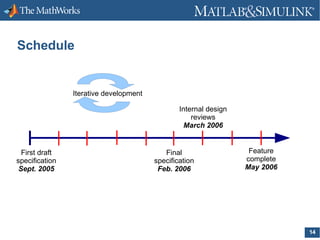
Schedule

Iterative development
Internal design
reviews
March 2006

First draft
specification
Sept. 2005

Final
specification
Feb. 2006

Feature
complete
May 2006

14
MATLAB is not C
Hmm . . . I might
throw an error.
MATLAB

[out1, out2] = function(in1, in2);
C

status = function(in1, in2, &out1, &out2);

15
MATLAB is not C

mxArray
void * p_real
void * p_complex
size_t dims[]
size_t ndims
mxCLASS_ID type
...
...

16
The Interface
hid_t
identifiers

C API

MATLAB API

H5Xfcn

H5X.fcn

A

D

Identifier
objects

× 12
F

G

ML
S

Exceptions

T

...
17
Special MATLAB Functions
H5ML.compare_values
H5ML.get_constant_names
H5ML.get_constant_value
H5ML.get_function_names
H5ML.get_mem_datatype
H5ML.hoffset
H5ML.sizeof
18
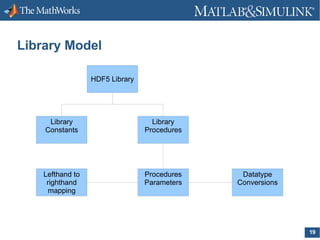
Library Model
HDF5 Library

Library
Constants

Library
Procedures

Lefthand to
righthand
mapping

Procedures
Parameters

Datatype
Conversions

19
Implementing the HDF5 Library








Step 1: Determine auto vs. manual conversion
Step 2: Convert .h to .xml
Step 3: Convert XML to C++
Step 4: Code manual functions
Step 5: Integrate
Step 6: Test

20
The conversion process

21
Converting XML to C++

// Definition
#define ADD_PROCEDURE_1_5(name,pfn,ret,a1,a2,a3,a4,a5) 
addMethod(new LibraryProcedure_1_5< LibraryParameter_T<ret>,
LibraryParameter_T<a1>,
LibraryParameter_T<a2>,
LibraryParameter_T<a3>,
LibraryParameter_T<a4>,
LibraryParameter_T<a5> >
(name, atts, pfn));


22
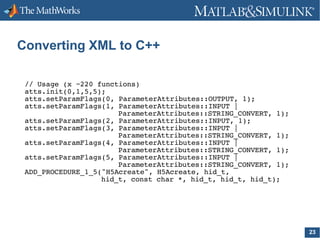
Converting XML to C++
// Usage (x ~220 functions)
atts.init(0,1,5,5);
atts.setParamFlags(0, ParameterAttributes::OUTPUT, 1);
atts.setParamFlags(1, ParameterAttributes::INPUT |
ParameterAttributes::STRING_CONVERT, 1);
atts.setParamFlags(2, ParameterAttributes::INPUT, 1);
atts.setParamFlags(3, ParameterAttributes::INPUT |
ParameterAttributes::STRING_CONVERT, 1);
atts.setParamFlags(4, ParameterAttributes::INPUT |
ParameterAttributes::STRING_CONVERT, 1);
atts.setParamFlags(5, ParameterAttributes::INPUT |
ParameterAttributes::STRING_CONVERT, 1);
ADD_PROCEDURE_1_5("H5Acreate", H5Acreate, hid_t,
hid_t, const char *, hid_t, hid_t, hid_t);

23
The HDF Group and The MathWorks






Continue to communicate future directions.
Don't change the existing API functions.
Communicate API functionality changes.
Produce a machine parsable version of hdf5.h.

24
The Future

HDF5

MAT-File

64-bits for large arrays
● Data subsetting on load
● Type conversion on load
● Parallel I/O?
●

25

Implementing HDF5 in MATLAB

  • 1.
    Jeff Mather &Alec Rogers The MathWorks, Inc. 29 November 2006 © 2006 The MathWorks, Inc. Implementing HDF5 in MATLAB
  • 2.
    HDF4 1-1 mapping ofC API first. (1998) Customer requests for high-level functions. HDFREAD, HDFWRITE, HDFINFO. (2000) 2
  • 3.
    HDF5 High-level first. (2003) Customerrequests for lower-level functionality. 1-1 mapping of C API. (2006) 3
  • 4.
    The World ofHDF Applications HDF4 / HDF5 APIs API Supported by MATLAB High-level access functions Customer application Customer application Customer application Customer application 4
  • 5.
    HDF5READ DATA = HDF5READ(FILENAME,DATASETNAME)returns in the variable DATA all data from the file FILENAME for the data set named DATASETNAME. DATA has to be extremely general because of the wide variety of datatypes that HDF5 accomodates. More control needed to match the uniqueness of customer datasets and files. Simple access only: ● No subsetting. ● Limited datatype control. 5
  • 6.
    HDF5INFO FILEINFO = HDF5INFO(FILENAME)returns a structure whose fields contain information about the contents of an HDF5 file. FILENAME is a string that specifies the name of the HDF file. 6
  • 7.
    HDF5WRITE HDF5WRITE(FILENAME, LOCATION, DATASET)adds the data in DATASET to the HDF5 file named FILENAME. LOCATION defines where to write the DATASET in the file and resembles a Unix-style path. The data in DATASET is mapped to HDF5 datatypes using the rules below. . . . HDF5WRITE is completely symmetric with HDF5READ. Objects disambiguate datatypes. The values in DATASET are cumbersome for non-native MATLAB types (e.g., arrays, compound, and references). 7
  • 8.
    Customer HDF5 Requests         Libraryupgrades (1.4.5, 1.6.4, 1.6.5, 1.8) Better support for large data Hyperselection, chunking New platform support (Solaris 64, MacIntel) GZIP, SZIP compression HDF5 file interrogation Bitfield, date/time datatypes Data translators: HDF5 --> MATLAB 8
  • 9.
    Use Cases Read partsof an HDF5 dataset (a hyperslab). 9
  • 10.
    Use Cases Read complicateddatatypes without the overhead of MATLAB objects for datasets. mydata(1).Data(1).Data(1) 10
  • 11.
    Use Cases Allow usersto extend our HDF5 functionality without waiting for us. 11
  • 12.
    Use Cases Be ableto drop in new versions of the HDF5 library when they become available. HDF5 1.8 12
  • 13.
    Use Cases Use avariety of esoteric HDF5 features at once: “I'm trying to use HDF5 files [with] grouping features like compound data types, group links, and reference data types.” 13
  • 14.
    Schedule Iterative development Internal design reviews March2006 First draft specification Sept. 2005 Final specification Feb. 2006 Feature complete May 2006 14
  • 15.
    MATLAB is notC Hmm . . . I might throw an error. MATLAB [out1, out2] = function(in1, in2); C status = function(in1, in2, &out1, &out2); 15
  • 16.
    MATLAB is notC mxArray void * p_real void * p_complex size_t dims[] size_t ndims mxCLASS_ID type ... ... 16
  • 17.
    The Interface hid_t identifiers C API MATLABAPI H5Xfcn H5X.fcn A D Identifier objects × 12 F G ML S Exceptions T ... 17
  • 18.
  • 19.
    Library Model HDF5 Library Library Constants Library Procedures Lefthandto righthand mapping Procedures Parameters Datatype Conversions 19
  • 20.
    Implementing the HDF5Library       Step 1: Determine auto vs. manual conversion Step 2: Convert .h to .xml Step 3: Convert XML to C++ Step 4: Code manual functions Step 5: Integrate Step 6: Test 20
  • 21.
  • 22.
    Converting XML toC++ // Definition #define ADD_PROCEDURE_1_5(name,pfn,ret,a1,a2,a3,a4,a5) addMethod(new LibraryProcedure_1_5< LibraryParameter_T<ret>, LibraryParameter_T<a1>, LibraryParameter_T<a2>, LibraryParameter_T<a3>, LibraryParameter_T<a4>, LibraryParameter_T<a5> > (name, atts, pfn)); 22
  • 23.
    Converting XML toC++ // Usage (x ~220 functions) atts.init(0,1,5,5); atts.setParamFlags(0, ParameterAttributes::OUTPUT, 1); atts.setParamFlags(1, ParameterAttributes::INPUT | ParameterAttributes::STRING_CONVERT, 1); atts.setParamFlags(2, ParameterAttributes::INPUT, 1); atts.setParamFlags(3, ParameterAttributes::INPUT | ParameterAttributes::STRING_CONVERT, 1); atts.setParamFlags(4, ParameterAttributes::INPUT | ParameterAttributes::STRING_CONVERT, 1); atts.setParamFlags(5, ParameterAttributes::INPUT | ParameterAttributes::STRING_CONVERT, 1); ADD_PROCEDURE_1_5("H5Acreate", H5Acreate, hid_t, hid_t, const char *, hid_t, hid_t, hid_t); 23
  • 24.
    The HDF Groupand The MathWorks     Continue to communicate future directions. Don't change the existing API functions. Communicate API functionality changes. Produce a machine parsable version of hdf5.h. 24
  • 25.
    The Future HDF5 MAT-File 64-bits forlarge arrays ● Data subsetting on load ● Type conversion on load ● Parallel I/O? ● 25