
The Adaptive Immune Response.The Adaptive Immune Response.
BY: Ahmed Khalil IbrahimBY: Ahmed Khalil Ibrahim
University of GeorgiaUniversity of Georgia
Adaptive Immune ResponseAdaptive Immune Response
in contrast to the innate immune response which we arein contrast to the innate immune response which we are
basically born with, the adaptive immune response is anbasically born with, the adaptive immune response is an
ever developing systemever developing system
– it continues to mature throughout our lifeit continues to mature throughout our life
– in most cases as each new microbial invader isin most cases as each new microbial invader is
encountered, our adaptive immune response initiatesencountered, our adaptive immune response initiates
a specific attack against the invadera specific attack against the invader
– generally this invader is remembered and thatgenerally this invader is remembered and that
“memory”“memory” is readily available in the case of a secondis readily available in the case of a second
or subsequent attack from the same invaderor subsequent attack from the same invader
Adaptive Immune ResponseAdaptive Immune Response
the adaptive immune responsethe adaptive immune response
– is learned or acquiredis learned or acquired
– recognizes specific substances foreign to therecognizes specific substances foreign to the
bodybody
– is essential for lifeis essential for life
Adaptive Immune ResponseAdaptive Immune Response
other terms used for the adaptive immune responseother terms used for the adaptive immune response
includeinclude
– acquired immunityacquired immunity
– specific immunityspecific immunity
adaptive immune response is characterized byadaptive immune response is characterized by
– specificityspecificity
– memorymemory
– learned ability to recognize (acquired) pathogenslearned ability to recognize (acquired) pathogens
which allows the body to usually only suffer once fromwhich allows the body to usually only suffer once from
that particular pathogenthat particular pathogen
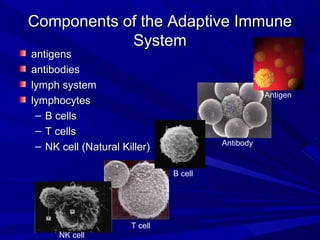
Components of the Adaptive ImmuneComponents of the Adaptive Immune
SystemSystem
antigensantigens
antibodiesantibodies
lymph systemlymph system
lymphocyteslymphocytes
– B cellsB cells
– T cellsT cells
– NK cell (Natural Killer)NK cell (Natural Killer)
Antigen
Antibody
B cell
T cell
NK cell
AntigensAntigens
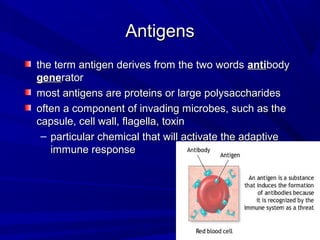
the term antigen derives from the two wordsthe term antigen derives from the two words antiantibodybody
genegeneratorrator
most antigens are proteins or large polysaccharidesmost antigens are proteins or large polysaccharides
often a component of invading microbes, such as theoften a component of invading microbes, such as the
capsule, cell wall, flagella, toxincapsule, cell wall, flagella, toxin
– particular chemical that will activate the adaptiveparticular chemical that will activate the adaptive
immune responseimmune response
AntigensAntigens
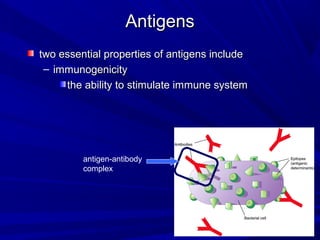
two essential properties of antigens includetwo essential properties of antigens include
– immunogenicityimmunogenicity
the ability to stimulate immune systemthe ability to stimulate immune system
antigen-antibody
complex
AntigensAntigens
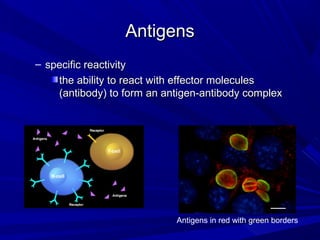
– specific reactivityspecific reactivity
the ability to react with effector moleculesthe ability to react with effector molecules
(antibody) to form an antigen-antibody complex(antibody) to form an antigen-antibody complex
Antigens in red with green borders
AntibodiesAntibodies
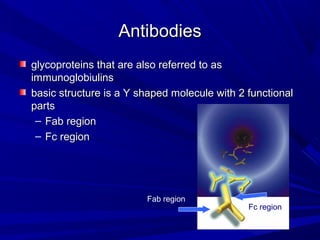
glycoproteins that are also referred to asglycoproteins that are also referred to as
immunoglobiulinsimmunoglobiulins
basic structure is a Y shaped molecule with 2 functionalbasic structure is a Y shaped molecule with 2 functional
partsparts
– Fab regionFab region
– Fc regionFc region
Fab region
Fc region
AntibodiesAntibodies
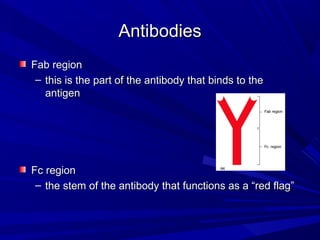
Fab regionFab region
– this is the part of the antibody that binds to thethis is the part of the antibody that binds to the
antigenantigen
Fc regionFc region
– the stem of the antibody that functions as a “red flag”the stem of the antibody that functions as a “red flag”
AntibodiesAntibodies
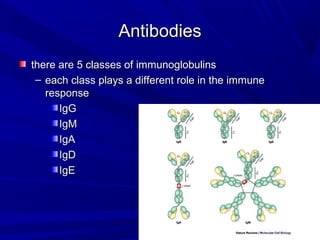
there are 5 classes of immunoglobulinsthere are 5 classes of immunoglobulins
– each class plays a different role in the immuneeach class plays a different role in the immune
responseresponse
IgGIgG
IgMIgM
IgAIgA
IgDIgD
IgEIgE
Lymphoid SystemLymphoid System
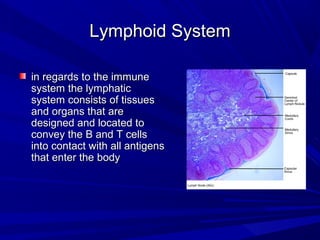
in regards to the immunein regards to the immune
system the lymphaticsystem the lymphatic
system consists of tissuessystem consists of tissues
and organs that areand organs that are
designed and located todesigned and located to
convey the B and T cellsconvey the B and T cells
into contact with all antigensinto contact with all antigens
that enter the bodythat enter the body
Lymphoid SystemLymphoid System
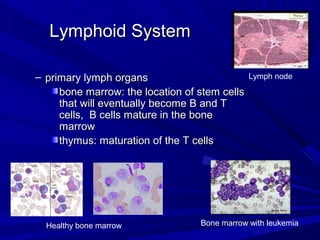
– primary lymph organsprimary lymph organs
bone marrow: the location of stem cellsbone marrow: the location of stem cells
that will eventually become B and Tthat will eventually become B and T
cells, B cells mature in the bonecells, B cells mature in the bone
marrowmarrow
thymus: maturation of the T cellsthymus: maturation of the T cells
Healthy bone marrow Bone marrow with leukemia
Lymph node
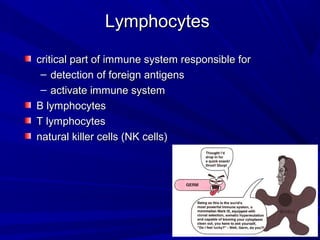
LymphocytesLymphocytes
critical part of immune system responsible forcritical part of immune system responsible for
– detection of foreign antigensdetection of foreign antigens
– activate immune systemactivate immune system
B lymphocytesB lymphocytes
T lymphocytesT lymphocytes
natural killer cells (NK cells)natural killer cells (NK cells)
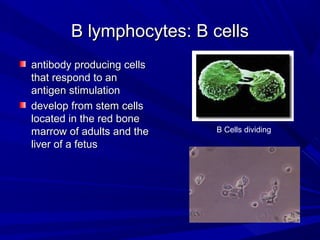
B lymphocytes: B cellsB lymphocytes: B cells
antibody producing cellsantibody producing cells
that respond to anthat respond to an
antigen stimulationantigen stimulation
develop from stem cellsdevelop from stem cells
located in the red bonelocated in the red bone
marrow of adults and themarrow of adults and the
liver of a fetusliver of a fetus
B Cells dividing
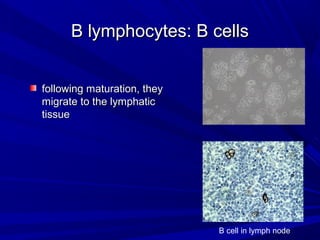
B lymphocytes: B cellsB lymphocytes: B cells
following maturation, theyfollowing maturation, they
migrate to the lymphaticmigrate to the lymphatic
tissuetissue
B cell in lymph node
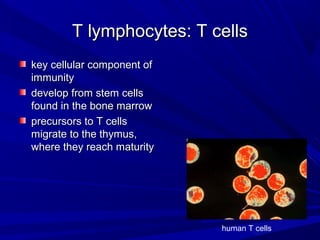
T lymphocytes: T cellsT lymphocytes: T cells
key cellular component ofkey cellular component of
immunityimmunity
develop from stem cellsdevelop from stem cells
found in the bone marrowfound in the bone marrow
precursors to T cellsprecursors to T cells
migrate to the thymus,migrate to the thymus,
where they reach maturitywhere they reach maturity
human T cells
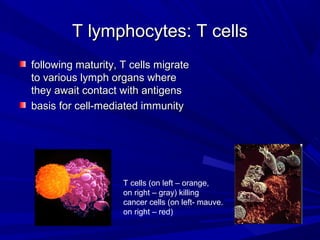
T lymphocytes: T cellsT lymphocytes: T cells
following maturity, T cells migratefollowing maturity, T cells migrate
to various lymph organs whereto various lymph organs where
they await contact with antigensthey await contact with antigens
basis for cell-mediated immunitybasis for cell-mediated immunity
T cells (on left – orange,
on right – gray) killing
cancer cells (on left- mauve.
on right – red)
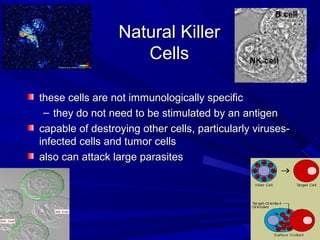
Natural KillerNatural Killer
CellsCells
these cells are not immunologically specificthese cells are not immunologically specific
– they do not need to be stimulated by an antigenthey do not need to be stimulated by an antigen
capable of destroying other cells, particularly viruses-capable of destroying other cells, particularly viruses-
infected cells and tumor cellsinfected cells and tumor cells
also can attack large parasitesalso can attack large parasites
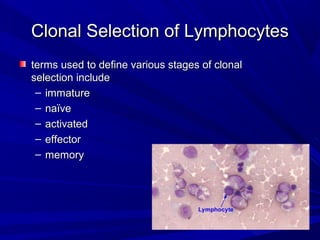
Clonal Selection of LymphocytesClonal Selection of Lymphocytes
terms used to define various stages of clonalterms used to define various stages of clonal
selection includeselection include
– immatureimmature
– naïvenaïve
– activatedactivated
– effectoreffector
– memorymemory
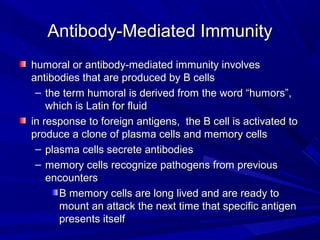
Antibody-Mediated ImmunityAntibody-Mediated Immunity
humoral or antibody-mediated immunity involveshumoral or antibody-mediated immunity involves
antibodies that are produced by B cellsantibodies that are produced by B cells
– the term humoral is derived from the word “humors”,the term humoral is derived from the word “humors”,
which is Latin for fluidwhich is Latin for fluid
in response to foreign antigens, the B cell is activated toin response to foreign antigens, the B cell is activated to
produce a clone of plasma cells and memory cellsproduce a clone of plasma cells and memory cells
– plasma cells secrete antibodiesplasma cells secrete antibodies
– memory cells recognize pathogens from previousmemory cells recognize pathogens from previous
encountersencounters
B memory cells are long lived and are ready toB memory cells are long lived and are ready to
mount an attack the next time that specific antigenmount an attack the next time that specific antigen
presents itselfpresents itself
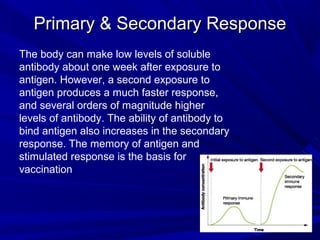
Primary & Secondary ResponsePrimary & Secondary Response
The body can make low levels of soluble
antibody about one week after exposure to
antigen. However, a second exposure to
antigen produces a much faster response,
and several orders of magnitude higher
levels of antibody. The ability of antibody to
bind antigen also increases in the secondary
response. The memory of antigen and
stimulated response is the basis for
vaccination
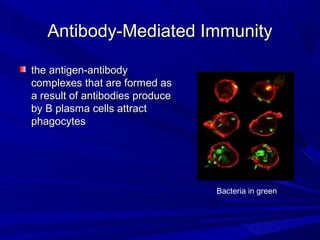
Antibody-Mediated ImmunityAntibody-Mediated Immunity
the antigen-antibodythe antigen-antibody
complexes that are formed ascomplexes that are formed as
a result of antibodies producea result of antibodies produce
by B plasma cells attractby B plasma cells attract
phagocytesphagocytes
Bacteria in green
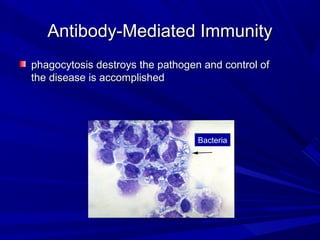
Antibody-Mediated ImmunityAntibody-Mediated Immunity
phagocytosis destroys the pathogen and control ofphagocytosis destroys the pathogen and control of
the disease is accomplishedthe disease is accomplished
Bacteria
The adaptive-immune-response albayati

The adaptive-immune-response albayati

  • 1.
    The Adaptive ImmuneResponse.The Adaptive Immune Response. BY: Ahmed Khalil IbrahimBY: Ahmed Khalil Ibrahim University of GeorgiaUniversity of Georgia
  • 2.
    Adaptive Immune ResponseAdaptiveImmune Response in contrast to the innate immune response which we arein contrast to the innate immune response which we are basically born with, the adaptive immune response is anbasically born with, the adaptive immune response is an ever developing systemever developing system – it continues to mature throughout our lifeit continues to mature throughout our life – in most cases as each new microbial invader isin most cases as each new microbial invader is encountered, our adaptive immune response initiatesencountered, our adaptive immune response initiates a specific attack against the invadera specific attack against the invader – generally this invader is remembered and thatgenerally this invader is remembered and that “memory”“memory” is readily available in the case of a secondis readily available in the case of a second or subsequent attack from the same invaderor subsequent attack from the same invader
  • 3.
    Adaptive Immune ResponseAdaptiveImmune Response the adaptive immune responsethe adaptive immune response – is learned or acquiredis learned or acquired – recognizes specific substances foreign to therecognizes specific substances foreign to the bodybody – is essential for lifeis essential for life
  • 4.
    Adaptive Immune ResponseAdaptiveImmune Response other terms used for the adaptive immune responseother terms used for the adaptive immune response includeinclude – acquired immunityacquired immunity – specific immunityspecific immunity adaptive immune response is characterized byadaptive immune response is characterized by – specificityspecificity – memorymemory – learned ability to recognize (acquired) pathogenslearned ability to recognize (acquired) pathogens which allows the body to usually only suffer once fromwhich allows the body to usually only suffer once from that particular pathogenthat particular pathogen
  • 5.
    Components of theAdaptive ImmuneComponents of the Adaptive Immune SystemSystem antigensantigens antibodiesantibodies lymph systemlymph system lymphocyteslymphocytes – B cellsB cells – T cellsT cells – NK cell (Natural Killer)NK cell (Natural Killer) Antigen Antibody B cell T cell NK cell
  • 6.
    AntigensAntigens the term antigenderives from the two wordsthe term antigen derives from the two words antiantibodybody genegeneratorrator most antigens are proteins or large polysaccharidesmost antigens are proteins or large polysaccharides often a component of invading microbes, such as theoften a component of invading microbes, such as the capsule, cell wall, flagella, toxincapsule, cell wall, flagella, toxin – particular chemical that will activate the adaptiveparticular chemical that will activate the adaptive immune responseimmune response
  • 7.
    AntigensAntigens two essential propertiesof antigens includetwo essential properties of antigens include – immunogenicityimmunogenicity the ability to stimulate immune systemthe ability to stimulate immune system antigen-antibody complex
  • 8.
    AntigensAntigens – specific reactivityspecificreactivity the ability to react with effector moleculesthe ability to react with effector molecules (antibody) to form an antigen-antibody complex(antibody) to form an antigen-antibody complex Antigens in red with green borders
  • 9.
    AntibodiesAntibodies glycoproteins that arealso referred to asglycoproteins that are also referred to as immunoglobiulinsimmunoglobiulins basic structure is a Y shaped molecule with 2 functionalbasic structure is a Y shaped molecule with 2 functional partsparts – Fab regionFab region – Fc regionFc region Fab region Fc region
  • 10.
    AntibodiesAntibodies Fab regionFab region –this is the part of the antibody that binds to thethis is the part of the antibody that binds to the antigenantigen Fc regionFc region – the stem of the antibody that functions as a “red flag”the stem of the antibody that functions as a “red flag”
  • 11.
    AntibodiesAntibodies there are 5classes of immunoglobulinsthere are 5 classes of immunoglobulins – each class plays a different role in the immuneeach class plays a different role in the immune responseresponse IgGIgG IgMIgM IgAIgA IgDIgD IgEIgE
  • 12.
    Lymphoid SystemLymphoid System inregards to the immunein regards to the immune system the lymphaticsystem the lymphatic system consists of tissuessystem consists of tissues and organs that areand organs that are designed and located todesigned and located to convey the B and T cellsconvey the B and T cells into contact with all antigensinto contact with all antigens that enter the bodythat enter the body
  • 13.
    Lymphoid SystemLymphoid System –primary lymph organsprimary lymph organs bone marrow: the location of stem cellsbone marrow: the location of stem cells that will eventually become B and Tthat will eventually become B and T cells, B cells mature in the bonecells, B cells mature in the bone marrowmarrow thymus: maturation of the T cellsthymus: maturation of the T cells Healthy bone marrow Bone marrow with leukemia Lymph node
  • 14.
    LymphocytesLymphocytes critical part ofimmune system responsible forcritical part of immune system responsible for – detection of foreign antigensdetection of foreign antigens – activate immune systemactivate immune system B lymphocytesB lymphocytes T lymphocytesT lymphocytes natural killer cells (NK cells)natural killer cells (NK cells)
  • 15.
    B lymphocytes: BcellsB lymphocytes: B cells antibody producing cellsantibody producing cells that respond to anthat respond to an antigen stimulationantigen stimulation develop from stem cellsdevelop from stem cells located in the red bonelocated in the red bone marrow of adults and themarrow of adults and the liver of a fetusliver of a fetus B Cells dividing
  • 16.
    B lymphocytes: BcellsB lymphocytes: B cells following maturation, theyfollowing maturation, they migrate to the lymphaticmigrate to the lymphatic tissuetissue B cell in lymph node
  • 17.
    T lymphocytes: TcellsT lymphocytes: T cells key cellular component ofkey cellular component of immunityimmunity develop from stem cellsdevelop from stem cells found in the bone marrowfound in the bone marrow precursors to T cellsprecursors to T cells migrate to the thymus,migrate to the thymus, where they reach maturitywhere they reach maturity human T cells
  • 18.
    T lymphocytes: TcellsT lymphocytes: T cells following maturity, T cells migratefollowing maturity, T cells migrate to various lymph organs whereto various lymph organs where they await contact with antigensthey await contact with antigens basis for cell-mediated immunitybasis for cell-mediated immunity T cells (on left – orange, on right – gray) killing cancer cells (on left- mauve. on right – red)
  • 19.
    Natural KillerNatural Killer CellsCells thesecells are not immunologically specificthese cells are not immunologically specific – they do not need to be stimulated by an antigenthey do not need to be stimulated by an antigen capable of destroying other cells, particularly viruses-capable of destroying other cells, particularly viruses- infected cells and tumor cellsinfected cells and tumor cells also can attack large parasitesalso can attack large parasites
  • 20.
    Clonal Selection ofLymphocytesClonal Selection of Lymphocytes terms used to define various stages of clonalterms used to define various stages of clonal selection includeselection include – immatureimmature – naïvenaïve – activatedactivated – effectoreffector – memorymemory
  • 21.
    Antibody-Mediated ImmunityAntibody-Mediated Immunity humoralor antibody-mediated immunity involveshumoral or antibody-mediated immunity involves antibodies that are produced by B cellsantibodies that are produced by B cells – the term humoral is derived from the word “humors”,the term humoral is derived from the word “humors”, which is Latin for fluidwhich is Latin for fluid in response to foreign antigens, the B cell is activated toin response to foreign antigens, the B cell is activated to produce a clone of plasma cells and memory cellsproduce a clone of plasma cells and memory cells – plasma cells secrete antibodiesplasma cells secrete antibodies – memory cells recognize pathogens from previousmemory cells recognize pathogens from previous encountersencounters B memory cells are long lived and are ready toB memory cells are long lived and are ready to mount an attack the next time that specific antigenmount an attack the next time that specific antigen presents itselfpresents itself
  • 22.
    Primary & SecondaryResponsePrimary & Secondary Response The body can make low levels of soluble antibody about one week after exposure to antigen. However, a second exposure to antigen produces a much faster response, and several orders of magnitude higher levels of antibody. The ability of antibody to bind antigen also increases in the secondary response. The memory of antigen and stimulated response is the basis for vaccination
  • 23.
    Antibody-Mediated ImmunityAntibody-Mediated Immunity theantigen-antibodythe antigen-antibody complexes that are formed ascomplexes that are formed as a result of antibodies producea result of antibodies produce by B plasma cells attractby B plasma cells attract phagocytesphagocytes Bacteria in green
  • 24.
    Antibody-Mediated ImmunityAntibody-Mediated Immunity phagocytosisdestroys the pathogen and control ofphagocytosis destroys the pathogen and control of the disease is accomplishedthe disease is accomplished Bacteria