JOURNALIZING
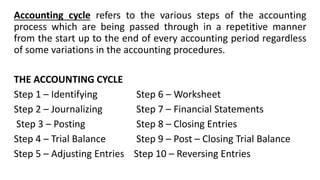
Accounting cycle refers to the various steps of the accounting
process which are being passed through in a repetitive manner
from the start up to the end of every accounting period regardless
of some variations in the accounting procedures.
THE ACCOUNTING CYCLE
Step 1 – Identifying Step 6 – Worksheet
Step 2 – Journalizing Step 7 – Financial Statements
Step 3 – Posting Step 8 – Closing Entries
Step 4 – Trial Balance Step 9 – Post – Closing Trial Balance
Step 5 – Adjusting Entries Step 10 – Reversing Entries
1st step – IDENTIFYING - The actual sequence of events
begins with the identification of transactions. - What
transactions are considered as accountable and what are not.
- The rule is, only transactions and events which are of
financial bearing to the business are being recognized.
1. Identifying transactions are the supporting business
documents that are on file or yet to be filed as evidence of
transactions to assure the reliability and verifiability of
accounting records.
2. Analyzing – the value received and the value parted away
in a particular transactions
Business Documents, to wit;
1. Purchase order – should be fill-up in placing orders
2. Charge invoice – issued by the supplier – acknowledged
that the customer have received the goods.
3. Check voucher – to accompany check, whenever
payment made by customer.
4. Check – shows the payment made by the customer
5. Official receipt – acknowledging to have received
payment from the customer.
2nd step – JOURNALIZING
Books of account – the records that are used and kept by the
business in storing all of the accounting data.
2 sets of books that are used by the business:
1. Book of original entry- called JOURNAL; 2 kinds 1.
General Journal 2. Special Journal. This is called the book
of original entry because it is in this book where
transactions are recorded for the first time.
2. Book of final entry – called the LEDGER; 2 kinds 1.
General Ledger 2. Subsidiary Ledger. This is called book of
final entry because it is in this book where transactions
that were recorded in the journal are transferred for final
recording.
Journal Can be loose-leaf or book bound.
It has the following columnar headings:
DATE COLUMN - shows the date when the transactions took place.
PARTICULARS - shows the item or the accounts debited and
credited as a result of a transaction analysis as well as a brief or
concise explanation of what the transaction is about.
FOLIO – shows the number of an account in a ledger or page of a
ledger to which it was transferred. Folio is the Latin word for “
page”. It is also called a “reference”.
DEBIT COLUMN – this is a money column showing the peso
amount of the value received in a transaction.
CREDIT COLUMN – this is the money column showing the amount
of the value parted with in a transaction.
General Ledger Also called “group of accounts”. Can be loose-leaf or book
bound form. This book will group items of accounts of the same kind, class
or nature. Each item or account is being provided with a leaf of a ledger.
It has two sides; the left hand side called a debit side and the right – hand
side called a credit side.
Each side has the column for the following:
DATE COLUMN - shows the date of the transaction that occurred as
recorded in the Journal.
PARTICULARS -shows a brief but a concise explanation of the transaction as
show in the Journal. This is sometimes called “explanation”. “Description”
or “Item”.
FOLIO - shows the page number of a Journal where entries are taken from
MONEY COLUMNS – the debit money column shows the amounts that are
transferred from the debit money column of the Journal while the credit
money column shows the amounts that are transferred from the credit
money column of the Journal.
At the end of the accounting period, the debit and credit entries of its
item or account in the ledger are totalled.
DEBIT BALANCE- if the debit side total is bigger than the credit side
total. We then say, the account is a debit balance.
CREDIT BALANCE- if the credit side total is bigger that the debit side
total. We then say, the account is a credit balance.
IN BALANCE or CLOSED ACCOUNT – if both totals of debit and credit
sides are equal.
A general ledger in its skeleton form is a T-ACCOUNT
Recording process
Recording- is the first phase of accounting. This involves the writing
down of business transaction in a systematic manner and in order of
their occurrence in the book of original entry called JOURNAL.
Journalizing- the act of recording business transactions in the journal
and it is the second step of the accounting process.
Journal entry- the entry that is made in the journal. A journal entry
may be simple or compound.
Simple journal entry – is one that has one debit item with a debit
amount and one credit item with a credit amount.
Compound journal entry- is one that may have one debit item and
two or more credit items; two or more debit items and one credit
item; or may have two or more items on both sides.
Complete journal entry- should have an explanation. The
explanation must state briefly but concisely the nature of the
transaction. It is usually worded “To record...” some
bookkeepers and accountants prefer to cut short the
explanation by eliminating the words “To record” to economize
the space of the journal which becomes widely acceptable.
Indentions made in preparing the journal entry:
1. The credit item is indented from the debit item
2. The first word of the explanation is indented from the
credit item.
Money columns of the journal provides the segregation of digits for
the million, thousands, hundreds, pesos and centavos.
a. The use of comma for million and thousands and the decimal point
for the centavos are eliminated;
b. The use of peso (P) is also eliminated because the debit and credit
columns are understood to be money columns and that peso is
used as its valuation;
c. The use of the dash (-) indicates that there is no centavo in the
amount. The double zero may also be used.
Opening entry- the first entry made in the general journal.
– Recording of the initial investments for the first time.
- Recording the balances of accounts in preparation for the next
annual accounting period.
*when transactions are recorded in the general journal, account titles
are being used.
Chart of accounts- the list of account titles.
When transactions are recorded in the general journal, account titles
are being used. A list of account titles are prepared beforehand to
guide bookkeeper and accountant of what specific titles are to be
used in describing the exchange of values in a transaction. This list of
account titles is called “Chart of Accounts”.
The chart of accounts shows account titles which are arranged in this
order: ASSETS, LIABILITIES, OWNER’S EQUITY, INCOME and
EXPENSES. If a transaction involves an account title which is not
included in a given chart, the bookkeeper may create an account title
that he thinks more appropriate to use in describing the exchange of
values.
Illustrative Problem:
Davao Laundry Services Transactions.docx

JOURNALIZING-AND-POSTING.pptx

  • 1.
  • 2.
    Accounting cycle refersto the various steps of the accounting process which are being passed through in a repetitive manner from the start up to the end of every accounting period regardless of some variations in the accounting procedures. THE ACCOUNTING CYCLE Step 1 – Identifying Step 6 – Worksheet Step 2 – Journalizing Step 7 – Financial Statements Step 3 – Posting Step 8 – Closing Entries Step 4 – Trial Balance Step 9 – Post – Closing Trial Balance Step 5 – Adjusting Entries Step 10 – Reversing Entries
  • 3.
    1st step –IDENTIFYING - The actual sequence of events begins with the identification of transactions. - What transactions are considered as accountable and what are not. - The rule is, only transactions and events which are of financial bearing to the business are being recognized. 1. Identifying transactions are the supporting business documents that are on file or yet to be filed as evidence of transactions to assure the reliability and verifiability of accounting records. 2. Analyzing – the value received and the value parted away in a particular transactions
  • 4.
    Business Documents, towit; 1. Purchase order – should be fill-up in placing orders 2. Charge invoice – issued by the supplier – acknowledged that the customer have received the goods. 3. Check voucher – to accompany check, whenever payment made by customer. 4. Check – shows the payment made by the customer 5. Official receipt – acknowledging to have received payment from the customer.
  • 5.
    2nd step –JOURNALIZING Books of account – the records that are used and kept by the business in storing all of the accounting data. 2 sets of books that are used by the business: 1. Book of original entry- called JOURNAL; 2 kinds 1. General Journal 2. Special Journal. This is called the book of original entry because it is in this book where transactions are recorded for the first time. 2. Book of final entry – called the LEDGER; 2 kinds 1. General Ledger 2. Subsidiary Ledger. This is called book of final entry because it is in this book where transactions that were recorded in the journal are transferred for final recording.
  • 6.
    Journal Can beloose-leaf or book bound. It has the following columnar headings: DATE COLUMN - shows the date when the transactions took place. PARTICULARS - shows the item or the accounts debited and credited as a result of a transaction analysis as well as a brief or concise explanation of what the transaction is about. FOLIO – shows the number of an account in a ledger or page of a ledger to which it was transferred. Folio is the Latin word for “ page”. It is also called a “reference”. DEBIT COLUMN – this is a money column showing the peso amount of the value received in a transaction. CREDIT COLUMN – this is the money column showing the amount of the value parted with in a transaction.
  • 7.
    General Ledger Alsocalled “group of accounts”. Can be loose-leaf or book bound form. This book will group items of accounts of the same kind, class or nature. Each item or account is being provided with a leaf of a ledger. It has two sides; the left hand side called a debit side and the right – hand side called a credit side. Each side has the column for the following: DATE COLUMN - shows the date of the transaction that occurred as recorded in the Journal. PARTICULARS -shows a brief but a concise explanation of the transaction as show in the Journal. This is sometimes called “explanation”. “Description” or “Item”. FOLIO - shows the page number of a Journal where entries are taken from MONEY COLUMNS – the debit money column shows the amounts that are transferred from the debit money column of the Journal while the credit money column shows the amounts that are transferred from the credit money column of the Journal.
  • 8.
    At the endof the accounting period, the debit and credit entries of its item or account in the ledger are totalled. DEBIT BALANCE- if the debit side total is bigger than the credit side total. We then say, the account is a debit balance. CREDIT BALANCE- if the credit side total is bigger that the debit side total. We then say, the account is a credit balance. IN BALANCE or CLOSED ACCOUNT – if both totals of debit and credit sides are equal. A general ledger in its skeleton form is a T-ACCOUNT
  • 9.
    Recording process Recording- isthe first phase of accounting. This involves the writing down of business transaction in a systematic manner and in order of their occurrence in the book of original entry called JOURNAL. Journalizing- the act of recording business transactions in the journal and it is the second step of the accounting process. Journal entry- the entry that is made in the journal. A journal entry may be simple or compound. Simple journal entry – is one that has one debit item with a debit amount and one credit item with a credit amount. Compound journal entry- is one that may have one debit item and two or more credit items; two or more debit items and one credit item; or may have two or more items on both sides.
  • 10.
    Complete journal entry-should have an explanation. The explanation must state briefly but concisely the nature of the transaction. It is usually worded “To record...” some bookkeepers and accountants prefer to cut short the explanation by eliminating the words “To record” to economize the space of the journal which becomes widely acceptable. Indentions made in preparing the journal entry: 1. The credit item is indented from the debit item 2. The first word of the explanation is indented from the credit item.
  • 11.
    Money columns ofthe journal provides the segregation of digits for the million, thousands, hundreds, pesos and centavos. a. The use of comma for million and thousands and the decimal point for the centavos are eliminated; b. The use of peso (P) is also eliminated because the debit and credit columns are understood to be money columns and that peso is used as its valuation; c. The use of the dash (-) indicates that there is no centavo in the amount. The double zero may also be used.
  • 12.
    Opening entry- thefirst entry made in the general journal. – Recording of the initial investments for the first time. - Recording the balances of accounts in preparation for the next annual accounting period. *when transactions are recorded in the general journal, account titles are being used. Chart of accounts- the list of account titles.
  • 13.
    When transactions arerecorded in the general journal, account titles are being used. A list of account titles are prepared beforehand to guide bookkeeper and accountant of what specific titles are to be used in describing the exchange of values in a transaction. This list of account titles is called “Chart of Accounts”. The chart of accounts shows account titles which are arranged in this order: ASSETS, LIABILITIES, OWNER’S EQUITY, INCOME and EXPENSES. If a transaction involves an account title which is not included in a given chart, the bookkeeper may create an account title that he thinks more appropriate to use in describing the exchange of values.
  • 14.
    Illustrative Problem: Davao LaundryServices Transactions.docx