Obstructed Labor - By Dr Gebresilassie
Andualem
1
Pocket Notes
Resident @ SPHMMC
By Dr Gebresilassie Andualem
Email: bjlomsecond@gmail.com
Obstructed Labor
March, 2019
Contents
Introduction
Incidence
Clinical Presentation and Diagnosis
Management
Complications
References
2
Obstructed Labor - By Dr Gebresilassie
Andualem
Introduction
Definition
– failure of descent of fetus in the birth canal
• for mechanical reasons
despite good uterine contractions
a totally preventable labor complication
3
It is a neglected labor & should not occur in a labor ward
Obstructed Labor - By Dr Gebresilassie
Andualem
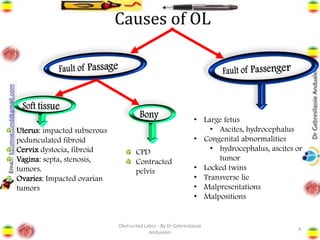
Causes of OL
4
CPD
Contracted
pelvis
Uterus: impacted subserous
pedunculated fibroid
Cervix dystocia, fibroid
Vagina: septa, stenosis,
tumors.
Ovaries: Impacted ovarian
tumors
• Large fetus
• Ascites, hydrocephalus
• Congenital abnormalities
• hydrocephalus, ascites or
tumor
• Locked twins
• Transverse lie
• Malpresentations
• Malpositions
Obstructed Labor - By Dr Gebresilassie
Andualem
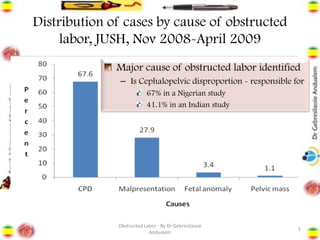
Distribution of cases by cause of obstructed
labor, JUSH, Nov 2008-April 2009
5
Major cause of obstructed labor identified
– Is Cephalopelvic disproportion - responsible for
67% in a Nigerian study
41.1% in an Indian study
Obstructed Labor - By Dr Gebresilassie
Andualem
Risks
Maternal
Malnutrition, rickets or osteomalacia
short stature
– Height <150 cm doe not have adequate
sensitivity and specificity to be used for
screening
Previous
– uterine scare
– stillbirth with prolonged labor
Care Provider related
Failure to act on risk factors
(previous scare to deliver in hospital)
Delay in referral to higher level of
care
Cultural
Young age (< 17 years)
Custom of early marriage
Female genital cutting
Socioeconomical
Lack of trained staff in recognizing
obstructed labor and its management
Lack of transport and
communication
Limited resource allocation for
reproductive health services and
programs
6
Obstructed Labor - By Dr Gebresilassie
Andualem
Incidence
Worldwide, OL occurs in an estimated 5% of live
births and accounts for 8% of maternal deaths
Africa has the highest maternal mortality in the world
– Estimated at an average of about 1,000 deaths per
100,000 live births
Different studies in developing countries
– Incidence of OL varies
• as low as 1.3% in a Sudan study to
• as high as 7% in a retrospective study done at JUSH
– Developing countries: 1–2%
JUSH, Nov 2008-April 2009
– incidence of obstructed labor was 12.2%
7
Obstructed Labor - By Dr Gebresilassie
Andualem
• OL Contributes to 22% of the maternal
mortality in Ethiopia
– Still this underestimation of the problem
– because deaths due to OL are often classified
under other complications such as
sepsis,
postpartum hemorrhage or
ruptured uterus
8
Obstructed Labor - By Dr Gebresilassie
Andualem
9
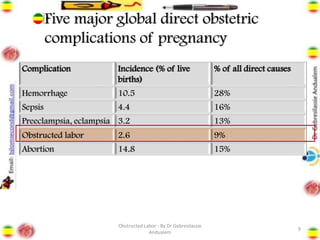
Complication Incidence (% of live
births)
% of all direct causes
Hemorrhage 10.5 28%
Sepsis 4.4 16%
Preeclampsia, eclampsia 3.2 13%
Obstructed labor 2.6 9%
Abortion 14.8 15%
Five major global direct obstetric
complications of pregnancy
Obstructed Labor - By Dr Gebresilassie
Andualem
Clinical Presentation and Diagnosis
History
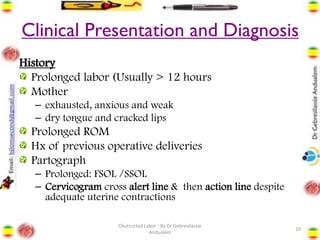
Prolonged labor (Usually > 12 hours
Mother
– exhausted, anxious and weak
– dry tongue and cracked lips
Prolonged ROM
Hx of previous operative deliveries
Partograph
– Prolonged: FSOL /SSOL
– Cervicogram cross alert line & then action line despite
adequate uterine contractions
10
Obstructed Labor - By Dr Gebresilassie
Andualem
Objectively
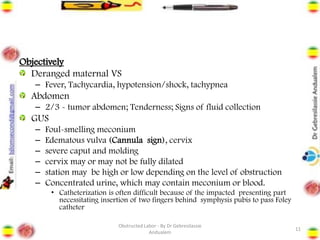
Deranged maternal VS
– Fever, Tachycardia, hypotension/shock, tachypnea
Abdomen
– 2/3 - tumor abdomen; Tenderness; Signs of fluid collection
GUS
– Foul-smelling meconium
– Edematous vulva (Cannula sign), cervix
– severe caput and molding
– cervix may or may not be fully dilated
– station may be high or low depending on the level of obstruction
– Concentrated urine, which may contain meconium or blood.
• Catheterization is often difficult because of the impacted presenting part
necessitating insertion of two fingers behind symphysis pubis to pass Foley
catheter
11
Obstructed Labor - By Dr Gebresilassie
Andualem
Morbid Anatomical Changes
Primigravida
• In response to mechanical obstruction,
uterine contraction gradually decreases
– Uterine Inertia
– Atonic uterus: common in primigravida and
may lead to atonic PPH after delivery
Multigravida
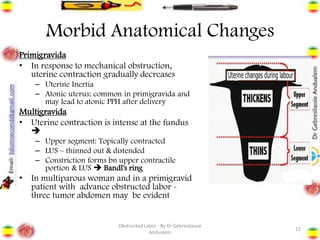
• Uterine contraction is intense at the fundus
➔
– Upper segment: Topically contracted
– LUS – thinned out & distended
– Constriction forms bn upper contractile
portion & LUS ➔ Bandl's ring
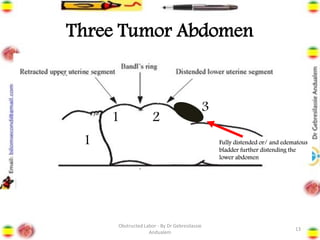
• In multiparous woman and in a primigravid
patient with advance obstructed labor -
three tumor abdomen may be evident
12
Obstructed Labor - By Dr Gebresilassie
Andualem
Three Tumor Abdomen
13
Fully distended or/ and edematous
bladder further distending the
lower abdomen
1
1 2
3
Obstructed Labor - By Dr Gebresilassie
Andualem
Bandl’s ring
a late sign of OL
can be seen as a depression across the abdomen at
about the level of the umbilicus
An hourglass constriction ring of the uterus
Incidence: 1 in 5000 live births
Diagnosis
– typically made at cesarean delivery
• Finding: transverse thickened muscular band can be observed
separating U & L – US of the uterus
– case reports have described predelivery diagnosis using
ultrasound
• Findings: Thinned LUS, thick UUS; a prominent ring in between
14
Obstructed Labor - By Dr Gebresilassie
Andualem
When to suspect Uterine Rupture ?
Abdomen
– Tender
– flank dullness suggestive of hemoperitoneum
Fetus
– Fetal parts easily felt
– lie and presentation may be difficult to detect
• Because baby - displaced into the peritoneal cavity
– distressed / dead
15
Obstructed Labor - By Dr Gebresilassie
Andualem
Differential diagnosis
16
Constriction ring
Full bladder
Fundal myoma
Obstructed Labor - By Dr Gebresilassie
Andualem
Management
• OL is an emergency condition
• Simultaneous activities
17
1) Resuscitation
• Monitor life threatening conditions (shock, sepsis)
• Antibiotics if - signs of infection prolonged ROM
2) Work-Up: CBC, B/G & Rh, Prepare blood preparation
3) Identifying the cause of OL
4) Decide on mode of delivery
• Laparotomy, CS, Instrumental, destructive ???
Obstructed Labor - By Dr Gebresilassie
Andualem
Standard components
• Crystalloids: RL/NS
• Catheterize
• Blood typing & Prepare Crossmatched blood
• Broad spectrum antibiotics
– Ampicillin + Gentamycin + Metronidazole
– Ceftriaxone + Metronidazole
• Obtain informed consent
• Proceed with the planned mode of delivery
18
Obstructed Labor - By Dr Gebresilassie
Andualem
Determinants of mode of labor
• No place for "wait & see" policy in OL
but balanced decision should be taken on the method
of delivery
• Factors
Fetal condition (dead or alive)
Station (descent) of presenting part
± evidence of imminent (overt) uterine rupture
Fetal presentation
Extent of cervical dilatation
Maternal hemodynamic status
19
Obstructed Labor - By Dr Gebresilassie
Andualem
20
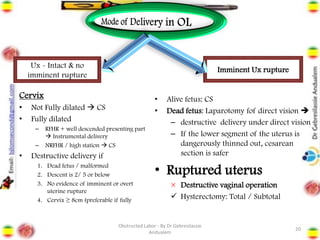
Ux - Intact & no
imminent rupture
Imminent Ux rupture
Cervix
• Not Fully dilated → CS
• Fully dilated
– RFHR + well descended presenting part
→ Instrumental delivery
– NRFHR / high station → CS
• Destructive delivery if
1. Dead fetus / malformed
2. Descent is 2/ 5 or below
3. No evidence of imminent or overt
uterine rupture
4. Cervix ≥ 8cm (preferable if fully
• Alive fetus: CS
• Dead fetus: Laparotomy fof direct vision ➔
– destructive delivery under direct vision
– If the lower segment of the uterus is
dangerously thinned out, cesarean
section is safer
• Ruptured uterus
× Destructive vaginal operation
✓ Hysterectomy: Total / Subtotal
Obstructed Labor - By Dr Gebresilassie
Andualem
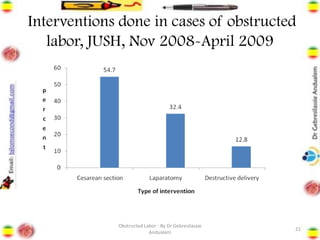
Interventions done in cases of obstructed
labor, JUSH, Nov 2008-April 2009
21
Obstructed Labor - By Dr Gebresilassie
Andualem
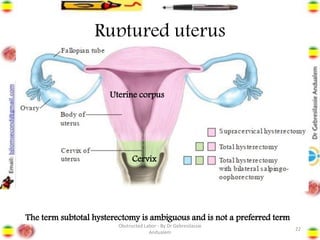
Ruptured uterus
• Destructive vaginal operation is a contraindicated
• Laparotomy ➔
– Total hysterectomy
• Extensive tear
• Necrotic edges
• Tears difficult to stitch such as posterior tears and extension into the vagina
• Grossly infected uterus
• Rupture after prolonged labor
• Future cervical cancer concern
– Subtotal hysterectomy
• Similar conditions as total hysterectomy that are related to infection and tear
• Relative ease of procedure than total hysterectomy
• High subtotal hysterectomy preserves menstruation
• May also preserve sexual pleasure
22
The term subtotal hysterectomy is ambiguous and is not a preferred term
Uterine corpus
Cervix
Obstructed Labor - By Dr Gebresilassie
Andualem
Options of Head extraction in OL
Pull method: Reverse breech
extraction
• Advantage
– lower risk of lateral or downward
uterine incision extension, blood
loss
– shorter operative time
• U 2018 – preferred – since this
approach is best supported by
available literature
Abdominovaginal delivery ("push
method")
• both abdomen & perineum
should be prepped preoperatively
• Disadvantage
– ↑ risk of uterine incision extension
(8X)
– ↑ risk of blood loss, transfusion,
postpartum endometritis
– Longer mean operative time
23
Obstructed Labor - By Dr Gebresilassie
Andualem
Other techniques
• Fetal head elevator, obstetrical spoon
– Obstetrical spoons
– Fetal head elevators
• Shoulders first techniques
– assistant gently push shoulder cephalad
– primary obstetrician tries to extract the fetal head
• Patwardhan's shoulders first technique
– first delivering the anterior shoulder and arm ➔ rotate the fetus and
delivering the posterior shoulder and arm
– fetal trunk, breech, and lower limbs are then successively delivered through
the incision using a combination of gentle traction on the arms, fingers
beneath the thorax, and fundal pressure
– Once the body is delivered, the head is lifted out of the pelvis in the same
manner as a reverse breech extraction
– Compared with the traditional abdominopelvic delivery technique, this
technique has been reported to reduce
• risk of uterine lacerations/extension of the incision, bladder injuries, and need for
blood transfusions
24
Obstructed Labor - By Dr Gebresilassie
Andualem
Postoperative care and follow up
• continue antibiotics until the woman is fever-free for 48 –
72 hours ➔ continue PO
• Intensive resuscitation and monitoring
• Blood transfusion
• Analgesics
• If outcome – SB/END
– Bereavement Care
– Breast care
• Fistula care and follow-up
– kept until infection is controlled
– Usually, the fistula repair is undertaken 2-3 months after
delivery
25
Obstructed Labor - By Dr Gebresilassie
Andualem
Bladder care
• Avoid distention & encourage urination
• Catheter
– Leave the urinary catheter in place for a minimum of 7 to
10 days (WHO) ➔
– If there is no fistula: remove the urinary catheter
– If VVF fistula is ≤ 4 cm diameter
• attempt conservative treatment
• Leave catheter for at least 4 to 6 weeks to allow fistula to heal
• Keep catheter as long as the fistula is not closed and as long as a
gradual decrease of its diameter is observed at each weekly
inspection
– If the fistula is > 4 cm diameter or conservative treatment
fails or the patient has fistula for over 3 months
• surgical treatment
26
Obstructed Labor - By Dr Gebresilassie
Andualem
Is OL Preventable?
Skilled birth attendance
Using the partograph
birth preparedness and complication readiness
– pillars of safer labour and delivery
– Help mother to organize herself into birth preparedness
Delaying early marriage
– Researches in Ethiopia have shown that 50% of women,
especially rural women, get married on average at around
16 years, and most of them rapidly become pregnant
Improved antenatal care coverage
Early referral
27
Obstructed Labor - By Dr Gebresilassie
Andualem
Complications
Maternal
• Necrotic vesico-vaginal
fistula
• Uterine rupture
• Postpartum hemorrhage
• Slow return of the uterus to
its pre-pregnancy size
• Shock
• small intestine becomes
paralyzed and stops
movement (paralytic ileus)
• Sepsis
• Death
Neonatal
• Intracranial haemorrhage
from excessive moulding.
• Birth injuries.
• Infections
• Severe asphyxia (life-
threatening lack of oxygen)
• Death
28
Obstructed Labor - By Dr Gebresilassie
Andualem
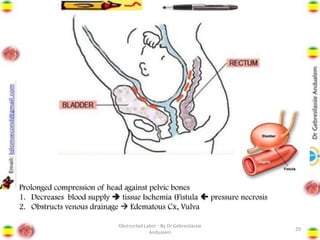
29
Prolonged compression of head against pelvic bones
1. Decreases blood supply ➔ tissue Ischemia (Fistula  pressure necrosis
2. Obstructs venous drainage → Edematous Cx, Vulva
Obstructed Labor - By Dr Gebresilassie
Andualem
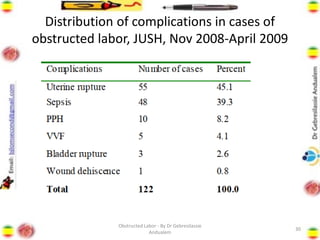
Distribution of complications in cases of
obstructed labor, JUSH, Nov 2008-April 2009
30
Obstructed Labor - By Dr Gebresilassie
Andualem
References
Gabbe 7th edition
Management protocol on selected obstetrics
topics (FMOH) - January, 2010
WHO recommendation on duration of bladder
catheterization after surgical repair of simple
obstetric urinary fistula, 2018
Incidence, causes & outcome of obstructed labor
in JUSH
Global burden of obstructed labor in the year
2000 (WHO) - Geneva, July 2003
31
Obstructed Labor - By Dr Gebresilassie
Andualem
32
Obstructed Labor - By Dr Gebresilassie
Andualem

Obstructed labor march 2019

  • 1.
    Obstructed Labor -By Dr Gebresilassie Andualem 1 Pocket Notes Resident @ SPHMMC By Dr Gebresilassie Andualem Email: bjlomsecond@gmail.com Obstructed Labor March, 2019
  • 2.
    Contents Introduction Incidence Clinical Presentation andDiagnosis Management Complications References 2 Obstructed Labor - By Dr Gebresilassie Andualem
  • 3.
    Introduction Definition – failure ofdescent of fetus in the birth canal • for mechanical reasons despite good uterine contractions a totally preventable labor complication 3 It is a neglected labor & should not occur in a labor ward Obstructed Labor - By Dr Gebresilassie Andualem
  • 4.
    Causes of OL 4 CPD Contracted pelvis Uterus:impacted subserous pedunculated fibroid Cervix dystocia, fibroid Vagina: septa, stenosis, tumors. Ovaries: Impacted ovarian tumors • Large fetus • Ascites, hydrocephalus • Congenital abnormalities • hydrocephalus, ascites or tumor • Locked twins • Transverse lie • Malpresentations • Malpositions Obstructed Labor - By Dr Gebresilassie Andualem
  • 5.
    Distribution of casesby cause of obstructed labor, JUSH, Nov 2008-April 2009 5 Major cause of obstructed labor identified – Is Cephalopelvic disproportion - responsible for 67% in a Nigerian study 41.1% in an Indian study Obstructed Labor - By Dr Gebresilassie Andualem
  • 6.
    Risks Maternal Malnutrition, rickets orosteomalacia short stature – Height <150 cm doe not have adequate sensitivity and specificity to be used for screening Previous – uterine scare – stillbirth with prolonged labor Care Provider related Failure to act on risk factors (previous scare to deliver in hospital) Delay in referral to higher level of care Cultural Young age (< 17 years) Custom of early marriage Female genital cutting Socioeconomical Lack of trained staff in recognizing obstructed labor and its management Lack of transport and communication Limited resource allocation for reproductive health services and programs 6 Obstructed Labor - By Dr Gebresilassie Andualem
  • 7.
    Incidence Worldwide, OL occursin an estimated 5% of live births and accounts for 8% of maternal deaths Africa has the highest maternal mortality in the world – Estimated at an average of about 1,000 deaths per 100,000 live births Different studies in developing countries – Incidence of OL varies • as low as 1.3% in a Sudan study to • as high as 7% in a retrospective study done at JUSH – Developing countries: 1–2% JUSH, Nov 2008-April 2009 – incidence of obstructed labor was 12.2% 7 Obstructed Labor - By Dr Gebresilassie Andualem
  • 8.
    • OL Contributesto 22% of the maternal mortality in Ethiopia – Still this underestimation of the problem – because deaths due to OL are often classified under other complications such as sepsis, postpartum hemorrhage or ruptured uterus 8 Obstructed Labor - By Dr Gebresilassie Andualem
  • 9.
    9 Complication Incidence (%of live births) % of all direct causes Hemorrhage 10.5 28% Sepsis 4.4 16% Preeclampsia, eclampsia 3.2 13% Obstructed labor 2.6 9% Abortion 14.8 15% Five major global direct obstetric complications of pregnancy Obstructed Labor - By Dr Gebresilassie Andualem
  • 10.
    Clinical Presentation andDiagnosis History Prolonged labor (Usually > 12 hours Mother – exhausted, anxious and weak – dry tongue and cracked lips Prolonged ROM Hx of previous operative deliveries Partograph – Prolonged: FSOL /SSOL – Cervicogram cross alert line & then action line despite adequate uterine contractions 10 Obstructed Labor - By Dr Gebresilassie Andualem
  • 11.
    Objectively Deranged maternal VS –Fever, Tachycardia, hypotension/shock, tachypnea Abdomen – 2/3 - tumor abdomen; Tenderness; Signs of fluid collection GUS – Foul-smelling meconium – Edematous vulva (Cannula sign), cervix – severe caput and molding – cervix may or may not be fully dilated – station may be high or low depending on the level of obstruction – Concentrated urine, which may contain meconium or blood. • Catheterization is often difficult because of the impacted presenting part necessitating insertion of two fingers behind symphysis pubis to pass Foley catheter 11 Obstructed Labor - By Dr Gebresilassie Andualem
  • 12.
    Morbid Anatomical Changes Primigravida •In response to mechanical obstruction, uterine contraction gradually decreases – Uterine Inertia – Atonic uterus: common in primigravida and may lead to atonic PPH after delivery Multigravida • Uterine contraction is intense at the fundus ➔ – Upper segment: Topically contracted – LUS – thinned out & distended – Constriction forms bn upper contractile portion & LUS ➔ Bandl's ring • In multiparous woman and in a primigravid patient with advance obstructed labor - three tumor abdomen may be evident 12 Obstructed Labor - By Dr Gebresilassie Andualem
  • 13.
    Three Tumor Abdomen 13 Fullydistended or/ and edematous bladder further distending the lower abdomen 1 1 2 3 Obstructed Labor - By Dr Gebresilassie Andualem
  • 14.
    Bandl’s ring a latesign of OL can be seen as a depression across the abdomen at about the level of the umbilicus An hourglass constriction ring of the uterus Incidence: 1 in 5000 live births Diagnosis – typically made at cesarean delivery • Finding: transverse thickened muscular band can be observed separating U & L – US of the uterus – case reports have described predelivery diagnosis using ultrasound • Findings: Thinned LUS, thick UUS; a prominent ring in between 14 Obstructed Labor - By Dr Gebresilassie Andualem
  • 15.
    When to suspectUterine Rupture ? Abdomen – Tender – flank dullness suggestive of hemoperitoneum Fetus – Fetal parts easily felt – lie and presentation may be difficult to detect • Because baby - displaced into the peritoneal cavity – distressed / dead 15 Obstructed Labor - By Dr Gebresilassie Andualem
  • 16.
    Differential diagnosis 16 Constriction ring Fullbladder Fundal myoma Obstructed Labor - By Dr Gebresilassie Andualem
  • 17.
    Management • OL isan emergency condition • Simultaneous activities 17 1) Resuscitation • Monitor life threatening conditions (shock, sepsis) • Antibiotics if - signs of infection prolonged ROM 2) Work-Up: CBC, B/G & Rh, Prepare blood preparation 3) Identifying the cause of OL 4) Decide on mode of delivery • Laparotomy, CS, Instrumental, destructive ??? Obstructed Labor - By Dr Gebresilassie Andualem
  • 18.
    Standard components • Crystalloids:RL/NS • Catheterize • Blood typing & Prepare Crossmatched blood • Broad spectrum antibiotics – Ampicillin + Gentamycin + Metronidazole – Ceftriaxone + Metronidazole • Obtain informed consent • Proceed with the planned mode of delivery 18 Obstructed Labor - By Dr Gebresilassie Andualem
  • 19.
    Determinants of modeof labor • No place for "wait & see" policy in OL but balanced decision should be taken on the method of delivery • Factors Fetal condition (dead or alive) Station (descent) of presenting part ± evidence of imminent (overt) uterine rupture Fetal presentation Extent of cervical dilatation Maternal hemodynamic status 19 Obstructed Labor - By Dr Gebresilassie Andualem
  • 20.
    20 Ux - Intact& no imminent rupture Imminent Ux rupture Cervix • Not Fully dilated → CS • Fully dilated – RFHR + well descended presenting part → Instrumental delivery – NRFHR / high station → CS • Destructive delivery if 1. Dead fetus / malformed 2. Descent is 2/ 5 or below 3. No evidence of imminent or overt uterine rupture 4. Cervix ≥ 8cm (preferable if fully • Alive fetus: CS • Dead fetus: Laparotomy fof direct vision ➔ – destructive delivery under direct vision – If the lower segment of the uterus is dangerously thinned out, cesarean section is safer • Ruptured uterus × Destructive vaginal operation ✓ Hysterectomy: Total / Subtotal Obstructed Labor - By Dr Gebresilassie Andualem
  • 21.
    Interventions done incases of obstructed labor, JUSH, Nov 2008-April 2009 21 Obstructed Labor - By Dr Gebresilassie Andualem
  • 22.
    Ruptured uterus • Destructivevaginal operation is a contraindicated • Laparotomy ➔ – Total hysterectomy • Extensive tear • Necrotic edges • Tears difficult to stitch such as posterior tears and extension into the vagina • Grossly infected uterus • Rupture after prolonged labor • Future cervical cancer concern – Subtotal hysterectomy • Similar conditions as total hysterectomy that are related to infection and tear • Relative ease of procedure than total hysterectomy • High subtotal hysterectomy preserves menstruation • May also preserve sexual pleasure 22 The term subtotal hysterectomy is ambiguous and is not a preferred term Uterine corpus Cervix Obstructed Labor - By Dr Gebresilassie Andualem
  • 23.
    Options of Headextraction in OL Pull method: Reverse breech extraction • Advantage – lower risk of lateral or downward uterine incision extension, blood loss – shorter operative time • U 2018 – preferred – since this approach is best supported by available literature Abdominovaginal delivery ("push method") • both abdomen & perineum should be prepped preoperatively • Disadvantage – ↑ risk of uterine incision extension (8X) – ↑ risk of blood loss, transfusion, postpartum endometritis – Longer mean operative time 23 Obstructed Labor - By Dr Gebresilassie Andualem
  • 24.
    Other techniques • Fetalhead elevator, obstetrical spoon – Obstetrical spoons – Fetal head elevators • Shoulders first techniques – assistant gently push shoulder cephalad – primary obstetrician tries to extract the fetal head • Patwardhan's shoulders first technique – first delivering the anterior shoulder and arm ➔ rotate the fetus and delivering the posterior shoulder and arm – fetal trunk, breech, and lower limbs are then successively delivered through the incision using a combination of gentle traction on the arms, fingers beneath the thorax, and fundal pressure – Once the body is delivered, the head is lifted out of the pelvis in the same manner as a reverse breech extraction – Compared with the traditional abdominopelvic delivery technique, this technique has been reported to reduce • risk of uterine lacerations/extension of the incision, bladder injuries, and need for blood transfusions 24 Obstructed Labor - By Dr Gebresilassie Andualem
  • 25.
    Postoperative care andfollow up • continue antibiotics until the woman is fever-free for 48 – 72 hours ➔ continue PO • Intensive resuscitation and monitoring • Blood transfusion • Analgesics • If outcome – SB/END – Bereavement Care – Breast care • Fistula care and follow-up – kept until infection is controlled – Usually, the fistula repair is undertaken 2-3 months after delivery 25 Obstructed Labor - By Dr Gebresilassie Andualem
  • 26.
    Bladder care • Avoiddistention & encourage urination • Catheter – Leave the urinary catheter in place for a minimum of 7 to 10 days (WHO) ➔ – If there is no fistula: remove the urinary catheter – If VVF fistula is ≤ 4 cm diameter • attempt conservative treatment • Leave catheter for at least 4 to 6 weeks to allow fistula to heal • Keep catheter as long as the fistula is not closed and as long as a gradual decrease of its diameter is observed at each weekly inspection – If the fistula is > 4 cm diameter or conservative treatment fails or the patient has fistula for over 3 months • surgical treatment 26 Obstructed Labor - By Dr Gebresilassie Andualem
  • 27.
    Is OL Preventable? Skilledbirth attendance Using the partograph birth preparedness and complication readiness – pillars of safer labour and delivery – Help mother to organize herself into birth preparedness Delaying early marriage – Researches in Ethiopia have shown that 50% of women, especially rural women, get married on average at around 16 years, and most of them rapidly become pregnant Improved antenatal care coverage Early referral 27 Obstructed Labor - By Dr Gebresilassie Andualem
  • 28.
    Complications Maternal • Necrotic vesico-vaginal fistula •Uterine rupture • Postpartum hemorrhage • Slow return of the uterus to its pre-pregnancy size • Shock • small intestine becomes paralyzed and stops movement (paralytic ileus) • Sepsis • Death Neonatal • Intracranial haemorrhage from excessive moulding. • Birth injuries. • Infections • Severe asphyxia (life- threatening lack of oxygen) • Death 28 Obstructed Labor - By Dr Gebresilassie Andualem
  • 29.
    29 Prolonged compression ofhead against pelvic bones 1. Decreases blood supply ➔ tissue Ischemia (Fistula  pressure necrosis 2. Obstructs venous drainage → Edematous Cx, Vulva Obstructed Labor - By Dr Gebresilassie Andualem
  • 30.
    Distribution of complicationsin cases of obstructed labor, JUSH, Nov 2008-April 2009 30 Obstructed Labor - By Dr Gebresilassie Andualem
  • 31.
    References Gabbe 7th edition Managementprotocol on selected obstetrics topics (FMOH) - January, 2010 WHO recommendation on duration of bladder catheterization after surgical repair of simple obstetric urinary fistula, 2018 Incidence, causes & outcome of obstructed labor in JUSH Global burden of obstructed labor in the year 2000 (WHO) - Geneva, July 2003 31 Obstructed Labor - By Dr Gebresilassie Andualem
  • 32.
    32 Obstructed Labor -By Dr Gebresilassie Andualem