SMOS:  Principles of Operation  of the MIRAS instrument   Prof. A. Camps Dept. de Teoria del Senyal i Comunicacions Universitat Politècnica de Catalunya and IEEC/CRAE-UPC E-mail:  [email_address] … on behalf of many people (many anonymous)  that kept this dream alive and make it happen devoted to Prof. Cal Swift… the pioneer
Outline of the presentation: Basic principles Imaging in Synthetic Aperture Radiometers: 2.1. Synthetic Aperture Radiometers 2.2. Image Reconstruction Algorithms: Ideal Case The SMOS Mission MIRAS instrument description 4.1. Array topology 4.2. Receivers’ architecture 4.3.  NIR architecture 4.4. DIgital COrrelator System (DICOS) 4.5. CAlibration System (CAS) 5. Instrument Performance 5.1. Angular Resolution 5.2. Radiometric Performance: definition of terms 5.3. Image Formation Through a Fourier Synthesis Process 5.4. Imaging Modes: Dual-polarization and full-polarimetric   6. Geolocalization: from director cosines grid to Earth reference frame grid  and Retrieval of Geophysical Parameters
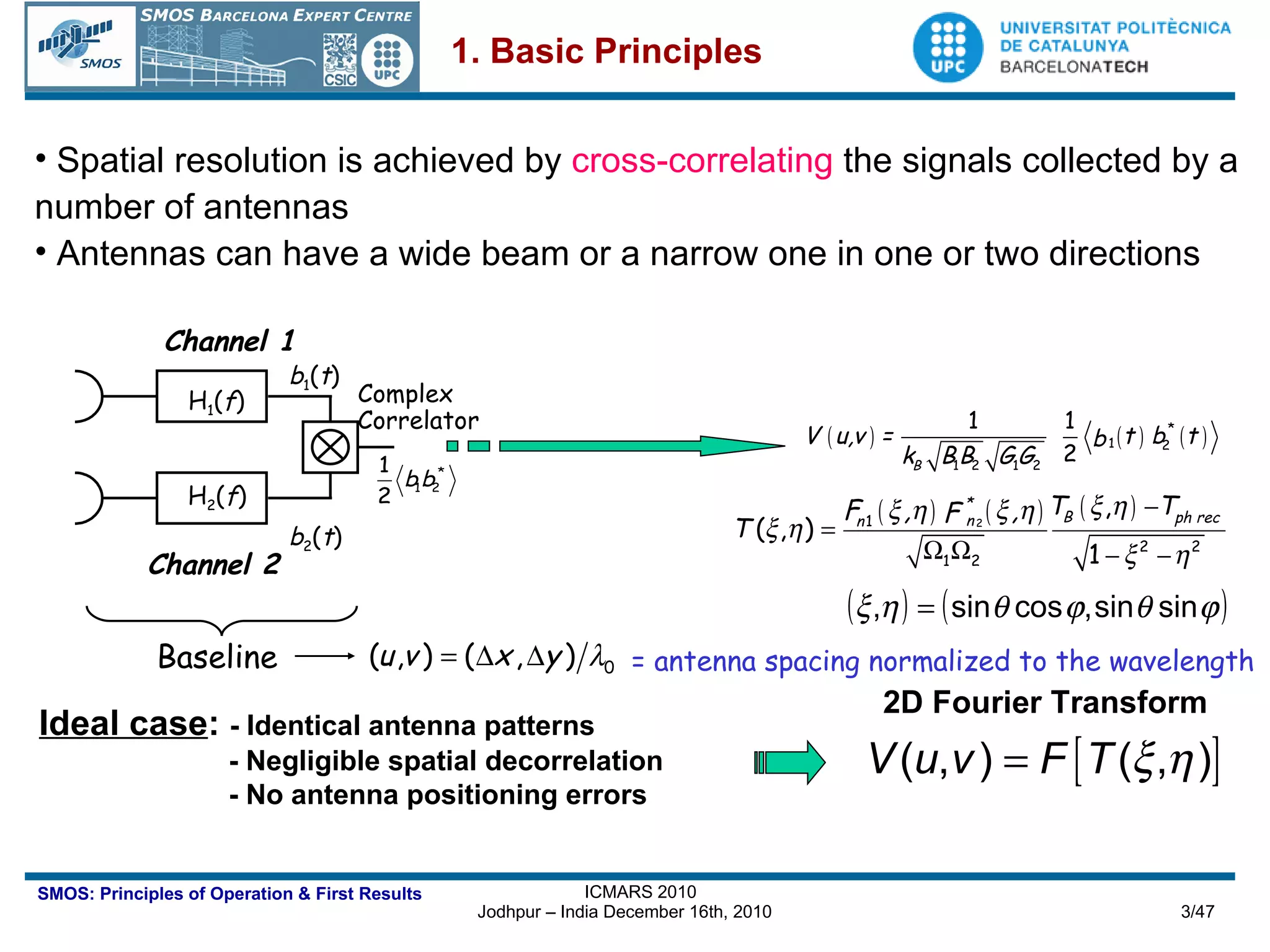
Channel 2 Channel 1 = antenna spacing normalized to the wavelength Baseline Spatial resolution is achieved by  cross-correlating  the signals collected by a number of antennas Antennas can have a wide beam or a narrow one in one or two directions Ideal case :  - Identical antenna patterns   - Negligible spatial decorrelation   - No antenna positioning errors 2D Fourier Transform 1. Basic Principles H 1 ( f ) H 2 ( f ) b 1 ( t ) b 2 ( t ) Complex  Correlator
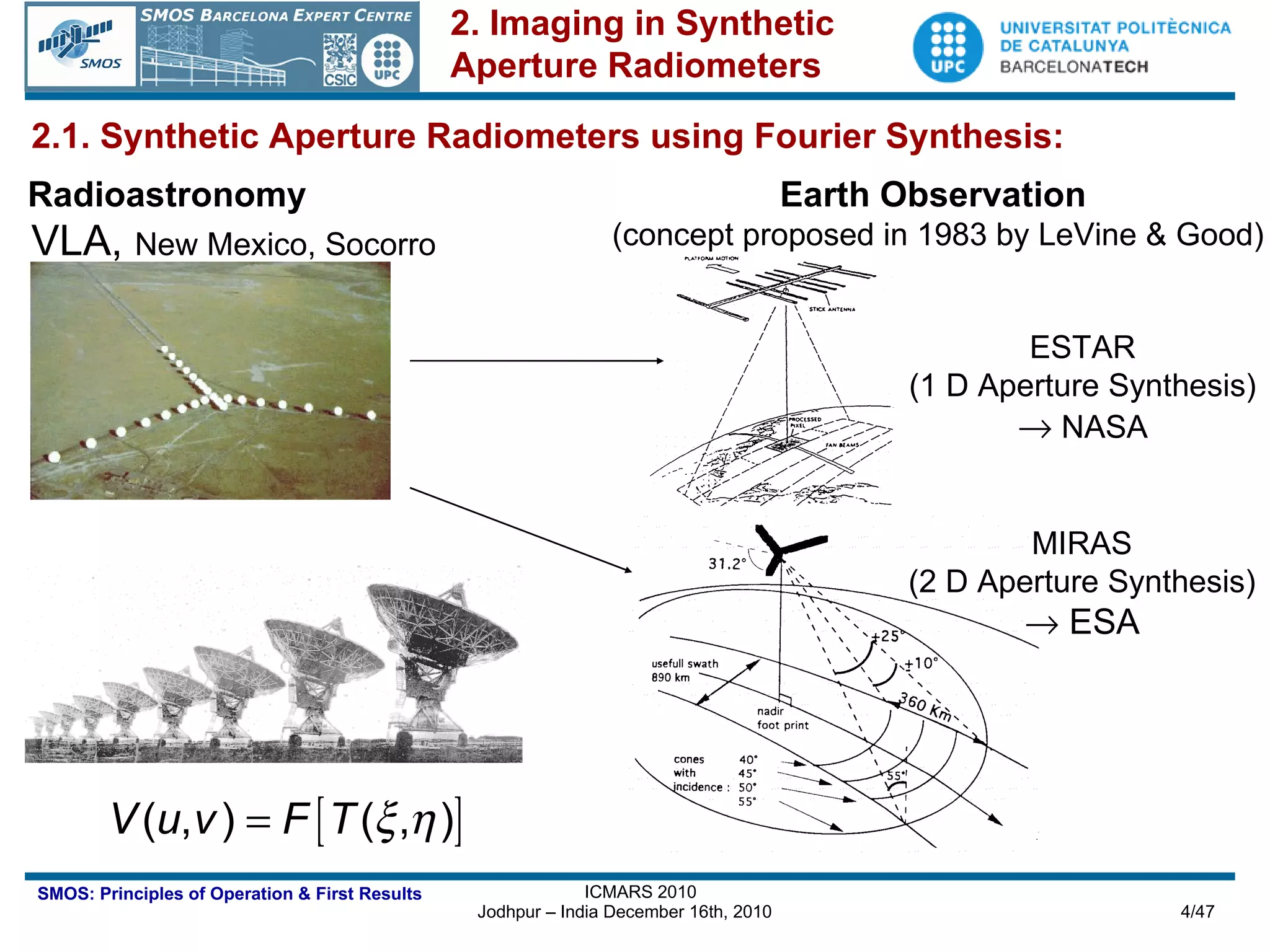
2.1. Synthetic Aperture Radiometers using Fourier Synthesis: VLA,  New Mexico, Socorro ESTAR (1 D Aperture Synthesis)    NASA Radioastronomy Earth Observation  (concept proposed in 1983 by LeVine & Good) MIRAS (2 D Aperture Synthesis)    ESA 2. Imaging in Synthetic  Aperture Radiometers
Differences between radio-astronomy and Earth observation: - Large antenna spacing Very narrow field of view (FOV) Obliquity factor (1/cos   ) can be approximated by 1 Antenna patterns are approximatedly constant (amplitude and phase) over the FOV Typically quasi-point sources imaged over cold background    super-resolution image reconstruction algorithms can be used
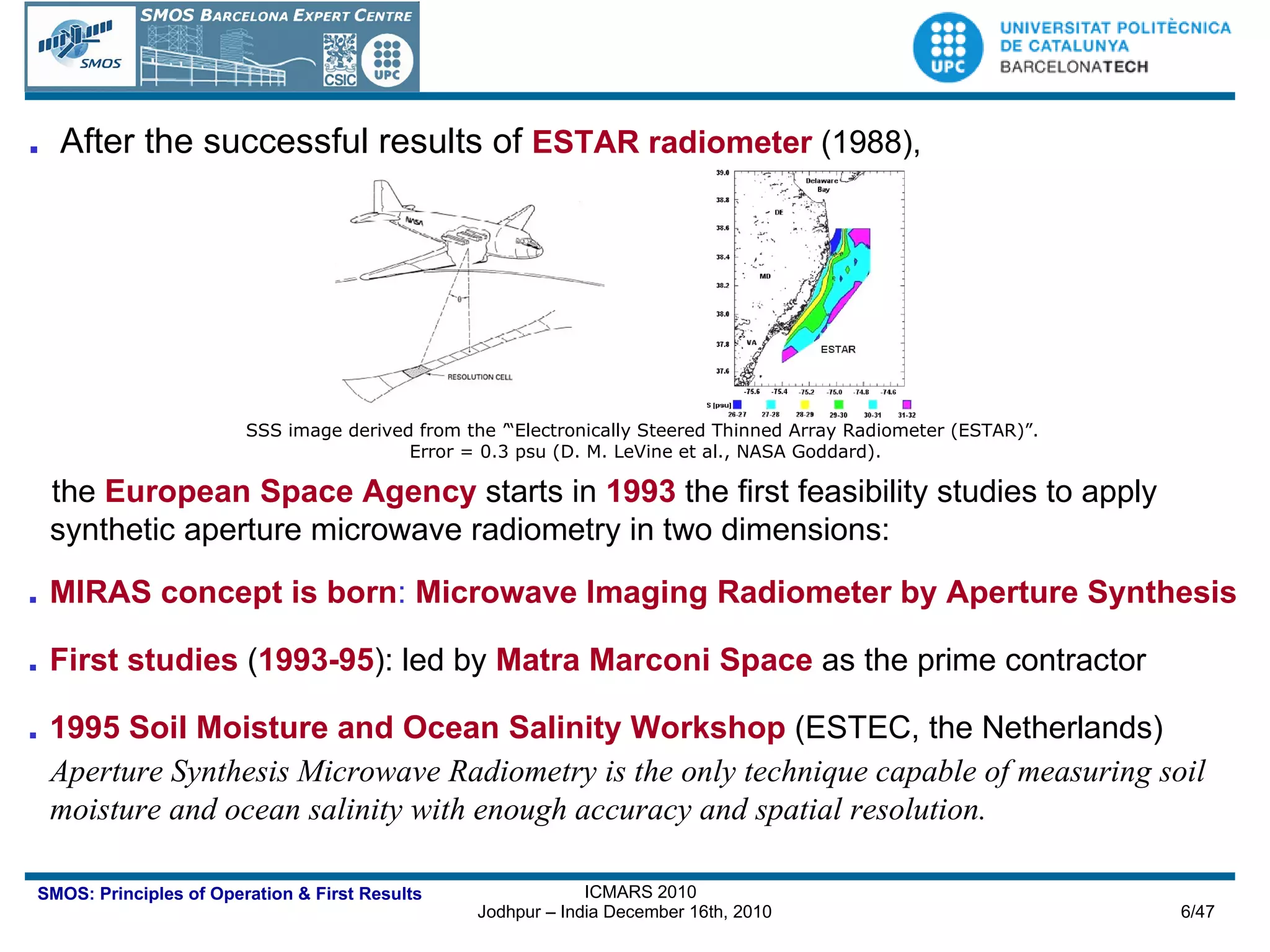
.  After the successful results of   ESTAR radiometer  (1988),   the   European Space Agency  starts in   1993  the first feasibility studies to apply synthetic aperture microwave radiometry in two dimensions: .   MIRAS concept is born :  Microwave Imaging Radiometer by Aperture Synthesis .   First studies  ( 1993-95 ): led by   Matra Marconi Space  as the prime contractor .   1995 Soil Moisture and Ocean Salinity Workshop  (ESTEC, the Netherlands) Aperture Synthesis Microwave Radiometry is the only technique capable of measuring soil moisture and ocean salinity with enough accuracy and spatial resolution. SSS image derived from the ’“Electronically Steered Thinned Array Radiometer (ESTAR)”.  Error = 0.3 psu (D. M. LeVine et al., NASA Goddard).
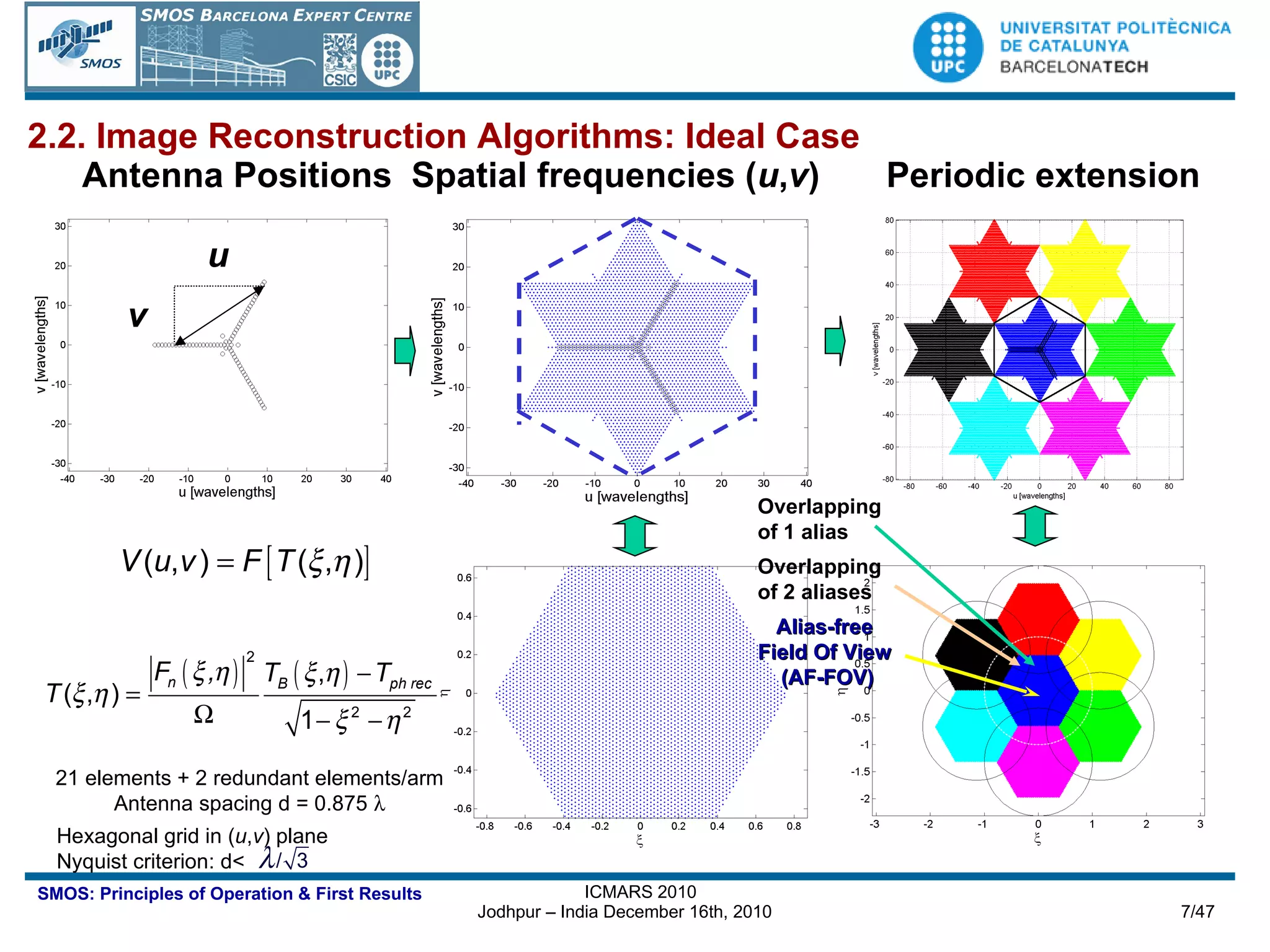
Antenna Positions Spatial frequencies ( u , v ) u v  Periodic extension 21 elements + 2 redundant elements/arm  Antenna spacing d = 0.875     Hexagonal grid in ( u , v ) plane Nyquist criterion: d<  Overlapping  of 1 alias Alias-free  Field Of View  (AF-FOV) Overlapping  of 2 aliases 2.2. Image Reconstruction Algorithms: Ideal Case
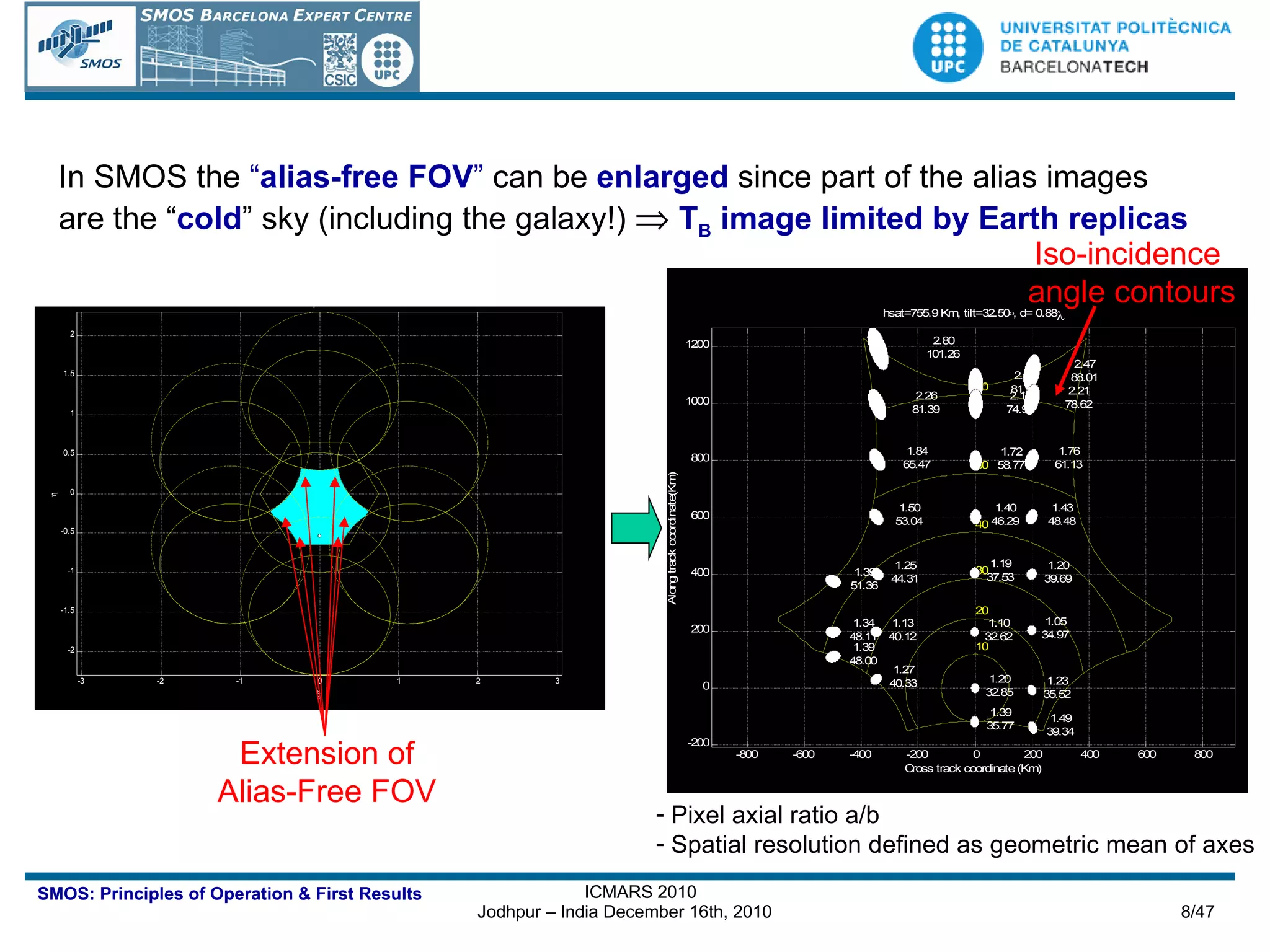
In SMOS the  “ alias-free FOV ”  can be  enlarged   since part of the alias images  are the “ cold ” sky (including the galaxy!)     T B  image limited by Earth replicas Extension of Alias-Free FOV Pixel axial ratio a/b Spatial resolution defined as geometric mean of axes Iso-incidence  angle contours
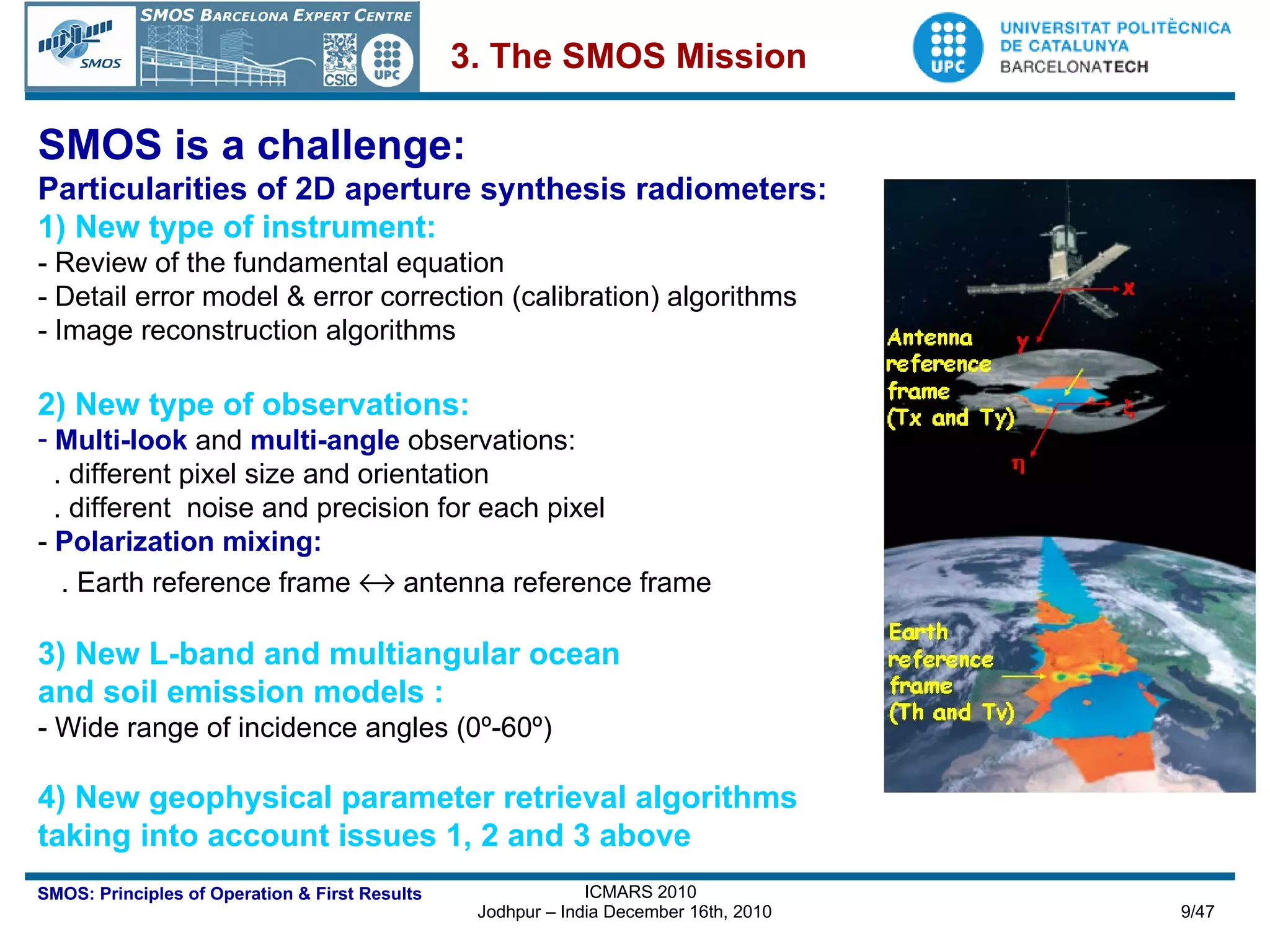
SMOS is a challenge: Particularities of 2D aperture synthesis radiometers: 1) New type of instrument:  - Review of the fundamental equation - Detail error model & error correction (calibration) algorithms - Image reconstruction algorithms 2) New type of observations: Multi-look  and  multi-angle   observations:  . different pixel size and orientation . different  noise and precision for each pixel -   Polarization mixing:   . Earth reference frame    antenna reference frame 3) New L-band and multiangular ocean  and soil emission models :  - Wide range of incidence angles (0º-60º) 4) New geophysical parameter retrieval algorithms taking into account issues 1, 2 and 3 above 3. The SMOS Mission
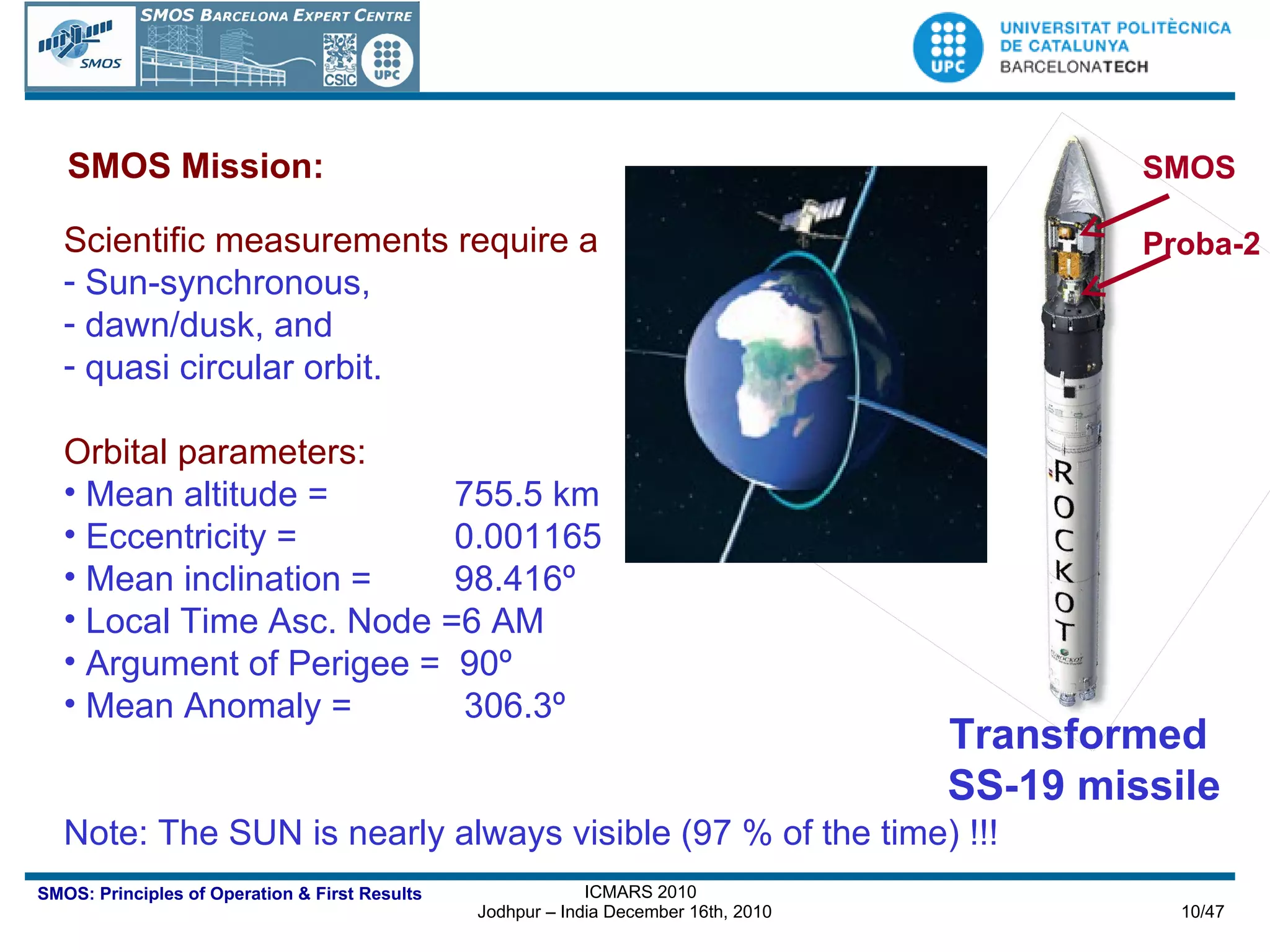
Scientific measurements require a  Sun-synchronous,  dawn/dusk, and quasi circular orbit. Orbital parameters: Mean altitude =  755.5 km Eccentricity =   0.001165 Mean inclination =   98.416º Local Time Asc. Node =6 AM Argument of Perigee =  90º Mean Anomaly =    306.3º Note: The SUN is nearly always visible (97 % of the time) !!! SMOS Mission: SMOS Proba-2 Transformed  SS-19 missile
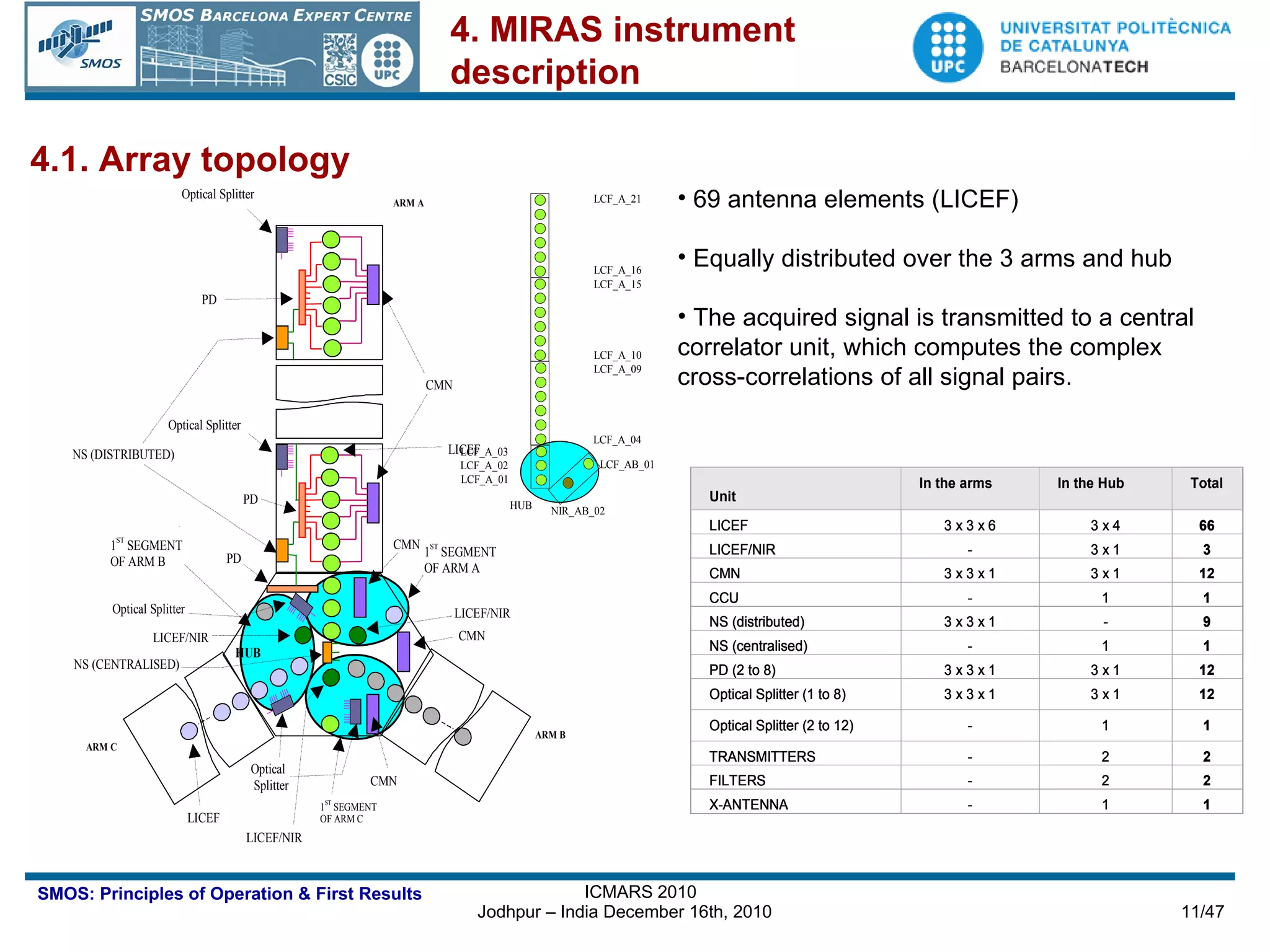
4.1. Array topology 69 antenna elements (LICEF) Equally distributed over the 3 arms and hub The acquired signal is transmitted to a central correlator unit, which computes the complex cross-correlations of all signal pairs.  4. MIRAS instrument  description
MIRAS consists of a central structure (hub) with 15 elements, and 3 deployable arms,  each one having 3 segments with 6 antennas each.  [credits EADS-CASA]
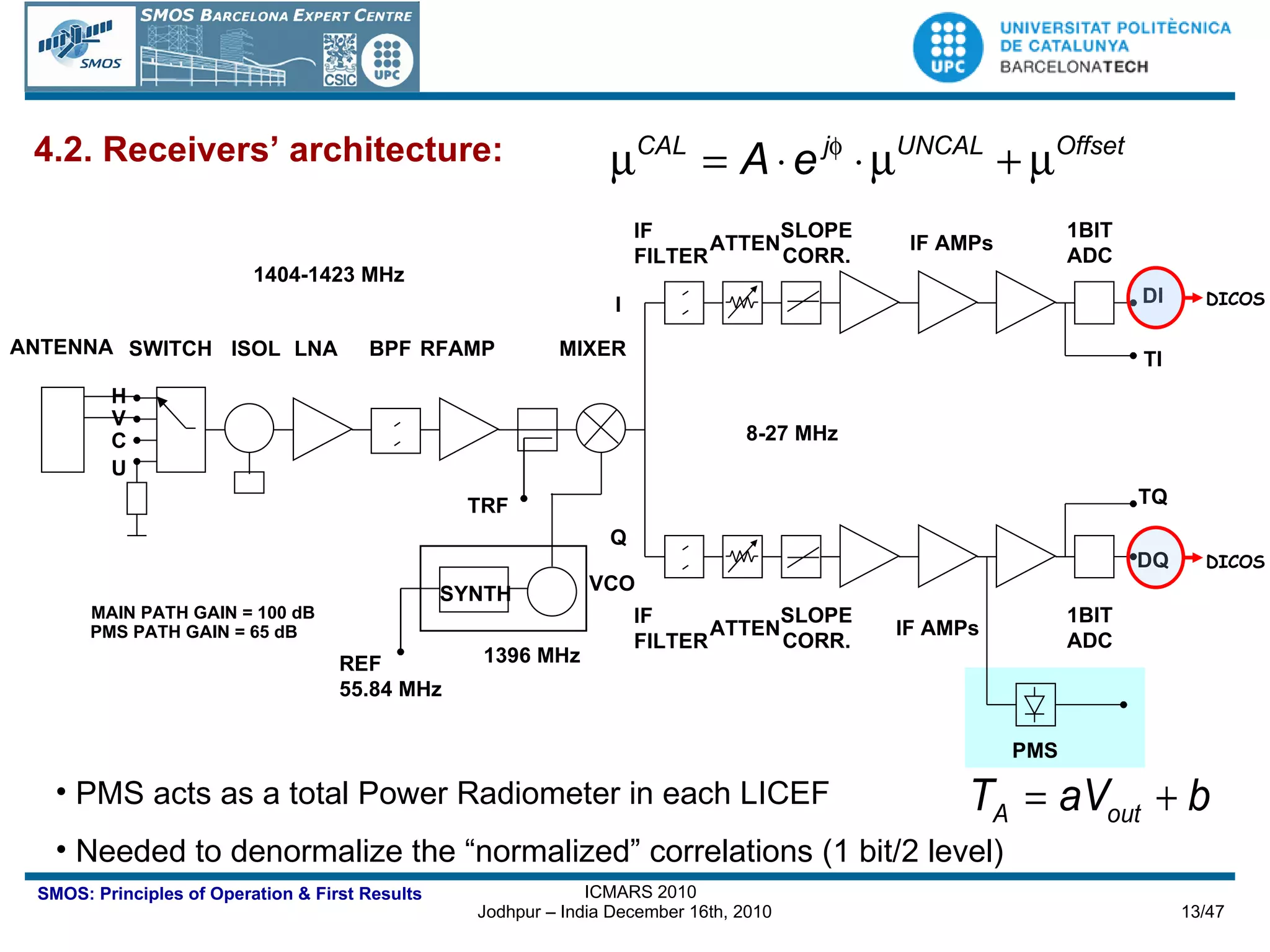
4.2. Receivers’ architecture: PMS acts as a total Power Radiometer in each LICEF Needed to denormalize the “normalized” correlations (1 bit/2 level) H V C U SWITCH ISOL LNA BPF RFAMP MIXER IF FILTER ATTEN SLOPE CORR. IF AMPs 1BIT ADC IF FILTER ATTEN SLOPE CORR. IF AMPs 1BIT ADC SYNTH 1396 MHz PMS 1404-1423 MHz 8-27 MHz DI TI TQ DQ REF 55.84 MHz VCO MAIN PATH GAIN = 100 dB PMS PATH GAIN = 65 dB TRF ANTENNA I Q DICOS DICOS
LICEF: the LIght and Cost Effective Front-end [credits MIER Comunicaciones]
4.3.  NIR architecture The   Noise Injection Radiometer (NIR)   is  fully polarimetric  and operates at 1.4 GHz 3 NIRs in the hub for redundancy. Functions: precise measurement of V pq (0,0) = T Apq  for mean value of T Bpq (  ,  ) image.  measurement of noise temperature level of the reference noise source of Calibration Subsystem (CAS)    absolute amplitude reference 1 st  LICEF unit  (V-pol) 2 nd  LICEF unit  (H-pol) Controller unit  (switches, noise injection...) Correlated noise inputs  (from Noise Distribution Network) allow phase/amplitude calibration of  receivers as LICEFs & for 3 rd  and 4 th   Stokes parameters measurements [credits TKK]
SMOS NIR: T  NA       +  T A  =  T U T  NA  +  T A  =  T REF  + T NR    Normal mode of operation: Calibrating internal noise source mode: known  (cold sky) ? [Colliander et al., 2005] [credits HUT]
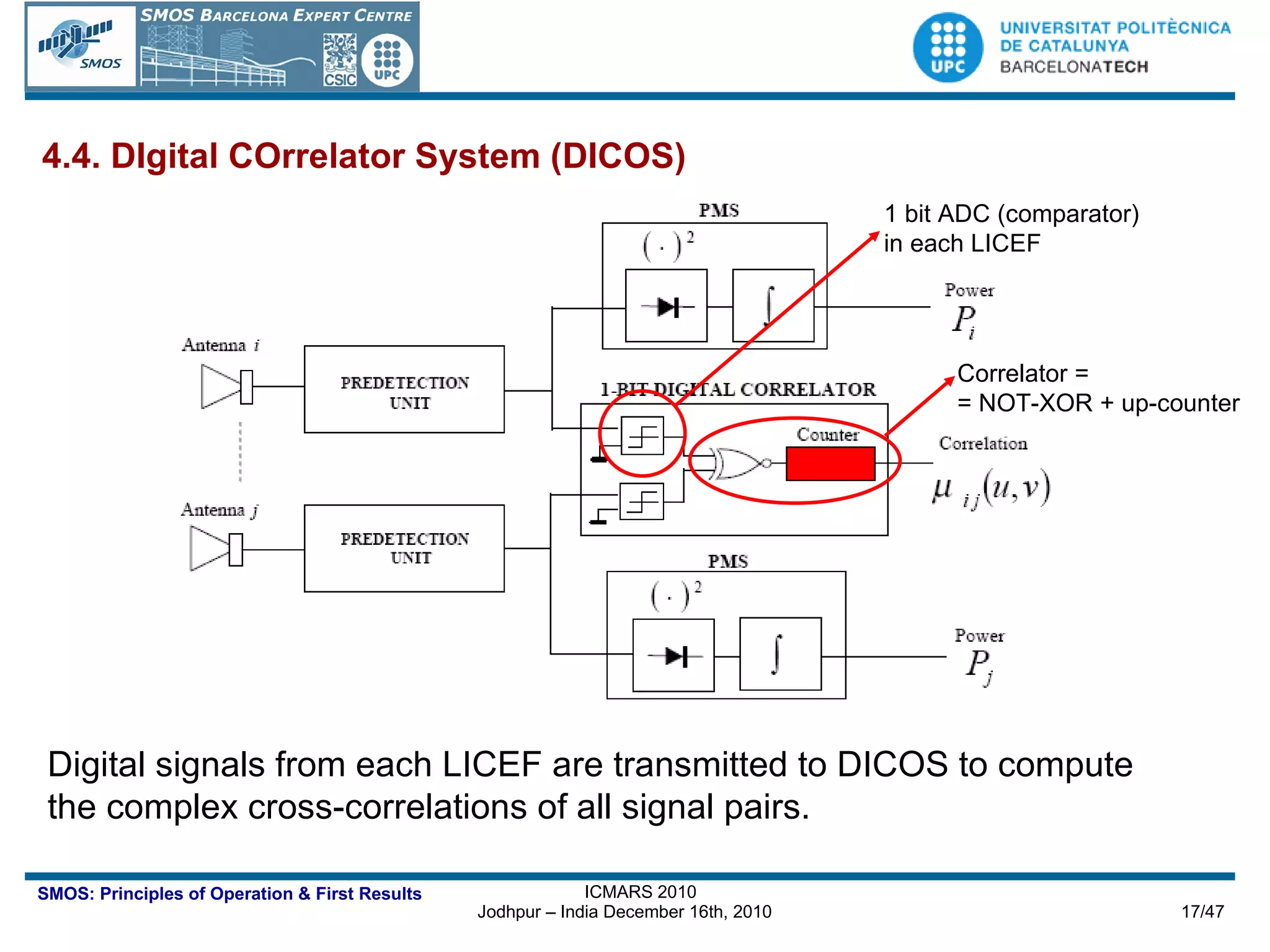
4.4. DIgital COrrelator System (DICOS) Digital signals from each LICEF are transmitted to DICOS to compute the complex cross-correlations of all signal pairs. 1 bit ADC (comparator)  in each LICEF Correlator =  = NOT-XOR + up-counter
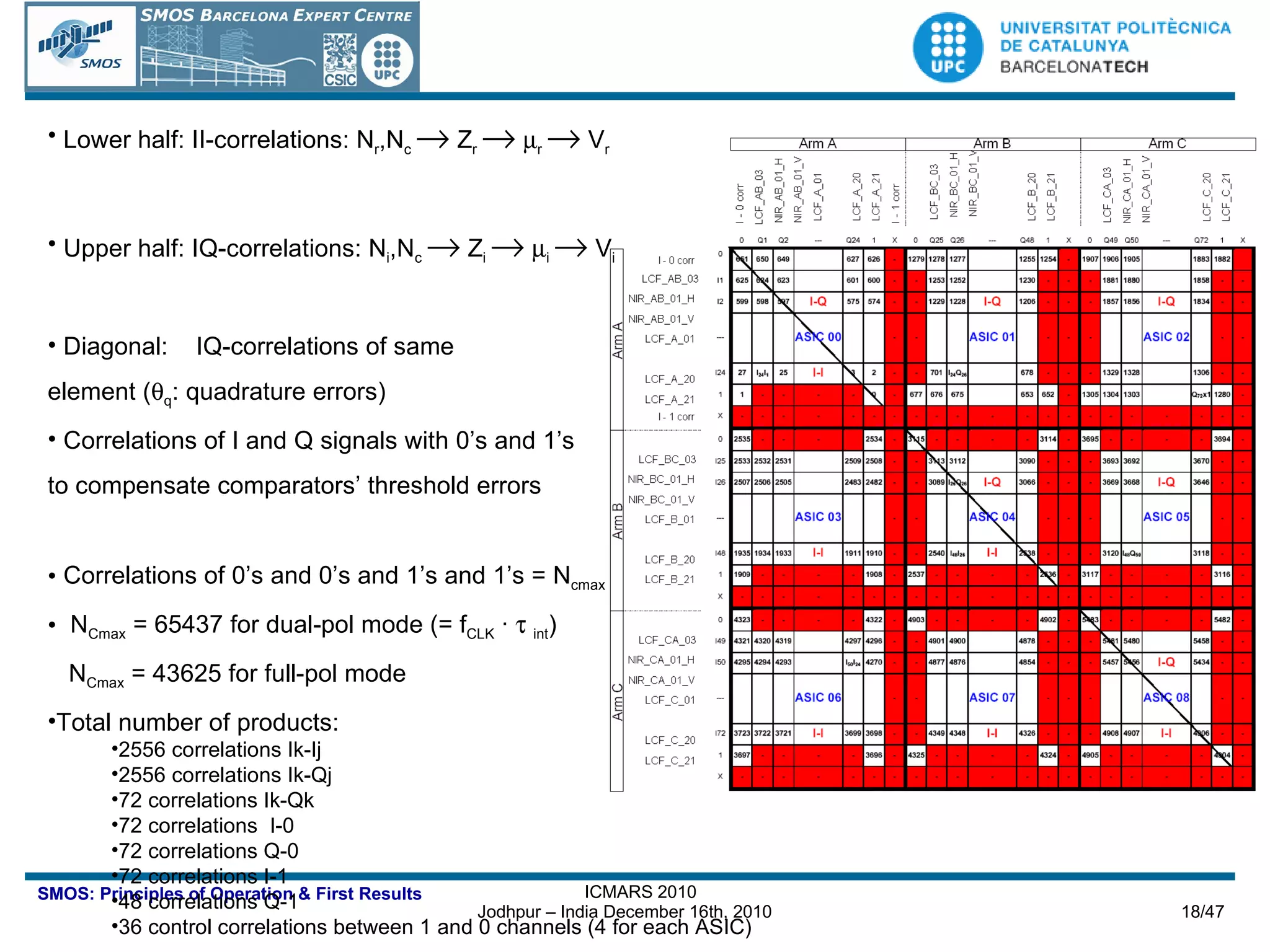
Lower half: II-correlations: N r ,N c    Z r      r    V r Upper half: IQ-correlations: N i ,N c    Z i      i    V i Diagonal:  IQ-correlations of same  element (  q : quadrature errors) Correlations of I and Q signals with 0’s and 1’s to compensate comparators’ threshold errors Correlations of 0’s and 0’s and 1’s and 1’s = N cmax N Cmax  = 65437 for dual-pol mode (= f CLK  ·     int ) N Cmax  = 43625 for full-pol mode Total number of products: 2556 correlations Ik-Ij  2556 correlations Ik-Qj 72 correlations Ik-Qk 72 correlations  I-0 72 correlations Q-0  72 correlations I-1  48 correlations Q-1  36 control correlations between 1 and 0 channels (4 for each ASIC)
CCU: the Correlator and Control Unit [credits EADS-CASA]
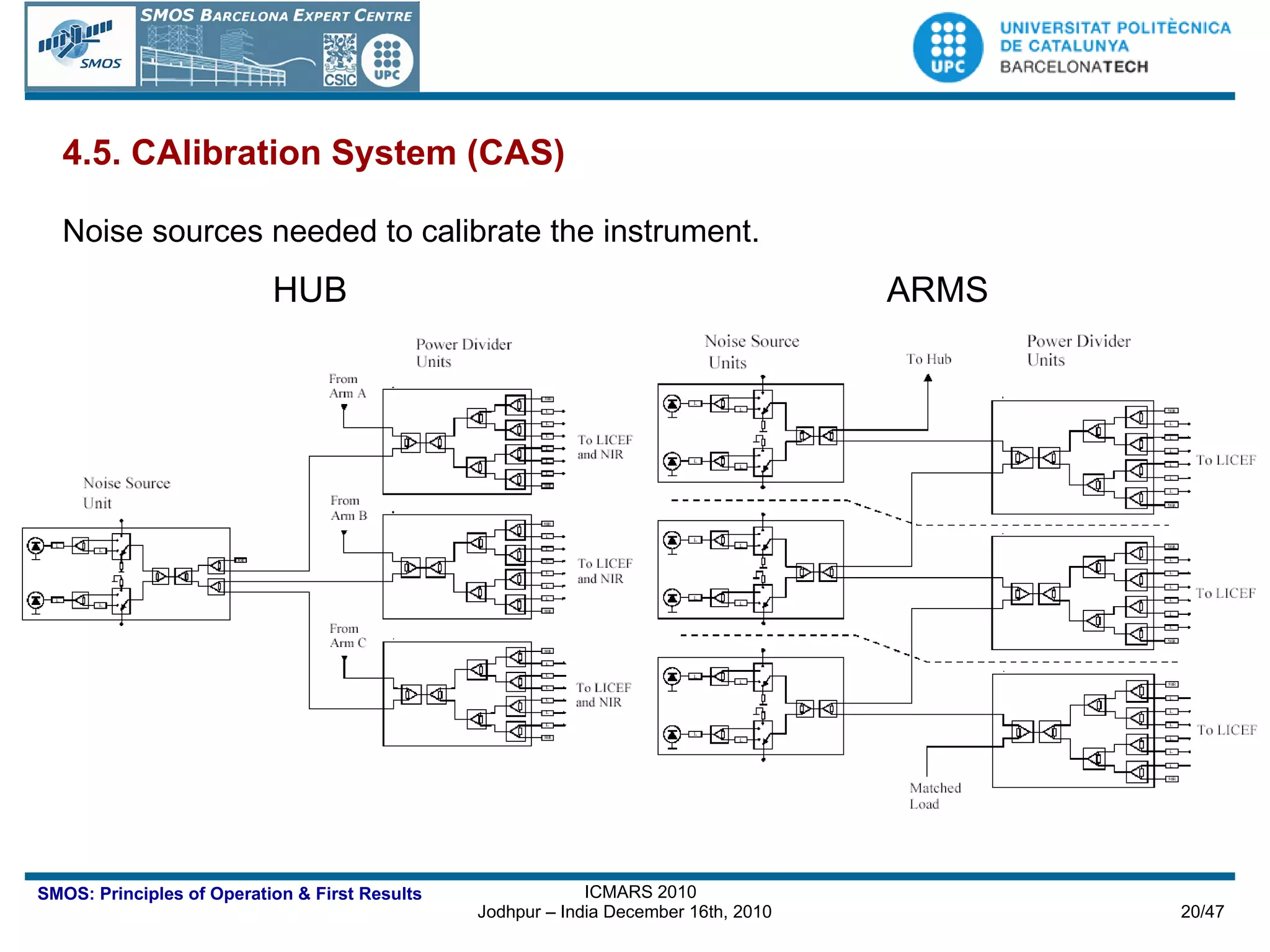
4.5. CAlibration System (CAS) Noise sources needed to calibrate the instrument. HUB ARMS
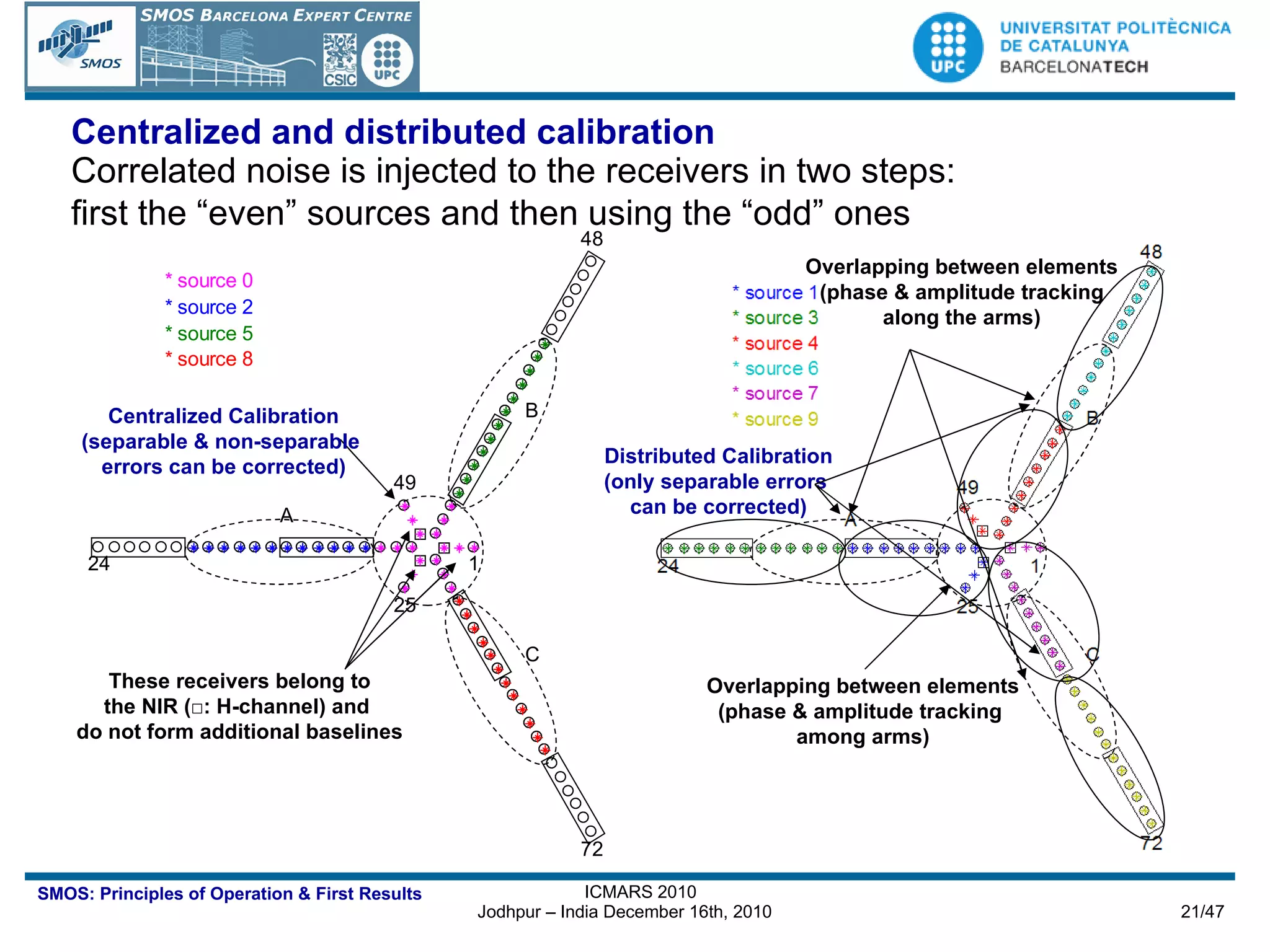
Correlated noise is injected to the receivers in two steps: first the “even” sources and then using the “odd” ones   Centralized and distributed calibration These receivers belong to the NIR (□: H-channel) and  do not form additional baselines Overlapping between elements (phase & amplitude tracking along the arms) Overlapping between elements (phase & amplitude tracking  among arms) Centralized Calibration (separable & non-separable  errors can be corrected) Distributed Calibration (only separable errors  can be corrected)
OVERALL SEGMENT ARCHITECTURE [credits EADS-CASA]
[credits EADS-CASA] 6 LICEF / segment
[credits EADS-CASA] MOHA
[credits EADS-CASA] CAS
[credits EADS-CASA] CMN
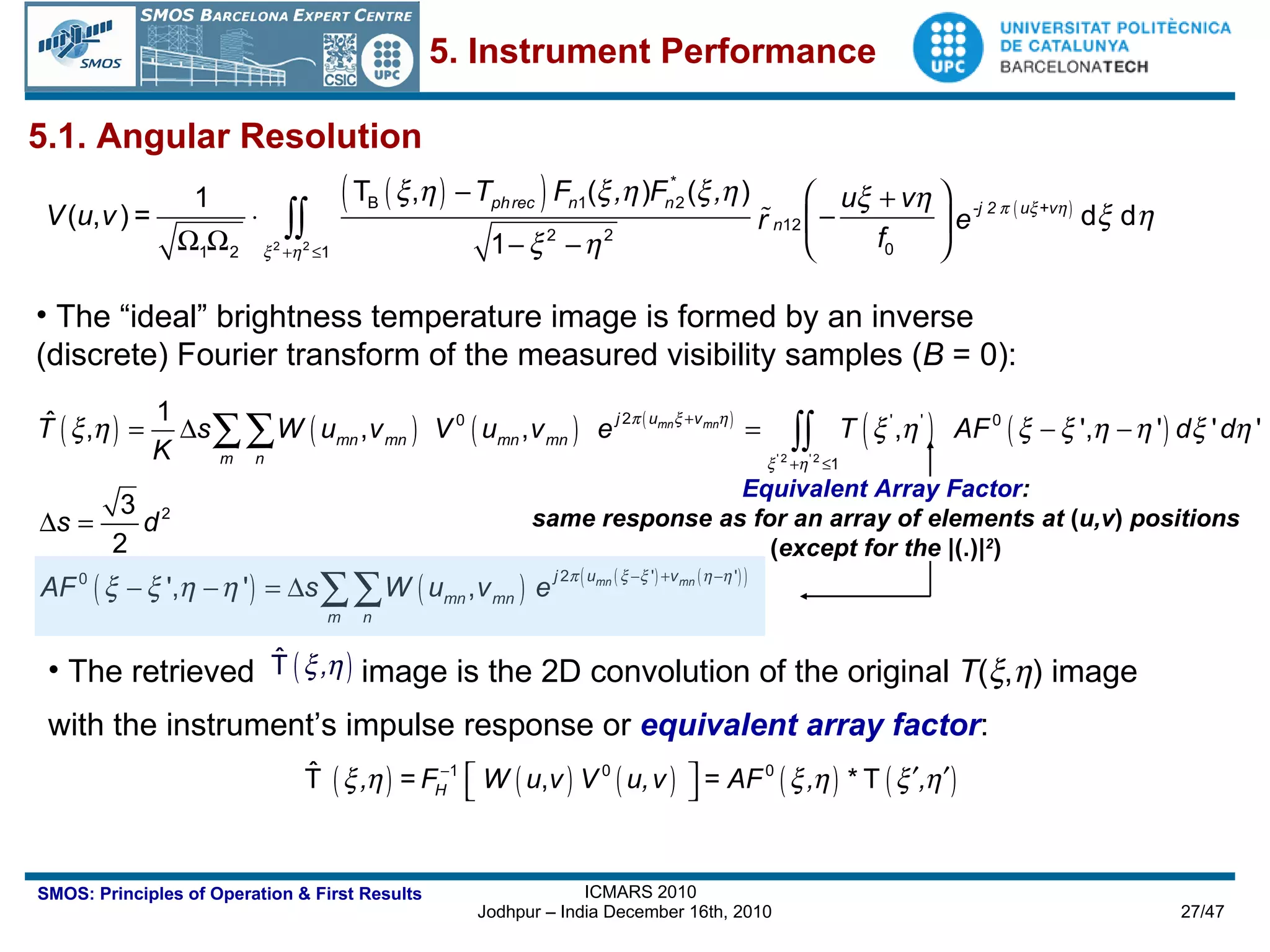
The retrieved  image is the 2D convolution of the original  T (  ,  ) image  with the instrument’s impulse response or  equivalent array factor : 5.1. Angular Resolution The “ideal” brightness temperature image is formed by an inverse  (discrete) Fourier transform of the measured visibility samples ( B  = 0): Equivalent Array Factor : same response as for an array of elements at  ( u,v )  positions ( except for the  |(.)| 2 ) 5. Instrument Performance
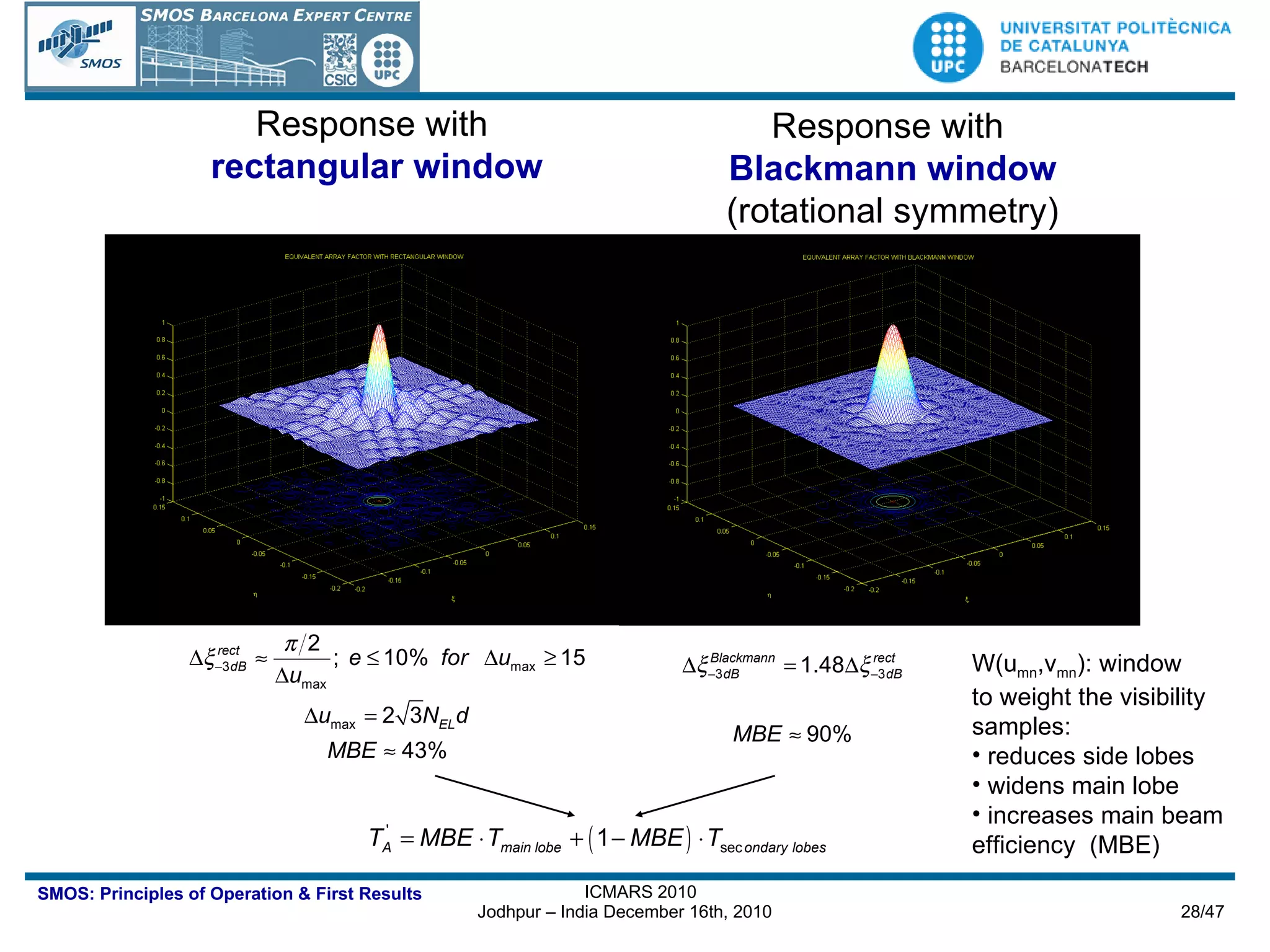
Response with  rectangular window Response with  Blackmann window (rotational symmetry) W(u mn ,v mn ): window  to weight the visibility  samples: reduces side lobes widens main lobe increases main beam  efficiency  (MBE)
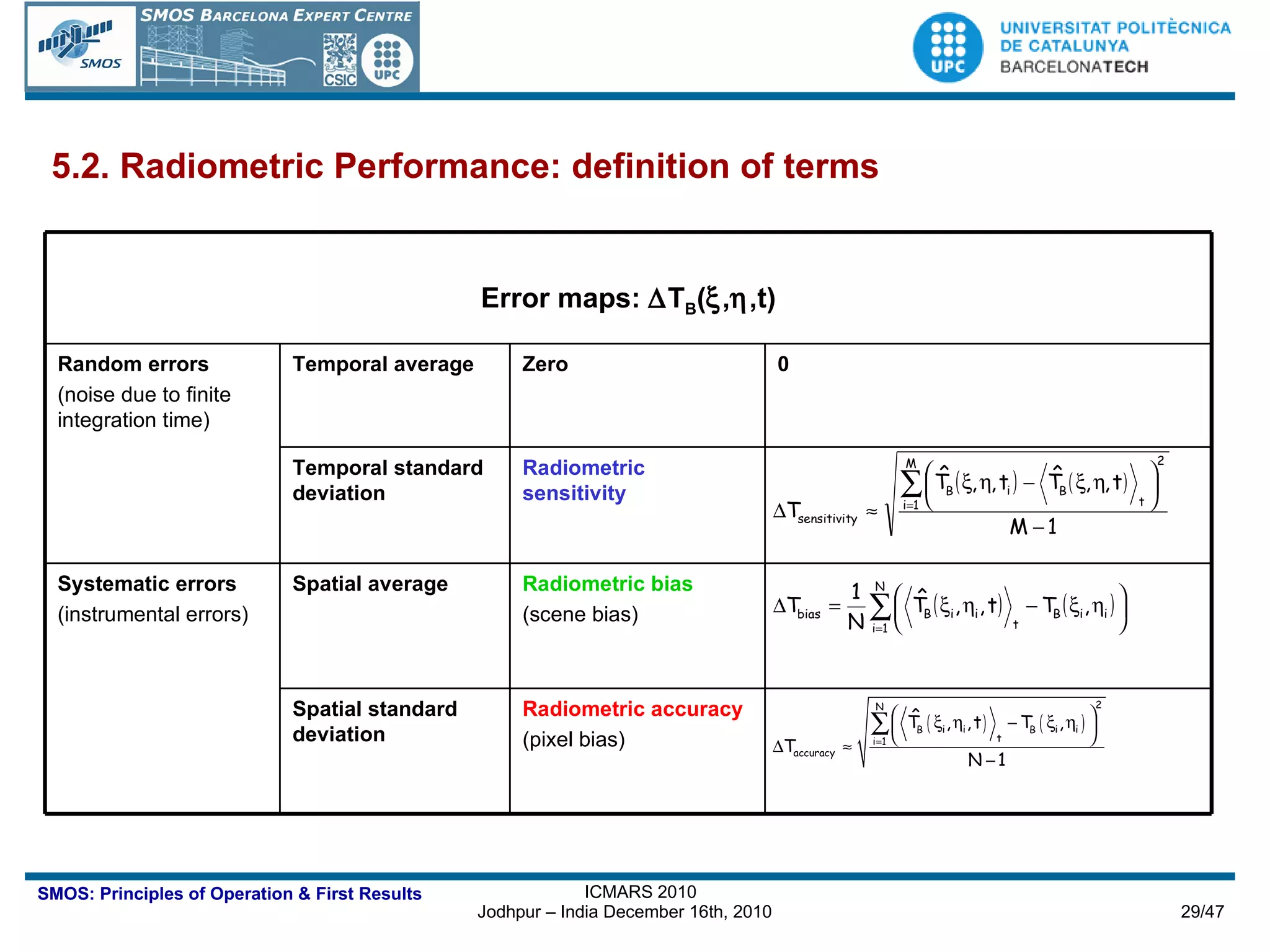
5.2. Radiometric Performance: definition of terms Radiometric accuracy (pixel bias) Spatial standard deviation Radiometric bias (scene bias) Spatial average Systematic errors (instrumental errors) Radiometric sensitivity Temporal standard deviation 0 Zero Temporal average Random errors (noise due to finite integration time) Error maps:   T B (  ,  ,t)
Cut for    =0 Dashed lines. Theoretical formula: Radiometric Sensitivity over ocean [credits I. Corbella]
Accuracy <  0.5 K Moon Galaxy (yellowish) Galaxy Alias Galactic radio-source (TBC) Cosmic Background Radiation at 3.3 K Sun Alias [credits DEIMOS]   Scene Bias < 0.1 K
45 deg singularity discarded All points with the same incidence angle averaged Fresnel Incidence angle dependence Singularity in the transformation  antenna to Earth reference frame  (dual-pol mode) [credits I. Corbella]
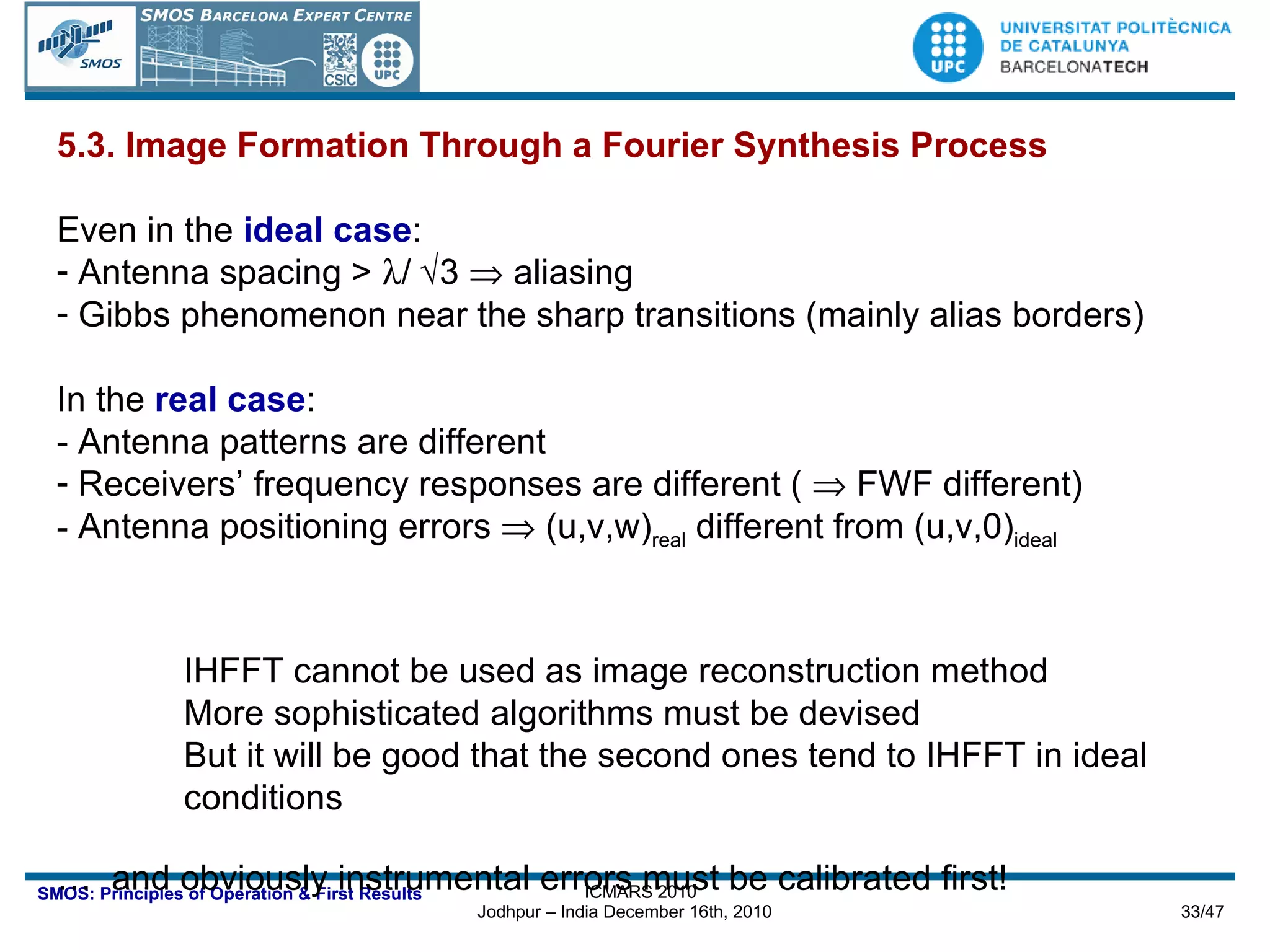
5.3. Image Formation Through a Fourier Synthesis Process Even in the  ideal case : Antenna spacing >   /  3    aliasing Gibbs phenomenon near the sharp transitions (mainly alias borders) In the  real case : - Antenna patterns are different  Receivers’ frequency responses are different (    FWF different) Antenna positioning errors    (u,v,w) real  different from (u,v,0) ideal IHFFT cannot be used as image reconstruction method More sophisticated algorithms must be devised But it will be good that the second ones tend to IHFFT in ideal  conditions …  and obviously instrumental errors must be calibrated first!
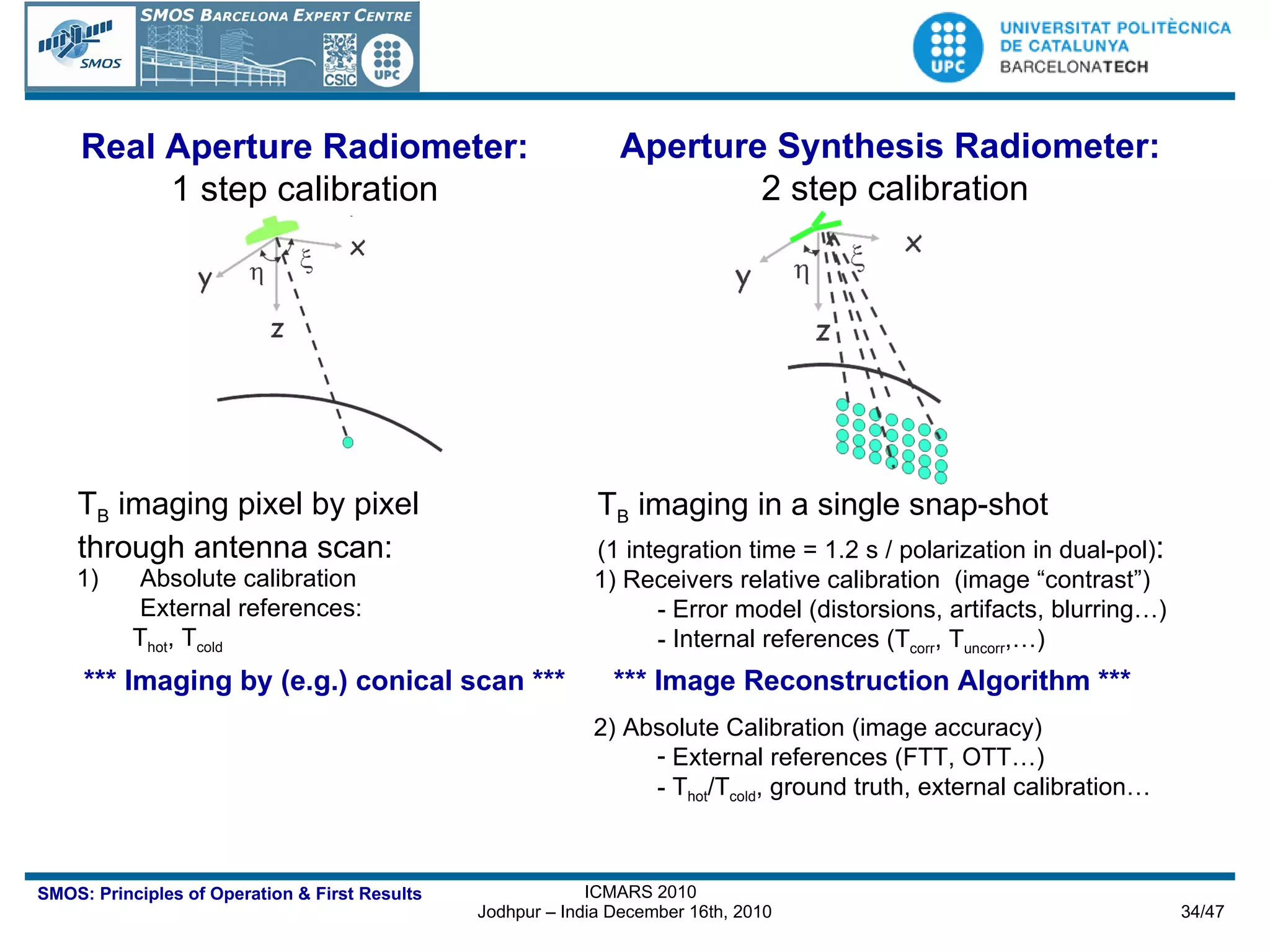
1) Receivers relative calibration  (image “contrast”) - Error model (distorsions, artifacts, blurring…) Internal references (T corr , T uncorr ,…) T B  imaging in a single snap-shot  (1 integration time = 1.2 s / polarization in dual-pol) : Aperture Synthesis Radiometer:   2 step calibration T B  imaging pixel by pixel through antenna scan: Real Aperture Radiometer: 1 step calibration Absolute calibration External references: T hot , T cold 2) Absolute Calibration (image accuracy) External references (FTT, OTT…) T hot /T cold , ground truth, external calibration… *** Image Reconstruction Algorithm *** *** Imaging by (e.g.) conical scan ***
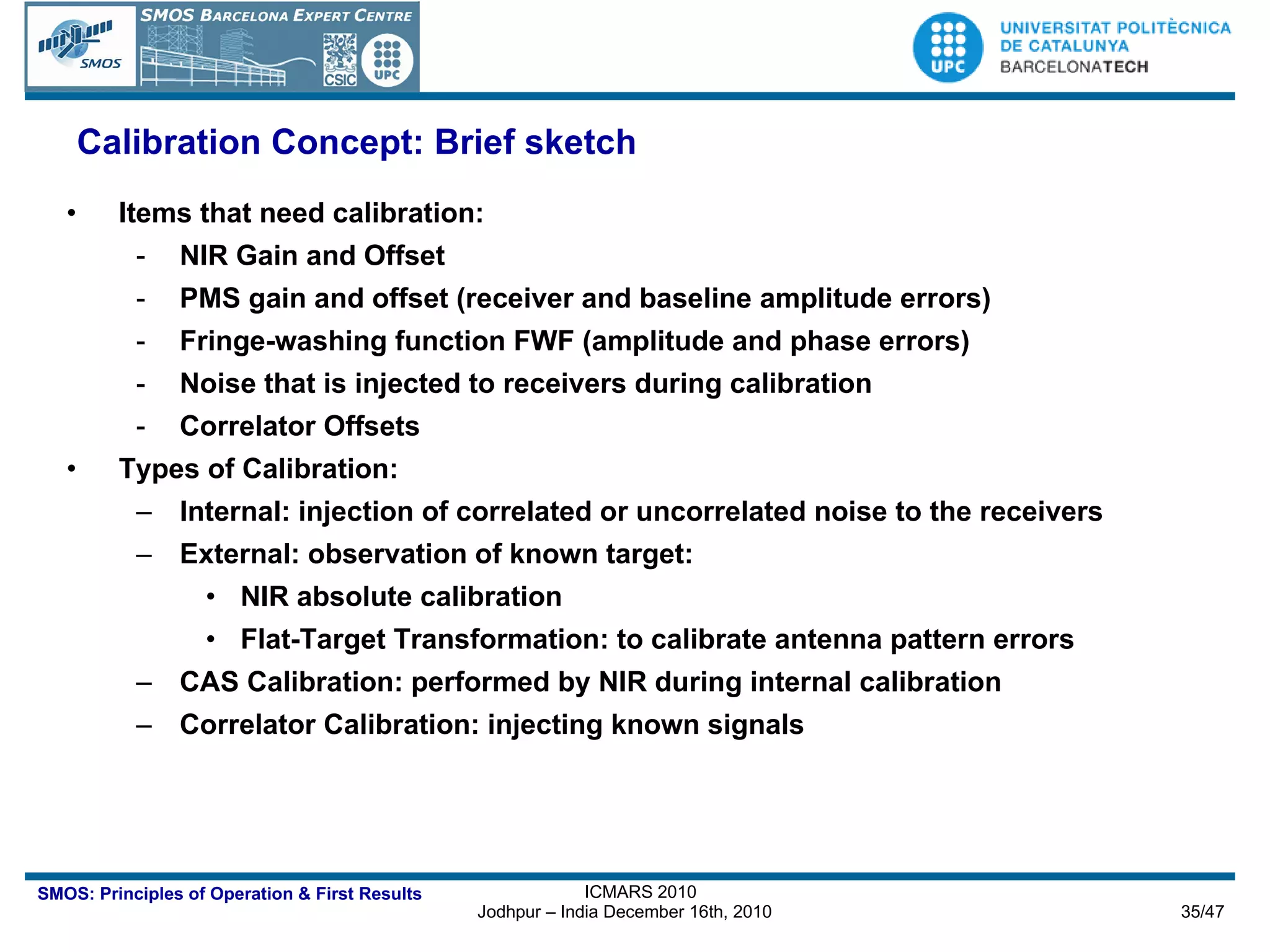
Calibration Concept: Brief sketch Items that need calibration: NIR Gain and Offset PMS gain and offset (receiver and baseline amplitude errors) Fringe-washing function FWF (amplitude and phase errors) Noise that is injected to receivers during calibration Correlator Offsets Types of Calibration: Internal: injection of correlated or uncorrelated noise to the receivers External: observation of known target: NIR absolute calibration Flat-Target Transformation: to calibrate antenna pattern errors  CAS Calibration: performed by NIR during internal calibration Correlator Calibration: injecting known signals
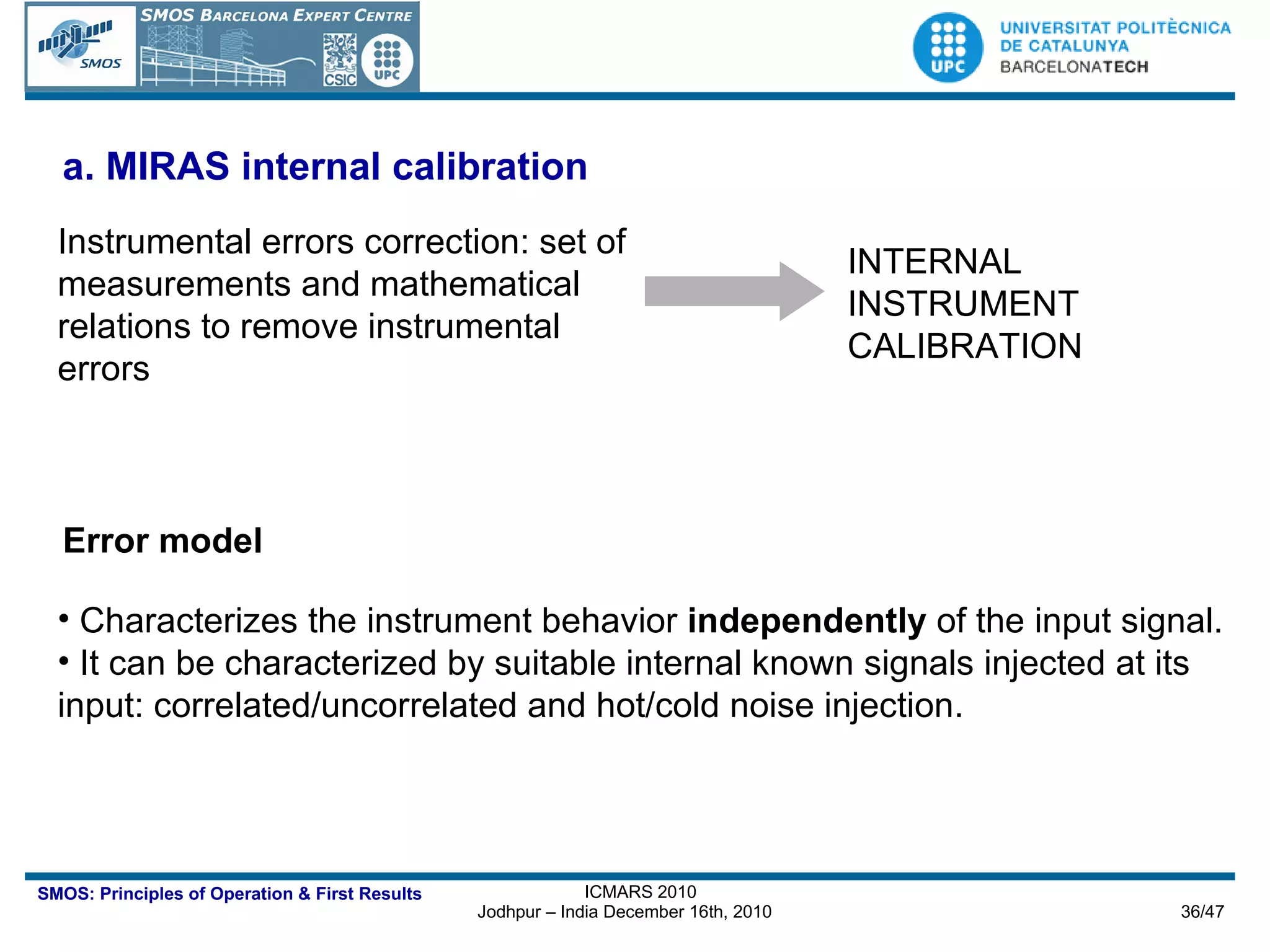
a.  MIRAS internal calibration Instrumental errors correction: set of measurements and mathematical relations to remove instrumental errors  INTERNAL INSTRUMENT CALIBRATION Characterizes the instrument behavior  independently  of the input signal.  It can be characterized by suitable internal known signals injected at its input: correlated/uncorrelated and hot/cold noise injection. Error model
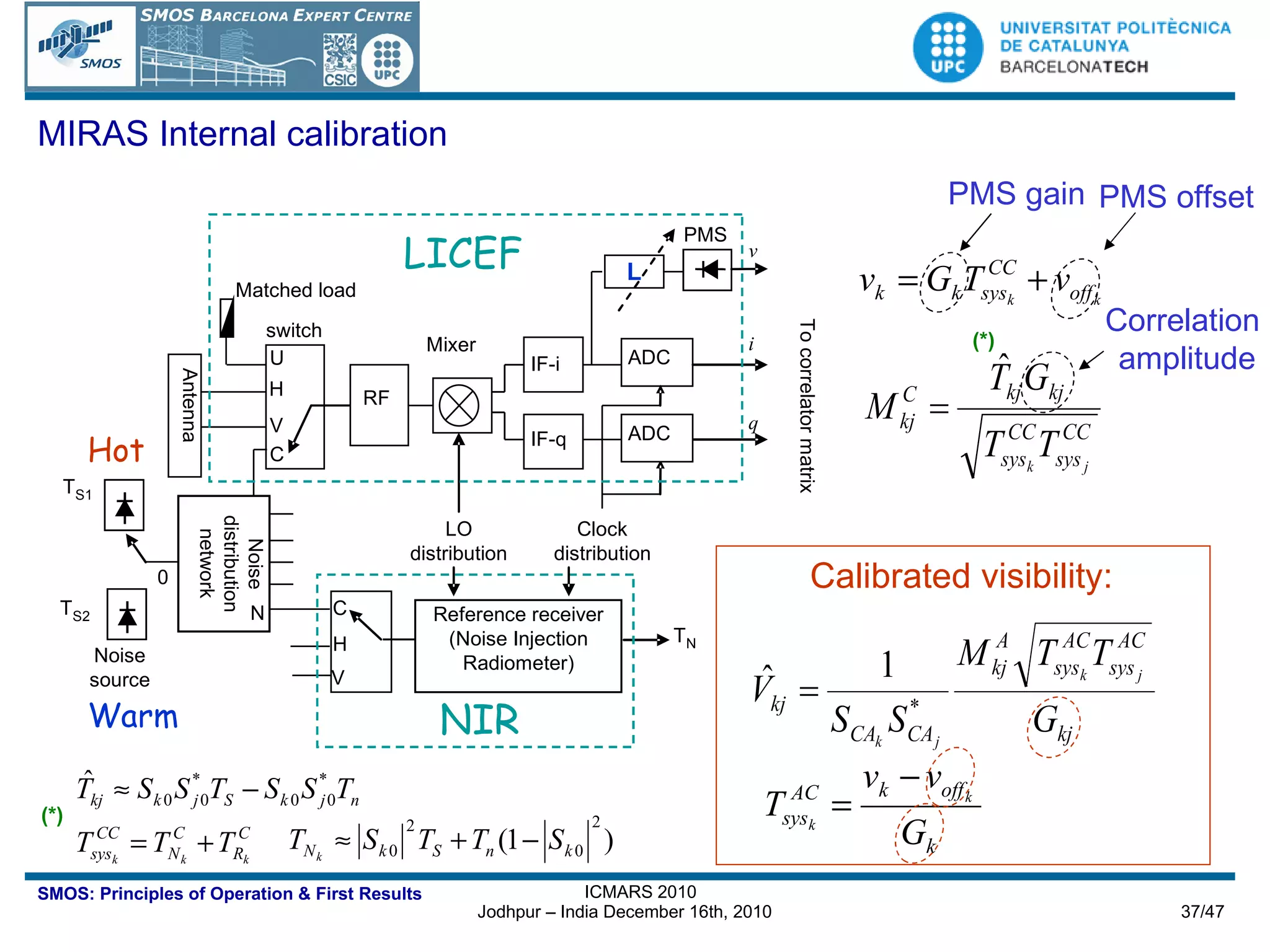
MIRAS Internal calibration Calibrated visibility: (*) (*) PMS gain PMS offset Correlation  amplitude
Formulation of the Problem: Instrument Equation After Internal Calibration [credits I. Corbella] To be corrected using  the  Flat Target Response
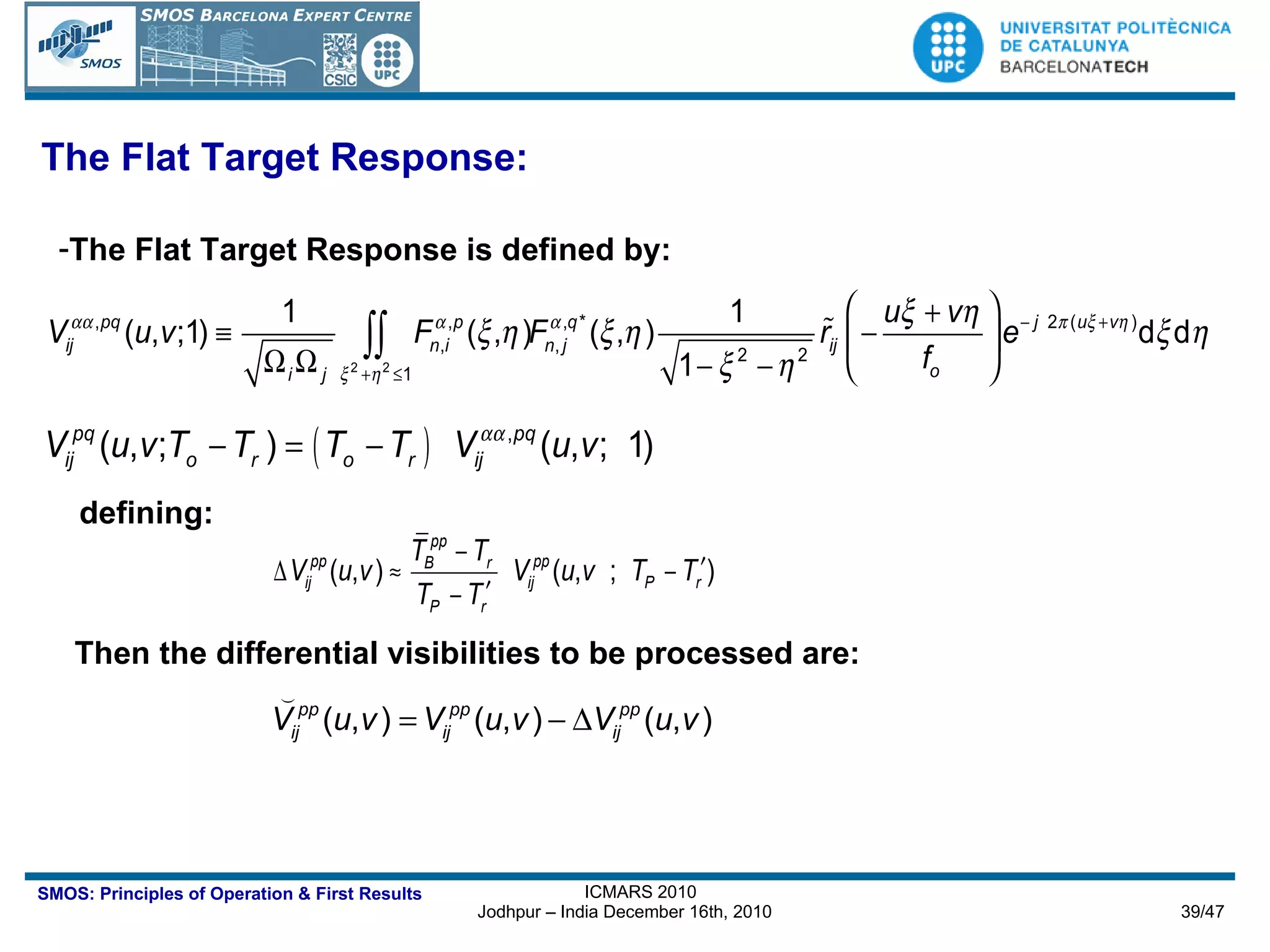
The Flat Target Response: The Flat Target Response is defined by:  defining:  Then the differential visibilities to be processed are:
Once in a month (every week during commissioning) the platform rotates to point to the cold sky External calibration is used to correct for elements not included in internal calibration: switch and antenna losses Also the Noise Injection Radiometer (NIR) is calibrated and the Flat Target Response (FTR) measured HERE IT GOES THE ANIMATION. T_X_skylook2.gif HERE IT GOES THE ANIMATION. T_Y_skylook2.gif External calibration [credits I. Corbella] Tx and Ty while satellite is turning up
5.4. Imaging Modes: Dual-polarization and full-polarimetric  Dual-polarization radiometer: MIRAS has dual-pol antennas, but only one receiver     polarizations have to be measured sequentially,  with an integration time of 1.2 s each [credits M. Martin-Neira]
Full-polarimetric mode:   (selected as operational mode for SMOS) [credits M. Martin-Neira]
6. Geolocalization:  from director cosines grid to Earth reference frame grid ISEA   family of grids  seem to be the best option for the SMOS Products ,  but   EASE-Grid  has come to be  popular amongst many of the Earth Observation missions of the USA , namely AQUA (NASA/NASDA) and AQUARIUS (NASA), which are particularly interesting for comparison with the SMOS products. Spatial partitioning of EASE-Grid is square-based and ISEA can be triangular, hexagonal or diamond-based : -  In its  hexagonal form, ISEA  has a  higher degree of compactness , quantize the plane with the  smallest average error  and provides the  greatest angular resolution .   ISEA hexagonal possesses  uniform adjacency with its neighbors , unlike the square EASE-Grid. Both grids  have  uniform alignment  and are  based on a spherical Earth assumption .  ISEA hexagonal at aperture 4 and resolution 9 (15km) is made up of 2,621,442 points and the EASE-Grid at 12km has 3,244,518 points. EASE-Grid is congruent ,  whereas  ISEA is not congruent , being impossible to decompose a hexagon into smaller hexagons or aggregate hexagons into larger ones. This would be a negative feature for real-time re-gridding, but in SMOS the grids will be pre-generated. 6. Geolocalization and Retrieval of Geophysical Parameters
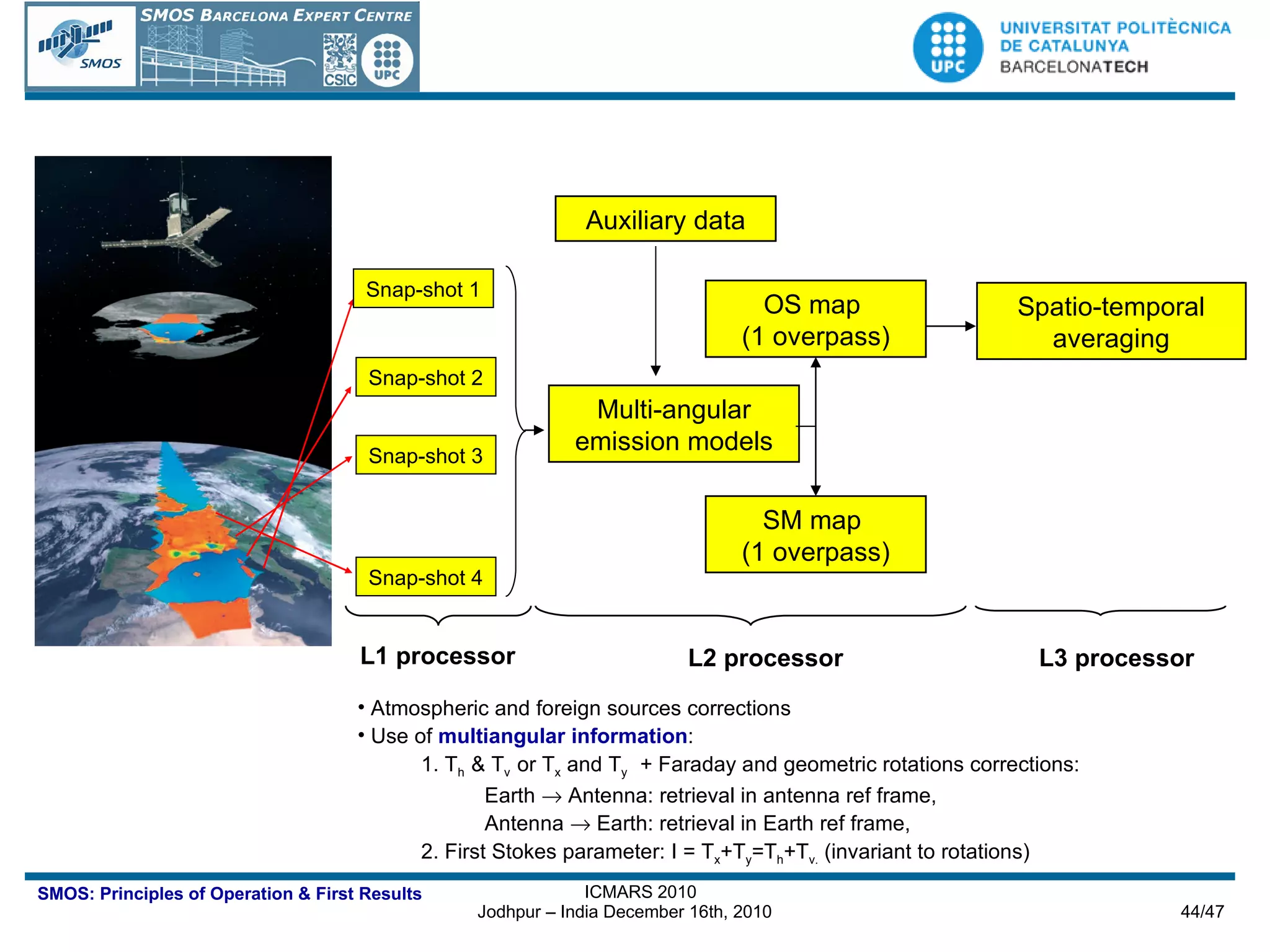
L1 processor L2 processor L3 processor Atmospheric and foreign sources corrections Use of  multiangular information : 1. T h  & T v  or T x  and T y  + Faraday and geometric rotations corrections:  Earth     Antenna: retrieval in antenna ref frame, Antenna    Earth: retrieval in Earth ref frame, 2. First Stokes parameter: I = T x +T y =T h +T v.  (invariant to rotations)  Auxiliary data Multi-angular emission models OS map  (1 overpass) SM map  (1 overpass) Spatio-temporal averaging Snap-shot 1 Snap-shot 2 Snap-shot 3 Snap-shot 4
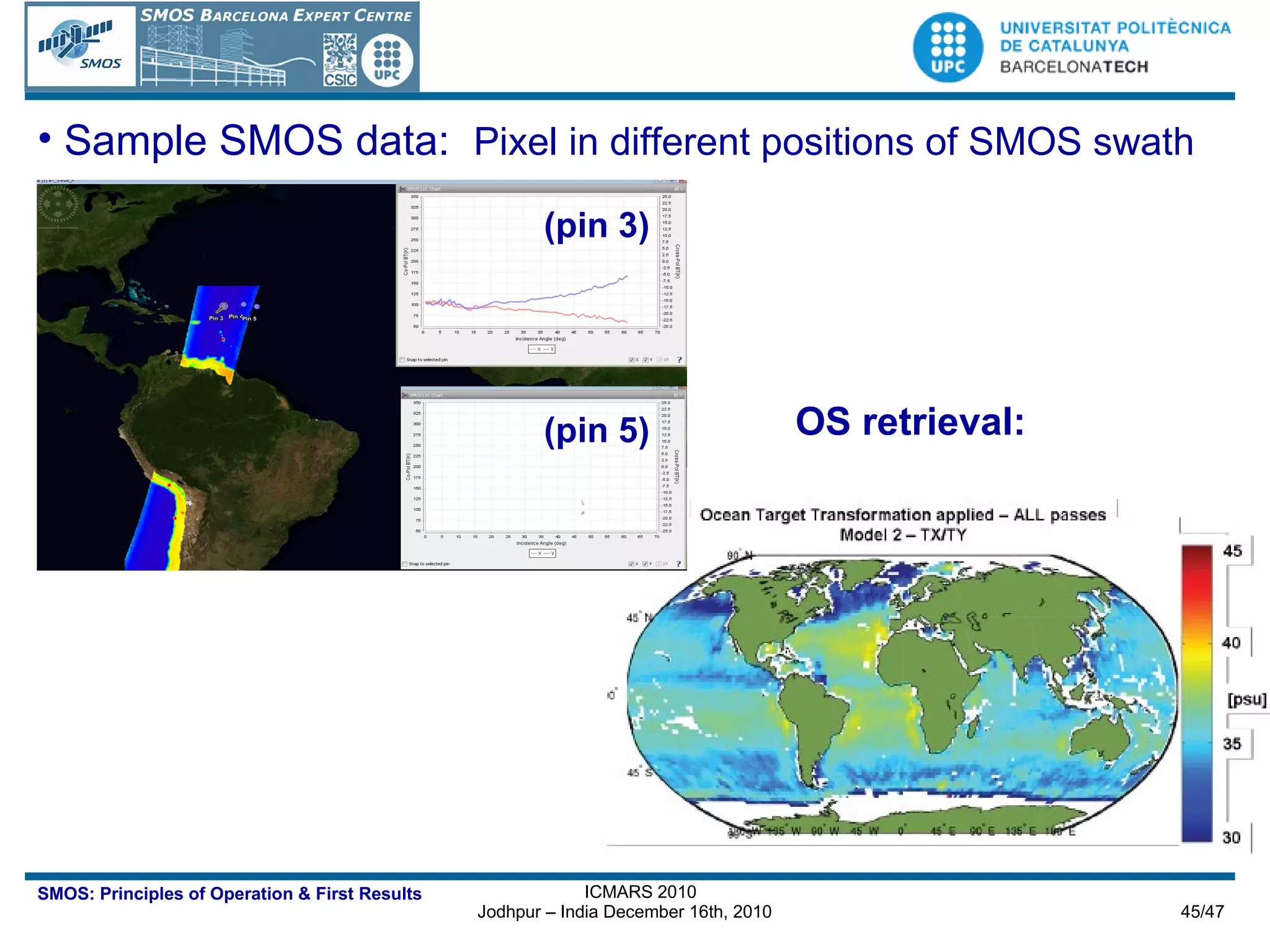
Sample SMOS data:  Pixel in different positions of SMOS swath OS retrieval: (pin 5) (pin 3)
Sample results of the application of the downscaling algorithm to a SMOS image covering the Murrumbidgee catchment, South-Eastern Australia, on January 19, 2010 (6 am). First row: 40 km SMOS soil moisture  [m 3 /m 3 ]  over Murrumbidgee (left), and zoom into Yanco site (right). Second row: 1 km downscaled soil moisture  [m 3 /m 3 ]  over Murrumbidgee (left), and zoom into Yanco site  (right ). Dots indicate the location of the soil moisture permanent stations within the Murrumbidgee catchment used for validation purposes with colors representing their measurement at the exact SMOS acquisition time (only within Yanco site). Empty areas in the images correspond to non-retrieved soil moisture or clouds masking MODIS Ts measurements. (a) 60 x 60 km Yanco site in the Murrumbidgee catchment, South-Eastern Australia, (b) 1 km MODIS NDVI, and (c) and LST [K] on January 19, 2010.  Sample SMOS data over Australia: Murrumbidge  catchement 60 km (b) MODIS NDVI [m 3 /m 3 ] (c) MODIS LST [m 3 /m 3 ] (a) Murrumbidgee catchment 1 km downscaled SMOS soil moisture [m 3 /m 3 ] using MODIS VIS/IR data 40 km SMOS soil moisture [m 3 /m 3 ]
Thanks for your attention!

MIRAS: the instrument aboard SMOS

  • 1.
    SMOS: Principlesof Operation of the MIRAS instrument Prof. A. Camps Dept. de Teoria del Senyal i Comunicacions Universitat Politècnica de Catalunya and IEEC/CRAE-UPC E-mail: [email_address] … on behalf of many people (many anonymous) that kept this dream alive and make it happen devoted to Prof. Cal Swift… the pioneer
  • 2.
    Outline of thepresentation: Basic principles Imaging in Synthetic Aperture Radiometers: 2.1. Synthetic Aperture Radiometers 2.2. Image Reconstruction Algorithms: Ideal Case The SMOS Mission MIRAS instrument description 4.1. Array topology 4.2. Receivers’ architecture 4.3. NIR architecture 4.4. DIgital COrrelator System (DICOS) 4.5. CAlibration System (CAS) 5. Instrument Performance 5.1. Angular Resolution 5.2. Radiometric Performance: definition of terms 5.3. Image Formation Through a Fourier Synthesis Process 5.4. Imaging Modes: Dual-polarization and full-polarimetric 6. Geolocalization: from director cosines grid to Earth reference frame grid and Retrieval of Geophysical Parameters
  • 3.
    Channel 2 Channel1 = antenna spacing normalized to the wavelength Baseline Spatial resolution is achieved by cross-correlating the signals collected by a number of antennas Antennas can have a wide beam or a narrow one in one or two directions Ideal case : - Identical antenna patterns - Negligible spatial decorrelation - No antenna positioning errors 2D Fourier Transform 1. Basic Principles H 1 ( f ) H 2 ( f ) b 1 ( t ) b 2 ( t ) Complex Correlator
  • 4.
    2.1. Synthetic ApertureRadiometers using Fourier Synthesis: VLA, New Mexico, Socorro ESTAR (1 D Aperture Synthesis)  NASA Radioastronomy Earth Observation (concept proposed in 1983 by LeVine & Good) MIRAS (2 D Aperture Synthesis)  ESA 2. Imaging in Synthetic Aperture Radiometers
  • 5.
    Differences between radio-astronomyand Earth observation: - Large antenna spacing Very narrow field of view (FOV) Obliquity factor (1/cos  ) can be approximated by 1 Antenna patterns are approximatedly constant (amplitude and phase) over the FOV Typically quasi-point sources imaged over cold background  super-resolution image reconstruction algorithms can be used
  • 6.
    . Afterthe successful results of ESTAR radiometer (1988), the European Space Agency starts in 1993 the first feasibility studies to apply synthetic aperture microwave radiometry in two dimensions: . MIRAS concept is born : Microwave Imaging Radiometer by Aperture Synthesis . First studies ( 1993-95 ): led by Matra Marconi Space as the prime contractor . 1995 Soil Moisture and Ocean Salinity Workshop (ESTEC, the Netherlands) Aperture Synthesis Microwave Radiometry is the only technique capable of measuring soil moisture and ocean salinity with enough accuracy and spatial resolution. SSS image derived from the ’“Electronically Steered Thinned Array Radiometer (ESTAR)”. Error = 0.3 psu (D. M. LeVine et al., NASA Goddard).
  • 7.
    Antenna Positions Spatialfrequencies ( u , v ) u v Periodic extension 21 elements + 2 redundant elements/arm Antenna spacing d = 0.875  Hexagonal grid in ( u , v ) plane Nyquist criterion: d< Overlapping of 1 alias Alias-free Field Of View (AF-FOV) Overlapping of 2 aliases 2.2. Image Reconstruction Algorithms: Ideal Case
  • 8.
    In SMOS the “ alias-free FOV ” can be enlarged since part of the alias images are the “ cold ” sky (including the galaxy!)  T B image limited by Earth replicas Extension of Alias-Free FOV Pixel axial ratio a/b Spatial resolution defined as geometric mean of axes Iso-incidence angle contours
  • 9.
    SMOS is achallenge: Particularities of 2D aperture synthesis radiometers: 1) New type of instrument: - Review of the fundamental equation - Detail error model & error correction (calibration) algorithms - Image reconstruction algorithms 2) New type of observations: Multi-look and multi-angle observations: . different pixel size and orientation . different noise and precision for each pixel - Polarization mixing: . Earth reference frame  antenna reference frame 3) New L-band and multiangular ocean and soil emission models : - Wide range of incidence angles (0º-60º) 4) New geophysical parameter retrieval algorithms taking into account issues 1, 2 and 3 above 3. The SMOS Mission
  • 10.
    Scientific measurements requirea Sun-synchronous, dawn/dusk, and quasi circular orbit. Orbital parameters: Mean altitude = 755.5 km Eccentricity = 0.001165 Mean inclination = 98.416º Local Time Asc. Node =6 AM Argument of Perigee = 90º Mean Anomaly = 306.3º Note: The SUN is nearly always visible (97 % of the time) !!! SMOS Mission: SMOS Proba-2 Transformed SS-19 missile
  • 11.
    4.1. Array topology69 antenna elements (LICEF) Equally distributed over the 3 arms and hub The acquired signal is transmitted to a central correlator unit, which computes the complex cross-correlations of all signal pairs. 4. MIRAS instrument description
  • 12.
    MIRAS consists ofa central structure (hub) with 15 elements, and 3 deployable arms, each one having 3 segments with 6 antennas each. [credits EADS-CASA]
  • 13.
    4.2. Receivers’ architecture:PMS acts as a total Power Radiometer in each LICEF Needed to denormalize the “normalized” correlations (1 bit/2 level) H V C U SWITCH ISOL LNA BPF RFAMP MIXER IF FILTER ATTEN SLOPE CORR. IF AMPs 1BIT ADC IF FILTER ATTEN SLOPE CORR. IF AMPs 1BIT ADC SYNTH 1396 MHz PMS 1404-1423 MHz 8-27 MHz DI TI TQ DQ REF 55.84 MHz VCO MAIN PATH GAIN = 100 dB PMS PATH GAIN = 65 dB TRF ANTENNA I Q DICOS DICOS
  • 14.
    LICEF: the LIghtand Cost Effective Front-end [credits MIER Comunicaciones]
  • 15.
    4.3. NIRarchitecture The Noise Injection Radiometer (NIR) is fully polarimetric and operates at 1.4 GHz 3 NIRs in the hub for redundancy. Functions: precise measurement of V pq (0,0) = T Apq for mean value of T Bpq (  ,  ) image. measurement of noise temperature level of the reference noise source of Calibration Subsystem (CAS)  absolute amplitude reference 1 st LICEF unit (V-pol) 2 nd LICEF unit (H-pol) Controller unit (switches, noise injection...) Correlated noise inputs (from Noise Distribution Network) allow phase/amplitude calibration of receivers as LICEFs & for 3 rd and 4 th Stokes parameters measurements [credits TKK]
  • 16.
    SMOS NIR: T NA   + T A = T U T NA + T A = T REF + T NR  Normal mode of operation: Calibrating internal noise source mode: known (cold sky) ? [Colliander et al., 2005] [credits HUT]
  • 17.
    4.4. DIgital COrrelatorSystem (DICOS) Digital signals from each LICEF are transmitted to DICOS to compute the complex cross-correlations of all signal pairs. 1 bit ADC (comparator) in each LICEF Correlator = = NOT-XOR + up-counter
  • 18.
    Lower half: II-correlations:N r ,N c  Z r   r  V r Upper half: IQ-correlations: N i ,N c  Z i   i  V i Diagonal: IQ-correlations of same element (  q : quadrature errors) Correlations of I and Q signals with 0’s and 1’s to compensate comparators’ threshold errors Correlations of 0’s and 0’s and 1’s and 1’s = N cmax N Cmax = 65437 for dual-pol mode (= f CLK ·  int ) N Cmax = 43625 for full-pol mode Total number of products: 2556 correlations Ik-Ij 2556 correlations Ik-Qj 72 correlations Ik-Qk 72 correlations I-0 72 correlations Q-0 72 correlations I-1 48 correlations Q-1 36 control correlations between 1 and 0 channels (4 for each ASIC)
  • 19.
    CCU: the Correlatorand Control Unit [credits EADS-CASA]
  • 20.
    4.5. CAlibration System(CAS) Noise sources needed to calibrate the instrument. HUB ARMS
  • 21.
    Correlated noise isinjected to the receivers in two steps: first the “even” sources and then using the “odd” ones Centralized and distributed calibration These receivers belong to the NIR (□: H-channel) and do not form additional baselines Overlapping between elements (phase & amplitude tracking along the arms) Overlapping between elements (phase & amplitude tracking among arms) Centralized Calibration (separable & non-separable errors can be corrected) Distributed Calibration (only separable errors can be corrected)
  • 22.
    OVERALL SEGMENT ARCHITECTURE[credits EADS-CASA]
  • 23.
    [credits EADS-CASA] 6LICEF / segment
  • 24.
  • 25.
  • 26.
  • 27.
    The retrieved image is the 2D convolution of the original T (  ,  ) image with the instrument’s impulse response or equivalent array factor : 5.1. Angular Resolution The “ideal” brightness temperature image is formed by an inverse (discrete) Fourier transform of the measured visibility samples ( B = 0): Equivalent Array Factor : same response as for an array of elements at ( u,v ) positions ( except for the |(.)| 2 ) 5. Instrument Performance
  • 28.
    Response with rectangular window Response with Blackmann window (rotational symmetry) W(u mn ,v mn ): window to weight the visibility samples: reduces side lobes widens main lobe increases main beam efficiency (MBE)
  • 29.
    5.2. Radiometric Performance:definition of terms Radiometric accuracy (pixel bias) Spatial standard deviation Radiometric bias (scene bias) Spatial average Systematic errors (instrumental errors) Radiometric sensitivity Temporal standard deviation 0 Zero Temporal average Random errors (noise due to finite integration time) Error maps:  T B (  ,  ,t)
  • 30.
    Cut for   =0 Dashed lines. Theoretical formula: Radiometric Sensitivity over ocean [credits I. Corbella]
  • 31.
    Accuracy < 0.5 K Moon Galaxy (yellowish) Galaxy Alias Galactic radio-source (TBC) Cosmic Background Radiation at 3.3 K Sun Alias [credits DEIMOS]   Scene Bias < 0.1 K
  • 32.
    45 deg singularitydiscarded All points with the same incidence angle averaged Fresnel Incidence angle dependence Singularity in the transformation antenna to Earth reference frame (dual-pol mode) [credits I. Corbella]
  • 33.
    5.3. Image FormationThrough a Fourier Synthesis Process Even in the ideal case : Antenna spacing >  /  3  aliasing Gibbs phenomenon near the sharp transitions (mainly alias borders) In the real case : - Antenna patterns are different Receivers’ frequency responses are different (  FWF different) Antenna positioning errors  (u,v,w) real different from (u,v,0) ideal IHFFT cannot be used as image reconstruction method More sophisticated algorithms must be devised But it will be good that the second ones tend to IHFFT in ideal conditions … and obviously instrumental errors must be calibrated first!
  • 34.
    1) Receivers relativecalibration (image “contrast”) - Error model (distorsions, artifacts, blurring…) Internal references (T corr , T uncorr ,…) T B imaging in a single snap-shot (1 integration time = 1.2 s / polarization in dual-pol) : Aperture Synthesis Radiometer: 2 step calibration T B imaging pixel by pixel through antenna scan: Real Aperture Radiometer: 1 step calibration Absolute calibration External references: T hot , T cold 2) Absolute Calibration (image accuracy) External references (FTT, OTT…) T hot /T cold , ground truth, external calibration… *** Image Reconstruction Algorithm *** *** Imaging by (e.g.) conical scan ***
  • 35.
    Calibration Concept: Briefsketch Items that need calibration: NIR Gain and Offset PMS gain and offset (receiver and baseline amplitude errors) Fringe-washing function FWF (amplitude and phase errors) Noise that is injected to receivers during calibration Correlator Offsets Types of Calibration: Internal: injection of correlated or uncorrelated noise to the receivers External: observation of known target: NIR absolute calibration Flat-Target Transformation: to calibrate antenna pattern errors CAS Calibration: performed by NIR during internal calibration Correlator Calibration: injecting known signals
  • 36.
    a. MIRASinternal calibration Instrumental errors correction: set of measurements and mathematical relations to remove instrumental errors INTERNAL INSTRUMENT CALIBRATION Characterizes the instrument behavior independently of the input signal. It can be characterized by suitable internal known signals injected at its input: correlated/uncorrelated and hot/cold noise injection. Error model
  • 37.
    MIRAS Internal calibrationCalibrated visibility: (*) (*) PMS gain PMS offset Correlation amplitude
  • 38.
    Formulation of theProblem: Instrument Equation After Internal Calibration [credits I. Corbella] To be corrected using the Flat Target Response
  • 39.
    The Flat TargetResponse: The Flat Target Response is defined by: defining: Then the differential visibilities to be processed are:
  • 40.
    Once in amonth (every week during commissioning) the platform rotates to point to the cold sky External calibration is used to correct for elements not included in internal calibration: switch and antenna losses Also the Noise Injection Radiometer (NIR) is calibrated and the Flat Target Response (FTR) measured HERE IT GOES THE ANIMATION. T_X_skylook2.gif HERE IT GOES THE ANIMATION. T_Y_skylook2.gif External calibration [credits I. Corbella] Tx and Ty while satellite is turning up
  • 41.
    5.4. Imaging Modes:Dual-polarization and full-polarimetric Dual-polarization radiometer: MIRAS has dual-pol antennas, but only one receiver  polarizations have to be measured sequentially, with an integration time of 1.2 s each [credits M. Martin-Neira]
  • 42.
    Full-polarimetric mode: (selected as operational mode for SMOS) [credits M. Martin-Neira]
  • 43.
    6. Geolocalization: from director cosines grid to Earth reference frame grid ISEA family of grids seem to be the best option for the SMOS Products , but EASE-Grid has come to be popular amongst many of the Earth Observation missions of the USA , namely AQUA (NASA/NASDA) and AQUARIUS (NASA), which are particularly interesting for comparison with the SMOS products. Spatial partitioning of EASE-Grid is square-based and ISEA can be triangular, hexagonal or diamond-based : - In its hexagonal form, ISEA has a higher degree of compactness , quantize the plane with the smallest average error and provides the greatest angular resolution . ISEA hexagonal possesses uniform adjacency with its neighbors , unlike the square EASE-Grid. Both grids have uniform alignment and are based on a spherical Earth assumption . ISEA hexagonal at aperture 4 and resolution 9 (15km) is made up of 2,621,442 points and the EASE-Grid at 12km has 3,244,518 points. EASE-Grid is congruent , whereas ISEA is not congruent , being impossible to decompose a hexagon into smaller hexagons or aggregate hexagons into larger ones. This would be a negative feature for real-time re-gridding, but in SMOS the grids will be pre-generated. 6. Geolocalization and Retrieval of Geophysical Parameters
  • 44.
    L1 processor L2processor L3 processor Atmospheric and foreign sources corrections Use of multiangular information : 1. T h & T v or T x and T y + Faraday and geometric rotations corrections: Earth  Antenna: retrieval in antenna ref frame, Antenna  Earth: retrieval in Earth ref frame, 2. First Stokes parameter: I = T x +T y =T h +T v. (invariant to rotations) Auxiliary data Multi-angular emission models OS map (1 overpass) SM map (1 overpass) Spatio-temporal averaging Snap-shot 1 Snap-shot 2 Snap-shot 3 Snap-shot 4
  • 45.
    Sample SMOS data: Pixel in different positions of SMOS swath OS retrieval: (pin 5) (pin 3)
  • 46.
    Sample results ofthe application of the downscaling algorithm to a SMOS image covering the Murrumbidgee catchment, South-Eastern Australia, on January 19, 2010 (6 am). First row: 40 km SMOS soil moisture [m 3 /m 3 ] over Murrumbidgee (left), and zoom into Yanco site (right). Second row: 1 km downscaled soil moisture [m 3 /m 3 ] over Murrumbidgee (left), and zoom into Yanco site (right ). Dots indicate the location of the soil moisture permanent stations within the Murrumbidgee catchment used for validation purposes with colors representing their measurement at the exact SMOS acquisition time (only within Yanco site). Empty areas in the images correspond to non-retrieved soil moisture or clouds masking MODIS Ts measurements. (a) 60 x 60 km Yanco site in the Murrumbidgee catchment, South-Eastern Australia, (b) 1 km MODIS NDVI, and (c) and LST [K] on January 19, 2010. Sample SMOS data over Australia: Murrumbidge catchement 60 km (b) MODIS NDVI [m 3 /m 3 ] (c) MODIS LST [m 3 /m 3 ] (a) Murrumbidgee catchment 1 km downscaled SMOS soil moisture [m 3 /m 3 ] using MODIS VIS/IR data 40 km SMOS soil moisture [m 3 /m 3 ]
  • 47.
    Thanks for yourattention!

Editor's Notes

  • #14 Block diagram of the LICEF-2 receivers, as used in the simulator.
  • #38 La transparencia 2 es simplement per dir que l&apos;analisi de la calibracio es redueix a estudiar les variacions de 3 parametres : guany i offset del PMS i Gkj. Llavors a les transparencies seguents presento resultats d&apos;aquests tres parametres.