PROTO-FLIGHT TEST OF
THE DUAL-FREQUENCY PRECIPITATION
RADAR FOR THE GLOBAL
PRECIPITATION MEASUREMENT

Kinji FURUKAWA 1), Masahiro KOJIMA 1), Takeshi MIURA 1),
Yasutoshi HYAKUSOKU 1),
Toshio IGUCHI 2), Hiroshi HANADO 2), Katsuhiro NAKAGAWA 2),
and Minoru OKUMURA 3)

1) GPM/DPR Project Team, Japan Aerospace Exploration Agency
2) Applied Electromagnetic Research Institute, National Institute
of Information
   and Communications Technology
3) NEC TOSHIBA Space systems, Ltd.

                                                                    IGARSS2011
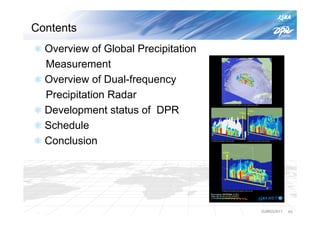
Contents
  Overview of Global Precipitation
  Measurement
  Overview of Dual-frequency
  Precipitation Radar
  Development status of DPR
  Schedule
  Conclusion


                                     IGARSS2011   P2
Overview of Global Precipitation Measurement


                                       IGARSS2011   P3
Objective and Mission Requirements of GPM

  Main objective
    To establish accurate and frequent global precipitation
    observing system from the space


  Basic Mission Requirements of GPM
    Global observation of precipitation
    Accurate precipitation measurement
    Frequent precipitation measurement


                                                     IGARSS2011   P4
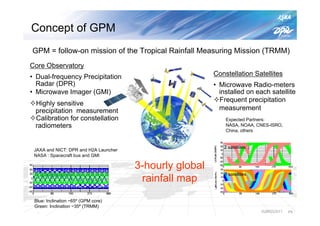
Concept of GPM
GPM = follow-on mission of the Tropical Rainfall Measuring Mission (TRMM)
Core Observatory
• Dual-frequency Precipitation                           Constellation Satellites
  Radar (DPR)                                            • Microwave Radio-meters
• Microwave Imager (GMI)                                   installed on each satellite
                                                           Frequent precipitation
 Highly sensitive
 precipitation measurement                                 measurement
 Calibration for constellation                               Expected Partners:
 radiometers                                                 NASA, NOAA, CNES-ISRO,
                                                             China, others


                                                            2 satellites
 JAXA and NICT: DPR and H2A Launcher
 NASA : Spacecraft bus and GMI

                                       3-hourly global
                                                            8 satellites
                                        rainfall map
 Blue: Inclination ~65º (GPM core)
 Green: Inclination ~35º (TRMM)
                                                                           IGARSS2011   P5
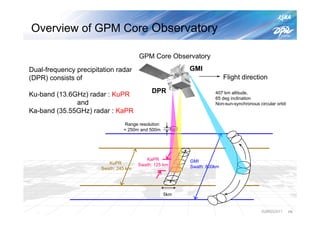
Overview of GPM Core Observatory

                                       GPM Core Observatory
Dual-frequency precipitation radar                       GMI
(DPR) consists of                                                       Flight direction

                                            DPR                    407 km altitude,
Ku-band (13.6GHz) radar : KuPR                                     65 deg inclination
              and                                                  Non-sun-synchronous circular orbit
Ka-band (35.55GHz) radar : KaPR
                                Range resolution
                                = 250m and 500m


                                          KaPR           GMI
                          KuPR         Swath: 125 km
                       Swath: 245 km                     Swath: 800km


                                                   5km


                                                                                         IGARSS2011     P6
Overview of Dual-frequency Precipitation Radar


                                        IGARSS2011   P7
Objectives of DPR

  Three-dimensional observation of precipitation
  High sensitivity measurement of light rainfall and
  heavy snowfall in high latitude
  Accurate estimation of rainfall rate by combining
  the Ku- and Ka-band radar data.
  Improvement of MWR’s precipitation estimation
  accuracy using the precipitation parameters (DSD,
  melting level, rain type, storm height, etc.)
  estimated by using DPR data.


                                              IGARSS2011   P8
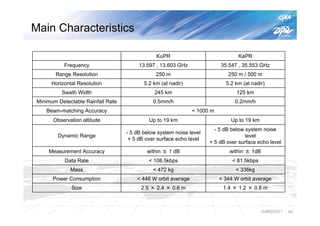
Main Characteristics

                                                KuPR                              KaPR
            Frequency                    13.597 , 13.603 GHz               35.547 , 35.553 GHz
        Range Resolution                        250 m                         250 m / 500 m
      Horizontal Resolution                5.2 km (at nadir)                 5.2 km (at nadir)
           Swath Width                         245 km                             125 km
 Minimum Detectable Rainfall Rate              0.5mm/h                           0.2mm/h
    Beam-matching Accuracy                                      < 1000 m
       Observation altitude                  Up to 19 km                       Up to 19 km
                                                                        - 5 dB below system noise
                                    - 5 dB below system noise level
         Dynamic Range                                                               level
                                     + 5 dB over surface echo level
                                                                      + 5 dB over surface echo level
     Measurement Accuracy                   within ± 1 dB                      within ± 1dB
            Data Rate                        < 108.5kbps                        < 81.5kbps
              Mass                             < 472 kg                          < 336kg
       Power Consumption                < 446 W orbit average              < 344 W orbit average
              Size                        2.5 × 2.4 × 0.6 m                 1.4 × 1.2 × 0.8 m


                                                                                              IGARSS2011   P9
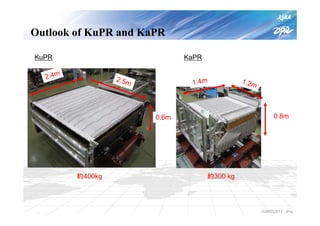
Outlook of KuPR and KaPR

KuPR                            KaPR

  2.4m            2.5m
                                 1 .4 m          1.2m


                         0.6m                                0.8m


         約400kg                        約300 kg


                                                        IGARSS2011   P10
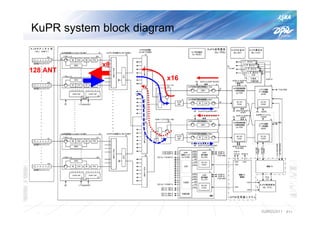
KuPR system block diagram


            x8
128 ANT
                       x16


                             IGARSS2011   P11
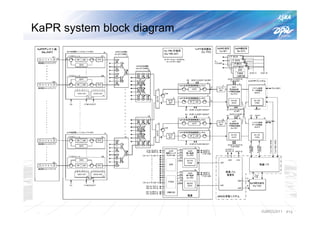
KaPR system block diagram


                            IGARSS2011   P12
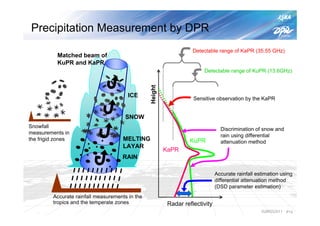
Precipitation Measurement by DPR
                                                                     Detectable range of KaPR (35.55 GHz)
           Matched beam of
           KuPR and KaPR
                                                                         Detectable range of KuPR (13.6GHz)


                                                 Height
                                        ICE                          Sensitive observation by the KaPR


                                      SNOW
Snowfall
                                                                                  Discrimination of snow and
measurements in
                                                                                  rain using differential
the frigid zones                      MELTING                       KuPR          attenuation method
                                      LAYAR
                                                          KaPR
                                     RAIN

                                                                                Accurate rainfall estimation using
                                                                                differential attenuation method
                                                                                (DSD parameter estimation)
         Accurate rainfall measurements in the
         tropics and the temperate zones                   Radar reflectivity
                                                                                                    IGARSS2011   P13
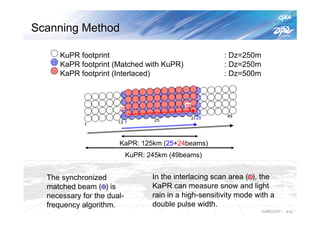
Scanning Method

      KuPR footprint                                     : Dz=250m
      KaPR footprint (Matched with KuPR)                 : Dz=250m
      KaPR footprint (Interlaced)                        : Dz=500m


                                             49
                       26

                                                  3725    49
                       13 1         25
             1


                       KaPR: 125km (25+24beams)
                            KuPR: 245km (49beams)


  The synchronized                 In the interlacing scan area ( ), the
  matched beam ( ) is              KaPR can measure snow and light
  necessary for the dual-          rain in a high-sensitivity mode with a
  frequency algorithm.             double pulse width.
                                                                     IGARSS2011   P14
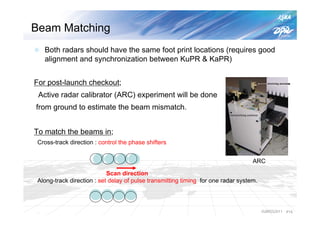
Beam Matching
   Both radars should have the same foot print locations (requires good
   alignment and synchronization between KuPR & KaPR)


For post-launch checkout;
 Active radar calibrator (ARC) experiment will be done
from ground to estimate the beam mismatch.


To match the beams in;
 Cross-track direction : control the phase shifters


                                                                                   ARC

                            Scan direction
 Along-track direction : set delay of pulse transmitting timing for one radar system.


                                                                                        IGARSS2011   P15
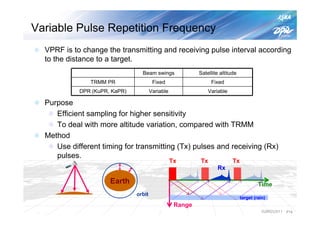
Variable Pulse Repetition Frequency
  VPRF is to change the transmitting and receiving pulse interval according
  to the distance to a target.
                                 Beam swings           Satellite altitude
               TRMM PR                  Fixed               Fixed
            DPR (KuPR, KaPR)           Variable            Variable

  Purpose
     Efficient sampling for higher sensitivity
     To deal with more altitude variation, compared with TRMM
  Method
     Use different timing for transmitting (Tx) pulses and receiving (Rx)
     pulses.
                                                  Tx   Tx              Tx
                                                               Rx                Time

                      Earth                                                          Time
                               orbit
                                                                            target (rain)
                                              Range
                                           Range
                                                                                       IGARSS2011   P16
Development status of DPR


                            IGARSS2011   P17
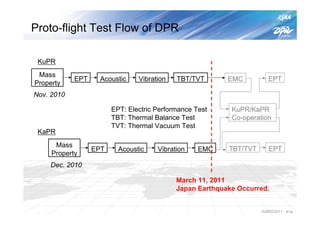
Proto-flight Test Flow of DPR

 KuPR
 Mass
            EPT     Acoustic    Vibration   TBT/TVT       EMC          EPT
Property
Nov. 2010

                        EPT: Electric Performance Test     KuPR/KaPR
                        TBT: Thermal Balance Test          Co-operation
                        TVT: Thermal Vacuum Test
 KaPR
      Mass
                  EPT     Acoustic    Vibration    EMC    TBT/TVT      EPT
     Property
     Dec. 2010

                                            March 11, 2011
                                            Japan Earthquake Occurred.


                                                                    IGARSS2011   P18
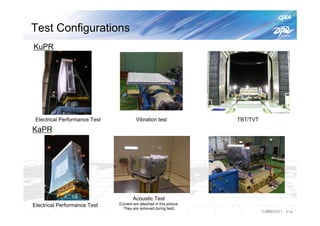
Test Configurations
KuPR


 Electrical Performance Test             Vibration test                TBT/TVT
KaPR


                                       Acoustic Test
Electrical Performance Test    (Covers are attached in this picture.
                                 They are removed during test)
                                                                                 IGARSS2011
                                                                                   ISTS2011   P19
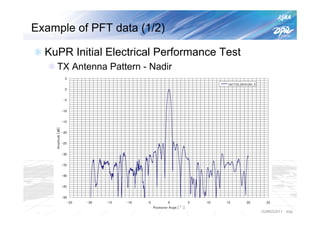
Example of PFT data (1/2)

  KuPR Initial Electrical Performance Test
    TX Antenna Pattern - Nadir


                                             IGARSS2011   P20
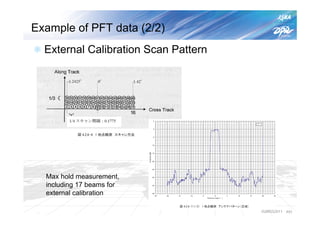
Example of PFT data (2/2)
  External Calibration Scan Pattern


  Max hold measurement,
  including 17 beams for
  external calibration

                                      IGARSS2011   P21
Recovery Activities on DPR

  Inspection
  KuPR is contaminated by the particles of the wall
  material (plasterboard) .
  Cleaning
  Vacuum cleaner, Low adhesive tape, wiping
  Health Check
  Power consumption, Receiving characteristic,
  Transmitting characteristic, SSPA LNA current
  Hold the PFT re-start review on May 19.
  Re-start PFT.

                                               IGARSS2011   P22
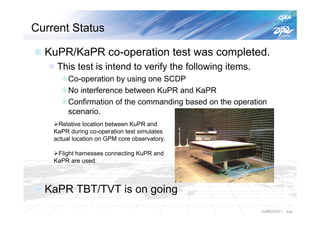
Current Status

  KuPR/KaPR co-operation test was completed.
     This test is intend to verify the following items.
         Co-operation by using one SCDP
         No interference between KuPR and KaPR
         Confirmation of the commanding based on the operation
         scenario.
     Relative location between KuPR and
    KaPR during co-operation test simulates
    actual location on GPM core observatory.
     Flight harnesses connecting KuPR and
    KaPR are used.


  KaPR TBT/TVT is on going
                                                            IGARSS2011   P23
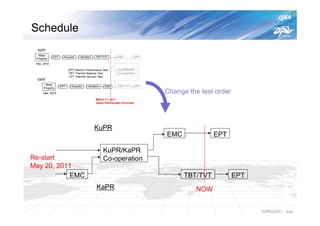
Schedule
  KuPR
  Mass
             EPT     Acoustic    Vibration   TBT/TVT       EMC         EPT
 Property
 Nov. 2010

                         EPT: Electric Performance Test     KuPR/KaPR
                         TBT: Thermal Balance Test          Co-operation
                         TVT: Thermal Vacuum Test
  KaPR
       Mass
                   EPT     Acoustic    Vibration    EMC    TBT/TVT     EPT
      Property
      Dec. 2010                                                              Change the test order
                                             March 11, 2011
                                             Japan Earthquake Occurred.


                                             KuPR
                                                                             EMC             EPT

                                                   KuPR/KaPR
Re-start                                           Co-operation
May 20, 2011
           EMC                                                                     TBT/TVT           EPT
                                              KaPR                                    NOW


                                                                                                           IGARSS2011   P24
Conclusion
  The DPR that will be installed on the GPM core observatory
  is being developed by JAXA and NICT.
  The main objective of the DPR is to measure the three-
  dimensional structure of precipitation including light rainfall
  and snowfall.
  Though Proto-flight test was interrupted due to Japan
  Earthquake on March 11, 2011, there is no significant impact
  to DPR from technical and schedule point of view.
  Proto-flight test has been restarted, and will be completed in
  the near future. After completion of all PFT, the DPR
  instrument will be verified as a space borne radar.


                                                         IGARSS2011   P25

1540.pdf

  • 1.
    PROTO-FLIGHT TEST OF THEDUAL-FREQUENCY PRECIPITATION RADAR FOR THE GLOBAL PRECIPITATION MEASUREMENT Kinji FURUKAWA 1), Masahiro KOJIMA 1), Takeshi MIURA 1), Yasutoshi HYAKUSOKU 1), Toshio IGUCHI 2), Hiroshi HANADO 2), Katsuhiro NAKAGAWA 2), and Minoru OKUMURA 3) 1) GPM/DPR Project Team, Japan Aerospace Exploration Agency 2) Applied Electromagnetic Research Institute, National Institute of Information and Communications Technology 3) NEC TOSHIBA Space systems, Ltd. IGARSS2011
  • 2.
    Contents Overviewof Global Precipitation Measurement Overview of Dual-frequency Precipitation Radar Development status of DPR Schedule Conclusion IGARSS2011 P2
  • 3.
    Overview of GlobalPrecipitation Measurement IGARSS2011 P3
  • 4.
    Objective and MissionRequirements of GPM Main objective To establish accurate and frequent global precipitation observing system from the space Basic Mission Requirements of GPM Global observation of precipitation Accurate precipitation measurement Frequent precipitation measurement IGARSS2011 P4
  • 5.
    Concept of GPM GPM= follow-on mission of the Tropical Rainfall Measuring Mission (TRMM) Core Observatory • Dual-frequency Precipitation Constellation Satellites Radar (DPR) • Microwave Radio-meters • Microwave Imager (GMI) installed on each satellite Frequent precipitation Highly sensitive precipitation measurement measurement Calibration for constellation Expected Partners: radiometers NASA, NOAA, CNES-ISRO, China, others 2 satellites JAXA and NICT: DPR and H2A Launcher NASA : Spacecraft bus and GMI 3-hourly global 8 satellites rainfall map Blue: Inclination ~65º (GPM core) Green: Inclination ~35º (TRMM) IGARSS2011 P5
  • 6.
    Overview of GPMCore Observatory GPM Core Observatory Dual-frequency precipitation radar GMI (DPR) consists of Flight direction DPR 407 km altitude, Ku-band (13.6GHz) radar : KuPR 65 deg inclination and Non-sun-synchronous circular orbit Ka-band (35.55GHz) radar : KaPR Range resolution = 250m and 500m KaPR GMI KuPR Swath: 125 km Swath: 245 km Swath: 800km 5km IGARSS2011 P6
  • 7.
    Overview of Dual-frequencyPrecipitation Radar IGARSS2011 P7
  • 8.
    Objectives of DPR Three-dimensional observation of precipitation High sensitivity measurement of light rainfall and heavy snowfall in high latitude Accurate estimation of rainfall rate by combining the Ku- and Ka-band radar data. Improvement of MWR’s precipitation estimation accuracy using the precipitation parameters (DSD, melting level, rain type, storm height, etc.) estimated by using DPR data. IGARSS2011 P8
  • 9.
    Main Characteristics KuPR KaPR Frequency 13.597 , 13.603 GHz 35.547 , 35.553 GHz Range Resolution 250 m 250 m / 500 m Horizontal Resolution 5.2 km (at nadir) 5.2 km (at nadir) Swath Width 245 km 125 km Minimum Detectable Rainfall Rate 0.5mm/h 0.2mm/h Beam-matching Accuracy < 1000 m Observation altitude Up to 19 km Up to 19 km - 5 dB below system noise - 5 dB below system noise level Dynamic Range level + 5 dB over surface echo level + 5 dB over surface echo level Measurement Accuracy within ± 1 dB within ± 1dB Data Rate < 108.5kbps < 81.5kbps Mass < 472 kg < 336kg Power Consumption < 446 W orbit average < 344 W orbit average Size 2.5 × 2.4 × 0.6 m 1.4 × 1.2 × 0.8 m IGARSS2011 P9
  • 10.
    Outlook of KuPRand KaPR KuPR KaPR 2.4m 2.5m 1 .4 m 1.2m 0.6m 0.8m 約400kg 約300 kg IGARSS2011 P10
  • 11.
    KuPR system blockdiagram x8 128 ANT x16 IGARSS2011 P11
  • 12.
    KaPR system blockdiagram IGARSS2011 P12
  • 13.
    Precipitation Measurement byDPR Detectable range of KaPR (35.55 GHz) Matched beam of KuPR and KaPR Detectable range of KuPR (13.6GHz) Height ICE Sensitive observation by the KaPR SNOW Snowfall Discrimination of snow and measurements in rain using differential the frigid zones MELTING KuPR attenuation method LAYAR KaPR RAIN Accurate rainfall estimation using differential attenuation method (DSD parameter estimation) Accurate rainfall measurements in the tropics and the temperate zones Radar reflectivity IGARSS2011 P13
  • 14.
    Scanning Method KuPR footprint : Dz=250m KaPR footprint (Matched with KuPR) : Dz=250m KaPR footprint (Interlaced) : Dz=500m 49 26 3725 49 13 1 25 1 KaPR: 125km (25+24beams) KuPR: 245km (49beams) The synchronized In the interlacing scan area ( ), the matched beam ( ) is KaPR can measure snow and light necessary for the dual- rain in a high-sensitivity mode with a frequency algorithm. double pulse width. IGARSS2011 P14
  • 15.
    Beam Matching Both radars should have the same foot print locations (requires good alignment and synchronization between KuPR & KaPR) For post-launch checkout; Active radar calibrator (ARC) experiment will be done from ground to estimate the beam mismatch. To match the beams in; Cross-track direction : control the phase shifters ARC Scan direction Along-track direction : set delay of pulse transmitting timing for one radar system. IGARSS2011 P15
  • 16.
    Variable Pulse RepetitionFrequency VPRF is to change the transmitting and receiving pulse interval according to the distance to a target. Beam swings Satellite altitude TRMM PR Fixed Fixed DPR (KuPR, KaPR) Variable Variable Purpose Efficient sampling for higher sensitivity To deal with more altitude variation, compared with TRMM Method Use different timing for transmitting (Tx) pulses and receiving (Rx) pulses. Tx Tx Tx Rx Time Earth Time orbit target (rain) Range Range IGARSS2011 P16
  • 17.
    Development status ofDPR IGARSS2011 P17
  • 18.
    Proto-flight Test Flowof DPR KuPR Mass EPT Acoustic Vibration TBT/TVT EMC EPT Property Nov. 2010 EPT: Electric Performance Test KuPR/KaPR TBT: Thermal Balance Test Co-operation TVT: Thermal Vacuum Test KaPR Mass EPT Acoustic Vibration EMC TBT/TVT EPT Property Dec. 2010 March 11, 2011 Japan Earthquake Occurred. IGARSS2011 P18
  • 19.
    Test Configurations KuPR ElectricalPerformance Test Vibration test TBT/TVT KaPR Acoustic Test Electrical Performance Test (Covers are attached in this picture. They are removed during test) IGARSS2011 ISTS2011 P19
  • 20.
    Example of PFTdata (1/2) KuPR Initial Electrical Performance Test TX Antenna Pattern - Nadir IGARSS2011 P20
  • 21.
    Example of PFTdata (2/2) External Calibration Scan Pattern Max hold measurement, including 17 beams for external calibration IGARSS2011 P21
  • 22.
    Recovery Activities onDPR Inspection KuPR is contaminated by the particles of the wall material (plasterboard) . Cleaning Vacuum cleaner, Low adhesive tape, wiping Health Check Power consumption, Receiving characteristic, Transmitting characteristic, SSPA LNA current Hold the PFT re-start review on May 19. Re-start PFT. IGARSS2011 P22
  • 23.
    Current Status KuPR/KaPR co-operation test was completed. This test is intend to verify the following items. Co-operation by using one SCDP No interference between KuPR and KaPR Confirmation of the commanding based on the operation scenario. Relative location between KuPR and KaPR during co-operation test simulates actual location on GPM core observatory. Flight harnesses connecting KuPR and KaPR are used. KaPR TBT/TVT is on going IGARSS2011 P23
  • 24.
    Schedule KuPR Mass EPT Acoustic Vibration TBT/TVT EMC EPT Property Nov. 2010 EPT: Electric Performance Test KuPR/KaPR TBT: Thermal Balance Test Co-operation TVT: Thermal Vacuum Test KaPR Mass EPT Acoustic Vibration EMC TBT/TVT EPT Property Dec. 2010 Change the test order March 11, 2011 Japan Earthquake Occurred. KuPR EMC EPT KuPR/KaPR Re-start Co-operation May 20, 2011 EMC TBT/TVT EPT KaPR NOW IGARSS2011 P24
  • 25.
    Conclusion TheDPR that will be installed on the GPM core observatory is being developed by JAXA and NICT. The main objective of the DPR is to measure the three- dimensional structure of precipitation including light rainfall and snowfall. Though Proto-flight test was interrupted due to Japan Earthquake on March 11, 2011, there is no significant impact to DPR from technical and schedule point of view. Proto-flight test has been restarted, and will be completed in the near future. After completion of all PFT, the DPR instrument will be verified as a space borne radar. IGARSS2011 P25