




L E S S O N S L E A R N E D AT T W I T T E R
H A D O O P P E R F O R M A N C E
O P T I M I Z AT I O N AT S C A L E
A L E X L E V E N S O N |
I A N O ' C O N N E L L |
@ T H I S W I L LW O R K
@ 0 X 1 3 8
DATA PLATFORM @TWITTER
Develop, maintain, and support the core data processing libraries used
at Twitter
In a good position to make system-wide performance improvements
Core Data Libraries Team
DATA PLATFORM @TWITTER
Idiomatic functional Scala library for writing Hadoop map reduce
Functional programming is a natural fit for map reduce
Compile time type checked
Core Data Libraries Team
github.com/twitter/scalding
DATA PLATFORM @TWITTER
Columnar storage format for the Hadoop ecosystem
Uses the Google Dremel column shredding and assembly algorithm
Core Data Libraries Team
APACHE PARQUET
github.com/apache/parquet-mr
DATA PLATFORM @TWITTER
Streaming map reduce for hybrid realtime / batch topologies
Write once, execute in parallel on Storm / Heron (online) and Scalding
(offline)
Core Data Libraries Team
SUMMINGBIRD
github.com/twitter/summingbird
Hadoop at Twitter Scale
H A D O O P AT T W I T T E R
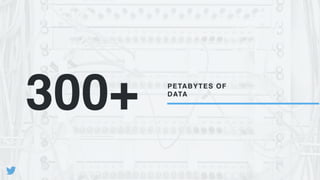
300+ PETABYTES OF
DATA
100k MAP REDUCE
JOBS DAILY
MULTIPLES OF
1000+
MACHINE
HADOOP
CLUSTERS
MULTIPLE
LARGEST
HADOOP
CLUSTERS IN THE
WORLD
AMONG THE
At this scale, even small system-wide
improvements can save significant
amounts of compute resources
C O S T AT S C A L E
What does your Hadoop cluster spend
most of its time doing?
W H AT T O I M P R O V E ?
Profile your cluster, you might be
surprised by what you find
M E A S U R E - D O N ' T G U E S S
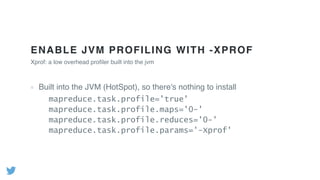
ENABLE JVM PROFILING WITH -XPROF
Built into the JVM (HotSpot), so there's nothing to install
Xprof: a low overhead profiler built into the jvm
mapreduce.task.profile='true'
mapreduce.task.profile.maps='0-'
mapreduce.task.profile.reduces='0-'
mapreduce.task.profile.params='-Xprof'
ENABLE JVM PROFILING WITH -XPROF
Low overhead (uses stack sampling)
Surfaces the most expensive methods
Prints directly to task logs (stdout)
Xprof: a low overhead profiler built into the jvm
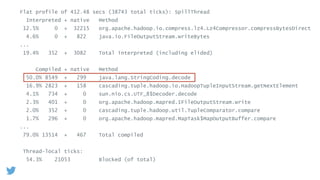
Flat profile of 412.48 secs (38743 total ticks): SpillThread
Interpreted + native Method
12.5% 0 + 32215 org.apache.hadoop.io.compress.lz4.Lz4Compressor.compressBytesDirect
4.6% 0 + 822 java.io.FileOutputStream.writeBytes
...
19.4% 352 + 3082 Total interpreted (including elided)
Compiled + native Method
50.0% 8549 + 299 java.lang.StringCoding.decode
16.9% 2823 + 158 cascading.tuple.hadoop.io.HadoopTupleInputStream.getNextElement
4.1% 734 + 0 sun.nio.cs.UTF_8$Decoder.decode
2.3% 401 + 0 org.apache.hadoop.mapred.IFileOutputStream.write
2.0% 352 + 0 cascading.tuple.hadoop.util.TupleComparator.compare
1.7% 296 + 0 org.apache.hadoop.mapred.MapTask$MapOutputBuffer.compare
...
79.0% 13514 + 467 Total compiled
Thread-local ticks:
54.3% 21053 Blocked (of total)
HADOOP CONFIGURATION OBJECT
Looks and behaves a lot like a HashMap
Surprisingly expensive
Configuration conf = new Configuration()
conf.set("myKey", "myValue")
String value = conf.get("myKey")
HADOOP CONFIGURATION OBJECT
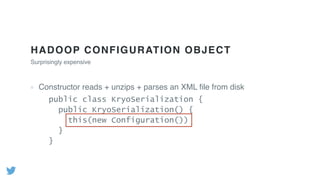
Constructor reads + unzips + parses an XML file from disk
Surprisingly expensive
public class KryoSerialization {
public KryoSerialization() {
this(new Configuration())
}
}
HADOOP CONFIGURATION OBJECT
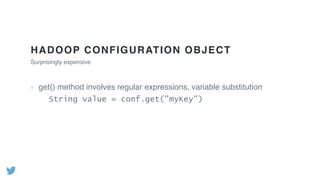
get() method involves regular expressions, variable substitution
Surprisingly expensive
String value = conf.get("myKey")
HADOOP CONFIGURATION OBJECT
Calling these methods in a loop, or once per record, is expensive
Some (non trivial) jobs were spending 30% of their time in
Configuration methods
Surprisingly expensive
It's hard to predict what needs to be
optimized without a profiler
L E S S O N L E A R N E D
If you don't profile, you could be missing
easy wins
L E S S O N L E A R N E D
Measure whether IO or CPU is your
biggest cost
L E S S O N L E A R N E D
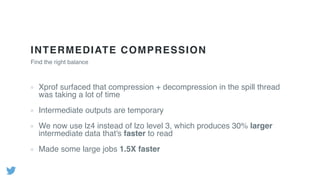
INTERMEDIATE COMPRESSION
Xprof surfaced that compression + decompression in the spill thread
was taking a lot of time
Intermediate outputs are temporary
We now use lz4 instead of lzo level 3, which produces 30% larger
intermediate data that's faster to read
Made some large jobs 1.5X faster
Find the right balance
Record Serialization + Deserialization can
be the most expensive part of your job
L E S S O N L E A R N E D
Record Serialization is CPU intensive, and
may overshadow IO
L E S S O N L E A R N E D
How to reduce costs due to record
serialization?
L E S S O N L E A R N E D
USE HADOOP'S RAW COMPARATOR API
Hadoop MR deserializes the map output keys in order to sort them
between the map and reduce phases
Don't make sorting more expensive than it already is
deserialize(keyBytes1).compare(deserialize(keyBytes2))
USE HADOOP'S RAW COMPARATOR API
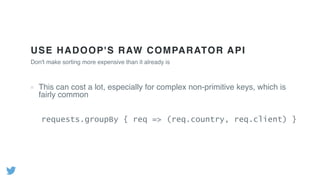
This can cost a lot, especially for complex non-primitive keys, which is
fairly common
Don't make sorting more expensive than it already is
requests.groupBy { req => (req.country, req.client) }
USE HADOOP'S RAW COMPARATOR API
This can cost a lot, especially for complex non-primitive keys, which is
fairly common
Don't make sorting more expensive than it already is
Complex object
that requires sorting
requests.groupBy { req => (req.country, req.client) }
Flat profile of 412.48 secs (38743 total ticks): SpillThread
Interpreted + native Method
12.5% 0 + 32215 org.apache.hadoop.io.compress.lz4.Lz4Compressor.compressBytesDirect
4.6% 0 + 822 java.io.FileOutputStream.writeBytes
...
19.4% 352 + 3082 Total interpreted (including elided)
Compiled + native Method
50.0% 8549 + 299 java.lang.StringCoding.decode
16.9% 2823 + 158 cascading.tuple.hadoop.io.HadoopTupleInputStream.getNextElement
4.1% 734 + 0 sun.nio.cs.UTF_8$Decoder.decode
2.3% 401 + 0 org.apache.hadoop.mapred.IFileOutputStream.write
2.0% 352 + 0 cascading.tuple.hadoop.util.TupleComparator.compare
1.7% 296 + 0 org.apache.hadoop.mapred.MapTask$MapOutputBuffer.compare
...
79.0% 13514 + 467 Total compiled
Thread-local ticks:
54.3% 21053 Blocked (of total)
USE HADOOP'S RAW COMPARATOR API
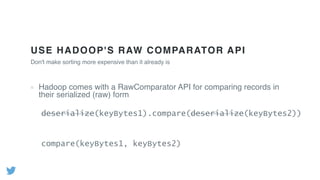
Hadoop comes with a RawComparator API for comparing records in
their serialized (raw) form
Don't make sorting more expensive than it already is
deserialize(keyBytes1).compare(deserialize(keyBytes2))
compare(keyBytes1, keyBytes2)
USE HADOOP'S RAW COMPARATOR API
Hadoop comes with a RawComparator API for comparing records in
their serialized (raw) form
Don't make sorting more expensive than it already is
public interface RawComparator<T> {
public int compare(byte[] b1, int s1, int l1,
byte[] b2, int s2, int l2);
}
USE HADOOP'S RAW COMPARATOR API
Unfortunately, this requires you to write a custom comparator by hand
And assumes that your data is actually easy to compare in its
serialized form
Don't make sorting more expensive than it already is
public interface RawComparator<T> {
public int compare(byte[] b1, int s1, int l1, byte[] b2, int s2, int l2);
}
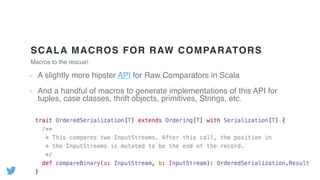
SCALA MACROS FOR RAW COMPARATORS
Macros to the rescue!
A slightly more hipster API for Raw Comparators in Scala
And a handful of macros to generate implementations of this API for
tuples, case classes, thrift objects, primitives, Strings, etc.
SCALA MACROS FOR RAW COMPARATORS
1 3 f o o 0 1 17 1 88 ...
Macros to the rescue!
First, creates a custom dense serialization format that's easy to
compare
1 3 f o o 0 1 22 0 ... ...
non-null String
null value
non-null int non-null int
null value
SCALA MACROS FOR RAW COMPARATORS
1 3 f o o 0 1 17 1 88 ...
Macros to the rescue!
Then, creates a compare method that takes advantage of this format
1 3 f 0 o 0 1 22 0 ... ...
SCALA MACROS FOR RAW COMPARATORS
Macros to the rescue!
TotalComputeTime
Default Raw Comparators
1.5X
FASTER
How to reduce costs due to record
serialization?
L E S S O N L E A R N E D
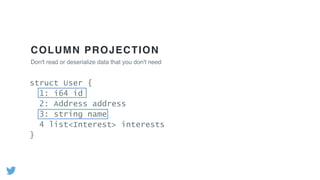
COLUMN PROJECTION
Don't read or deserialize data that you don't need
struct User {
1: i64 id
2: Address address
3: string name
4 list<Interest> interests
}
COLUMN PROJECTION
Columnar file formats like Apache Parquet support this directly
Specialized record deserializers can skip over unwanted fields in row
oriented storage
Don't read or deserialize data that you don't need
APACHE PARQUET
Columnar storage for the people
In traditional row-oriented storage layout, an entire record is stored
sequentially
R1.A R1.B R1.C R2.A R2.B R2.C R3.A R3.B R3.C
APACHE PARQUET
Columnar storage for the people
In traditional row-oriented storage layout, an entire record is stored
sequentially
9903489083
"123 elm street"
"alice"
"columnar file formats"
9903489084
"333 oak street"
"bob"
"Hadoop"
Compressed with lzo / gzip / snappy
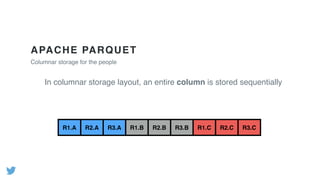
APACHE PARQUET
Columnar storage for the people
In columnar storage layout, an entire column is stored sequentially
R1.A R2.A R3.A R1.B R2.B R3.B R1.C R2.C R3.C
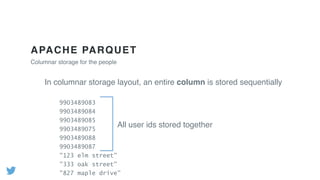
APACHE PARQUET
Columnar storage for the people
All user ids stored together
In columnar storage layout, an entire column is stored sequentially
9903489083
9903489084
9903489085
9903489075
9903489088
9903489087
"123 elm street"
"333 oak street"
"827 maple drive"
APACHE PARQUET
Columnar storage for the people
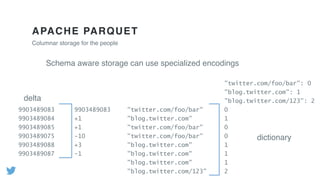
Schema aware storage can use specialized encodings
9903489083
9903489084
9903489085
9903489075
9903489088
9903489087
9903489083
+1
+1
-10
+3
-1
delta
"twitter.com/foo/bar"
"blog.twitter.com"
"twitter.com/foo/bar"
"blog.twitter.com"
"blog.twitter.com"
"blog.twitter.com"
"blog.twitter.com/123"
"twitter.com/foo/bar": 0
"blog.twitter.com": 1
"blog.twitter.com/123": 2
0
1
0
0
1
1
1
2
dictionary
FILE SIZE COMPARISON
SizeinGB
B64 Lzo Thrift Block Lzo Thrift Gzipped Json Lzo Parquet
2X
SMALLER
B64 Lzo Thrift Block Lzo Thrift Gzipped Json Lzo Parquet
APACHE PARQUET
Columnar storage for the people
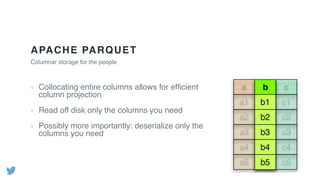
Collocating entire columns allows for efficient
column projection
Read off disk only the columns you need
Possibly more importantly: deserialize only the
columns you need
TotalComputeTime
1 column 10 columns 40 columns
Parquet Lzo Thrift
COLUMN PROJECTION WITH PARQUET
3X
FASTER
1.5X
FASTER
1.15X
FASTER
TotalComputeTime
1 column 10 columns 40 columns
Parquet Lzo Thrift
COLUMN PROJECTION WITH PARQUET
3X
FASTER
1.5X
FASTER
1.15X
FASTER
APACHE PARQUET
Columnar storage for the people
Parquet is often slower to read all columns than row oriented
storage
Parquet is a dense format, read performance scales with the number
of columns in the schema -- nulls take time read
Sparse, row oriented formats (thrift) scale with the number of columns
present in the data -- nulls take no time read
COLUMN PROJECTION FOR ROW ORIENTED DATA
Row oriented is a very common way to store Thrift, Avro, Protocol
Buffers, etc.
Specialized record deserializers can skip over unwanted fields in these
row oriented storage formats
Prototype implemented as a Scala macro that creates a custom
deserializer at compile time
Don't deserialize data that you don't need
COLUMN PROJECTION FOR ROW ORIENTED DATA
Don't deserialize data that you don't need
198 111 121 054 e l m _ s t r ... a l i c e ...
Decode User Id to Long
Skip over unwanted address field
Decode Name to String
COLUMN PROJECTION FOR ROW ORIENTED DATA
No IO savings
But only decodes the fields you care about into objects
CPU time spent decoding Strings can be huge compared to time it
takes to load + ignore the encoded bytes
Don't deserialize data that you don't need
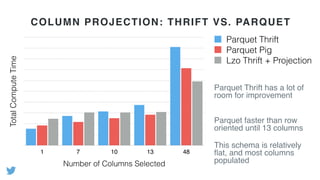
TotalComputeTime
Number of Columns Selected
1 7 10 13 48
Parquet Thrift
Parquet Pig
Lzo Thrift + Projection
COLUMN PROJECTION: THRIFT VS. PARQUET
Parquet Thrift has a lot of
room for improvement
Parquet faster than row
oriented until 13 columns
This schema is relatively
flat, and most columns
populated
APACHE PARQUET
Columnar storage for the people
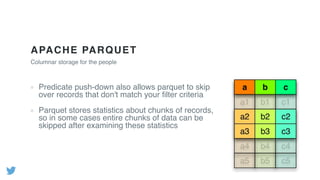
Predicate push-down also allows parquet to skip
over records that don't match your filter criteria
Parquet stores statistics about chunks of records,
so in some cases entire chunks of data can be
skipped after examining these statistics
APACHE PARQUET
Columnar storage for the people
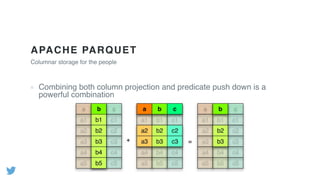
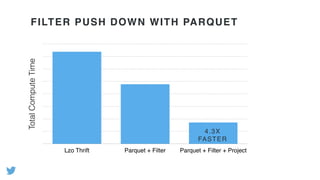
Combining both column projection and predicate push down is a
powerful combination
TotalComputeTime
Lzo Thrift Parquet + Filter Parquet + Filter + Project
FILTER PUSH DOWN WITH PARQUET
4.3X
FASTER
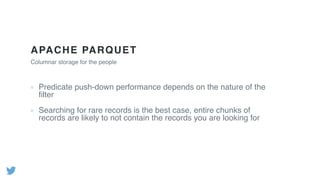
APACHE PARQUET
Columnar storage for the people
Predicate push-down performance depends on the nature of the
filter
Searching for rare records is the best case, entire chunks of
records are likely to not contain the records you are looking for
Key take aways
I N S U M M A R Y
IN SUMMARY
Key takeaways
IN SUMMARY
Key takeaways
Profile!
IN SUMMARY
Key takeaways
Profile!
Serialization is expensive, and Hadoop does a lot of it
IN SUMMARY
Key takeaways
Profile!
Serialization is expensive, and Hadoop does a lot of it
Choose a storage format that fits your access patterns
IN SUMMARY
Key takeaways
Profile!
Serialization is expensive, and Hadoop does a lot of it
Choose a storage format that fits your access patterns
Use column projection
IN SUMMARY
Key takeaways
Profile!
Serialization is expensive, and Hadoop does a lot of it
Choose a storage format that fits your access patterns
Use column projection
Sorting is expensive -- use Raw Comparators
IN SUMMARY
Key takeaways
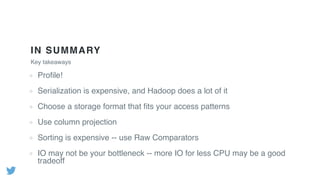
Profile!
Serialization is expensive, and Hadoop does a lot of it
Choose a storage format that fits your access patterns
Use column projection
Sorting is expensive -- use Raw Comparators
IO may not be your bottleneck -- more IO for less CPU may be a good
tradeoff
ACKNOWLEDGEMENTS
Thanks to everyone involved!
Dmitriy Ryaboy @squarecog
Gera Shegalov @gerashegalov
Julien Le Dem @J_
Katya Gonina @katyagonina
Mansur Ashraf @mansur_ashraf
Oscar Boykin @posco
Sriram Krishnan @krishnansriram
Tianshuo Deng @tsdeng
Zak Taylor @zakattacktaylor
And many more!
GET INVOLVED
Contributions always welcome!
github.com/twitter/scalding
github.com/twitter/algebird
github.com/twitter/chill
github.com/apache/parquet-mr
JOIN THE FLOCK
We're Hiring!
Work on data processing challenges at scale
Strong commitment to open source
jobs.twitter.com
Data Platform: (https://about.twitter.com/careers/positions?jvi=oipMYfwb,Job)
Q U E S T I O N S ?
A L E X L E V E N S O N |
I A N O ' C O N N E L L |
@ T H I S W I L LW O R K
@ 0 X 1 3 8

Hadoop Performance Optimization at Scale, Lessons Learned at Twitter

  • 1.
    L E SS O N S L E A R N E D AT T W I T T E R H A D O O P P E R F O R M A N C E O P T I M I Z AT I O N AT S C A L E A L E X L E V E N S O N | I A N O ' C O N N E L L | @ T H I S W I L LW O R K @ 0 X 1 3 8
  • 2.
    DATA PLATFORM @TWITTER Develop,maintain, and support the core data processing libraries used at Twitter In a good position to make system-wide performance improvements Core Data Libraries Team
  • 3.
    DATA PLATFORM @TWITTER Idiomaticfunctional Scala library for writing Hadoop map reduce Functional programming is a natural fit for map reduce Compile time type checked Core Data Libraries Team github.com/twitter/scalding
  • 4.
    DATA PLATFORM @TWITTER Columnarstorage format for the Hadoop ecosystem Uses the Google Dremel column shredding and assembly algorithm Core Data Libraries Team APACHE PARQUET github.com/apache/parquet-mr
  • 5.
    DATA PLATFORM @TWITTER Streamingmap reduce for hybrid realtime / batch topologies Write once, execute in parallel on Storm / Heron (online) and Scalding (offline) Core Data Libraries Team SUMMINGBIRD github.com/twitter/summingbird
  • 6.
    Hadoop at TwitterScale H A D O O P AT T W I T T E R
  • 7.
  • 8.
    100k MAP REDUCE JOBSDAILY MULTIPLES OF
  • 9.
  • 10.
  • 11.
    At this scale,even small system-wide improvements can save significant amounts of compute resources C O S T AT S C A L E
  • 12.
    What does yourHadoop cluster spend most of its time doing? W H AT T O I M P R O V E ?
  • 13.
    Profile your cluster,you might be surprised by what you find M E A S U R E - D O N ' T G U E S S
  • 14.
    ENABLE JVM PROFILINGWITH -XPROF Built into the JVM (HotSpot), so there's nothing to install Xprof: a low overhead profiler built into the jvm mapreduce.task.profile='true' mapreduce.task.profile.maps='0-' mapreduce.task.profile.reduces='0-' mapreduce.task.profile.params='-Xprof'
  • 15.
    ENABLE JVM PROFILINGWITH -XPROF Low overhead (uses stack sampling) Surfaces the most expensive methods Prints directly to task logs (stdout) Xprof: a low overhead profiler built into the jvm
  • 16.
    Flat profile of412.48 secs (38743 total ticks): SpillThread Interpreted + native Method 12.5% 0 + 32215 org.apache.hadoop.io.compress.lz4.Lz4Compressor.compressBytesDirect 4.6% 0 + 822 java.io.FileOutputStream.writeBytes ... 19.4% 352 + 3082 Total interpreted (including elided) Compiled + native Method 50.0% 8549 + 299 java.lang.StringCoding.decode 16.9% 2823 + 158 cascading.tuple.hadoop.io.HadoopTupleInputStream.getNextElement 4.1% 734 + 0 sun.nio.cs.UTF_8$Decoder.decode 2.3% 401 + 0 org.apache.hadoop.mapred.IFileOutputStream.write 2.0% 352 + 0 cascading.tuple.hadoop.util.TupleComparator.compare 1.7% 296 + 0 org.apache.hadoop.mapred.MapTask$MapOutputBuffer.compare ... 79.0% 13514 + 467 Total compiled Thread-local ticks: 54.3% 21053 Blocked (of total)
  • 17.
    HADOOP CONFIGURATION OBJECT Looksand behaves a lot like a HashMap Surprisingly expensive Configuration conf = new Configuration() conf.set("myKey", "myValue") String value = conf.get("myKey")
  • 18.
    HADOOP CONFIGURATION OBJECT Constructorreads + unzips + parses an XML file from disk Surprisingly expensive public class KryoSerialization { public KryoSerialization() { this(new Configuration()) } }
  • 19.
    HADOOP CONFIGURATION OBJECT get()method involves regular expressions, variable substitution Surprisingly expensive String value = conf.get("myKey")
  • 20.
    HADOOP CONFIGURATION OBJECT Callingthese methods in a loop, or once per record, is expensive Some (non trivial) jobs were spending 30% of their time in Configuration methods Surprisingly expensive
  • 21.
    It's hard topredict what needs to be optimized without a profiler L E S S O N L E A R N E D
  • 22.
    If you don'tprofile, you could be missing easy wins L E S S O N L E A R N E D
  • 23.
    Measure whether IOor CPU is your biggest cost L E S S O N L E A R N E D
  • 24.
    INTERMEDIATE COMPRESSION Xprof surfacedthat compression + decompression in the spill thread was taking a lot of time Intermediate outputs are temporary We now use lz4 instead of lzo level 3, which produces 30% larger intermediate data that's faster to read Made some large jobs 1.5X faster Find the right balance
  • 25.
    Record Serialization +Deserialization can be the most expensive part of your job L E S S O N L E A R N E D
  • 26.
    Record Serialization isCPU intensive, and may overshadow IO L E S S O N L E A R N E D
  • 27.
    How to reducecosts due to record serialization? L E S S O N L E A R N E D
  • 28.
    USE HADOOP'S RAWCOMPARATOR API Hadoop MR deserializes the map output keys in order to sort them between the map and reduce phases Don't make sorting more expensive than it already is deserialize(keyBytes1).compare(deserialize(keyBytes2))
  • 29.
    USE HADOOP'S RAWCOMPARATOR API This can cost a lot, especially for complex non-primitive keys, which is fairly common Don't make sorting more expensive than it already is requests.groupBy { req => (req.country, req.client) }
  • 30.
    USE HADOOP'S RAWCOMPARATOR API This can cost a lot, especially for complex non-primitive keys, which is fairly common Don't make sorting more expensive than it already is Complex object that requires sorting requests.groupBy { req => (req.country, req.client) }
  • 31.
    Flat profile of412.48 secs (38743 total ticks): SpillThread Interpreted + native Method 12.5% 0 + 32215 org.apache.hadoop.io.compress.lz4.Lz4Compressor.compressBytesDirect 4.6% 0 + 822 java.io.FileOutputStream.writeBytes ... 19.4% 352 + 3082 Total interpreted (including elided) Compiled + native Method 50.0% 8549 + 299 java.lang.StringCoding.decode 16.9% 2823 + 158 cascading.tuple.hadoop.io.HadoopTupleInputStream.getNextElement 4.1% 734 + 0 sun.nio.cs.UTF_8$Decoder.decode 2.3% 401 + 0 org.apache.hadoop.mapred.IFileOutputStream.write 2.0% 352 + 0 cascading.tuple.hadoop.util.TupleComparator.compare 1.7% 296 + 0 org.apache.hadoop.mapred.MapTask$MapOutputBuffer.compare ... 79.0% 13514 + 467 Total compiled Thread-local ticks: 54.3% 21053 Blocked (of total)
  • 32.
    USE HADOOP'S RAWCOMPARATOR API Hadoop comes with a RawComparator API for comparing records in their serialized (raw) form Don't make sorting more expensive than it already is deserialize(keyBytes1).compare(deserialize(keyBytes2)) compare(keyBytes1, keyBytes2)
  • 33.
    USE HADOOP'S RAWCOMPARATOR API Hadoop comes with a RawComparator API for comparing records in their serialized (raw) form Don't make sorting more expensive than it already is public interface RawComparator<T> { public int compare(byte[] b1, int s1, int l1, byte[] b2, int s2, int l2); }
  • 34.
    USE HADOOP'S RAWCOMPARATOR API Unfortunately, this requires you to write a custom comparator by hand And assumes that your data is actually easy to compare in its serialized form Don't make sorting more expensive than it already is public interface RawComparator<T> { public int compare(byte[] b1, int s1, int l1, byte[] b2, int s2, int l2); }
  • 35.
    SCALA MACROS FORRAW COMPARATORS Macros to the rescue! A slightly more hipster API for Raw Comparators in Scala And a handful of macros to generate implementations of this API for tuples, case classes, thrift objects, primitives, Strings, etc.
  • 36.
    SCALA MACROS FORRAW COMPARATORS 1 3 f o o 0 1 17 1 88 ... Macros to the rescue! First, creates a custom dense serialization format that's easy to compare 1 3 f o o 0 1 22 0 ... ... non-null String null value non-null int non-null int null value
  • 37.
    SCALA MACROS FORRAW COMPARATORS 1 3 f o o 0 1 17 1 88 ... Macros to the rescue! Then, creates a compare method that takes advantage of this format 1 3 f 0 o 0 1 22 0 ... ...
  • 38.
    SCALA MACROS FORRAW COMPARATORS Macros to the rescue! TotalComputeTime Default Raw Comparators 1.5X FASTER
  • 39.
    How to reducecosts due to record serialization? L E S S O N L E A R N E D
  • 40.
    COLUMN PROJECTION Don't reador deserialize data that you don't need struct User { 1: i64 id 2: Address address 3: string name 4 list<Interest> interests }
  • 41.
    COLUMN PROJECTION Columnar fileformats like Apache Parquet support this directly Specialized record deserializers can skip over unwanted fields in row oriented storage Don't read or deserialize data that you don't need
  • 42.
    APACHE PARQUET Columnar storagefor the people In traditional row-oriented storage layout, an entire record is stored sequentially R1.A R1.B R1.C R2.A R2.B R2.C R3.A R3.B R3.C
  • 43.
    APACHE PARQUET Columnar storagefor the people In traditional row-oriented storage layout, an entire record is stored sequentially 9903489083 "123 elm street" "alice" "columnar file formats" 9903489084 "333 oak street" "bob" "Hadoop" Compressed with lzo / gzip / snappy
  • 44.
    APACHE PARQUET Columnar storagefor the people In columnar storage layout, an entire column is stored sequentially R1.A R2.A R3.A R1.B R2.B R3.B R1.C R2.C R3.C
  • 45.
    APACHE PARQUET Columnar storagefor the people All user ids stored together In columnar storage layout, an entire column is stored sequentially 9903489083 9903489084 9903489085 9903489075 9903489088 9903489087 "123 elm street" "333 oak street" "827 maple drive"
  • 46.
    APACHE PARQUET Columnar storagefor the people Schema aware storage can use specialized encodings 9903489083 9903489084 9903489085 9903489075 9903489088 9903489087 9903489083 +1 +1 -10 +3 -1 delta "twitter.com/foo/bar" "blog.twitter.com" "twitter.com/foo/bar" "twitter.com/foo/bar" "blog.twitter.com" "blog.twitter.com" "blog.twitter.com" "blog.twitter.com/123" "twitter.com/foo/bar": 0 "blog.twitter.com": 1 "blog.twitter.com/123": 2 0 1 0 0 1 1 1 2 dictionary
  • 47.
    FILE SIZE COMPARISON SizeinGB B64Lzo Thrift Block Lzo Thrift Gzipped Json Lzo Parquet 2X SMALLER B64 Lzo Thrift Block Lzo Thrift Gzipped Json Lzo Parquet
  • 48.
    APACHE PARQUET Columnar storagefor the people Collocating entire columns allows for efficient column projection Read off disk only the columns you need Possibly more importantly: deserialize only the columns you need
  • 49.
    TotalComputeTime 1 column 10columns 40 columns Parquet Lzo Thrift COLUMN PROJECTION WITH PARQUET 3X FASTER 1.5X FASTER 1.15X FASTER
  • 50.
    TotalComputeTime 1 column 10columns 40 columns Parquet Lzo Thrift COLUMN PROJECTION WITH PARQUET 3X FASTER 1.5X FASTER 1.15X FASTER
  • 51.
    APACHE PARQUET Columnar storagefor the people Parquet is often slower to read all columns than row oriented storage Parquet is a dense format, read performance scales with the number of columns in the schema -- nulls take time read Sparse, row oriented formats (thrift) scale with the number of columns present in the data -- nulls take no time read
  • 52.
    COLUMN PROJECTION FORROW ORIENTED DATA Row oriented is a very common way to store Thrift, Avro, Protocol Buffers, etc. Specialized record deserializers can skip over unwanted fields in these row oriented storage formats Prototype implemented as a Scala macro that creates a custom deserializer at compile time Don't deserialize data that you don't need
  • 53.
    COLUMN PROJECTION FORROW ORIENTED DATA Don't deserialize data that you don't need 198 111 121 054 e l m _ s t r ... a l i c e ... Decode User Id to Long Skip over unwanted address field Decode Name to String
  • 54.
    COLUMN PROJECTION FORROW ORIENTED DATA No IO savings But only decodes the fields you care about into objects CPU time spent decoding Strings can be huge compared to time it takes to load + ignore the encoded bytes Don't deserialize data that you don't need
  • 55.
    TotalComputeTime Number of ColumnsSelected 1 7 10 13 48 Parquet Thrift Parquet Pig Lzo Thrift + Projection COLUMN PROJECTION: THRIFT VS. PARQUET Parquet Thrift has a lot of room for improvement Parquet faster than row oriented until 13 columns This schema is relatively flat, and most columns populated
  • 56.
    APACHE PARQUET Columnar storagefor the people Predicate push-down also allows parquet to skip over records that don't match your filter criteria Parquet stores statistics about chunks of records, so in some cases entire chunks of data can be skipped after examining these statistics
  • 57.
    APACHE PARQUET Columnar storagefor the people Combining both column projection and predicate push down is a powerful combination
  • 58.
    TotalComputeTime Lzo Thrift Parquet+ Filter Parquet + Filter + Project FILTER PUSH DOWN WITH PARQUET 4.3X FASTER
  • 59.
    APACHE PARQUET Columnar storagefor the people Predicate push-down performance depends on the nature of the filter Searching for rare records is the best case, entire chunks of records are likely to not contain the records you are looking for
  • 60.
    Key take aways IN S U M M A R Y
  • 61.
  • 62.
  • 63.
    IN SUMMARY Key takeaways Profile! Serializationis expensive, and Hadoop does a lot of it
  • 64.
    IN SUMMARY Key takeaways Profile! Serializationis expensive, and Hadoop does a lot of it Choose a storage format that fits your access patterns
  • 65.
    IN SUMMARY Key takeaways Profile! Serializationis expensive, and Hadoop does a lot of it Choose a storage format that fits your access patterns Use column projection
  • 66.
    IN SUMMARY Key takeaways Profile! Serializationis expensive, and Hadoop does a lot of it Choose a storage format that fits your access patterns Use column projection Sorting is expensive -- use Raw Comparators
  • 67.
    IN SUMMARY Key takeaways Profile! Serializationis expensive, and Hadoop does a lot of it Choose a storage format that fits your access patterns Use column projection Sorting is expensive -- use Raw Comparators IO may not be your bottleneck -- more IO for less CPU may be a good tradeoff
  • 68.
    ACKNOWLEDGEMENTS Thanks to everyoneinvolved! Dmitriy Ryaboy @squarecog Gera Shegalov @gerashegalov Julien Le Dem @J_ Katya Gonina @katyagonina Mansur Ashraf @mansur_ashraf Oscar Boykin @posco Sriram Krishnan @krishnansriram Tianshuo Deng @tsdeng Zak Taylor @zakattacktaylor And many more!
  • 69.
    GET INVOLVED Contributions alwayswelcome! github.com/twitter/scalding github.com/twitter/algebird github.com/twitter/chill github.com/apache/parquet-mr
  • 70.
    JOIN THE FLOCK We'reHiring! Work on data processing challenges at scale Strong commitment to open source jobs.twitter.com Data Platform: (https://about.twitter.com/careers/positions?jvi=oipMYfwb,Job)
  • 71.
    Q U ES T I O N S ? A L E X L E V E N S O N | I A N O ' C O N N E L L | @ T H I S W I L LW O R K @ 0 X 1 3 8