

ClickHouse
Mark Cache
5 minute primer
2020-02-05 SF ClickHouse Meetup Mik Kocikowski mik@cloudflare.com slide 1/6
Link to slides ^^ (will also show at the end)
How ClickHouse stores data (MergeTree engine)
- Data in MergeTree table is stored in “parts” (each INSERT produces a part)
- Parts are continuously merged
- Each part stores data in primary key order
- Each part has its own directory
- Within that directory each column has its own “bin” and “mrk” files
- default/my_table/20200202_5042_6949_1107/userId.bin
- default/my_table/20200202_5042_6949_1107/userId.mrk
- …
- default/my_table/20200202_5042_6949_1107/timestamp.bin
- default/my_table/20200202_5042_6949_1107/timestamp.mrk
2020-02-05 SF ClickHouse Meetup Mik Kocikowski mik@cloudflare.com slide 2/6
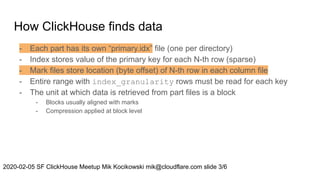
How ClickHouse finds data
- Each part has its own “primary.idx” file (one per directory)
- Index stores value of the primary key for each N-th row (sparse)
- Mark files store location (byte offset) of N-th row in each column file
- Entire range with index_granularity rows must be read for each key
- The unit at which data is retrieved from part files is a block
- Blocks usually aligned with marks
- Compression applied at block level
2020-02-05 SF ClickHouse Meetup Mik Kocikowski mik@cloudflare.com slide 3/6
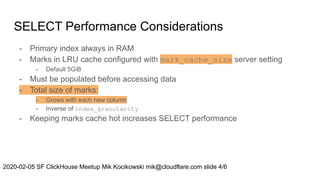
SELECT Performance Considerations
- Primary index always in RAM
- Marks in LRU cache configured with mark_cache_size server setting
- Default 5GiB
- Must be populated before accessing data
- Total size of marks:
- Grows with each new column
- Inverse of index_granularity
- Keeping marks cache hot increases SELECT performance
2020-02-05 SF ClickHouse Meetup Mik Kocikowski mik@cloudflare.com slide 4/6
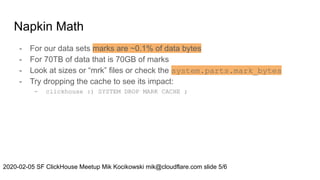
Napkin Math
- For our data sets marks are ~0.1% of data bytes
- For 70TB of data that is 70GB of marks
- Look at sizes or “mrk” files or check the system.parts.mark_bytes
- Try dropping the cache to see its impact:
- clickhouse :) SYSTEM DROP MARK CACHE ;
2020-02-05 SF ClickHouse Meetup Mik Kocikowski mik@cloudflare.com slide 5/6
ClickHouse documentation is fantastic:
- https://clickhouse.tech/docs/en/development/arc
hitecture/#merge-tree
- https://clickhouse.tech/docs/en/operations/table_
engines/mergetree/#mergetree-data-storage
- https://clickhouse.tech/docs/en/operations/syste
m_tables/#system_tables-parts
- https://clickhouse.tech/docs/en/operations/serve
r_settings/settings/#server-mark-cache-size
- https://clickhouse.tech/docs/en/query_language/
system/#query_language-system-drop-mark-cac
he
Thanks!
2020-02-05 SF ClickHouse Meetup Mik Kocikowski mik@cloudflare.com slide 6/6
Google slides ^^

ClickHouse Mark Cache, by Mik Kocikowski, Cloudflare

  • 1.
    ClickHouse Mark Cache 5 minuteprimer 2020-02-05 SF ClickHouse Meetup Mik Kocikowski mik@cloudflare.com slide 1/6 Link to slides ^^ (will also show at the end)
  • 2.
    How ClickHouse storesdata (MergeTree engine) - Data in MergeTree table is stored in “parts” (each INSERT produces a part) - Parts are continuously merged - Each part stores data in primary key order - Each part has its own directory - Within that directory each column has its own “bin” and “mrk” files - default/my_table/20200202_5042_6949_1107/userId.bin - default/my_table/20200202_5042_6949_1107/userId.mrk - … - default/my_table/20200202_5042_6949_1107/timestamp.bin - default/my_table/20200202_5042_6949_1107/timestamp.mrk 2020-02-05 SF ClickHouse Meetup Mik Kocikowski mik@cloudflare.com slide 2/6
  • 3.
    How ClickHouse findsdata - Each part has its own “primary.idx” file (one per directory) - Index stores value of the primary key for each N-th row (sparse) - Mark files store location (byte offset) of N-th row in each column file - Entire range with index_granularity rows must be read for each key - The unit at which data is retrieved from part files is a block - Blocks usually aligned with marks - Compression applied at block level 2020-02-05 SF ClickHouse Meetup Mik Kocikowski mik@cloudflare.com slide 3/6
  • 4.
    SELECT Performance Considerations -Primary index always in RAM - Marks in LRU cache configured with mark_cache_size server setting - Default 5GiB - Must be populated before accessing data - Total size of marks: - Grows with each new column - Inverse of index_granularity - Keeping marks cache hot increases SELECT performance 2020-02-05 SF ClickHouse Meetup Mik Kocikowski mik@cloudflare.com slide 4/6
  • 5.
    Napkin Math - Forour data sets marks are ~0.1% of data bytes - For 70TB of data that is 70GB of marks - Look at sizes or “mrk” files or check the system.parts.mark_bytes - Try dropping the cache to see its impact: - clickhouse :) SYSTEM DROP MARK CACHE ; 2020-02-05 SF ClickHouse Meetup Mik Kocikowski mik@cloudflare.com slide 5/6
  • 6.
    ClickHouse documentation isfantastic: - https://clickhouse.tech/docs/en/development/arc hitecture/#merge-tree - https://clickhouse.tech/docs/en/operations/table_ engines/mergetree/#mergetree-data-storage - https://clickhouse.tech/docs/en/operations/syste m_tables/#system_tables-parts - https://clickhouse.tech/docs/en/operations/serve r_settings/settings/#server-mark-cache-size - https://clickhouse.tech/docs/en/query_language/ system/#query_language-system-drop-mark-cac he Thanks! 2020-02-05 SF ClickHouse Meetup Mik Kocikowski mik@cloudflare.com slide 6/6 Google slides ^^