Embedding Pig in scripting languagesWhat happens when you feed a Pig to a Python?Julien Le Dem – Principal Engineer - Content Platforms at Yahoo!Pig committerjulien@ledem.net@julienledem
DisclaimerNo animals were hurtin the making of this presentationI’m cuteI’m hungryPicture credits:OZinOH: http://www.flickr.com/photos/75905404@N00/5421543577/Stephen & Claire Farnsworth: http://www.flickr.com/photos/the_farnsworths/4720850597/
What for ?Simplifying the implementation of iterative algorithms:Loop and exit criteriaSimpler User Defined FunctionsEasier parameter passing
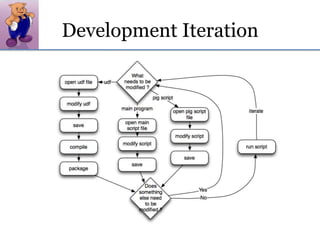
BeforeThe implementation has the following artifacts:
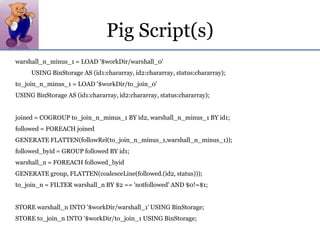
Pig Script(s)warshall_n_minus_1 = LOAD '$workDir/warshall_0'	USING BinStorage AS (id1:chararray, id2:chararray, status:chararray);to_join_n_minus_1 = LOAD '$workDir/to_join_0'USING BinStorage AS (id1:chararray, id2:chararray, status:chararray);joined = COGROUP to_join_n_minus_1 BY id2, warshall_n_minus_1 BY id1;followed = FOREACH joinedGENERATE FLATTEN(followRel(to_join_n_minus_1,warshall_n_minus_1));followed_byid = GROUP followed BY id1;warshall_n = FOREACH followed_byidGENERATE group, FLATTEN(coalesceLine(followed.(id2, status)));to_join_n = FILTER warshall_n BY $2 == 'notfollowed' AND $0!=$1;STORE warshall_n INTO '$workDir/warshall_1' USING BinStorage;STORE to_join_n INTO '$workDir/to_join_1 USING BinStorage;
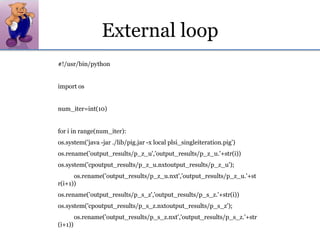
External loop#!/usr/bin/python import osnum_iter=int(10)for i in range(num_iter):os.system('java -jar ./lib/pig.jar -x local plsi_singleiteration.pig')os.rename('output_results/p_z_u','output_results/p_z_u.'+str(i))os.system('cpoutput_results/p_z_u.nxtoutput_results/p_z_u');	os.rename('output_results/p_z_u.nxt','output_results/p_z_u.'+str(i+1))os.rename('output_results/p_s_z','output_results/p_s_z.'+str(i))os.system('cpoutput_results/p_s_z.nxtoutput_results/p_s_z');	os.rename('output_results/p_s_z.nxt','output_results/p_s_z.'+str(i+1))
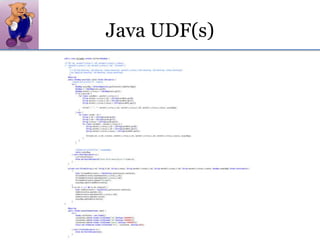
Java UDF(s)
Development Iteration
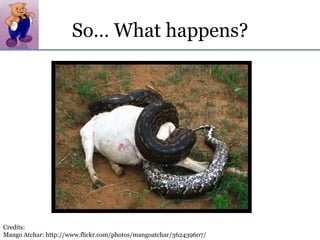
So… What happens?Credits: Mango Atchar: http://www.flickr.com/photos/mangoatchar/362439607/
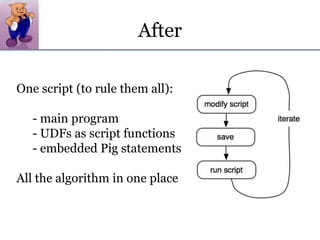
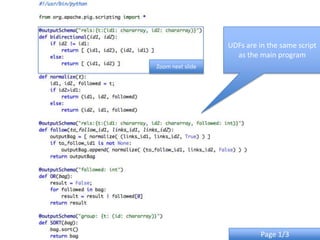
AfterOne script (to rule them all):	- main program	- UDFs as script functions 	- embedded Pig statementsAll the algorithm in one place
ReferencesIt uses JVM implementations of scripting languages (Jython, Rhino).This is a joint effort, see the following Jiras: 	in Pig 0.8: PIG-928 Python UDFs   in Pig0.9: PIG-1479 embedding, PIG-1794 JavaScript supportDoc: http://pig.apache.org/docs/
Examples1) Simple example: fixed loop iteration2) Adding convergence criteria and accessing intermediary output3)More advanced example with UDFs
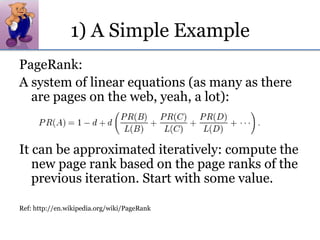
1) A Simple ExamplePageRank:A system of linear equations (as many as there are pages on the web, yeah, a lot): It can be approximated iteratively: compute the new page rank based on the page ranks of the previous iteration. Start with some value.Ref: http://en.wikipedia.org/wiki/PageRank
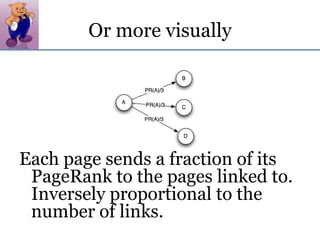
Or more visuallyEach page sends a fraction of its PageRank to the pages linked to. Inversely proportional to the number of links.
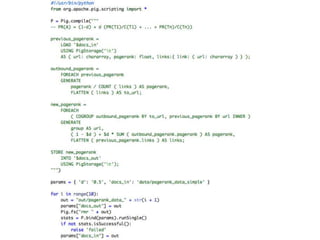
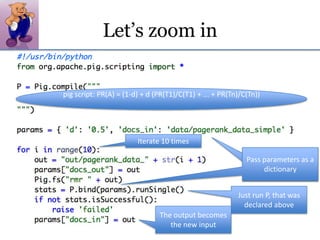
Let’s zoom inpig script: PR(A) = (1-d) + d (PR(T1)/C(T1) + ... + PR(Tn)/C(Tn))Iterate 10 timesPass parameters as a dictionaryPass parameters as a dictionaryJust run P, that was declared aboveThe output becomes the new input
Practical resultApplied to the English Wikipedia link graph:http://wiki.dbpedia.org/Downloads36#owikipediapagelinksIt turns out that the max PageRank is awarded to:http://en.wikipedia.org/wiki/United_StatesThanks @ogrisel for the suggestion
2) Same example, one step furtherNow let’s say that we define a threshold as a convergence criteria instead of a fixed iteration count.
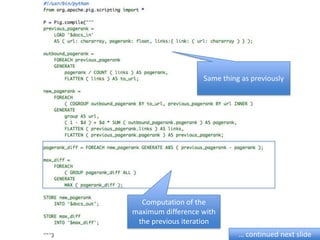
Same thing as previouslyComputation of the maximum difference with the previous iteration… continued next slide
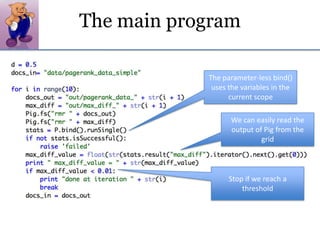
The main programThe parameter-less bind() uses the variables in the current scopeWe can easily read the output of Pig from the gridStop if we reach a threshold
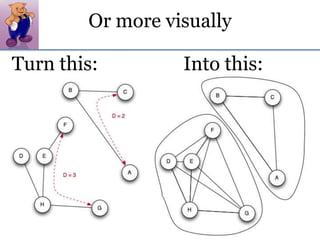
3) Now somethingmore complexCompute a transitive closure: find the connected components of a graph. - Useful if you’re doing de-duplication - Requires iterations and UDFs
Or more visuallyTurn this:	                Into this:
ConvergenceConverges in : log2(max(Diameter of a component))Diameter = “the longest shortest path”Bottom line: the number of iterations will be reasonable.
UDFs are in the same script as the main programZoom next slidePage 1/3
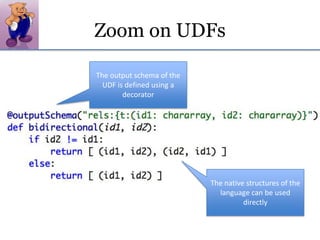
Zoom on UDFsThe output schema of the UDF is defined using a decoratorThe native structures of the language can be used directly
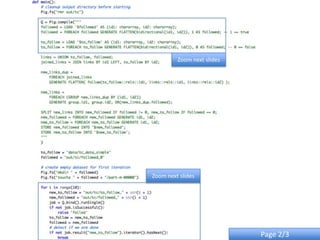
Zoom next slidesZoom next slidesPage 2/3
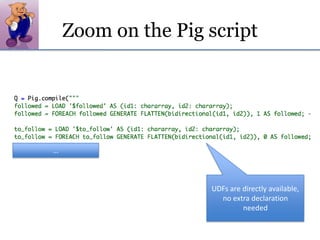
Zoom on the Pig script…UDFs are directly available, no extra declaration needed
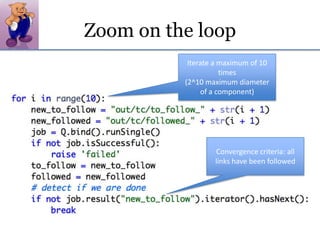
Zoom on the loopIterate a maximum of 10 times(2^10 maximum diameter of a component)Convergence criteria: all links have been followed
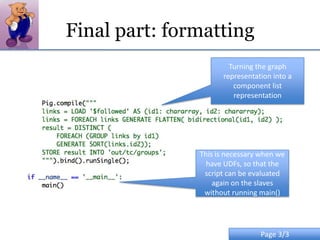
Final part: formattingTurning the graph representation into a component list representationThis is necessary when we have UDFs, so that the script can be evaluated again on the slaves without running main()Page 3/3
One more thing …I presented Python but JavaScript is available as well (experimental).The framework is extensible. Any JVM implementation of a language could be integrated (contribute!).The examples can be found at:https://github.com/julienledem/Pig-scripting-examples
Questions???

Embedding Pig in scripting languages

  • 1.
    Embedding Pig inscripting languagesWhat happens when you feed a Pig to a Python?Julien Le Dem – Principal Engineer - Content Platforms at Yahoo!Pig committerjulien@ledem.net@julienledem
  • 2.
    DisclaimerNo animals werehurtin the making of this presentationI’m cuteI’m hungryPicture credits:OZinOH: http://www.flickr.com/photos/75905404@N00/5421543577/Stephen & Claire Farnsworth: http://www.flickr.com/photos/the_farnsworths/4720850597/
  • 3.
    What for ?Simplifyingthe implementation of iterative algorithms:Loop and exit criteriaSimpler User Defined FunctionsEasier parameter passing
  • 4.
    BeforeThe implementation hasthe following artifacts:
  • 5.
    Pig Script(s)warshall_n_minus_1 =LOAD '$workDir/warshall_0' USING BinStorage AS (id1:chararray, id2:chararray, status:chararray);to_join_n_minus_1 = LOAD '$workDir/to_join_0'USING BinStorage AS (id1:chararray, id2:chararray, status:chararray);joined = COGROUP to_join_n_minus_1 BY id2, warshall_n_minus_1 BY id1;followed = FOREACH joinedGENERATE FLATTEN(followRel(to_join_n_minus_1,warshall_n_minus_1));followed_byid = GROUP followed BY id1;warshall_n = FOREACH followed_byidGENERATE group, FLATTEN(coalesceLine(followed.(id2, status)));to_join_n = FILTER warshall_n BY $2 == 'notfollowed' AND $0!=$1;STORE warshall_n INTO '$workDir/warshall_1' USING BinStorage;STORE to_join_n INTO '$workDir/to_join_1 USING BinStorage;
  • 6.
    External loop#!/usr/bin/python importosnum_iter=int(10)for i in range(num_iter):os.system('java -jar ./lib/pig.jar -x local plsi_singleiteration.pig')os.rename('output_results/p_z_u','output_results/p_z_u.'+str(i))os.system('cpoutput_results/p_z_u.nxtoutput_results/p_z_u'); os.rename('output_results/p_z_u.nxt','output_results/p_z_u.'+str(i+1))os.rename('output_results/p_s_z','output_results/p_s_z.'+str(i))os.system('cpoutput_results/p_s_z.nxtoutput_results/p_s_z'); os.rename('output_results/p_s_z.nxt','output_results/p_s_z.'+str(i+1))
  • 7.
  • 8.
  • 9.
    So… What happens?Credits:Mango Atchar: http://www.flickr.com/photos/mangoatchar/362439607/
  • 10.
    AfterOne script (torule them all): - main program - UDFs as script functions - embedded Pig statementsAll the algorithm in one place
  • 11.
    ReferencesIt uses JVMimplementations of scripting languages (Jython, Rhino).This is a joint effort, see the following Jiras: in Pig 0.8: PIG-928 Python UDFs in Pig0.9: PIG-1479 embedding, PIG-1794 JavaScript supportDoc: http://pig.apache.org/docs/
  • 12.
    Examples1) Simple example:fixed loop iteration2) Adding convergence criteria and accessing intermediary output3)More advanced example with UDFs
  • 13.
    1) A SimpleExamplePageRank:A system of linear equations (as many as there are pages on the web, yeah, a lot): It can be approximated iteratively: compute the new page rank based on the page ranks of the previous iteration. Start with some value.Ref: http://en.wikipedia.org/wiki/PageRank
  • 14.
    Or more visuallyEachpage sends a fraction of its PageRank to the pages linked to. Inversely proportional to the number of links.
  • 16.
    Let’s zoom inpigscript: PR(A) = (1-d) + d (PR(T1)/C(T1) + ... + PR(Tn)/C(Tn))Iterate 10 timesPass parameters as a dictionaryPass parameters as a dictionaryJust run P, that was declared aboveThe output becomes the new input
  • 17.
    Practical resultApplied tothe English Wikipedia link graph:http://wiki.dbpedia.org/Downloads36#owikipediapagelinksIt turns out that the max PageRank is awarded to:http://en.wikipedia.org/wiki/United_StatesThanks @ogrisel for the suggestion
  • 18.
    2) Same example,one step furtherNow let’s say that we define a threshold as a convergence criteria instead of a fixed iteration count.
  • 19.
    Same thing aspreviouslyComputation of the maximum difference with the previous iteration… continued next slide
  • 20.
    The main programTheparameter-less bind() uses the variables in the current scopeWe can easily read the output of Pig from the gridStop if we reach a threshold
  • 21.
    3) Now somethingmorecomplexCompute a transitive closure: find the connected components of a graph. - Useful if you’re doing de-duplication - Requires iterations and UDFs
  • 22.
    Or more visuallyTurnthis: Into this:
  • 23.
    ConvergenceConverges in :log2(max(Diameter of a component))Diameter = “the longest shortest path”Bottom line: the number of iterations will be reasonable.
  • 24.
    UDFs are inthe same script as the main programZoom next slidePage 1/3
  • 25.
    Zoom on UDFsTheoutput schema of the UDF is defined using a decoratorThe native structures of the language can be used directly
  • 26.
    Zoom next slidesZoomnext slidesPage 2/3
  • 27.
    Zoom on thePig script…UDFs are directly available, no extra declaration needed
  • 28.
    Zoom on theloopIterate a maximum of 10 times(2^10 maximum diameter of a component)Convergence criteria: all links have been followed
  • 29.
    Final part: formattingTurningthe graph representation into a component list representationThis is necessary when we have UDFs, so that the script can be evaluated again on the slaves without running main()Page 3/3
  • 30.
    One more thing…I presented Python but JavaScript is available as well (experimental).The framework is extensible. Any JVM implementation of a language could be integrated (contribute!).The examples can be found at:https://github.com/julienledem/Pig-scripting-examples
  • 31.