SHH SIGNALING PATHWAY
Dr . Dur-e-Zahra (Haematology)
Dr . Atif Nawaz (Anatomy)
CONTENTS
• Introduction
• Discovery and name
• SHH, PTCH1,SMO,GLI1
• Mechanism
• Expression outcome in Cancers
• Pathway relationship with patient prognosis
• Inhibitors
INTRODUCTION
• The Hedgehog signaling pathway is one of the key regulators of
animal development and is present in all bilaterians from
invertebrates like D.melanogaster to higher vertebrates like
Mammals
• In vertebrates, it is involved in organogenesis, including the growth of
digits on limbs and the organization of the brain.
DISCOVERY AND NAME
• The pathway takes its name from its polypeptide ligand, an
INTERCELLULAR signaling molecule called Hedgehog (Hh) which was
discovered in the embryo of fruit flies of the genus Drosophila
• It was named so because the fruit fly larva lacking the Hh gene are said to
resemble hedgehog
• The mutated hedgehog genes often cause birth defects.
• Also, if it is activated later in life, certain cancers can be triggered and
begin to spread.
DISCOVERY
• In 1995, Christiane Nüsslein-
Volhard and Eric Wieschaus shared the
Nobel Prize with Edward B. Lewis for
their work studying genetic mutations
in Drosophila embryogenesis .
HEDGEHOG
SIGNALING
PATHWAY
SONIC
HEDGEHOG
PATHWAY
INDIAN
HEDGEHOG
PATHWAY
DESSERT
HEDGEHOG
PATHWAY
COMPONENTS OF SHH PATHWAY
SHH
protein
ptch1
smo Gli
SHH (SONIC HEDGEHOG)
• Sonic hedgehog is a segment polarity protein that in humans is encoded by the SHH
gene
• Sonic hedgehog is example of a morphogen as defined by Lewis Wolpert's French
flag model—a molecule that diffuses to form a concentration gradient and has
different effects on the cells of the developing embryo depending on its concentration
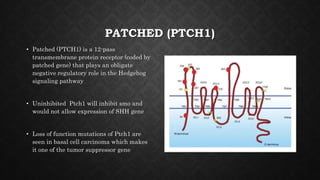
PATCHED (PTCH1)
• Patched (PTCH1) is a 12-pass
transmembrane protein receptor (coded by
patched gene) that plays an obligate
negative regulatory role in the Hedgehog
signaling pathway
• Uninhibited Ptch1 will inhibit smo and
would not allow expression of SHH gene
• Loss of function mutations of Ptch1 are
seen in basal cell carcinoma which makes
it one of the tumor suppressor gene
SMOOTHENED (SMO)
• Smoothened is a protein that in humans is encoded by the SMO gene.
• Smoothened is a Class Frizzled (Class F) G protein-coupled receptor that is a
component of the hedgehog signaling pathway and is conserved from flies to
humans
• It is the molecular target of the natural teratogen cyclopamine.
• It also is the target of Vismodegib, the first hedgehog pathway inhibitor to be
approved by the U.S. Food and Drug Administration (FDA)
• Gain-of-function mutations in the smo gene were discovered in the majority of those
BCCs implicating SMO as an oncogene
GLI FAMILY
• Zinc Finger Protein Family
• GLI1, GLI 2, GLI 3 proteins coded by respective genes
• Effectors of SHH pathway
• All of them can be transcriptional repressors or activators
• Gli1 (Glioma associated oncogene) and Gli2 both associated with BCC
• Overexpression of Gli3 in animals does not lead to the development of BCC-like
tumors.
Hh absent
PTCH inhibits Smo
Transcription inhibitor
GLI3 released in nuclear
area
Hh gene can’t be
expressed
Hh present
Binds PTCH
Smo
inhibition
released
Cytoplasmic
proteins
activate SHH
pathway
GLI factor
start
transcription
of SHH gene
INVERTEBRATES VERTEBRATES
One Hh Ligand three Hh ligands, Sonic hedgehog (Shh),
Desert hedgehog (Dhh) and Indian hedgehog
(Ihh);
Transmembrane receptors are Patched (Ptc),
cubitus interruptus (Ci), Smoothened (Smo)
two twelve-pass transmembrane receptors,
Patched1 (PTCH1) and Patched2 (PTCH2);
Smoothened (Smo)
signal transducers, such as Cos2, Fused (Fu),
or SuFu
three transcription factors, including GLI1,
GLI2 and GLI3
GASTRIC CANCERS
• All gastric cancer cell lines express the ligand Shh
• Increased Shh expression is associated with shorter survival
time in gastric cancer patients.
• High expression of Gli1 transcription factor is indicative of
highly aggresive tumor with poor prognosis in gastric cancer
patients
High SHH protein expression correlates with poor GC
prognosis. Patients with higher SHH expression displayed a lower
survival rate compared with that of patients with lower
expression (P = 0.033)
SHH PATHWAY & PATIENT
PROGNOSIS
EXAMPLES:
• Gastric Cancers
• Prostate cancers
• Pancreatic cancers
• Non small cell lung cancers
• Breast Cancer
• Hepatocellular Carcinoma
• Gastrointestinal Stromal tumors
• Colonic Cancers
PROSTATE CANCERS
• High expression of all hedgehog pathway components
is associated with poor prognosis
• Shh & Smo levels are significantly associated with
prostatic cancer recurrence
HH SIGNALLING IN PANCREATIC
CANCERS
• Shh overexpressed in 70% of pancreatic cancers
• Over expression of Shh can function as prognostic biomarker
in pancreatic ductal adenocarcinoma
• Over expression is detected in pancreatic intraepithelial
neoplasia & high levels are observed throughout the disease
but absent in normal pancreas.
HEPATOCELLULAR CARCINOMA
PATIENTS
• In this study, we found that GLI1 expression in HCC tissues
showed a significant relationship with DFS and OS
• The expression of GLI1 in SHH pathway is possibly involved
in HCC progression, which may be a useful prognostic
indicator of HCC.
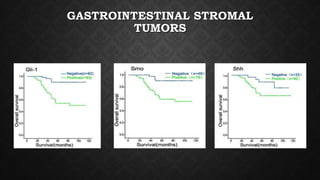
GASTROINTESTINAL STROMAL
TUMORS
SHH PATHWAY & BREAST
CANCERS
• Expression of hedgehog pathway components
SHH,PTCH1,GLI1 show increased expression in invasive
carcinomas but not in normal breat epithelium when detected
by immunohistochemistry
• Noman et al. established that SHH is overexpressed and is
involved in mediating the aggressive phenotype of the breast
cancer
SHH PATHWAY & COLONIC
CANCER
• Hh Gli pathway is active in epithelial colon cancers & is critical
for tumor growth,recurrence,metastasis.
NON-SMALL CELL LUNG CANCER
(NSCLC)
• Positivity of Gli1-cytoplasmic and Gli1-nuclear expression was
expressed in adenocarcinoma at a significantly higher level and
more frequently than compared to squamous cell carcinoma
(p<0.05).
• Overall survival was longer in Gli1 and Ptch1 negative tumor
samples compared to the positive group (p=0.02).
INHIBITORS OF SHH PATHWAY
Shh Pathway Inhibition in teatment of Basal Cell Carcinoma
INHIBITORS OF SHH PATHWAY
• Pathway can be blocked at various sites by inhibitors which
serve as useful anticancer drugs.
• The first component identified was cyclopamine, blocked
smoothened.
• However, cyclopamine could not be a potent therapeutic target
because of its low bioavailability short half-life and chemical
instability.
• Several synthetic, small-molecule SMO antagonists with higher
potency than cyclopamine such as SANT1–SANT4, CUR-61414
GDC-0449 are now available and have been tested in
preclinical models against a variety of solid tumors
• BCC is the first cancer to be treated with HH pathway
antagonists. GDC-0449 (vismodegib) a small molecule inhibitor
of SMO was the first drug to be used for the treatment of basal
cell carcinomas.
• It is used for locally advanced and metastatic BCC and is more
pharmacologically favorable than cyclopamine. LDE225
(sonidegib), discovered in 2010, is another potent selective SMO
antagonist with high tissue penetration and the ability to cross
the blood–brain barrier and is used for the treatment of BCC.
• The clinical success of hedgehog inhibitors is limited to brain
and skin cancers
• Presently the SMO antagonists and other pathway inhibitors
are also being studied for other solid tumors with activated HH
pathways, such as HH-dependent medulloblastomas or ovarian
cancer and metastatic pancreatic cancer, Colon cancer but have
not been very successful with respect to disease-free survival.
Compound Target
molecule
Stage Cancer
GDC-0449
vismodegib
SMO FDA approved Basal cell carcinoma
GDC-0449
vismodegib
SMO
Undergoing clinical
trials
Pancreatic cancer
Colorectal cancer
Prostate cancer
Breast cancer
Glasdegib SMO FDA approved
Acute myeloid
leukemia
LDE225
Sonidegib
SMO FDA approved Basal cell carcinoma
IPI-926
Saridegib
SMO
Undergoing clinical
trials
chondrosarcoma
Table 1. This table describes hedgehog inhibitors which are FDA approved or undergoing clinical trials for various cancers.
Taladegib SMO
Advanced solid tumors
Esophageal cancer
Colon cancer
BMS-833923 SMO
Undergoing clinical
trials
Advanced or metastatic
gastric, gastroesophageal,
or esophageal
adenocarcinomas
Itraconazole SMO
Undergoing clinical
trials
Basal cell carcinoma
Prostate cancer
Non-small cell lung cancer
Vitamin D SMO
Undergoing clinical
trials
Basal cell carcinoma
Acute myeloid leukemia
Arsenic
trioxide
GLI
Undergoing clinical
trials
Advanced Basal cell
carcinoma
Acute myeloid leukemia
QUESTIONS
• Most studied of the HH pathway?
• Name important receptors and ligands in SHH pathway
• Target ligand for therapeutics
• The disease most commonly associated with SHH pathway?
Shh signaling pathway

Shh signaling pathway

  • 2.
    SHH SIGNALING PATHWAY Dr. Dur-e-Zahra (Haematology) Dr . Atif Nawaz (Anatomy)
  • 3.
    CONTENTS • Introduction • Discoveryand name • SHH, PTCH1,SMO,GLI1 • Mechanism • Expression outcome in Cancers • Pathway relationship with patient prognosis • Inhibitors
  • 4.
    INTRODUCTION • The Hedgehogsignaling pathway is one of the key regulators of animal development and is present in all bilaterians from invertebrates like D.melanogaster to higher vertebrates like Mammals • In vertebrates, it is involved in organogenesis, including the growth of digits on limbs and the organization of the brain.
  • 5.
    DISCOVERY AND NAME •The pathway takes its name from its polypeptide ligand, an INTERCELLULAR signaling molecule called Hedgehog (Hh) which was discovered in the embryo of fruit flies of the genus Drosophila • It was named so because the fruit fly larva lacking the Hh gene are said to resemble hedgehog • The mutated hedgehog genes often cause birth defects. • Also, if it is activated later in life, certain cancers can be triggered and begin to spread.
  • 6.
    DISCOVERY • In 1995,Christiane Nüsslein- Volhard and Eric Wieschaus shared the Nobel Prize with Edward B. Lewis for their work studying genetic mutations in Drosophila embryogenesis .
  • 7.
  • 8.
    COMPONENTS OF SHHPATHWAY SHH protein ptch1 smo Gli
  • 9.
    SHH (SONIC HEDGEHOG) •Sonic hedgehog is a segment polarity protein that in humans is encoded by the SHH gene • Sonic hedgehog is example of a morphogen as defined by Lewis Wolpert's French flag model—a molecule that diffuses to form a concentration gradient and has different effects on the cells of the developing embryo depending on its concentration
  • 10.
    PATCHED (PTCH1) • Patched(PTCH1) is a 12-pass transmembrane protein receptor (coded by patched gene) that plays an obligate negative regulatory role in the Hedgehog signaling pathway • Uninhibited Ptch1 will inhibit smo and would not allow expression of SHH gene • Loss of function mutations of Ptch1 are seen in basal cell carcinoma which makes it one of the tumor suppressor gene
  • 11.
    SMOOTHENED (SMO) • Smoothenedis a protein that in humans is encoded by the SMO gene. • Smoothened is a Class Frizzled (Class F) G protein-coupled receptor that is a component of the hedgehog signaling pathway and is conserved from flies to humans • It is the molecular target of the natural teratogen cyclopamine. • It also is the target of Vismodegib, the first hedgehog pathway inhibitor to be approved by the U.S. Food and Drug Administration (FDA) • Gain-of-function mutations in the smo gene were discovered in the majority of those BCCs implicating SMO as an oncogene
  • 13.
    GLI FAMILY • ZincFinger Protein Family • GLI1, GLI 2, GLI 3 proteins coded by respective genes • Effectors of SHH pathway • All of them can be transcriptional repressors or activators • Gli1 (Glioma associated oncogene) and Gli2 both associated with BCC • Overexpression of Gli3 in animals does not lead to the development of BCC-like tumors.
  • 15.
    Hh absent PTCH inhibitsSmo Transcription inhibitor GLI3 released in nuclear area Hh gene can’t be expressed
  • 16.
    Hh present Binds PTCH Smo inhibition released Cytoplasmic proteins activateSHH pathway GLI factor start transcription of SHH gene
  • 17.
    INVERTEBRATES VERTEBRATES One HhLigand three Hh ligands, Sonic hedgehog (Shh), Desert hedgehog (Dhh) and Indian hedgehog (Ihh); Transmembrane receptors are Patched (Ptc), cubitus interruptus (Ci), Smoothened (Smo) two twelve-pass transmembrane receptors, Patched1 (PTCH1) and Patched2 (PTCH2); Smoothened (Smo) signal transducers, such as Cos2, Fused (Fu), or SuFu three transcription factors, including GLI1, GLI2 and GLI3
  • 26.
    GASTRIC CANCERS • Allgastric cancer cell lines express the ligand Shh • Increased Shh expression is associated with shorter survival time in gastric cancer patients. • High expression of Gli1 transcription factor is indicative of highly aggresive tumor with poor prognosis in gastric cancer patients
  • 27.
    High SHH proteinexpression correlates with poor GC prognosis. Patients with higher SHH expression displayed a lower survival rate compared with that of patients with lower expression (P = 0.033)
  • 28.
    SHH PATHWAY &PATIENT PROGNOSIS EXAMPLES: • Gastric Cancers • Prostate cancers • Pancreatic cancers • Non small cell lung cancers • Breast Cancer • Hepatocellular Carcinoma • Gastrointestinal Stromal tumors • Colonic Cancers
  • 29.
    PROSTATE CANCERS • Highexpression of all hedgehog pathway components is associated with poor prognosis • Shh & Smo levels are significantly associated with prostatic cancer recurrence
  • 30.
    HH SIGNALLING INPANCREATIC CANCERS • Shh overexpressed in 70% of pancreatic cancers • Over expression of Shh can function as prognostic biomarker in pancreatic ductal adenocarcinoma • Over expression is detected in pancreatic intraepithelial neoplasia & high levels are observed throughout the disease but absent in normal pancreas.
  • 31.
    HEPATOCELLULAR CARCINOMA PATIENTS • Inthis study, we found that GLI1 expression in HCC tissues showed a significant relationship with DFS and OS • The expression of GLI1 in SHH pathway is possibly involved in HCC progression, which may be a useful prognostic indicator of HCC.
  • 32.
  • 33.
    SHH PATHWAY &BREAST CANCERS • Expression of hedgehog pathway components SHH,PTCH1,GLI1 show increased expression in invasive carcinomas but not in normal breat epithelium when detected by immunohistochemistry • Noman et al. established that SHH is overexpressed and is involved in mediating the aggressive phenotype of the breast cancer
  • 34.
    SHH PATHWAY &COLONIC CANCER • Hh Gli pathway is active in epithelial colon cancers & is critical for tumor growth,recurrence,metastasis.
  • 35.
    NON-SMALL CELL LUNGCANCER (NSCLC) • Positivity of Gli1-cytoplasmic and Gli1-nuclear expression was expressed in adenocarcinoma at a significantly higher level and more frequently than compared to squamous cell carcinoma (p<0.05). • Overall survival was longer in Gli1 and Ptch1 negative tumor samples compared to the positive group (p=0.02).
  • 36.
    INHIBITORS OF SHHPATHWAY Shh Pathway Inhibition in teatment of Basal Cell Carcinoma
  • 37.
    INHIBITORS OF SHHPATHWAY • Pathway can be blocked at various sites by inhibitors which serve as useful anticancer drugs. • The first component identified was cyclopamine, blocked smoothened. • However, cyclopamine could not be a potent therapeutic target because of its low bioavailability short half-life and chemical instability.
  • 38.
    • Several synthetic,small-molecule SMO antagonists with higher potency than cyclopamine such as SANT1–SANT4, CUR-61414 GDC-0449 are now available and have been tested in preclinical models against a variety of solid tumors • BCC is the first cancer to be treated with HH pathway antagonists. GDC-0449 (vismodegib) a small molecule inhibitor of SMO was the first drug to be used for the treatment of basal cell carcinomas.
  • 39.
    • It isused for locally advanced and metastatic BCC and is more pharmacologically favorable than cyclopamine. LDE225 (sonidegib), discovered in 2010, is another potent selective SMO antagonist with high tissue penetration and the ability to cross the blood–brain barrier and is used for the treatment of BCC. • The clinical success of hedgehog inhibitors is limited to brain and skin cancers
  • 40.
    • Presently theSMO antagonists and other pathway inhibitors are also being studied for other solid tumors with activated HH pathways, such as HH-dependent medulloblastomas or ovarian cancer and metastatic pancreatic cancer, Colon cancer but have not been very successful with respect to disease-free survival.
  • 41.
    Compound Target molecule Stage Cancer GDC-0449 vismodegib SMOFDA approved Basal cell carcinoma GDC-0449 vismodegib SMO Undergoing clinical trials Pancreatic cancer Colorectal cancer Prostate cancer Breast cancer Glasdegib SMO FDA approved Acute myeloid leukemia LDE225 Sonidegib SMO FDA approved Basal cell carcinoma IPI-926 Saridegib SMO Undergoing clinical trials chondrosarcoma Table 1. This table describes hedgehog inhibitors which are FDA approved or undergoing clinical trials for various cancers.
  • 42.
    Taladegib SMO Advanced solidtumors Esophageal cancer Colon cancer BMS-833923 SMO Undergoing clinical trials Advanced or metastatic gastric, gastroesophageal, or esophageal adenocarcinomas Itraconazole SMO Undergoing clinical trials Basal cell carcinoma Prostate cancer Non-small cell lung cancer Vitamin D SMO Undergoing clinical trials Basal cell carcinoma Acute myeloid leukemia Arsenic trioxide GLI Undergoing clinical trials Advanced Basal cell carcinoma Acute myeloid leukemia
  • 43.
    QUESTIONS • Most studiedof the HH pathway? • Name important receptors and ligands in SHH pathway • Target ligand for therapeutics • The disease most commonly associated with SHH pathway?