RECONSTRUCTIVE
PERIODONTAL SURGERY
Presented By:
Dr. Manish Ashtankar
MDS
Periodontics and Implantology
• CONTENT
• EVALUATION OF NEW ATTACHMENT AND PERIODONTAL
RECONSTRUCTION
• Clinical Methods
• Radiographic Method
• Surgical Reentry
• Histological Method
• RECONSTRUCTIVE SURGICAL TECHNIQUE
• Non-Bone-Graft-Associated New Attachment
• Graft Material and Procedure
• Combined Technique
• SUMMARY
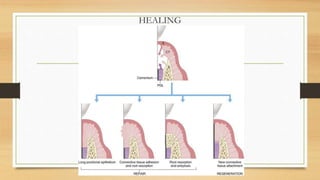
HEALING
EVALUATION OF NEW ATTACHMENT AND
PERIODONTAL RECONSTRUCTION
• New attachment has occurred
• Extent?
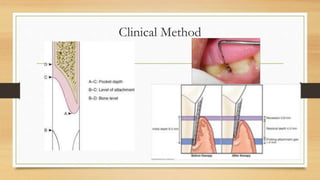
Clinical Method
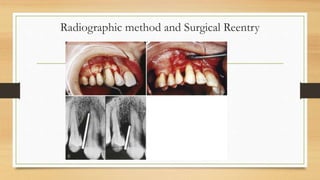
Radiographic method and Surgical Reentry
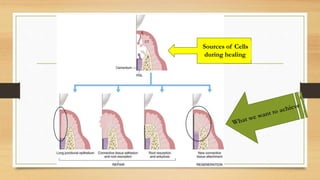
Sources of Cells
during healing
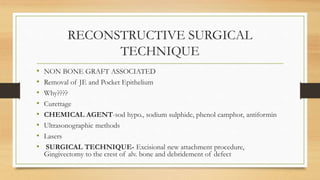
RECONSTRUCTIVE SURGICAL
TECHNIQUE
• NON BONE GRAFT ASSOCIATED
• Removal of JE and Pocket Epithelium
• Why????
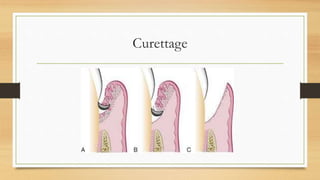
• Curettage
• CHEMICAL AGENT-sod hypo., sodium sulphide, phenol camphor, antiformin
• Ultrasonographic methods
• Lasers
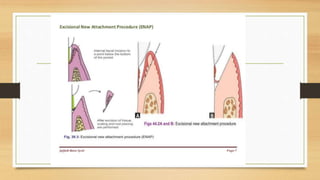
• SURGICAL TECHNIQUE- Excisional new attachment procedure,
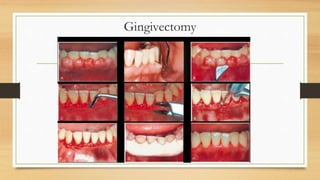
Gingivectomy to the crest of alv. bone and debridement of defect
Curettage
Gingivectomy
Prevention Of Impending Of Epithelial Migration
• Removal of interdental papilla and replacement by autogenous free gingival
graft from palate.
• Coronally displaced flap-increase the distance between epithelium and
wound area.
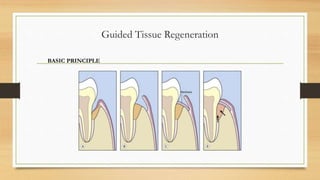
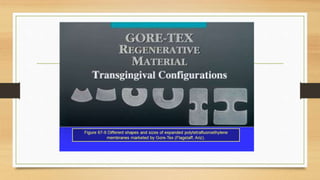
Guided Tissue Regeneration
BASIC PRINCIPLE
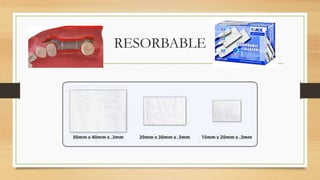
RESORBABLE
• Collagen membrane
• Vicryl membrane(polyglactin 910)
• Polylactic acid membrane
• Cargile membrane
• Oxidised cellulose membrane
• Hydrolyzable polyester
• Autogenous PERIOSTEUM
Clot Stabilization, Wound Protection, And Space Creation
• Preservation of root surface –fibrin clot interface
• Prevent apical migration of gingival epithelium
• Allow for connective tissue attachment
• Titanium reinforced ePTFE membrane
• Prevent Collapse— Resorbable membrane
Bio-modification of root surface
• Why required???
• Citric acid
• Fibronectin – glycoprotein-fibroblast require to attach to tooth surface
• Tetracycline-increases binding of fibronectin-turn stimulate fibroblast
attachment-suppress epithelial cell attachment and migration
Citric acid
• pH-1.0-1.4
• Application time-2or 3 min.
• Mode of action
• Removal of smear layer formed after root planing
• This creates a mat like collagen surface with exposed dentinal tubules
• PDL cells and gingival FIBROBLASTS adhere better to demineralized root surface.
•
CITRIC ACID MECHANISM FOR GAINING ROOT COVERAGE
• EXPOSED ROOT SURFACE
• CITRIC ACID Ph 1.0
• 4microns DEMINERALIZED SURFACE EXPOSED COLLAGEN FIBRILS
+EXPOSED COLLAGEN FIBRILS OF FLAP OR GRAFT.
• PLASMA FIBRONECTIN FACTOR,FACTOR 13
• FIBRIN COVALENT LINKAGE
Actions
• Accelerated healing and new cementum formation.
• No significant action on non-root planed roots,after root planing-4mm deep
demineralized zone is created.
• Antibacterial effect.(Daly,1982)
• Root detoxification(Aleo et al,1975)
• Prevents migration of epithelium .
• Enhanced fibroblast growth and stability(Boyko et al ,1980)
• Attachment by direct linkage.
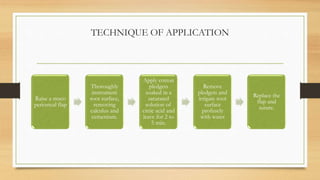
TECHNIQUE OF APPLICATION
Raise a muco
periosteal flap
Thoroughly
instrument
root surface,
removing
calculus and
cementum.
Apply cotton
pledgets
soaked in a
saturated
solution of
citric acid and
leave for 2 to
5 min.
Remove
pledgets and
irrigate root
surface
profusely
with water
Replace the
flap and
suture.
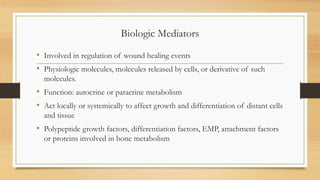
Biologic Mediators
• Involved in regulation of wound healing events
• Physiologic molecules, molecules released by cells, or derivative of such
molecules.
• Function: autocrine or paracrine metabolism
• Act locally or systemically to affect growth and differentiation of distant cells
and tissue
• Polypeptide growth factors, differentiation factors, EMP, attachment factors
or proteins involved in bone metabolism
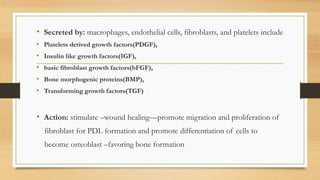
• Secreted by: macrophages, endothelial cells, fibroblasts, and platelets include
• Platelets derived growth factors(PDGF),
• Insulin like growth factors(IGF),
• basic fibroblast growth factors(bFGF),
• Bone morphogenic proteins(BMP),
• Transforming growth factors(TGF)
• Action: stimulate –wound healing—promote migration and proliferation of
fibroblast for PDL formation and promote differentiation of cells to
become osteoblast –favoring bone formation
Enamel Matrix Protein
• Amlogenin- secreted by HERS – tooth development—Acellular Cementum
formation– favor periodontal regeneration.
• Emdogain – marketed product [FDA approved]
Price $. 075.113.
0.3ml
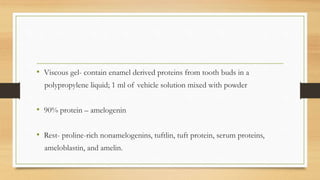
• Viscous gel- contain enamel derived proteins from tooth buds in a
polypropylene liquid; 1 ml of vehicle solution mixed with powder
• 90% protein – amelogenin
• Rest- proline-rich nonamelogenins, tuftlin, tuft protein, serum proteins,
ameloblastin, and amelin.
Technique
• Raised flap
• Debridement , control bleeding in defect
• Root surface treatment –citric acid or 24% EDTA(pH-6.7), 15 sec
• Rinse with saline
• Apply gel
• avoid contamination of wound by saliva and blood
• suture
• Systemic antibiotic[ doxycycline 100 mg ] for 10 to 21 days recommended
v
Action
• Promote bone cell attachment and cell spreading.
• Enhance proliferation of more immature bone cells
• Stimulating differentiation of more mature bone cells
• Not osteo-inductive but “ osteopromotive”
• Stimulate bone formation when combined with DFDB
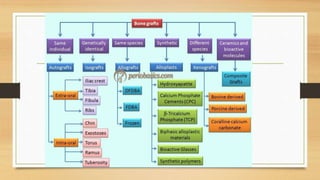
Graft Materials and Procedures
• Bone graft are the materials used for replacement or augmentation of the
bone
• Classification:
• Autograft (from same individual)
• Allograft/Homograft (different individual -- same species)
• Xenograft/Heterograft (different species)
• Alloplast (A synthetic graft or inert foreign body implanted into tissue)
Properties
• Osteogenesis:
• Osteoblast in transplanted bone having adequate blood supply
and cellular viability
• Form a new center of ossification within the graft
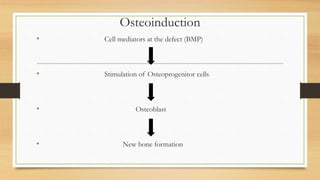
Osteoinduction
• Cell mediators at the defect (BMP)
• Stimulation of Osteoprogenitor cells
• Osteoblast
• New bone formation
Osteoconduction
• Physical effect by which the matrix of graft form a scaffold that favors
outside cells to penetrate the graft and form a new bone
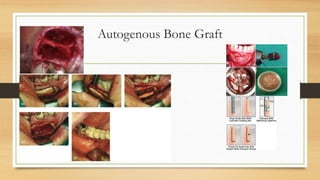
Autogenous Bone Graft
• Cortical bone chips
• Osseous coagulum
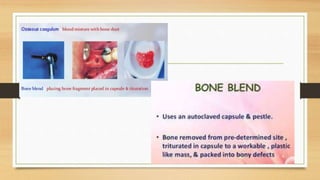
• Bone blend
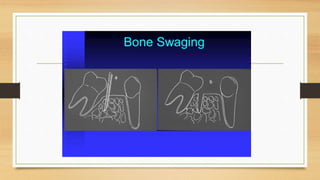
• Bone swaging
• Intraoral cancellous bone marrow transplant
Autogenous Bone Graft
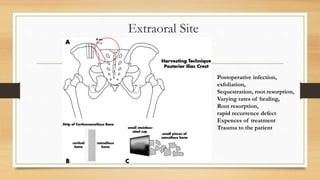
Extraoral Site
Postoperative infection,
exfoliation,
Sequestration, root resorption,
Varying rates of healing,
Root resorption,
rapid recurrence defect
Expences of treatment
Trauma to the patient
Allograft and Xenograft
• Foreign to body---risk to provoke immune response
• Suppress antigenic potential—by radiation, freezing, chemical treatment
• Allograft –DFDBA(Decalcified Freeze-Dried Bone Allograft ), FDBA
• Commercially obtained—cortical bone—12 hours—death of DONOR
---Defatted----cut in pieces---washed in absolute alcohol---deep frozen
• May be demineralized then---ground and sieved---250 to 750um and
• Freeze-dried
• Finally Vacuum sealed in glass vials
• FDBA--- Osteoconductive
• DFDBA– Osteoinductive
• DFDBA more osteogenic---so preferable
• DFDBA—Demineralisation—in cold, diluted HCL acid
• Exposes –component of bone matrix---BMPs[bone morphogenetic protein]
• Cancellous DFDBA>>>Cortical DFDBA
• Osteogenin or BMP3 –bone inductive protein isolated from the extracellular
matrix of human bone—tested and found to enhance osseous regeneration.
Xenograft
• Calf bone [ Boplant –treated by detergent extraction—sterilized—freeze-dried.
• Kiel bone is calf or OX bone –denatured with 20% H2O2---Dries with Acetone—
Sterilized with ethylene oxide.
• Anorganic bone is OX bone—organic material extracted by---ethylenediamine---
then sterilized by autoclaving.
• Ospurane : cow bone soaked in KOH , acetone and salt solution
• Boiled Bone: cow bone boiled or autoclaved
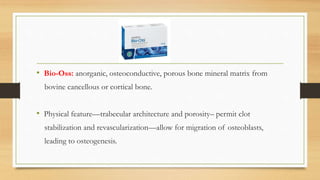
• Bio-Oss: anorganic, osteoconductive, porous bone mineral matrix from
bovine cancellous or cortical bone.
• Physical feature—trabecular architecture and porosity– permit clot
stabilization and revascularization—allow for migration of osteoblasts,
leading to osteogenesis.
Non Bone Graft Materials
• Sclera, dura, cartilage, cementum, dentin, plaster of paris, plastic materials,
ceramics and coral derived materials.
• Not a reliable substitute.
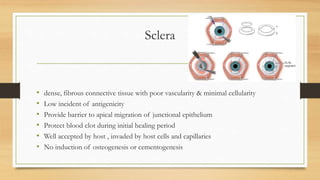
Sclera
• dense, fibrous connective tissue with poor vascularity & minimal cellularity
• Low incident of antigenicity
• Provide barrier to apical migration of junctional epithelium
• Protect blood clot during initial healing period
• Well accepted by host , invaded by host cells and capillaries
• No induction of osteogenesis or cementogenesis
• Cartilage: serves as a scaffolding, received limited evaluation
• Plaster of Paris [calcium sulfate] : biocompatible, porous, allowing fluid
exchange, resorbs completely in 1 to 2 weeks.
• Usefulness in human studies not proved
• Plastic material : composite of Polymethyl-methacrylate and
Polyhydroxyethylmethacrylate.
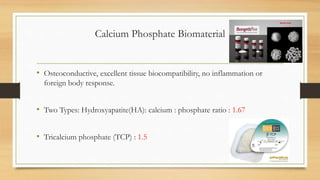
Calcium Phosphate Biomaterial
• Osteoconductive, excellent tissue biocompatibility, no inflammation or
foreign body response.
• Two Types: Hydroxyapatite(HA): calcium : phosphate ratio : 1.67
• Tricalcium phosphate (TCP) : 1.5
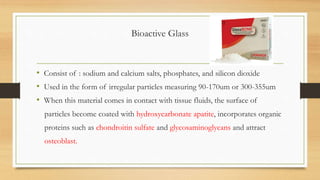
Bioactive Glass
• Consist of : sodium and calcium salts, phosphates, and silicon dioxide
• Used in the form of irregular particles measuring 90-170um or 300-355um
• When this material comes in contact with tissue fluids, the surface of
particles become coated with hydroxycarbonate apatite, incorporates organic
proteins such as chondroitin sulfate and glycosaminoglycans and attract
osteoblast.
Coral Derived Material
• Two types:
• Natural coral [resorbed slowly-several months]
• Coral derived porous hydroxyapatite [ years for resorption]
• Shows microscopic cementum and bone formation
• But slow resorbability —limited clinical success
Combined technique
• Froum et al : criteria for choice of treatment
• Clinical result depend upon:
• 1) dimension and morphology of defect( deeper>shallower)
• 2) number of walls
• 3) amount of root surface exposed and ability to obtain adequate flap
coverage
• 4) angle of defect with long axis of tooth (smaller – better)
Clinical Decision Tree
• For Deep, Well-Contained Defects—EMD alone, CAF (if necessary)
• For Moderate-Deep, Noncontained defects- EMD+Graft, CAF(if necessary)
• For Supracrestal Defects with a shallow Vertical Defect-
EMD+Graft+Barrier membrane, with Coronally Advanced Flap
EMD- enamel matrix derivative. Emdogain
[Froum et al 2001]
References
• Carranza 10th ed. and 12th ed.

Reconstructive periodontal surgery

  • 1.
    RECONSTRUCTIVE PERIODONTAL SURGERY Presented By: Dr.Manish Ashtankar MDS Periodontics and Implantology
  • 2.
    • CONTENT • EVALUATIONOF NEW ATTACHMENT AND PERIODONTAL RECONSTRUCTION • Clinical Methods • Radiographic Method • Surgical Reentry • Histological Method • RECONSTRUCTIVE SURGICAL TECHNIQUE • Non-Bone-Graft-Associated New Attachment • Graft Material and Procedure • Combined Technique • SUMMARY
  • 3.
  • 4.
    EVALUATION OF NEWATTACHMENT AND PERIODONTAL RECONSTRUCTION • New attachment has occurred • Extent?
  • 5.
  • 6.
    Radiographic method andSurgical Reentry
  • 7.
  • 8.
    RECONSTRUCTIVE SURGICAL TECHNIQUE • NONBONE GRAFT ASSOCIATED • Removal of JE and Pocket Epithelium • Why???? • Curettage • CHEMICAL AGENT-sod hypo., sodium sulphide, phenol camphor, antiformin • Ultrasonographic methods • Lasers • SURGICAL TECHNIQUE- Excisional new attachment procedure, Gingivectomy to the crest of alv. bone and debridement of defect
  • 9.
  • 11.
  • 12.
    Prevention Of ImpendingOf Epithelial Migration • Removal of interdental papilla and replacement by autogenous free gingival graft from palate. • Coronally displaced flap-increase the distance between epithelium and wound area.
  • 13.
  • 15.
  • 16.
    • Collagen membrane •Vicryl membrane(polyglactin 910) • Polylactic acid membrane • Cargile membrane • Oxidised cellulose membrane • Hydrolyzable polyester • Autogenous PERIOSTEUM
  • 17.
    Clot Stabilization, WoundProtection, And Space Creation • Preservation of root surface –fibrin clot interface • Prevent apical migration of gingival epithelium • Allow for connective tissue attachment • Titanium reinforced ePTFE membrane • Prevent Collapse— Resorbable membrane
  • 18.
    Bio-modification of rootsurface • Why required??? • Citric acid • Fibronectin – glycoprotein-fibroblast require to attach to tooth surface • Tetracycline-increases binding of fibronectin-turn stimulate fibroblast attachment-suppress epithelial cell attachment and migration
  • 19.
    Citric acid • pH-1.0-1.4 •Application time-2or 3 min. • Mode of action • Removal of smear layer formed after root planing • This creates a mat like collagen surface with exposed dentinal tubules • PDL cells and gingival FIBROBLASTS adhere better to demineralized root surface. •
  • 20.
    CITRIC ACID MECHANISMFOR GAINING ROOT COVERAGE • EXPOSED ROOT SURFACE • CITRIC ACID Ph 1.0 • 4microns DEMINERALIZED SURFACE EXPOSED COLLAGEN FIBRILS +EXPOSED COLLAGEN FIBRILS OF FLAP OR GRAFT. • PLASMA FIBRONECTIN FACTOR,FACTOR 13 • FIBRIN COVALENT LINKAGE
  • 21.
    Actions • Accelerated healingand new cementum formation. • No significant action on non-root planed roots,after root planing-4mm deep demineralized zone is created. • Antibacterial effect.(Daly,1982) • Root detoxification(Aleo et al,1975) • Prevents migration of epithelium . • Enhanced fibroblast growth and stability(Boyko et al ,1980) • Attachment by direct linkage.
  • 22.
    TECHNIQUE OF APPLICATION Raisea muco periosteal flap Thoroughly instrument root surface, removing calculus and cementum. Apply cotton pledgets soaked in a saturated solution of citric acid and leave for 2 to 5 min. Remove pledgets and irrigate root surface profusely with water Replace the flap and suture.
  • 23.
    Biologic Mediators • Involvedin regulation of wound healing events • Physiologic molecules, molecules released by cells, or derivative of such molecules. • Function: autocrine or paracrine metabolism • Act locally or systemically to affect growth and differentiation of distant cells and tissue • Polypeptide growth factors, differentiation factors, EMP, attachment factors or proteins involved in bone metabolism
  • 24.
    • Secreted by:macrophages, endothelial cells, fibroblasts, and platelets include • Platelets derived growth factors(PDGF), • Insulin like growth factors(IGF), • basic fibroblast growth factors(bFGF), • Bone morphogenic proteins(BMP), • Transforming growth factors(TGF) • Action: stimulate –wound healing—promote migration and proliferation of fibroblast for PDL formation and promote differentiation of cells to become osteoblast –favoring bone formation
  • 25.
    Enamel Matrix Protein •Amlogenin- secreted by HERS – tooth development—Acellular Cementum formation– favor periodontal regeneration. • Emdogain – marketed product [FDA approved] Price $. 075.113. 0.3ml
  • 26.
    • Viscous gel-contain enamel derived proteins from tooth buds in a polypropylene liquid; 1 ml of vehicle solution mixed with powder • 90% protein – amelogenin • Rest- proline-rich nonamelogenins, tuftlin, tuft protein, serum proteins, ameloblastin, and amelin.
  • 27.
    Technique • Raised flap •Debridement , control bleeding in defect • Root surface treatment –citric acid or 24% EDTA(pH-6.7), 15 sec • Rinse with saline • Apply gel • avoid contamination of wound by saliva and blood • suture • Systemic antibiotic[ doxycycline 100 mg ] for 10 to 21 days recommended v
  • 28.
    Action • Promote bonecell attachment and cell spreading. • Enhance proliferation of more immature bone cells • Stimulating differentiation of more mature bone cells • Not osteo-inductive but “ osteopromotive” • Stimulate bone formation when combined with DFDB
  • 29.
    Graft Materials andProcedures • Bone graft are the materials used for replacement or augmentation of the bone • Classification: • Autograft (from same individual) • Allograft/Homograft (different individual -- same species) • Xenograft/Heterograft (different species) • Alloplast (A synthetic graft or inert foreign body implanted into tissue)
  • 31.
    Properties • Osteogenesis: • Osteoblastin transplanted bone having adequate blood supply and cellular viability • Form a new center of ossification within the graft
  • 32.
    Osteoinduction • Cell mediatorsat the defect (BMP) • Stimulation of Osteoprogenitor cells • Osteoblast • New bone formation
  • 33.
    Osteoconduction • Physical effectby which the matrix of graft form a scaffold that favors outside cells to penetrate the graft and form a new bone
  • 34.
    Autogenous Bone Graft •Cortical bone chips • Osseous coagulum • Bone blend • Bone swaging • Intraoral cancellous bone marrow transplant
  • 35.
  • 38.
    Extraoral Site Postoperative infection, exfoliation, Sequestration,root resorption, Varying rates of healing, Root resorption, rapid recurrence defect Expences of treatment Trauma to the patient
  • 39.
    Allograft and Xenograft •Foreign to body---risk to provoke immune response • Suppress antigenic potential—by radiation, freezing, chemical treatment • Allograft –DFDBA(Decalcified Freeze-Dried Bone Allograft ), FDBA • Commercially obtained—cortical bone—12 hours—death of DONOR ---Defatted----cut in pieces---washed in absolute alcohol---deep frozen • May be demineralized then---ground and sieved---250 to 750um and • Freeze-dried • Finally Vacuum sealed in glass vials
  • 40.
    • FDBA--- Osteoconductive •DFDBA– Osteoinductive • DFDBA more osteogenic---so preferable • DFDBA—Demineralisation—in cold, diluted HCL acid • Exposes –component of bone matrix---BMPs[bone morphogenetic protein] • Cancellous DFDBA>>>Cortical DFDBA • Osteogenin or BMP3 –bone inductive protein isolated from the extracellular matrix of human bone—tested and found to enhance osseous regeneration.
  • 41.
    Xenograft • Calf bone[ Boplant –treated by detergent extraction—sterilized—freeze-dried. • Kiel bone is calf or OX bone –denatured with 20% H2O2---Dries with Acetone— Sterilized with ethylene oxide. • Anorganic bone is OX bone—organic material extracted by---ethylenediamine--- then sterilized by autoclaving.
  • 42.
    • Ospurane :cow bone soaked in KOH , acetone and salt solution • Boiled Bone: cow bone boiled or autoclaved
  • 43.
    • Bio-Oss: anorganic,osteoconductive, porous bone mineral matrix from bovine cancellous or cortical bone. • Physical feature—trabecular architecture and porosity– permit clot stabilization and revascularization—allow for migration of osteoblasts, leading to osteogenesis.
  • 44.
    Non Bone GraftMaterials • Sclera, dura, cartilage, cementum, dentin, plaster of paris, plastic materials, ceramics and coral derived materials. • Not a reliable substitute.
  • 45.
    Sclera • dense, fibrousconnective tissue with poor vascularity & minimal cellularity • Low incident of antigenicity • Provide barrier to apical migration of junctional epithelium • Protect blood clot during initial healing period • Well accepted by host , invaded by host cells and capillaries • No induction of osteogenesis or cementogenesis
  • 46.
    • Cartilage: servesas a scaffolding, received limited evaluation • Plaster of Paris [calcium sulfate] : biocompatible, porous, allowing fluid exchange, resorbs completely in 1 to 2 weeks. • Usefulness in human studies not proved • Plastic material : composite of Polymethyl-methacrylate and Polyhydroxyethylmethacrylate.
  • 47.
    Calcium Phosphate Biomaterial •Osteoconductive, excellent tissue biocompatibility, no inflammation or foreign body response. • Two Types: Hydroxyapatite(HA): calcium : phosphate ratio : 1.67 • Tricalcium phosphate (TCP) : 1.5
  • 48.
    Bioactive Glass • Consistof : sodium and calcium salts, phosphates, and silicon dioxide • Used in the form of irregular particles measuring 90-170um or 300-355um • When this material comes in contact with tissue fluids, the surface of particles become coated with hydroxycarbonate apatite, incorporates organic proteins such as chondroitin sulfate and glycosaminoglycans and attract osteoblast.
  • 49.
    Coral Derived Material •Two types: • Natural coral [resorbed slowly-several months] • Coral derived porous hydroxyapatite [ years for resorption] • Shows microscopic cementum and bone formation • But slow resorbability —limited clinical success
  • 50.
    Combined technique • Froumet al : criteria for choice of treatment • Clinical result depend upon: • 1) dimension and morphology of defect( deeper>shallower) • 2) number of walls • 3) amount of root surface exposed and ability to obtain adequate flap coverage • 4) angle of defect with long axis of tooth (smaller – better)
  • 51.
    Clinical Decision Tree •For Deep, Well-Contained Defects—EMD alone, CAF (if necessary) • For Moderate-Deep, Noncontained defects- EMD+Graft, CAF(if necessary) • For Supracrestal Defects with a shallow Vertical Defect- EMD+Graft+Barrier membrane, with Coronally Advanced Flap EMD- enamel matrix derivative. Emdogain [Froum et al 2001]
  • 53.