Reproductive Physiology
The Male Reproductive System
Dr. Khalid Alregaiey
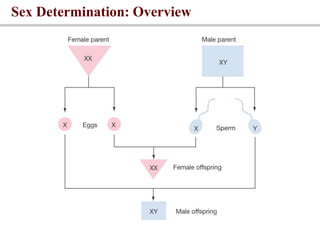
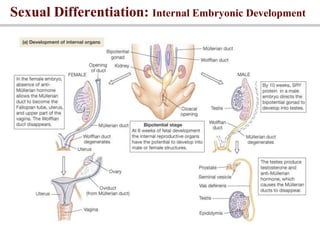
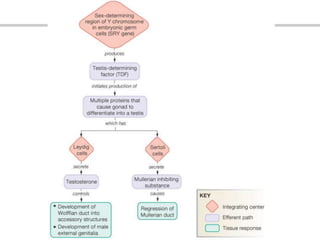
Sex Determination: Overview
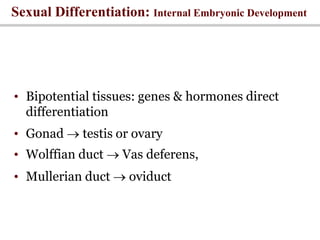
• Bipotential tissues: genes & hormones direct
differentiation
• Gonad  testis or ovary
• Wolffian duct  Vas deferens,
• Mullerian duct  oviduct
Sexual Differentiation: Internal Embryonic Development
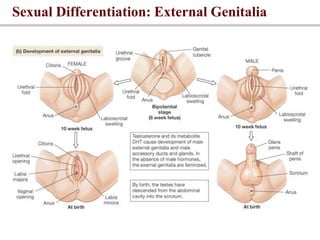
Sexual Differentiation: External Genitalia
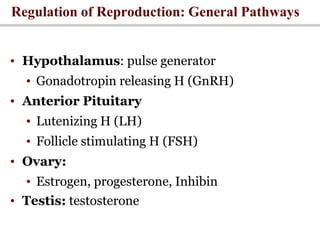
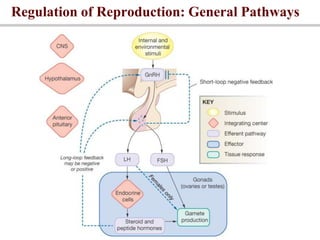
Regulation of Reproduction: General Pathways
• Hypothalamus: pulse generator
• Gonadotropin releasing H (GnRH)
• Anterior Pituitary
• Lutenizing H (LH)
• Follicle stimulating H (FSH)
• Ovary:
• Estrogen, progesterone, Inhibin
• Testis: testosterone
Regulation of Reproduction: General Pathways
Male Reproductive Anatomy and Physiology
• Testis
• Epididymis
• Vas deferens
• Seminal vesicle
• Prostate
• Bulbourethral
• Ejaculatory duct
• Urethra
• Penis
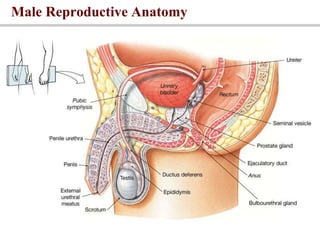
Male Reproductive Anatomy
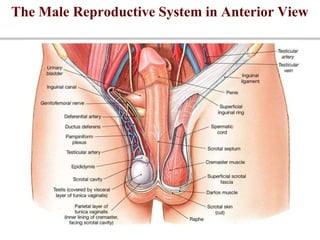
The Male Reproductive System in Anterior View
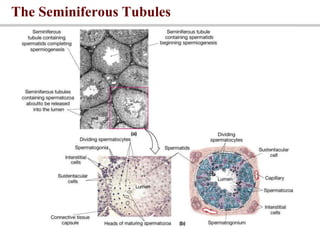
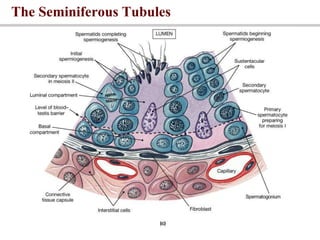
The Seminiferous Tubules
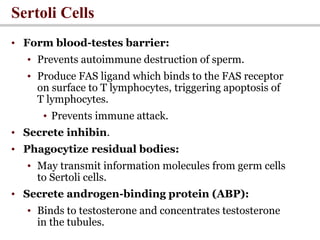
Sertoli Cells
• Form blood-testes barrier:
• Prevents autoimmune destruction of sperm.
• Produce FAS ligand which binds to the FAS receptor
on surface to T lymphocytes, triggering apoptosis of
T lymphocytes.
• Prevents immune attack.
• Secrete inhibin.
• Phagocytize residual bodies:
• May transmit information molecules from germ cells
to Sertoli cells.
• Secrete androgen-binding protein (ABP):
• Binds to testosterone and concentrates testosterone
in the tubules.
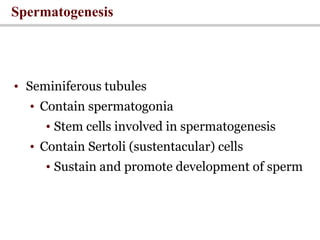
• Seminiferous tubules
• Contain spermatogonia
• Stem cells involved in spermatogenesis
• Contain Sertoli (sustentacular) cells
• Sustain and promote development of sperm
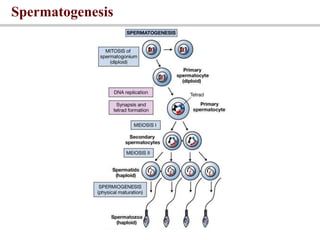
Spermatogenesis
Spermatogenesis
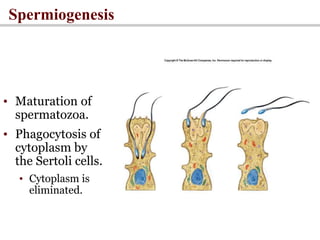
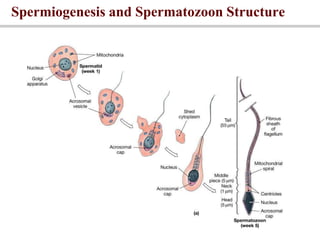
Spermiogenesis
• Maturation of
spermatozoa.
• Phagocytosis of
cytoplasm by
the Sertoli cells.
• Cytoplasm is
eliminated.
Insert fig. 20.18
Spermiogenesis and Spermatozoon Structure
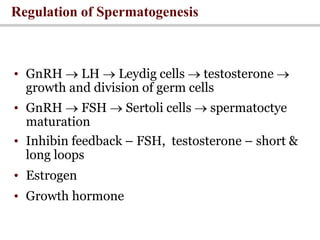
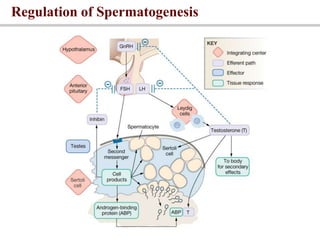
• GnRH  LH  Leydig cells  testosterone 
growth and division of germ cells
• GnRH  FSH  Sertoli cells  spermatoctye
maturation
• Inhibin feedback – FSH, testosterone – short &
long loops
• Estrogen
• Growth hormone
Regulation of Spermatogenesis
Maturation of Sperm in Epididymis
• Sperms in the early portion of epididymis are
nonmotile
• After 18-24 h they develop capability of motility
• Most of sperms are stored in epididymis
• After ejaculation they become motile
• Activity of a sperm is greatly enhanced in neutral
to slightly alkaline medium
Seminal Vesicles
• S Vs produce fructose, citric acid and other
nutrients as well as prostaglandins and fibrinogen
Prostate
• Slightly alkaline milky fluid that help in
neutralizing other seminal fluids as well as the
vaginal fluids
• Prostates fluids also contain clotting protein and
profibrinolysin
Semen
• Milky white, sticky mixture of sperm and accessory
gland secretions (65% of semen is from seminal
vesicle, 25% prostate)
• Provides a transport medium and nutrients
(fructose), protects and activates sperm, and
facilitates their movement
• pH is 7.5
• Prostaglandins in semen:
• Decrease the viscosity of mucus in the cervix
• Stimulate reverse peristalsis in the uterus
• Facilitate the movement of sperm through the
female reproductive tract
Semen
• Clotting factors coagulate semen immediately after
ejaculation, then fibrinolysin liquefies the sticky
mass during the next 15-30 minutes
• After ejaculation, sperms can live 24-48 h
• Freshly ejaculated semen undergoes a process
called capacitation: 1. inhibitory factors are
washed out by uterine and fallopian fluids, 2. the
sperm swims away from cholesterol vesicles, 3. the
mebrane of the sperms becomes more permeable to
Ca++
• Only 2-5 ml of semen are ejaculated, but it contains
35-200 million sperm/ml (<20 million infertile)
• When the majority of the sperm are
morphologically abnormal or nonmotile then
person is likely to be infertile
Semen
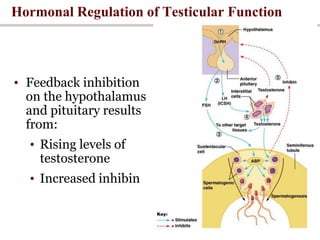
Hormonal Regulation of Testicular Function
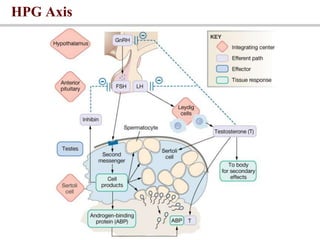
• The hypothalamus releases gonadotropin-
releasing hormone (GnRH)
• GnRH stimulates the anterior pituitary to secrete
FSH and LH
• FSH causes Sertoli cells to release androgen-
binding protein (ABP)
• LH stimulates interstitial (Leydig) cells to
release testosterone
• ABP binding of testosterone enhances
spermatogenesis
HPG Axis
Hormonal Regulation of Testicular Function
• Feedback inhibition
on the hypothalamus
and pituitary results
from:
• Rising levels of
testosterone
• Increased inhibin
Mechanism and Effects of Testosterone Activity
• Testosterone is synthesized from cholesterol
• It binds to testosterone –binding globulin
(TeBG), ABP, serum albumin, or to
corticosterone-binding globulin (CBG)
• Once it diffuses to cells it either binds to
androgen receptor or converted to DHT which
then binds to the androgen receptor
• Testosterone targets all accessory organs, its
deficiency causes these organs to atrophy
• It causes testes descent during the last 2-3
months of gestation.
Testosterone Functions:
• Testosterone targets all male reproductive organs
and accessory glands, its deficiency causes these
organs to atrophy
• Causes the appearance of pubic, axillary, and
facial hair
• Enhances growth of the chest and deepening of
the voice
• Skin thickens and becomes oily
• Bones grow and increase in density and
calcium retention. It is also responsible for the
male pelvis shape (narrow, long, funnel-like
shape).
Testosterone functions (continued)
• It increases basal metabolic rate
• Increases red blood cells
• It also causes hair growth (pubic, axillary) and
libido in females.
• Spermatogenesis and erection.
Male Sexual Act
• Erection is initiated by sexual stimuli including:
• Touch and mechanical stimulation of the
glans penis and other parts
• Erotic sights, sounds, and smells
• Erection can be induced or inhibited solely by
emotional or higher mental activity
• Enlargement and stiffening of the penis from
engorgement of erectile tissue with blood
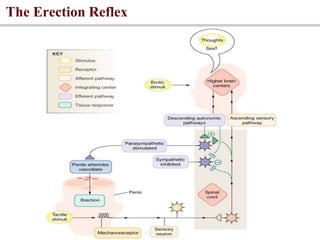
• During sexual arousal, a parasympathetic reflex
promotes the release of nitric oxide, VIP, and
Acetylcholine.
• Nitric oxide relaxes the penis arteries and
causes erectile tissue to fill with blood
• Expansion of the corpora cavernosa:
• Compresses their drainage veins
• Retards blood outflow and maintains
engorgement
• When the sexual stimulus becomes extremely
intense, spinal cord begins to send sympathetic
impulses to initiate emission
• Filling of the internal urethra with semen elicits
signals that promotes ejaculation
• After orgasm, the excitement disappears within
1-2 minutes (resolution)
The Erection Reflex

1&2-Male Reproductive system.ppt

  • 1.
    Reproductive Physiology The MaleReproductive System Dr. Khalid Alregaiey
  • 2.
  • 3.
    • Bipotential tissues:genes & hormones direct differentiation • Gonad  testis or ovary • Wolffian duct  Vas deferens, • Mullerian duct  oviduct Sexual Differentiation: Internal Embryonic Development
  • 4.
    Sexual Differentiation: InternalEmbryonic Development
  • 5.
  • 7.
    Regulation of Reproduction:General Pathways • Hypothalamus: pulse generator • Gonadotropin releasing H (GnRH) • Anterior Pituitary • Lutenizing H (LH) • Follicle stimulating H (FSH) • Ovary: • Estrogen, progesterone, Inhibin • Testis: testosterone
  • 8.
  • 9.
    Male Reproductive Anatomyand Physiology • Testis • Epididymis • Vas deferens • Seminal vesicle • Prostate • Bulbourethral • Ejaculatory duct • Urethra • Penis
  • 10.
  • 11.
    The Male ReproductiveSystem in Anterior View
  • 12.
  • 13.
  • 14.
    Sertoli Cells • Formblood-testes barrier: • Prevents autoimmune destruction of sperm. • Produce FAS ligand which binds to the FAS receptor on surface to T lymphocytes, triggering apoptosis of T lymphocytes. • Prevents immune attack. • Secrete inhibin. • Phagocytize residual bodies: • May transmit information molecules from germ cells to Sertoli cells. • Secrete androgen-binding protein (ABP): • Binds to testosterone and concentrates testosterone in the tubules.
  • 15.
    • Seminiferous tubules •Contain spermatogonia • Stem cells involved in spermatogenesis • Contain Sertoli (sustentacular) cells • Sustain and promote development of sperm Spermatogenesis
  • 16.
  • 17.
    Spermiogenesis • Maturation of spermatozoa. •Phagocytosis of cytoplasm by the Sertoli cells. • Cytoplasm is eliminated. Insert fig. 20.18
  • 18.
  • 19.
    • GnRH LH  Leydig cells  testosterone  growth and division of germ cells • GnRH  FSH  Sertoli cells  spermatoctye maturation • Inhibin feedback – FSH, testosterone – short & long loops • Estrogen • Growth hormone Regulation of Spermatogenesis
  • 20.
  • 21.
    Maturation of Spermin Epididymis • Sperms in the early portion of epididymis are nonmotile • After 18-24 h they develop capability of motility • Most of sperms are stored in epididymis • After ejaculation they become motile • Activity of a sperm is greatly enhanced in neutral to slightly alkaline medium
  • 22.
    Seminal Vesicles • SVs produce fructose, citric acid and other nutrients as well as prostaglandins and fibrinogen Prostate • Slightly alkaline milky fluid that help in neutralizing other seminal fluids as well as the vaginal fluids • Prostates fluids also contain clotting protein and profibrinolysin
  • 23.
    Semen • Milky white,sticky mixture of sperm and accessory gland secretions (65% of semen is from seminal vesicle, 25% prostate) • Provides a transport medium and nutrients (fructose), protects and activates sperm, and facilitates their movement • pH is 7.5 • Prostaglandins in semen: • Decrease the viscosity of mucus in the cervix • Stimulate reverse peristalsis in the uterus • Facilitate the movement of sperm through the female reproductive tract
  • 24.
    Semen • Clotting factorscoagulate semen immediately after ejaculation, then fibrinolysin liquefies the sticky mass during the next 15-30 minutes • After ejaculation, sperms can live 24-48 h • Freshly ejaculated semen undergoes a process called capacitation: 1. inhibitory factors are washed out by uterine and fallopian fluids, 2. the sperm swims away from cholesterol vesicles, 3. the mebrane of the sperms becomes more permeable to Ca++
  • 25.
    • Only 2-5ml of semen are ejaculated, but it contains 35-200 million sperm/ml (<20 million infertile) • When the majority of the sperm are morphologically abnormal or nonmotile then person is likely to be infertile Semen
  • 26.
    Hormonal Regulation ofTesticular Function • The hypothalamus releases gonadotropin- releasing hormone (GnRH) • GnRH stimulates the anterior pituitary to secrete FSH and LH • FSH causes Sertoli cells to release androgen- binding protein (ABP) • LH stimulates interstitial (Leydig) cells to release testosterone • ABP binding of testosterone enhances spermatogenesis
  • 27.
  • 28.
    Hormonal Regulation ofTesticular Function • Feedback inhibition on the hypothalamus and pituitary results from: • Rising levels of testosterone • Increased inhibin
  • 29.
    Mechanism and Effectsof Testosterone Activity • Testosterone is synthesized from cholesterol • It binds to testosterone –binding globulin (TeBG), ABP, serum albumin, or to corticosterone-binding globulin (CBG) • Once it diffuses to cells it either binds to androgen receptor or converted to DHT which then binds to the androgen receptor • Testosterone targets all accessory organs, its deficiency causes these organs to atrophy • It causes testes descent during the last 2-3 months of gestation.
  • 30.
    Testosterone Functions: • Testosteronetargets all male reproductive organs and accessory glands, its deficiency causes these organs to atrophy • Causes the appearance of pubic, axillary, and facial hair • Enhances growth of the chest and deepening of the voice • Skin thickens and becomes oily • Bones grow and increase in density and calcium retention. It is also responsible for the male pelvis shape (narrow, long, funnel-like shape).
  • 31.
    Testosterone functions (continued) •It increases basal metabolic rate • Increases red blood cells • It also causes hair growth (pubic, axillary) and libido in females. • Spermatogenesis and erection.
  • 32.
    Male Sexual Act •Erection is initiated by sexual stimuli including: • Touch and mechanical stimulation of the glans penis and other parts • Erotic sights, sounds, and smells • Erection can be induced or inhibited solely by emotional or higher mental activity • Enlargement and stiffening of the penis from engorgement of erectile tissue with blood
  • 33.
    • During sexualarousal, a parasympathetic reflex promotes the release of nitric oxide, VIP, and Acetylcholine. • Nitric oxide relaxes the penis arteries and causes erectile tissue to fill with blood • Expansion of the corpora cavernosa: • Compresses their drainage veins • Retards blood outflow and maintains engorgement
  • 34.
    • When thesexual stimulus becomes extremely intense, spinal cord begins to send sympathetic impulses to initiate emission • Filling of the internal urethra with semen elicits signals that promotes ejaculation • After orgasm, the excitement disappears within 1-2 minutes (resolution)
  • 35.