Spectral Analysis at the Limit –
Applications in Radio Astronomy
Bruno Stuber Christian Monstein
Content
1. Objectives and Technical Challenges
2. Applications in Radio Astronomy
3. Summary and Conclusion
17. March 2015 2
Spectral Analysis at the Limit –
Applications in Radio Astronomy
Digital Filterbank: 1-/2-Channel Mode using FPGAs
Bruno Stuber FHNW, Institute for Automation
Christian Monstein ETH Zurich, Institute for Astronomy
17. March 2015 3
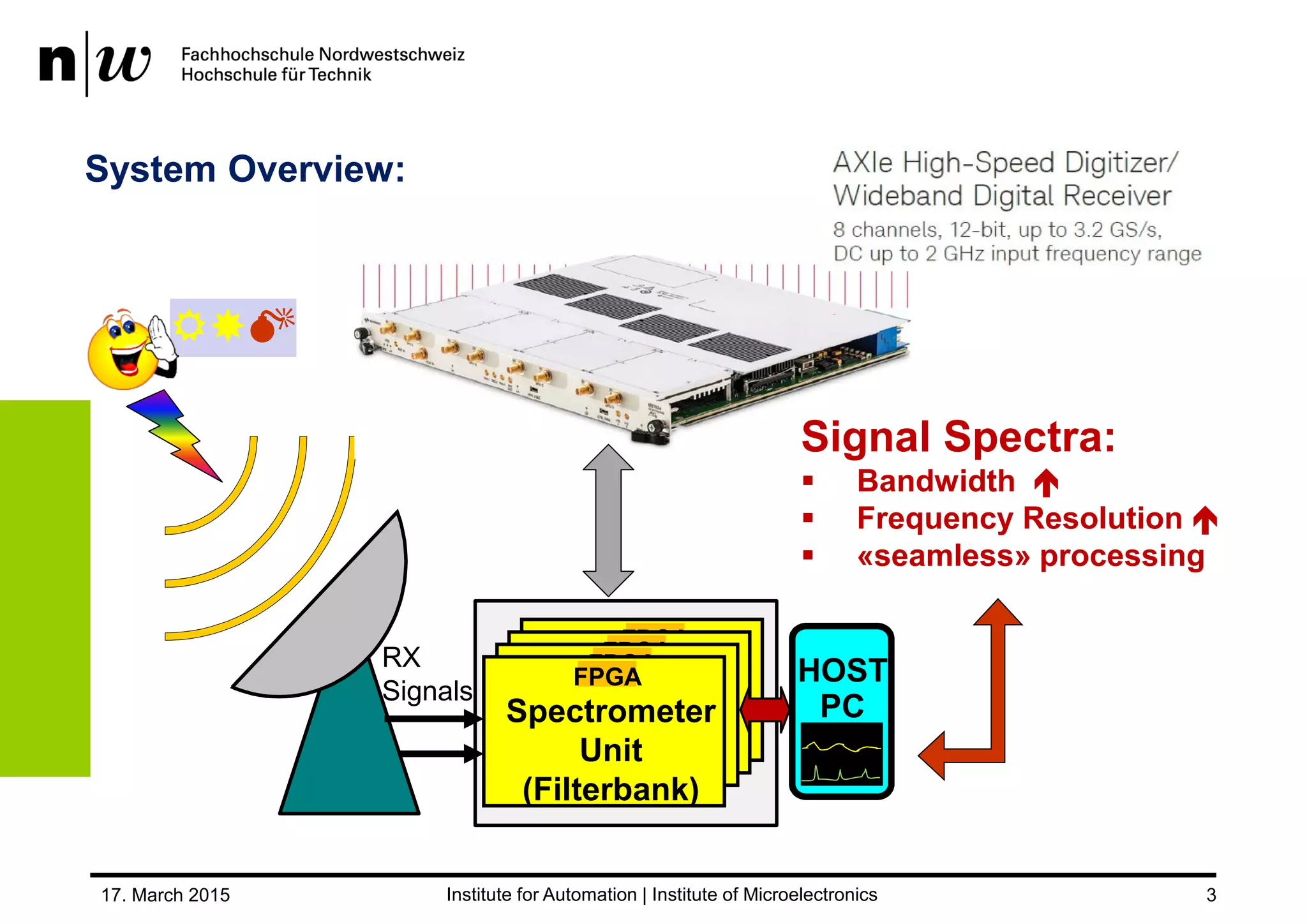
FPGAFPGA
FPGA
Spectrometer
Unit
(Filterbank)
HOST
PC
RX
Signals
FPGA
Signal Spectra:
 Bandwidth 
 Frequency Resolution 
 «seamless» processing
System Overview:

Project
CTI
Contribution
Total [kFr]
CTI
FHNW
Project Partners FHNW
Filterbank 2014 457 360
Industrial Partner
ETH Zurich IA
Uni Bern IAP
IA
IME
FFT 2 2008
CoSpan
(50++) 50 Uni Bern IAP
IA
IME
FFT 1 2005
ARGOS
292 240
Industrial Partner
ETH Zurich IA
Uni Bern IAP
IA
IME
17. March 2015 4
The Line of Projects:
17. March 2015 5
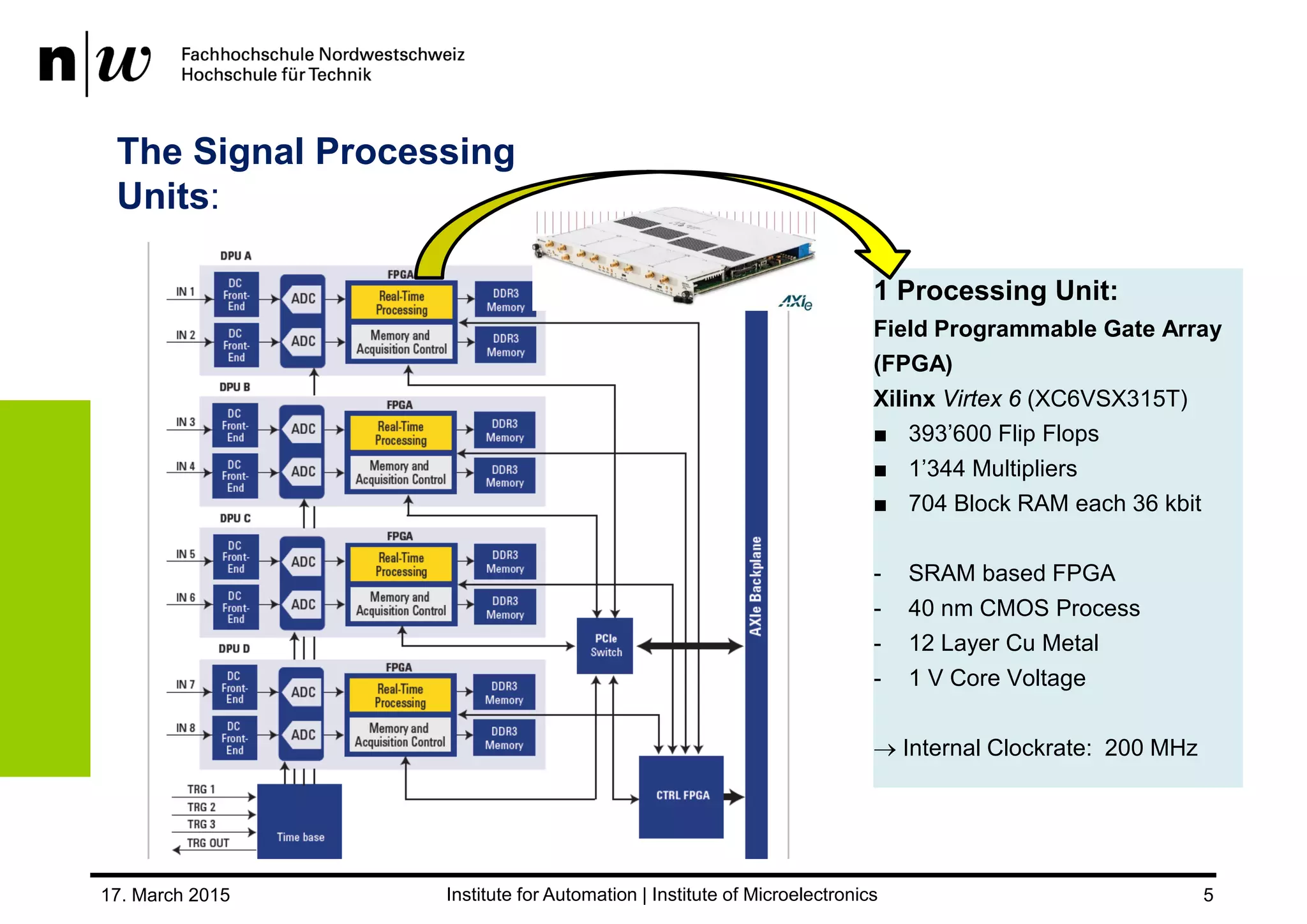
1 Processing Unit:
Field Programmable Gate Array
(FPGA)
Xilinx Virtex 6 (XC6VSX315T)
■ 393’600 Flip Flops
■ 1’344 Multipliers
■ 704 Block RAM each 36 kbit
- SRAM based FPGA
- 40 nm CMOS Process
- 12 Layer Cu Metal
- 1 V Core Voltage
 Internal Clockrate: 200 MHz
The Signal Processing
Units:
17. March 2015 6
A
D
Filter-
Bank
(Polyphase
Filters)
Output
Pro-
cessing
Accumu-
lation 1
x(t)
fs
(3.2 GS/s )
32k
FFT
DDR3
RAM
Control-
Inter-
face
Data-
Inter-
face
Window
ROM
FPGA
Data
Control
Accumu-
lation 2
X
Single Channel Mode:
A
D
Filter-
bank
Accu
3&4
x(t)
32k
FFT
DDR3
RAM
Control-
Inter-
face
Corr.
ROM
Data-
Inter-
face
Window
ROM
FPGA
Data
Control
y(t)
Filter-
bank Output
Pro-
cessing
Accu
1&2
32k
FFT
X
Y
A
D
fs
(1.6 GS/s )
Dual Channel Mode:
Inside the FPGA: The «FFT» respectively the Filterbank Unit:
Mode-Switching
«on the fly»
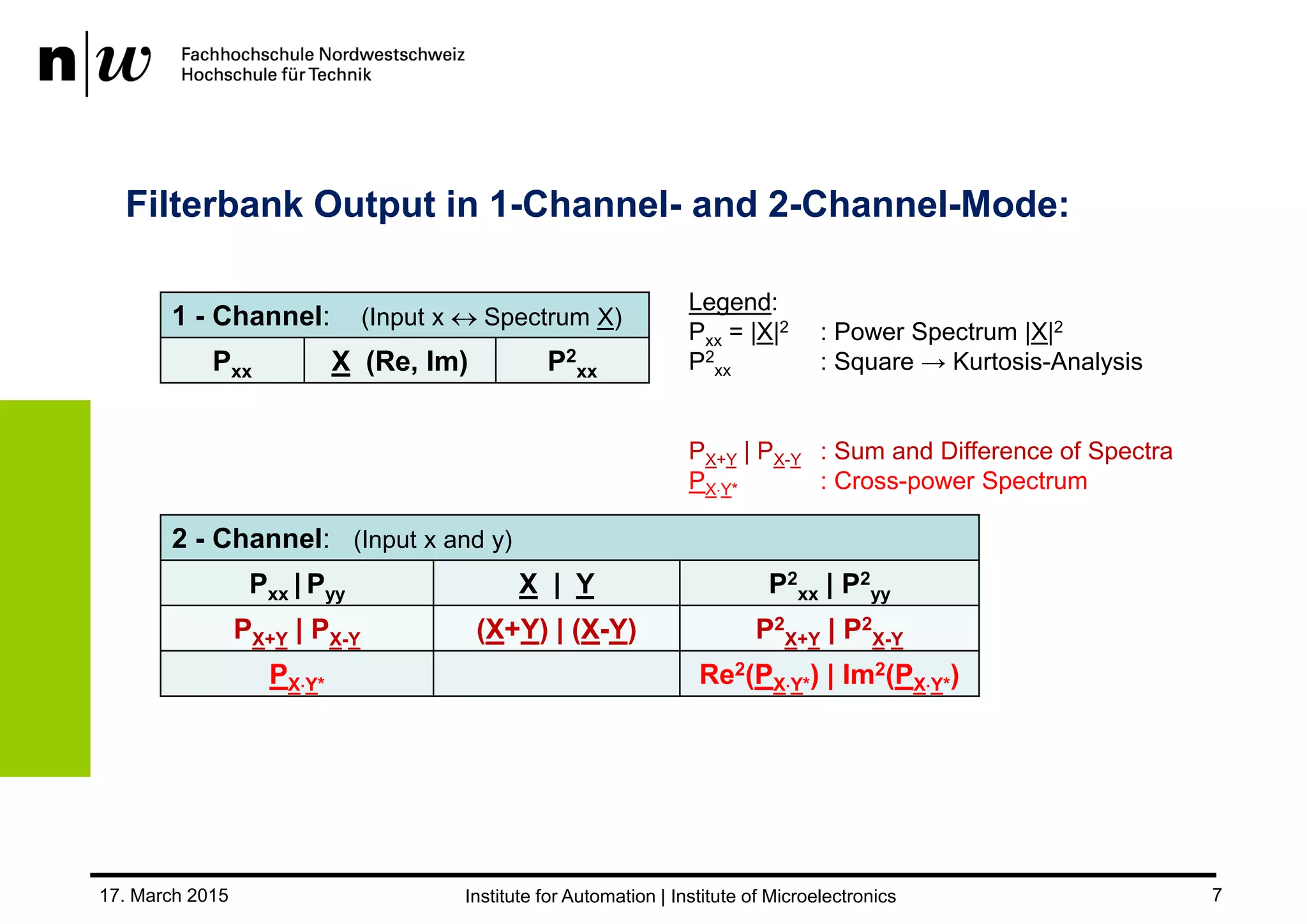
1 - Channel: (Input x  Spectrum X)
Pxx X (Re, Im) P2
xx
17. March 2015 7
2 - Channel: (Input x and y)
Pxx | Pyy X | Y P2
xx | P2
yy
PX+Y | PX-Y (X+Y) | (X-Y) P2
X+Y | P2
X-Y
PXY* Re2(PXY*) | Im2(PXY*)
Legend:
Pxx = |X|2 : Power Spectrum |X|2
P2
xx : Square → Kurtosis-Analysis
PX+Y | PX-Y : Sum and Difference of Spectra
PXY* : Cross-power Spectrum
Filterbank Output in 1-Channel- and 2-Channel-Mode:
17. March 2015 8
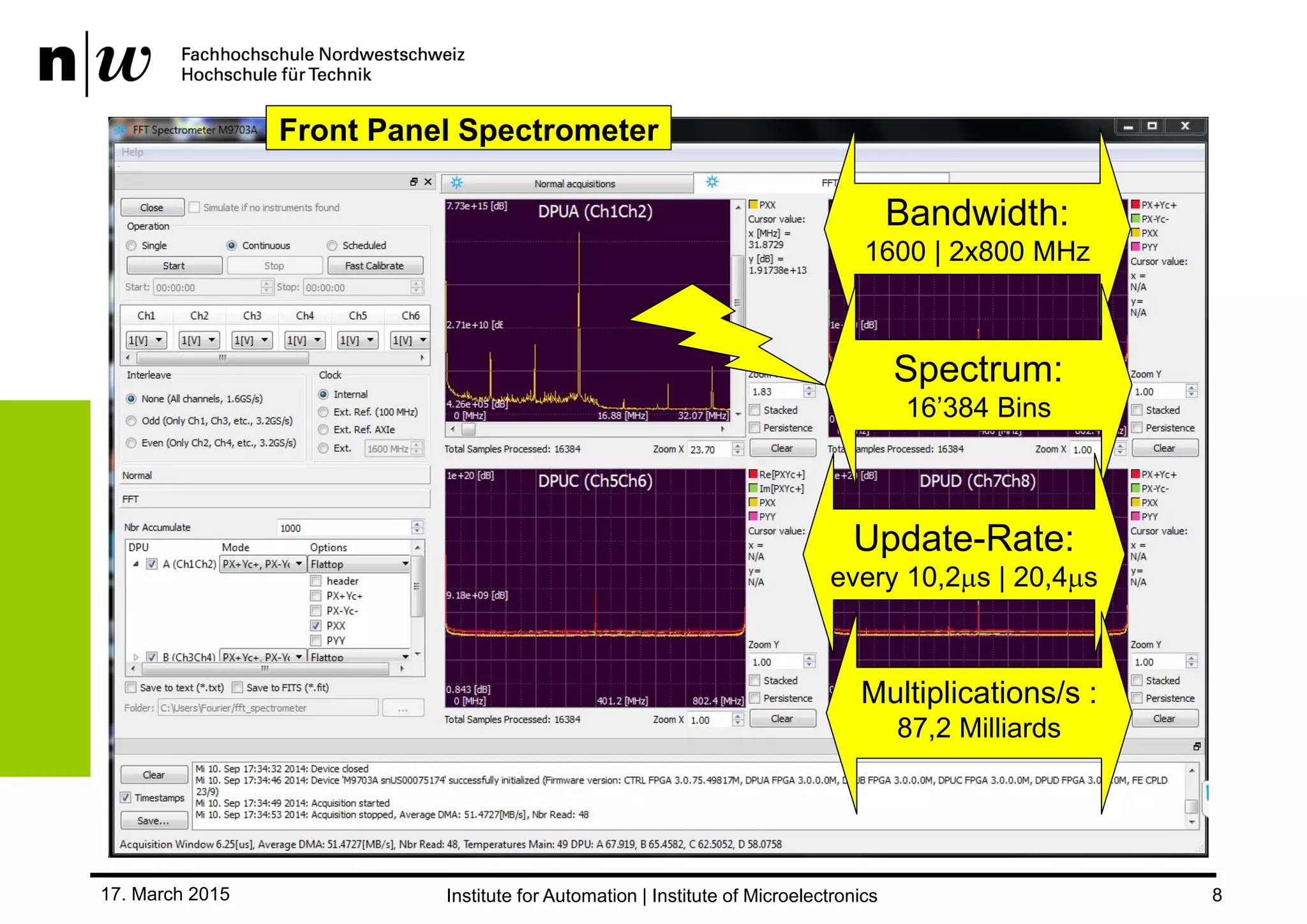
Front Panel Spectrometer
Bandwidth:
1600 | 2x800 MHz
Spectrum:
16’384 Bins
Update-Rate:
every 10,2s | 20,4s
Multiplications/s :
87,2 Milliards
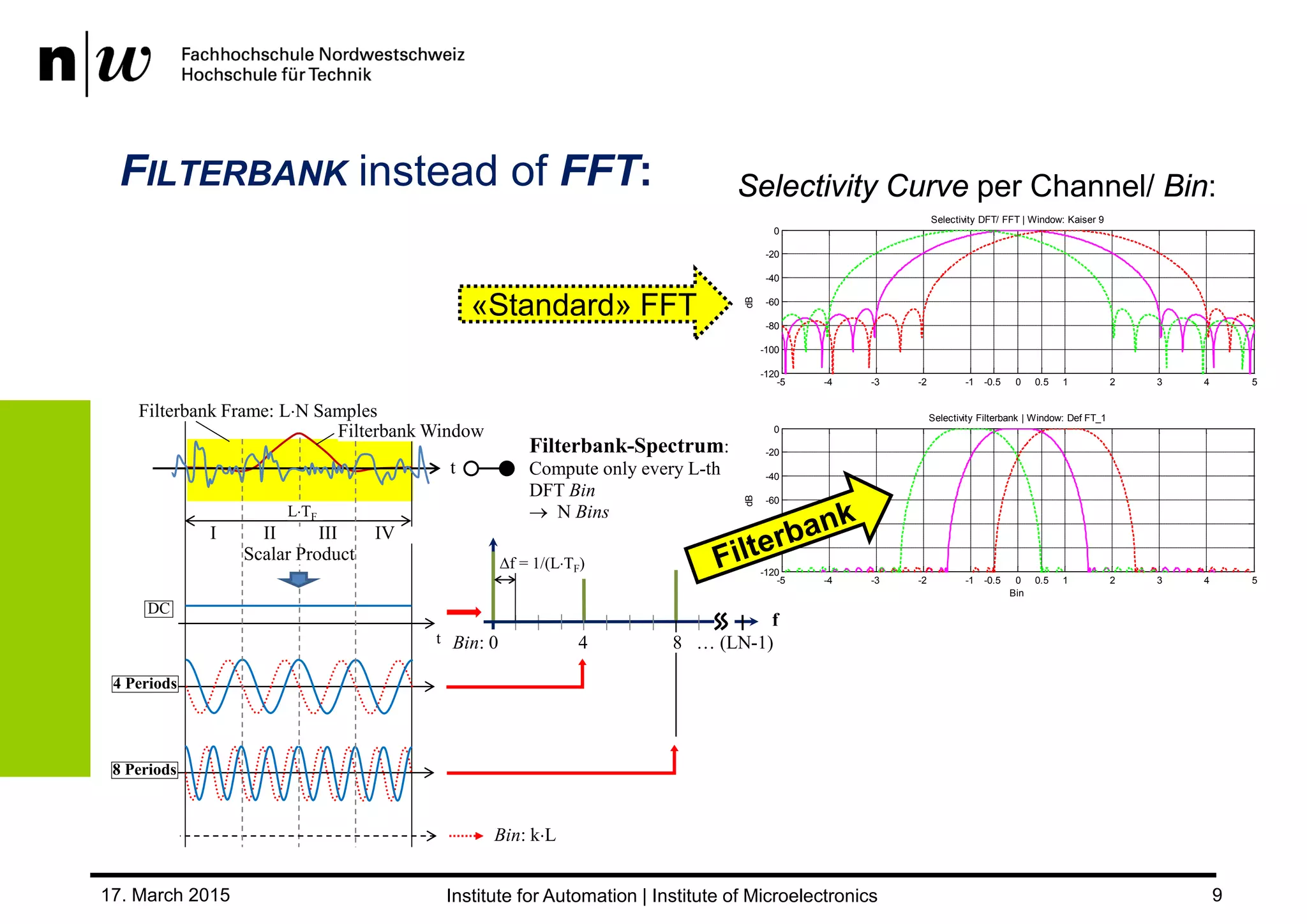
FILTERBANK instead of FFT:
17. March 2015 9
Filterbank-Spectrum:
Compute only every L-th
DFT Bin
 N Bins
t
DC
Filterbank Frame: LN Samples
Scalar Product
f
Bin: 0 4 8 … (LN-1)
Bin: kL
4 Periods
f = 1/(LTF)
LTF
8 Periods
t
Filterbank Window
I II III IV
-5 -4 -3 -2 -1 -0.5 0 0.5 1 2 3 4 5
-120
-100
-80
-60
-40
-20
0
Selectivity DFT/ FFT | Window: Kaiser 9
dB
-5 -4 -3 -2 -1 -0.5 0 0.5 1 2 3 4 5
-120
-100
-80
-60
-40
-20
0
Selectivity Filterbank | Window: Def FT_1
Bin
dB
Selectivity Curve per Channel/ Bin:
«Standard» FFT
17. March 2015 10
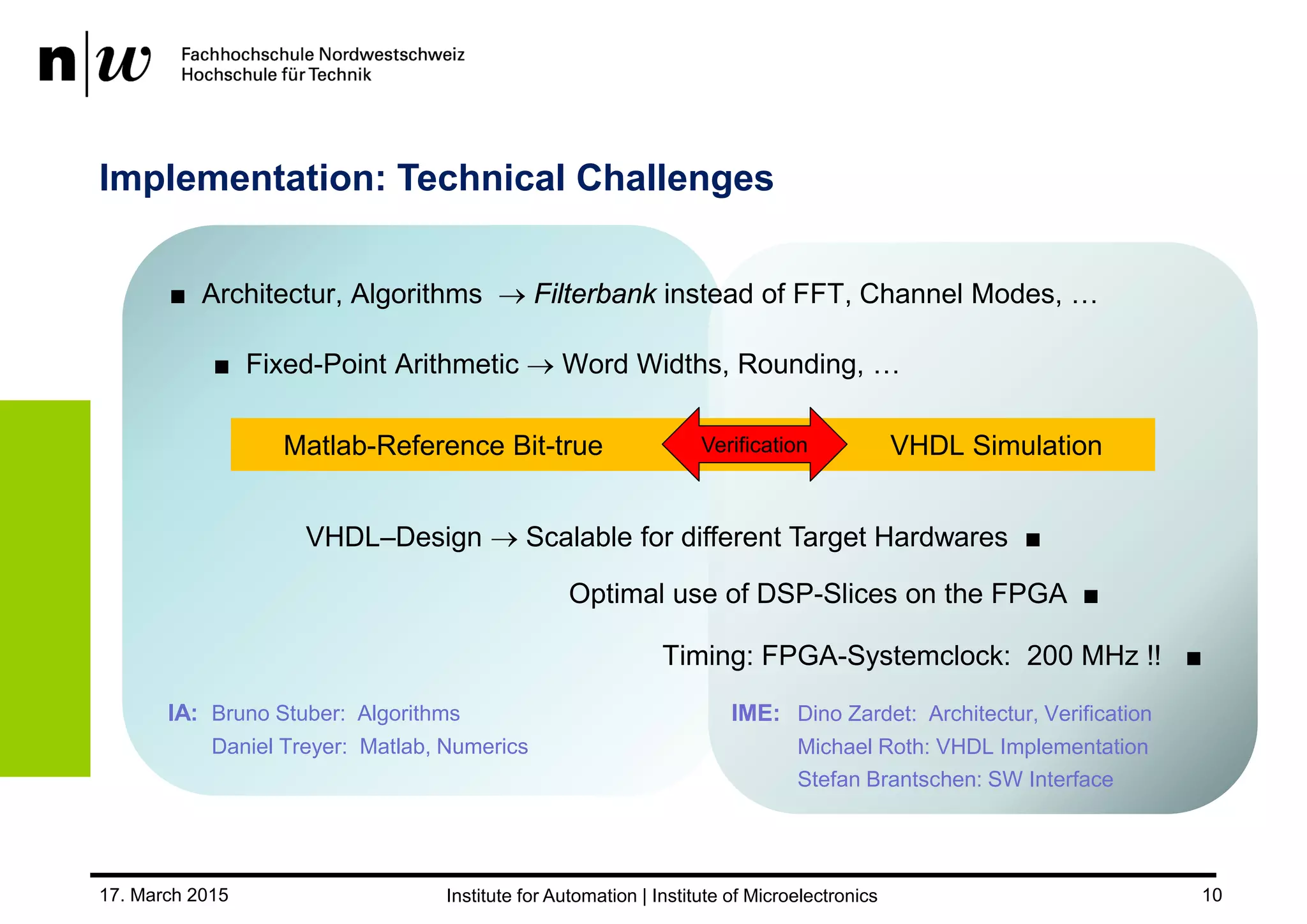
Implementation: Technical Challenges
■ Architectur, Algorithms  Filterbank instead of FFT, Channel Modes, …
VHDL–Design  Scalable for different Target Hardwares ■
Timing: FPGA-Systemclock: 200 MHz !! ■
Matlab-Reference Bit-true VHDL SimulationVerification
IA: Bruno Stuber: Algorithms
Daniel Treyer: Matlab, Numerics
IME: Dino Zardet: Architectur, Verification
Michael Roth: VHDL Implementation
Stefan Brantschen: SW Interface
Optimal use of DSP-Slices on the FPGA ■
■ Fixed-Point Arithmetic  Word Widths, Rounding, …
17. March 2015 11
…’’at the Limit’’ ???
The Signals:
• Dynamic of the Input Signal
• Signal deep below the Noise Level  Averaging, Measuring Differencies
• Short-term and Long-term Stability of the Equipment
The Technique:
• Speed: Spectra processing «seamless»: 3,2 GS/s  97’600 Spectra/s
• Functionality: New Level achieved  1-Channel, 2-Channel Mode, …
• FPGA: Complexity and Speed  Routing and Timing
17. March 2015 12
Spectrometer M0703A applications
• Antenna power in Radio Astronomy
• Plan A: Gold mine in Uruguay
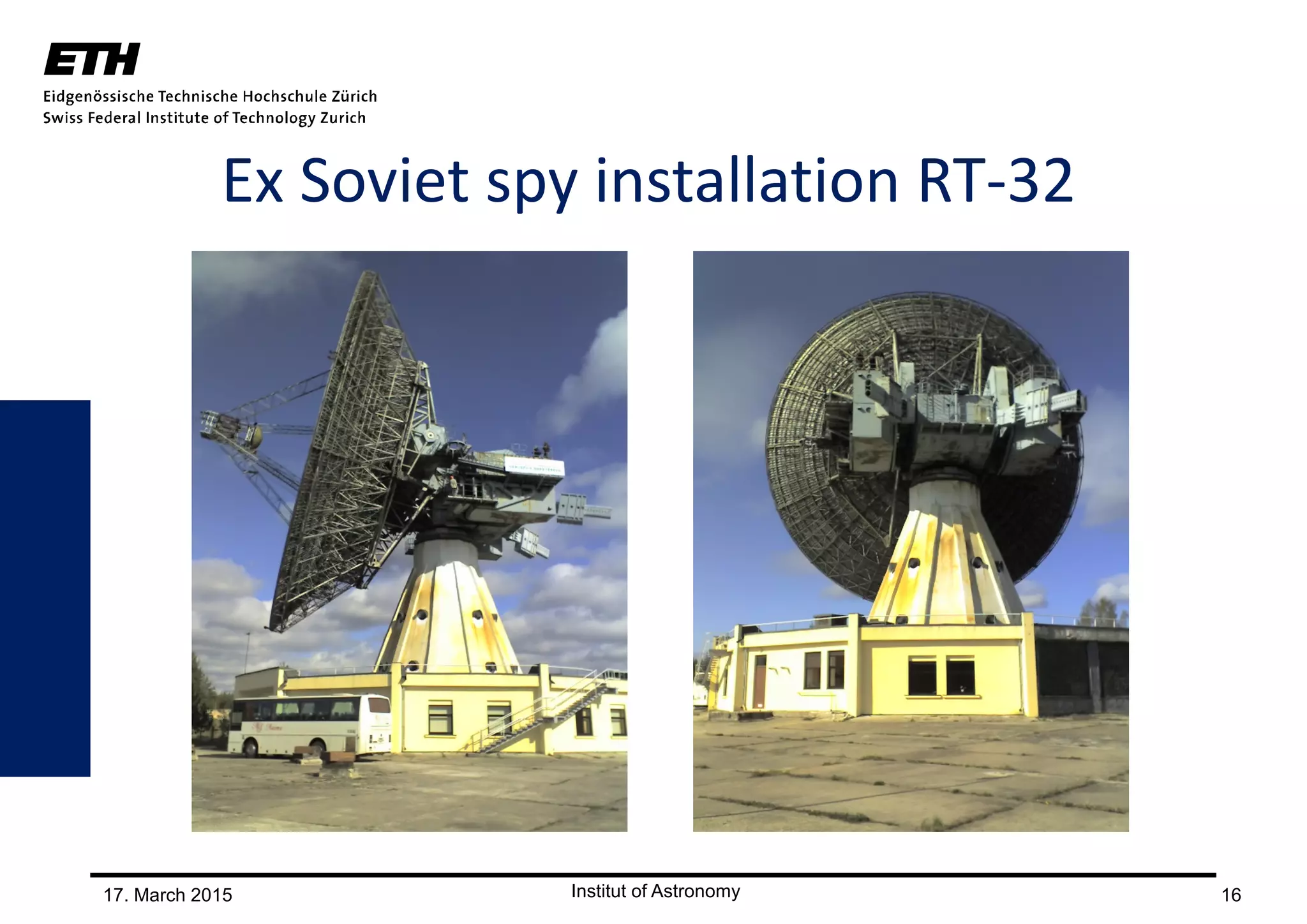
• Plan B: Russian spy telescope in Latvia
• Prototyping in Bleien AG
- Spectrum issue
- 1/f noise, Allan Time
- Solar bursts
- Sky map
17. March 2015 13
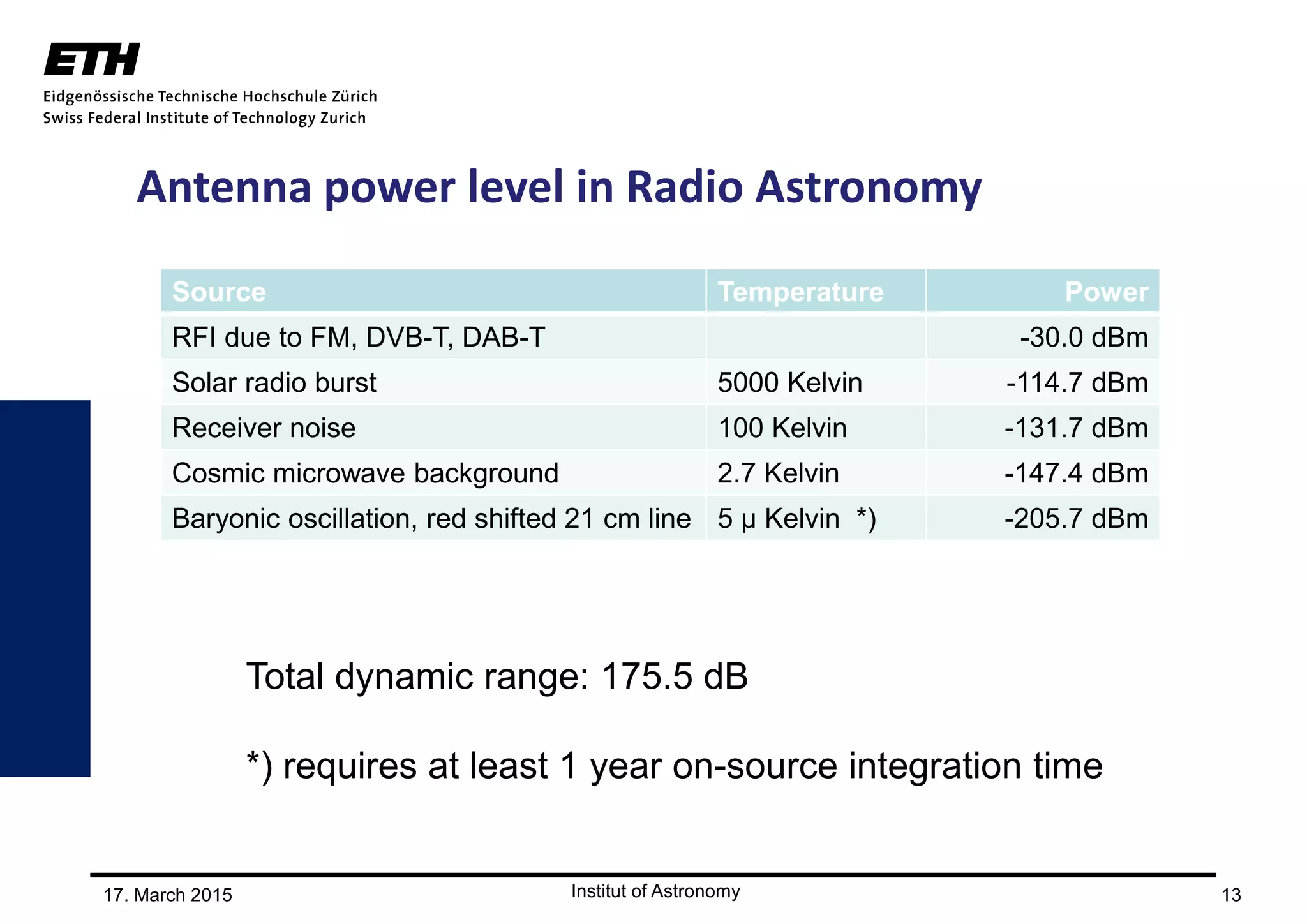
Antenna power level in Radio Astronomy
Source Temperature Power
RFI due to FM, DVB-T, DAB-T -30.0 dBm
Solar radio burst 5000 Kelvin -114.7 dBm
Receiver noise 100 Kelvin -131.7 dBm
Cosmic microwave background 2.7 Kelvin -147.4 dBm
Baryonic oscillation, red shifted 21 cm line 5 µ Kelvin *) -205.7 dBm
Total dynamic range: 175.5 dB
*) requires at least 1 year on-source integration time
17. March 2015 14
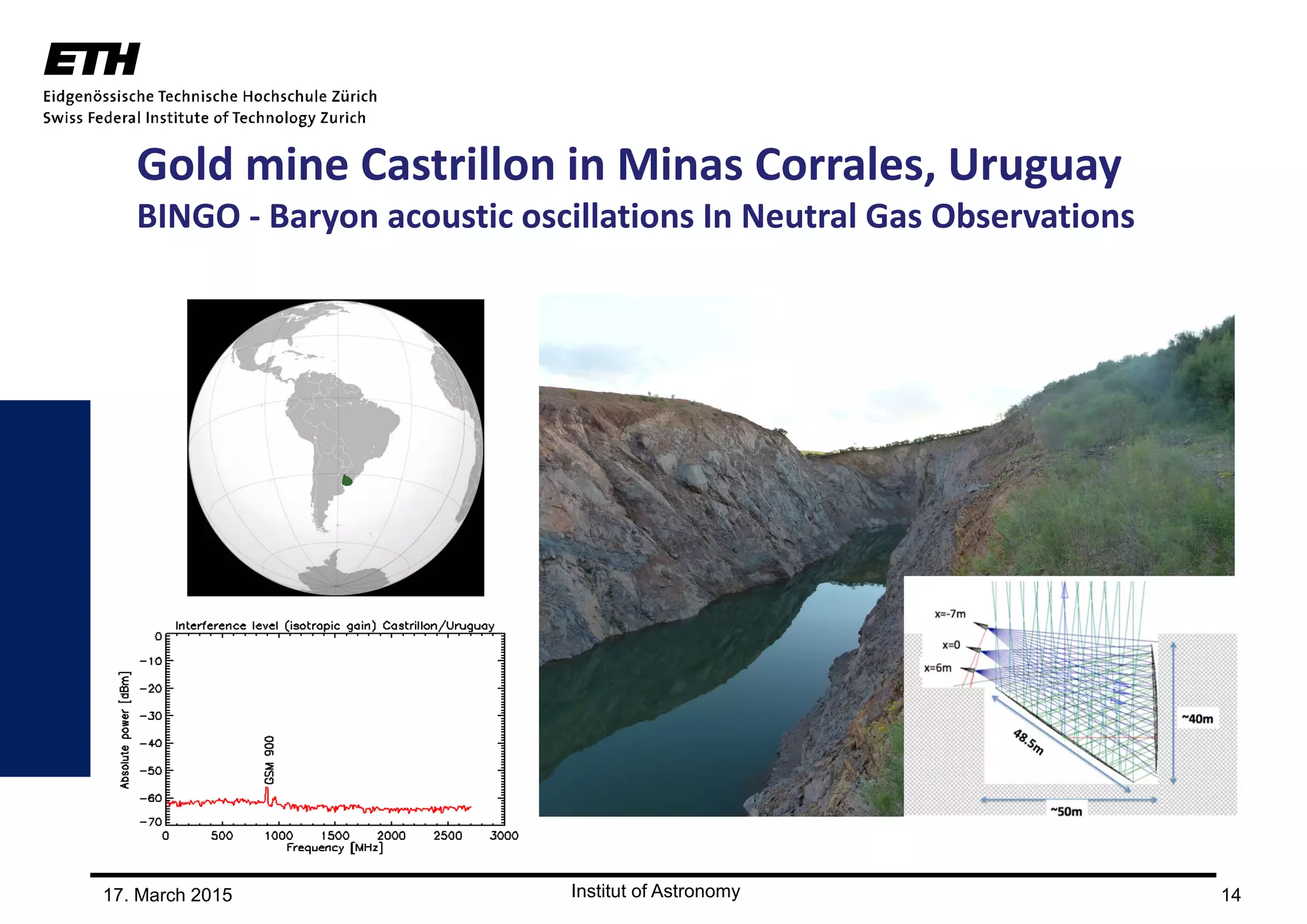
Gold mine Castrillon in Minas Corrales, Uruguay
BINGO - Baryon acoustic oscillations In Neutral Gas Observations
17. March 2015 15
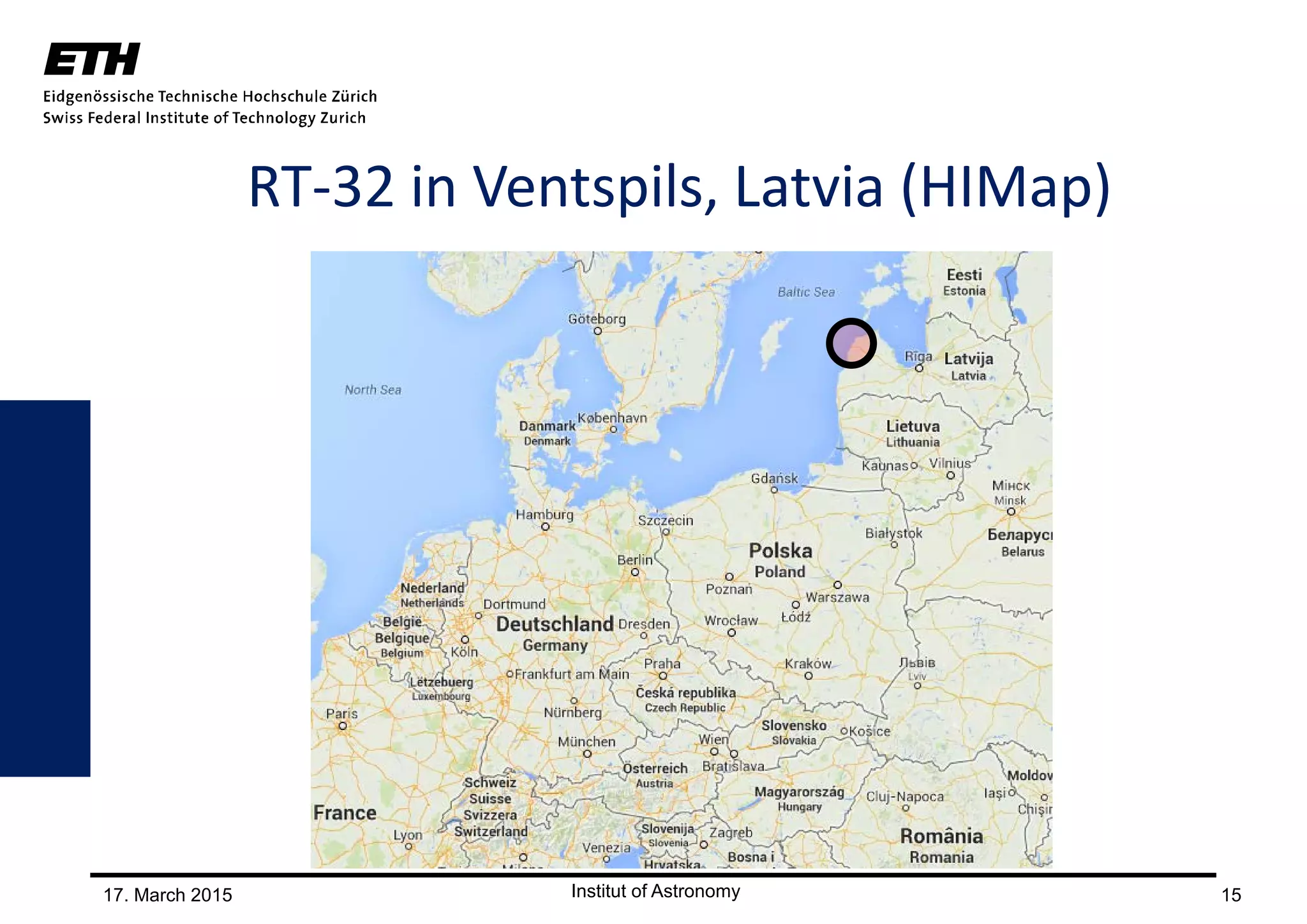
RT-32 in Ventspils, Latvia (HIMap)
17. March 2015 16
Ex Soviet spy installation RT-32
17. March 2015 17
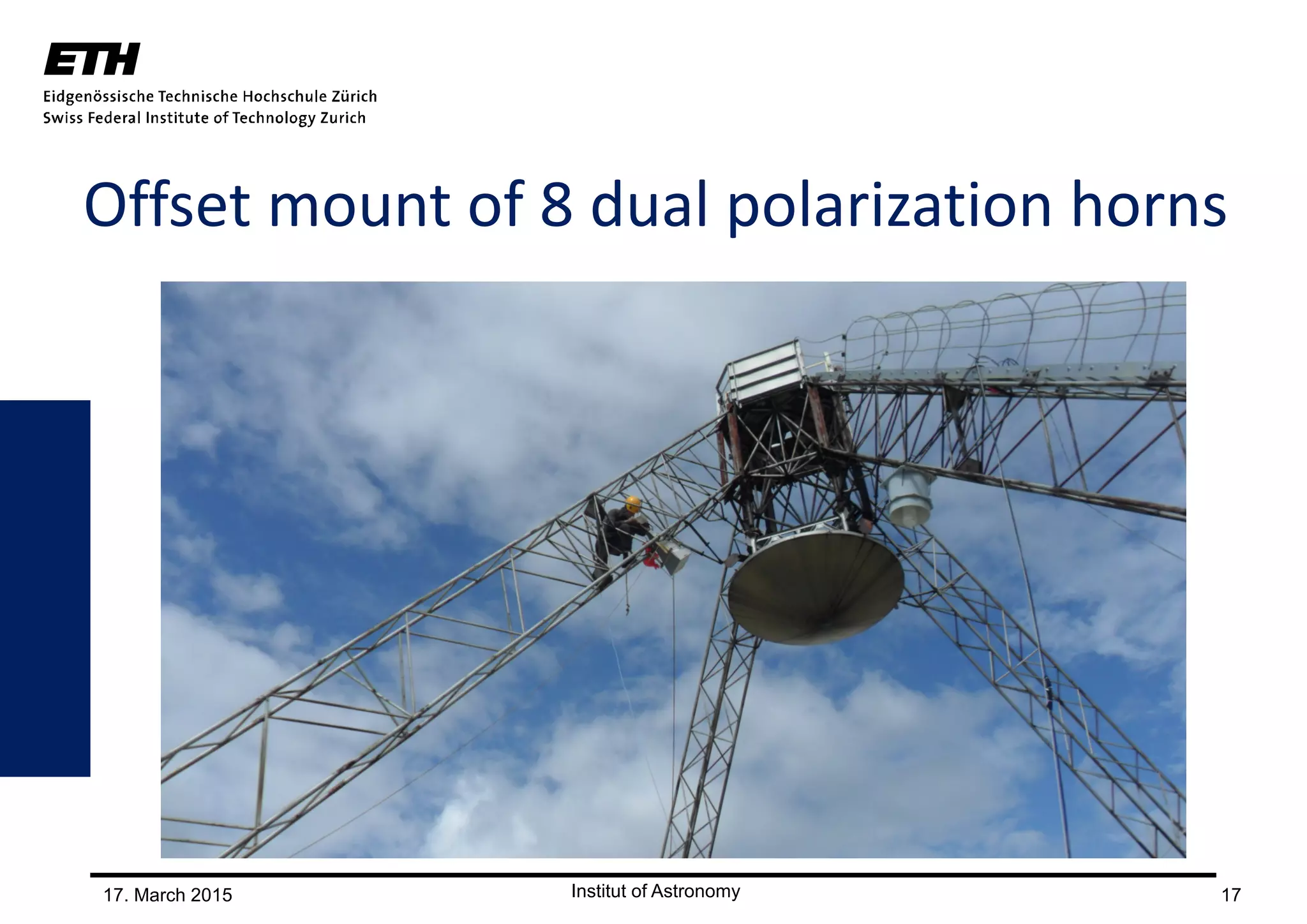
Offset mount of 8 dual polarization horns
17. March 2015 18
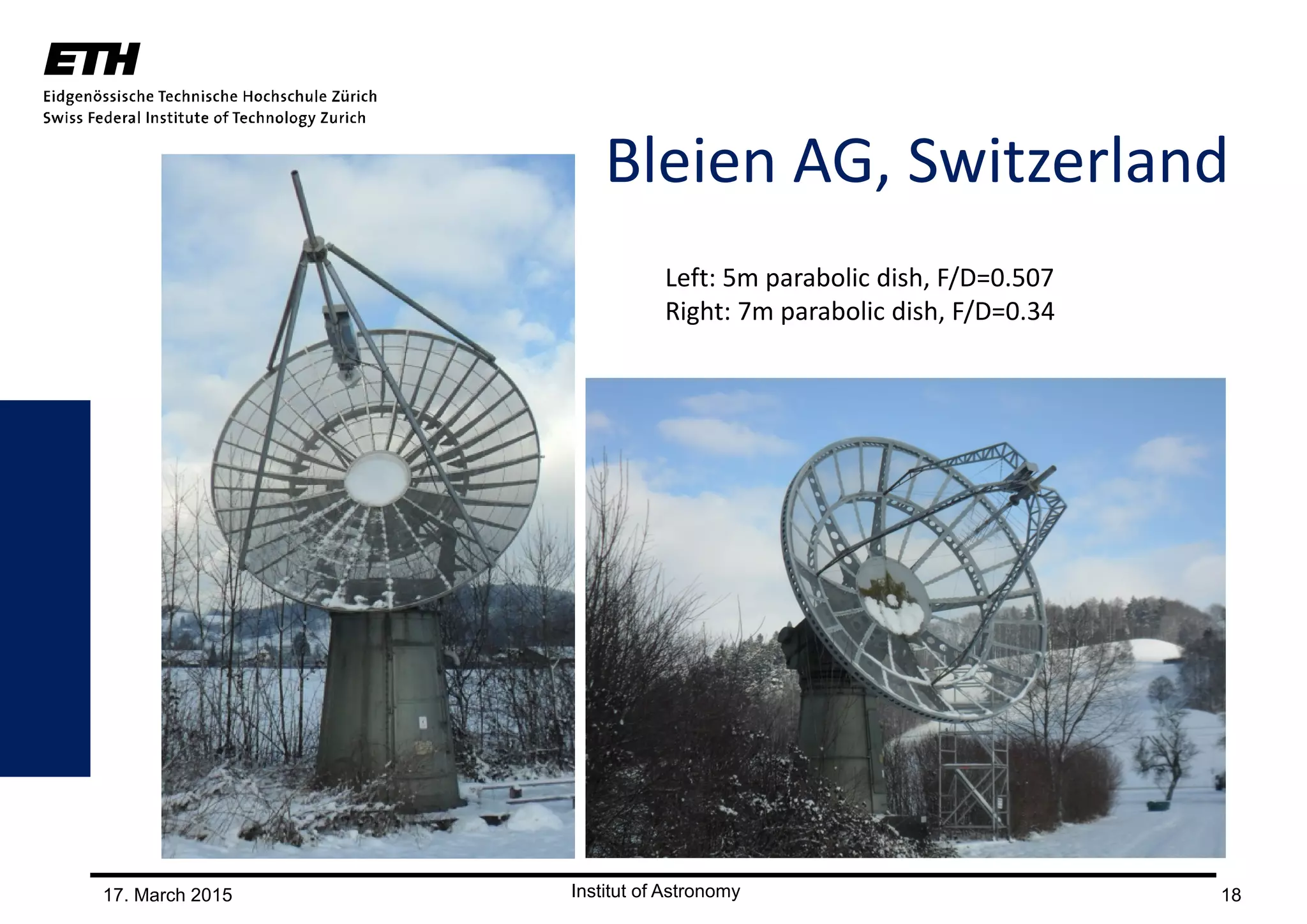
Bleien AG, Switzerland
Left: 5m parabolic dish, F/D=0.507
Right: 7m parabolic dish, F/D=0.34
17. March 2015 19
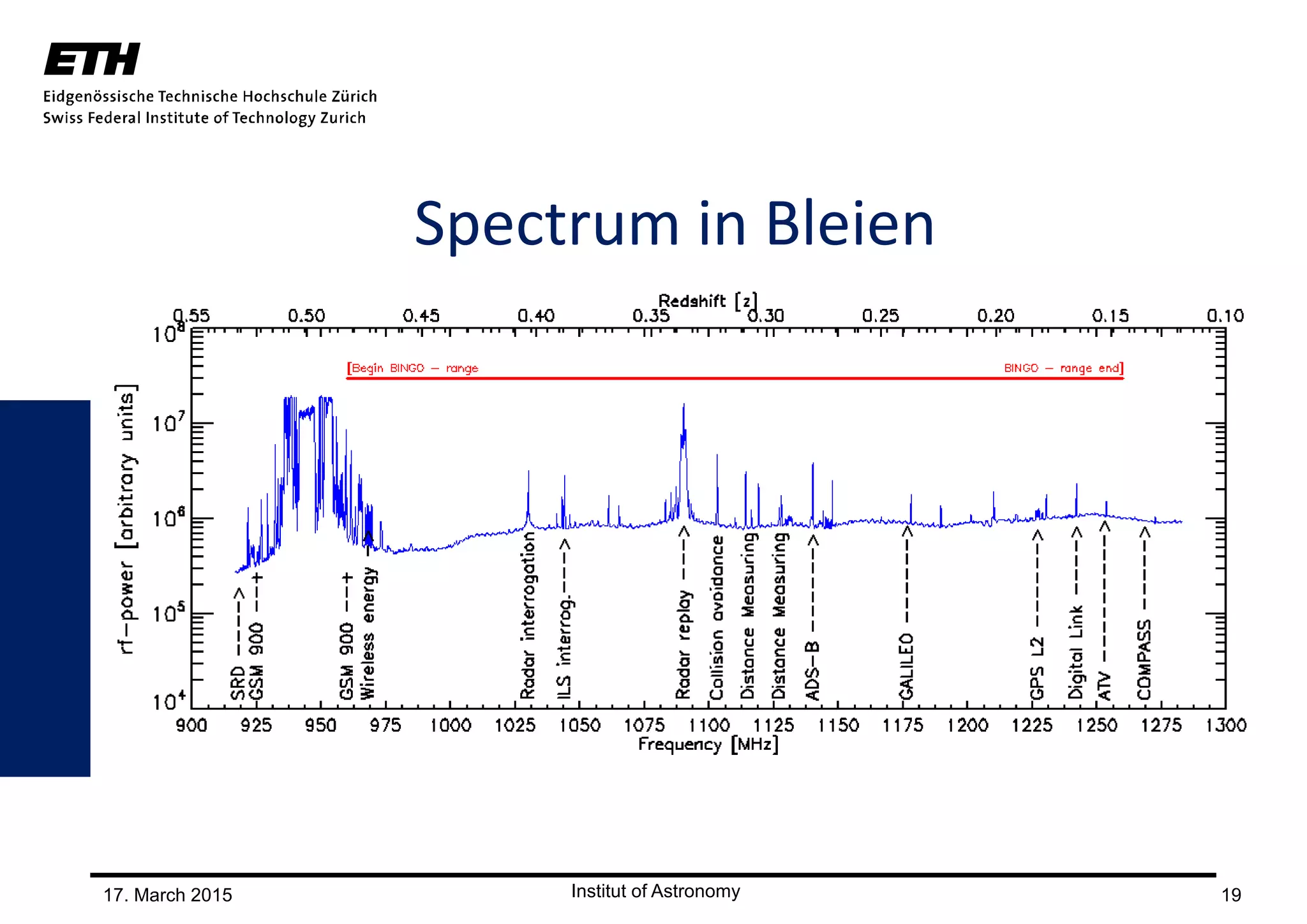
Spectrum in Bleien
17. March 2015 20
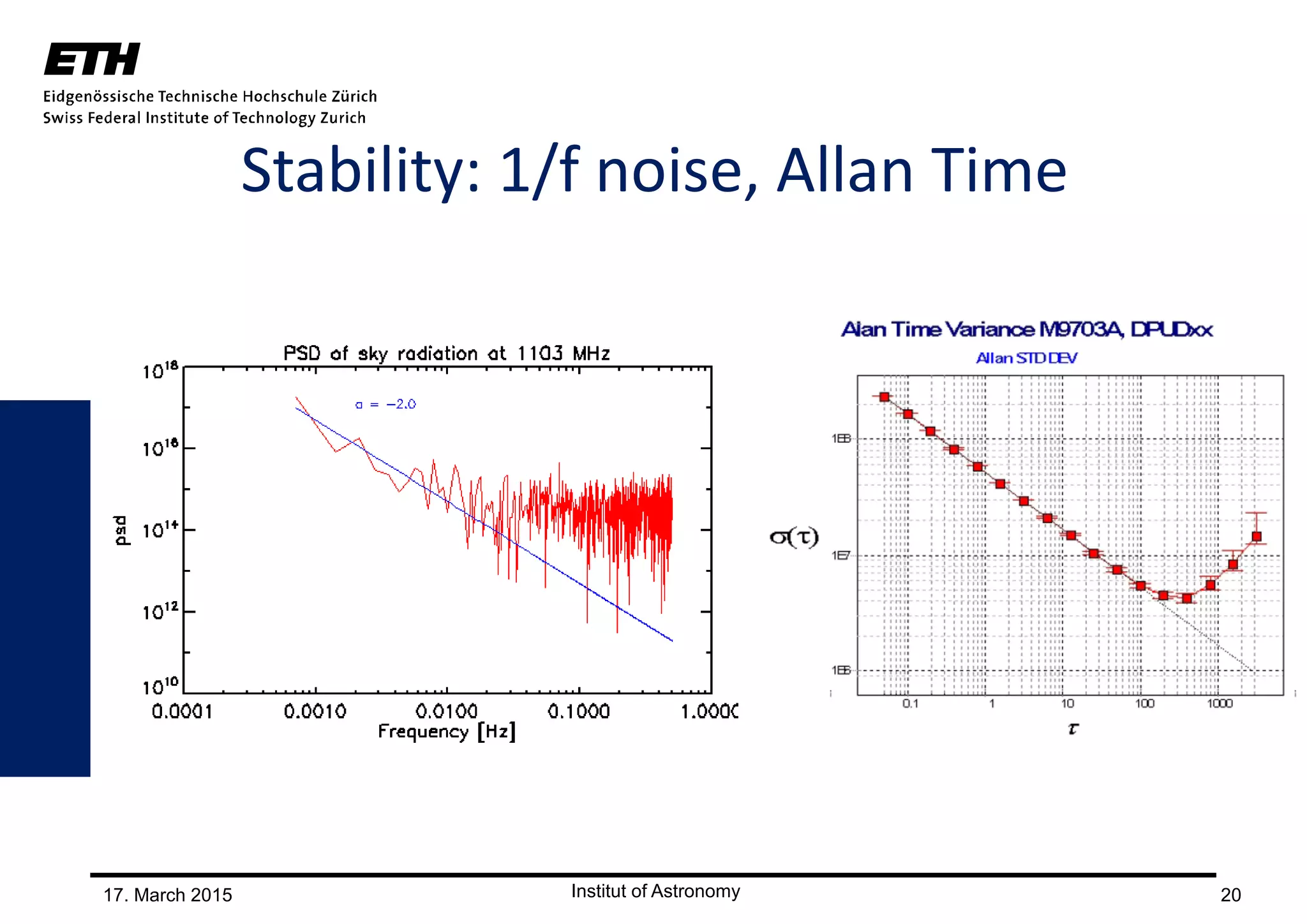
Stability: 1/f noise, Allan Time
17. March 2015 21
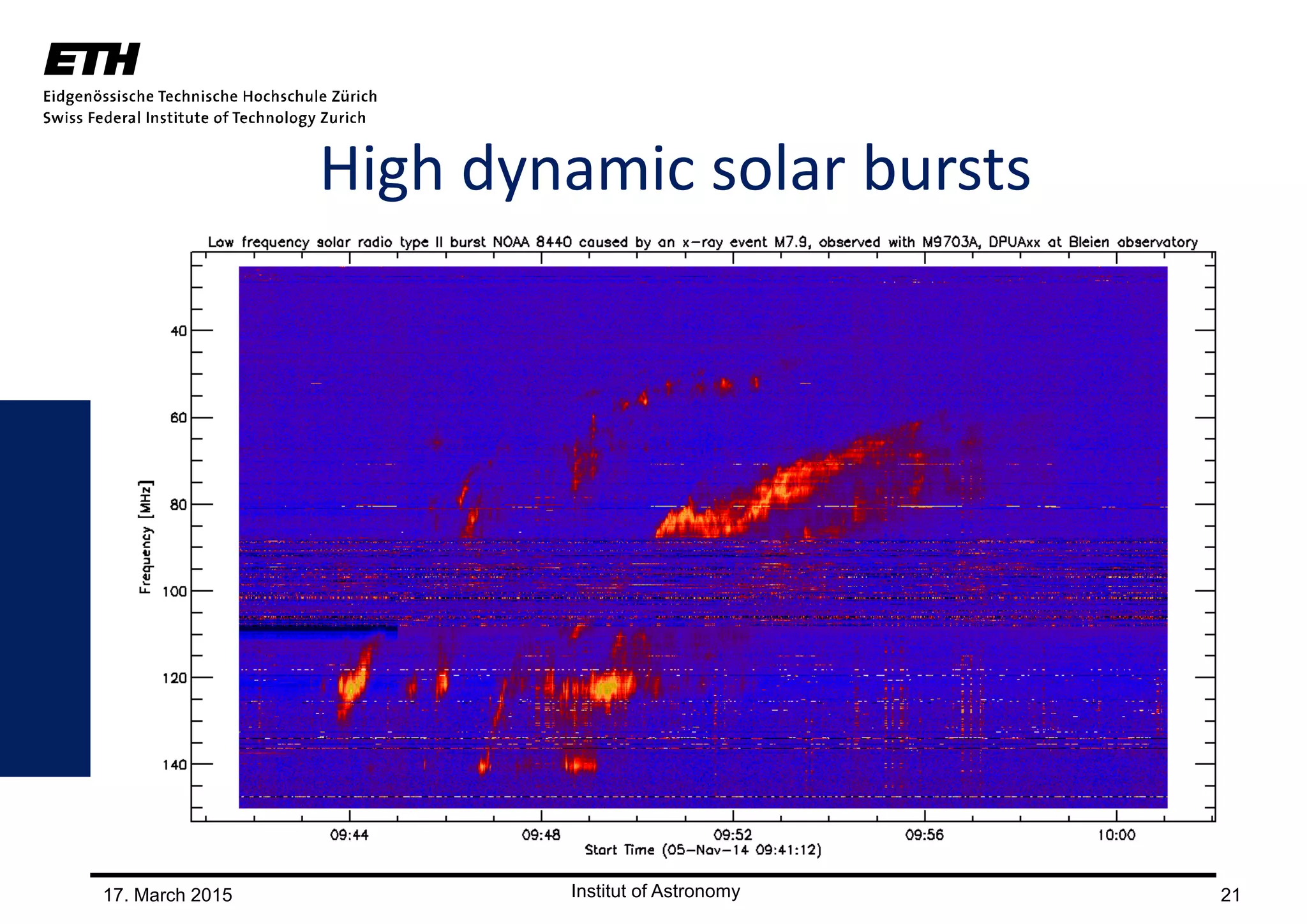
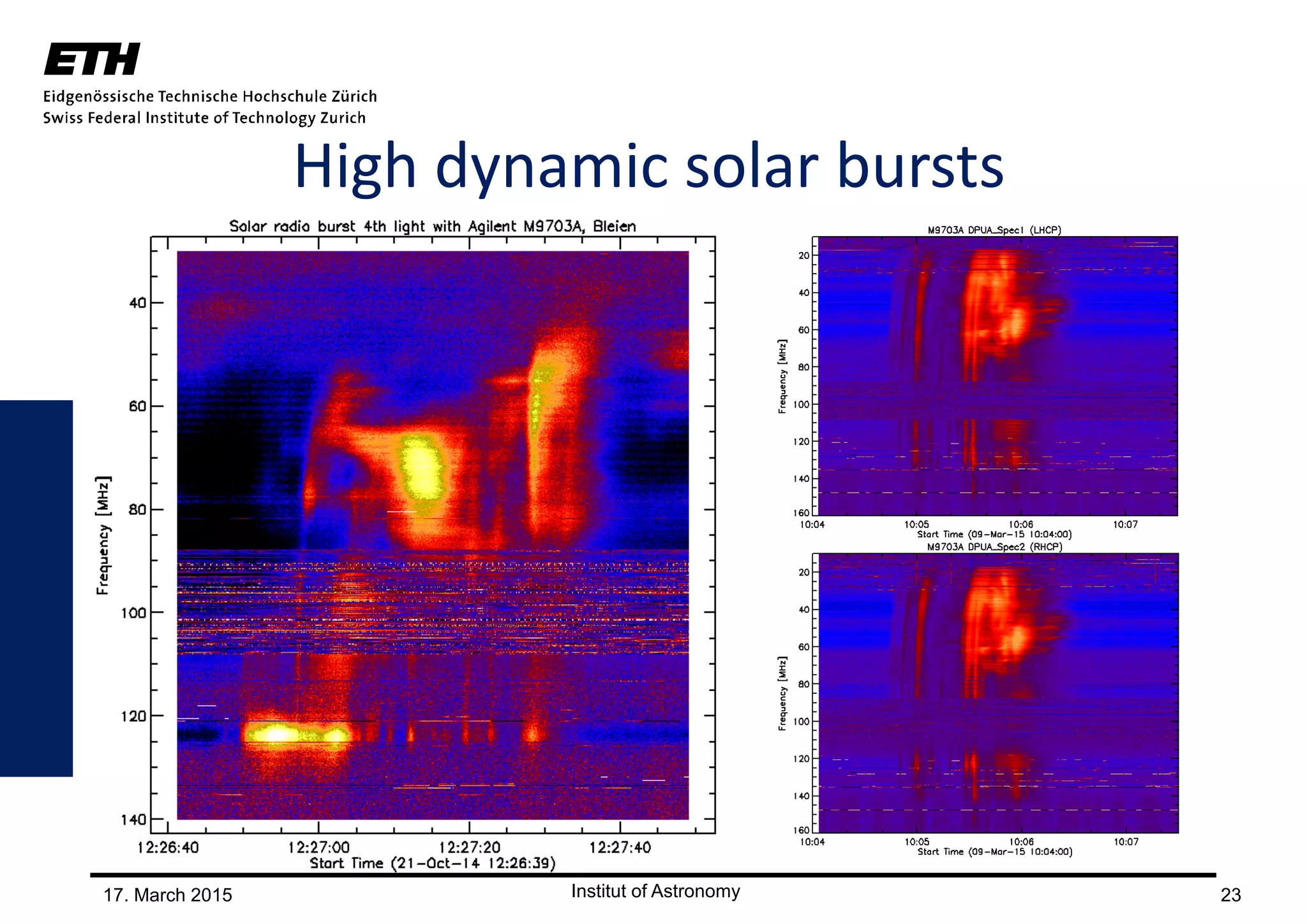
High dynamic solar bursts
17. March 2015 22
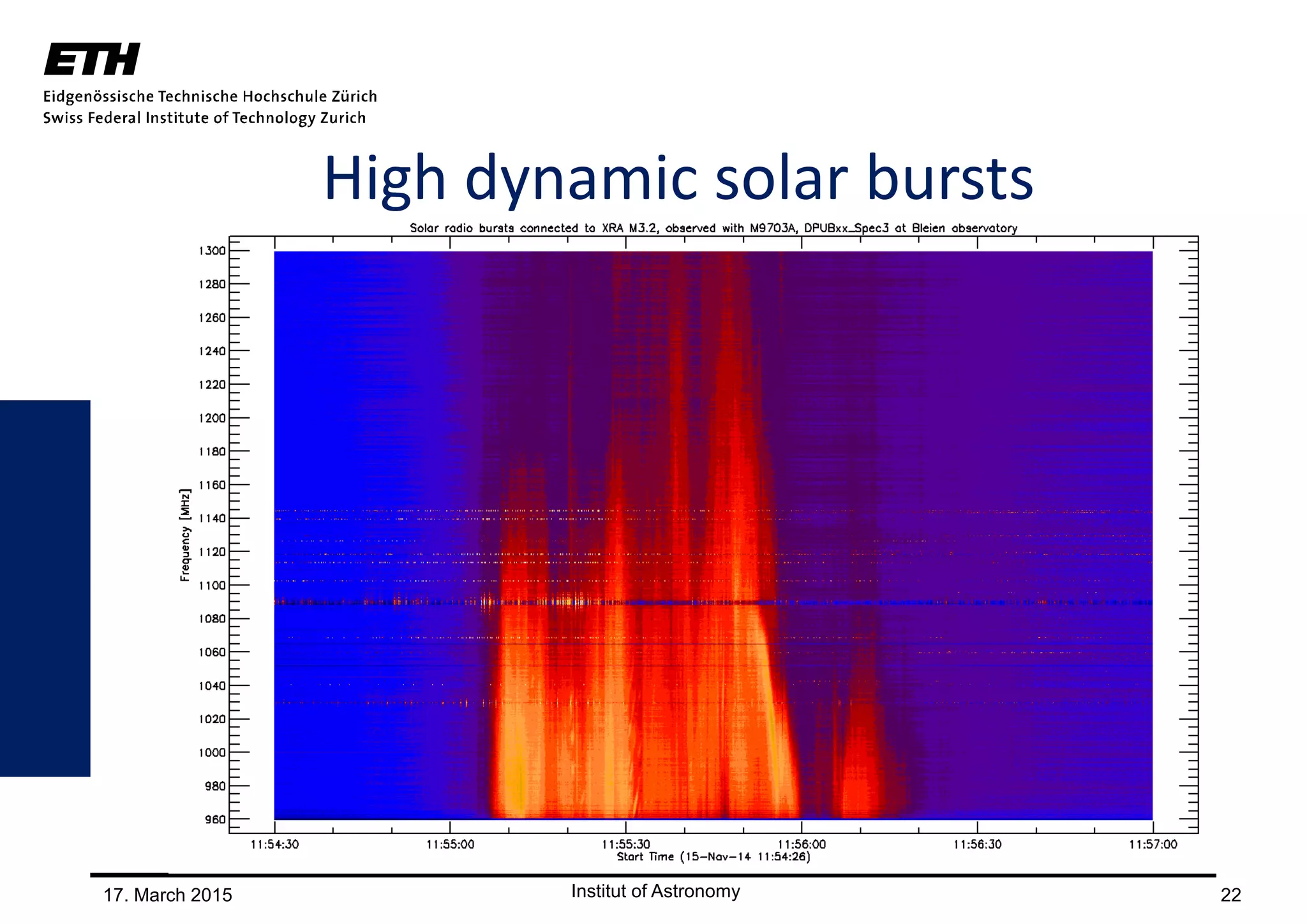
High dynamic solar bursts
17. March 2015 23
High dynamic solar bursts
17. March 2015 24
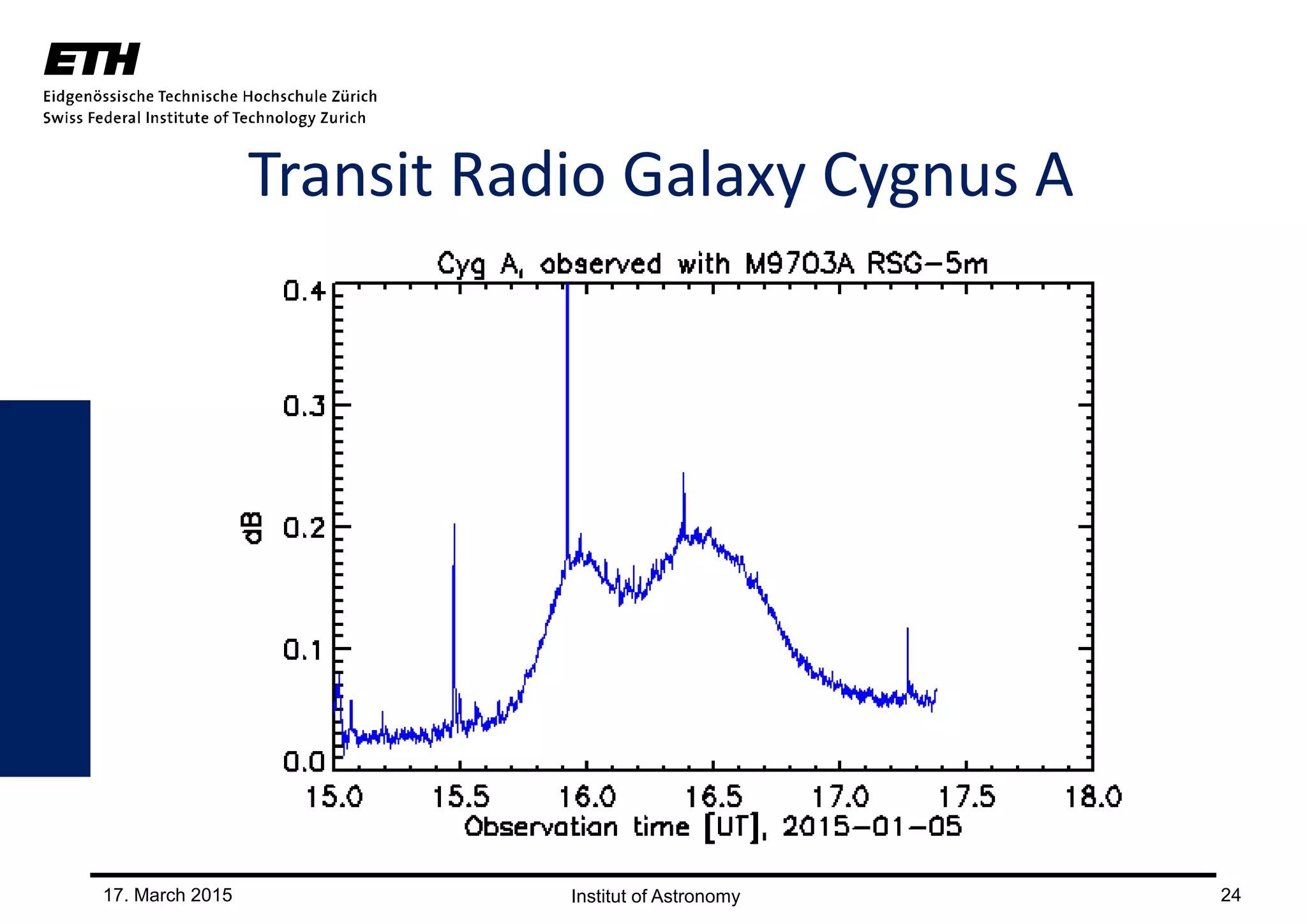
Transit Radio Galaxy Cygnus A
17. March 2015 25
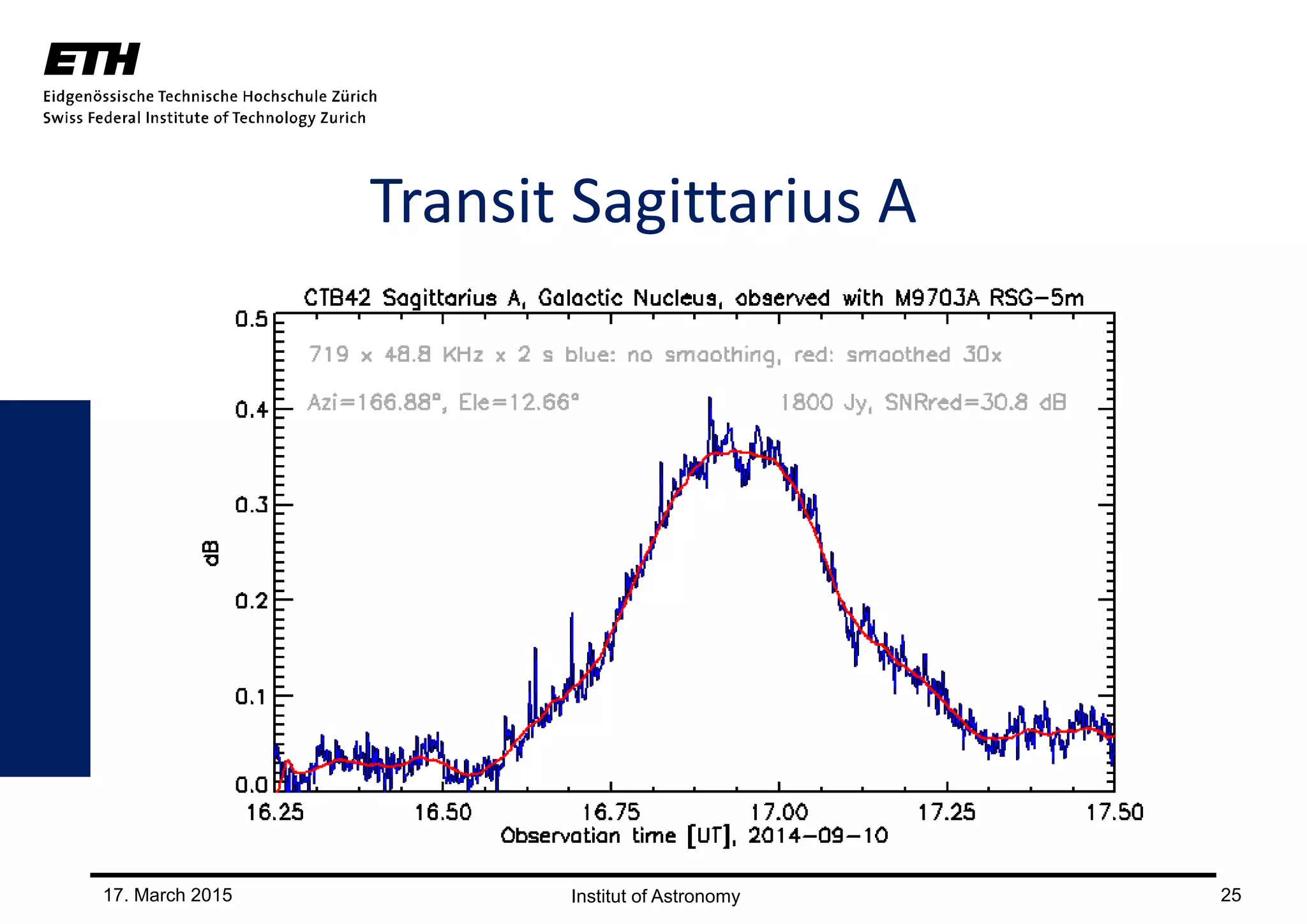
Transit Sagittarius A
17. March 2015 26
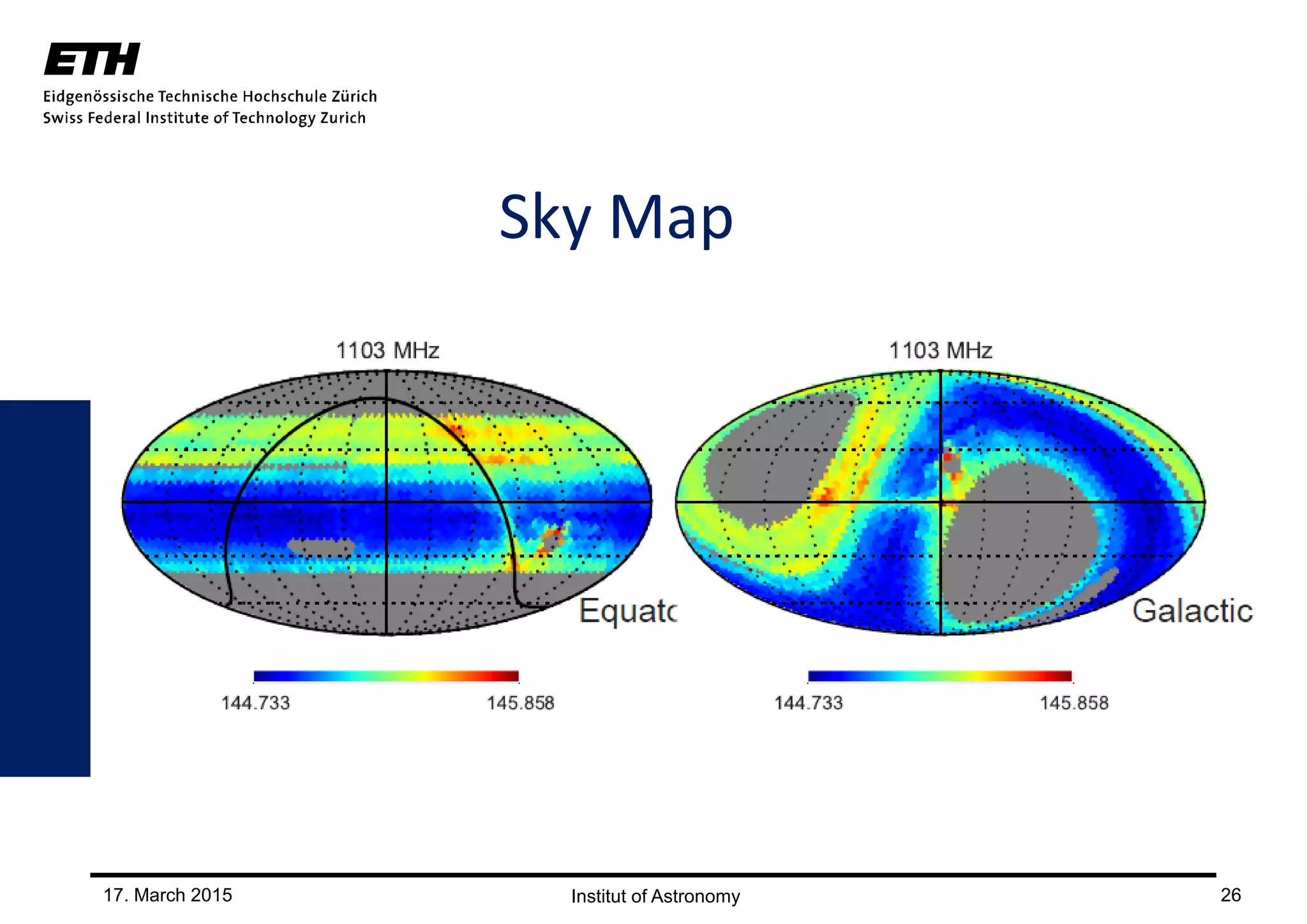
Sky Map
17. March 2015 27
Conclusions
Spectrometer is working …
+ Input dynamic range improved (8 Bit → 12 Bit)
+ Numerical artefacts reduced
+ Functionality and modes significantly enhanced
~ ADC input leveling not clear yet (rfi vs resolution)
~ Stability analog-input over time
17. März 2015 28
Experts
Bruno Stuber
www.fhnw.ch/personen/bruno-stuber
University of Applied Sciences and Arts Northwestern Switzerland FHNW,
Institute for Automation
www.fhnw.ch/technik/ia/
Christian Monstein
www.astro.ethz.ch/people/person-detail.html?persid=86162
ETH Zurich, Institute for Astronomy
www.astro.ethz.ch/
Daniel Treyer FHNW, Institute for Automation
Dino Zardet, Michael Roth FHNW, Institute of Microelectronics
Axel Murk University of Bern, Institute of Applied Physics

Spectral Analysis at the Limit - Applications in Radio Astronomy

  • 1.
    Spectral Analysis atthe Limit – Applications in Radio Astronomy Bruno Stuber Christian Monstein
  • 2.
    Content 1. Objectives andTechnical Challenges 2. Applications in Radio Astronomy 3. Summary and Conclusion 17. March 2015 2 Spectral Analysis at the Limit – Applications in Radio Astronomy Digital Filterbank: 1-/2-Channel Mode using FPGAs Bruno Stuber FHNW, Institute for Automation Christian Monstein ETH Zurich, Institute for Astronomy
  • 3.
    17. March 20153 FPGAFPGA FPGA Spectrometer Unit (Filterbank) HOST PC RX Signals FPGA Signal Spectra:  Bandwidth   Frequency Resolution   «seamless» processing System Overview: 
  • 4.
    Project CTI Contribution Total [kFr] CTI FHNW Project PartnersFHNW Filterbank 2014 457 360 Industrial Partner ETH Zurich IA Uni Bern IAP IA IME FFT 2 2008 CoSpan (50++) 50 Uni Bern IAP IA IME FFT 1 2005 ARGOS 292 240 Industrial Partner ETH Zurich IA Uni Bern IAP IA IME 17. March 2015 4 The Line of Projects:
  • 5.
    17. March 20155 1 Processing Unit: Field Programmable Gate Array (FPGA) Xilinx Virtex 6 (XC6VSX315T) ■ 393’600 Flip Flops ■ 1’344 Multipliers ■ 704 Block RAM each 36 kbit - SRAM based FPGA - 40 nm CMOS Process - 12 Layer Cu Metal - 1 V Core Voltage  Internal Clockrate: 200 MHz The Signal Processing Units:
  • 6.
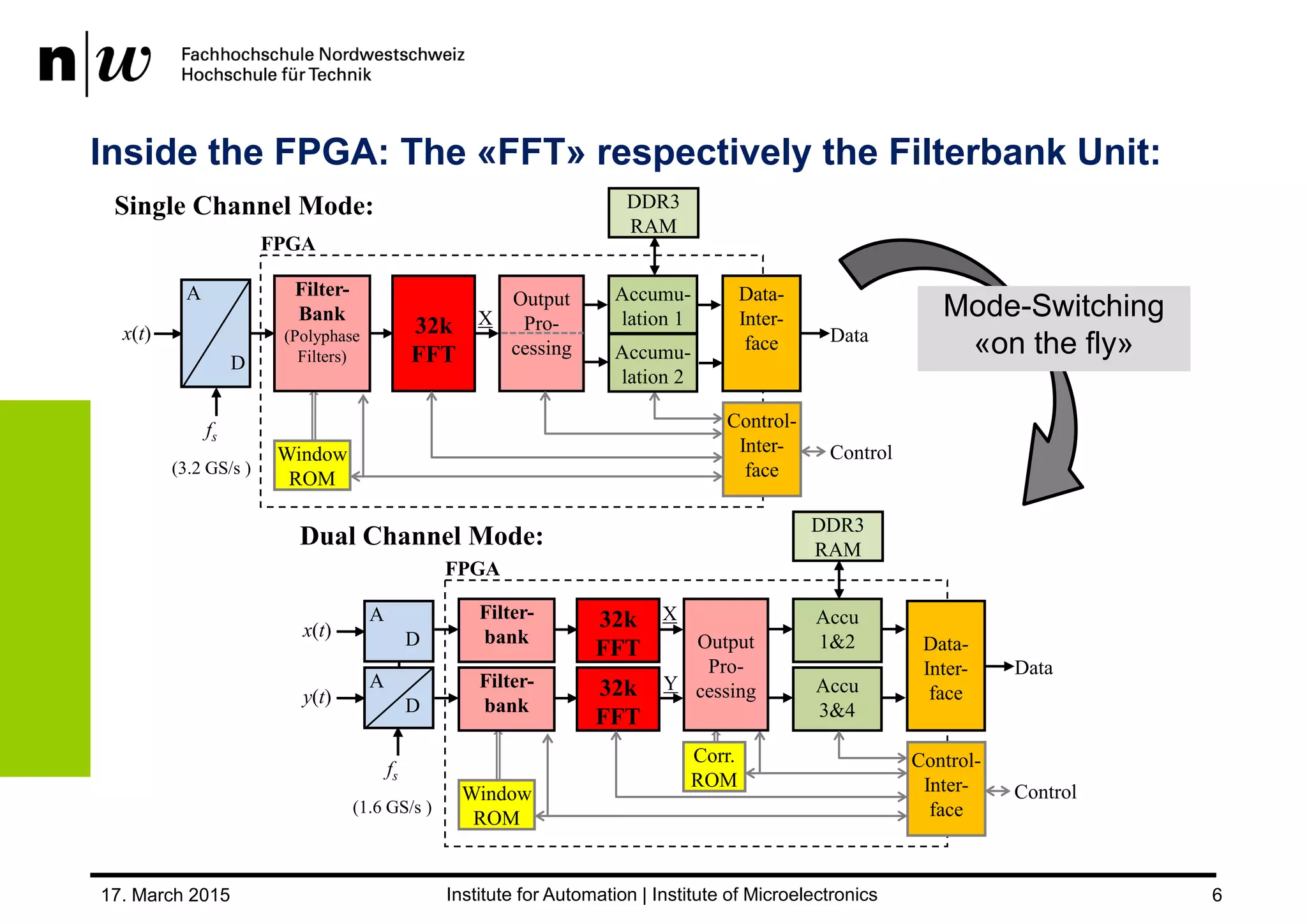
    17. March 20156 A D Filter- Bank (Polyphase Filters) Output Pro- cessing Accumu- lation 1 x(t) fs (3.2 GS/s ) 32k FFT DDR3 RAM Control- Inter- face Data- Inter- face Window ROM FPGA Data Control Accumu- lation 2 X Single Channel Mode: A D Filter- bank Accu 3&4 x(t) 32k FFT DDR3 RAM Control- Inter- face Corr. ROM Data- Inter- face Window ROM FPGA Data Control y(t) Filter- bank Output Pro- cessing Accu 1&2 32k FFT X Y A D fs (1.6 GS/s ) Dual Channel Mode: Inside the FPGA: The «FFT» respectively the Filterbank Unit: Mode-Switching «on the fly»
  • 7.
    1 - Channel:(Input x  Spectrum X) Pxx X (Re, Im) P2 xx 17. March 2015 7 2 - Channel: (Input x and y) Pxx | Pyy X | Y P2 xx | P2 yy PX+Y | PX-Y (X+Y) | (X-Y) P2 X+Y | P2 X-Y PXY* Re2(PXY*) | Im2(PXY*) Legend: Pxx = |X|2 : Power Spectrum |X|2 P2 xx : Square → Kurtosis-Analysis PX+Y | PX-Y : Sum and Difference of Spectra PXY* : Cross-power Spectrum Filterbank Output in 1-Channel- and 2-Channel-Mode:
  • 8.
    17. March 20158 Front Panel Spectrometer Bandwidth: 1600 | 2x800 MHz Spectrum: 16’384 Bins Update-Rate: every 10,2s | 20,4s Multiplications/s : 87,2 Milliards
  • 9.
    FILTERBANK instead ofFFT: 17. March 2015 9 Filterbank-Spectrum: Compute only every L-th DFT Bin  N Bins t DC Filterbank Frame: LN Samples Scalar Product f Bin: 0 4 8 … (LN-1) Bin: kL 4 Periods f = 1/(LTF) LTF 8 Periods t Filterbank Window I II III IV -5 -4 -3 -2 -1 -0.5 0 0.5 1 2 3 4 5 -120 -100 -80 -60 -40 -20 0 Selectivity DFT/ FFT | Window: Kaiser 9 dB -5 -4 -3 -2 -1 -0.5 0 0.5 1 2 3 4 5 -120 -100 -80 -60 -40 -20 0 Selectivity Filterbank | Window: Def FT_1 Bin dB Selectivity Curve per Channel/ Bin: «Standard» FFT
  • 10.
    17. March 201510 Implementation: Technical Challenges ■ Architectur, Algorithms  Filterbank instead of FFT, Channel Modes, … VHDL–Design  Scalable for different Target Hardwares ■ Timing: FPGA-Systemclock: 200 MHz !! ■ Matlab-Reference Bit-true VHDL SimulationVerification IA: Bruno Stuber: Algorithms Daniel Treyer: Matlab, Numerics IME: Dino Zardet: Architectur, Verification Michael Roth: VHDL Implementation Stefan Brantschen: SW Interface Optimal use of DSP-Slices on the FPGA ■ ■ Fixed-Point Arithmetic  Word Widths, Rounding, …
  • 11.
    17. March 201511 …’’at the Limit’’ ??? The Signals: • Dynamic of the Input Signal • Signal deep below the Noise Level  Averaging, Measuring Differencies • Short-term and Long-term Stability of the Equipment The Technique: • Speed: Spectra processing «seamless»: 3,2 GS/s  97’600 Spectra/s • Functionality: New Level achieved  1-Channel, 2-Channel Mode, … • FPGA: Complexity and Speed  Routing and Timing
  • 12.
    17. March 201512 Spectrometer M0703A applications • Antenna power in Radio Astronomy • Plan A: Gold mine in Uruguay • Plan B: Russian spy telescope in Latvia • Prototyping in Bleien AG - Spectrum issue - 1/f noise, Allan Time - Solar bursts - Sky map
  • 13.
    17. March 201513 Antenna power level in Radio Astronomy Source Temperature Power RFI due to FM, DVB-T, DAB-T -30.0 dBm Solar radio burst 5000 Kelvin -114.7 dBm Receiver noise 100 Kelvin -131.7 dBm Cosmic microwave background 2.7 Kelvin -147.4 dBm Baryonic oscillation, red shifted 21 cm line 5 µ Kelvin *) -205.7 dBm Total dynamic range: 175.5 dB *) requires at least 1 year on-source integration time
  • 14.
    17. March 201514 Gold mine Castrillon in Minas Corrales, Uruguay BINGO - Baryon acoustic oscillations In Neutral Gas Observations
  • 15.
    17. March 201515 RT-32 in Ventspils, Latvia (HIMap)
  • 16.
    17. March 201516 Ex Soviet spy installation RT-32
  • 17.
    17. March 201517 Offset mount of 8 dual polarization horns
  • 18.
    17. March 201518 Bleien AG, Switzerland Left: 5m parabolic dish, F/D=0.507 Right: 7m parabolic dish, F/D=0.34
  • 19.
    17. March 201519 Spectrum in Bleien
  • 20.
    17. March 201520 Stability: 1/f noise, Allan Time
  • 21.
    17. March 201521 High dynamic solar bursts
  • 22.
    17. March 201522 High dynamic solar bursts
  • 23.
    17. March 201523 High dynamic solar bursts
  • 24.
    17. March 201524 Transit Radio Galaxy Cygnus A
  • 25.
    17. March 201525 Transit Sagittarius A
  • 26.
    17. March 201526 Sky Map
  • 27.
    17. March 201527 Conclusions Spectrometer is working … + Input dynamic range improved (8 Bit → 12 Bit) + Numerical artefacts reduced + Functionality and modes significantly enhanced ~ ADC input leveling not clear yet (rfi vs resolution) ~ Stability analog-input over time
  • 28.
    17. März 201528 Experts Bruno Stuber www.fhnw.ch/personen/bruno-stuber University of Applied Sciences and Arts Northwestern Switzerland FHNW, Institute for Automation www.fhnw.ch/technik/ia/ Christian Monstein www.astro.ethz.ch/people/person-detail.html?persid=86162 ETH Zurich, Institute for Astronomy www.astro.ethz.ch/ Daniel Treyer FHNW, Institute for Automation Dino Zardet, Michael Roth FHNW, Institute of Microelectronics Axel Murk University of Bern, Institute of Applied Physics

Editor's Notes

  • #3 Text rechts ergänzt
  • #4 Text rechts ergänzt