Tesla: Internationalization from
Singapore to China
Presented by:
Barria, Cristina
Dailey, Michael
Huber, Kyle
Nangati, Kundai
Tunon, Milagros
Executive Summary
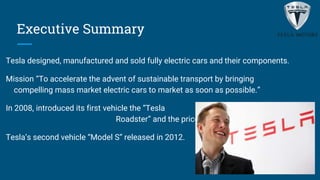
Tesla designed, manufactured and sold fully electric cars and their components.
Mission “To accelerate the advent of sustainable transport by bringing
compelling mass market electric cars to market as soon as possible.”
In 2008, introduced its first vehicle the “Tesla
Roadster” and the price was about $109,000
Tesla’s second vehicle “Model S” released in 2012.
Executive Summary
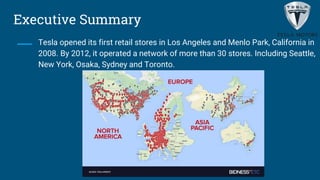
Tesla opened its first retail stores in Los Angeles and Menlo Park, California in
2008. By 2012, it operated a network of more than 30 stores. Including Seattle,
New York, Osaka, Sydney and Toronto.
Tesla’s Opportunities and Strengths
Strengths
● Tesla’s ability to innovate
where other automakers don’t
consider important.
● Their CEO experience.
● Inventions and small
partnership with other
manufacturers.
Opportunities
● The concern today in global
warming.
● Not so many competitors in
the electric vehicle market.
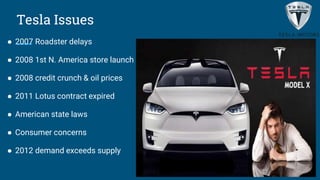
Tesla Issues
● 2007 Roadster delays
● 2008 1st N. America store launch
● 2008 credit crunch & oil prices
● 2011 Lotus contract expired
● American state laws
● Consumer concerns
● 2012 demand exceeds supply
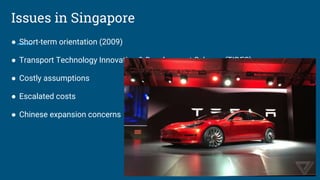
Issues in Singapore
● Short-term orientation (2009)
● Transport Technology Innovation & Development Scheme (TIDES)
● Costly assumptions
● Escalated costs
● Chinese expansion concerns
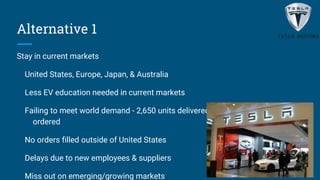
Alternative 1
Stay in current markets
United States, Europe, Japan, & Australia
Less EV education needed in current markets
Failing to meet world demand - 2,650 units delivered / 15,000
ordered
No orders filled outside of United States
Delays due to new employees & suppliers
Miss out on emerging/growing markets
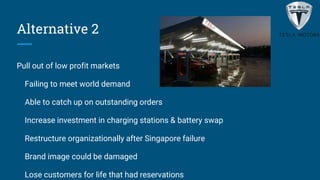
Alternative 2
Pull out of low profit markets
Failing to meet world demand
Able to catch up on outstanding orders
Increase investment in charging stations & battery swap
Restructure organizationally after Singapore failure
Brand image could be damaged
Lose customers for life that had reservations
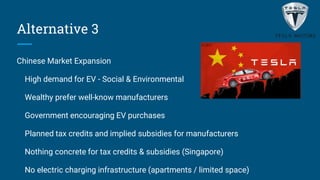
Alternative 3
Chinese Market Expansion
High demand for EV - Social & Environmental
Wealthy prefer well-know manufacturers
Government encouraging EV purchases
Planned tax credits and implied subsidies for manufacturers
Nothing concrete for tax credits & subsidies (Singapore)
No electric charging infrastructure (apartments / limited space)
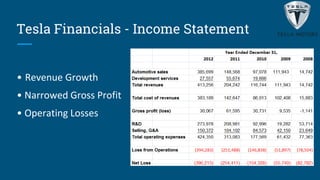
Tesla Financials - Income Statement
• Revenue Growth
• Narrowed Gross Profit
• Operating Losses
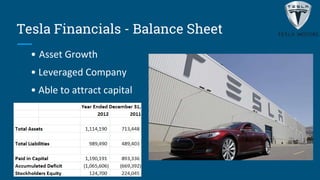
Tesla Financials - Balance Sheet
• Asset Growth
• Leveraged Company
• Able to attract capital
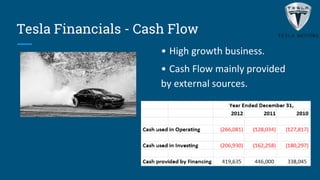
Tesla Financials - Cash Flow
• High growth business.
• Cash Flow mainly provided
by external sources.
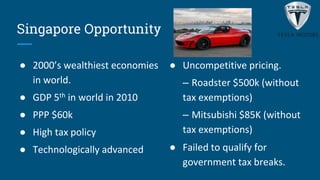
Singapore Opportunity
● 2000’s wealthiest economies
in world.
● GDP 5th in world in 2010
● PPP $60k
● High tax policy
● Technologically advanced
● Uncompetitive pricing.
– Roadster $500k (without
tax exemptions)
– Mitsubishi $85K (without
tax exemptions)
● Failed to qualify for
government tax breaks.
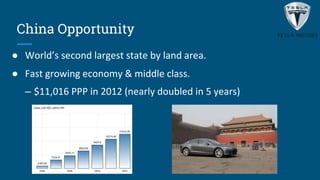
China Opportunity
● World’s second largest state by land area.
● Fast growing economy & middle class.
– $11,016 PPP in 2012 (nearly doubled in 5 years)
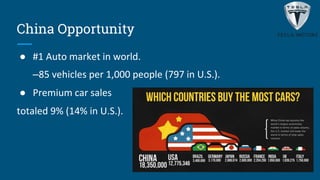
China Opportunity
● #1 Auto market in world.
–85 vehicles per 1,000 people (797 in U.S.).
● Premium car sales
totaled 9% (14% in U.S.).
Recommendation
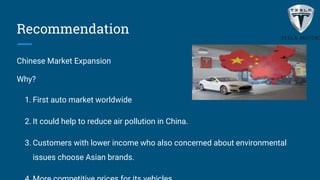
Chinese Market Expansion
Why?
1. First auto market worldwide
2. It could help to reduce air pollution in China.
3. Customers with lower income who also concerned about environmental
issues choose Asian brands.
Recommendation
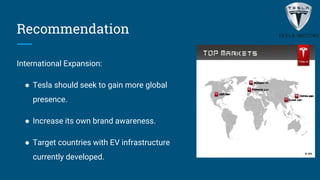
International Expansion:
● Tesla should seek to gain more global
presence.
● Increase its own brand awareness.
● Target countries with EV infrastructure
currently developed.
Tesla

Tesla

  • 1.
    Tesla: Internationalization from Singaporeto China Presented by: Barria, Cristina Dailey, Michael Huber, Kyle Nangati, Kundai Tunon, Milagros
  • 2.
    Executive Summary Tesla designed,manufactured and sold fully electric cars and their components. Mission “To accelerate the advent of sustainable transport by bringing compelling mass market electric cars to market as soon as possible.” In 2008, introduced its first vehicle the “Tesla Roadster” and the price was about $109,000 Tesla’s second vehicle “Model S” released in 2012.
  • 3.
    Executive Summary Tesla openedits first retail stores in Los Angeles and Menlo Park, California in 2008. By 2012, it operated a network of more than 30 stores. Including Seattle, New York, Osaka, Sydney and Toronto.
  • 4.
    Tesla’s Opportunities andStrengths Strengths ● Tesla’s ability to innovate where other automakers don’t consider important. ● Their CEO experience. ● Inventions and small partnership with other manufacturers. Opportunities ● The concern today in global warming. ● Not so many competitors in the electric vehicle market.
  • 5.
    Tesla Issues ● 2007Roadster delays ● 2008 1st N. America store launch ● 2008 credit crunch & oil prices ● 2011 Lotus contract expired ● American state laws ● Consumer concerns ● 2012 demand exceeds supply
  • 6.
    Issues in Singapore ●Short-term orientation (2009) ● Transport Technology Innovation & Development Scheme (TIDES) ● Costly assumptions ● Escalated costs ● Chinese expansion concerns
  • 7.
    Alternative 1 Stay incurrent markets United States, Europe, Japan, & Australia Less EV education needed in current markets Failing to meet world demand - 2,650 units delivered / 15,000 ordered No orders filled outside of United States Delays due to new employees & suppliers Miss out on emerging/growing markets
  • 8.
    Alternative 2 Pull outof low profit markets Failing to meet world demand Able to catch up on outstanding orders Increase investment in charging stations & battery swap Restructure organizationally after Singapore failure Brand image could be damaged Lose customers for life that had reservations
  • 9.
    Alternative 3 Chinese MarketExpansion High demand for EV - Social & Environmental Wealthy prefer well-know manufacturers Government encouraging EV purchases Planned tax credits and implied subsidies for manufacturers Nothing concrete for tax credits & subsidies (Singapore) No electric charging infrastructure (apartments / limited space)
  • 10.
    Tesla Financials -Income Statement • Revenue Growth • Narrowed Gross Profit • Operating Losses
  • 11.
    Tesla Financials -Balance Sheet • Asset Growth • Leveraged Company • Able to attract capital
  • 12.
    Tesla Financials -Cash Flow • High growth business. • Cash Flow mainly provided by external sources.
  • 13.
    Singapore Opportunity ● 2000’swealthiest economies in world. ● GDP 5th in world in 2010 ● PPP $60k ● High tax policy ● Technologically advanced ● Uncompetitive pricing. – Roadster $500k (without tax exemptions) – Mitsubishi $85K (without tax exemptions) ● Failed to qualify for government tax breaks.
  • 14.
    China Opportunity ● World’ssecond largest state by land area. ● Fast growing economy & middle class. – $11,016 PPP in 2012 (nearly doubled in 5 years)
  • 15.
    China Opportunity ● #1Auto market in world. –85 vehicles per 1,000 people (797 in U.S.). ● Premium car sales totaled 9% (14% in U.S.).
  • 16.
    Recommendation Chinese Market Expansion Why? 1.First auto market worldwide 2. It could help to reduce air pollution in China. 3. Customers with lower income who also concerned about environmental issues choose Asian brands.
  • 17.
    Recommendation International Expansion: ● Teslashould seek to gain more global presence. ● Increase its own brand awareness. ● Target countries with EV infrastructure currently developed.