Tertiary level of
prevention
Uzma Jan
48
BDS Batch III
Prevention
Definition and Concept
• Actions aimed at eradicating, eliminating or minimizing the
impact of disease and disability, or if none of these are
feasible, retarding the progress of the disease and
disability.
• The concept of prevention is best defined in the context of
levels, traditionally called primary, secondary and tertiary
prevention. A fourth level, called primordial prevention was
later added
Preventive Health
Definition
Preventive Health care Involves:
• Measures taken to identify and minimize risk factors for
disease.
• Improve the course of an existing disease.
• Screening for early detection of disease.
level of prevention
Old Classification
• Primary
• Secondary
• Tertiary
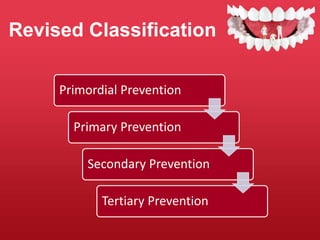
Revised Classification
Primordial Prevention
Primary Prevention
Secondary Prevention
Tertiary Prevention
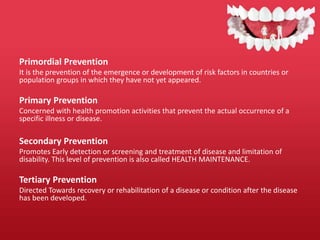
Primordial Prevention
It is the prevention of the emergence or development of risk factors in countries or
population groups in which they have not yet appeared.
Primary Prevention
Concerned with health promotion activities that prevent the actual occurrence of a
specific illness or disease.
Secondary Prevention
Promotes Early detection or screening and treatment of disease and limitation of
disability. This level of prevention is also called HEALTH MAINTENANCE.
Tertiary Prevention
Directed Towards recovery or rehabilitation of a disease or condition after the disease
has been developed.
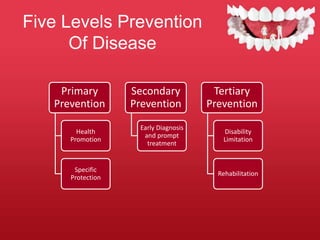
Five Levels Prevention
Of Disease
Primary
Prevention
Health
Promotion
Specific
Protection
Secondary
Prevention
Early Diagnosis
and prompt
treatment
Tertiary
Prevention
Disability
Limitation
Rehabilitation
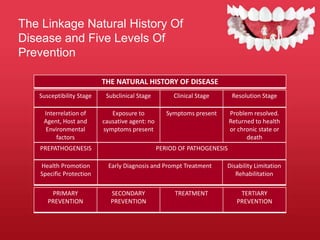
The Linkage Natural History Of
Disease and Five Levels Of
Prevention
THE NATURAL HISTORY OF DISEASE
Susceptibility Stage Subclinical Stage Clinical Stage Resolution Stage
Interrelation of
Agent, Host and
Environmental
factors
Exposure to
causative agent: no
symptoms present
Symptoms present Problem resolved.
Returned to health
or chronic state or
death
PREPATHOGENESIS PERIOD OF PATHOGENESIS
Health Promotion
Specific Protection
Early Diagnosis and Prompt Treatment Disability Limitation
Rehabilitation
PRIMARY
PREVENTION
SECONDARY
PREVENTION
TREATMENT TERTIARY
PREVENTION
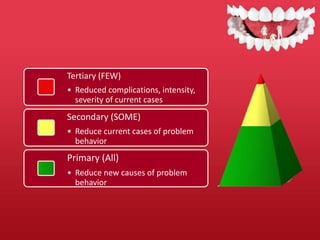
Tertiary (FEW)
• Reduced complications, intensity,
severity of current cases
Secondary (SOME)
• Reduce current cases of problem
behavior
Primary (All)
• Reduce new causes of problem
behavior
Tertiary Prevention
• It is used when the disease process has advanced beyond
its early stages.
• It is defined as "all the measures available to reduce or limit
impairments and disabilities. and to promote the patients'
adjustment to irremediable conditions."
• Intervention that should be accomplished in the stage of
tertiary prevention are disability limitation, and
rehabilitation.
Tertiary Prevention
• Tertiary prevention attempts to reduce the damage caused
by symptomatic disease by focusing on mental, physical,
and social rehabilitation. Unlike secondary prevention,
which aims to prevent disability, the objective of tertiary
prevention is to maximize the remaining capabilities and
functions of an already disabled patient.[2] Goals of tertiary
prevention include: preventing pain and damage, halting
progression and complications from disease, and restoring
the health and functions of the individuals affected by
disease.
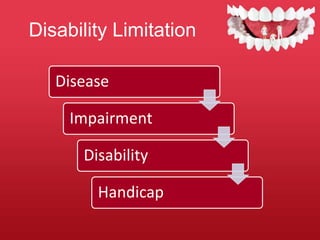
Disability Limitation
Disease
Impairment
Disability
Handicap
Impairment
Impairment is "any loss or abnormality of psychological,
physiological or anatomical structure of function."
Disability
Disability is "any restriction or lack of ability to perform an
activity in the manner or within the range considered normal
for the human being."
Handicap
Handicap is termed as "a disadvantage for a given individual,
resulting from an impairment or disability, that limits or
prevents the fulfillment of a role in the community that is
normal (depending on age, sex, and social and cultural
factors) for that individual."
Rehabilitation
Rehabilitation is "the combined and coordinated use of
medical, social, educational, and vocational measures for
training and retraining the individual to the highest possible
level of functional ability."
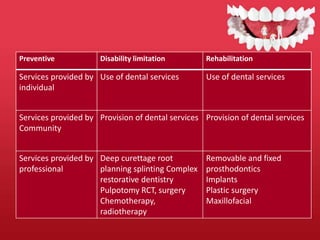
Preventive Disability limitation Rehabilitation
Services provided by
individual
Use of dental services Use of dental services
Services provided by
Community
Provision of dental services Provision of dental services
Services provided by
professional
Deep curettage root
planning splinting Complex
restorative dentistry
Pulpotomy RCT, surgery
Chemotherapy,
radiotherapy
Removable and fixed
prosthodontics
Implants
Plastic surgery
Maxillofacial
References
• http://www.academia.edu/894962/Principles_of_Prev
ention_The_Four_Stages_Theory_of_Prevention
• http://phprimer.afmc.ca/Part1-
TheoryThinkingAboutHealth/Chapter4BasicConceptsIn
PreventionSurveillanceAndHealthPromotion/Thestages
ofprevention
• http://www.slideshare.net/arunmadanan/models-of-
prevention-22182026?qid=08b2ee83-d817-4161-9250-
e4b308822bea&v=qf1&b=&from_search=14
Thank you

Tertiary level of prevention

  • 1.
  • 2.
    Prevention Definition and Concept •Actions aimed at eradicating, eliminating or minimizing the impact of disease and disability, or if none of these are feasible, retarding the progress of the disease and disability. • The concept of prevention is best defined in the context of levels, traditionally called primary, secondary and tertiary prevention. A fourth level, called primordial prevention was later added
  • 3.
    Preventive Health Definition Preventive Healthcare Involves: • Measures taken to identify and minimize risk factors for disease. • Improve the course of an existing disease. • Screening for early detection of disease.
  • 4.
    level of prevention OldClassification • Primary • Secondary • Tertiary
  • 5.
    Revised Classification Primordial Prevention PrimaryPrevention Secondary Prevention Tertiary Prevention
  • 6.
    Primordial Prevention It isthe prevention of the emergence or development of risk factors in countries or population groups in which they have not yet appeared. Primary Prevention Concerned with health promotion activities that prevent the actual occurrence of a specific illness or disease. Secondary Prevention Promotes Early detection or screening and treatment of disease and limitation of disability. This level of prevention is also called HEALTH MAINTENANCE. Tertiary Prevention Directed Towards recovery or rehabilitation of a disease or condition after the disease has been developed.
  • 7.
    Five Levels Prevention OfDisease Primary Prevention Health Promotion Specific Protection Secondary Prevention Early Diagnosis and prompt treatment Tertiary Prevention Disability Limitation Rehabilitation
  • 8.
    The Linkage NaturalHistory Of Disease and Five Levels Of Prevention THE NATURAL HISTORY OF DISEASE Susceptibility Stage Subclinical Stage Clinical Stage Resolution Stage Interrelation of Agent, Host and Environmental factors Exposure to causative agent: no symptoms present Symptoms present Problem resolved. Returned to health or chronic state or death PREPATHOGENESIS PERIOD OF PATHOGENESIS Health Promotion Specific Protection Early Diagnosis and Prompt Treatment Disability Limitation Rehabilitation PRIMARY PREVENTION SECONDARY PREVENTION TREATMENT TERTIARY PREVENTION
  • 9.
    Tertiary (FEW) • Reducedcomplications, intensity, severity of current cases Secondary (SOME) • Reduce current cases of problem behavior Primary (All) • Reduce new causes of problem behavior
  • 10.
    Tertiary Prevention • Itis used when the disease process has advanced beyond its early stages. • It is defined as "all the measures available to reduce or limit impairments and disabilities. and to promote the patients' adjustment to irremediable conditions." • Intervention that should be accomplished in the stage of tertiary prevention are disability limitation, and rehabilitation.
  • 11.
    Tertiary Prevention • Tertiaryprevention attempts to reduce the damage caused by symptomatic disease by focusing on mental, physical, and social rehabilitation. Unlike secondary prevention, which aims to prevent disability, the objective of tertiary prevention is to maximize the remaining capabilities and functions of an already disabled patient.[2] Goals of tertiary prevention include: preventing pain and damage, halting progression and complications from disease, and restoring the health and functions of the individuals affected by disease.
  • 12.
  • 13.
    Impairment Impairment is "anyloss or abnormality of psychological, physiological or anatomical structure of function."
  • 14.
    Disability Disability is "anyrestriction or lack of ability to perform an activity in the manner or within the range considered normal for the human being."
  • 15.
    Handicap Handicap is termedas "a disadvantage for a given individual, resulting from an impairment or disability, that limits or prevents the fulfillment of a role in the community that is normal (depending on age, sex, and social and cultural factors) for that individual."
  • 16.
    Rehabilitation Rehabilitation is "thecombined and coordinated use of medical, social, educational, and vocational measures for training and retraining the individual to the highest possible level of functional ability."
  • 17.
    Preventive Disability limitationRehabilitation Services provided by individual Use of dental services Use of dental services Services provided by Community Provision of dental services Provision of dental services Services provided by professional Deep curettage root planning splinting Complex restorative dentistry Pulpotomy RCT, surgery Chemotherapy, radiotherapy Removable and fixed prosthodontics Implants Plastic surgery Maxillofacial
  • 18.
  • 19.