Natural History Of
Diseases and Levels of
Prevention
By : Sourav Goswami
Moderator : Dr P R Deshmukh
MGIMS, Sevagram
Framework
•1.Definition
•2.Understanding Natural History of
Disease
•3.Its Importance
•4.Stages
•5.Application : Levels of
Prevention/Screening/prognosis/Ev
aluation
Definition
•Natural History of a disease
signifies the way in which a disease
evolves over time from the earliest
stage of its prepathogenesis phase
to its termination as
recovery,disability or death,in the
absence of treatment or prevention.
Natural History of Typhoid
Entry of
S.typhi
Entry of
S.typhi
Incuba-
tion
period
14 days
Incuba-
tion
period
14 days
Palpabl
-e
spleen
,Rash
Palpabl
-e
spleen
,Rash
Headach
e, Fever,
Pea-
soup
stool
Headach
e, Fever,
Pea-
soup
stool
COMPLICATIONS:
Hemorrhage
Perforation
Peritonities
COMPLICATIONS:
Hemorrhage
Perforation
Peritonities
DEATH/
DISABIL-
ITY(carri
e-r)
DEATH/
DISABIL-
ITY(carri
e-r)
RecoveryRecovery
Natural history of disease
Natural history of Hepatitis B infection
SUSCEPTIBLE
HOST
SUSCEPTIBLE
HOST
ON
EXPOSURE
ON
EXPOSURE
ENTRY
OF HBV
ENTRY
OF HBV
DEVEL
-OP
HEP-B
DEVEL
-OP
HEP-B
OUTCOMEOUTCOME
C
I
R
R
H
O
S
I
S
C
I
R
R
H
O
S
I
S
HCCHCC
CARRIERCARRIER
DEATHDEATH
Susceptible
host
TIME
Incubation period
Death
Recovery
Exposure Onset
Latent Infectious Non-infectious
Infection
No infection
Clinical disease
• Incubation period
the time interval between invasion by an infectious
agent and appearance of the first sign or symptom
of the disease in question
Latent period
It is used in non-infectious diseases as the equivalent
of incubation period in infectious disease
-”Period from disease initiation to disease detection”
Infectious period
the time during which the host can infect another
susceptible host
• Non-infectious period
the period when the host’s ability to transmit
disease to other hosts ceases
Stages of Natural History
of Disease
The natural history of disease can
be divided into two stages :
1. Pre-pathogenesis phase
2. Pathogenesis phase
1. Pre-Pathogenesis Phase / Stage
of susceptibility
In this stage, the disease has not developed
but the ground has been laid by the presence
of factors that favor its occurrence, for eg :
1.Alcohol consumption for Cirrhosis of liver
2.High Cholesterol, obesity, Type A personality:
Heart Disease
3.Smoking, Hypertension, High Cholesterol :
Stroke
4.Radiation, Smoking, Immune suppression:
Cancer
Pathogenesis phase
• 1. Asymptomatic (Early Pathogenesis)
phase
• 2. Early, Discernible Disease
• 3. Full-Blown (Classical) Disease
• 4. Termination - a) Complete Recovery
• b) Chronic Disease
• c) Life With Residual
Disability
• d) Death
Why is it important to study
natural history of disease?
•1. For planning preventive activities
•2.Adjusting lead time & length bias
for proper implementation of
screening program
•3.Forecasting prognosis
•4. Evaluation of intervention
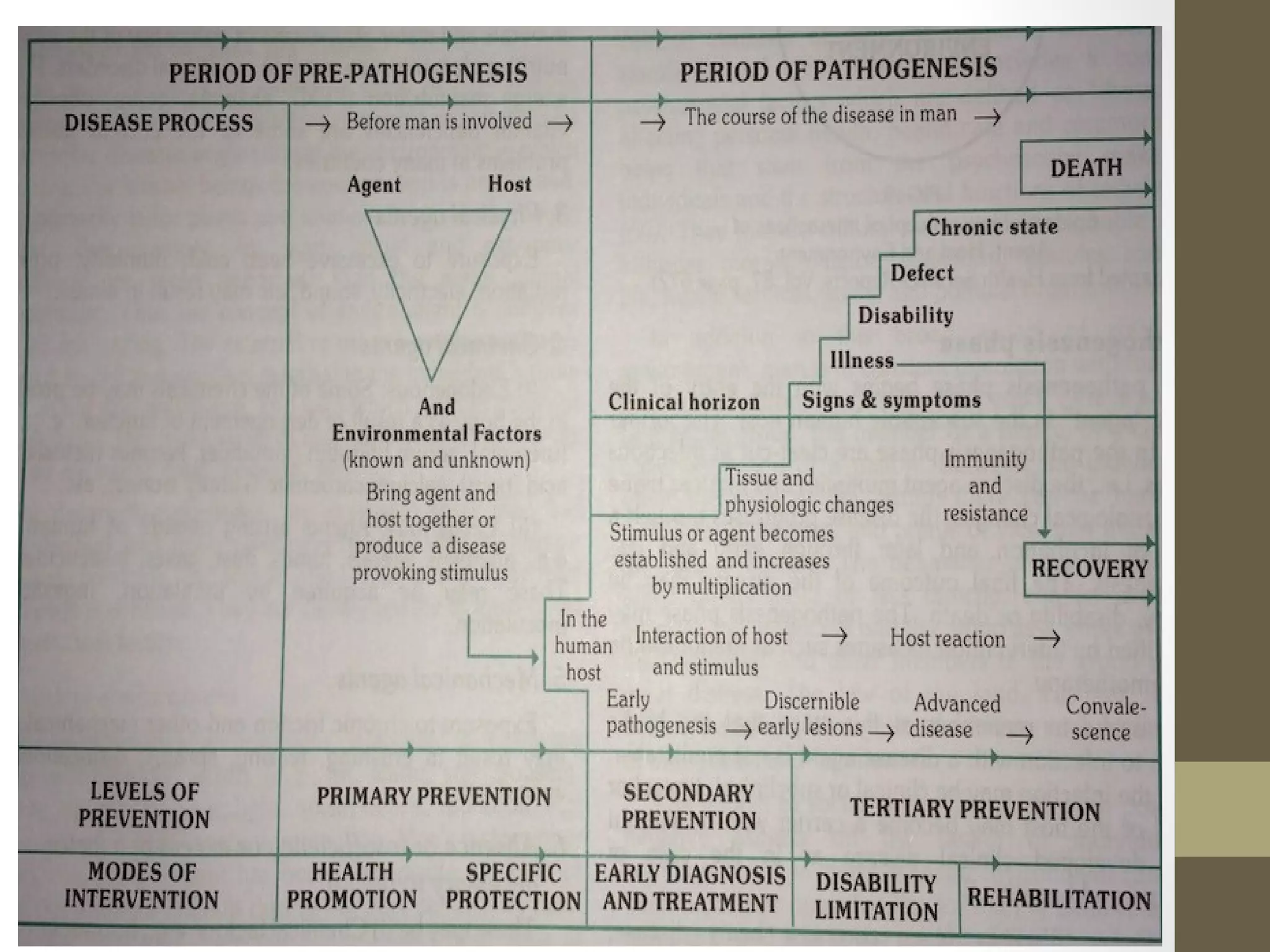
Prevention
Levels of prevention
•In general, there are mainly three
major levels of prevention, depending
on the phase of the natural history of
the disease :
•1. Primary prevention (also primordial
prevention )
•2. Secondary prevention
•3. Tertiary prevention
• Primary prevention seeks to prevent the
onset of specific diseases via risk reduction:
• (a) by altering behaviors /exposures that can
lead to disease,(eg : cessation of smoking ) or
• (b) by enhancing resistance to the effects of
exposure to a disease agent (eg : Vaccination )
• It can be done by : (1) Health Promotion
(2) Specific protection
Health Promotion
• “The process of enabling people to
increase control over, and to improve
health” (WHO)
It is not directed against any particular disease,
but is intended to strengthen the host through
a variety of approaches :
• 1.Health education
• 2.Environmental modifications
• 3.Nutritional intervention
• 4.Lifestyle and behavioural changes
1) HEALTH EDUCATION : Most cost effective
intervention. Now people have moved to behavior
change communication.
2) ENVIRONMENTAL MODIFICATION :
# provision of safe water
#Installation of sanitary latrines
#Control of insects & rodents etc
3)NUTRITIONAL INTERVENTIONS :
# Food distribution & nutritional
improvements of vulnarable groups ( viz. Mid-day
meal in schools ,Khichri on Anganwadi etc ) etc
4) LIFE STYLE & BEHAVIOURAL CHANGE :
# motivation for healthy lifestyle
Contd……
Specific protection
• immunization to protect against
specific diseases
• fortification of foods with specific
nutrients (as salt with iodine),
• use of condoms to protect
against STDs,
• use of chemoprophylactic drugs
to protect against particular
diseases (as malaria,
meningococcal meningitis, etc)
#Primordial Prevention
• This is prevention of the emergence of risk
factors in countries or population groups in
which they haven't yet appeared.
• By “individual and mass education”
• It addresses BROAD HEALTH
DETERMINANTS rather than preventing
personal exposure to risk factors, which is
the goal of primary prevention.
Contd ……
•Thus, outlawing alcohol in
certain countries/areas would
represent primordial
prevention, whereas
•a campaign against drinking and
would be an example of
primary prevention.
Secondary prevention
• It include all actions undertaken at the
stage of early pathogenesis so as to halt
the progress of disease at it’s earliest
stage,
• It is done by “early diagnosis and
prompt treatment”
• eg : Screening for Cancer/ treatment of
Tuberculosis-early diagnosis & prompt
treatment/Diagnosis & treatment of
malaria
Tertiary Prevention
• It signifies interventions done in the late
pathogenesis phase.
• “All measures available to reduce or limit
impairments and disabilities,minimise
sufferings caused by existing departures from
good health and to promote the patient’s
adjustment to irremediable conditions”
( Last,, A Dictionary of Epidemiology )
• It can be attained by : a) Disability limitation
& b) Rehabilitation
Disability limitation
(impairment/disability/handicap
)
•Impairment is defined as "any loss or
abnormality of psychological,
physiological, or anatomical
structure or function."
• Impairment is a deviation from
normal organ function; it may be
visible or invisible (screening tests
generally seek to identify
impairments).
• Disability is defined as "any restriction or lack
(resulting from an impairment) of ability to
perform an activity in the manner or within
the range considered normal for a human
being."
• An impairment does not necessarily lead to a
disability, for the impairment may be
corrected.
• For example, I am wearing eye glasses, but do
not perceive that any disability arises from my
impaired vision. A disability refers to the
function of the individual (rather than of an
organ, as with impairment).
• Handicap is defined as "a disadvantage for
a given individual, resulting from an
impairment or a disability, that limits or
prevents the fulfillment of a role that is
normal (depending on age, sex, and social
and cultural factors) for that individual."
• Handicap considers the person's participation
in their social context.
• For example, if there is a wheel-chair
access ramp at work, a disabled person
may not be handicapped in coming to work
there
Disability limitation
• Concept of disability:
DISEASE
Accident
(1)
DISEASE
Accident
(1)
IMPAIRMENT
Loss of foot
(2)
IMPAIRMENT
Loss of foot
(2)
DISABIL-ITY
Cannot walk
(3)
DISABIL-ITY
Cannot walk
(3)
HANDICAP
Unemploye
d
(4)
HANDICAP
Unemploye
d
(4)
Contd…
• Disability limitation includes all measures
to prevent the occurrence of further
complications, impairments, disabilities
and handicaps or even death. For
example :
• When we apply plaster cast to a patient
who has suffered Colle’s fracture, we are
actually trying to prevent complications
and further disability like mal-union or
non-union (4)
Rehabilitation
• “Rehabilitation” (Re =restore into,
habitat = the original home or
environment of the person)
• “The combined and coordinated use of
medical,social,educational and vocational
measures for training and retraining the
individual to the highest possible level of
functional ability”
• It includes Physiotherapy,speech
therapy,audiology,psychology, vocational
work etc
Rehabilitation contd…
• The following areas of concern have been
identified :
• 1)Medical rehabilitation – restoration of
function
• 2)Vocational rehabilitation- restoration
of the capacity to earn a livelihood
• 3)Social rehabilitation –restoration of
family & social relationships
• 4)Psychological rehabilitation –
restoration of personal dignity and
confidence
Examples of rehabilitation
•Establishing schools for the blind,
•provision of aids for the crippled,
•reconstructive surgery in leprosy,
•change of profession for a more
suitable one etc
Knowledge of Natural History
of disease helps in adjusting
lead-time & length
bias…..which helps in
implementing proper
screening measures
Lead time bias in a screening
study….........
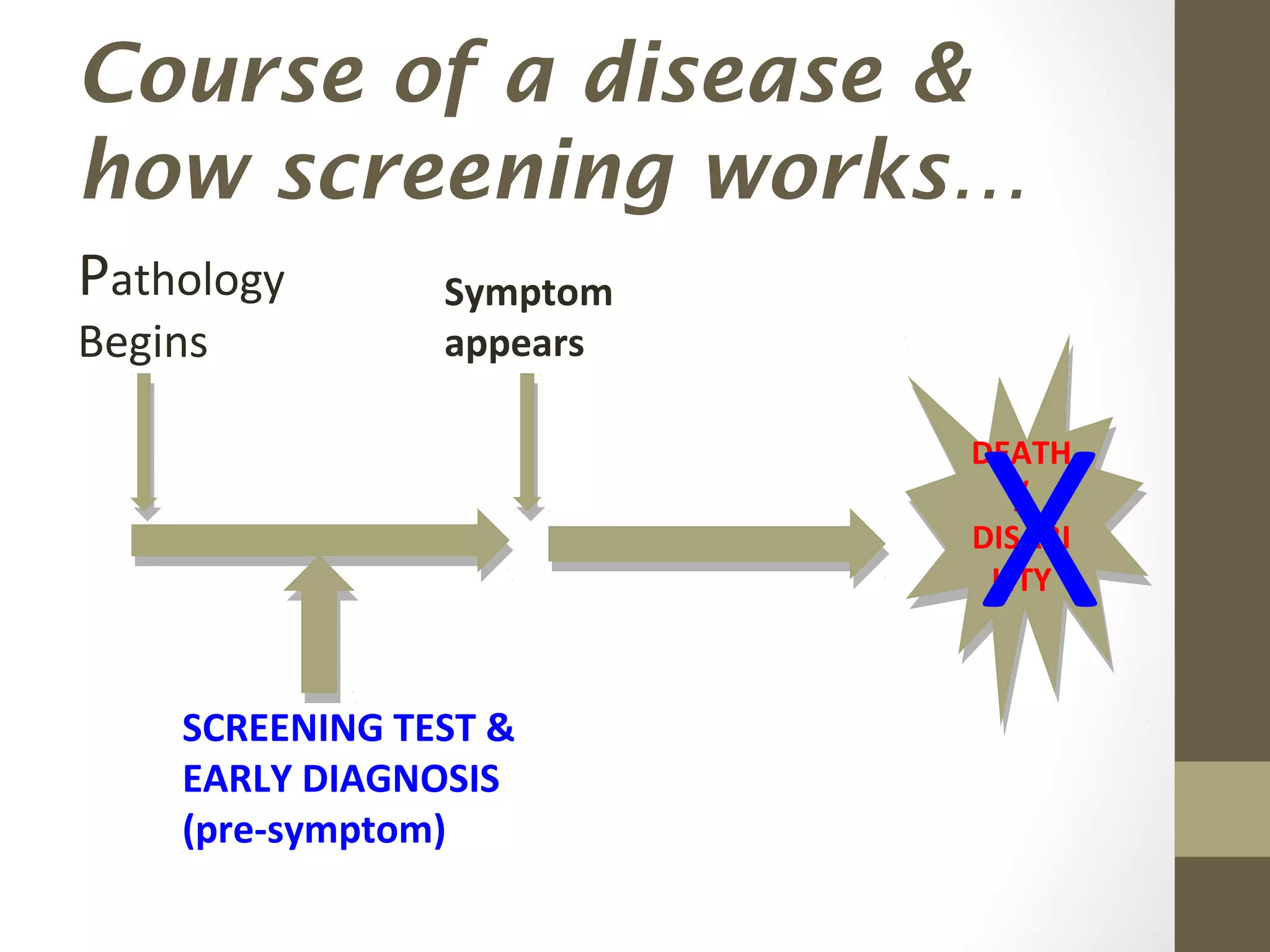
Course of a disease &
how screening works…
Pathology
Begins
Symptom
appears
DEATH
/
DISABI
LITY
DEATH
/
DISABI
LITY
SCREENING TEST &
EARLY DIAGNOSIS
(pre-symptom)
X
Lead time bias
• Lead Time :
Time between detection by screening and
symptoms development/diagnosis
If we start counting years of survival
from date of diagnosis , moving the
date of diagnosis earlier , makes
survival appear longer even if
treatment is ineffective.
•Solving lead time bias problem :
•Compare age specific mortality
between screened and not-screened.
•Not survival!
•Count from the date of
randomisation.
Length time bias…..
Length time bias
•Screening picks up prevalent disease
- Prevalence = Incidence X Duration
Slowly growing tumors have greater
duration in presymptomatic phase,
therefore greater prevalence
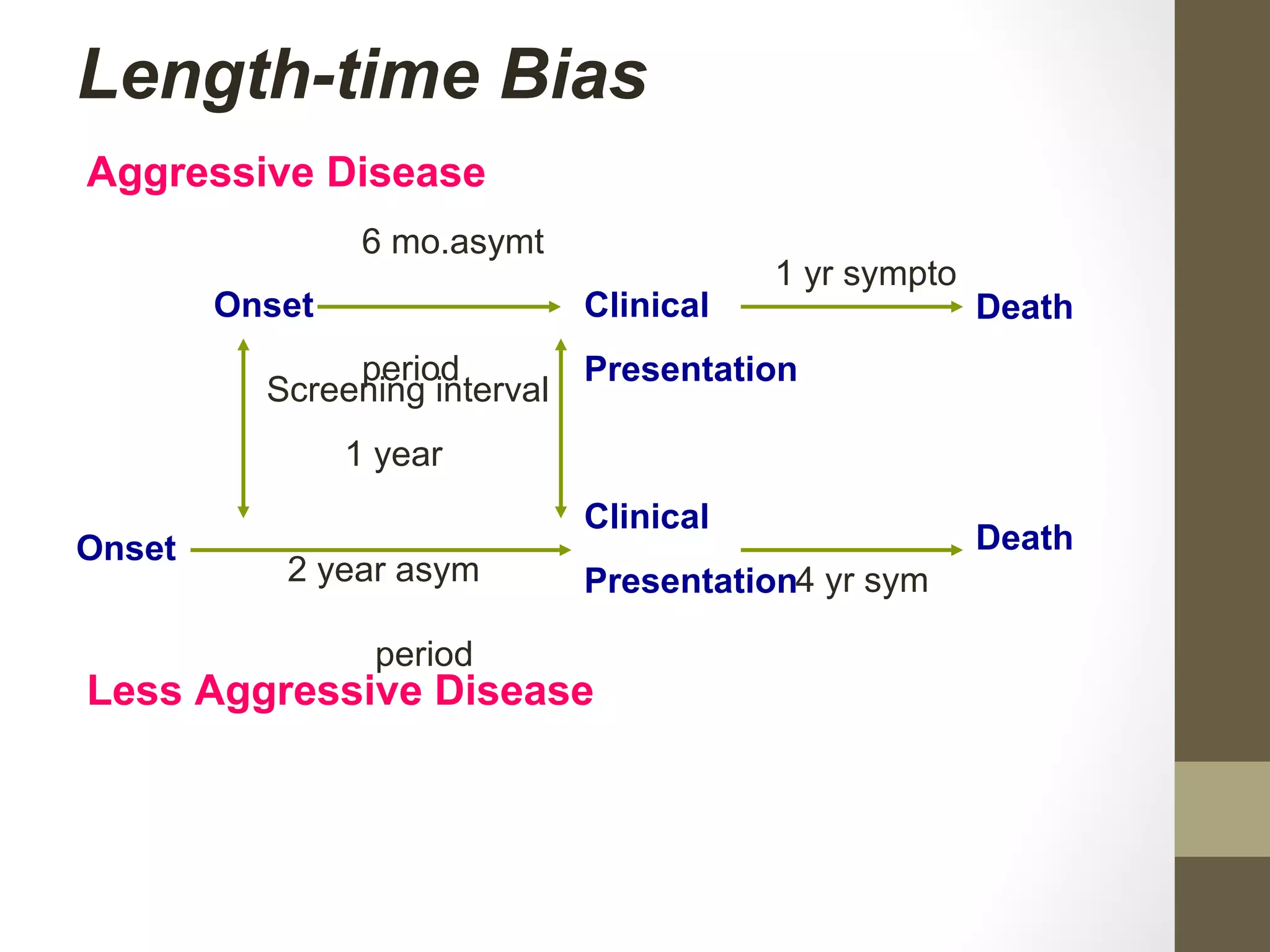
Length-time Bias
Aggressive Disease
Onset Clinical
Presentation
Death
Clinical
Presentation
DeathOnset
1 yr sympto
Screening interval
1 year
6 mo.asymt
period
2 year asym
period
4 yr sym
Less Aggressive Disease
• Therefore, cases picked up by screening
,will be disproptionately those, that are
slower growing.
• Slower growing tumors tend to have
longer survival (better prognosis)
independent of treatment .
• Overestimation of survival duration among
screening detected cases caused by the
relative excess of slowly progressing cases.
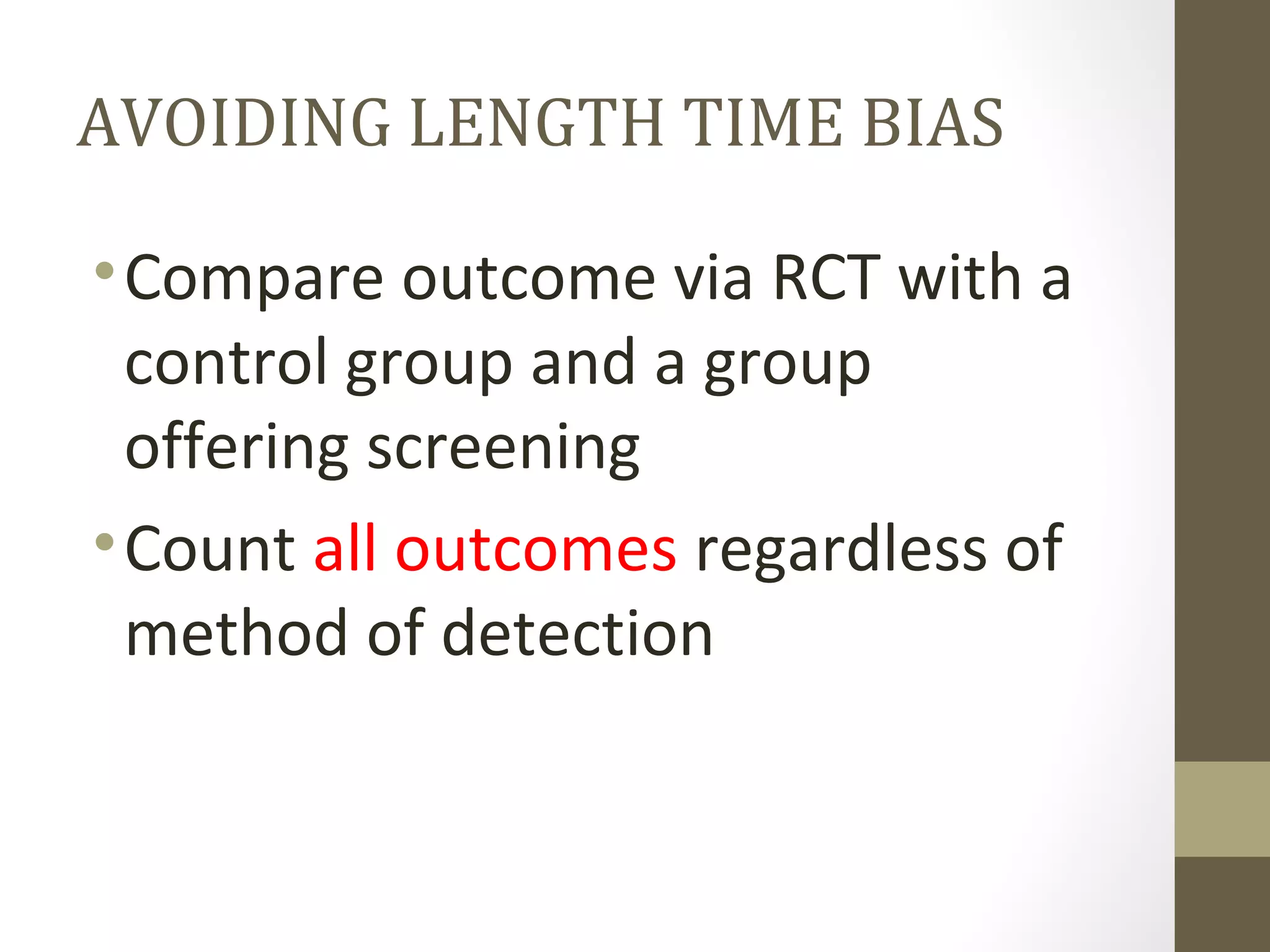
AVOIDING LENGTH TIME BIAS
•Compare outcome via RCT with a
control group and a group
offering screening
•Count all outcomes regardless of
method of detection
Prognosis: How much time do I 
have doc???
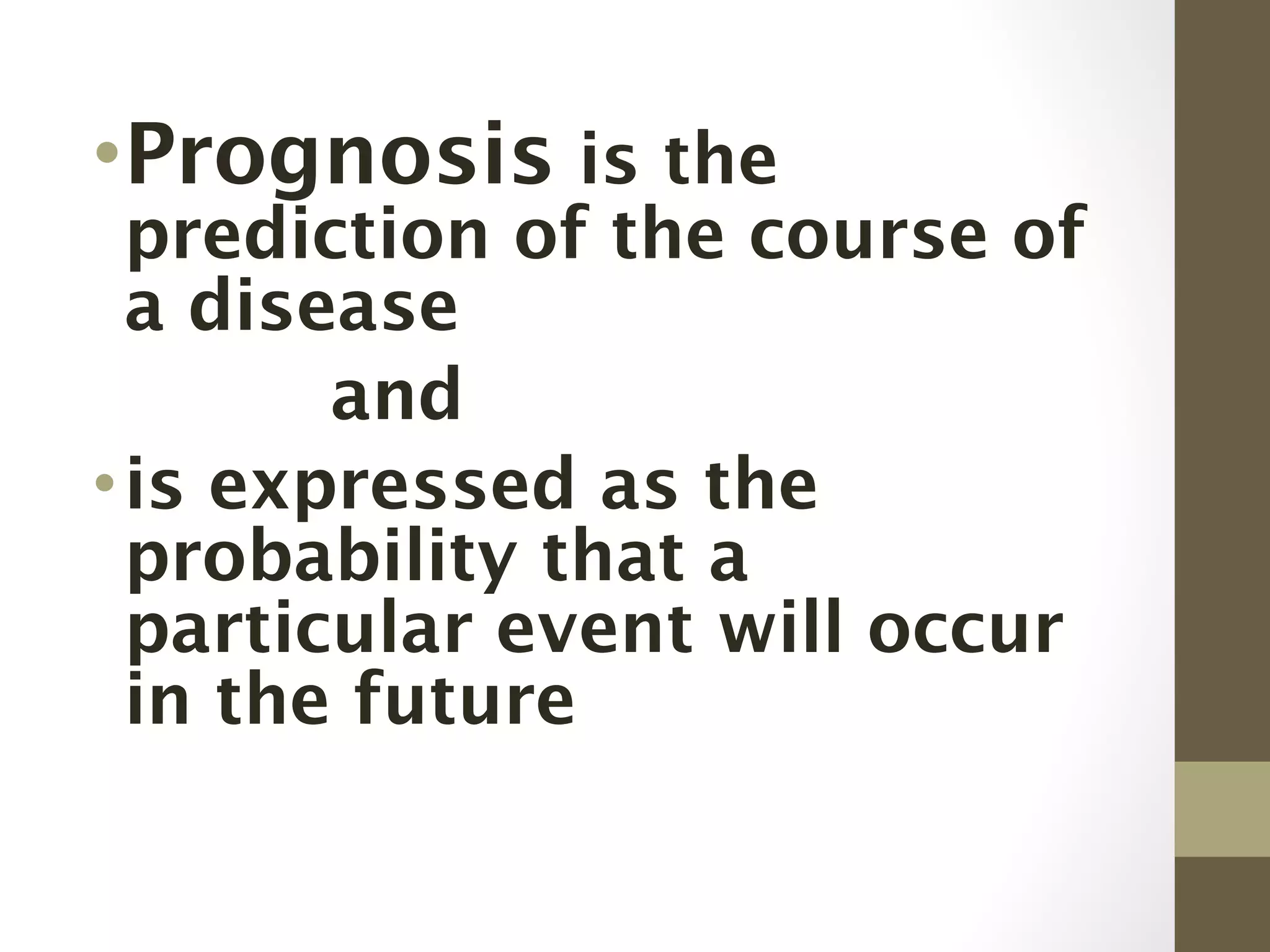
•Prognosis is the
prediction of the course of
a disease
and
•is expressed as the
probability that a
particular event will occur
in the future
Prognosis contd …..
• Predictions are based on defined groups of
patients and the outcome may be quite
different for the individual patients
• However, knowledge of the likely prognosis
is helpful in determining the most useful
treatment.
• Prognostic factors are characteristics
associated with outcome in patients with
the disease in question.
• For example, for a patient with AMI, the
prognosis is directly related to heart muscle
function.
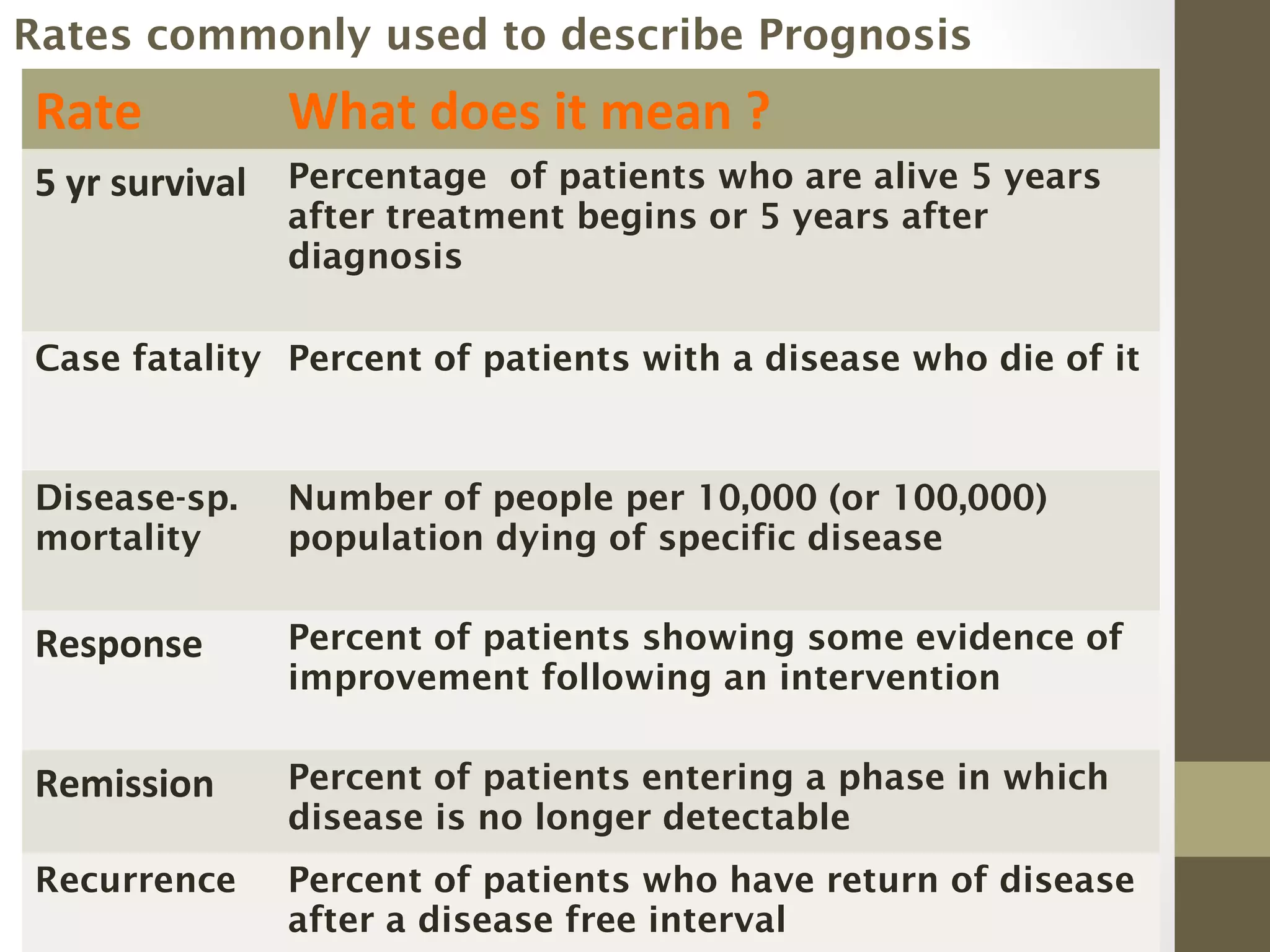
Rates commonly used to describe Prognosis
Rate What does it mean ?
5 yr survival Percentage of patients who are alive 5 years
after treatment begins or 5 years after
diagnosis
Case fatality Percent of patients with a disease who die of it
Disease-sp.
mortality
Number of people per 10,000 (or 100,000)
population dying of specific disease
Response Percent of patients showing some evidence of
improvement following an intervention
Remission Percent of patients entering a phase in which
disease is no longer detectable
Recurrence Percent of patients who have return of disease
after a disease free interval
Application of natural history of
disease : Evaluation of interventional
measures
Evaluation helps in
1)Providing feedback on the
effectiveness of a intervention
2)helps to determine whether the
program is appropriate for the target
population
• 3) is there any problems with its
implementation and support, and
• 4)whether there are any ongoing
concerns that need to be resolved as
the programme is implemented.
•5)It helps in Comparing intervention
modalities
Reference
• 1) AFMC (Association of Faculties of
Medicine of Canada) Primer on Population
Health-A virtual textbook on Public Health
concepts for clinicians
• 2)Epidemiology by Leon Gordis( Fifth
Edition)
• 3)Park’s testbook of Preventive and social
Medicine( 23rd
edition )
• 4)Text book of Public Health and community
medicine by Armed Force Medical College
Thank you !

Natural History of Disease & Levels of prevention

  • 1.
    Natural History Of Diseasesand Levels of Prevention By : Sourav Goswami Moderator : Dr P R Deshmukh MGIMS, Sevagram
  • 2.
    Framework •1.Definition •2.Understanding Natural Historyof Disease •3.Its Importance •4.Stages •5.Application : Levels of Prevention/Screening/prognosis/Ev aluation
  • 3.
    Definition •Natural History ofa disease signifies the way in which a disease evolves over time from the earliest stage of its prepathogenesis phase to its termination as recovery,disability or death,in the absence of treatment or prevention.
  • 4.
    Natural History ofTyphoid Entry of S.typhi Entry of S.typhi Incuba- tion period 14 days Incuba- tion period 14 days Palpabl -e spleen ,Rash Palpabl -e spleen ,Rash Headach e, Fever, Pea- soup stool Headach e, Fever, Pea- soup stool COMPLICATIONS: Hemorrhage Perforation Peritonities COMPLICATIONS: Hemorrhage Perforation Peritonities DEATH/ DISABIL- ITY(carri e-r) DEATH/ DISABIL- ITY(carri e-r) RecoveryRecovery
  • 5.
  • 6.
    Natural history ofHepatitis B infection SUSCEPTIBLE HOST SUSCEPTIBLE HOST ON EXPOSURE ON EXPOSURE ENTRY OF HBV ENTRY OF HBV DEVEL -OP HEP-B DEVEL -OP HEP-B OUTCOMEOUTCOME C I R R H O S I S C I R R H O S I S HCCHCC CARRIERCARRIER DEATHDEATH
  • 7.
    Susceptible host TIME Incubation period Death Recovery Exposure Onset LatentInfectious Non-infectious Infection No infection Clinical disease
  • 8.
    • Incubation period thetime interval between invasion by an infectious agent and appearance of the first sign or symptom of the disease in question Latent period It is used in non-infectious diseases as the equivalent of incubation period in infectious disease -”Period from disease initiation to disease detection” Infectious period the time during which the host can infect another susceptible host • Non-infectious period the period when the host’s ability to transmit disease to other hosts ceases
  • 9.
    Stages of NaturalHistory of Disease The natural history of disease can be divided into two stages : 1. Pre-pathogenesis phase 2. Pathogenesis phase
  • 10.
    1. Pre-Pathogenesis Phase/ Stage of susceptibility In this stage, the disease has not developed but the ground has been laid by the presence of factors that favor its occurrence, for eg : 1.Alcohol consumption for Cirrhosis of liver 2.High Cholesterol, obesity, Type A personality: Heart Disease 3.Smoking, Hypertension, High Cholesterol : Stroke 4.Radiation, Smoking, Immune suppression: Cancer
  • 11.
    Pathogenesis phase • 1.Asymptomatic (Early Pathogenesis) phase • 2. Early, Discernible Disease • 3. Full-Blown (Classical) Disease • 4. Termination - a) Complete Recovery • b) Chronic Disease • c) Life With Residual Disability • d) Death
  • 12.
    Why is itimportant to study natural history of disease? •1. For planning preventive activities •2.Adjusting lead time & length bias for proper implementation of screening program •3.Forecasting prognosis •4. Evaluation of intervention
  • 13.
  • 14.
    Levels of prevention •Ingeneral, there are mainly three major levels of prevention, depending on the phase of the natural history of the disease : •1. Primary prevention (also primordial prevention ) •2. Secondary prevention •3. Tertiary prevention
  • 16.
    • Primary preventionseeks to prevent the onset of specific diseases via risk reduction: • (a) by altering behaviors /exposures that can lead to disease,(eg : cessation of smoking ) or • (b) by enhancing resistance to the effects of exposure to a disease agent (eg : Vaccination ) • It can be done by : (1) Health Promotion (2) Specific protection
  • 17.
    Health Promotion • “Theprocess of enabling people to increase control over, and to improve health” (WHO) It is not directed against any particular disease, but is intended to strengthen the host through a variety of approaches : • 1.Health education • 2.Environmental modifications • 3.Nutritional intervention • 4.Lifestyle and behavioural changes
  • 18.
    1) HEALTH EDUCATION: Most cost effective intervention. Now people have moved to behavior change communication. 2) ENVIRONMENTAL MODIFICATION : # provision of safe water #Installation of sanitary latrines #Control of insects & rodents etc 3)NUTRITIONAL INTERVENTIONS : # Food distribution & nutritional improvements of vulnarable groups ( viz. Mid-day meal in schools ,Khichri on Anganwadi etc ) etc 4) LIFE STYLE & BEHAVIOURAL CHANGE : # motivation for healthy lifestyle Contd……
  • 19.
    Specific protection • immunizationto protect against specific diseases • fortification of foods with specific nutrients (as salt with iodine), • use of condoms to protect against STDs, • use of chemoprophylactic drugs to protect against particular diseases (as malaria, meningococcal meningitis, etc)
  • 20.
    #Primordial Prevention • Thisis prevention of the emergence of risk factors in countries or population groups in which they haven't yet appeared. • By “individual and mass education” • It addresses BROAD HEALTH DETERMINANTS rather than preventing personal exposure to risk factors, which is the goal of primary prevention.
  • 21.
    Contd …… •Thus, outlawingalcohol in certain countries/areas would represent primordial prevention, whereas •a campaign against drinking and would be an example of primary prevention.
  • 22.
    Secondary prevention • Itinclude all actions undertaken at the stage of early pathogenesis so as to halt the progress of disease at it’s earliest stage, • It is done by “early diagnosis and prompt treatment” • eg : Screening for Cancer/ treatment of Tuberculosis-early diagnosis & prompt treatment/Diagnosis & treatment of malaria
  • 23.
    Tertiary Prevention • Itsignifies interventions done in the late pathogenesis phase. • “All measures available to reduce or limit impairments and disabilities,minimise sufferings caused by existing departures from good health and to promote the patient’s adjustment to irremediable conditions” ( Last,, A Dictionary of Epidemiology ) • It can be attained by : a) Disability limitation & b) Rehabilitation
  • 24.
    Disability limitation (impairment/disability/handicap ) •Impairment isdefined as "any loss or abnormality of psychological, physiological, or anatomical structure or function." • Impairment is a deviation from normal organ function; it may be visible or invisible (screening tests generally seek to identify impairments).
  • 25.
    • Disability isdefined as "any restriction or lack (resulting from an impairment) of ability to perform an activity in the manner or within the range considered normal for a human being." • An impairment does not necessarily lead to a disability, for the impairment may be corrected. • For example, I am wearing eye glasses, but do not perceive that any disability arises from my impaired vision. A disability refers to the function of the individual (rather than of an organ, as with impairment).
  • 26.
    • Handicap isdefined as "a disadvantage for a given individual, resulting from an impairment or a disability, that limits or prevents the fulfillment of a role that is normal (depending on age, sex, and social and cultural factors) for that individual." • Handicap considers the person's participation in their social context. • For example, if there is a wheel-chair access ramp at work, a disabled person may not be handicapped in coming to work there
  • 27.
    Disability limitation • Conceptof disability: DISEASE Accident (1) DISEASE Accident (1) IMPAIRMENT Loss of foot (2) IMPAIRMENT Loss of foot (2) DISABIL-ITY Cannot walk (3) DISABIL-ITY Cannot walk (3) HANDICAP Unemploye d (4) HANDICAP Unemploye d (4)
  • 28.
    Contd… • Disability limitationincludes all measures to prevent the occurrence of further complications, impairments, disabilities and handicaps or even death. For example : • When we apply plaster cast to a patient who has suffered Colle’s fracture, we are actually trying to prevent complications and further disability like mal-union or non-union (4)
  • 29.
    Rehabilitation • “Rehabilitation” (Re=restore into, habitat = the original home or environment of the person) • “The combined and coordinated use of medical,social,educational and vocational measures for training and retraining the individual to the highest possible level of functional ability” • It includes Physiotherapy,speech therapy,audiology,psychology, vocational work etc
  • 30.
    Rehabilitation contd… • Thefollowing areas of concern have been identified : • 1)Medical rehabilitation – restoration of function • 2)Vocational rehabilitation- restoration of the capacity to earn a livelihood • 3)Social rehabilitation –restoration of family & social relationships • 4)Psychological rehabilitation – restoration of personal dignity and confidence
  • 31.
    Examples of rehabilitation •Establishingschools for the blind, •provision of aids for the crippled, •reconstructive surgery in leprosy, •change of profession for a more suitable one etc
  • 32.
    Knowledge of NaturalHistory of disease helps in adjusting lead-time & length bias…..which helps in implementing proper screening measures
  • 33.
    Lead time biasin a screening study….........
  • 34.
    Course of adisease & how screening works… Pathology Begins Symptom appears DEATH / DISABI LITY DEATH / DISABI LITY SCREENING TEST & EARLY DIAGNOSIS (pre-symptom) X
  • 35.
    Lead time bias •Lead Time : Time between detection by screening and symptoms development/diagnosis If we start counting years of survival from date of diagnosis , moving the date of diagnosis earlier , makes survival appear longer even if treatment is ineffective.
  • 37.
    •Solving lead timebias problem : •Compare age specific mortality between screened and not-screened. •Not survival! •Count from the date of randomisation.
  • 38.
  • 39.
    Length time bias •Screeningpicks up prevalent disease - Prevalence = Incidence X Duration Slowly growing tumors have greater duration in presymptomatic phase, therefore greater prevalence
  • 40.
    Length-time Bias Aggressive Disease OnsetClinical Presentation Death Clinical Presentation DeathOnset 1 yr sympto Screening interval 1 year 6 mo.asymt period 2 year asym period 4 yr sym Less Aggressive Disease
  • 41.
    • Therefore, casespicked up by screening ,will be disproptionately those, that are slower growing. • Slower growing tumors tend to have longer survival (better prognosis) independent of treatment . • Overestimation of survival duration among screening detected cases caused by the relative excess of slowly progressing cases.
  • 43.
    AVOIDING LENGTH TIMEBIAS •Compare outcome via RCT with a control group and a group offering screening •Count all outcomes regardless of method of detection
  • 44.
  • 45.
    •Prognosis is the predictionof the course of a disease and •is expressed as the probability that a particular event will occur in the future
  • 46.
    Prognosis contd ….. •Predictions are based on defined groups of patients and the outcome may be quite different for the individual patients • However, knowledge of the likely prognosis is helpful in determining the most useful treatment. • Prognostic factors are characteristics associated with outcome in patients with the disease in question. • For example, for a patient with AMI, the prognosis is directly related to heart muscle function.
  • 47.
    Rates commonly usedto describe Prognosis Rate What does it mean ? 5 yr survival Percentage of patients who are alive 5 years after treatment begins or 5 years after diagnosis Case fatality Percent of patients with a disease who die of it Disease-sp. mortality Number of people per 10,000 (or 100,000) population dying of specific disease Response Percent of patients showing some evidence of improvement following an intervention Remission Percent of patients entering a phase in which disease is no longer detectable Recurrence Percent of patients who have return of disease after a disease free interval
  • 48.
    Application of naturalhistory of disease : Evaluation of interventional measures Evaluation helps in 1)Providing feedback on the effectiveness of a intervention 2)helps to determine whether the program is appropriate for the target population
  • 49.
    • 3) isthere any problems with its implementation and support, and • 4)whether there are any ongoing concerns that need to be resolved as the programme is implemented. •5)It helps in Comparing intervention modalities
  • 50.
    Reference • 1) AFMC(Association of Faculties of Medicine of Canada) Primer on Population Health-A virtual textbook on Public Health concepts for clinicians • 2)Epidemiology by Leon Gordis( Fifth Edition) • 3)Park’s testbook of Preventive and social Medicine( 23rd edition ) • 4)Text book of Public Health and community medicine by Armed Force Medical College
  • 51.