TERPINOIDS,CITRAL AND
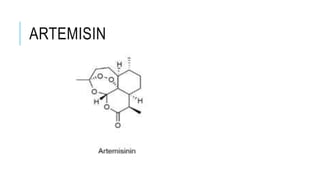
ARTEMISIN
BY
RISHAV PAUL
INTRODUCTION
oThe terpenoids, also known as isoprenoids, are a large and diverse
class of naturally occurring organic chemicals derived from the 5-
carbon compound isoprene, and the
isoprene polymers called terpenes. While sometimes used
interchangeably with "terpenes", terpenoids contain
additional functional groups, usually containing oxygen.Terpenoids
are the largest class of plant secondary metabolites, representing
about 60% of known natural products. Terpenoids are colourless
lighter than water with boiling point 150-180 °C. They are optically
active lighter than water but soluble in organic solvents
CLASSIFICATION
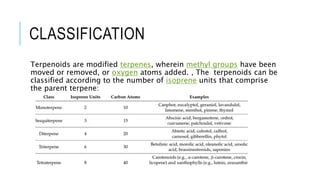
Terpenoids are modified terpenes, wherein methyl groups have been
moved or removed, or oxygen atoms added. , The terpenoids can be
classified according to the number of isoprene units that comprise
the parent terpene:
EXTRACTION
1) Ecuelle/Crushing/Expression
2) Hydrodistilation/Steam distillation
3) Solvent extraction
4) Enfleurage method
5) Supercritical fluid method
6) Steam distillation by microwave
SEPERATION AND ISOLATION
Separation and isolation of terpenoids from volatile oil
Terpenoids are present in volatile oils in the form of mixture. These terpenoidsare present either in the
form of hydrocarbon or their oxygenated derivative(alcohol, aldehyde, ketone etc.). These are
separated usually by two methods:
Physical method, and Chemical method.
Physical method: In physical method different chromatographic methods and fractional distillation
isapplied for separation of constituent terpenoids.
Chemical method:
Separation of terpenoid hydrocarbon: These are separated by using Tilden reagent composed of
solution of Nitrosyl chloride (NOCl) in chloroform. The terpenoid hydrocarbons on treatment withTilden
reagent forms crystalline adduct having sharp m.p., which is separated from volatile oilfollowed by
hydrolysis or decomposed to get back the terpenoid hydrocarbon.
Separation of terpenoid alcohol: Terpenoid alcohols on reaction with thallic anhydride forms
diester,which precipitate out from volatile oil. These di-esters on treatment with NaHCO3 in
presenceKOH, yields back terpene alcohol and thallic acid.
Separation of terpenoid aldehyde and ketone: Terpenoid aldehydes and ketones forms
crystallineadduct on reaction with NaHSO3 and phenyl hydrazines etc. These crystalline adducts can
behydrolyzed to get back carbonyl compounds.
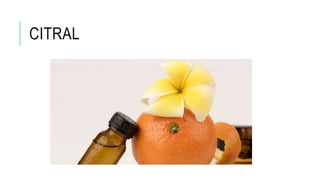
CITRAL
BIOLOGICAL SOURCE
It is obtained by distillation of leaves andaerial parts of plant of
Cymbopogon
Flexuosus or Cymbopogon Citratus.
Family: Graminae (Poaceae)
INTRODUCTION
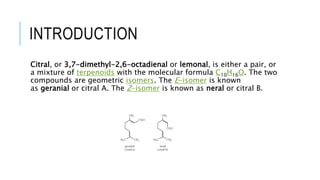
Citral, or 3,7-dimethyl-2,6-octadienal or lemonal, is either a pair, or
a mixture of terpenoids with the molecular formula C10H16O. The two
compounds are geometric isomers. The E-isomer is known
as geranial or citral A. The Z-isomer is known as neral or citral B.
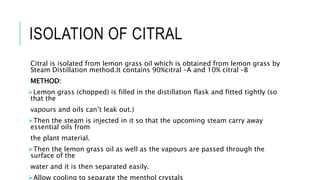
ISOLATION OF CITRAL
Citral is isolated from lemon grass oil which is obtained from lemon grass by
Steam Distillation method.It contains 90%citral –A and 10% citral –B
METHOD:
Lemon grass (chopped) is filled in the distillation flask and fitted tightly (so
that the
vapours and oils can’t leak out.)
Then the steam is injected in it so that the upcoming steam carry away
essential oils from
the plant material.
Then the lemon grass oil as well as the vapours are passed through the
surface of the
water and it is then separated easily.
Allow cooling to separate the menthol crystals
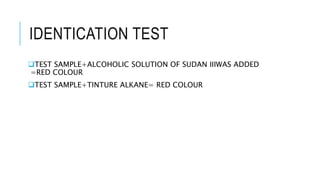
IDENTICATION TEST
TEST SAMPLE+ALCOHOLIC SOLUTION OF SUDAN IIIWAS ADDED
=RED COLOUR
TEST SAMPLE+TINTURE ALKANE= RED COLOUR
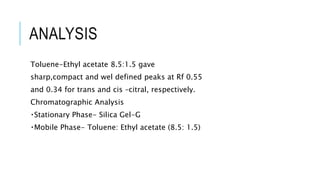
ANALYSIS
Toluene-Ethyl acetate 8.5:1.5 gave
sharp,compact and wel defined peaks at Rf 0.55
and 0.34 for trans and cis –citral, respectively.
Chromatographic Analysis
Stationary Phase- Silica Gel-G
Mobile Phase- Toluene: Ethyl acetate (8.5: 1.5)
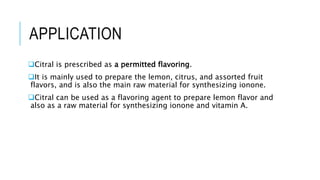
APPLICATION
Citral is prescribed as a permitted flavoring.
It is mainly used to prepare the lemon, citrus, and assorted fruit
flavors, and is also the main raw material for synthesizing ionone.
Citral can be used as a flavoring agent to prepare lemon flavor and
also as a raw material for synthesizing ionone and vitamin A.
ARTEMISIN
INTRODUCTION
Artemisin is a sesquiterpenoid lactone.
It is known as a powerful medicine to reduce the number of
plasmodium parasite in the blood of patients with malaria.
It is used as a frist-line & second-line drug treatment for
plasmodium falciparum malaria as well as for chloroquineresistant
plasmodium vivax malaria.
BIOLOGICAL SOURCE
Artemisin is obtained from the
unexpanded flower head of Artimisia annua,Artimisia
maritima,Artimisia brevifolia and other species of
Artemisia
FAMILY- Compositae
CHEMICAL CONSTITUENTS- Astemisia contains essential
oils and two crystalline substances (santonin and artemisin)
ASSAY
Determine by high performance thin-layer
chromatography,coating the plate with silica gel GF254.
MOBOLE PHASE- A mixture of 1 volume of hexane and 1 volume
of diethyl ether.
TEST SOLUTION: To 0.1 g of coarsely powdered substance under
examination, add 10 ml of hexane and keep for 12 hours, filter.
Repeat the process of extraction 3 times. Combine the extracts,
evaporate and dissolve in 1.0 ml of hexane
USES
Artemisinin and its derivatives have been used for the treatment of
malarial and parasitic worm (helminth) infections. They have the
advantage over other drugs in having an ability to kill faster and kill
all the life cycle stages of the parasites.
Terpinoids,citral and artemisin

Terpinoids,citral and artemisin

  • 1.
  • 2.
    INTRODUCTION oThe terpenoids, alsoknown as isoprenoids, are a large and diverse class of naturally occurring organic chemicals derived from the 5- carbon compound isoprene, and the isoprene polymers called terpenes. While sometimes used interchangeably with "terpenes", terpenoids contain additional functional groups, usually containing oxygen.Terpenoids are the largest class of plant secondary metabolites, representing about 60% of known natural products. Terpenoids are colourless lighter than water with boiling point 150-180 °C. They are optically active lighter than water but soluble in organic solvents
  • 3.
    CLASSIFICATION Terpenoids are modifiedterpenes, wherein methyl groups have been moved or removed, or oxygen atoms added. , The terpenoids can be classified according to the number of isoprene units that comprise the parent terpene:
  • 4.
    EXTRACTION 1) Ecuelle/Crushing/Expression 2) Hydrodistilation/Steamdistillation 3) Solvent extraction 4) Enfleurage method 5) Supercritical fluid method 6) Steam distillation by microwave
  • 5.
    SEPERATION AND ISOLATION Separationand isolation of terpenoids from volatile oil Terpenoids are present in volatile oils in the form of mixture. These terpenoidsare present either in the form of hydrocarbon or their oxygenated derivative(alcohol, aldehyde, ketone etc.). These are separated usually by two methods: Physical method, and Chemical method. Physical method: In physical method different chromatographic methods and fractional distillation isapplied for separation of constituent terpenoids. Chemical method: Separation of terpenoid hydrocarbon: These are separated by using Tilden reagent composed of solution of Nitrosyl chloride (NOCl) in chloroform. The terpenoid hydrocarbons on treatment withTilden reagent forms crystalline adduct having sharp m.p., which is separated from volatile oilfollowed by hydrolysis or decomposed to get back the terpenoid hydrocarbon. Separation of terpenoid alcohol: Terpenoid alcohols on reaction with thallic anhydride forms diester,which precipitate out from volatile oil. These di-esters on treatment with NaHCO3 in presenceKOH, yields back terpene alcohol and thallic acid. Separation of terpenoid aldehyde and ketone: Terpenoid aldehydes and ketones forms crystallineadduct on reaction with NaHSO3 and phenyl hydrazines etc. These crystalline adducts can behydrolyzed to get back carbonyl compounds.
  • 6.
  • 7.
    BIOLOGICAL SOURCE It isobtained by distillation of leaves andaerial parts of plant of Cymbopogon Flexuosus or Cymbopogon Citratus. Family: Graminae (Poaceae)
  • 8.
    INTRODUCTION Citral, or 3,7-dimethyl-2,6-octadienalor lemonal, is either a pair, or a mixture of terpenoids with the molecular formula C10H16O. The two compounds are geometric isomers. The E-isomer is known as geranial or citral A. The Z-isomer is known as neral or citral B.
  • 9.
    ISOLATION OF CITRAL Citralis isolated from lemon grass oil which is obtained from lemon grass by Steam Distillation method.It contains 90%citral –A and 10% citral –B METHOD: Lemon grass (chopped) is filled in the distillation flask and fitted tightly (so that the vapours and oils can’t leak out.) Then the steam is injected in it so that the upcoming steam carry away essential oils from the plant material. Then the lemon grass oil as well as the vapours are passed through the surface of the water and it is then separated easily. Allow cooling to separate the menthol crystals
  • 10.
    IDENTICATION TEST TEST SAMPLE+ALCOHOLICSOLUTION OF SUDAN IIIWAS ADDED =RED COLOUR TEST SAMPLE+TINTURE ALKANE= RED COLOUR
  • 11.
    ANALYSIS Toluene-Ethyl acetate 8.5:1.5gave sharp,compact and wel defined peaks at Rf 0.55 and 0.34 for trans and cis –citral, respectively. Chromatographic Analysis Stationary Phase- Silica Gel-G Mobile Phase- Toluene: Ethyl acetate (8.5: 1.5)
  • 12.
    APPLICATION Citral is prescribedas a permitted flavoring. It is mainly used to prepare the lemon, citrus, and assorted fruit flavors, and is also the main raw material for synthesizing ionone. Citral can be used as a flavoring agent to prepare lemon flavor and also as a raw material for synthesizing ionone and vitamin A.
  • 13.
  • 14.
    INTRODUCTION Artemisin is asesquiterpenoid lactone. It is known as a powerful medicine to reduce the number of plasmodium parasite in the blood of patients with malaria. It is used as a frist-line & second-line drug treatment for plasmodium falciparum malaria as well as for chloroquineresistant plasmodium vivax malaria.
  • 15.
    BIOLOGICAL SOURCE Artemisin isobtained from the unexpanded flower head of Artimisia annua,Artimisia maritima,Artimisia brevifolia and other species of Artemisia FAMILY- Compositae CHEMICAL CONSTITUENTS- Astemisia contains essential oils and two crystalline substances (santonin and artemisin)
  • 16.
    ASSAY Determine by highperformance thin-layer chromatography,coating the plate with silica gel GF254. MOBOLE PHASE- A mixture of 1 volume of hexane and 1 volume of diethyl ether. TEST SOLUTION: To 0.1 g of coarsely powdered substance under examination, add 10 ml of hexane and keep for 12 hours, filter. Repeat the process of extraction 3 times. Combine the extracts, evaporate and dissolve in 1.0 ml of hexane
  • 17.
    USES Artemisinin and itsderivatives have been used for the treatment of malarial and parasitic worm (helminth) infections. They have the advantage over other drugs in having an ability to kill faster and kill all the life cycle stages of the parasites.