TERPENOIDS
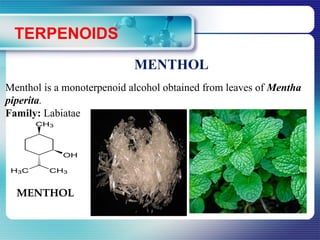
Menthol is amonoterpenoid alcohol obtained from leaves of Mentha
piperita.
Family: Labiatae
MENTHOL
MENTHOL
3.
Method 1
•Take weighquantity of coarse powder of leaves.
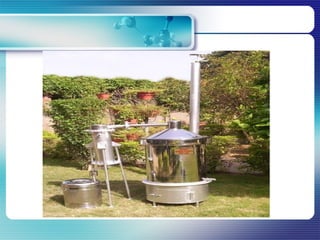
•Extract oil by water distillation.
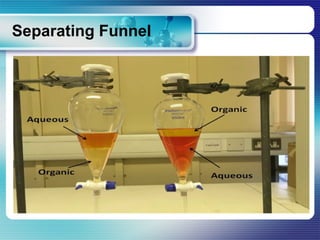
•Separate the oil from water by using separating funnel and
allow cooling.
•Crystals of menthol will separate out.
•Collect the crystals by centrifugation.
•Recrystallize menthol from acetone or low boiling solvent to
which menthol having solubility.
ISOLATION:
5.
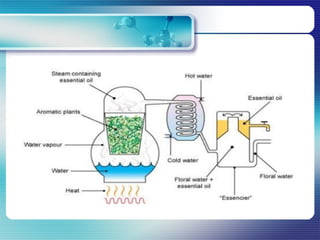
•Take air driedweighed quantity of mentha plant in stainless
still container of assembly.
•The steam under pressure, generated with the help of boiler.
•Steam is then passed through the drug.
•The plant material containing oils, releasing the plant’s
aromatic molecules and turning them into vapor.
•It takes about 3-4 hours for distillation. Menthol comes over
latter part of distillation.
•Further it is passing through condenser where the vapor cools
back into liquid form.
•Essential oil floats on top of the water. From here, it is
siphoned off.
•Allow cooling, crystals of menthol will separate out.
Method 2
7.
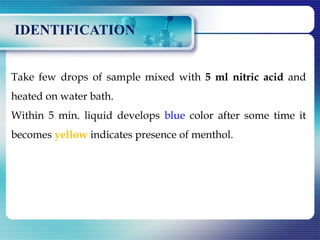
Take few dropsof sample mixed with 5 ml nitric acid and
heated on water bath.
Within 5 min. liquid develops blue color after some time it
becomes yellow indicates presence of menthol.
IDENTIFICATION
8.
ANALYSIS
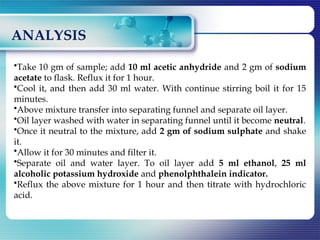
•Take 10 gmof sample; add 10 ml acetic anhydride and 2 gm of sodium
acetate to flask. Reflux it for 1 hour.
•Cool it, and then add 30 ml water. With continue stirring boil it for 15
minutes.
•Above mixture transfer into separating funnel and separate oil layer.
•Oil layer washed with water in separating funnel until it become neutral.
•Once it neutral to the mixture, add 2 gm of sodium sulphate and shake
it.
•Allow it for 30 minutes and filter it.
•Separate oil and water layer. To oil layer add 5 ml ethanol, 25 ml
alcoholic potassium hydroxide and phenolphthalein indicator.
•Reflux the above mixture for 1 hour and then titrate with hydrochloric
acid.
9.
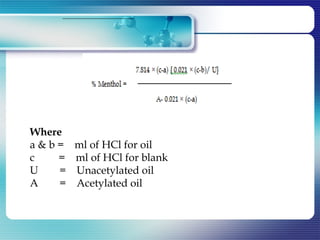
Where
a & b= ml of HCl for oil
c = ml of HCl for blank
U = Unacetylated oil
A = Acetylated oil
10.
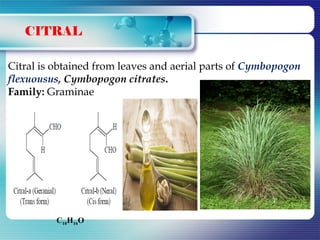
Citral is obtainedfrom leaves and aerial parts of Cymbopogon
flexuousus, Cymbopogon citrates.
Family: Graminae
CITRAL
C10H16O
11.
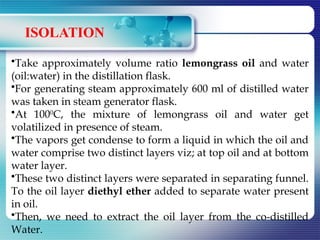
ISOLATION
•Take approximately volumeratio lemongrass oil and water
(oil:water) in the distillation flask.
•For generating steam approximately 600 ml of distilled water
was taken in steam generator flask.
•At 1000
C, the mixture of lemongrass oil and water get
volatilized in presence of steam.
•The vapors get condense to form a liquid in which the oil and
water comprise two distinct layers viz; at top oil and at bottom
water layer.
•These two distinct layers were separated in separating funnel.
To the oil layer diethyl ether added to separate water present
in oil.
•Then, we need to extract the oil layer from the co-distilled
Water.
12.
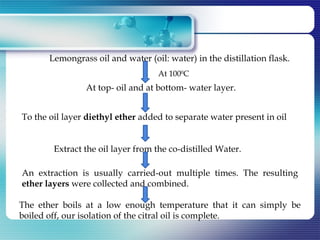
Lemongrass oil andwater (oil: water) in the distillation flask.
At top- oil and at bottom- water layer.
At 1000
C
To the oil layer diethyl ether added to separate water present in oil
Extract the oil layer from the co-distilled Water.
An extraction is usually carried-out multiple times. The resulting
ether layers were collected and combined.
The ether boils at a low enough temperature that it can simply be
boiled off, our isolation of the citral oil is complete.
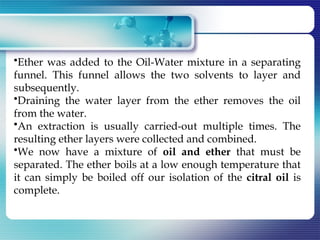
•Ether was addedto the Oil-Water mixture in a separating
funnel. This funnel allows the two solvents to layer and
subsequently.
•Draining the water layer from the ether removes the oil
from the water.
•An extraction is usually carried-out multiple times. The
resulting ether layers were collected and combined.
•We now have a mixture of oil and ether that must be
separated. The ether boils at a low enough temperature that
it can simply be boiled off our isolation of the citral oil is
complete.
15.
•Take sample tothis add alcoholic solution of sudan red III, it
shows red colour.
•Take sample to this add tincture alkane, it shows red colour.
Both above test indicate presence of citral.
3.1.2.3 ANALYSIS
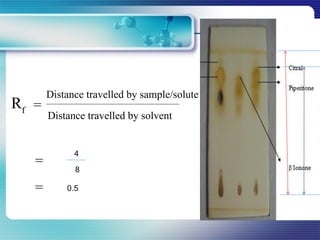
A) Chromatographic analysis
Stationary phase: Silica gel G.
Mobile Phase- Toluene: Ethyl acetate (8.5:1.5)
Rf
value- 0.5 and 0.3 for trans and cis citral respectively.
IDENTIFICATION
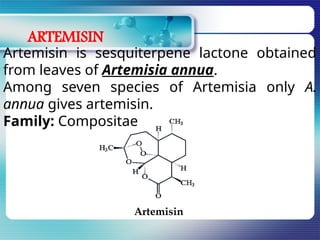
ARTEMISIN
Artemisin is sesquiterpenelactone obtained
from leaves of Artemisia annua.
Among seven species of Artemisia only A.
annua gives artemisin.
Family: Compositae
Artemisin
18.
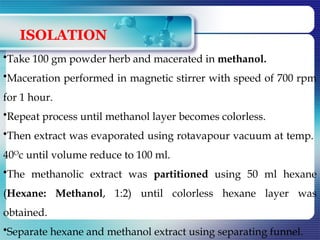
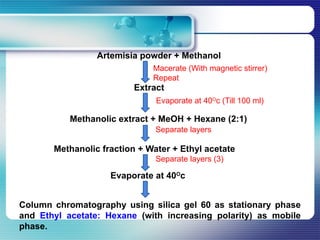
ISOLATION
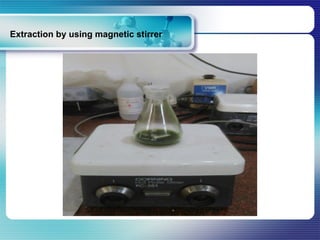
•Take 100 gmpowder herb and macerated in methanol.
•Maceration performed in magnetic stirrer with speed of 700 rpm
for 1 hour.
•Repeat process until methanol layer becomes colorless.
•Then extract was evaporated using rotavapour vacuum at temp.
40O
c until volume reduce to 100 ml.
•The methanolic extract was partitioned using 50 ml hexane
(Hexane: Methanol, 1:2) until colorless hexane layer was
obtained.
•Separate hexane and methanol extract using separating funnel.
•To methanolic extractadd 10 ml distilled water and 50 ml
ethyl acetate partitioned until ethyl acetate layer become
colorless.
•Again separate ethyl acetate and methanol-water extract.
•Each extract was concentrate using rotavapour vaccum at
temp. 400
C.
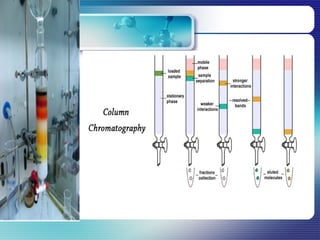
•Artemisin was fractionated from Ethyl acetate by coloumn
chromatography using silica gel 60 as stationary phase and
Ethyl acetate: Hexane (with increasing polarity) as mobile
phase.
21.
Artemisia powder +Methanol
Extract
Macerate (With magnetic stirrer)
Repeat
Methanolic extract + MeOH + Hexane (2:1)
Methanolic fraction + Water + Ethyl acetate
Column chromatography using silica gel 60 as stationary phase
and Ethyl acetate: Hexane (with increasing polarity) as mobile
phase.
Evaporate at 40O
c (Till 100 ml)
Separate layers
Separate layers (3)
Evaporate at 40O
c
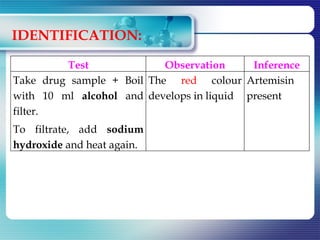
23.
IDENTIFICATION:
Test Observation Inference
Takedrug sample + Boil
with 10 ml alcohol and
filter.
To filtrate, add sodium
hydroxide and heat again.
The red colour
develops in liquid
Artemisin
present
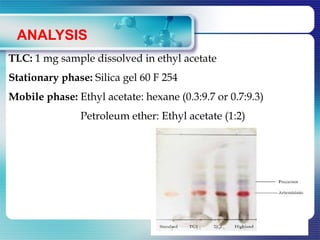
24.
ANALYSIS
TLC: 1 mgsample dissolved in ethyl acetate
Stationary phase: Silica gel 60 F 254
Mobile phase: Ethyl acetate: hexane (0.3:9.7 or 0.7:9.3)
Petroleum ether: Ethyl acetate (1:2)
25.
GLYCOSIDES
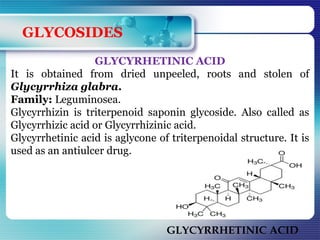
GLYCYRHETINIC ACID
It isobtained from dried unpeeled, roots and stolen of
Glycyrrhiza glabra.
Family: Leguminosea.
Glycyrrhizin is triterpenoid saponin glycoside. Also called as
Glycyrrhizic acid or Glycyrrhizinic acid.
Glycyrrhetinic acid is aglycone of triterpenoidal structure. It is
used as an antiulcer drug.
GLYCYRRHETINIC ACID
26.
ISOLATION
•Take weighed quantityof Glycyrrhiza root powder and
extract it with chloroform.
•Filter and separate the marc.
•Extract the marc with 0.5 M H2
SO4
for 1 hour.
•Filter and extract the filtrate with three portions of
chloroform.
•Separate chloroform layer. Repeat this step.
•Combine the chloroform layers.
Distill off the chloroform extract to yield a dry residue of
27.
IDENTIFICATION
1. Liebermenn test
3ml extract + 3 ml acetic
anhydride, heat and cool.
To this add drop of conc.
Sulphuric acid
Blue colour Triterpenoids
presents
2. Liebermenn- Burchard
test
3 ml extract + 2 ml
chloroform + 1 ml acetic
anhydride + one drop
concentrated sulphuric
Blue-green to
red orange
colour
Triterpenoid /
Steroids
presents
28.
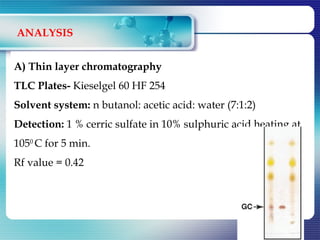
A) Thin layerchromatography
TLC Plates- Kieselgel 60 HF 254
Solvent system: n butanol: acetic acid: water (7:1:2)
Detection: 1 % cerric sulfate in 10% sulphuric acid heating at
1050
C for 5 min.
Rf value = 0.42
ANALYSIS
29.
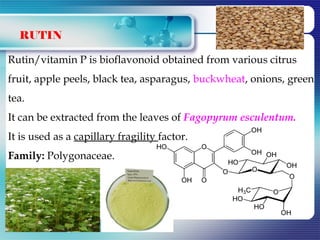
Rutin/vitamin P isbioflavonoid obtained from various citrus
fruit, apple peels, black tea, asparagus, buckwheat, onions, green
tea.
It can be extracted from the leaves of Fagopyrum esculentum.
It is used as a capillary fragility factor.
Family: Polygonaceae.
RUTIN
30.
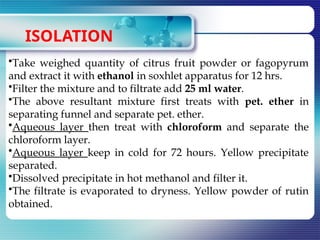
ISOLATION
•Take weighed quantityof citrus fruit powder or fagopyrum
and extract it with ethanol in soxhlet apparatus for 12 hrs.
•Filter the mixture and to filtrate add 25 ml water.
•The above resultant mixture first treats with pet. ether in
separating funnel and separate pet. ether.
•Aqueous layer then treat with chloroform and separate the
chloroform layer.
•Aqueous layer keep in cold for 72 hours. Yellow precipitate
separated.
•Dissolved precipitate in hot methanol and filter it.
•The filtrate is evaporated to dryness. Yellow powder of rutin
obtained.
31.
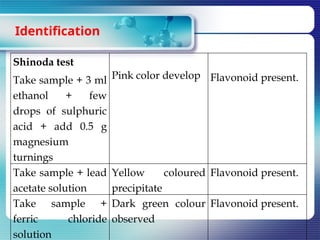
Shinoda test
Take sample+ 3 ml
ethanol + few
drops of sulphuric
acid + add 0.5 g
magnesium
turnings
Pink color develop Flavonoid present.
Take sample + lead
acetate solution
Yellow coloured
precipitate
Flavonoid present.
Take sample +
ferric chloride
solution
Dark green colour
observed
Flavonoid present.
Identification
32.
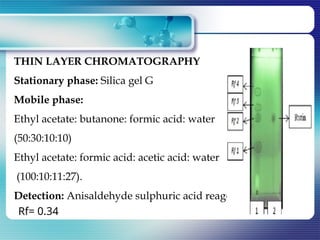
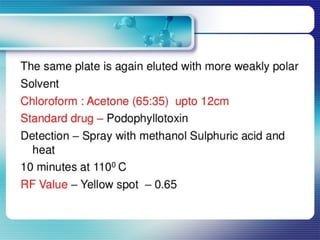
THIN LAYER CHROMATOGRAPHY
Stationaryphase: Silica gel G
Mobile phase:
Ethyl acetate: butanone: formic acid: water
(50:30:10:10)
Ethyl acetate: formic acid: acetic acid: water
(100:10:11:27).
Detection: Anisaldehyde sulphuric acid reagent
Rf= 0.34
33.
ALKALOIDS
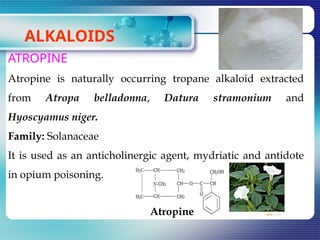
ATROPINE
Atropine is naturallyoccurring tropane alkaloid extracted
from Atropa belladonna, Datura stramonium and
Hyoscyamus niger.
Family: Solanaceae
It is used as an anticholinergic agent, mydriatic and antidote
in opium poisoning.
Atropine
34.
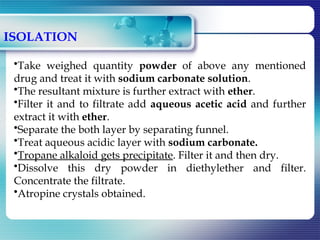
ISOLATION
•Take weighed quantitypowder of above any mentioned
drug and treat it with sodium carbonate solution.
•The resultant mixture is further extract with ether.
•Filter it and to filtrate add aqueous acetic acid and further
extract it with ether.
•Separate the both layer by separating funnel.
•Treat aqueous acidic layer with sodium carbonate.
•Tropane alkaloid gets precipitate. Filter it and then dry.
•Dissolve this dry powder in diethylether and filter.
Concentrate the filtrate.
•Atropine crystals obtained.
35.
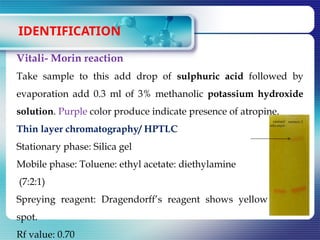
IDENTIFICATION
Vitali- Morin reaction
Takesample to this add drop of sulphuric acid followed by
evaporation add 0.3 ml of 3% methanolic potassium hydroxide
solution. Purple color produce indicate presence of atropine.
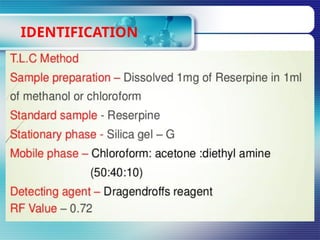
Thin layer chromatography/ HPTLC
Stationary phase: Silica gel
Mobile phase: Toluene: ethyl acetate: diethylamine
(7:2:1)
Spreying reagent: Dragendorff’s reagent shows yellow orange
spot.
Rf value: 0.70
36.
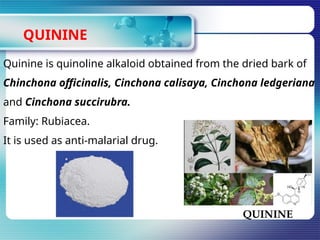
QUININE
Quinine is quinolinealkaloid obtained from the dried bark of
Chinchona officinalis, Cinchona calisaya, Cinchona ledgeriana
and Cinchona succirubra.
Family: Rubiacea.
It is used as anti-malarial drug.
QUININE
37.
ISOLATION
•Take weighed quantityof cinchona bark powder and moist it with
alcoholic calcium hydroxide/calcium oxide/ potassium hydroxide
(20%) and sodium hydroxide solution (5%).
•Keep the mixture for 1 hour so that alkaloids convert into free
bases.
•The resultant mixture extract with benzene in soxhlet extractor (6
hrs.).
•Filter it and to filtrate add 5% sulphuric acid. Shake well in
separating funnel.
•Separate aqueous and benzene layer.
•Adjust the pH of aqueous layer to 6.5 with sodium hydroxide.
•Precipitate of quinine sulphate separate out.
•Recrystallize with hot water.
•Quinine sulphate is salt so dissolve it in dilute sulphuric acid and
add ammonia solution.
•Pure quinine crystals separate out.
38.
IDENTIFICATION
Thalloquin test
Take testsample to this add bromine water and ammonia
solution it shows emerald green colour indicate presence of
quinine.
Thin layer chromatography
Stationary phase: Silica gel G.
Mobile phase: Diethylamine: ether: toluene (10:24:40).
Spraying reagent: Iodoplatinate reagent.
Rf = 0.24
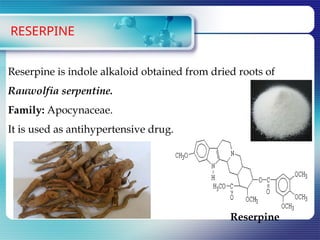
39.
Reserpine is indolealkaloid obtained from dried roots of
Rauwolfia serpentine.
Family: Apocynaceae.
It is used as antihypertensive drug.
Reserpine
RESERPINE
40.
•Take weighed quantityof root powder and moisten with 10%
sodium bi carbonate.
•Extract above mixture with benzene.
•Filter it and concentrate. Add ether and dilute hydrochloric
acid to it. Shake well. Separate acid layer.
•Again washed with ether. Make alkaline with ammonia.
•Then extract above solution with chloroform.
•The chloroform extract washed with 10% sodium carbonate.
•Separate chloroform layer and evaporate to dry.
•Dissolve it in methanol to get crystals of reserpine.
ISOLATION
41.
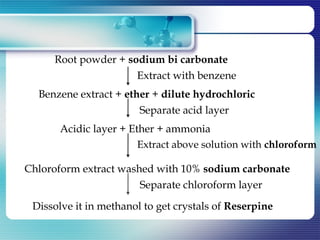
Root powder +sodium bi carbonate
Extract with benzene
Benzene extract + ether + dilute hydrochloric
Separate acid layer
Acidic layer + Ether + ammonia
Extract above solution with chloroform
Chloroform extract washed with 10% sodium carbonate
Separate chloroform layer
Dissolve it in methanol to get crystals of Reserpine
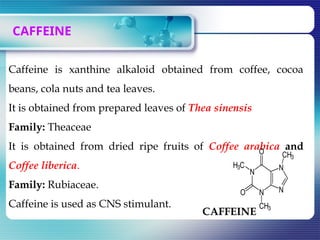
CAFFEINE
Caffeine is xanthinealkaloid obtained from coffee, cocoa
beans, cola nuts and tea leaves.
It is obtained from prepared leaves of Thea sinensis
Family: Theaceae
It is obtained from dried ripe fruits of Coffee arabica and
Coffee liberica.
Family: Rubiaceae.
Caffeine is used as CNS stimulant.
CAFFEINE
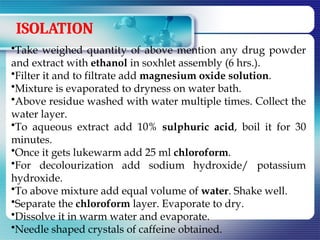
44.
•Take weighed quantityof above mention any drug powder
and extract with ethanol in soxhlet assembly (6 hrs.).
•Filter it and to filtrate add magnesium oxide solution.
•Mixture is evaporated to dryness on water bath.
•Above residue washed with water multiple times. Collect the
water layer.
•To aqueous extract add 10% sulphuric acid, boil it for 30
minutes.
•Once it gets lukewarm add 25 ml chloroform.
•For decolourization add sodium hydroxide/ potassium
hydroxide.
•To above mixture add equal volume of water. Shake well.
•Separate the chloroform layer. Evaporate to dry.
•Dissolve it in warm water and evaporate.
•Needle shaped crystals of caffeine obtained.
ISOLATION
45.
IDENTIFICATION
Murexide test
Take testsample to this add hydrochloric acid and potassium
chloride. Heat it till it gets dry. Expose this powder to dilute
ammonia. Purple color indicates presence of caffeine.
Thin layer chromatography
Stationary phase: Silica gel G
Mobile phase: Ethyl acetate: methanol: acetic acid (8:1:1) or
Chloroform: methanol (9:1).
Spraying reagent: In iodine chamber visible brown spot
46.
RESINS
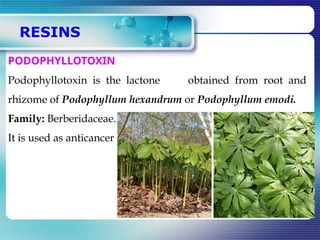
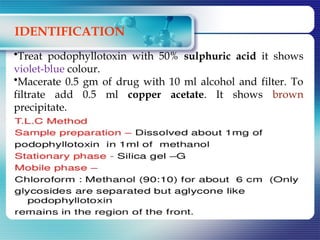
PODOPHYLLOTOXIN
Podophyllotoxin is thelactone obtained from root and
rhizome of Podophyllum hexandrum or Podophyllum emodi.
Family: Berberidaceae.
It is used as anticancer agent.
ISOLATION
•Extract approx. 120gm root powder with methanol (300
ml) in soxhlet assembly.
•Filter it and concentrate.
•To this add 200 ml acidified water (200 ml water and 2 ml
hydrochloric acid). Cool it.
•Allow mixture to stand for 2 hours. Precipitate formed.
•Filter under vaccum.
•Filtrate washed with acidified water. Precipitate formed.
•Filter and dissolve residue in sufficient quantity of hot
alcohol (90%).
•Filter and evaporate to dryness.
•Recrystallise the residue in benzene to get podophyllotoxin.
49.
IDENTIFICATION
•Treat podophyllotoxin with50% sulphuric acid it shows
violet-blue colour.
•Macerate 0.5 gm of drug with 10 ml alcohol and filter. To
filtrate add 0.5 ml copper acetate. It shows brown
precipitate.
51.
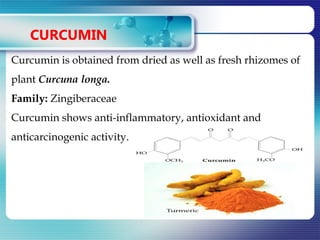
CURCUMIN
Curcumin is obtainedfrom dried as well as fresh rhizomes of
plant Curcuna longa.
Family: Zingiberaceae
Curcumin shows anti-inflammatory, antioxidant and
anticarcinogenic activity.
CURCUMIN
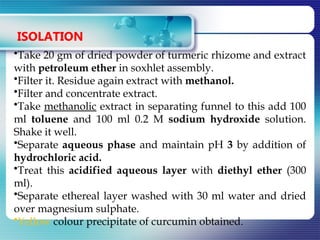
52.
ISOLATION
•Take 20 gmof dried powder of turmeric rhizome and extract
with petroleum ether in soxhlet assembly.
•Filter it. Residue again extract with methanol.
•Filter and concentrate extract.
•Take methanolic extract in separating funnel to this add 100
ml toluene and 100 ml 0.2 M sodium hydroxide solution.
Shake it well.
•Separate aqueous phase and maintain pH 3 by addition of
hydrochloric acid.
•Treat this acidified aqueous layer with diethyl ether (300
ml).
•Separate ethereal layer washed with 30 ml water and dried
over magnesium sulphate.
•Yellow colour precipitate of curcumin obtained.
53.
IDENTIFICATION
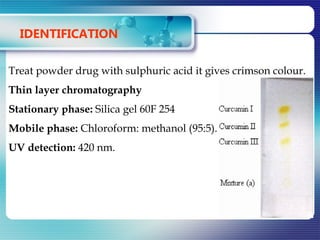
Treat powder drugwith sulphuric acid it gives crimson colour.
Thin layer chromatography
Stationary phase: Silica gel 60F 254
Mobile phase: Chloroform: methanol (95:5).
UV detection: 420 nm.