PRESENTED BY
PABBA SUPRAJA
1008-21-884-018
M.PHARM 2nd SEMESTER
PHARMACEUTICAL CHEMISTRY
UNIVERSITY COLLEGE OF TECHNOLOGY
OSMANIA UNIVERSITY
UNDER THE GUIDANCE OF
DR. S. ANITHA
FACULTY OF PHARMACY
UCT, OSMANIA UNIVERSITY
CONTENTS:
Effluents Introduction
Classification
Sources of Effluents
Effects of Industrial effluents
Effluent Mangement System
Disposal of Effluents
Existing Laws effluents management & disposal in different countries
-Effluents are defined as the materials generally discarded from industrial operations or derived from
manufacturing processes into a clean water body or environment and causes harmful effects.
Effluents are a large source of environmental pollution.
-Effluents are also known as waste or industrial wastes.
-Effluent comes from the Latin verb effluere, "to flow out".
-Effluent is defined by the United States Environmental Protection Agency as "wastewater - treated
or untreated - that flows out of a treatment plant, sewer, or industrial outfall. Generally refers to
wastes discharged into surface waters".
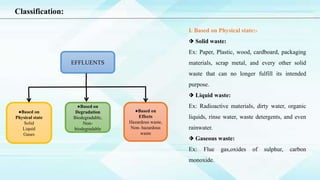
Classification:
EFFLUENTS
●Based on
Physical state
Solid
Liquid
Gases
●Based on
Degradation
Biodegradable,
Non-
biodegradable
●Based on
Effects
Hazardous waste,
Non- hazardous
waste
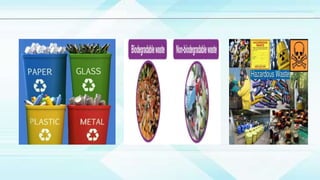
Ⅰ. Based on Physical state:-
⬗ Solid waste:
Ex: Paper, Plastic, wood, cardboard, packaging
materials, scrap metal, and every other solid
waste that can no longer fulfill its intended
purpose.
⬗ Liquid waste:
Ex: Radioactive materials, dirty water, organic
liquids, rinse water, waste detergents, and even
rainwater.
⬗ Gaseous waste:
Ex: Flue gas,oxides of sulphur, carbon
monoxide.
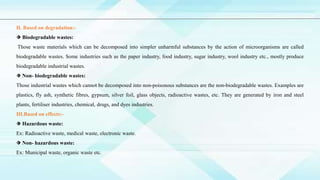
Ⅱ. Based on degradation:-
⬗ Biodegradable wastes:
Those waste materials which can be decomposed into simpler unharmful substances by the action of microorganisms are called
biodegradable wastes. Some industries such as the paper industry, food industry, sugar industry, wool industry etc., mostly produce
biodegradable industrial wastes.
⬗ Non- biodegradable wastes:
Those industrial wastes which cannot be decomposed into non-poisonous substances are the non-biodegradable wastes. Examples are
plastics, fly ash, synthetic fibres, gypsum, silver foil, glass objects, radioactive wastes, etc. They are generated by iron and steel
plants, fertiliser industries, chemical, drugs, and dyes industries.
Ⅲ.Based on effects:-
⬗ Hazardous waste:
Ex: Radioactive waste, medical waste, electronic waste.
⬗ Non- hazardous waste:
Ex: Municipal waste, organic waste etc.
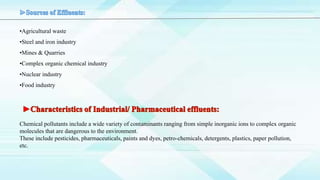
•Agricultural waste
•Steel and iron industry
•Mines & Quarries
•Complex organic chemical industry
•Nuclear industry
•Food industry
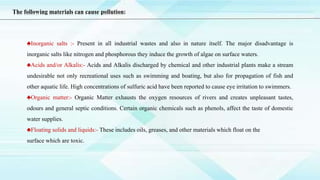
Chemical pollutants include a wide variety of contaminants ranging from simple inorganic ions to complex organic
molecules that are dangerous to the environment.
These include pesticides, pharmaceuticals, paints and dyes, petro-chemicals, detergents, plastics, paper pollution,
etc.
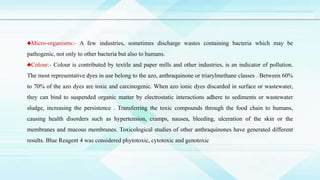
♣Inorganic salts :- Present in all industrial wastes and also in nature itself. The major disadvantage is
inorganic salts like nitrogen and phosphorous they induce the growth of algae on surface waters.
♣Acids and/or Alkalis:- Acids and Alkalis discharged by chemical and other industrial plants make a stream
undesirable not only recreational uses such as swimming and boating, but also for propagation of fish and
other aquatic life. High concentrations of sulfuric acid have been reported to cause eye irritation to swimmers.
♣Organic matter:- Organic Matter exhausts the oxygen resources of rivers and creates unpleasant tastes,
odours and general septic conditions. Certain organic chemicals such as phenols, affect the taste of domestic
water supplies.
♣Floating solids and liquids:- These includes oils, greases, and other materials which float on the
surface which are toxic.
The following materials can cause pollution:
♣Micro-organisms:- A few industries, sometimes discharge wastes containing bacteria which may be
pathogenic, not only to other bacteria but also to humans.
♣Colour:- Colour is contributed by textile and paper mills and other industries, is an indicator of pollution.
The most representative dyes in use belong to the azo, anthraquinone or triarylmethane classes . Between 60%
to 70% of the azo dyes are toxic and carcinogenic. When azo ionic dyes discarded in surface or wastewater,
they can bind to suspended organic matter by electrostatic interactions adhere to sediments or wastewater
sludge, increasing the persistence . Transferring the toxic compounds through the food chain to humans,
causing health disorders such as hypertension, cramps, nausea, bleeding, ulceration of the skin or the
membranes and mucous membranes. Toxicological studies of other anthraquinones have generated different
results. Blue Reagent 4 was considered phytotoxic, cytotoxic and genotoxic
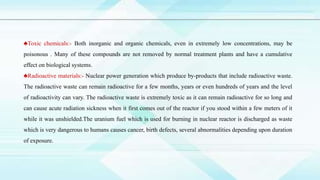
♣Toxic chemicals:- Both inorganic and organic chemicals, even in extremely low concentrations, may be
poisonous . Many of these compounds are not removed by normal treatment plants and have a cumulative
effect on biological systems.
♣Radioactive materials:- Nuclear power generation which produce by-products that include radioactive waste.
The radioactive waste can remain radioactive for a few months, years or even hundreds of years and the level
of radioactivity can vary. The radioactive waste is extremely toxic as it can remain radioactive for so long and
can cause acute radiation sickness when it first comes out of the reactor if you stood within a few meters of it
while it was unshielded.The uranium fuel which is used for burning in nuclear reactor is discharged as waste
which is very dangerous to humans causes cancer, birth defects, several abnormalities depending upon duration
of exposure.
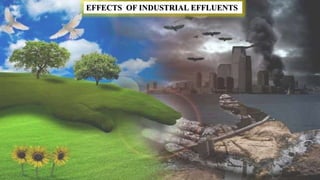
EFFECTS OF INDUSTRIAL EFFLUENTS
Industrial waste is very harmful for population and environment. Few impacts are stated below –
✔ Industries release many harmful gases such as carbon dioxide, sulfur dioxide, nitrogen oxides etc. which
cause air pollution and also effects human health.
For example: Sulphur dioxide can cause respiratory problems such as bronchitis, and can irritate nose,
throat and lungs. Nitrogen oxides can cause asthama.
✔ Liquid industrial waste is generally consists of water consisting of toxic chemicals and some micro-
organisms which causes many diseases like diarrhea, cholera, dysentery, typhoid, hepatitis A, and polio.
✔ In industrial wastewater nitrates and phosphates are there which often cause eutrophication.
✔ Industries use large quantities of water and also release a huge quantity of wastewater which contain
many harmful chemicals and heavy metals. This wastewater pollutes natural sources of water and
ultimately health and environment.
✔ It is one of the main causes of global warming.
✔ Industrial wastewater destroys useful bacteria and other microorganisms present in soil.
✔ Some industries cause sound pollution as well.
✔ chemical agents like metals, aromatic and halogenated hydrocarbons, chlorinated aromatic and nitro
compounds can cause hepatotoxicity.
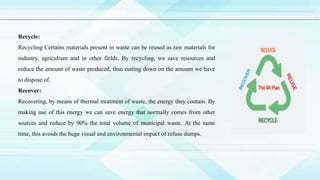
4R’ s CONCEPT :
- Reduce, Reuse, Recycle, and Recover
- The European Union has laid down guidelines for suitable waste management that guarantees the protection
of the environment and for wich the development of the so-called 4R's must be encouraged.
Reduce:
Avoiding the production of waste and in harmfulness, for which a radical change in patterns of production
and consumption is necessary.
Reuse:
Reusing everything that is left over prolongs the life span of products and means less waste is produced.
Recycle:
Recycling Certains materials present in waste can be reused as raw materials for
industry, agriculture and in other fields. By recycling, we save resources and
reduce the amount of waste produced, thus cutting down on the amount we have
to dispose of.
Recover:
Recovering, by means of thermal treatment of waste, the energy they contain. By
making use of this energy we can save energy that normally comes from other
sources and reduce by 90% the total volume of municipal waste. At the same
time, this avoids the huge visual and environmental impact of refuse dumps.
Generally Effluent Treatment Plant (ETP) is used to treat the waste from industries before discharging them
into rivers, lakes etc, by stage wise process to bring waste in permisible limit as prescribed by CPCB ( Central
pollution control board) to maintain sustainable environment.
*Need of ETP :
• To clean industry effluent and recycle it for further use.
• To reduce the usage of fresh/potable water in industries.
• To preserve natural environment against pollution.
•To meet the Standards for emission or discharge of environmental pollutants from various Industries set by
the Government and avoid hefty penalties.
• To safeguard environment against pollution and contribute in sustainable development.
• Treatment levels:
Primary
Secondary
Tertiary (or advanced)
• Treatment mechanisms:
Physical
Chemical
Biological
Treatment Levels & Mechanisms of ETP
It is of general nature and is used for removing suspended solids, odour, colour and to neutralize the high or
low pH
It involves methods of:
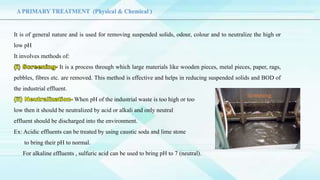
It is a process through which large materials like wooden pieces, metal pieces, paper, rags,
pebbles, fibres etc. are removed. This method is effective and helps in reducing suspended solids and BOD of
the industrial effluent.
When pH of the industrial waste is too high or too
low then it should be neutralized by acid or alkali and only neutral
effluent should be discharged into the environment.
Ex: Acidic effluents can be treated by using caustic soda and lime stone
to bring their pH to normal.
For alkaline effluents , sulfuric acid can be used to bring pH to 7 (neutral).
Δ PRIMARY TREATMENT (Physical & Chemical )
Screening
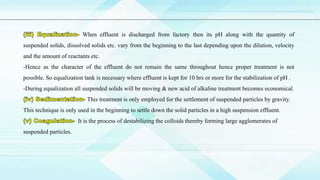
When effluent is discharged from factory then its pH along with the quantity of
suspended solids, dissolved solids etc. vary from the beginning to the last depending upon the dilution, velocity
and the amount of reactants etc.
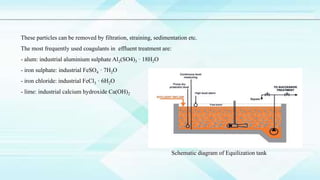
-Hence as the character of the effluent do not remain the same throughout hence proper treatment is not
possible. So equalization tank is necessary where effluent is kept for 10 hrs or more for the stabilization of pH .
-During equalization all suspended solids will be moving & new acid of alkaline treatment becomes economical.
This treatment is only employed for the settlement of suspended particles by gravity.
This technique is only used in the beginning to settle down the solid particles in a high suspension effluent.
It is the process of destabilizing the colloids thereby forming large agglomerates of
suspended particles.
These particles can be removed by filtration, straining, sedimentation etc.
The most frequently used coagulants in effluent treatment are:
- alum: industrial aluminium sulphate Al2(SO4)3 · 18H2O
- iron sulphate: industrial FeSO4 · 7H2O
- iron chloride: industrial FeCl3 · 6H2O
- lime: industrial calcium hydroxide Ca(OH)2
Schematic diagram of Equilization tank
ΔSECONDARY TREATMENT ( Biological)
•The main objective at this stage is to further reduce the amount of organic matter and other substances still
present in the effluent after the primary treatment and thereby satisfy the standards for discharge into surface
waters (rivers, lakes).
•Biological treatment process can take many forms but all are based around microorganisms, mainly bacteria.
•Secondary treatment is performed by three ways i.e., Aerobic, Anaerobic and Activated slude process.
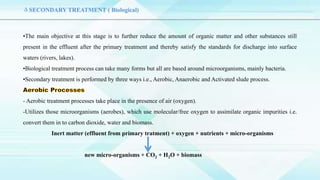
- Aerobic treatment processes take place in the presence of air (oxygen).
-Utilizes those microorganisms (aerobes), which use molecular/free oxygen to assimilate organic impurities i.e.
convert them in to carbon dioxide, water and biomass.
Inert matter (effluent from primary tratment) + oxygen + nutrients + micro-organisms
new micro-organisms + CO2 + H2O + biomass
- The anaerobic treatment processes take place in the absence of air (oxygen).
- Utilizes microorganisms (anaerobes) which do not require air (molecular/free oxygen) to assimilate organic
impurities. The final products are methane and biomass.
-Bacteria belong to genera, methanosarcina, methano bacterium and methanococcus act to produce methane.
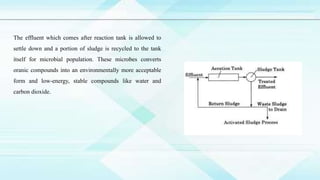
It is an important biological oxidation method for the removal of suspended and colloidal solids in the effluent.
In this method, effluent is continuously subjected to biological degradation carried out by microbial suspended
in the reaction tank into which oxygen is introduced by mechanical methods.
The effluent which comes after reaction tank is allowed to
settle down and a portion of sludge is recycled to the tank
itself for microbial population. These microbes converts
oranic compounds into an environmentally more acceptable
form and low-energy, stable compounds like water and
carbon dioxide.
Δ TERITIARY OR ADVANCED TREATMENT OF INDUSTRIAL EFFLUENTS
This type of treatment is needed for the effluent for the removal of bacteria and dissolved inorganic matter
(metals, metal oxides, metal carbonates, metal sulphates etc.
- For killing bacteria, chlorine or a mixture of chlorine and bromine can be used.
-For the removal of inorganic substances, the following methods have been recommended:
•Passing through semi-perameable membrane.
•It is a technique by which metals are removed by precipitating them either as hydroxides at high pH or as
sulphates etc.
•For example, chromate from electroplating industry can easily be removed by reaction with ferrous sulphate &
then precipitating it with lime. From Barium chloride factory, the excess of Barium is precipitated as Barium
sulphate by the addition of Dil. Sulphuric acid.
•This method is generally employed when waste solid/solids are reused in the industry. It is a method
used for recovery of radioactive substances. Here the effluent is boiled and after the evaporation of the
water, the concentrated solution is left out in the vessel which is again used in the recycle process of the
industry.
•As activated carbon has high adsorption power hence it is utilized for the removal of pesticides such as
DDT, hexachlorobenzene, Dieldrin, Heptachlor, Lindane, Aldrin, Chlordane, Toxophene, Methoxychlor,
Heptachlor epioxide & others. The simple mechanism involves in this techniques is based on the
phenomenon of adsorption.
•Ion exchange resins are insoluble in water and in organic solvents.
•They contain active or counter ions that will exchange reversibly with other ions, in a solution without any
appreciable physical change occurring in the materials.
•Ion exchange resins are of two types i.e., Cation Exchange Resins and Anion Exchange Resins.
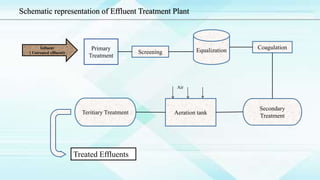
Primary
Treatment
Influent
( Untreated effluent) Screening
Coagulation
Aeration tank
Air
Equalization
Teritiary Treatment
Secondary
Treatment
Treated Effluents
Schematic representation of Effluent Treatment Plant
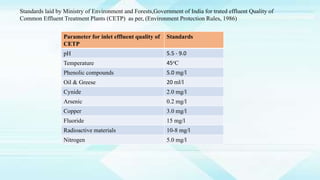
Parameter for inlet effluent quality of
CETP
Standards
pH 5.5 - 9.0
Temperature 45oC
Phenolic compounds 5.0 mg/l
Oil & Greese 20 ml/l
Cynide 2.0 mg/l
Arsenic 0.2 mg/l
Copper 3.0 mg/l
Fluoride 15 mg/l
Radioactive materials 10-8 mg/l
Nitrogen 5.0 mg/l
Standards laid by Ministry of Environment and Forests,Government of India for trated effluent Quality of
Common Effluent Treatment Plants (CETP) as per, (Environment Protection Rules, 1986)
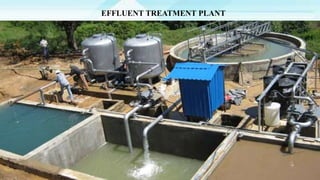
EFFLUENT TREATMENT PLANT
DISPOSAL OF EFFLUENTS :
Thefollowing methods can be used for disposal:
•In this process, the waste that cannot be reused or recycled are separated out.
•Spread as a thin layer in low-lying areas across a city. A layer of soil is added after each layer of garbage.
•However, once this process is complete, the area is declared unfit for construction of buildings for the next 20
years. Instead, it can only be used as a playground or a park.
• Combustion of waste to reduce it to incombustible matter such as ash and waste gas.
•The exhaust gases from this process may be toxic, hence it is treated before being released into the environment.
•Reduces the volume of waste by 90 per cent and is considered as one of the most hygienic methods of waste
disposal.
The heat generated can be used to produce electricity.
Disadvantage is generation of greenhouse gases such as carbon dioxide and carbon monoxide.
•Technique that includes shredding the waste into smaller pieces, pushing to mix properly and placing it in such a
way to fill voids.
•Waste compaction results in reducing the amount and size of waste that ultimately results in less pollution of the
environment.
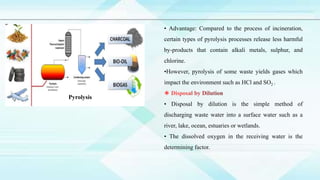
•It is a process of converting industrial and domestic wastes into a recovered fuel.
•Pyrolysis process potentially yield an alternative to fossil fuels.
•It is a thermo-chemical decomposition of organic materials by heat in the absence of stoichiometric quantities of
oxygen.
• Advantage: Compared to the process of incineration,
certain types of pyrolysis processes release less harmful
by-products that contain alkali metals, sulphur, and
chlorine.
•However, pyrolysis of some waste yields gases which
impact the environment such as HCl and SO2 .
• Disposal by dilution is the simple method of
discharging waste water into a surface water such as a
river, lake, ocean, estuaries or wetlands.
• The dissolved oxygen in the receiving water is the
determining factor.
Pyrolysis
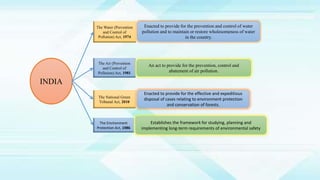
INDIA
Enacted to provide for the prevention and control of water
pollution and to maintain or restore wholesomeness of water
in the country.
The Air (Prevention
and Control of
Pollution) Act, 1981
The National Green
Tribunal Act, 2010
The Environment
Protection Act, 1986
An act to provide for the prevention, control and
abatement of air pollution.
Enacted to provide for the effective and expeditious
disposal of cases relating to environment protection
and conservation of forests.
The Water (Prevention
and Control of
Pollution) Act, 1974
Establishes the framework for studying, planning and
implementing long-term requirements of environmental safety
» Hazardous Wastes (Management, Handling and Transboundary) Rules 2008, brought out a guide for manufacture,
storage and import of hazardous chemicals and for management of hazardous wastes.
» Biomedical Waste (Management and Handling) Rules 1998, were formulated along parallel lines, for proper disposal,
segregation, transport, etc, of infectious wastes.
» Municipal Solid Wastes (Management and Handling) Rules 2000, aim at enabling municipalities to dispose municipal
solid waste in a scientific manner.
Other Countries:
CANADA
Canadian Environmental Protection Act, 1999
Canada Water Act
PAKISTHAN
Pakistan Environmental Protection Act 1997
Sindh Environmental Protection Act 2014
SINGAPORE
Environmental Protection and Management Act
Hazardous Waste (Control of Export, Import and Transit) Act
PHILIPPINES
Philippine Environmental Impact Statement System
Toxic Substances and Hazardous and Nuclear Waste Control Act of 1990
Environmental Awareness and Education Act of 2008
1. Mr. Ch. Balakrishna, “Industrial Waste Water Treatment (A70139)” Department of Civil Engineering,
Institute of Aeronautical Engineering Dundigal, Hyderabad.
2. J. Buljan and I. Kral, G. Clonfero, M. Bosnic and F. Schmel “Introduction to Treatment of Tannery
Effluents” United Nations Industrial Development Organization, Vienna, 2011.
3. https://www.slideshare.net/redeyeshayat/solid-waste-and-its-management-ppt.
4. Jebin Ahmed, Abhijeet Thakur and Arun Goyal, CHAPTER 1:Industrial Wastewater and Its Toxic Effects ,
in Biological Treatment of Industrial Wastewater, 2021, pp. 1-14 DOI: 10.1039/9781839165399-00001.
5. https://www.slideshare.net/sahil_shaggy/effluent-treatment-plant-114838035.
Effluents and its management

Effluents and its management

  • 1.
    PRESENTED BY PABBA SUPRAJA 1008-21-884-018 M.PHARM2nd SEMESTER PHARMACEUTICAL CHEMISTRY UNIVERSITY COLLEGE OF TECHNOLOGY OSMANIA UNIVERSITY UNDER THE GUIDANCE OF DR. S. ANITHA FACULTY OF PHARMACY UCT, OSMANIA UNIVERSITY
  • 2.
    CONTENTS: Effluents Introduction Classification Sources ofEffluents Effects of Industrial effluents Effluent Mangement System Disposal of Effluents Existing Laws effluents management & disposal in different countries
  • 3.
    -Effluents are definedas the materials generally discarded from industrial operations or derived from manufacturing processes into a clean water body or environment and causes harmful effects. Effluents are a large source of environmental pollution. -Effluents are also known as waste or industrial wastes. -Effluent comes from the Latin verb effluere, "to flow out". -Effluent is defined by the United States Environmental Protection Agency as "wastewater - treated or untreated - that flows out of a treatment plant, sewer, or industrial outfall. Generally refers to wastes discharged into surface waters".
  • 4.
    Classification: EFFLUENTS ●Based on Physical state Solid Liquid Gases ●Basedon Degradation Biodegradable, Non- biodegradable ●Based on Effects Hazardous waste, Non- hazardous waste Ⅰ. Based on Physical state:- ⬗ Solid waste: Ex: Paper, Plastic, wood, cardboard, packaging materials, scrap metal, and every other solid waste that can no longer fulfill its intended purpose. ⬗ Liquid waste: Ex: Radioactive materials, dirty water, organic liquids, rinse water, waste detergents, and even rainwater. ⬗ Gaseous waste: Ex: Flue gas,oxides of sulphur, carbon monoxide.
  • 5.
    Ⅱ. Based ondegradation:- ⬗ Biodegradable wastes: Those waste materials which can be decomposed into simpler unharmful substances by the action of microorganisms are called biodegradable wastes. Some industries such as the paper industry, food industry, sugar industry, wool industry etc., mostly produce biodegradable industrial wastes. ⬗ Non- biodegradable wastes: Those industrial wastes which cannot be decomposed into non-poisonous substances are the non-biodegradable wastes. Examples are plastics, fly ash, synthetic fibres, gypsum, silver foil, glass objects, radioactive wastes, etc. They are generated by iron and steel plants, fertiliser industries, chemical, drugs, and dyes industries. Ⅲ.Based on effects:- ⬗ Hazardous waste: Ex: Radioactive waste, medical waste, electronic waste. ⬗ Non- hazardous waste: Ex: Municipal waste, organic waste etc.
  • 7.
    •Agricultural waste •Steel andiron industry •Mines & Quarries •Complex organic chemical industry •Nuclear industry •Food industry Chemical pollutants include a wide variety of contaminants ranging from simple inorganic ions to complex organic molecules that are dangerous to the environment. These include pesticides, pharmaceuticals, paints and dyes, petro-chemicals, detergents, plastics, paper pollution, etc.
  • 8.
    ♣Inorganic salts :-Present in all industrial wastes and also in nature itself. The major disadvantage is inorganic salts like nitrogen and phosphorous they induce the growth of algae on surface waters. ♣Acids and/or Alkalis:- Acids and Alkalis discharged by chemical and other industrial plants make a stream undesirable not only recreational uses such as swimming and boating, but also for propagation of fish and other aquatic life. High concentrations of sulfuric acid have been reported to cause eye irritation to swimmers. ♣Organic matter:- Organic Matter exhausts the oxygen resources of rivers and creates unpleasant tastes, odours and general septic conditions. Certain organic chemicals such as phenols, affect the taste of domestic water supplies. ♣Floating solids and liquids:- These includes oils, greases, and other materials which float on the surface which are toxic. The following materials can cause pollution:
  • 9.
    ♣Micro-organisms:- A fewindustries, sometimes discharge wastes containing bacteria which may be pathogenic, not only to other bacteria but also to humans. ♣Colour:- Colour is contributed by textile and paper mills and other industries, is an indicator of pollution. The most representative dyes in use belong to the azo, anthraquinone or triarylmethane classes . Between 60% to 70% of the azo dyes are toxic and carcinogenic. When azo ionic dyes discarded in surface or wastewater, they can bind to suspended organic matter by electrostatic interactions adhere to sediments or wastewater sludge, increasing the persistence . Transferring the toxic compounds through the food chain to humans, causing health disorders such as hypertension, cramps, nausea, bleeding, ulceration of the skin or the membranes and mucous membranes. Toxicological studies of other anthraquinones have generated different results. Blue Reagent 4 was considered phytotoxic, cytotoxic and genotoxic
  • 10.
    ♣Toxic chemicals:- Bothinorganic and organic chemicals, even in extremely low concentrations, may be poisonous . Many of these compounds are not removed by normal treatment plants and have a cumulative effect on biological systems. ♣Radioactive materials:- Nuclear power generation which produce by-products that include radioactive waste. The radioactive waste can remain radioactive for a few months, years or even hundreds of years and the level of radioactivity can vary. The radioactive waste is extremely toxic as it can remain radioactive for so long and can cause acute radiation sickness when it first comes out of the reactor if you stood within a few meters of it while it was unshielded.The uranium fuel which is used for burning in nuclear reactor is discharged as waste which is very dangerous to humans causes cancer, birth defects, several abnormalities depending upon duration of exposure.
  • 11.
  • 12.
    Industrial waste isvery harmful for population and environment. Few impacts are stated below – ✔ Industries release many harmful gases such as carbon dioxide, sulfur dioxide, nitrogen oxides etc. which cause air pollution and also effects human health. For example: Sulphur dioxide can cause respiratory problems such as bronchitis, and can irritate nose, throat and lungs. Nitrogen oxides can cause asthama. ✔ Liquid industrial waste is generally consists of water consisting of toxic chemicals and some micro- organisms which causes many diseases like diarrhea, cholera, dysentery, typhoid, hepatitis A, and polio. ✔ In industrial wastewater nitrates and phosphates are there which often cause eutrophication.
  • 13.
    ✔ Industries uselarge quantities of water and also release a huge quantity of wastewater which contain many harmful chemicals and heavy metals. This wastewater pollutes natural sources of water and ultimately health and environment. ✔ It is one of the main causes of global warming. ✔ Industrial wastewater destroys useful bacteria and other microorganisms present in soil. ✔ Some industries cause sound pollution as well. ✔ chemical agents like metals, aromatic and halogenated hydrocarbons, chlorinated aromatic and nitro compounds can cause hepatotoxicity.
  • 14.
    4R’ s CONCEPT: - Reduce, Reuse, Recycle, and Recover - The European Union has laid down guidelines for suitable waste management that guarantees the protection of the environment and for wich the development of the so-called 4R's must be encouraged. Reduce: Avoiding the production of waste and in harmfulness, for which a radical change in patterns of production and consumption is necessary. Reuse: Reusing everything that is left over prolongs the life span of products and means less waste is produced.
  • 15.
    Recycle: Recycling Certains materialspresent in waste can be reused as raw materials for industry, agriculture and in other fields. By recycling, we save resources and reduce the amount of waste produced, thus cutting down on the amount we have to dispose of. Recover: Recovering, by means of thermal treatment of waste, the energy they contain. By making use of this energy we can save energy that normally comes from other sources and reduce by 90% the total volume of municipal waste. At the same time, this avoids the huge visual and environmental impact of refuse dumps.
  • 16.
    Generally Effluent TreatmentPlant (ETP) is used to treat the waste from industries before discharging them into rivers, lakes etc, by stage wise process to bring waste in permisible limit as prescribed by CPCB ( Central pollution control board) to maintain sustainable environment. *Need of ETP : • To clean industry effluent and recycle it for further use. • To reduce the usage of fresh/potable water in industries. • To preserve natural environment against pollution. •To meet the Standards for emission or discharge of environmental pollutants from various Industries set by the Government and avoid hefty penalties. • To safeguard environment against pollution and contribute in sustainable development.
  • 17.
    • Treatment levels: Primary Secondary Tertiary(or advanced) • Treatment mechanisms: Physical Chemical Biological Treatment Levels & Mechanisms of ETP
  • 18.
    It is ofgeneral nature and is used for removing suspended solids, odour, colour and to neutralize the high or low pH It involves methods of: It is a process through which large materials like wooden pieces, metal pieces, paper, rags, pebbles, fibres etc. are removed. This method is effective and helps in reducing suspended solids and BOD of the industrial effluent. When pH of the industrial waste is too high or too low then it should be neutralized by acid or alkali and only neutral effluent should be discharged into the environment. Ex: Acidic effluents can be treated by using caustic soda and lime stone to bring their pH to normal. For alkaline effluents , sulfuric acid can be used to bring pH to 7 (neutral). Δ PRIMARY TREATMENT (Physical & Chemical ) Screening
  • 19.
    When effluent isdischarged from factory then its pH along with the quantity of suspended solids, dissolved solids etc. vary from the beginning to the last depending upon the dilution, velocity and the amount of reactants etc. -Hence as the character of the effluent do not remain the same throughout hence proper treatment is not possible. So equalization tank is necessary where effluent is kept for 10 hrs or more for the stabilization of pH . -During equalization all suspended solids will be moving & new acid of alkaline treatment becomes economical. This treatment is only employed for the settlement of suspended particles by gravity. This technique is only used in the beginning to settle down the solid particles in a high suspension effluent. It is the process of destabilizing the colloids thereby forming large agglomerates of suspended particles.
  • 20.
    These particles canbe removed by filtration, straining, sedimentation etc. The most frequently used coagulants in effluent treatment are: - alum: industrial aluminium sulphate Al2(SO4)3 · 18H2O - iron sulphate: industrial FeSO4 · 7H2O - iron chloride: industrial FeCl3 · 6H2O - lime: industrial calcium hydroxide Ca(OH)2 Schematic diagram of Equilization tank
  • 21.
    ΔSECONDARY TREATMENT (Biological) •The main objective at this stage is to further reduce the amount of organic matter and other substances still present in the effluent after the primary treatment and thereby satisfy the standards for discharge into surface waters (rivers, lakes). •Biological treatment process can take many forms but all are based around microorganisms, mainly bacteria. •Secondary treatment is performed by three ways i.e., Aerobic, Anaerobic and Activated slude process. - Aerobic treatment processes take place in the presence of air (oxygen). -Utilizes those microorganisms (aerobes), which use molecular/free oxygen to assimilate organic impurities i.e. convert them in to carbon dioxide, water and biomass. Inert matter (effluent from primary tratment) + oxygen + nutrients + micro-organisms new micro-organisms + CO2 + H2O + biomass
  • 22.
    - The anaerobictreatment processes take place in the absence of air (oxygen). - Utilizes microorganisms (anaerobes) which do not require air (molecular/free oxygen) to assimilate organic impurities. The final products are methane and biomass. -Bacteria belong to genera, methanosarcina, methano bacterium and methanococcus act to produce methane. It is an important biological oxidation method for the removal of suspended and colloidal solids in the effluent. In this method, effluent is continuously subjected to biological degradation carried out by microbial suspended in the reaction tank into which oxygen is introduced by mechanical methods.
  • 23.
    The effluent whichcomes after reaction tank is allowed to settle down and a portion of sludge is recycled to the tank itself for microbial population. These microbes converts oranic compounds into an environmentally more acceptable form and low-energy, stable compounds like water and carbon dioxide.
  • 24.
    Δ TERITIARY ORADVANCED TREATMENT OF INDUSTRIAL EFFLUENTS This type of treatment is needed for the effluent for the removal of bacteria and dissolved inorganic matter (metals, metal oxides, metal carbonates, metal sulphates etc. - For killing bacteria, chlorine or a mixture of chlorine and bromine can be used. -For the removal of inorganic substances, the following methods have been recommended: •Passing through semi-perameable membrane. •It is a technique by which metals are removed by precipitating them either as hydroxides at high pH or as sulphates etc. •For example, chromate from electroplating industry can easily be removed by reaction with ferrous sulphate & then precipitating it with lime. From Barium chloride factory, the excess of Barium is precipitated as Barium sulphate by the addition of Dil. Sulphuric acid.
  • 25.
    •This method isgenerally employed when waste solid/solids are reused in the industry. It is a method used for recovery of radioactive substances. Here the effluent is boiled and after the evaporation of the water, the concentrated solution is left out in the vessel which is again used in the recycle process of the industry. •As activated carbon has high adsorption power hence it is utilized for the removal of pesticides such as DDT, hexachlorobenzene, Dieldrin, Heptachlor, Lindane, Aldrin, Chlordane, Toxophene, Methoxychlor, Heptachlor epioxide & others. The simple mechanism involves in this techniques is based on the phenomenon of adsorption.
  • 26.
    •Ion exchange resinsare insoluble in water and in organic solvents. •They contain active or counter ions that will exchange reversibly with other ions, in a solution without any appreciable physical change occurring in the materials. •Ion exchange resins are of two types i.e., Cation Exchange Resins and Anion Exchange Resins.
  • 27.
    Primary Treatment Influent ( Untreated effluent)Screening Coagulation Aeration tank Air Equalization Teritiary Treatment Secondary Treatment Treated Effluents Schematic representation of Effluent Treatment Plant
  • 28.
    Parameter for inleteffluent quality of CETP Standards pH 5.5 - 9.0 Temperature 45oC Phenolic compounds 5.0 mg/l Oil & Greese 20 ml/l Cynide 2.0 mg/l Arsenic 0.2 mg/l Copper 3.0 mg/l Fluoride 15 mg/l Radioactive materials 10-8 mg/l Nitrogen 5.0 mg/l Standards laid by Ministry of Environment and Forests,Government of India for trated effluent Quality of Common Effluent Treatment Plants (CETP) as per, (Environment Protection Rules, 1986)
  • 29.
  • 30.
    DISPOSAL OF EFFLUENTS: Thefollowing methods can be used for disposal: •In this process, the waste that cannot be reused or recycled are separated out. •Spread as a thin layer in low-lying areas across a city. A layer of soil is added after each layer of garbage. •However, once this process is complete, the area is declared unfit for construction of buildings for the next 20 years. Instead, it can only be used as a playground or a park. • Combustion of waste to reduce it to incombustible matter such as ash and waste gas. •The exhaust gases from this process may be toxic, hence it is treated before being released into the environment. •Reduces the volume of waste by 90 per cent and is considered as one of the most hygienic methods of waste disposal.
  • 31.
    The heat generatedcan be used to produce electricity. Disadvantage is generation of greenhouse gases such as carbon dioxide and carbon monoxide. •Technique that includes shredding the waste into smaller pieces, pushing to mix properly and placing it in such a way to fill voids. •Waste compaction results in reducing the amount and size of waste that ultimately results in less pollution of the environment. •It is a process of converting industrial and domestic wastes into a recovered fuel. •Pyrolysis process potentially yield an alternative to fossil fuels. •It is a thermo-chemical decomposition of organic materials by heat in the absence of stoichiometric quantities of oxygen.
  • 32.
    • Advantage: Comparedto the process of incineration, certain types of pyrolysis processes release less harmful by-products that contain alkali metals, sulphur, and chlorine. •However, pyrolysis of some waste yields gases which impact the environment such as HCl and SO2 . • Disposal by dilution is the simple method of discharging waste water into a surface water such as a river, lake, ocean, estuaries or wetlands. • The dissolved oxygen in the receiving water is the determining factor. Pyrolysis
  • 34.
    INDIA Enacted to providefor the prevention and control of water pollution and to maintain or restore wholesomeness of water in the country. The Air (Prevention and Control of Pollution) Act, 1981 The National Green Tribunal Act, 2010 The Environment Protection Act, 1986 An act to provide for the prevention, control and abatement of air pollution. Enacted to provide for the effective and expeditious disposal of cases relating to environment protection and conservation of forests. The Water (Prevention and Control of Pollution) Act, 1974 Establishes the framework for studying, planning and implementing long-term requirements of environmental safety
  • 35.
    » Hazardous Wastes(Management, Handling and Transboundary) Rules 2008, brought out a guide for manufacture, storage and import of hazardous chemicals and for management of hazardous wastes. » Biomedical Waste (Management and Handling) Rules 1998, were formulated along parallel lines, for proper disposal, segregation, transport, etc, of infectious wastes. » Municipal Solid Wastes (Management and Handling) Rules 2000, aim at enabling municipalities to dispose municipal solid waste in a scientific manner. Other Countries: CANADA Canadian Environmental Protection Act, 1999 Canada Water Act PAKISTHAN Pakistan Environmental Protection Act 1997 Sindh Environmental Protection Act 2014
  • 36.
    SINGAPORE Environmental Protection andManagement Act Hazardous Waste (Control of Export, Import and Transit) Act PHILIPPINES Philippine Environmental Impact Statement System Toxic Substances and Hazardous and Nuclear Waste Control Act of 1990 Environmental Awareness and Education Act of 2008
  • 37.
    1. Mr. Ch.Balakrishna, “Industrial Waste Water Treatment (A70139)” Department of Civil Engineering, Institute of Aeronautical Engineering Dundigal, Hyderabad. 2. J. Buljan and I. Kral, G. Clonfero, M. Bosnic and F. Schmel “Introduction to Treatment of Tannery Effluents” United Nations Industrial Development Organization, Vienna, 2011. 3. https://www.slideshare.net/redeyeshayat/solid-waste-and-its-management-ppt. 4. Jebin Ahmed, Abhijeet Thakur and Arun Goyal, CHAPTER 1:Industrial Wastewater and Its Toxic Effects , in Biological Treatment of Industrial Wastewater, 2021, pp. 1-14 DOI: 10.1039/9781839165399-00001. 5. https://www.slideshare.net/sahil_shaggy/effluent-treatment-plant-114838035.