DEPARTMENT OF
CIVIL ENGINEERING
TERMINAL AREA
Er. Ramprasad Kumawat
(M.Tech.)
TOPIC :- TERMINAL AREA
1. Introduction to Terminal Design (Landside)
2. Type of Terminals
3. Principles of Terminal Design
4. Introduction to Landside Technological
Improvement Design to Improve Capacity and
Reduce Delay
5. Terminal Facilities and Services
landside
 Landside areas include parking facilities,
public transportation, terminal building
and all utilities that support the operations
of terminals.
 All these facilities associated with the
movement of passengers and their
baggage.
Landside Facilities
LANDSIDE
TERMINAL
BUILDING
PASSENGE
R
MOVEMEN
T
BAGGAGE
HANDLING
PUBLIC
TRANSPORTAT
ION
PARKING
FACILITIES
Terminal Building
 Terminal building is the main building
where passengers embark and disembark
aircrafts.
 *embark = go onboard an aircraft.
 The terminals are the ‘front door’ to the
Airport and serve as the public interface
between the airside and landside elements.
The World's Largest Airport
Terminal
 The Hong Kong International Airport
passenger terminal building is 1.3 km long
and covers an area of 135.9 acres and is
the world's largest single airport building.
 It also has 48 aircraft parking stands
with boarding gates and air bridges, the
terminal has a capacity of 45 million
passengers a year, arriving on 460 flights
every day.
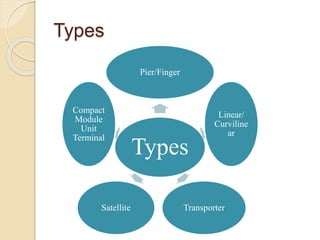
Types
Types
Pier/Finger
Linear/
Curviline
ar
TransporterSatellite
Compact
Module
Unit
Terminal
Linear/ Curve linear
 Simplest & Most straight-forward.
 Simple organizational principles.
 Consists of a single passenger processing area.
 Primarily appropriate for low-activity O&P
airports.
 Direct relationship between curbside and the
aircraft.(Short walking distances)
 Centralized passenger processing.
 Airport:
 McNamara Terminal of Detroit Metro Airport
Pier/Finger
 A/C are parked on both side of a concourse.
 A/C usually arranged around the axis of the pier in a
perpendicular.
 Passengers are usually processed at the simple terminal location
and then routed down a "pier" where aircraft are parked in the
"finger" slots or gates for boarding.
 This concept fully separates the passenger processing functions
from the concourse activities.
 Compare to linear, this concept type increases passenger walking
distances from the processing area.
 Compact arrangements of a/c along the pier, allow efficient
servicing of the a/c, thus lowering the operating costs for the
airlines.
 Example:
 Kansai International Airport
Satellite
 • It is completely surrounded by aircraft.
 • Connected to the processing areas of the terminal via
underground, at-grade, or overhead connector.
 • Parked in a nose-in arrangement around the satellite.
 • Passenger processing is handled in a separate
terminal facility.
 • It is work well for heavy-activity airport with O&D
and large percentage of connecting passengers.
 • Example:
 • Orlando International
 • Hartsfield-Jackson Atlanta International
 • Denver International
 • Chicago O’Hare International
Transporter
 • It provides a complete separation of passenger
facilities from those required to service and maintain
the aircraft.
• Aircraft and a/c-servicing functions are remotely
located from the terminal.
• Passengers access the a/c via the mobile lounges that
leave from the terminal gates, go directly to the aircraft.
• The use of buses that drop off the passengers adjacent
to the a/c on the apron.
• Airplane taxiing time to and from the runway is
decreased as well as reduce the amount of aircraft
engine noise around the terminal.
• Example:
• Dulles International Airport
• Tampa International Airport
Compact Module Unit Terminal
 It is defined by the IATA as 2 or more
separate, self-contained building, each
housing a single airline or group of
airlines, each having direct access to
ground transportation.
 Example:
 Kennedy International Airport, NY
 London Heathrow
Main Function of Terminal Airport
 Change of Movement Type-From car,
train or bus to plane.
 Processing (passenger processing
space)-Ticket, check-in, security check.
 Provide Passenger Facilities - Shopping,
toilets, eating, meeting & greeting,
business & conference.
Function of Terminal Airport
 To provide circulation, processing and
holding space.
 To operate smoothly.
 To ensure the premium level of service.
Parts of Terminal Building
 A terminal building could be made for passengers,
cargo and for any other specific purposes.
 It comprises the basic physical parts as
• Front side of the Terminal
• Visitors Area and Check-in Area
• Shop retails
• Security Hold Area & Baggage Make Up area
• Passengers Meet and Greet area
• Airlines offices, counters for Tour and Travel
agencies counters for Taxi services
• Lounges of Business class or Executive Class
passengers
Introduction to Landside Technological
Improvement Design to Improve
Capacity and Reduce Delay
 Aircraft guidance, surveillance, and control.
Airport access.
 Airspace use procedures.
 Weather and atmospheric effects.
 Noise control and abatement.
 Airport surface utilization.
 Terminal facilities and services.
Aircraft guidance, surveillance, and
control
 Microwave Landing System
 Improve precision of navigation; make more flexible
use of airspace
 Surveillance radar
 Improve surveillance; reduce separation
 Traffic management techniques
 Improve traffic flow
 Airport access
 Terminal curb front design
 Facilitate airport entrance and exit
 Airport circulation roads
 Facilitate automobile traffic flow
Airport access
 Terminal curb front design
 Facilitate airport entrance and exit
 Airport circulation roads
 Facilitate automobile traffic flow
Airspace use procedures
 Reduced lateral separation for parallel and
converging runways
 Increase utilization of multiple runways in
IMC
 Reduced longitudinal separation
 Reduce in-trail separation
 Separate short runways for small aircraft
 Segregate air traffic by size and speed
Weather and atmospheric effects
 Wake vortex detection
 Reduce in-trail separation
 Wind shear detection
 Alert pilots to wind shear
Noise control and abatement
 Control of aircraft noise
 Reduce aircraft noise
 Aircraft operating procedures
 Lessen or distribute noise impacts
Airport surface utilization
 Surveillance and control
 Improve surveillance, control, and guidance of
aircraft on ground
 High-speed turnoffs and improved taxiways
 Reduce runway occupancy time
 Taxiway marking and lighting
 Increase efficiency of taxiway use
 Apron and gate facilities
 Improve docking at gate; improve aircraft
maintenance and servicing
Terminal facilities and services
 Terminal building design
 Increase utility and efficiency of terminal building
 Passenger movers
 Improve circulation in terminal; reduce walking
distance
 Ticketing
 Expedite ticket purchase and passenger check-in
 Baggage handling
 Expedite baggage check-in, transfer, and pickup
 Passenger security screening
 Make screening faster and more reliable
 Federal Inspection Service
 Expedite customs and immigration clearance
Facilities required at Terminal
Building
 Access and Landside Interface.
 Processing.
 Holding Areas.
 Airlines and Support Activities.
Access and Landside Interface
 To ease the transfer of passenger flows.
 The facilities include :
 Curbside loading and unloading.
 Curbside baggage check-in where this is
permitted.
 Shuttle services to parking lots and other
terminal.
 Loading and unloading areas for car,
buses, taxis, limousines and rapid surface
modes.
Processing
 Areas are designated for the formalities
associated with processing passenger.
 The facilities include:
 Airline ticket and passenger check-in.
Baggage check-in.
 Gate check-in.
 Incoming and outgoing customs.
 Immigration control.
 Security check areas.
 Baggage claim.
Holding Areas
 The areas where passengers wait, in some case
with airport visitors, between period occupied by
passing through the various process.
 The facilities required:
 Passenger Lounges - general, departure and
gate lounges.
 Passenger Services Areas - wash rooms, internet
access and public telephone.
 Concessions - restaurant, bar and duty-free
shop.
 Observation Decks and Visitors’ Lobbies
Airlines and Support Activities
 The facilities must be provided:
 Airlines offices - rest and refreshment areas for
pilot and crew.
 Airport management offices - security, services.
Governmental office - police, health,
immigration. Offices and support areas for
maintenance staff.
 The design must also cater to the need of airlines,
airport and support personal working in the
terminal area.
Services Required at Terminal
Building
 Check-in
 Immigration Duties
 Security Checks
 Passenger Screening
 Baggage Screening
 Parking Facilities
 Public Transportation
Check - In
 Airport Check-in are service counters
found at commercial airports handling
commercial air travel. The check-in is
normally handled by an airline or a
handling agent working on behalf of an
airline. Passengers usually hand over any
baggage they do not wish or are not
allowed to carry-on to the aircraft's cabin
and receive a boarding pass before they
can proceed to board their aircraft.
Immigration Duties
 Immigration responsible for:
 Monitor persons who leave or enter the
country,
 Checking for appropriate
documentation, Arresting people wanted
by international arrest warrants.
 Block the entry of dangerous people to
the country.
Security Checks
 Passenger Screening:
 Confirming the identity of travelers,
Checking a photo ID & transports.
 Body Screening using Metal Detector
Gate Baggage Screening using X-ray
machine
Passenger Screening
 Purpose: to ensure that certain prohibited
items don’t board commercial airliners.
Every passenger thus is screened by airport
security staff using the latest screening
techniques to prevent any terrorist or criminal
activity.
 Every piece of luggage is screened for
explosives using the latest technology and
equipment before being placed on a plane
Passenger Screening
 Metal objects will be detected and
produce alarm sound.
Baggage Screening
 The X-ray machine:
 Place all carry-on baggage and any items you
are carrying with you on the belt of the X-ray
machine.
 Laptop computers and video cameras with
cassettes must be removed from their carrying
cases and placed in one of the bins provided.
You will also need to remove your coat, jacket,
suit jacket or blazer and place it in one of the
bins. These items go through the X-ray
machine.
Parking Facilities
 Public Parking Facility- for airline passengers
 Near terminal building.
 Off-Airport Parking- for airline passengers
 Far away from terminal building, with lower
charges.
 Separate Parking-for airport employee
 Far away from terminal area, airport workers
using bus go to the terminal.
 Car Rental Parking-for taxi or airport limousine
 Close to the terminal building. Pick-up / Drop-
off
Public Transportation
 Taxis and limousine - Airport taxis or airport
limousines are provided by Airport Limo. The taxis and
limousines are readily available at the Taxi and
Limousine counters.
 Bus - Both public and private buses connect KLIA to
several points in Kuala Lumpur and beyond.
 Express Train- Kuala Lumpur International Airport
can be reached by the KLIA Express (ERL) and the
KLIA Transit train services.
 Aerotrain - Main Terminal Building to Satellite
Terminal A. The journey between terminals takes under
two minutes train is able to transport 250passengers
one time.

Terminal area

  • 1.
    DEPARTMENT OF CIVIL ENGINEERING TERMINALAREA Er. Ramprasad Kumawat (M.Tech.)
  • 2.
    TOPIC :- TERMINALAREA 1. Introduction to Terminal Design (Landside) 2. Type of Terminals 3. Principles of Terminal Design 4. Introduction to Landside Technological Improvement Design to Improve Capacity and Reduce Delay 5. Terminal Facilities and Services
  • 3.
    landside  Landside areasinclude parking facilities, public transportation, terminal building and all utilities that support the operations of terminals.  All these facilities associated with the movement of passengers and their baggage.
  • 4.
  • 5.
    Terminal Building  Terminalbuilding is the main building where passengers embark and disembark aircrafts.  *embark = go onboard an aircraft.  The terminals are the ‘front door’ to the Airport and serve as the public interface between the airside and landside elements.
  • 6.
    The World's LargestAirport Terminal  The Hong Kong International Airport passenger terminal building is 1.3 km long and covers an area of 135.9 acres and is the world's largest single airport building.  It also has 48 aircraft parking stands with boarding gates and air bridges, the terminal has a capacity of 45 million passengers a year, arriving on 460 flights every day.
  • 7.
  • 8.
    Linear/ Curve linear Simplest & Most straight-forward.  Simple organizational principles.  Consists of a single passenger processing area.  Primarily appropriate for low-activity O&P airports.  Direct relationship between curbside and the aircraft.(Short walking distances)  Centralized passenger processing.  Airport:  McNamara Terminal of Detroit Metro Airport
  • 9.
    Pier/Finger  A/C areparked on both side of a concourse.  A/C usually arranged around the axis of the pier in a perpendicular.  Passengers are usually processed at the simple terminal location and then routed down a "pier" where aircraft are parked in the "finger" slots or gates for boarding.  This concept fully separates the passenger processing functions from the concourse activities.  Compare to linear, this concept type increases passenger walking distances from the processing area.  Compact arrangements of a/c along the pier, allow efficient servicing of the a/c, thus lowering the operating costs for the airlines.  Example:  Kansai International Airport
  • 10.
    Satellite  • Itis completely surrounded by aircraft.  • Connected to the processing areas of the terminal via underground, at-grade, or overhead connector.  • Parked in a nose-in arrangement around the satellite.  • Passenger processing is handled in a separate terminal facility.  • It is work well for heavy-activity airport with O&D and large percentage of connecting passengers.  • Example:  • Orlando International  • Hartsfield-Jackson Atlanta International  • Denver International  • Chicago O’Hare International
  • 11.
    Transporter  • Itprovides a complete separation of passenger facilities from those required to service and maintain the aircraft. • Aircraft and a/c-servicing functions are remotely located from the terminal. • Passengers access the a/c via the mobile lounges that leave from the terminal gates, go directly to the aircraft. • The use of buses that drop off the passengers adjacent to the a/c on the apron. • Airplane taxiing time to and from the runway is decreased as well as reduce the amount of aircraft engine noise around the terminal. • Example: • Dulles International Airport • Tampa International Airport
  • 12.
    Compact Module UnitTerminal  It is defined by the IATA as 2 or more separate, self-contained building, each housing a single airline or group of airlines, each having direct access to ground transportation.  Example:  Kennedy International Airport, NY  London Heathrow
  • 13.
    Main Function ofTerminal Airport  Change of Movement Type-From car, train or bus to plane.  Processing (passenger processing space)-Ticket, check-in, security check.  Provide Passenger Facilities - Shopping, toilets, eating, meeting & greeting, business & conference.
  • 14.
    Function of TerminalAirport  To provide circulation, processing and holding space.  To operate smoothly.  To ensure the premium level of service.
  • 15.
    Parts of TerminalBuilding  A terminal building could be made for passengers, cargo and for any other specific purposes.  It comprises the basic physical parts as • Front side of the Terminal • Visitors Area and Check-in Area • Shop retails • Security Hold Area & Baggage Make Up area • Passengers Meet and Greet area • Airlines offices, counters for Tour and Travel agencies counters for Taxi services • Lounges of Business class or Executive Class passengers
  • 16.
    Introduction to LandsideTechnological Improvement Design to Improve Capacity and Reduce Delay  Aircraft guidance, surveillance, and control. Airport access.  Airspace use procedures.  Weather and atmospheric effects.  Noise control and abatement.  Airport surface utilization.  Terminal facilities and services.
  • 17.
    Aircraft guidance, surveillance,and control  Microwave Landing System  Improve precision of navigation; make more flexible use of airspace  Surveillance radar  Improve surveillance; reduce separation  Traffic management techniques  Improve traffic flow  Airport access  Terminal curb front design  Facilitate airport entrance and exit  Airport circulation roads  Facilitate automobile traffic flow
  • 18.
    Airport access  Terminalcurb front design  Facilitate airport entrance and exit  Airport circulation roads  Facilitate automobile traffic flow
  • 19.
    Airspace use procedures Reduced lateral separation for parallel and converging runways  Increase utilization of multiple runways in IMC  Reduced longitudinal separation  Reduce in-trail separation  Separate short runways for small aircraft  Segregate air traffic by size and speed
  • 20.
    Weather and atmosphericeffects  Wake vortex detection  Reduce in-trail separation  Wind shear detection  Alert pilots to wind shear
  • 21.
    Noise control andabatement  Control of aircraft noise  Reduce aircraft noise  Aircraft operating procedures  Lessen or distribute noise impacts
  • 22.
    Airport surface utilization Surveillance and control  Improve surveillance, control, and guidance of aircraft on ground  High-speed turnoffs and improved taxiways  Reduce runway occupancy time  Taxiway marking and lighting  Increase efficiency of taxiway use  Apron and gate facilities  Improve docking at gate; improve aircraft maintenance and servicing
  • 23.
    Terminal facilities andservices  Terminal building design  Increase utility and efficiency of terminal building  Passenger movers  Improve circulation in terminal; reduce walking distance  Ticketing  Expedite ticket purchase and passenger check-in  Baggage handling  Expedite baggage check-in, transfer, and pickup  Passenger security screening  Make screening faster and more reliable  Federal Inspection Service  Expedite customs and immigration clearance
  • 24.
    Facilities required atTerminal Building  Access and Landside Interface.  Processing.  Holding Areas.  Airlines and Support Activities.
  • 25.
    Access and LandsideInterface  To ease the transfer of passenger flows.  The facilities include :  Curbside loading and unloading.  Curbside baggage check-in where this is permitted.  Shuttle services to parking lots and other terminal.  Loading and unloading areas for car, buses, taxis, limousines and rapid surface modes.
  • 26.
    Processing  Areas aredesignated for the formalities associated with processing passenger.  The facilities include:  Airline ticket and passenger check-in. Baggage check-in.  Gate check-in.  Incoming and outgoing customs.  Immigration control.  Security check areas.  Baggage claim.
  • 27.
    Holding Areas  Theareas where passengers wait, in some case with airport visitors, between period occupied by passing through the various process.  The facilities required:  Passenger Lounges - general, departure and gate lounges.  Passenger Services Areas - wash rooms, internet access and public telephone.  Concessions - restaurant, bar and duty-free shop.  Observation Decks and Visitors’ Lobbies
  • 28.
    Airlines and SupportActivities  The facilities must be provided:  Airlines offices - rest and refreshment areas for pilot and crew.  Airport management offices - security, services. Governmental office - police, health, immigration. Offices and support areas for maintenance staff.  The design must also cater to the need of airlines, airport and support personal working in the terminal area.
  • 29.
    Services Required atTerminal Building  Check-in  Immigration Duties  Security Checks  Passenger Screening  Baggage Screening  Parking Facilities  Public Transportation
  • 30.
    Check - In Airport Check-in are service counters found at commercial airports handling commercial air travel. The check-in is normally handled by an airline or a handling agent working on behalf of an airline. Passengers usually hand over any baggage they do not wish or are not allowed to carry-on to the aircraft's cabin and receive a boarding pass before they can proceed to board their aircraft.
  • 31.
    Immigration Duties  Immigrationresponsible for:  Monitor persons who leave or enter the country,  Checking for appropriate documentation, Arresting people wanted by international arrest warrants.  Block the entry of dangerous people to the country.
  • 32.
    Security Checks  PassengerScreening:  Confirming the identity of travelers, Checking a photo ID & transports.  Body Screening using Metal Detector Gate Baggage Screening using X-ray machine
  • 33.
    Passenger Screening  Purpose:to ensure that certain prohibited items don’t board commercial airliners. Every passenger thus is screened by airport security staff using the latest screening techniques to prevent any terrorist or criminal activity.  Every piece of luggage is screened for explosives using the latest technology and equipment before being placed on a plane
  • 34.
    Passenger Screening  Metalobjects will be detected and produce alarm sound.
  • 35.
    Baggage Screening  TheX-ray machine:  Place all carry-on baggage and any items you are carrying with you on the belt of the X-ray machine.  Laptop computers and video cameras with cassettes must be removed from their carrying cases and placed in one of the bins provided. You will also need to remove your coat, jacket, suit jacket or blazer and place it in one of the bins. These items go through the X-ray machine.
  • 36.
    Parking Facilities  PublicParking Facility- for airline passengers  Near terminal building.  Off-Airport Parking- for airline passengers  Far away from terminal building, with lower charges.  Separate Parking-for airport employee  Far away from terminal area, airport workers using bus go to the terminal.  Car Rental Parking-for taxi or airport limousine  Close to the terminal building. Pick-up / Drop- off
  • 37.
    Public Transportation  Taxisand limousine - Airport taxis or airport limousines are provided by Airport Limo. The taxis and limousines are readily available at the Taxi and Limousine counters.  Bus - Both public and private buses connect KLIA to several points in Kuala Lumpur and beyond.  Express Train- Kuala Lumpur International Airport can be reached by the KLIA Express (ERL) and the KLIA Transit train services.  Aerotrain - Main Terminal Building to Satellite Terminal A. The journey between terminals takes under two minutes train is able to transport 250passengers one time.