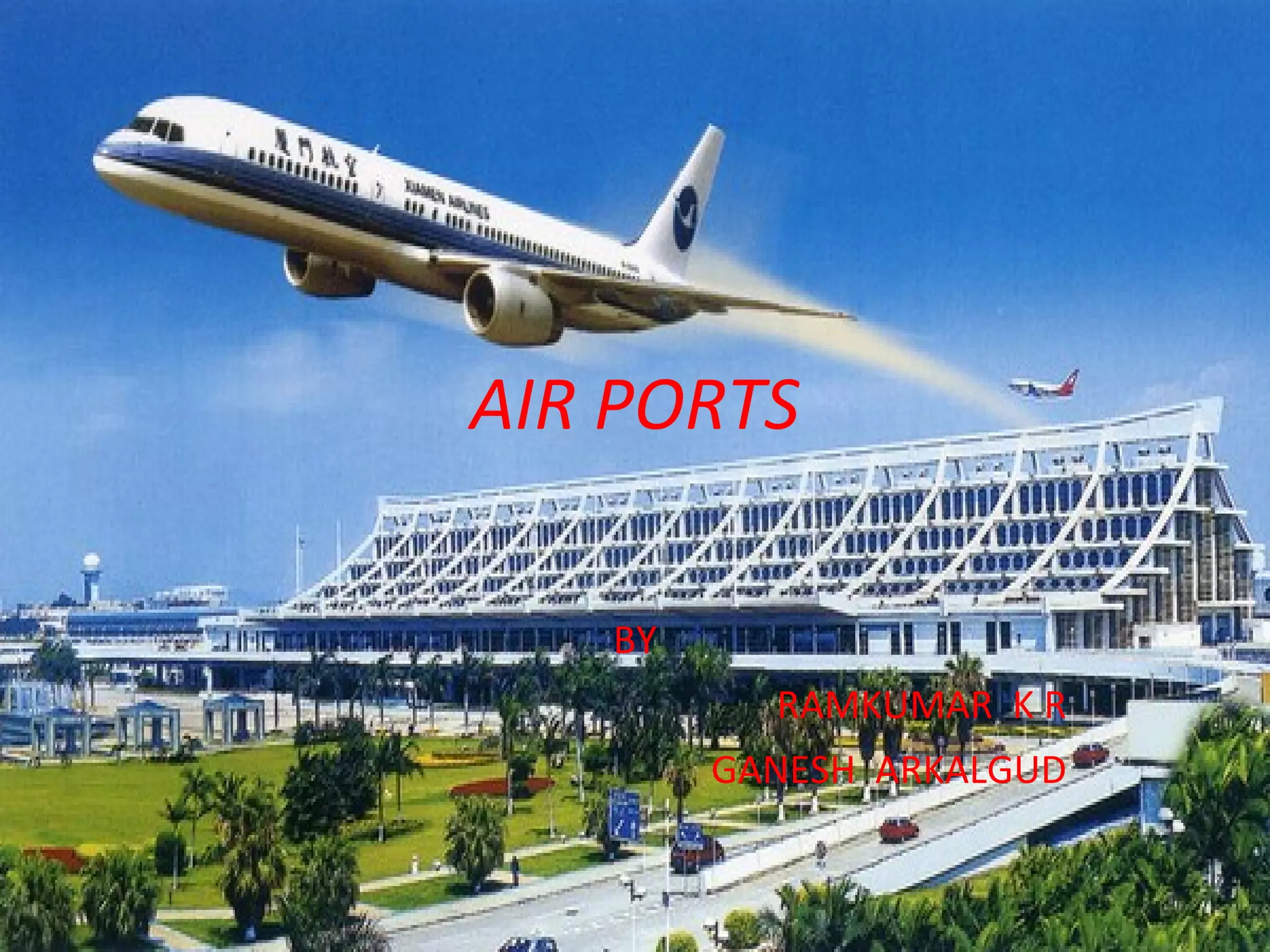
AIR PORTS
BY
RAMKUMAR K R
GANESH ARKALGUD
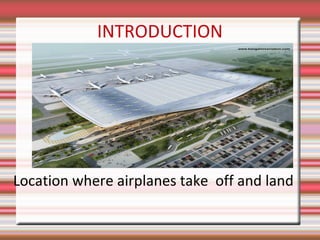
INTRODUCTION

Location where airplanes take off and land
TYPES OF AIRPORTS
• Military (Example : Yelahanka air base)
• Civilian
 Domestic
 International
• Civil Military Co-ordination
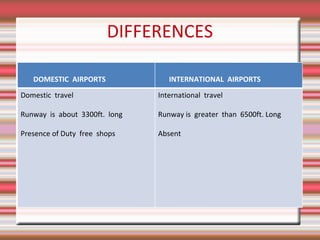
DIFFERENCES
DOMESTIC AIRPORTS
DOMESTIC AIRPORTS

INTERNATIONAL AIRPORTS

• International travel

Domestic travel

International travel

Runway is about 3300ft. long

Runway is greater than 6500ft.than
• Runway is greater Long

Presence of Duty free shops

6500ft. Long
Absent
• Absent
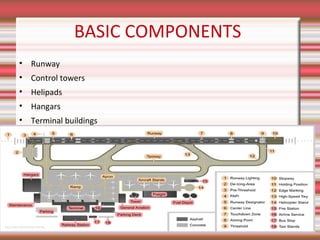
BASIC COMPONENTS
• Runway
• Control towers
• Helipads
• Hangars
• Terminal buildings
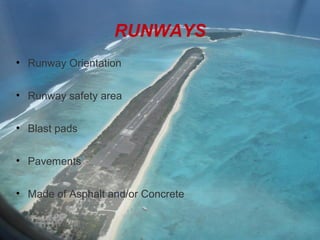
RUNWAYS
• Runway Orientation
• Runway safety area
• Blast pads
• Pavements
• Made of Asphalt and/or Concrete
RUNWAY MARKINGS


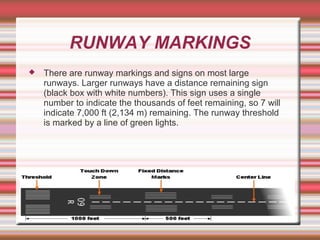
There are runway markings and signs on most large
runways. Larger runways have a distance remaining sign
(black box with white numbers). This sign uses a single
number to indicate the thousands of feet remaining, so 7 will
indicate 7,000 ft (2,134 m) remaining. The runway threshold
is marked by a line of green lights.
BASIC RUNWAY LENGTH
It is the length of the runway under following assumed
conditions of the airport
1. Airport altitude is at sea level
2. Temperature at airport is standard(15°C)
3. Runway is levelled in longitudinal direction
4. No wind is blowing on runway
5. Aircraft is loaded to it’s full loading capacity
6. There is no wind blowing Enroute to the destination
7. Enroute temperature is standard
BASIC RUNWAY LENGTH


Normal landing case



Normal takeoff case



Engine failure case
For jet engine aircrafts, all 3 cases are considered.
For piston engine Aircrafts only 1st and 3rd cases are
considered.
CORRECTIONS FOR ELEVATION


As elevation increases, air density reduces.



This reduces lift on wings of Aircraft and
requires greater ground speed



Longer runway is required for greater speeds



ICAO recommends basic runway length to
be increased at a rate of 7% per 1000 ft.
Rise in elevation above mean sea level
CORRECTIONS FOR
TEMPERATURE

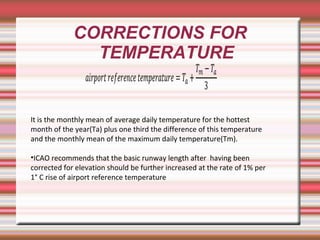
It is the monthly mean of average daily temperature for the hottest
month of the year(Ta) plus one third the difference of this temperature
and the monthly mean of the maximum daily temperature(Tm).
•ICAO recommends that the basic runway length after having been
corrected for elevation should be further increased at the rate of 1% per
1° C rise of airport reference temperature
CONTROL TOWER


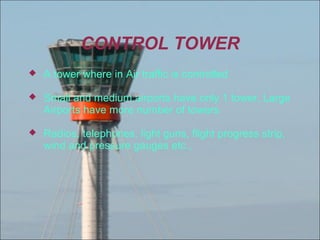
A tower where in Air traffic is controlled



Small and medium airports have only 1 tower, Large
Airports have more number of towers



Radios, telephones, light guns, flight progress strip,
wind and pressure gauges etc.,
HELIPAD


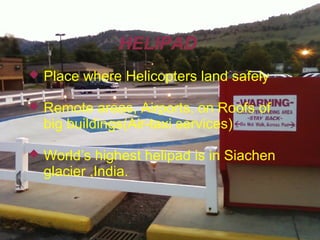
Place where Helicopters land safely



Remote areas, Airports, on Roofs of
big buildings(Air-taxi services)



World’s highest helipad is in Siachen
glacier ,India.
HANGARS


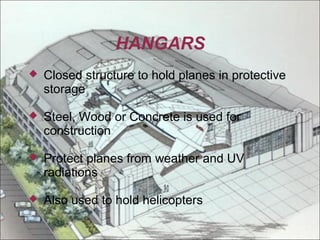
Closed structure to hold planes in protective
storage



Steel, Wood or Concrete is used for
construction



Protect planes from weather and UV
radiations



Also used to hold helicopters
TERMINAL BUILDING
•

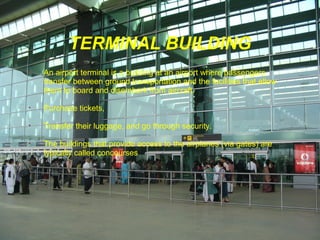
An airport terminal is a building at an airport where passengers
transfer between ground transportation and the facilities that allow
them to board and disembark from aircraft.

•

Purchase tickets,

•

Transfer their luggage, and go through security.

•

The buildings that provide access to the airplanes (via gates) are
typically called concourses.
1.
2.
3.
4.

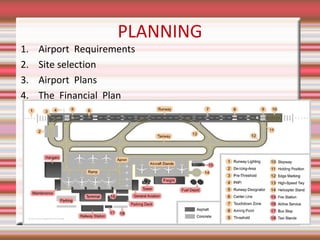
PLANNING

Airport Requirements
Site selection
Airport Plans
The Financial Plan
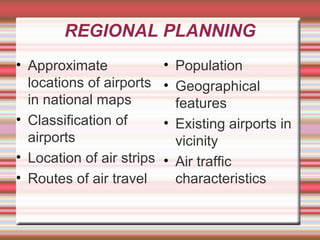
REGIONAL PLANNING
• Approximate
locations of airports
in national maps
• Classification of
airports
• Location of air strips
• Routes of air travel

• Population
• Geographical
features
• Existing airports in
vicinity
• Air traffic
characteristics
ICAO MASTER PLANNING
PROCESS
•
•
•
•
•
•
•
•

Planning method
Forecasting for planning purposes
Site evaluation and selection
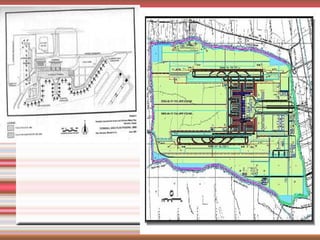
Airport configuration
Aircraft apron
Passenger building
Departure and Arrivals
Other facilities
SITE SELECTION
Depends on Class of airport under consideration.
Factors for the site selection of a major airport are
1.
Regional plan
2.
Airport use
3.
Proximity to other airports
4.
Ground accessibility
5.
Topography
6.
Obstructions
7.
Visibility
8.
Wind
9.
Noise nuisance
10. Grading, drainage and soil characteristics
11. Future development
12. Availability of utilities from town
13. Economic considerations
LIGHTING OF AIRPORTS


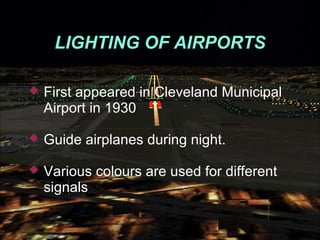
First appeared in Cleveland Municipal
Airport in 1930



Guide airplanes during night.



Various colours are used for different
signals
APRONS
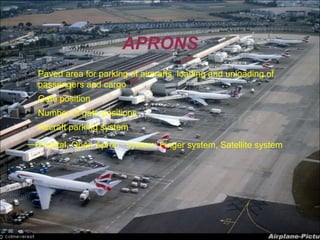
• Paved area for parking of aircrafts, loading and unloading of
passengers and cargo
• Gate position
• Number of gate positions
• Aircraft parking system

→Frontal, Open Apron

system, Finger system, Satellite system
ORGANISATIONS
•
•
•
•

National Airports Authority (NAA)
International Airports Authority of India (IAAI)
Airports Authority of India (AAI)
International Civil Aviation Organisation
(ICAO)
• Federal Aviation Agency (FAA)
• Directorate of Civil Aviation
REFERENCES


Airport Planning and Design, by S.K. Khanna,
M.G. Arora, S.S. Jain (6th edition)



Airport Engineering, by Ranganwala S.C.



Google images



IEEE Xplore.org
THANK YOU

Airports

  • 1.
    AIR PORTS BY RAMKUMAR KR GANESH ARKALGUD
  • 2.
  • 4.
    TYPES OF AIRPORTS •Military (Example : Yelahanka air base) • Civilian  Domestic  International • Civil Military Co-ordination
  • 5.
    DIFFERENCES DOMESTIC AIRPORTS DOMESTIC AIRPORTS INTERNATIONALAIRPORTS • International travel Domestic travel International travel Runway is about 3300ft. long Runway is greater than 6500ft.than • Runway is greater Long Presence of Duty free shops 6500ft. Long Absent • Absent
  • 6.
    BASIC COMPONENTS • Runway •Control towers • Helipads • Hangars • Terminal buildings
  • 7.
    RUNWAYS • Runway Orientation •Runway safety area • Blast pads • Pavements • Made of Asphalt and/or Concrete
  • 8.
    RUNWAY MARKINGS  There arerunway markings and signs on most large runways. Larger runways have a distance remaining sign (black box with white numbers). This sign uses a single number to indicate the thousands of feet remaining, so 7 will indicate 7,000 ft (2,134 m) remaining. The runway threshold is marked by a line of green lights.
  • 9.
    BASIC RUNWAY LENGTH Itis the length of the runway under following assumed conditions of the airport 1. Airport altitude is at sea level 2. Temperature at airport is standard(15°C) 3. Runway is levelled in longitudinal direction 4. No wind is blowing on runway 5. Aircraft is loaded to it’s full loading capacity 6. There is no wind blowing Enroute to the destination 7. Enroute temperature is standard
  • 10.
    BASIC RUNWAY LENGTH  Normallanding case  Normal takeoff case  Engine failure case For jet engine aircrafts, all 3 cases are considered. For piston engine Aircrafts only 1st and 3rd cases are considered.
  • 11.
    CORRECTIONS FOR ELEVATION  Aselevation increases, air density reduces.  This reduces lift on wings of Aircraft and requires greater ground speed  Longer runway is required for greater speeds  ICAO recommends basic runway length to be increased at a rate of 7% per 1000 ft. Rise in elevation above mean sea level
  • 12.
    CORRECTIONS FOR TEMPERATURE It isthe monthly mean of average daily temperature for the hottest month of the year(Ta) plus one third the difference of this temperature and the monthly mean of the maximum daily temperature(Tm). •ICAO recommends that the basic runway length after having been corrected for elevation should be further increased at the rate of 1% per 1° C rise of airport reference temperature
  • 13.
    CONTROL TOWER  A towerwhere in Air traffic is controlled  Small and medium airports have only 1 tower, Large Airports have more number of towers  Radios, telephones, light guns, flight progress strip, wind and pressure gauges etc.,
  • 14.
    HELIPAD  Place where Helicoptersland safely  Remote areas, Airports, on Roofs of big buildings(Air-taxi services)  World’s highest helipad is in Siachen glacier ,India.
  • 15.
    HANGARS  Closed structure tohold planes in protective storage  Steel, Wood or Concrete is used for construction  Protect planes from weather and UV radiations  Also used to hold helicopters
  • 16.
    TERMINAL BUILDING • An airportterminal is a building at an airport where passengers transfer between ground transportation and the facilities that allow them to board and disembark from aircraft. • Purchase tickets, • Transfer their luggage, and go through security. • The buildings that provide access to the airplanes (via gates) are typically called concourses.
  • 17.
  • 18.
    REGIONAL PLANNING • Approximate locationsof airports in national maps • Classification of airports • Location of air strips • Routes of air travel • Population • Geographical features • Existing airports in vicinity • Air traffic characteristics
  • 19.
    ICAO MASTER PLANNING PROCESS • • • • • • • • Planningmethod Forecasting for planning purposes Site evaluation and selection Airport configuration Aircraft apron Passenger building Departure and Arrivals Other facilities
  • 21.
    SITE SELECTION Depends onClass of airport under consideration. Factors for the site selection of a major airport are 1. Regional plan 2. Airport use 3. Proximity to other airports 4. Ground accessibility 5. Topography 6. Obstructions 7. Visibility 8. Wind 9. Noise nuisance 10. Grading, drainage and soil characteristics 11. Future development 12. Availability of utilities from town 13. Economic considerations
  • 22.
    LIGHTING OF AIRPORTS  Firstappeared in Cleveland Municipal Airport in 1930  Guide airplanes during night.  Various colours are used for different signals
  • 23.
    APRONS • Paved areafor parking of aircrafts, loading and unloading of passengers and cargo • Gate position • Number of gate positions • Aircraft parking system →Frontal, Open Apron system, Finger system, Satellite system
  • 24.
    ORGANISATIONS • • • • National Airports Authority(NAA) International Airports Authority of India (IAAI) Airports Authority of India (AAI) International Civil Aviation Organisation (ICAO) • Federal Aviation Agency (FAA) • Directorate of Civil Aviation
  • 25.
    REFERENCES  Airport Planning andDesign, by S.K. Khanna, M.G. Arora, S.S. Jain (6th edition)  Airport Engineering, by Ranganwala S.C.  Google images  IEEE Xplore.org
  • 26.