TensorFlow & Keras
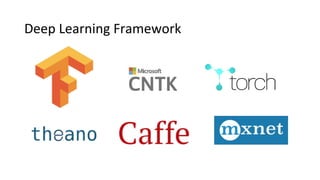
Deep Learning Framework
Overview: TensorFlow
What is TensorFlow?
• URL: https://www.tensorflow.org/
• Released under the open source license on
November 9, 2015
• Current version 1.2
• Open source software library for numerical
computation using data flow graphs
• Originally developed by Google Brain Team to
conduct machine learning and deep neural
networks research
• General enough to be applicable in a wide
variety of other domains as well
• TensorFlow provides an extensive suite of
functions and classes that allow users to build
various models from scratch.
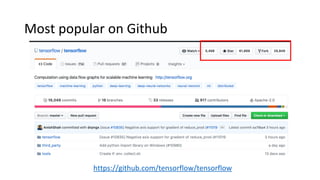
Most popular on Github
https://github.com/tensorflow/tensorflow
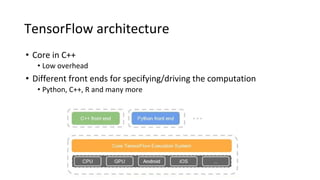
TensorFlow architecture
• Core in C++
• Low overhead
• Different front ends for specifying/driving the computation
• Python, C++, R and many more
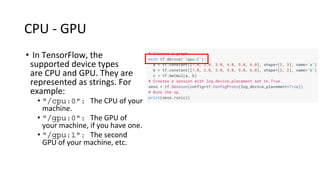
CPU - GPU
• In TensorFlow, the
supported device types
are CPU and GPU. They are
represented as strings. For
example:
• "/cpu:0": The CPU of your
machine.
• "/gpu:0": The GPU of
your machine, if you have one.
• "/gpu:1": The second
GPU of your machine, etc.
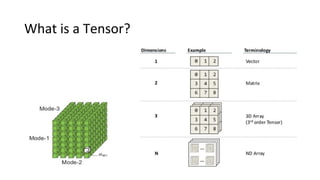
What is a Tensor?
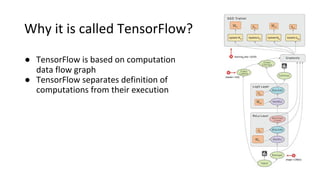
Why it is called TensorFlow?
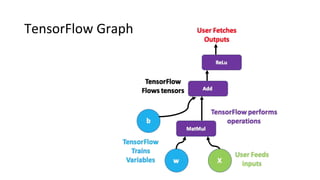
● TensorFlow is based on computation
data flow graph
● TensorFlow separates definition of
computations from their execution
TensorFlow Graph
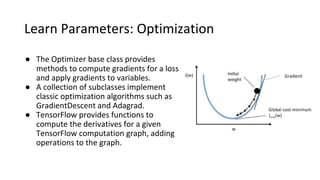
Learn Parameters: Optimization
● The Optimizer base class provides
methods to compute gradients for a loss
and apply gradients to variables.
● A collection of subclasses implement
classic optimization algorithms such as
GradientDescent and Adagrad.
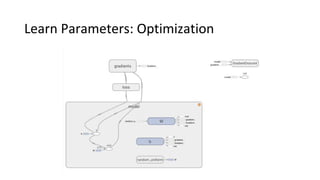
● TensorFlow provides functions to
compute the derivatives for a given
TensorFlow computation graph, adding
operations to the graph.
Learn Parameters: Optimization
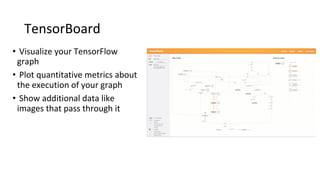
TensorBoard
• Visualize your TensorFlow
graph
• Plot quantitative metrics about
the execution of your graph
• Show additional data like
images that pass through it
TensorFlow Models
https://github.com/tensorflow/models
Models
• adversarial_crypto: protecting communications with adversarial neural cryptography.
• adversarial_text: semi-supervised sequence learning with adversarial training.
• attention_ocr: a model for real-world image text extraction.
• autoencoder: various autoencoders.
• cognitive_mapping_and_planning: implementation of a spatial memory based mapping and planning
architecture for visual navigation.
• compression: compressing and decompressing images using a pre-trained Residual GRU network.
• differential_privacy: privacy-preserving student models from multiple teachers.
• domain_adaptation: domain separation networks.
• im2txt: image-to-text neural network for image captioning.
• inception: deep convolutional networks for computer vision.
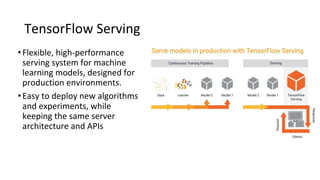
TensorFlow Serving
•Flexible, high-performance
serving system for machine
learning models, designed for
production environments.
•Easy to deploy new algorithms
and experiments, while
keeping the same server
architecture and APIs
Code snippet
import tensorflow as tf
# build a linear model where y = w * x + b
w = tf.Variable([0.2], tf.float32, name='weight')
b = tf.Variable([0.3], tf.float32, name='bias')
X = tf.placeholder(tf.float32, name="X")
Y = tf.placeholder(tf.float32, name='Y')
# the training values for x and y
x = ([2.,3.,4.,5.])
y = ([-1.,-2.,-3.,-4.])
# define the linear model
linear_model = w*X+b
# define the loss function
square_delta = tf.square(linear_model - Y)
loss = tf.reduce_sum(square_delta)
#set the learning rate and training epoch
learning_rate = 0.01
training_epoch = 1000
# optimizer
optimizer = tf.train.GradientDescentOptimizer(learning_rate)
train = optimizer.minimize(loss)
# start a session
init = tf.global_variables_initializer()
with tf.Session() as sess:
sess.run(init)
for i in range(training_epoch):
sess.run(train, feed_dict={X:x,Y:y})
# evaluate training accuracy
curr_w, curr_b, curr_loss = sess.run([w, b, loss], {X:x,Y:y})
print('w: %f b: %f loss: %f '%(curr_w, curr_b, curr_loss))
TensorFlow: Installation
• pip3 install tensorflow
or
• Anaconda: conda install -c conda-forge tensorflow
Overview: Keras
Keras
•https://keras.io/
•Minimalist, highly modular neural
networks library
•Written in Python
•Capable of running on top of either
TensorFlow/Theano and CNTK
•Developed with a focus on enabling
fast experimentation
Guiding Principles
•Modularity
• A model is understood as a sequence or a graph of standalone,
fully-configurable modules that can be plugged together with as little
restrictions as possible
•Minimalism
• Each module should be kept short and simple
•Easy extensibility
• New modules can be easily added and extended
•Python
• Supports Python
General Design
•General idea is to based on layers and their input/output
• Prepare your inputs and output tensors
• Create first layer to handle input tensor
• Create output layer to handle targets
• Build virtually any model you like in between
Layers
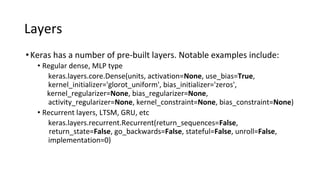
•Keras has a number of pre-built layers. Notable examples include:
• Regular dense, MLP type
keras.layers.core.Dense(units, activation=None, use_bias=True,
kernel_initializer='glorot_uniform', bias_initializer='zeros',
kernel_regularizer=None, bias_regularizer=None,
activity_regularizer=None, kernel_constraint=None, bias_constraint=None)
• Recurrent layers, LTSM, GRU, etc
keras.layers.recurrent.Recurrent(return_sequences=False,
return_state=False, go_backwards=False, stateful=False, unroll=False,
implementation=0)
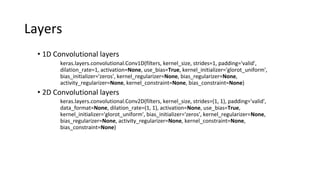
Layers
• 1D Convolutional layers
keras.layers.convolutional.Conv1D(filters, kernel_size, strides=1, padding='valid',
dilation_rate=1, activation=None, use_bias=True, kernel_initializer='glorot_uniform',
bias_initializer='zeros', kernel_regularizer=None, bias_regularizer=None,
activity_regularizer=None, kernel_constraint=None, bias_constraint=None)
• 2D Convolutional layers
keras.layers.convolutional.Conv2D(filters, kernel_size, strides=(1, 1), padding='valid',
data_format=None, dilation_rate=(1, 1), activation=None, use_bias=True,
kernel_initializer='glorot_uniform', bias_initializer='zeros', kernel_regularizer=None,
bias_regularizer=None, activity_regularizer=None, kernel_constraint=None,
bias_constraint=None)
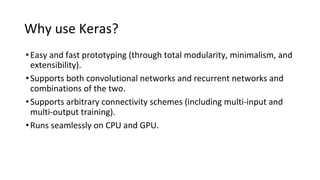
Why use Keras?
•Easy and fast prototyping (through total modularity, minimalism, and
extensibility).
•Supports both convolutional networks and recurrent networks and
combinations of the two.
•Supports arbitrary connectivity schemes (including multi-input and
multi-output training).
•Runs seamlessly on CPU and GPU.
Keras Code examples
•The core data structure of Keras is a model
•Model → a way to organize layers
Model
Sequential Graph
Code-snippet
import numpy as np
from keras.models import Sequential
from keras.layers.core import Activation, Dense
from keras.optimizers import SGD
X = np.array([[0,0],[0,1],[1,0],[1,1]])
y = np.array([[0],[1],[1],[0]])
model = Sequential()
model.add(Dense(2, input_dim=2, activation='sigmoid'))
model.add(Dense(1, activation='sigmoid'))
sgd = SGD(lr=0.1, decay=1e-6, momentum=0.9, nesterov=True)
model.compile(loss='mean_squared_error', optimizer=sgd)
history = model.fit(X, y, nb_epoch=10000, batch_size=4)
Keras: Installation
• Theano :
• pip3 install Theano
• CNTK
• $ export CNTK_BINARY_URL=... [choose link here]
• pip3 install $CNTK_BINARY_URL
• TensorFlow :
• $ export TF_BINARY_URL=... [choose link here]
• pip3 install $TF_BINARY_URL
• Keras :
• pip3 install keras
• To enable GPU computing :
• NVidia Cuda
• CuDNN
• CNMeM
Demo
Slides & Codes available from Github:
https://github.com/kuanhoong/Magic_DeepLearning

TensorFlow and Keras: An Overview

  • 1.
  • 2.
  • 3.
  • 4.
    What is TensorFlow? •URL: https://www.tensorflow.org/ • Released under the open source license on November 9, 2015 • Current version 1.2 • Open source software library for numerical computation using data flow graphs • Originally developed by Google Brain Team to conduct machine learning and deep neural networks research • General enough to be applicable in a wide variety of other domains as well • TensorFlow provides an extensive suite of functions and classes that allow users to build various models from scratch.
  • 5.
    Most popular onGithub https://github.com/tensorflow/tensorflow
  • 6.
    TensorFlow architecture • Corein C++ • Low overhead • Different front ends for specifying/driving the computation • Python, C++, R and many more
  • 7.
    CPU - GPU •In TensorFlow, the supported device types are CPU and GPU. They are represented as strings. For example: • "/cpu:0": The CPU of your machine. • "/gpu:0": The GPU of your machine, if you have one. • "/gpu:1": The second GPU of your machine, etc.
  • 8.
    What is aTensor?
  • 9.
    Why it iscalled TensorFlow? ● TensorFlow is based on computation data flow graph ● TensorFlow separates definition of computations from their execution
  • 10.
  • 11.
    Learn Parameters: Optimization ●The Optimizer base class provides methods to compute gradients for a loss and apply gradients to variables. ● A collection of subclasses implement classic optimization algorithms such as GradientDescent and Adagrad. ● TensorFlow provides functions to compute the derivatives for a given TensorFlow computation graph, adding operations to the graph.
  • 12.
  • 13.
    TensorBoard • Visualize yourTensorFlow graph • Plot quantitative metrics about the execution of your graph • Show additional data like images that pass through it
  • 14.
    TensorFlow Models https://github.com/tensorflow/models Models • adversarial_crypto:protecting communications with adversarial neural cryptography. • adversarial_text: semi-supervised sequence learning with adversarial training. • attention_ocr: a model for real-world image text extraction. • autoencoder: various autoencoders. • cognitive_mapping_and_planning: implementation of a spatial memory based mapping and planning architecture for visual navigation. • compression: compressing and decompressing images using a pre-trained Residual GRU network. • differential_privacy: privacy-preserving student models from multiple teachers. • domain_adaptation: domain separation networks. • im2txt: image-to-text neural network for image captioning. • inception: deep convolutional networks for computer vision.
  • 15.
    TensorFlow Serving •Flexible, high-performance servingsystem for machine learning models, designed for production environments. •Easy to deploy new algorithms and experiments, while keeping the same server architecture and APIs
  • 16.
    Code snippet import tensorflowas tf # build a linear model where y = w * x + b w = tf.Variable([0.2], tf.float32, name='weight') b = tf.Variable([0.3], tf.float32, name='bias') X = tf.placeholder(tf.float32, name="X") Y = tf.placeholder(tf.float32, name='Y') # the training values for x and y x = ([2.,3.,4.,5.]) y = ([-1.,-2.,-3.,-4.]) # define the linear model linear_model = w*X+b # define the loss function square_delta = tf.square(linear_model - Y) loss = tf.reduce_sum(square_delta) #set the learning rate and training epoch learning_rate = 0.01 training_epoch = 1000 # optimizer optimizer = tf.train.GradientDescentOptimizer(learning_rate) train = optimizer.minimize(loss) # start a session init = tf.global_variables_initializer() with tf.Session() as sess: sess.run(init) for i in range(training_epoch): sess.run(train, feed_dict={X:x,Y:y}) # evaluate training accuracy curr_w, curr_b, curr_loss = sess.run([w, b, loss], {X:x,Y:y}) print('w: %f b: %f loss: %f '%(curr_w, curr_b, curr_loss))
  • 17.
    TensorFlow: Installation • pip3install tensorflow or • Anaconda: conda install -c conda-forge tensorflow
  • 18.
  • 19.
    Keras •https://keras.io/ •Minimalist, highly modularneural networks library •Written in Python •Capable of running on top of either TensorFlow/Theano and CNTK •Developed with a focus on enabling fast experimentation
  • 20.
    Guiding Principles •Modularity • Amodel is understood as a sequence or a graph of standalone, fully-configurable modules that can be plugged together with as little restrictions as possible •Minimalism • Each module should be kept short and simple •Easy extensibility • New modules can be easily added and extended •Python • Supports Python
  • 21.
    General Design •General ideais to based on layers and their input/output • Prepare your inputs and output tensors • Create first layer to handle input tensor • Create output layer to handle targets • Build virtually any model you like in between
  • 22.
    Layers •Keras has anumber of pre-built layers. Notable examples include: • Regular dense, MLP type keras.layers.core.Dense(units, activation=None, use_bias=True, kernel_initializer='glorot_uniform', bias_initializer='zeros', kernel_regularizer=None, bias_regularizer=None, activity_regularizer=None, kernel_constraint=None, bias_constraint=None) • Recurrent layers, LTSM, GRU, etc keras.layers.recurrent.Recurrent(return_sequences=False, return_state=False, go_backwards=False, stateful=False, unroll=False, implementation=0)
  • 23.
    Layers • 1D Convolutionallayers keras.layers.convolutional.Conv1D(filters, kernel_size, strides=1, padding='valid', dilation_rate=1, activation=None, use_bias=True, kernel_initializer='glorot_uniform', bias_initializer='zeros', kernel_regularizer=None, bias_regularizer=None, activity_regularizer=None, kernel_constraint=None, bias_constraint=None) • 2D Convolutional layers keras.layers.convolutional.Conv2D(filters, kernel_size, strides=(1, 1), padding='valid', data_format=None, dilation_rate=(1, 1), activation=None, use_bias=True, kernel_initializer='glorot_uniform', bias_initializer='zeros', kernel_regularizer=None, bias_regularizer=None, activity_regularizer=None, kernel_constraint=None, bias_constraint=None)
  • 24.
    Why use Keras? •Easyand fast prototyping (through total modularity, minimalism, and extensibility). •Supports both convolutional networks and recurrent networks and combinations of the two. •Supports arbitrary connectivity schemes (including multi-input and multi-output training). •Runs seamlessly on CPU and GPU.
  • 25.
    Keras Code examples •Thecore data structure of Keras is a model •Model → a way to organize layers Model Sequential Graph
  • 26.
    Code-snippet import numpy asnp from keras.models import Sequential from keras.layers.core import Activation, Dense from keras.optimizers import SGD X = np.array([[0,0],[0,1],[1,0],[1,1]]) y = np.array([[0],[1],[1],[0]]) model = Sequential() model.add(Dense(2, input_dim=2, activation='sigmoid')) model.add(Dense(1, activation='sigmoid')) sgd = SGD(lr=0.1, decay=1e-6, momentum=0.9, nesterov=True) model.compile(loss='mean_squared_error', optimizer=sgd) history = model.fit(X, y, nb_epoch=10000, batch_size=4)
  • 27.
    Keras: Installation • Theano: • pip3 install Theano • CNTK • $ export CNTK_BINARY_URL=... [choose link here] • pip3 install $CNTK_BINARY_URL • TensorFlow : • $ export TF_BINARY_URL=... [choose link here] • pip3 install $TF_BINARY_URL • Keras : • pip3 install keras • To enable GPU computing : • NVidia Cuda • CuDNN • CNMeM
  • 28.
    Demo Slides & Codesavailable from Github: https://github.com/kuanhoong/Magic_DeepLearning