


Deep	Learning	with	R
Poo	Kuan	Hoong
https://www.facebook.com/rusergroupmalaysia/
https://www.meetup.com/MY-RUserGroup/
Disclaimer: The views and opinions
expressed in this slides are those of
the author and do not necessarily
reflect the official policy or position of
ASEAN Data Analytics Exchange
(ADAX). Examples of analysis
performed within this slides are only
examples. They should not be utilized
in real-world analytic products as they
are based only on very limited and
dated open source information.
Assumptions made within the analysis
are not reflective of the position of
ADAX.
Agenda
• Introduction
• Where	are	we	now…
• What	is	Deep	Learning?
• Human	Brain	and	Neural	Networks
• Deep	Learning:	Strengths	and	Weaknesses
• Deep	Learning	Libraries
• TensorFlow
• MXNET
• Demo
About	me
Poo	Kuan	Hoong,	http://www.linkedin.com/in/kuanhoong
• Senior	Manager	Data	Science
• Senior	Lecturer
• Chairperson	Data	Science	
Institute
• Founder	R	User	Group	&	
TensorFlow User	Group
• Speaker/Trainer
• Senior	Data	Scientist
Malaysia	R	User	Group
The	Malaysia	R	User	group's	aims	are:
• To	provide	members	ranging	from	
beginners	to	R	professionals	and	
experts	to	share	and	learn	about	R	
programming
• A	knowledge	sharing	and	
presentations	platform	in	relation	to	
the	techniques	using	R.
https://www.facebook.com/rusergroupmalaysia/
https://www.meetup.com/MY-RUserGroup/
https://www.facebook.com/groups/TensorFlowMY/
https://www.meetup.com/tensorflow-deep-learning-malaysia
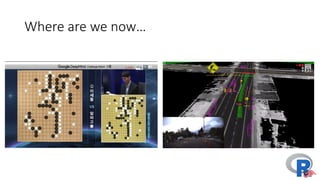
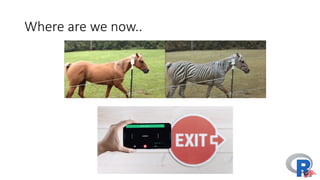
Where	are	we	now…
Where	are	we	now..
Introduction
• In	the	past	10	years,	machine	learning	and	
Artificial
Intelligence	(AI)	have	shown	tremendous	
progress
• The	recent	success	can	be	attributed	to:
• Explosion	of	data
• Cheap	computing	cost	- CPUs	and	GPUs
• Improvement	of	machine	learning	models
• Much	of	the	current	excitement	concerns	a	
subfield	of	it
called	“Deep	Learning”.
A	brief	history	of	Machine	learning
• Most	of	the	machine	learning	methods	are	based	on	supervised	
learning
Input
Feature	
Representation
Learning	Algorithm
A	brief	history	of	Machine	learning
32	45	21	..
12	10	45	..
17	33	36	..
…			…			…
12	56	18	..
92	76	22	..
33	63	71	..
…			…			…
Features	Training
Eg.	Features	of	a	cat
Cat?
How	can	we	do	better?
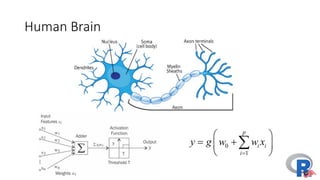
Human	Brain
Auditory	Cortex
Auditory	cortex	learns	to	see.
(Same	rewiring	process	also	
works	for	touch/	somatosensory	
cortex.)
Seeing	with	tongue
Human	Brain
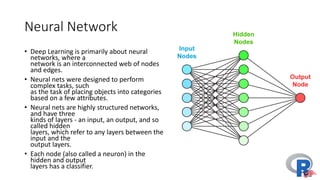
Neural	Network
• Deep	Learning	is	primarily	about	neural	
networks,	where	a	
network	is	an	interconnected	web	of	nodes	
and	edges.
• Neural	nets	were	designed	to	perform	
complex	tasks,	such
as	the	task	of	placing	objects	into	categories	
based	on	a	few	attributes.
• Neural	nets	are	highly	structured	networks,	
and	have	three	
kinds	of	layers	- an	input,	an	output,	and	so	
called	hidden
layers,	which	refer	to	any	layers	between	the	
input	and	the
output	layers.
• Each	node	(also	called	a	neuron)	in	the	
hidden	and	output
layers	has	a	classifier.
Neural	Network:	Forward	Propagation
• The	input	neurons	first	receive	the	
data	features	of	the	object.	After	
processing	the	data,	they	send	their	
output	to	the	first	hidden	layer.
• The	hidden	layer	processes	this	output	
and	sends	the	results	to	the	next	
hidden	layer.
• This	continues	until	the	data	reaches	
the	final	output	layer,	where	the	
output	value	determines	the	object's	
classification.
• This	entire	process	is	known	as	
Forward	Propagation,	or	Forward	prop.
Neural	Network:	Backward	Propagation
• To	train	a	neural	network	over	a	large	set	of	labelled	data,	you	must	
continuously	compute	the	difference	between	the	network’s	
predicted	output	and	the	actual	output.
• This	difference	is	called	the	cost,	and	the	process	for	training	a	net	is	
known	as	backpropagation,	or	backprop
• During	backprop,	weights	and	biases	are	tweaked	slightly	until	the	
lowest	possible	cost	is	achieved.
• An	important	aspect	of	this	process	is	the	gradient,	which	is	a	
measure	of	how	much	the	cost	changes	with	respect	to	a	change	in	a	
weight	or	bias	value.
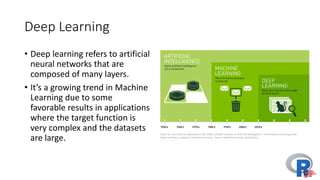
Deep	Learning
• Deep	learning	refers	to	artificial	
neural	networks	that	are
composed	of	many	layers.
• It’s	a	growing	trend	in	Machine	
Learning	due	to	some
favorable	results	in	applications	
where	the	target	function	is
very	complex	and	the	datasets	
are	large.
Deep	Learning:	Strengths
• Robust
• No	need	to	design	the	features	ahead	of	time	- features	are	
automatically	learned	to	be	optimal	for	the	task	at	hand
• Robustness	to	natural	variations	in	the	data	is	automatically	learned
• Generalizable
• The	same	neural	net	approach	can	be	used	for	many	different
applications	and	data	types
• Scalable
• Performance	improves	with	more	data,	method	is	massively	
parallelizable
Deep	Learning:	Weaknesses
• Deep	Learning	requires	a	large	dataset,	hence	long	training	
period.
• In	term	of	cost,	Machine	Learning	methods	like	SVMs	and
other	tree	ensembles	are	very	easily	deployed	even	by	relative
machine	learning	novices	and	can	usually	get	you	reasonably
good	results.
• Deep	learning	methods	tend	to	learn	everything.	It’s	better
to	encode	prior	knowledge	about	structure	of	images	(or	audio
or	text).
• The	learned	features	are	often	difficult	to	understand.	Many
vision	features	are	also	not	really	human-understandable	(e.g,
concatenations/combinations	of	different	features).
• Requires	a	good	understanding	of	how	to	model	multiple
modalities	with	traditional	tools.
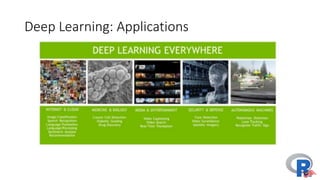
Deep	Learning:	Applications
Deep	Learning	Libraries
• MXNet:	The	R	interface	to	the	MXNet deep	learning	library.
• darch:	An	R	package	for	deep	architectures	and	restricted
Boltzmann	machines.
• deepnet:	An	R	package	implementing	feed-forward	neural
networks,	restricted	Boltzmann	machines,	deep	belief	networks,	and	
stacked	autoencoders.
• Tensorflow	for	R:		The	tensorflow package	provides	access	to	the	complete	
TensorFlow API	from	within	R.
• h2o:	The	R	interface	to	the	H2O	deep-learning	framework.
• Deepwater:	GPU	Enabled	Deep	Learning	using	h2o	platform
TensorFlow
• URL:	https://www.tensorflow.org/
• Released	under	the	open	source	
license on	November	9,	2015
• Current	version	1.2
• Open	source	software	library	for	
numerical	computation	using	data	flow	
graphs	
• Originally	developed	by	Google	Brain	
Team	to	conduct	machine	learning	and	
deep	neural	networks	research	
• General	enough	to	be	applicable	in	a	
wide	variety	of	other	domains	as	well	
• TensorFlow provides	an	extensive	suite	
of	functions	and	classes	that	allow	
users	to	build	various	models	from	
scratch.
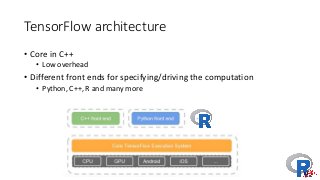
TensorFlow architecture
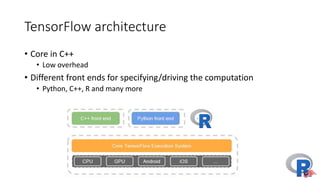
• Core	in	C++
• Low	overhead
• Different	front	ends	for	specifying/driving	the	computation
• Python,	C++,	R	and	many	more
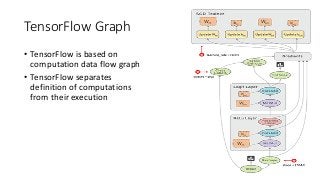
TensorFlow Graph
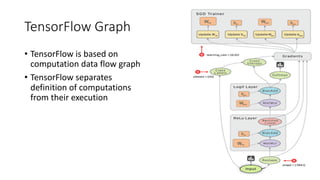
• TensorFlow is	based	on	
computation	data	flow	graph
• TensorFlow separates	
definition	of	computations	
from	their	execution
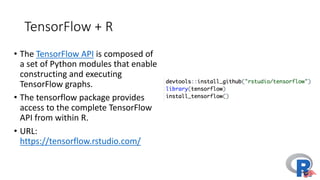
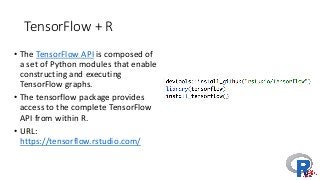
TensorFlow +	R
• The TensorFlow	API is	composed	of	
a	set	of	Python	modules	that	enable	
constructing	and	executing	
TensorFlow graphs.	
• The	tensorflow package	provides	
access	to	the	complete	TensorFlow
API	from	within	R.
• URL:	
https://tensorflow.rstudio.com/
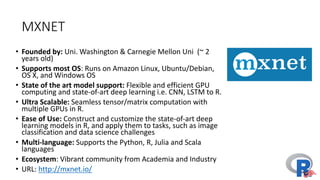
MXNET
• Founded	by:	Uni.	Washington	&	Carnegie	Mellon	Uni (~	2	
years	old)
• Supports	most	OS:	Runs	on	Amazon	Linux,	Ubuntu/Debian,	
OS	X,	and	Windows	OS
• State	of	the	art	model	support:	Flexible	and	efficient	GPU	
computing	and	state-of-art	deep	learning	i.e.	CNN,	LSTM	to	R.
• Ultra	Scalable:	Seamless	tensor/matrix	computation	with	
multiple	GPUs	in	R.
• Ease	of	Use:	Construct	and	customize	the	state-of-art	deep
learning	models	in	R,	and	apply	them	to	tasks,	such	as	image
classification	and	data	science	challenges
• Multi-language:	Supports	the	Python,	R,	Julia	and	Scala	
languages
• Ecosystem:	Vibrant	community	from	Academia	and	Industry
• URL:	http://mxnet.io/
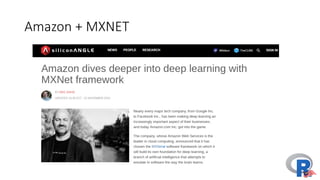
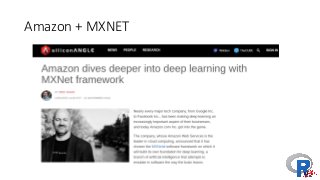
Amazon	+	MXNET
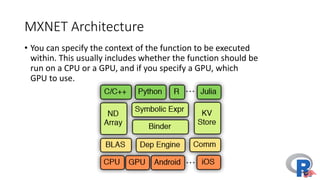
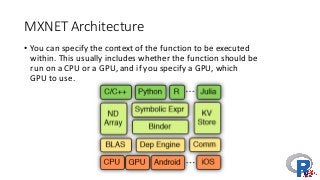
MXNET	Architecture
• You	can	specify	the	context	of	the	function	to	be	executed	
within.	This	usually	includes	whether	the	function	should	be
run	on	a	CPU	or	a	GPU,	and	if	you	specify	a	GPU,	which
GPU	to	use.
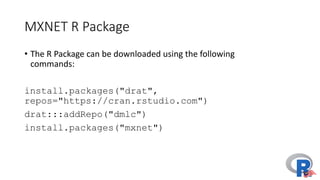
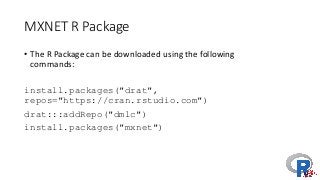
MXNET	R	Package
• The	R	Package	can	be	downloaded	using	the	following	
commands:
install.packages("drat",
repos="https://cran.rstudio.com")
drat:::addRepo("dmlc")
install.packages("mxnet")
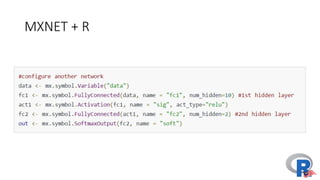
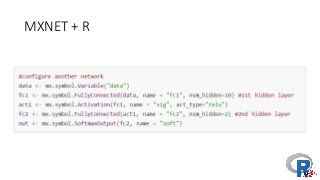
MXNET	+	R
Thanks!
Questions?
@kuanhoong
https://www.linkedin.com/in/kuanhoong
kuanhoong@gmail.com
DEMO
Slides	and	Codes	are	available:	
http://github.com/kuanhoong/deeplearning-r

Deep Learning with R