Keras
A deep learning library
What is keras?
● Keras is a high-level neural networks API, written in Python.
● Built on top of either Theano or TensorFlow.
● Most powerful & easy to use for developing and evaluating deep learning
models.
Why use Keras?
● Allows for easy and fast prototyping (through user friendliness, modularity,
and extensibility).
● Supports both convolutional networks and recurrent networks, as well as
combinations of the two.
● Runs seamlessly on CPU and GPU.
Creating a keras model
● Architecture Definition:-no of layers,no of nodes in layers,activation function
to be used.
● Compile:-defines the loss function and some details about how optimization
works.
● Fit:-cycle of backpropagation and optimization of model weights with your
data.
● Predict:-to predict the model prepared.
Keras code for creating model
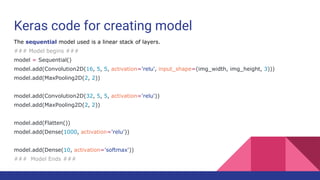
The sequential model used is a linear stack of layers.
### Model begins ###
model = Sequential()
model.add(Convolution2D(16, 5, 5, activation='relu', input_shape=(img_width, img_height, 3)))
model.add(MaxPooling2D(2, 2))
model.add(Convolution2D(32, 5, 5, activation='relu'))
model.add(MaxPooling2D(2, 2))
model.add(Flatten())
model.add(Dense(1000, activation='relu'))
model.add(Dense(10, activation='softmax'))
### Model Ends ###
Compile model
# Compile model
model.compile(loss='binary_crossentropy', optimizer='adam', metrics=['accuracy'])
● The loss function to use to evaluate a set of weights.
● The optimizer used to search through different weights for the network and any optional metrics we
would like to collect and report during training.
● For classification problem you will want to set this to metrics=[‘accuracy’]
Fit the model
# fit model
model.fit(x_train, y_train,
batch_size=batch_size,
epochs=epochs,
verbose=1,
validation_data=(x_test, y_test))
● Execution of model for some data.
● Train data and iterate data in batches.
Evaluate Model
score = model.evaluate(x_test, y_test, verbose=0)
print('Test loss:', score[0])
print('Test accuracy:', score[1])
● It give us an idea of how well we have modeled the dataset.
Predict
classes=model.predict(x_test,batch_size=128)
● It generates prediction on new data
Thank you

Keras: Deep Learning Library for Python

  • 1.
  • 2.
    What is keras? ●Keras is a high-level neural networks API, written in Python. ● Built on top of either Theano or TensorFlow. ● Most powerful & easy to use for developing and evaluating deep learning models.
  • 3.
    Why use Keras? ●Allows for easy and fast prototyping (through user friendliness, modularity, and extensibility). ● Supports both convolutional networks and recurrent networks, as well as combinations of the two. ● Runs seamlessly on CPU and GPU.
  • 4.
    Creating a kerasmodel ● Architecture Definition:-no of layers,no of nodes in layers,activation function to be used. ● Compile:-defines the loss function and some details about how optimization works. ● Fit:-cycle of backpropagation and optimization of model weights with your data. ● Predict:-to predict the model prepared.
  • 5.
    Keras code forcreating model The sequential model used is a linear stack of layers. ### Model begins ### model = Sequential() model.add(Convolution2D(16, 5, 5, activation='relu', input_shape=(img_width, img_height, 3))) model.add(MaxPooling2D(2, 2)) model.add(Convolution2D(32, 5, 5, activation='relu')) model.add(MaxPooling2D(2, 2)) model.add(Flatten()) model.add(Dense(1000, activation='relu')) model.add(Dense(10, activation='softmax')) ### Model Ends ###
  • 6.
    Compile model # Compilemodel model.compile(loss='binary_crossentropy', optimizer='adam', metrics=['accuracy']) ● The loss function to use to evaluate a set of weights. ● The optimizer used to search through different weights for the network and any optional metrics we would like to collect and report during training. ● For classification problem you will want to set this to metrics=[‘accuracy’]
  • 7.
    Fit the model #fit model model.fit(x_train, y_train, batch_size=batch_size, epochs=epochs, verbose=1, validation_data=(x_test, y_test)) ● Execution of model for some data. ● Train data and iterate data in batches.
  • 8.
    Evaluate Model score =model.evaluate(x_test, y_test, verbose=0) print('Test loss:', score[0]) print('Test accuracy:', score[1]) ● It give us an idea of how well we have modeled the dataset.
  • 9.
  • 10.