


Deep Learning with R
Poo Kuan Hoong
Malaysia R User Group
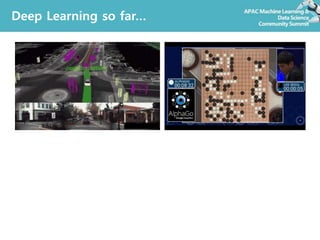
Deep Learning so far…
Introduction
 In the past 10 years, machine learning and Artificial
Intelligence (AI) have shown tremendous progress
 The recent success can be attributed to:
 Explosion of data
 Cheap computing cost - CPUs and GPUs
 Improvement of machine learning models
 Much of the current excitement concerns a subfield of it
called “deep learning”.
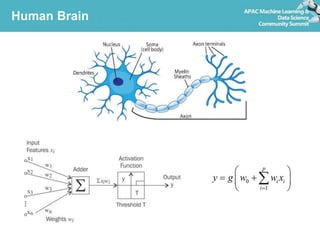
Human Brain
Neural Networks
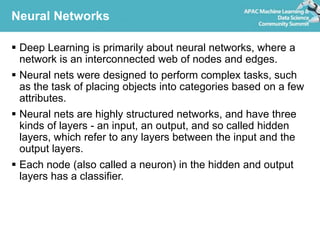
 Deep Learning is primarily about neural networks, where a
network is an interconnected web of nodes and edges.
 Neural nets were designed to perform complex tasks, such
as the task of placing objects into categories based on a few
attributes.
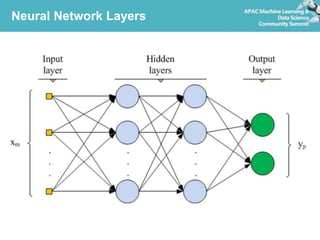
 Neural nets are highly structured networks, and have three
kinds of layers - an input, an output, and so called hidden
layers, which refer to any layers between the input and the
output layers.
 Each node (also called a neuron) in the hidden and output
layers has a classifier.
Neural Network Layers
Deep Learning
 Deep learning refers to artificial neural networks that are
composed of many layers.
 It’s a growing trend in Machine Learning due to some
favorable results in applications where the target function is
very complex and the datasets are large.
Deep Learning: Strengths
 Robust
 No need to design the features ahead of time - features are
automatically learned to be optimal for the task at hand
 Robustness to natural variations in the data is automatically learned
 Generalizable
 The same neural net approach can be used for many different
applications and data types
 Scalable
 Performance improves with more data, method is massively
parallelizable
Deep Learning: Weaknesses
 Deep Learning requires a large dataset, hence long training
period.
 In term of cost, Machine Learning methods like SVMs and
other tree ensembles are very easily deployed even by relative
machine learning novices and can usually get you reasonably
good results.
 Deep learning methods tend to learn everything. It’s better
to encode prior knowledge about structure of images (or audio
or text).
 The learned features are often difficult to understand. Many
vision features are also not really human-understandable (e.g,
concatenations/combinations of different features).
 Requires a good understanding of how to model multiple
modalities with traditional tools.
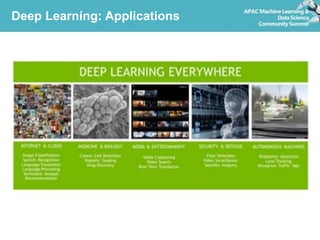
Deep Learning: Applications
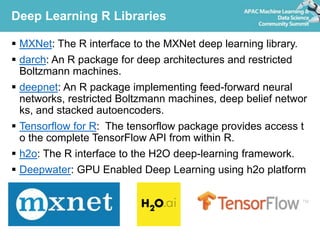
Deep Learning R Libraries
 MXNet: The R interface to the MXNet deep learning library.
 darch: An R package for deep architectures and restricted
Boltzmann machines.
 deepnet: An R package implementing feed-forward neural
networks, restricted Boltzmann machines, deep belief networ
ks, and stacked autoencoders.
 Tensorflow for R: The tensorflow package provides access t
o the complete TensorFlow API from within R.
 h2o: The R interface to the H2O deep-learning framework.
 Deepwater: GPU Enabled Deep Learning using h2o platform
H2O
 Founded in 2012
 Stanford & Purdue Math and Systems Engineer
 Headquarters: Mountain View, California, USA
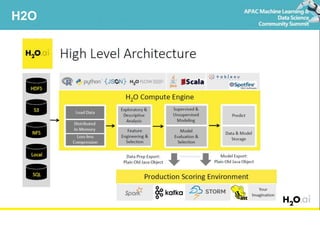
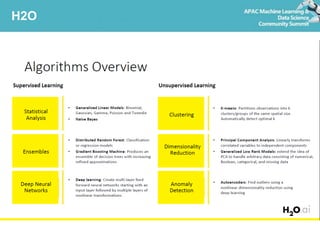
 h2o is an open source, distributed, Java machine learning
library
 Ease of Use via Web Interface
 R, Python, Scala, REST/JSON, Spark & Hadoop Interfaces
 Distributed Algorithms Scale to Big Data
 Package can be downloaded from http://www.h2o.ai/downloa
d/h2o/r
H2O
H2O
H2O + R
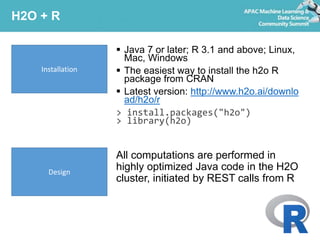
All computations are performed in
highly optimized Java code in the H2O
cluster, initiated by REST calls from R
Installation
Design
 Java 7 or later; R 3.1 and above; Linux,
Mac, Windows
 The easiest way to install the h2o R
package from CRAN
 Latest version: http://www.h2o.ai/downlo
ad/h2o/r
> install.packages("h2o")
> library(h2o)
H2O info
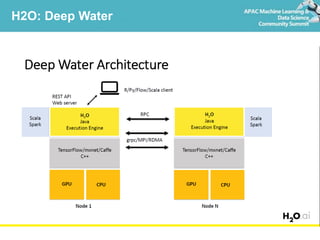
H2O Deep Water
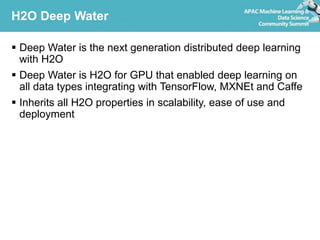
 Deep Water is the next generation distributed deep learning
with H2O
 Deep Water is H2O for GPU that enabled deep learning on
all data types integrating with TensorFlow, MXNEt and Caffe
 Inherits all H2O properties in scalability, ease of use and
deployment
H2O: Deep Water
H2O: Deep Water
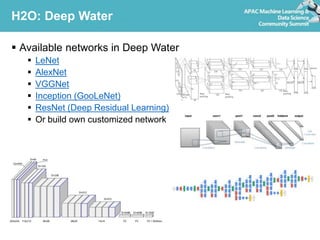
 Available networks in Deep Water
 LeNet
 AlexNet
 VGGNet
 Inception (GooLeNet)
 ResNet (Deep Residual Learning)
 Or build own customized network
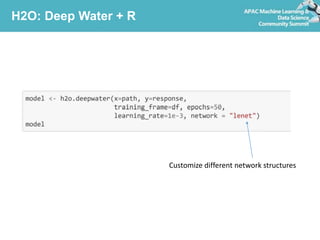
H2O: Deep Water + R
Customize different network structures
MXNET
 Founded by: Uni. Washington & Carnegie Mellon Uni (~1.5 years
old)
 Supports most OS: Runs on Amazon Linux, Ubuntu/Debian, OS
X, and Windows OS
 State of the art model support: Flexible and efficient GPU
computing and state-of-art deep learning i.e. CNN, LSTM to R.
 Ultra Scalable: Seamless tensor/matrix computation with multiple
GPUs in R.
 Ease of Use: Construct and customize the state-of-art deep
learning models in R, and apply them to tasks, such as image
classification and data science challenges
 Multi-language: Supports the Python, R, Julia and Scala
languages
 Ecosystem: Vibrant community from Academia and Industry
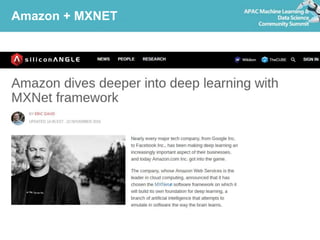
Amazon + MXNET
MXNET Architecture
 You can specify the context of the function to be executed
within. This usually includes whether the function should be
run on a CPU or a GPU, and if you specify a GPU, which
GPU to use.
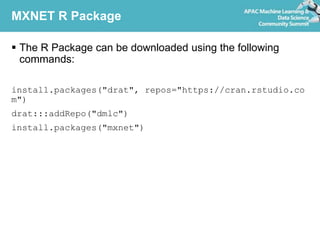
MXNET R Package
 The R Package can be downloaded using the following
commands:
install.packages("drat", repos="https://cran.rstudio.co
m")
drat:::addRepo("dmlc")
install.packages("mxnet")
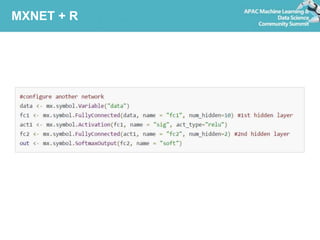
MXNET + R
Demo
Lastly…
Thank you
Questions?

Deep Learning with Microsoft R Open

  • 2.
    Deep Learning withR Poo Kuan Hoong Malaysia R User Group
  • 3.
  • 4.
    Introduction  In thepast 10 years, machine learning and Artificial Intelligence (AI) have shown tremendous progress  The recent success can be attributed to:  Explosion of data  Cheap computing cost - CPUs and GPUs  Improvement of machine learning models  Much of the current excitement concerns a subfield of it called “deep learning”.
  • 5.
  • 6.
    Neural Networks  DeepLearning is primarily about neural networks, where a network is an interconnected web of nodes and edges.  Neural nets were designed to perform complex tasks, such as the task of placing objects into categories based on a few attributes.  Neural nets are highly structured networks, and have three kinds of layers - an input, an output, and so called hidden layers, which refer to any layers between the input and the output layers.  Each node (also called a neuron) in the hidden and output layers has a classifier.
  • 7.
  • 8.
    Deep Learning  Deeplearning refers to artificial neural networks that are composed of many layers.  It’s a growing trend in Machine Learning due to some favorable results in applications where the target function is very complex and the datasets are large.
  • 9.
    Deep Learning: Strengths Robust  No need to design the features ahead of time - features are automatically learned to be optimal for the task at hand  Robustness to natural variations in the data is automatically learned  Generalizable  The same neural net approach can be used for many different applications and data types  Scalable  Performance improves with more data, method is massively parallelizable
  • 10.
    Deep Learning: Weaknesses Deep Learning requires a large dataset, hence long training period.  In term of cost, Machine Learning methods like SVMs and other tree ensembles are very easily deployed even by relative machine learning novices and can usually get you reasonably good results.  Deep learning methods tend to learn everything. It’s better to encode prior knowledge about structure of images (or audio or text).  The learned features are often difficult to understand. Many vision features are also not really human-understandable (e.g, concatenations/combinations of different features).  Requires a good understanding of how to model multiple modalities with traditional tools.
  • 11.
  • 12.
    Deep Learning RLibraries  MXNet: The R interface to the MXNet deep learning library.  darch: An R package for deep architectures and restricted Boltzmann machines.  deepnet: An R package implementing feed-forward neural networks, restricted Boltzmann machines, deep belief networ ks, and stacked autoencoders.  Tensorflow for R: The tensorflow package provides access t o the complete TensorFlow API from within R.  h2o: The R interface to the H2O deep-learning framework.  Deepwater: GPU Enabled Deep Learning using h2o platform
  • 13.
    H2O  Founded in2012  Stanford & Purdue Math and Systems Engineer  Headquarters: Mountain View, California, USA  h2o is an open source, distributed, Java machine learning library  Ease of Use via Web Interface  R, Python, Scala, REST/JSON, Spark & Hadoop Interfaces  Distributed Algorithms Scale to Big Data  Package can be downloaded from http://www.h2o.ai/downloa d/h2o/r
  • 14.
  • 15.
  • 16.
    H2O + R Allcomputations are performed in highly optimized Java code in the H2O cluster, initiated by REST calls from R Installation Design  Java 7 or later; R 3.1 and above; Linux, Mac, Windows  The easiest way to install the h2o R package from CRAN  Latest version: http://www.h2o.ai/downlo ad/h2o/r > install.packages("h2o") > library(h2o)
  • 17.
  • 18.
    H2O Deep Water Deep Water is the next generation distributed deep learning with H2O  Deep Water is H2O for GPU that enabled deep learning on all data types integrating with TensorFlow, MXNEt and Caffe  Inherits all H2O properties in scalability, ease of use and deployment
  • 19.
  • 20.
    H2O: Deep Water Available networks in Deep Water  LeNet  AlexNet  VGGNet  Inception (GooLeNet)  ResNet (Deep Residual Learning)  Or build own customized network
  • 21.
    H2O: Deep Water+ R Customize different network structures
  • 22.
    MXNET  Founded by:Uni. Washington & Carnegie Mellon Uni (~1.5 years old)  Supports most OS: Runs on Amazon Linux, Ubuntu/Debian, OS X, and Windows OS  State of the art model support: Flexible and efficient GPU computing and state-of-art deep learning i.e. CNN, LSTM to R.  Ultra Scalable: Seamless tensor/matrix computation with multiple GPUs in R.  Ease of Use: Construct and customize the state-of-art deep learning models in R, and apply them to tasks, such as image classification and data science challenges  Multi-language: Supports the Python, R, Julia and Scala languages  Ecosystem: Vibrant community from Academia and Industry
  • 23.
  • 24.
    MXNET Architecture  Youcan specify the context of the function to be executed within. This usually includes whether the function should be run on a CPU or a GPU, and if you specify a GPU, which GPU to use.
  • 25.
    MXNET R Package The R Package can be downloaded using the following commands: install.packages("drat", repos="https://cran.rstudio.co m") drat:::addRepo("dmlc") install.packages("mxnet")
  • 26.
  • 27.
  • 28.