Grammar 101


Tenses - Timeline
Learning Objectives
•   To understand that events and actions can take
    place in different periods of time.
•   To apply a simple timeline to describe two
    basic tenses – present and past.
Introduction
•   Have you ever wondered why action verbs
    such as talk or play in fairy tales always end
    with ‘-ed’?
•   Do you know why the same verb can take on
    multiple forms such as talk, talks, talked and
    talking?
•   Do you know when they are used?
•   These questions will be answered in our
    exploration of tenses today. Buckle up and get
    ready for a great learning journey!
Introduction
•   There are three basic types of tenses – past,
    present and future.
•   They are represented by changes to verbs –
    will, ed, ing, es or s.
•   A simple but very effective tool can help you
    differentiate between the different types of
    tenses used in different time periods.
•   It is called a TIMELINE.
Timeline
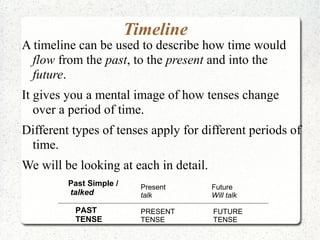
A timeline can be used to describe how time would
  flow from the past, to the present and into the
  future.
It gives you a mental image of how tenses change
   over a period of time.
Different types of tenses apply for different periods of
 time.
We will be looking at each in detail.
         Past Simple /     Present      Future
         talked            talk         Will talk

          PAST             PRESENT      FUTURE
          TENSE            TENSE        TENSE
Timeline – Past Tense
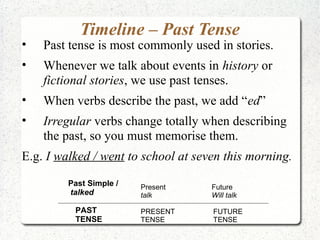
•   Past tense is most commonly used in stories.
•   Whenever we talk about events in history or
    fictional stories, we use past tenses.
•   When verbs describe the past, we add “ed”
•   Irregular verbs change totally when describing
    the past, so you must memorise them.
E.g. I walked / went to school at seven this morning.
         Past Simple /   Present     Future
         talked          talk        Will talk

          PAST           PRESENT     FUTURE
          TENSE          TENSE       TENSE
Activity
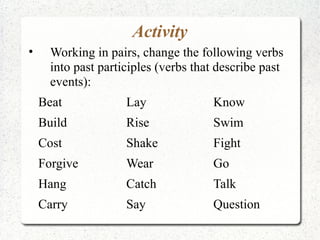
•     Working in pairs, change the following verbs
      into past participles (verbs that describe past
      events):
    Beat             Lay              Know
    Build            Rise             Swim
    Cost             Shake            Fight
    Forgive          Wear             Go
    Hang             Catch            Talk
    Carry            Say              Question
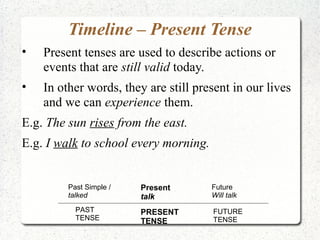
Timeline – Present Tense
•   Present tenses are used to describe actions or
    events that are still valid today.
•   In other words, they are still present in our lives
    and we can experience them.
E.g. The sun rises from the east.
E.g. I walk to school every morning.


         Past Simple /   Present       Future
         talked          talk          Will talk

           PAST          PRESENT       FUTURE
           TENSE         TENSE         TENSE
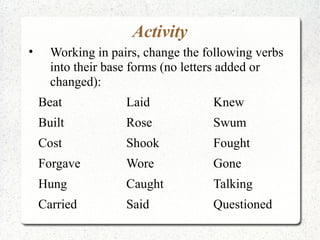
Activity
•     Working in pairs, change the following verbs
      into their base forms (no letters added or
      changed):
    Beat            Laid            Knew
    Built           Rose            Swum
    Cost            Shook           Fought
    Forgave         Wore            Gone
    Hung            Caught          Talking
    Carried         Said            Questioned
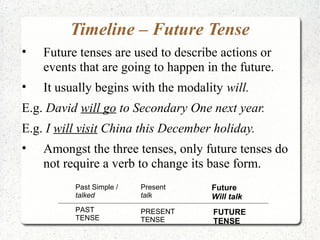
Timeline – Future Tense
•   Future tenses are used to describe actions or
    events that are going to happen in the future.
•   It usually begins with the modality will.
E.g. David will go to Secondary One next year.
E.g. I will visit China this December holiday.
•   Amongst the three tenses, only future tenses do
    not require a verb to change its base form.
          Past Simple /   Present    Future
          talked          talk       Will talk
          PAST            PRESENT    FUTURE
          TENSE           TENSE      TENSE
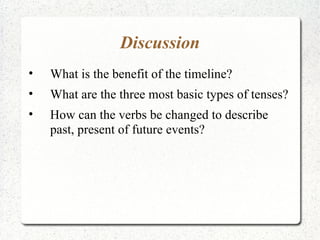
Discussion
•   What is the benefit of the timeline?
•   What are the three most basic types of tenses?
•   How can the verbs be changed to describe
    past, present of future events?
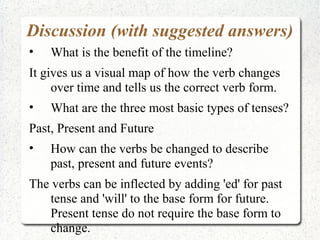
Discussion (with suggested answers)
•   What is the benefit of the timeline?
It gives us a visual map of how the verb changes
     over time and tells us the correct verb form.
•   What are the three most basic types of tenses?
Past, Present and Future
•   How can the verbs be changed to describe
    past, present and future events?
The verbs can be inflected by adding 'ed' for past
   tense and 'will' to the base form for future.
   Present tense do not require the base form to
   change.

Lower pri timeline

  • 1.
  • 2.
    Learning Objectives • To understand that events and actions can take place in different periods of time. • To apply a simple timeline to describe two basic tenses – present and past.
  • 3.
    Introduction • Have you ever wondered why action verbs such as talk or play in fairy tales always end with ‘-ed’? • Do you know why the same verb can take on multiple forms such as talk, talks, talked and talking? • Do you know when they are used? • These questions will be answered in our exploration of tenses today. Buckle up and get ready for a great learning journey!
  • 4.
    Introduction • There are three basic types of tenses – past, present and future. • They are represented by changes to verbs – will, ed, ing, es or s. • A simple but very effective tool can help you differentiate between the different types of tenses used in different time periods. • It is called a TIMELINE.
  • 5.
    Timeline A timeline canbe used to describe how time would flow from the past, to the present and into the future. It gives you a mental image of how tenses change over a period of time. Different types of tenses apply for different periods of time. We will be looking at each in detail. Past Simple / Present Future talked talk Will talk PAST PRESENT FUTURE TENSE TENSE TENSE
  • 6.
    Timeline – PastTense • Past tense is most commonly used in stories. • Whenever we talk about events in history or fictional stories, we use past tenses. • When verbs describe the past, we add “ed” • Irregular verbs change totally when describing the past, so you must memorise them. E.g. I walked / went to school at seven this morning. Past Simple / Present Future talked talk Will talk PAST PRESENT FUTURE TENSE TENSE TENSE
  • 7.
    Activity • Working in pairs, change the following verbs into past participles (verbs that describe past events): Beat Lay Know Build Rise Swim Cost Shake Fight Forgive Wear Go Hang Catch Talk Carry Say Question
  • 8.
    Timeline – PresentTense • Present tenses are used to describe actions or events that are still valid today. • In other words, they are still present in our lives and we can experience them. E.g. The sun rises from the east. E.g. I walk to school every morning. Past Simple / Present Future talked talk Will talk PAST PRESENT FUTURE TENSE TENSE TENSE
  • 9.
    Activity • Working in pairs, change the following verbs into their base forms (no letters added or changed): Beat Laid Knew Built Rose Swum Cost Shook Fought Forgave Wore Gone Hung Caught Talking Carried Said Questioned
  • 10.
    Timeline – FutureTense • Future tenses are used to describe actions or events that are going to happen in the future. • It usually begins with the modality will. E.g. David will go to Secondary One next year. E.g. I will visit China this December holiday. • Amongst the three tenses, only future tenses do not require a verb to change its base form. Past Simple / Present Future talked talk Will talk PAST PRESENT FUTURE TENSE TENSE TENSE
  • 11.
    Discussion • What is the benefit of the timeline? • What are the three most basic types of tenses? • How can the verbs be changed to describe past, present of future events?
  • 12.
    Discussion (with suggestedanswers) • What is the benefit of the timeline? It gives us a visual map of how the verb changes over time and tells us the correct verb form. • What are the three most basic types of tenses? Past, Present and Future • How can the verbs be changed to describe past, present and future events? The verbs can be inflected by adding 'ed' for past tense and 'will' to the base form for future. Present tense do not require the base form to change.