Presentation
        10 tips for leading communities


Stan Garfield
July 2011
1. Carefully choose the community topic

•    Make ‘em SMILE
     1. Subject: A specialty to learn and/or collaborate about
          ubject:
     2.     Members: People interested in the subject
             embers:
     3.     Interaction: Meetings, calls, and discussions
             nteraction:
     4.     Leaders: People passionate about the subject who are dedicated to
             eaders:
            creating, building, and sustaining a community
     5.     Enthusiasm: Motivation to engage and spend time collaborating and/or
              nthusiasm:
            learning about the subject
• Avoid redundancy
  o Narrowing either by geography or function should be discouraged
    o Local chapters can be created as subsets of larger communities
    o Suggest that overlapping communities with similar topics be combined,
      either directly or with one as a subset of the other
• Avoid having too narrow a scope
  o Start with the broadest feasible topics, and narrow down as needed
    o Spin off narrower sub-topics only when a high volume of discussion or
                            topics
      communication makes it necessary
    o Challenge those with a niche topic to prove that it warrants its own
      community
2     Communities of Practice
2. Publicize
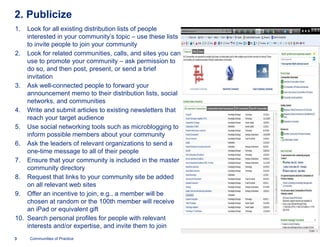
1.  Look for all existing distribution lists of people
    interested in your community’s topic – use these lists
    to invite people to join your community
2. Look for related communities, calls, and sites you can
    use to promote your community – ask permission to
    do so, and then post, present, or send a brief
    invitation
3. Ask well-connected people to forward your
    announcement memo to their distribution lists, social
    networks, and communities
4. Write and submit articles to existing newsletters that
    reach your target audience
5. Use social networking tools such as microblogging to
    inform possible members about your community
6. Ask the leaders of relevant organizations to send a
    one-time message to all of their people
7. Ensure that your community is included in the master
    community directory
8. Request that links to your community site be added
    on all relevant web sites
9. Offer an incentive to join, e.g., a member will be
    chosen at random or the 100th member will receive
    an iPad or equivalent gift
10. Search personal profiles for people with relevant
    interests and/or expertise, and invite them to join
3    Communities of Practice
3. Increase membership
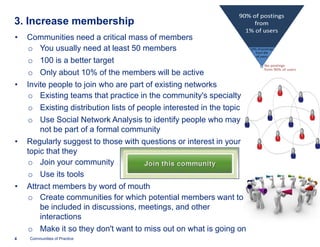
•   Communities need a critical mass of members
    o You usually need at least 50 members
    o 100 is a better target
    o Only about 10% of the members will be active
•   Invite people to join who are part of existing networks
    o Existing teams that practice in the community's specialty
    o Existing distribution lists of people interested in the topic
    o Use Social Network Analysis to identify people who may
        not be part of a formal community
•   Regularly suggest to those with questions or interest in your
    topic that they
    o Join your community
    o Use its tools
•   Attract members by word of mouth
    o Create communities for which potential members want to
        be included in discussions, meetings, and other
        interactions
    o Make it so they don't want to miss out on what is going on
4   Communities of Practice
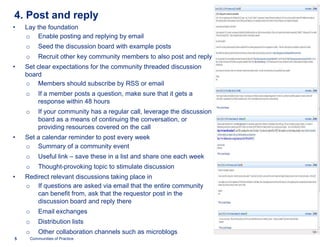
4. Post and reply
•   Lay the foundation
    o Enable posting and replying by email
    o       Seed the discussion board with example posts
    o       Recruit other key community members to also post and reply
•   Set clear expectations for the community threaded discussion
    board
    o Members should subscribe by RSS or email
    o       If a member posts a question, make sure that it gets a
            response within 48 hours
    o       If your community has a regular call, leverage the discussion
            board as a means of continuing the conversation, or
            providing resources covered on the call
•   Set a calendar reminder to post every week
    o Summary of a community event
    o       Useful link – save these in a list and share one each week
    o       Thought-provoking topic to stimulate discussion
                    provoking
•   Redirect relevant discussions taking place in
    o If questions are asked via email that the entire community
        can benefit from, ask that the requestor post in the
        discussion board and reply there
    o       Email exchanges
    o       Distribution lists
    o       Other collaboration channels such as microblogs
5       Communities of Practice
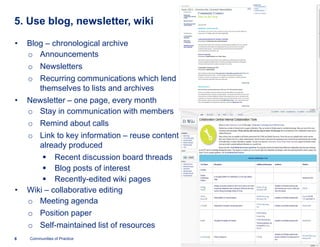
5. Use blog, newsletter, wiki

•   Blog – chronological archive
    o Announcements
    o Newsletters
    o Recurring communications which lend
       themselves to lists and archives
•   Newsletter – one page, every month
    o Stay in communication with members
    o Remind about calls
    o Link to key information – reuse content
       already produced
        § Recent discussion board threads
        § Blog posts of interest
        § Recently-edited wiki pages
•   Wiki – collaborative editing
    o Meeting agenda
    o Position paper
    o Self-maintained list of resources
6   Communities of Practice
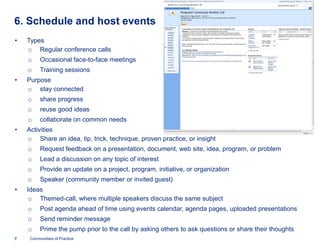
6. Schedule and host events
•   Types
    o Regular conference calls
    o     Occasional face-to-face meetings
    o     Training sessions
•   Purpose
    o stay connected
    o     share progress
    o     reuse good ideas
    o     collaborate on common needs
•   Activities
    o Share an idea, tip, trick, technique, proven practice, or insight
    o     Request feedback on a presentation, document, web site, idea, program, or problem
    o     Lead a discussion on any topic of interest
    o     Provide an update on a project, program, initiative, or organization
    o     Speaker (community member or invited guest)
•   Ideas
     o Themed-call, where multiple speakers discuss the same subject
              call,
    o     Post agenda ahead of time using events calendar, agenda pages, uploaded presentations
    o     Send reminder message
    o     Prime the pump prior to the call by asking others to ask questions or share their thoughts
7    Communities of Practice
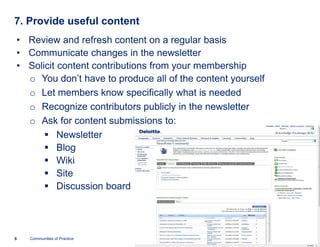
7. Provide useful content
• Review and refresh content on a regular basis
• Communicate changes in the newsletter
• Solicit content contributions from your membership
  o You don’t have to produce all of the content yourself
  o Let members know specifically what is needed
  o Recognize contributors publicly in the newsletter
  o Ask for content submissions to:
      § Newsletter
      § Blog
      § Wiki
      § Site
      § Discussion board


8   Communities of Practice
8. Tell members how they should participate
• Become a SPACE cowboy
  1. Subscribe: Get email or RSS and regularly read a threaded
      ubscribe:
     discussion board
  2. Post: Start a new thread or reply in a threaded discussion board
      ost:
  3. Attend: Participate in community events
       ttend:
  4. Contribute: Submit content to the community newsletter, blog,
       ontribute:
     wiki, or site
  5. Engage: Ask a question, make a comment, or give a
      ngage:
     presentation


9   Communities of Practice
9. Set goals and measure progress
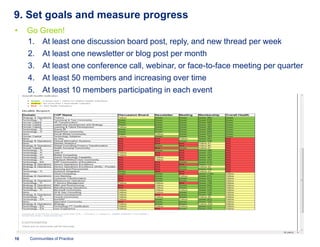
•    Go Green!
     1. At least one discussion board post, reply, and new thread per week
     2. At least one newsletter or blog post per month
     3. At least one conference call, webinar, or face
                                                  face-to-face meeting per quarter
     4. At least 50 members and increasing over time
     5. At least 10 members participating in each event


10   Communities of Practice
10. Solicit, find, and publicize success stories
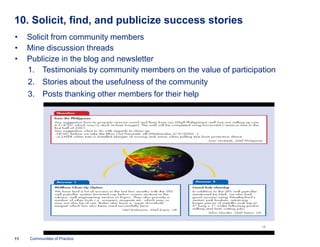
•    Solicit from community members
•    Mine discussion threads
•    Publicize in the blog and newsletter
     1. Testimonials by community members on the value of participation
     2. Stories about the usefulness of the community
     3. Posts thanking other members for their help


11   Communities of Practice
As used in this presentation, ‘Deloitte’ means Deloitte Touche Tohmatsu and its member firms.

Deloitte refers to one or more of Deloitte Touche Tohmatsu, a Swiss Verein, and its network of member firms, each of which is a legally separate and
independent entity. Please see www.deloitte.com/about for a detailed description of the legal structure of Deloitte Touche Tohmatsu and its member
firms.

This publication is for internal distribution and use only among personnel of Deloitte Touche Tohmatsu, its member firms, and its and their affiliates.
Deloitte Touche Tohmatsu, its member firms, and its and their affiliates shall not be responsible for any loss whatsoever sus
                                                                                                                          sustained by any person who
relies on this publication.

Ten tips for leading communities(deloitte)

  • 1.
    Presentation 10 tips for leading communities Stan Garfield July 2011
  • 2.
    1. Carefully choosethe community topic • Make ‘em SMILE 1. Subject: A specialty to learn and/or collaborate about ubject: 2. Members: People interested in the subject embers: 3. Interaction: Meetings, calls, and discussions nteraction: 4. Leaders: People passionate about the subject who are dedicated to eaders: creating, building, and sustaining a community 5. Enthusiasm: Motivation to engage and spend time collaborating and/or nthusiasm: learning about the subject • Avoid redundancy o Narrowing either by geography or function should be discouraged o Local chapters can be created as subsets of larger communities o Suggest that overlapping communities with similar topics be combined, either directly or with one as a subset of the other • Avoid having too narrow a scope o Start with the broadest feasible topics, and narrow down as needed o Spin off narrower sub-topics only when a high volume of discussion or topics communication makes it necessary o Challenge those with a niche topic to prove that it warrants its own community 2 Communities of Practice
  • 3.
    2. Publicize 1. Look for all existing distribution lists of people interested in your community’s topic – use these lists to invite people to join your community 2. Look for related communities, calls, and sites you can use to promote your community – ask permission to do so, and then post, present, or send a brief invitation 3. Ask well-connected people to forward your announcement memo to their distribution lists, social networks, and communities 4. Write and submit articles to existing newsletters that reach your target audience 5. Use social networking tools such as microblogging to inform possible members about your community 6. Ask the leaders of relevant organizations to send a one-time message to all of their people 7. Ensure that your community is included in the master community directory 8. Request that links to your community site be added on all relevant web sites 9. Offer an incentive to join, e.g., a member will be chosen at random or the 100th member will receive an iPad or equivalent gift 10. Search personal profiles for people with relevant interests and/or expertise, and invite them to join 3 Communities of Practice
  • 4.
    3. Increase membership • Communities need a critical mass of members o You usually need at least 50 members o 100 is a better target o Only about 10% of the members will be active • Invite people to join who are part of existing networks o Existing teams that practice in the community's specialty o Existing distribution lists of people interested in the topic o Use Social Network Analysis to identify people who may not be part of a formal community • Regularly suggest to those with questions or interest in your topic that they o Join your community o Use its tools • Attract members by word of mouth o Create communities for which potential members want to be included in discussions, meetings, and other interactions o Make it so they don't want to miss out on what is going on 4 Communities of Practice
  • 5.
    4. Post andreply • Lay the foundation o Enable posting and replying by email o Seed the discussion board with example posts o Recruit other key community members to also post and reply • Set clear expectations for the community threaded discussion board o Members should subscribe by RSS or email o If a member posts a question, make sure that it gets a response within 48 hours o If your community has a regular call, leverage the discussion board as a means of continuing the conversation, or providing resources covered on the call • Set a calendar reminder to post every week o Summary of a community event o Useful link – save these in a list and share one each week o Thought-provoking topic to stimulate discussion provoking • Redirect relevant discussions taking place in o If questions are asked via email that the entire community can benefit from, ask that the requestor post in the discussion board and reply there o Email exchanges o Distribution lists o Other collaboration channels such as microblogs 5 Communities of Practice
  • 6.
    5. Use blog,newsletter, wiki • Blog – chronological archive o Announcements o Newsletters o Recurring communications which lend themselves to lists and archives • Newsletter – one page, every month o Stay in communication with members o Remind about calls o Link to key information – reuse content already produced § Recent discussion board threads § Blog posts of interest § Recently-edited wiki pages • Wiki – collaborative editing o Meeting agenda o Position paper o Self-maintained list of resources 6 Communities of Practice
  • 7.
    6. Schedule andhost events • Types o Regular conference calls o Occasional face-to-face meetings o Training sessions • Purpose o stay connected o share progress o reuse good ideas o collaborate on common needs • Activities o Share an idea, tip, trick, technique, proven practice, or insight o Request feedback on a presentation, document, web site, idea, program, or problem o Lead a discussion on any topic of interest o Provide an update on a project, program, initiative, or organization o Speaker (community member or invited guest) • Ideas o Themed-call, where multiple speakers discuss the same subject call, o Post agenda ahead of time using events calendar, agenda pages, uploaded presentations o Send reminder message o Prime the pump prior to the call by asking others to ask questions or share their thoughts 7 Communities of Practice
  • 8.
    7. Provide usefulcontent • Review and refresh content on a regular basis • Communicate changes in the newsletter • Solicit content contributions from your membership o You don’t have to produce all of the content yourself o Let members know specifically what is needed o Recognize contributors publicly in the newsletter o Ask for content submissions to: § Newsletter § Blog § Wiki § Site § Discussion board 8 Communities of Practice
  • 9.
    8. Tell membershow they should participate • Become a SPACE cowboy 1. Subscribe: Get email or RSS and regularly read a threaded ubscribe: discussion board 2. Post: Start a new thread or reply in a threaded discussion board ost: 3. Attend: Participate in community events ttend: 4. Contribute: Submit content to the community newsletter, blog, ontribute: wiki, or site 5. Engage: Ask a question, make a comment, or give a ngage: presentation 9 Communities of Practice
  • 10.
    9. Set goalsand measure progress • Go Green! 1. At least one discussion board post, reply, and new thread per week 2. At least one newsletter or blog post per month 3. At least one conference call, webinar, or face face-to-face meeting per quarter 4. At least 50 members and increasing over time 5. At least 10 members participating in each event 10 Communities of Practice
  • 11.
    10. Solicit, find,and publicize success stories • Solicit from community members • Mine discussion threads • Publicize in the blog and newsletter 1. Testimonials by community members on the value of participation 2. Stories about the usefulness of the community 3. Posts thanking other members for their help 11 Communities of Practice
  • 12.
    As used inthis presentation, ‘Deloitte’ means Deloitte Touche Tohmatsu and its member firms. Deloitte refers to one or more of Deloitte Touche Tohmatsu, a Swiss Verein, and its network of member firms, each of which is a legally separate and independent entity. Please see www.deloitte.com/about for a detailed description of the legal structure of Deloitte Touche Tohmatsu and its member firms. This publication is for internal distribution and use only among personnel of Deloitte Touche Tohmatsu, its member firms, and its and their affiliates. Deloitte Touche Tohmatsu, its member firms, and its and their affiliates shall not be responsible for any loss whatsoever sus sustained by any person who relies on this publication.