Across the border with  Communities of Practice September 2007 Dr. Robin Teigland Stockholm School of Economics robin.teigland@hhs.se
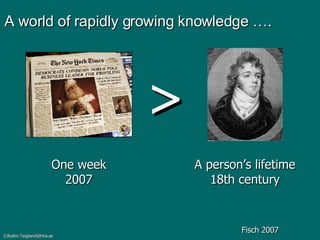
A world of rapidly growing knowledge …. > A person’s lifetime 18th century One week 2007 Fisch 2007
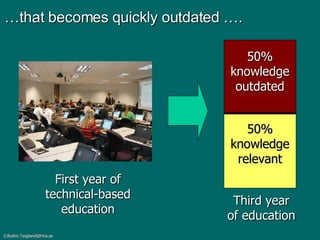
… that becomes quickly outdated …. 50% knowledge relevant 50% knowledge outdated First year of technical-based education Third year of education
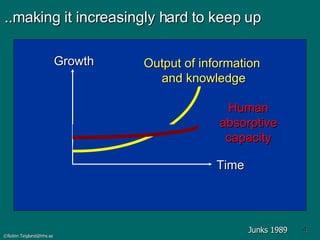
..making it increasingly hard to keep up Growth Time Output of information and knowledge Human  absorptive capacity Junks 1989
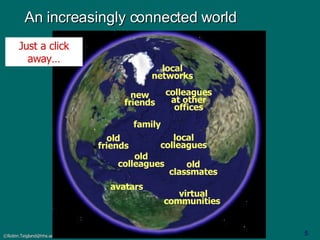
An increasingly connected world new friends family local colleagues old friends old colleagues colleagues at other offices Just a click away… virtual communities  local networks old classmates avatars
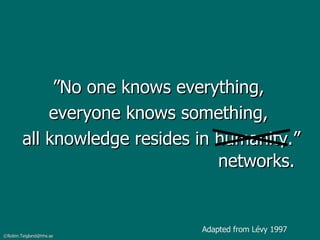
” No one knows everything,  everyone knows something,  all knowledge resides in humanity.” networks. Adapted from Lévy 1997
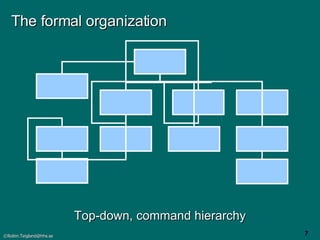
The formal organization Top-down, command hierarchy
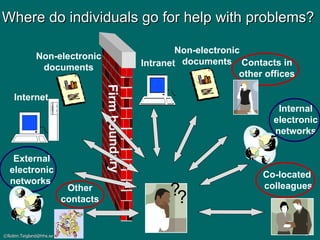
Where do individuals go for help with problems? Co-located  colleagues Intranet Non-electronic documents Internal electronic networks Contacts in other offices Firm boundary External electronic networks  Internet Non-electronic documents Other contacts ? ?
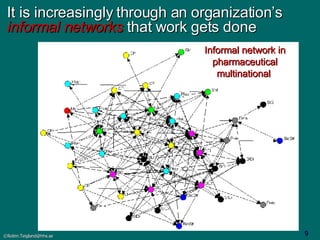
It is increasingly through an organization’s  informal networks  that work gets done Informal network in pharmaceutical multinational
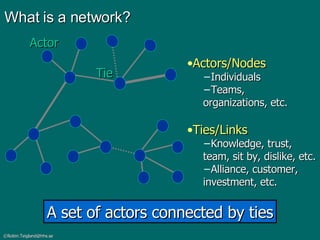
What is a network? A set of actors connected by ties Ties/Links Knowledge, trust, team, sit by, dislike, etc. Alliance, customer, investment, etc. Tie Actors/Nodes Individuals Teams, organizations, etc. Actor
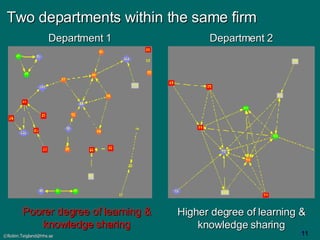
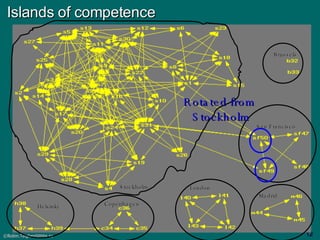
Two departments within the same firm Department 1 Department 2 Higher degree of learning & knowledge sharing Poorer degree of learning & knowledge sharing
San Francisco Stockholm London Brussels Helsinki Madrid Copenhagen Islands of competence Rotated from  Stockholm
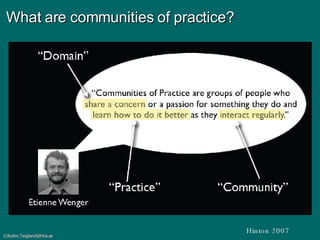
Hinton 2007 What are communities of practice?
What are communities of practice? Groups of people who come together  to share and to learn from one another   face-to-face and/or virtually.  They are held together by a  common interest in a body of knowledge  and are driven by a desire and need to share problems, experiences, insights, templates, tools, and best practices.  Members deepen their knowledge by  interacting on an ongoing   basis . This interaction leads to  continuous learning and innovation
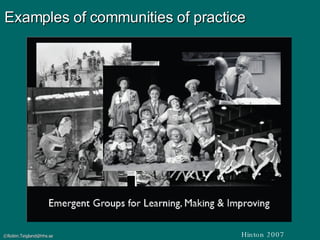
Examples of communities of practice Hinton 2007
Challenges to knowledge databases Time consuming and difficult Takes times for writer to document experiences Takes time for reader to search through databases, information overload Often weak incentives to contribute golden nuggets Difficult to understand Difficult for writer to explain context, tacit ->explicit Difficult for reader to interpret experience and use in own situation Data becomes out-of-date very quickly  Difficult to maintain, especially in fast moving industries
It turns out that ….  the community ends up being not the secondary resource for knowledge, but for the majority of participants …, it’s the *primary* resource. Hinton 2007
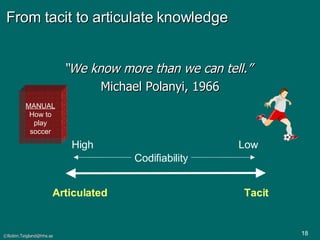
From tacit to articulate knowledge  “ We know more than we can tell.”  Michael Polanyi, 1966 Tacit Articulated High Low Codifiability MANUAL How to play soccer
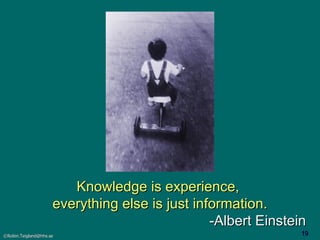
Knowledge is experience,  everything else is just information. -Albert Einstein
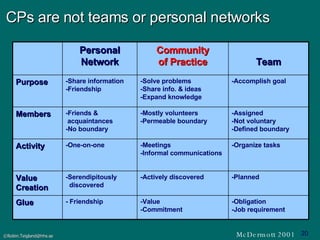
CPs are not teams or personal networks McDermott 2001 -Obligation -Job requirement -Value -Commitment - Friendship Glue -Planned -Actively discovered -Serendipitously  discovered Value Creation -Organize tasks -Meetings -Informal communications -One-on-one Activity -Assigned -Not voluntary -Defined boundary -Mostly volunteers -Permeable boundary -Friends & acquaintances -No boundary Members -Accomplish goal -Solve problems -Share info. & ideas -Expand knowledge -Share information -Friendship Purpose Team Community of Practice Personal Network
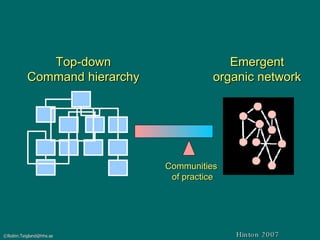
Hinton 2007 Top-down Command hierarchy Emergent organic network Communities  of practice
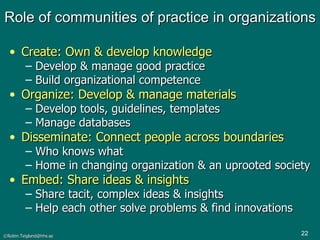
Role of communities of practice in organizations  Create: Own & develop knowledge Develop & manage good practice Build organizational competence Organize: Develop & manage materials Develop tools, guidelines, templates  Manage databases Disseminate: Connect people across boundaries Who knows what  Home in changing organization & an uprooted society Embed: Share ideas & insights   Share tacit, complex ideas & insights Help each other solve problems & find innovations
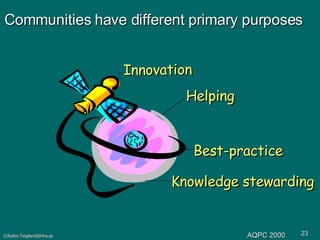
Communities have different primary purposes Helping Best-practice Innovation Knowledge stewarding AQPC 2000
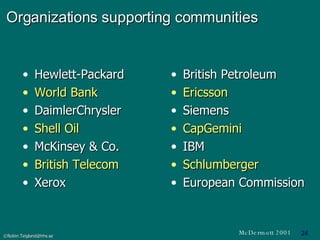
Organizations supporting communities Hewlett-Packard  World Bank DaimlerChrysler Shell Oil McKinsey & Co. British Telecom Xerox British Petroleum Ericsson  Siemens CapGemini IBM Schlumberger European Commission McDermott 2001
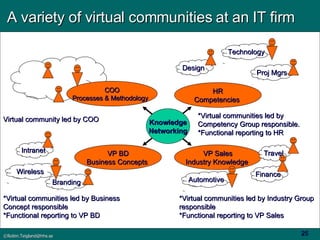
A variety of virtual communities at an IT firm Knowledge Networking VP BD Business Concepts  VP Sales Industry Knowledge  HR Competencies  COO Processes  &  Methodology   Virtual community led by COO Wireless Branding Intranet *Virtual communities led by Business Concept responsible *Functional reporting to VP BD Travel Automotive Finance *Virtual communities led by Industry Group responsible *Functional reporting to VP Sales Proj Mgrs Technology Design *Virtual communities led by Competency Group responsible. *Functional reporting to HR
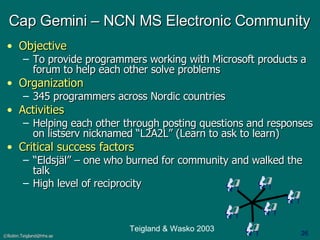
Cap Gemini – NCN MS Electronic Community Objective To provide programmers working with Microsoft products a forum to help each other solve problems  Organization  345 programmers across Nordic countries Activities Helping each other through posting questions and responses on listserv nicknamed “L2A2L” (Learn to ask to learn) Critical success factors “ Eldsjäl” – one who burned for community and walked the talk High level of reciprocity Teigland & Wasko 2003
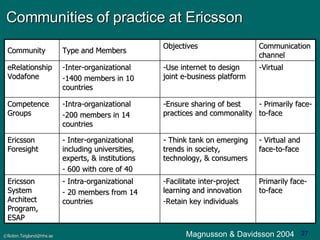
Communities of practice at Ericsson Magnusson & Davidsson 2004 Community Type and Members Objectives Communication channel eRelationship Vodafone Inter-organizational 1400 members in 10 countries -Use internet to design joint e-business platform -Virtual Competence Groups Intra-organizational  200 members in 14 countries -Ensure sharing of best practices and commonality - Primarily face-to-face  Ericsson Foresight - Inter-organizational including universities, experts, & institutions - 600 with core of 40 - Think tank on emerging trends in society, technology, & consumers - Virtual and face-to-face  Ericsson System Architect Program, ESAP - Intra-organizational  20 members from 14 countries Facilitate inter-project learning and innovation Retain key individuals  Primarily face-to-face
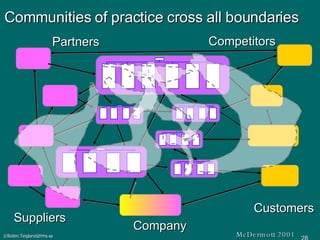
Communities of practice cross all boundaries Company Suppliers Customers Competitors Partners McDermott 2001
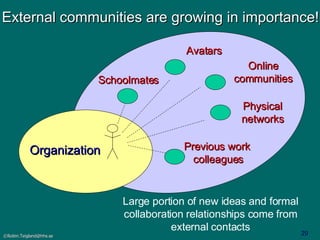
External communities are growing in importance! Online communities Schoolmates Avatars Previous work  colleagues Large portion of new ideas and formal collaboration relationships come from external contacts Organization Physical networks
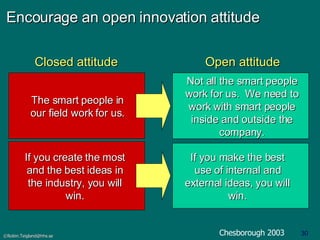
Encourage an open innovation attitude Not all the smart people work for us.  We need to work with smart people inside and outside the company. The smart people in our field work for us. If you create the most and the best ideas in the industry, you will win. If you make the best use of internal and external ideas, you will win. Closed attitude Open attitude Chesborough 2003
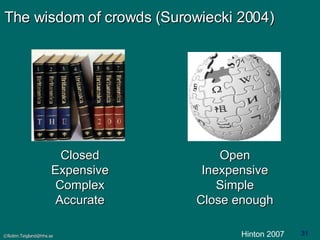
The wisdom of crowds (Surowiecki 2004)  Closed Expensive Complex Accurate Open Inexpensive Simple Close enough Hinton 2007
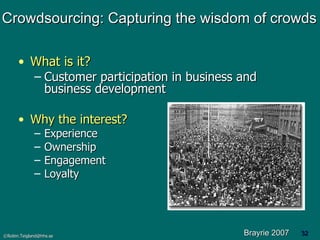
Crowdsourcing: Capturing the wisdom of crowds What is it? Customer participation in business and business development Why the interest? Experience Ownership Engagement Loyalty Brayrie 2007
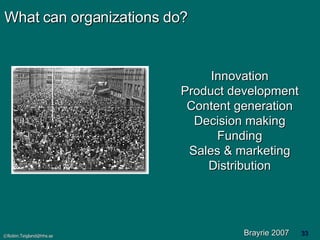
What can organizations do? Innovation Product development Content generation Decision making Funding Sales & marketing Distribution Brayrie 2007
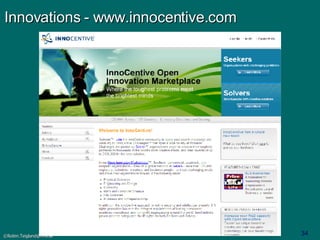
Innovations - www.innocentive.com
Problem solutions - The Goldcorp Challenge
Decision making & funding – My football club Brayrie 2007
Product development - www.ideastorm.com Brayrie 2007
Building the Dell community Brayrie 2007
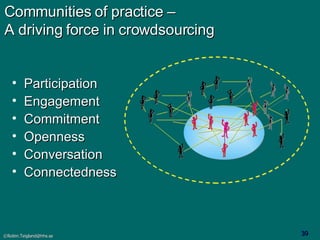
Communities of practice – A driving force in crowdsourcing Participation Engagement Commitment Openness Conversation Connectedness
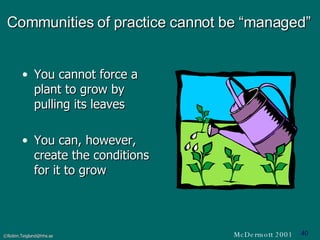
Communities of practice cannot be “managed” You cannot force a plant to grow by pulling its leaves You can, however, create the conditions for it to grow McDermott 2001
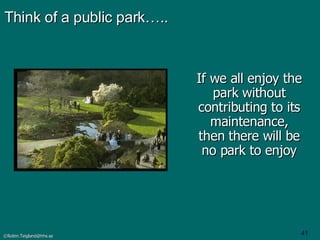
Think of a public park….. If we all enjoy the park without contributing to its maintenance, then there will be no park to enjoy
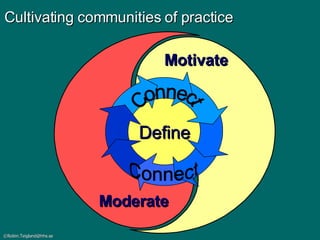
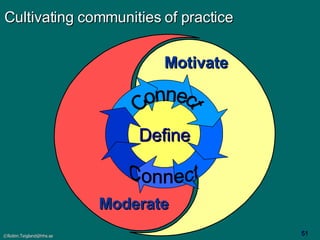
Cultivating communities of practice Define Motivate Moderate Connect Connect
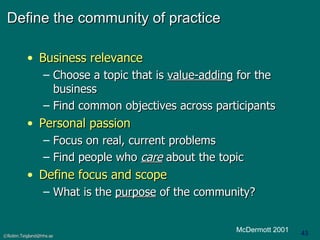
Define the community of practice Business relevance Choose a topic that is  value-adding  for the business Find common objectives across participants Personal passion Focus on real, current problems Find people who  care  about the topic Define focus and scope What is the  purpose  of the community? McDermott 2001
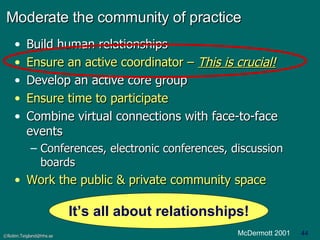
Moderate the community of practice Build human relationships Ensure an active coordinator –  This is crucial! Develop an active core group Ensure time to participate Combine virtual connections with face-to-face events Conferences, electronic conferences, discussion boards Work the public & private community space   It’s all about relationships! McDermott 2001
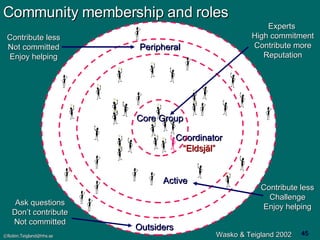
Community membership and roles Wasko & Teigland 2002 Outsiders Ask questions Don’t contribute Not committed Peripheral Contribute less Not committed Enjoy helping Coordinator “ Eldsjäl” Active Contribute less Challenge Enjoy helping Experts  High commitment Contribute more Reputation Core Group
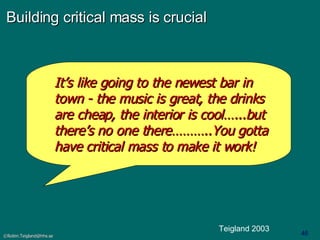
Building critical mass is crucial It’s like going to the newest bar in town - the music is great, the drinks are cheap, the interior is cool…...but there’s no one there………..You gotta have critical mass to make it work! Teigland 2003
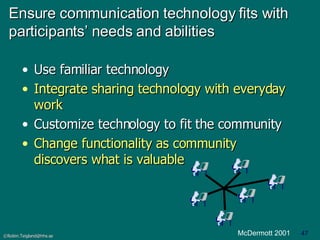
Ensure communication technology fits with participants’ needs and abilities Use familiar technology Integrate sharing technology with everyday work Customize technology to fit the community Change functionality as community discovers what is valuable McDermott 2001
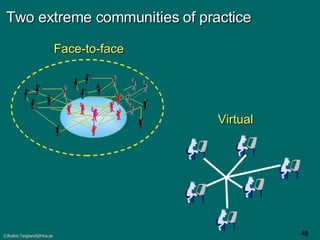
Two extreme communities of practice Face-to-face Virtual
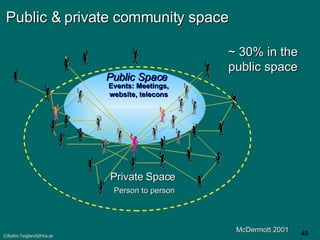
Public & private community space ~ 30% in the public space Public Space McDermott 2001 Events: Meetings, website, telecons Private Space Person to person
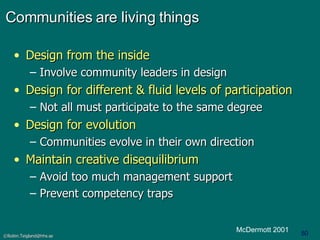
Communities are living things Design from the inside Involve community leaders in design   Design for different & fluid levels of participation Not all must participate to the same degree Design for evolution Communities evolve in their own direction Maintain creative disequilibrium Avoid too much management support Prevent competency traps McDermott 2001
Cultivating communities of practice Define Motivate Moderate Connect Connect
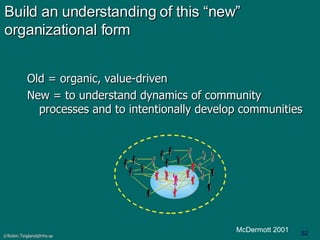
Build an understanding of this “new” organizational form Old = organic, value-driven New = to understand dynamics of community processes and to intentionally develop communities McDermott 2001
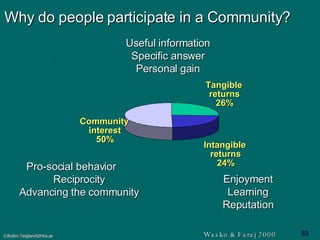
Why do people participate in a Community? Wasko & Faraj 2000 Useful information Specific answer Personal gain Enjoyment Learning Reputation Pro-social behavior Reciprocity Advancing the community Tangible  returns 26% Intangible  returns 24% Community  interest 50%
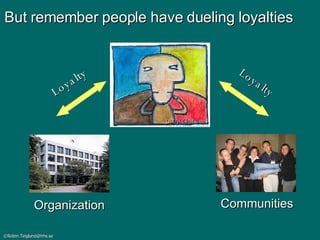
But remember people have dueling loyalties Loyalty Loyalty Organization Communities
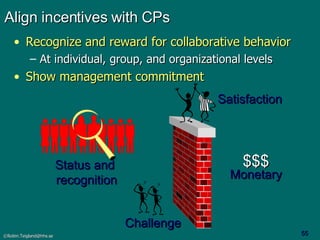
Align incentives with CPs Recognize and reward for collaborative behavior   At individual, group, and organizational levels Show management commitment Challenge Satisfaction $$$ Monetary Status and  recognition
Reward and broadcast results Reward  Collect data & tell stories linking activities, knowledge assets, & value Broadcast results User various means to communicate stories Value is always for  someone!
Critical failure factors for CPs Community leaders inactive or lousy networkers Scope too wide Focus on standardizing work processes Company leaders discourage participation Build it, wait (pray) for them to come Build more empty libraries McDermott 2001
Interested in learning more? Contact me at   [email_address] Sources Brayrie, 2007, http://www.slideshare.net/brayrie/crowdsourcing Hinton, A. 2007.  http://s3.amazonaws.com/ppt-download/architectures-for-conversation-ii-what-communities-of-practice-can-mean-for-information-architecture-5733.pdf Hustad, E. & Munkvold, E. 2005.  IT-Supported Competence Management: A Case Study at Ericsson.  ISM Journal. Magnusson, M. & Davidsson, N. Knowledge Networking at Ericsson: A Study of Knowledge Exchange and Communities of Knowing.  Chalmers Working Paper. McDermott, R.  http://www.mcdermottconsulting.com/ Wenger, E.  http://www.ewenger.com/ More by Robin at www.knowledgenetworking.org Teigland, R. 2003,  http://www.hhs.se/NR/rdonlyres/4165BDC8-C42C-43CF-8EEF-57DCEB0939BC/0/TeiglandthesisKnowledgeNetworking.pdf
Appendix
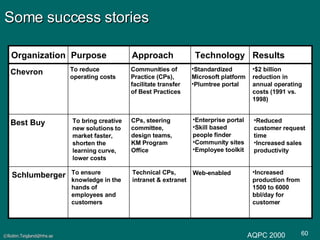
Some success stories Organization Purpose Approach Technology Results Chevron To reduce operating costs Communities of Practice (CPs), facilitate transfer of Best Practices Standardized Microsoft platform Plumtree portal $2 billion reduction in annual operating costs (1991 vs. 1998) Best Buy Enterprise portal Skill based people finder Community sites Employee toolkit Increased production from 1500 to 6000 bbl/day for customer Schlumberger To ensure knowledge in the hands of employees and customers Technical CPs, intranet & extranet Web-enabled To bring creative new solutions to market faster, shorten the learning curve,  lower costs CPs, steering committee, design teams, KM Program Office Reduced customer request time Increased sales productivity AQPC 2000
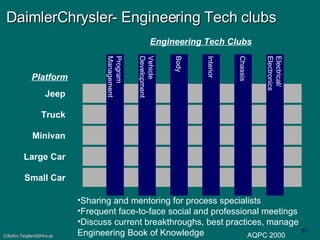
DaimlerChrysler- Engineering Tech clubs Sharing and mentoring for process specialists Frequent face-to-face social and professional meetings Discuss current breakthroughs, best practices, manage Engineering Book of Knowledge AQPC 2000 Jeep Truck Minivan Large Car Small Car Platform Engineering Tech Clubs Program Management Vehicle Development Body Interior Chassis Electrical/ Electronics
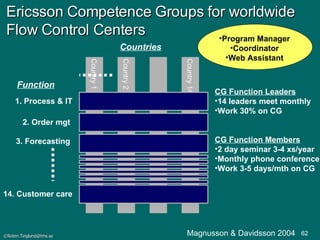
Ericsson Competence Groups for worldwide  Flow Control Centers Country 1 Country 2 Country 14 1. Process & IT 2. Order mgt  14. Customer care Function Countries 3. Forecasting  CG Function Leaders 14 leaders meet monthly Work 30% on CG CG Function Members 2 day seminar 3-4 xs/year Monthly phone conference Work 3-5 days/mth on CG Program Manager Coordinator Web Assistant Magnusson & Davidsson 2004
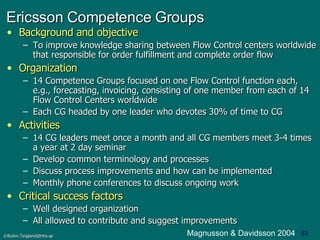
Ericsson Competence Groups Background and objective To improve knowledge sharing between Flow Control centers worldwide that responsible for order fulfillment and complete order flow Organization  14 Competence Groups focused on one Flow Control function each, e.g., forecasting, invoicing, consisting of one member from each of 14 Flow Control Centers worldwide  Each CG headed by one leader who devotes 30% of time to CG Activities 14 CG leaders meet once a month and all CG members meet 3-4 times a year at 2 day seminar Develop common terminology and processes Discuss process improvements and how can be implemented Monthly phone conferences to discuss ongoing work Critical success factors Well designed organization  All allowed to contribute and suggest improvements Magnusson & Davidsson 2004
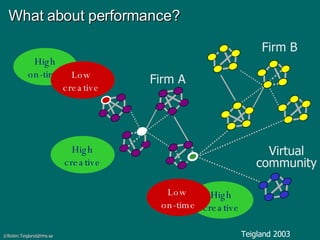
What about performance? Firm A High creative Low  on-time High on-time Low  creative  Teigland 2003 High creative Virtual community Firm B
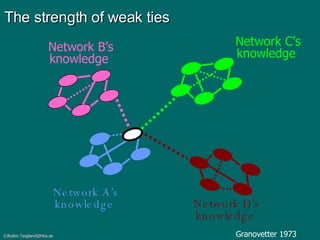
The strength of weak ties Network A’s knowledge  Network D’s knowledge  Network B’s knowledge  Network C’s knowledge  Granovetter 1973

Communities Of Practice Teigland

  • 1.
    Across the borderwith Communities of Practice September 2007 Dr. Robin Teigland Stockholm School of Economics robin.teigland@hhs.se
  • 2.
    A world ofrapidly growing knowledge …. > A person’s lifetime 18th century One week 2007 Fisch 2007
  • 3.
    … that becomesquickly outdated …. 50% knowledge relevant 50% knowledge outdated First year of technical-based education Third year of education
  • 4.
    ..making it increasinglyhard to keep up Growth Time Output of information and knowledge Human absorptive capacity Junks 1989
  • 5.
    An increasingly connectedworld new friends family local colleagues old friends old colleagues colleagues at other offices Just a click away… virtual communities local networks old classmates avatars
  • 6.
    ” No oneknows everything, everyone knows something, all knowledge resides in humanity.” networks. Adapted from Lévy 1997
  • 7.
    The formal organizationTop-down, command hierarchy
  • 8.
    Where do individualsgo for help with problems? Co-located colleagues Intranet Non-electronic documents Internal electronic networks Contacts in other offices Firm boundary External electronic networks Internet Non-electronic documents Other contacts ? ?
  • 9.
    It is increasinglythrough an organization’s informal networks that work gets done Informal network in pharmaceutical multinational
  • 10.
    What is anetwork? A set of actors connected by ties Ties/Links Knowledge, trust, team, sit by, dislike, etc. Alliance, customer, investment, etc. Tie Actors/Nodes Individuals Teams, organizations, etc. Actor
  • 11.
    Two departments withinthe same firm Department 1 Department 2 Higher degree of learning & knowledge sharing Poorer degree of learning & knowledge sharing
  • 12.
    San Francisco StockholmLondon Brussels Helsinki Madrid Copenhagen Islands of competence Rotated from Stockholm
  • 13.
    Hinton 2007 Whatare communities of practice?
  • 14.
    What are communitiesof practice? Groups of people who come together to share and to learn from one another face-to-face and/or virtually. They are held together by a common interest in a body of knowledge and are driven by a desire and need to share problems, experiences, insights, templates, tools, and best practices. Members deepen their knowledge by interacting on an ongoing basis . This interaction leads to continuous learning and innovation
  • 15.
    Examples of communitiesof practice Hinton 2007
  • 16.
    Challenges to knowledgedatabases Time consuming and difficult Takes times for writer to document experiences Takes time for reader to search through databases, information overload Often weak incentives to contribute golden nuggets Difficult to understand Difficult for writer to explain context, tacit ->explicit Difficult for reader to interpret experience and use in own situation Data becomes out-of-date very quickly Difficult to maintain, especially in fast moving industries

  • 17.
    It turns outthat …. the community ends up being not the secondary resource for knowledge, but for the majority of participants …, it’s the *primary* resource. Hinton 2007
  • 18.
    From tacit toarticulate knowledge “ We know more than we can tell.” Michael Polanyi, 1966 Tacit Articulated High Low Codifiability MANUAL How to play soccer
  • 19.
    Knowledge is experience, everything else is just information. -Albert Einstein
  • 20.
    CPs are notteams or personal networks McDermott 2001 -Obligation -Job requirement -Value -Commitment - Friendship Glue -Planned -Actively discovered -Serendipitously discovered Value Creation -Organize tasks -Meetings -Informal communications -One-on-one Activity -Assigned -Not voluntary -Defined boundary -Mostly volunteers -Permeable boundary -Friends & acquaintances -No boundary Members -Accomplish goal -Solve problems -Share info. & ideas -Expand knowledge -Share information -Friendship Purpose Team Community of Practice Personal Network
  • 21.
    Hinton 2007 Top-downCommand hierarchy Emergent organic network Communities of practice
  • 22.
    Role of communitiesof practice in organizations Create: Own & develop knowledge Develop & manage good practice Build organizational competence Organize: Develop & manage materials Develop tools, guidelines, templates Manage databases Disseminate: Connect people across boundaries Who knows what Home in changing organization & an uprooted society Embed: Share ideas & insights Share tacit, complex ideas & insights Help each other solve problems & find innovations
  • 23.
    Communities have differentprimary purposes Helping Best-practice Innovation Knowledge stewarding AQPC 2000
  • 24.
    Organizations supporting communitiesHewlett-Packard World Bank DaimlerChrysler Shell Oil McKinsey & Co. British Telecom Xerox British Petroleum Ericsson Siemens CapGemini IBM Schlumberger European Commission McDermott 2001
  • 25.
    A variety ofvirtual communities at an IT firm Knowledge Networking VP BD Business Concepts VP Sales Industry Knowledge HR Competencies COO Processes & Methodology Virtual community led by COO Wireless Branding Intranet *Virtual communities led by Business Concept responsible *Functional reporting to VP BD Travel Automotive Finance *Virtual communities led by Industry Group responsible *Functional reporting to VP Sales Proj Mgrs Technology Design *Virtual communities led by Competency Group responsible. *Functional reporting to HR
  • 26.
    Cap Gemini –NCN MS Electronic Community Objective To provide programmers working with Microsoft products a forum to help each other solve problems Organization 345 programmers across Nordic countries Activities Helping each other through posting questions and responses on listserv nicknamed “L2A2L” (Learn to ask to learn) Critical success factors “ Eldsjäl” – one who burned for community and walked the talk High level of reciprocity Teigland & Wasko 2003
  • 27.
    Communities of practiceat Ericsson Magnusson & Davidsson 2004 Community Type and Members Objectives Communication channel eRelationship Vodafone Inter-organizational 1400 members in 10 countries -Use internet to design joint e-business platform -Virtual Competence Groups Intra-organizational 200 members in 14 countries -Ensure sharing of best practices and commonality - Primarily face-to-face Ericsson Foresight - Inter-organizational including universities, experts, & institutions - 600 with core of 40 - Think tank on emerging trends in society, technology, & consumers - Virtual and face-to-face Ericsson System Architect Program, ESAP - Intra-organizational 20 members from 14 countries Facilitate inter-project learning and innovation Retain key individuals Primarily face-to-face
  • 28.
    Communities of practicecross all boundaries Company Suppliers Customers Competitors Partners McDermott 2001
  • 29.
    External communities aregrowing in importance! Online communities Schoolmates Avatars Previous work colleagues Large portion of new ideas and formal collaboration relationships come from external contacts Organization Physical networks
  • 30.
    Encourage an openinnovation attitude Not all the smart people work for us. We need to work with smart people inside and outside the company. The smart people in our field work for us. If you create the most and the best ideas in the industry, you will win. If you make the best use of internal and external ideas, you will win. Closed attitude Open attitude Chesborough 2003
  • 31.
    The wisdom ofcrowds (Surowiecki 2004) Closed Expensive Complex Accurate Open Inexpensive Simple Close enough Hinton 2007
  • 32.
    Crowdsourcing: Capturing thewisdom of crowds What is it? Customer participation in business and business development Why the interest? Experience Ownership Engagement Loyalty Brayrie 2007
  • 33.
    What can organizationsdo? Innovation Product development Content generation Decision making Funding Sales & marketing Distribution Brayrie 2007
  • 34.
  • 35.
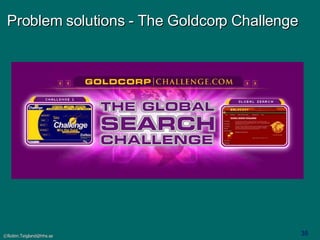
    Problem solutions -The Goldcorp Challenge
  • 36.
    Decision making &funding – My football club Brayrie 2007
  • 37.
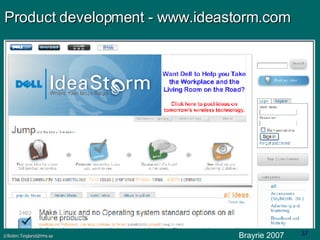
    Product development -www.ideastorm.com Brayrie 2007
  • 38.
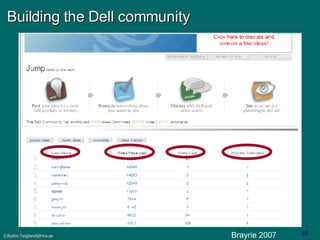
    Building the Dellcommunity Brayrie 2007
  • 39.
    Communities of practice– A driving force in crowdsourcing Participation Engagement Commitment Openness Conversation Connectedness
  • 40.
    Communities of practicecannot be “managed” You cannot force a plant to grow by pulling its leaves You can, however, create the conditions for it to grow McDermott 2001
  • 41.
    Think of apublic park….. If we all enjoy the park without contributing to its maintenance, then there will be no park to enjoy
  • 42.
    Cultivating communities ofpractice Define Motivate Moderate Connect Connect
  • 43.
    Define the communityof practice Business relevance Choose a topic that is value-adding for the business Find common objectives across participants Personal passion Focus on real, current problems Find people who care about the topic Define focus and scope What is the purpose of the community? McDermott 2001
  • 44.
    Moderate the communityof practice Build human relationships Ensure an active coordinator – This is crucial! Develop an active core group Ensure time to participate Combine virtual connections with face-to-face events Conferences, electronic conferences, discussion boards Work the public & private community space It’s all about relationships! McDermott 2001
  • 45.
    Community membership androles Wasko & Teigland 2002 Outsiders Ask questions Don’t contribute Not committed Peripheral Contribute less Not committed Enjoy helping Coordinator “ Eldsjäl” Active Contribute less Challenge Enjoy helping Experts High commitment Contribute more Reputation Core Group
  • 46.
    Building critical massis crucial It’s like going to the newest bar in town - the music is great, the drinks are cheap, the interior is cool…...but there’s no one there………..You gotta have critical mass to make it work! Teigland 2003
  • 47.
    Ensure communication technologyfits with participants’ needs and abilities Use familiar technology Integrate sharing technology with everyday work Customize technology to fit the community Change functionality as community discovers what is valuable McDermott 2001
  • 48.
    Two extreme communitiesof practice Face-to-face Virtual
  • 49.
    Public & privatecommunity space ~ 30% in the public space Public Space McDermott 2001 Events: Meetings, website, telecons Private Space Person to person
  • 50.
    Communities are livingthings Design from the inside Involve community leaders in design Design for different & fluid levels of participation Not all must participate to the same degree Design for evolution Communities evolve in their own direction Maintain creative disequilibrium Avoid too much management support Prevent competency traps McDermott 2001
  • 51.
    Cultivating communities ofpractice Define Motivate Moderate Connect Connect
  • 52.
    Build an understandingof this “new” organizational form Old = organic, value-driven New = to understand dynamics of community processes and to intentionally develop communities McDermott 2001
  • 53.
    Why do peopleparticipate in a Community? Wasko & Faraj 2000 Useful information Specific answer Personal gain Enjoyment Learning Reputation Pro-social behavior Reciprocity Advancing the community Tangible returns 26% Intangible returns 24% Community interest 50%
  • 54.
    But remember peoplehave dueling loyalties Loyalty Loyalty Organization Communities
  • 55.
    Align incentives withCPs Recognize and reward for collaborative behavior At individual, group, and organizational levels Show management commitment Challenge Satisfaction $$$ Monetary Status and recognition
  • 56.
    Reward and broadcastresults Reward Collect data & tell stories linking activities, knowledge assets, & value Broadcast results User various means to communicate stories Value is always for someone!
  • 57.
    Critical failure factorsfor CPs Community leaders inactive or lousy networkers Scope too wide Focus on standardizing work processes Company leaders discourage participation Build it, wait (pray) for them to come Build more empty libraries McDermott 2001
  • 58.
    Interested in learningmore? Contact me at [email_address] Sources Brayrie, 2007, http://www.slideshare.net/brayrie/crowdsourcing Hinton, A. 2007. http://s3.amazonaws.com/ppt-download/architectures-for-conversation-ii-what-communities-of-practice-can-mean-for-information-architecture-5733.pdf Hustad, E. & Munkvold, E. 2005. IT-Supported Competence Management: A Case Study at Ericsson. ISM Journal. Magnusson, M. & Davidsson, N. Knowledge Networking at Ericsson: A Study of Knowledge Exchange and Communities of Knowing. Chalmers Working Paper. McDermott, R. http://www.mcdermottconsulting.com/ Wenger, E. http://www.ewenger.com/ More by Robin at www.knowledgenetworking.org Teigland, R. 2003, http://www.hhs.se/NR/rdonlyres/4165BDC8-C42C-43CF-8EEF-57DCEB0939BC/0/TeiglandthesisKnowledgeNetworking.pdf
  • 59.
  • 60.
    Some success storiesOrganization Purpose Approach Technology Results Chevron To reduce operating costs Communities of Practice (CPs), facilitate transfer of Best Practices Standardized Microsoft platform Plumtree portal $2 billion reduction in annual operating costs (1991 vs. 1998) Best Buy Enterprise portal Skill based people finder Community sites Employee toolkit Increased production from 1500 to 6000 bbl/day for customer Schlumberger To ensure knowledge in the hands of employees and customers Technical CPs, intranet & extranet Web-enabled To bring creative new solutions to market faster, shorten the learning curve, lower costs CPs, steering committee, design teams, KM Program Office Reduced customer request time Increased sales productivity AQPC 2000
  • 61.
    DaimlerChrysler- Engineering Techclubs Sharing and mentoring for process specialists Frequent face-to-face social and professional meetings Discuss current breakthroughs, best practices, manage Engineering Book of Knowledge AQPC 2000 Jeep Truck Minivan Large Car Small Car Platform Engineering Tech Clubs Program Management Vehicle Development Body Interior Chassis Electrical/ Electronics
  • 62.
    Ericsson Competence Groupsfor worldwide Flow Control Centers Country 1 Country 2 Country 14 1. Process & IT 2. Order mgt 14. Customer care Function Countries 3. Forecasting CG Function Leaders 14 leaders meet monthly Work 30% on CG CG Function Members 2 day seminar 3-4 xs/year Monthly phone conference Work 3-5 days/mth on CG Program Manager Coordinator Web Assistant Magnusson & Davidsson 2004
  • 63.
    Ericsson Competence GroupsBackground and objective To improve knowledge sharing between Flow Control centers worldwide that responsible for order fulfillment and complete order flow Organization 14 Competence Groups focused on one Flow Control function each, e.g., forecasting, invoicing, consisting of one member from each of 14 Flow Control Centers worldwide Each CG headed by one leader who devotes 30% of time to CG Activities 14 CG leaders meet once a month and all CG members meet 3-4 times a year at 2 day seminar Develop common terminology and processes Discuss process improvements and how can be implemented Monthly phone conferences to discuss ongoing work Critical success factors Well designed organization All allowed to contribute and suggest improvements Magnusson & Davidsson 2004
  • 64.
    What about performance?Firm A High creative Low on-time High on-time Low creative Teigland 2003 High creative Virtual community Firm B
  • 65.
    The strength ofweak ties Network A’s knowledge Network D’s knowledge Network B’s knowledge Network C’s knowledge Granovetter 1973

Editor's Notes

  • #2 Photo from http://www.geocities.com/taiwan_rock/green_island_basalt_cliff2-wp.jpg