Optimal Design of Internal
     Induction Coils
     Dr. Valentin Nemkov
     Eng. Robert Goldstein
     Dr. Vladimir Bukanin
Types of Inductors for Internal
      Surface Heating (ID Coils)

•   Inductor with Central Rod
•   Hairpin
•   Single Turn Cylindrical
•   Multi-Turn Cylindrical
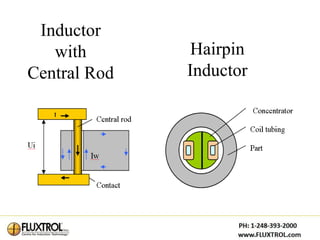
Inductor
   with        Hairpin
Central Rod   Inductor
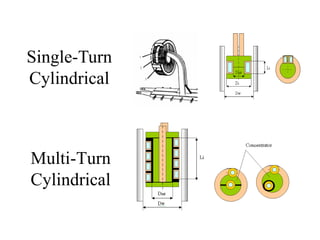
Single-Turn
Cylindrical


Multi-Turn
Cylindrical
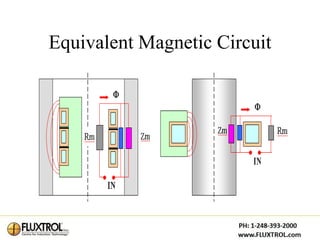
Equivalent Magnetic Circuit
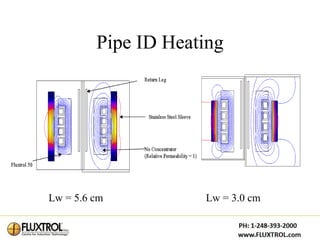
Pipe ID Heating


Lw = 5.6 cm          Lw = 3.0 cm
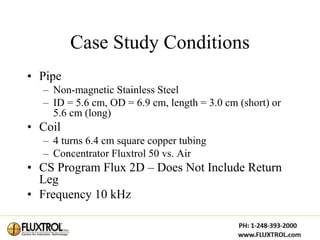
Case Study Conditions
• Pipe
  – Non-magnetic Stainless Steel
  – ID = 5.6 cm, OD = 6.9 cm, length = 3.0 cm (short) or
    5.6 cm (long)
• Coil
  – 4 turns 6.4 cm square copper tubing
  – Concentrator Fluxtrol 50 vs. Air
• CS Program Flux 2D – Does Not Include Return
  Leg
• Frequency 10 kHz
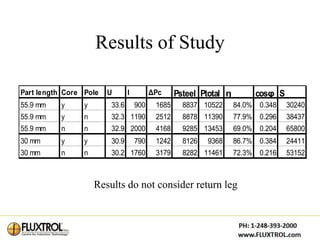
Results of Study

Part length Core Pole   U       I         ΔPc     Psteel Ptotal η        cosφ S
55.9 mm   y      y       33.6       900    1685     8837 10522      84.0% 0.348   30240
55.9 mm   y      n       32.3 1190         2512     8878 11390      77.9% 0.296   38437
55.9 mm   n      n       32.9 2000         4168     9285 13453      69.0% 0.204   65800
30 mm     y      y       30.9       790    1242     8126   9368     86.7% 0.384   24411
30 mm     n      n       30.2 1760         3179     8282 11461      72.3% 0.216   53152


                     Results do not consider return leg
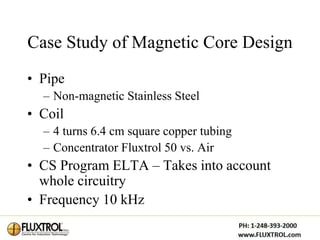
Case Study of Magnetic Core Design
• Pipe
  – Non-magnetic Stainless Steel
• Coil
  – 4 turns 6.4 cm square copper tubing
  – Concentrator Fluxtrol 50 vs. Air
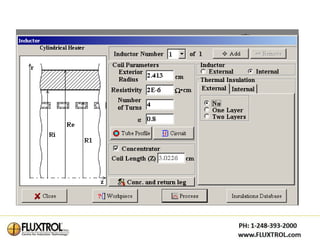
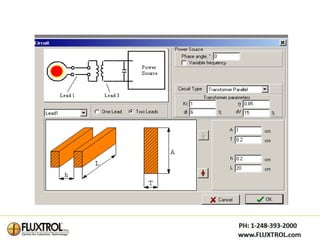
• CS Program ELTA – Takes into account
  whole circuitry
• Frequency 10 kHz
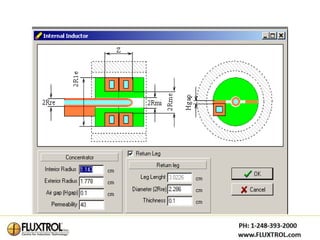
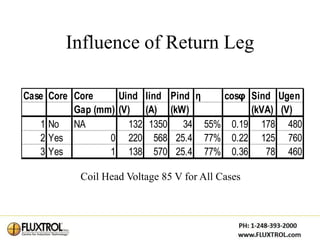
Influence of Return Leg

Case Core Core     Uind Iind Pind η cosφ Sind Ugen
          Gap (mm) (V) (A) (kW)          (kVA) (V)
   1 No NA           132 1350 34 55% 0.19 178 480
   2 Yes         0 220 568 25.4 77% 0.22 125 760
   3 Yes         1 138 570 25.4 77% 0.36    78 460

          Coil Head Voltage 85 V for All Cases
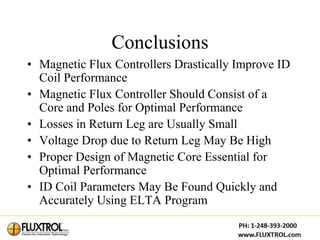
Conclusions
• Magnetic Flux Controllers Drastically Improve ID
  Coil Performance
• Magnetic Flux Controller Should Consist of a
  Core and Poles for Optimal Performance
• Losses in Return Leg are Usually Small
• Voltage Drop due to Return Leg May Be High
• Proper Design of Magnetic Core Essential for
  Optimal Performance
• ID Coil Parameters May Be Found Quickly and
  Accurately Using ELTA Program

Optimal Design of Internal Induction Coils

  • 1.
    Optimal Design ofInternal Induction Coils Dr. Valentin Nemkov Eng. Robert Goldstein Dr. Vladimir Bukanin
  • 2.
    Types of Inductorsfor Internal Surface Heating (ID Coils) • Inductor with Central Rod • Hairpin • Single Turn Cylindrical • Multi-Turn Cylindrical
  • 3.
    Inductor with Hairpin Central Rod Inductor
  • 4.
  • 5.
  • 6.
    Pipe ID Heating Lw= 5.6 cm Lw = 3.0 cm
  • 7.
    Case Study Conditions •Pipe – Non-magnetic Stainless Steel – ID = 5.6 cm, OD = 6.9 cm, length = 3.0 cm (short) or 5.6 cm (long) • Coil – 4 turns 6.4 cm square copper tubing – Concentrator Fluxtrol 50 vs. Air • CS Program Flux 2D – Does Not Include Return Leg • Frequency 10 kHz
  • 8.
    Results of Study Partlength Core Pole U I ΔPc Psteel Ptotal η cosφ S 55.9 mm y y 33.6 900 1685 8837 10522 84.0% 0.348 30240 55.9 mm y n 32.3 1190 2512 8878 11390 77.9% 0.296 38437 55.9 mm n n 32.9 2000 4168 9285 13453 69.0% 0.204 65800 30 mm y y 30.9 790 1242 8126 9368 86.7% 0.384 24411 30 mm n n 30.2 1760 3179 8282 11461 72.3% 0.216 53152 Results do not consider return leg
  • 9.
    Case Study ofMagnetic Core Design • Pipe – Non-magnetic Stainless Steel • Coil – 4 turns 6.4 cm square copper tubing – Concentrator Fluxtrol 50 vs. Air • CS Program ELTA – Takes into account whole circuitry • Frequency 10 kHz
  • 13.
    Influence of ReturnLeg Case Core Core Uind Iind Pind η cosφ Sind Ugen Gap (mm) (V) (A) (kW) (kVA) (V) 1 No NA 132 1350 34 55% 0.19 178 480 2 Yes 0 220 568 25.4 77% 0.22 125 760 3 Yes 1 138 570 25.4 77% 0.36 78 460 Coil Head Voltage 85 V for All Cases
  • 14.
    Conclusions • Magnetic FluxControllers Drastically Improve ID Coil Performance • Magnetic Flux Controller Should Consist of a Core and Poles for Optimal Performance • Losses in Return Leg are Usually Small • Voltage Drop due to Return Leg May Be High • Proper Design of Magnetic Core Essential for Optimal Performance • ID Coil Parameters May Be Found Quickly and Accurately Using ELTA Program