Downloaded 175 times
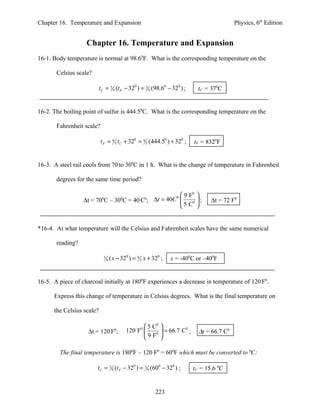
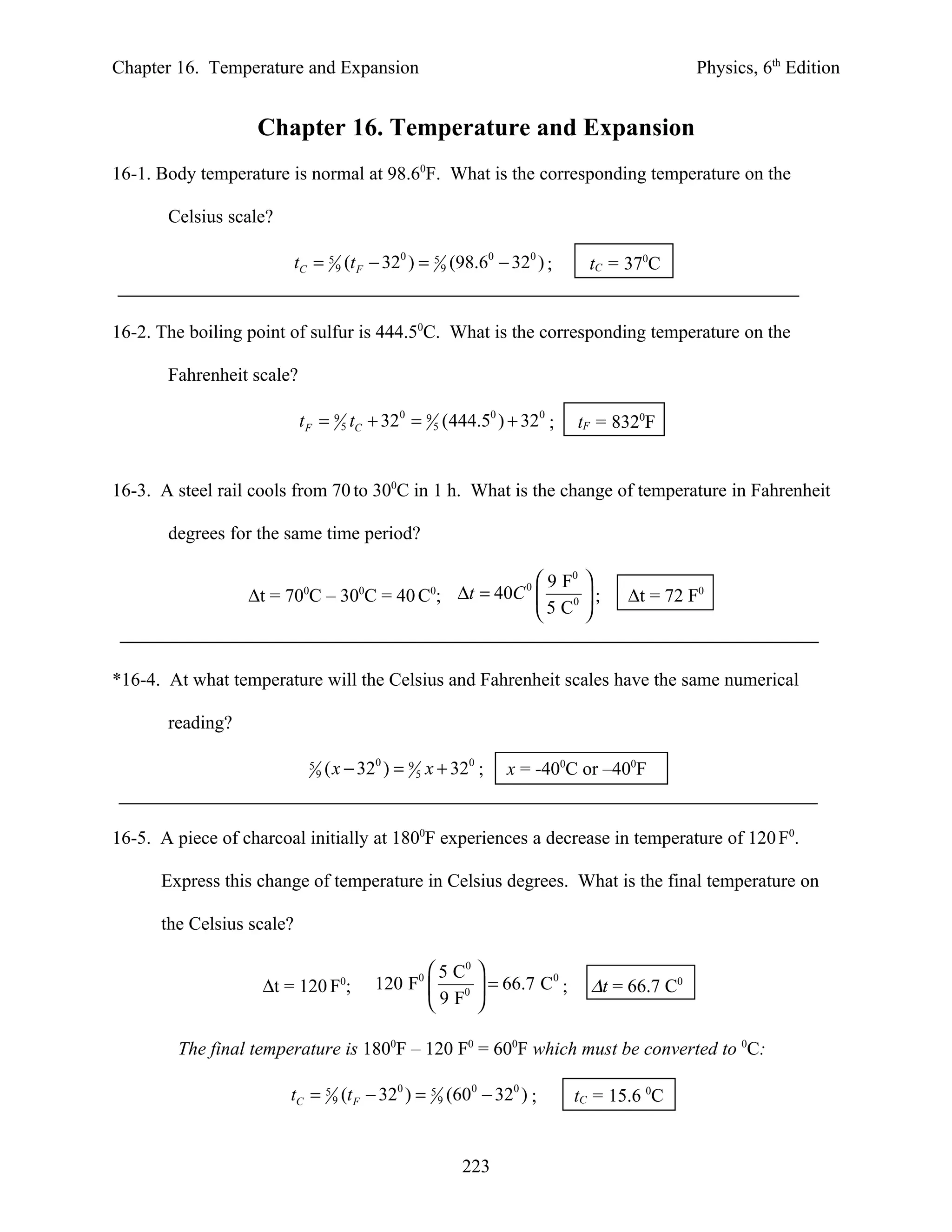
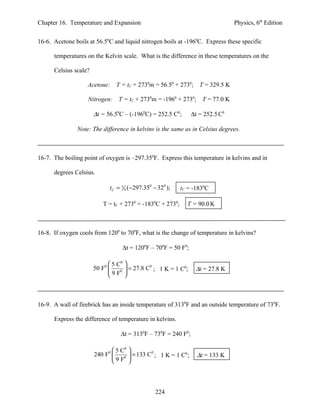
![Chapter 16. Temperature and Expansion Physics, 6th Edition
16-10. Gold melts at 1336K. What is the corresponding temperature in degrees Celsius and in
degrees Fahrenheit.
tC = 1336 K – 2730 = 10630C; tC = 10600C
t F = 9 5 tC + 320 = 9 5 (10630 ) + 320 ; tF = 19500F
16-11. A sample of gas cools from –120 to -1800C. Express the change of temperature in kelvins
and in Fahrenheit degrees. [ Since 1 K = 1 C0, the change in kelvins is the same as in C0.]
∆t = -1800C – (-1200C) = -60 C0 ; ∆T = -60 K
9 F0
∆t = −60C 0
0
= −108 F0 ; ∆t = -108 F0
5 C
Temperature and Expansion
16-12. A slab of concrete is 20 m long. What will be the increase in length if the temperature
changes from 120C to 300C. Assume that α = 9 x 10⁻⁶/C0.
∆L = α L0 ∆t = (9 x 10⁻⁶ /C0 )(20 m)(300 C - 120 C) ; ∆L = 3.24 mm
16-13. A piece of copper tubing is 6 m long at 200C. How much will it increase in length when
heated to 800C?
∆L = α L0 ∆t = (1.7 x 10⁻⁵ /C0 )(6 m)(800 C - 200 C) ; ∆L = 6.12 mm
16-14. A silver bar is 1 ft long at 700F. How much will it increase in length when it is placed into
boiling water (2120F)?
∆L = α L0 ∆t = (1.1 x 10⁻⁵ /F0 )(1 ft)(2120 F - 700 F) ; ∆L = 0.00156 ft
∆L = 0.00156 ft(1 in./12 ft); ∆L = 0.0187 in.
225](https://image.slidesharecdn.com/anschp16-100927184042-phpapp02/85/Anschp16-3-320.jpg)
![Chapter 16. Temperature and Expansion Physics, 6th Edition
16-15. The diameter of a hole in a steel plate 9 cm when the temperature is 200C. What will be
the diameter of the hole at 2000C?
∆L = α L0 ∆t = (1.2 x 10⁻⁵ /C0 )(9 cm)(2000 C - 200 C) ; ∆L = 0.0194 cm
L = L0 + ∆L = 9.00 cm + 0.0194 cm; L = 9.02 cm
*16-16. A brass rod is 2.00 m long at 150C. To what temperature must the rod be heated so that
its new length is 2.01 m? [ ∆L = 2.01 m – 2.00 m = 0.01 m ]
∆L 0.010 m
∆L = α L0 ∆t ; ∆t = = ; ∆t = 278 C0
α Lo (1.8 x 10⁻⁵ /C0 )(2.00 m)
t = to + ∆t = 150C + 278 C0; t = 2930C
16-17. A square copper plate 4 cm on a side at 200C is heated to 1200C. What is the increase in
the area of the copper plate? [ γ = 2α = 2(1.7 x 10⁻⁵/C0) = 3.4 x 10⁻⁵/C0 ]
∆A = γAo∆t = (3.4 x 10⁻⁵/C0)(4 cm)2(1200C – 200C);
∆A = 0.0544 cm2.
*16-18. A circular hole in a steel plate has a diameter of 20.0 cm at 270C. To what temperature
must the plate be heated in order that the area of the hole be 314 cm2?
π D 2 π (20 cm) 2
A= = = 314.16 cm 2 at 270C
4 4
The change in area must be 314 cm2 – 314.16 cm2: ∆A = - 0.16 cm
∆A −0.16 cm
∆A = 2α A0 ∆t ; ∆t = = = −21.2 C0
2α A0 2(1.2 x 10 /C )(314.16 cm)
-5 0
Thus, the final temperature is 270C – 21.20C: t = 5.880C
226](https://image.slidesharecdn.com/anschp16-100927184042-phpapp02/85/Anschp16-4-320.jpg)
![Chapter 16. Temperature and Expansion Physics, 6th Edition
16-19. What is the increase in volume of 16.0 liters of ethyl alcohol when the temperature is
increased by 30 C0?
∆V = βVo∆t = (11 x 10-4/C0)(16 L)(500C – 200C); ∆V = 0.528 L
16-20. A Pyrex beaker has an inside volume of 600 mL at 200C. At what temperature will the
inside volume be 603 mL? [ ∆V = 603 mL – 300 mL = 3 mL ]
∆V 3 mL
∆V = βV0 ∆t ; ∆t = = = 556 C0
βV0 (0.3 x 10 /C )(600 mL)
−5 0
t = 200 C + 5560C; t = 5760C
16-21. If 200 cm3 of benzene exactly fills an aluminum cup at 400C, and the system cools to
180C, how much benzene (at 180C) can be added to the cup without overflowing?
∆V = ∆VB − ∆VAL = β BV0 ∆t − (3α )V0 ∆t ; ∆t = (18 – 40) = -22 C0
∆V = (12.4 x 10⁻⁴ /C0)(200 cm3)(-22 C0) – 3(2.4 x 10⁻⁵/C0)(200 cm3)(-22 C)
∆V = -5.456 cm3 + 0.3168 cm3 = -5.14 cm3; VB = 5.14 cm3
16-22. A Pyrex glass beaker is filled to the top with 200 cm3 of mercury at 200C. How much
mercury will overflow if the temperature of the system is increased to 680C?
Vo = 200 cm3; βm = 1.8 x 10⁻⁴/C0; αp = 0.3 x 10⁻⁵/C0
∆V = ∆Vm − ∆V p = β mV0 ∆t − (3α p )V0 ∆t ; ∆t = 680C – 200C = 48 C0;
∆V = (1.8 x 10⁻⁴ /C0)(200 cm3)(48 C0) – 3(0.3 x 10⁻⁵/C0)(200 cm3)(48 C0)
∆V = 1.728 cm3 – 0.0864 cm3 = 5.14 cm3; VB = 1.64 cm3
227](https://image.slidesharecdn.com/anschp16-100927184042-phpapp02/85/Anschp16-5-320.jpg)
![Chapter 16. Temperature and Expansion Physics, 6th Edition
Challenge Problems
*16-23. The diameter of the hole in a copper plate at 200C is 3.00 mm. To what temperature must
the copper be cooled if its diameter is to be 2.99 mm. [∆L = (2.99 – 3.00) = -0.01 mm ]
∆L −0.010 m
∆L = α L0 ∆t ; ∆t = = ; ∆t = -196 C0
α Lo (1.7 x 10⁻⁵ /C0 )(3.00 m)
t = to + ∆t = 200C - 196 C0; t = -1760C
16-24. A rectangular sheet of aluminum measures 6 by 9 cm at 280C. What is its area at 00C?
Ao = (6 cm)(9 cm) = 54 cm2; ∆t = 00 – 280C = -280C ; γ = 2α
∆A = 2αAo∆t = 2(2.4 x 10⁻⁵/C0)(54 cm2)(-28 C0) = -0.0726 cm2
A = 54 cm2 – 0.0726 cm2; A = 53.9 cm2
*16-25. A steel tape measures the length of an aluminum rod as 60 cm when both are at 80C.
What will the tape read for the length of the rod if both are at 380?
The aluminum rod will expand more than does the steel tape. Thus the tape
will give a smaller reading based on the difference in the change of length.
∆LAL = αAlL0∆t = (2.4 x 10⁻⁵/C0)(60 cm)(30 C0); ∆LAl = 0.0432 cm
∆Ls = αsL0∆t = (1.2 x 10⁻⁵/C0)(60 cm)(30 C0); ∆LAl = 0.0216 cm
The reading will be less by the difference in the expansions.
Reading = 60 cm + (0.0432 cm - 0.0216 cm); Reading = 60.02 cm
16-26. At 200C, a copper cube measures 40 cm on a side. What is the volume of the cube when
the temperature reaches 1500C? [ V0 = (40 cm)3 = 64,000 cm3 ; ∆t = 150 – 20 = 130 C0 ]
V = V0 + 3αV0∆t = 64,000 cm3 + 3(1.7 x 10⁻⁵/C0)(64,000 cm3)(130 C0)
V = 64,000 cm3 + 424 cm3; V = 64,420 cm3
228](https://image.slidesharecdn.com/anschp16-100927184042-phpapp02/85/Anschp16-6-320.jpg)
![Chapter 16. Temperature and Expansion Physics, 6th Edition
16-27. A Pyrex beaker (α = 0.3 x 10⁻⁵/C0) is filled to the top with 200 mL of glycerine (β = 5.1
x 10-4 /C0). How much glycerine will overflow the top if the system is heated from 200C
to 1000C? [ Vo = 200 mL; βg = 5.1 x 10⁻⁴/C0; αp = 0.3 x 10⁻⁵/C0 ]
∆V = ∆Vm − ∆V p = β mV0 ∆t − (3α p )V0 ∆t ; ∆t = 1000C – 200C = 80 C0;
∆V = (5.1 x 10⁻⁴ /C0)(200 mL)(80 C0) – 3(0.3 x 10⁻⁵/C0)(200 mL)(80 C0)
∆V = 8.16 mL – 0.1444 mL = 8.016 mL; VB = 8.02 mL
16-28. A stove is at 4500F. If the temperature drops by 50 kelvins, what is the new temperature
in degrees Celsius?
tC = 5 9 (t F − 320 ) = 5 9 (450 − 320 ) ; tC = 232.20C
Since 1 K = 1 C0: t = 232.20 – 500 and t = 1820C
*16-29. A 100-ft steel tape correctly measures distance when the temperature is 200C. What is
the true measurement if this tape indicates distance of 94.62 ft on a day when the
temperature is 360C?
∆L = αLo∆t = (1.2 x 10⁻⁵/C0)(100 ft)(360C – 200C) = 0.0192 ft
L = Lo + ∆L = 94.62 ft + 0.0192 ft; L = 94.64 ft
*16-30. The diameter of a steel rod is 3.000 mm when the temperature is 200C. Also at 200C, the
diameter of a brass ring is 2.995 mm. At what common temperature will the brass ring
slip over the steel rod smoothly?
∆Lb - ∆Ls = 3.000 mm – 2.999 mm = 0.001 mm
(1.8 x 10⁻⁵/C0)(3.000 mm) ∆t – (1.2 x 10⁻⁵/C0)(2.999 mm) ∆t = 0.001 mm
From which: ∆t = 55.2 C0 and t = 200C + 55.20 C t = 75.20C
229](https://image.slidesharecdn.com/anschp16-100927184042-phpapp02/85/Anschp16-7-320.jpg)
![Chapter 16. Temperature and Expansion Physics, 6th Edition
*16-31. A certain metal cube increases its volume by 0.50 percent when its temperature increases
by 100 C0. What is the linear expansion coefficient for this metal? [ 0.5 % = 0.005 ]
1 ∆V 1
∆V = βV0 ∆t = 3αV0 ∆t ; α= = (0.0050)
3∆t V0 3(100 C0 )
α = 1.67 x 10⁻⁵/C0
16-32. By what percentage does a brass cube increase its volume when heated from 200C to
1000C? [ β = 3α and ∆t = 1000C – 200C = 80 C0 ]
∆V
∆V = βV0 ∆t = 3αV0 ∆t ; = 3α ∆t = 3(1.8 x 10⁻⁵ /C0 )(80 C0 )
V0
∆V
= 4.32 x 10⁻³ ; (∆V/V) = 0.432 %
V0
16-33. A round brass plug has a diameter of 8.001 cm at 280C. To what temperature must the
plug be cooled if it is to fit snugly into an 8.000 cm hole?
∆L −0.001 cm
∆L = α L0 ∆t ; ∆t = = ; ∆t = -6.94 C0
α Lo (1.8 x 10⁻⁵ /C0 )(8.001 cm)
t = to + ∆t = 280C – 6.94 C0; t = 21.10C
*6-34. Five hundred cubic centimeters of ethyl alcohol completely fill a Pyrex beaker. If the
temperature of the system increases by 70 C0, what volume of alcohol overflows?
Vo = 500 cm3; βm = 11 x 10-4/C0; αp = 0.3 x 10⁻⁵/C0
∆V = ∆Vm − ∆V p = β mV0 ∆t − (3α p )V0 ∆t ; ∆t = 70 C0;
∆V = (11 x 10-4 /C0)(500 cm3)(70 C0) – 3(0.3 x 10⁻⁵/C0)(500 cm3)(70 C0)
∆V = 38.5 cm3 – 0.315 cm3 = 5.14 cm3; VB = 38.2 cm3
230](https://image.slidesharecdn.com/anschp16-100927184042-phpapp02/85/Anschp16-8-320.jpg)
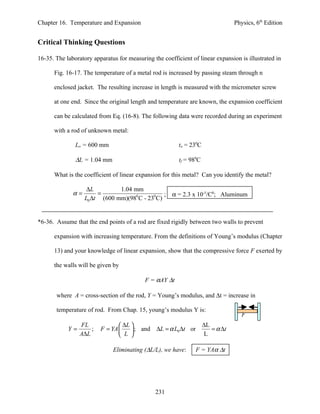
![Chapter 16. Temperature and Expansion Physics, 6th Edition
*16-37. Prove that the density of a material changes with temperature so that the new density ρ
is given by
ρo
ρ=
1 + β∆t
where ρo = original density, β = volume expansion coefficient, and ∆t = change in
temperature.
Vf
Vf = Vo + βVo∆t = Vo(1 + α∆t) from which = 1 − β ∆t ;
V0
m/ ρ
Now, ρ = m/V or V = m/ρ , so that: = 1 + β ∆t
m / ρ0
ρo ρ0
= 1 + β ∆t ; ρ=
ρ 1 + β ∆t
16-38. The density of mercury at 00C is 13.6 g/cm3. Use the relation in the previous example to
find the density of mercury at 600C?
ρ0 (13.6 g/cm3 )
ρ= = ; ρ = 13.5 g/cm3
1 + β ∆t 1 + (1.8 x 10⁻⁴ /C0 )(60 C0 )
16-39. A steel ring has an inside diameter of 4.000 cm at 200C. The ring is to be slipped over a
copper shaft that has a diameter of 4.003 cm at 200C. (a) To what temperature must the
ring be heated? (b) If the ring and the shaft are cooled uniformly, at what temperature will
the ring just slip off the shaft? [ ∆Ls = 4.003 cm – 4.00 cm = 0.003 cm ]
0.003 cm
(a) ∆Ls = αLo∆t; ∆t = -5 0
= 62.5 C0
(1.2 x 10 /C )(4.000 cm)
The steel ring must be heated to: 200C + 62.50 or 82.50C
232](https://image.slidesharecdn.com/anschp16-100927184042-phpapp02/85/Anschp16-10-320.jpg)

This document provides examples of temperature conversions between Celsius, Fahrenheit, and Kelvin scales. It also includes examples of calculating thermal expansion of materials when temperature changes. Key points covered include: - Converting between Celsius, Fahrenheit, and Kelvin scales using defined formulas. - Calculating changes in length, area, and volume of various materials like metals and liquids as their temperatures change, using thermal expansion coefficients. - Examples involve temperatures ranges from -1960C to 4500F and materials like copper, steel, glass, and liquids. Thermal expansion is used to calculate changes in dimensions or if materials will overflow containers.


