Definition
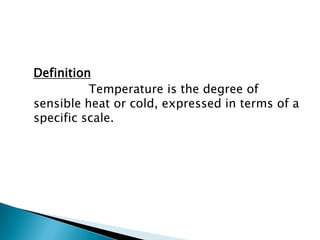
Temperature is the degree of
sensible heat or cold, expressed in terms of a
specific scale.
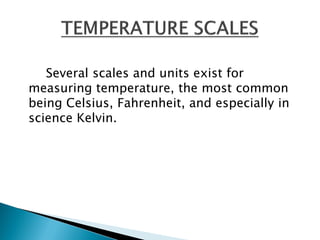
Several scales and units exist for
measuring temperature, the most common
being Celsius, Fahrenheit, and especially in
science Kelvin.
Celsius Scale
 The Celsius scale is used for common
temperature measurements in most of the
world.
 It is an empirical scale.
 Its zero point is 0oC being defined by the
freezing point of water, and 100oC was the
boiling point of water, both at sea level
atmospheric pressure.
 Because of the hundred degree interval, it is
called a centigrade scale.
Fahrenheit Scale
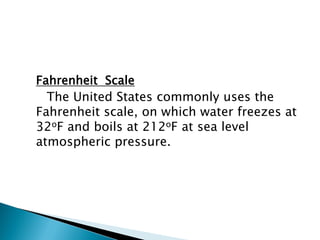
The United States commonly uses the
Fahrenheit scale, on which water freezes at
32oF and boils at 212oF at sea level
atmospheric pressure.
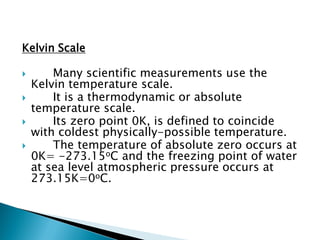
Kelvin Scale
 Many scientific measurements use the
Kelvin temperature scale.
 It is a thermodynamic or absolute
temperature scale.
 Its zero point 0K, is defined to coincide
with coldest physically-possible temperature.
 The temperature of absolute zero occurs at
0K= -273.15oC and the freezing point of water
at sea level atmospheric pressure occurs at
273.15K=0oC.
It is a marker of endocrine, metabolic,
or muscle activity; the response of the body
to heat or cold in the environment ; or the
presence of infection or inflammation,
among other illnesses, it is one of the vital
signs.
Normal body temperature
Body temperature is usually measured by a
thermometer placed in the mouth, the rectum,
or the auditory canal(for tympanic membrane
temperature)
The normal oral temperature is 37oC (98.6oF);
rectally, it s 37.3oC (99.2oF).
The tympanic membrane temperature is a
direct reflection of the body’s core
temperature.
Body temperature is regulated by
thermoregulatory centers in the hypothalamus
that balances heat production and heat loss.
85% of body heat loss is through skin
(radiation, conduction, sweating) and the
remainder through the lungs and fecal and
urinary excretions.
Muscular work (including shivering) is a
mechanism for raising body temperature.
Elevation of temperature above normal is
called fever (pyrexia), and subnormal
temperature is hypothermia.
Other factors that can influence body temperature
are:-
Age : Infants and children have a wider range of
body temperature than adults, and elderly have a
lower body temperature than others.
Menstruation cycle in women: The temperature rises
in the ovulatory mid-cycle and remains high until
menstruation period.
Exercise: Temperature rises with moderate to
vigorous muscular activity.
Oral Temperature
Oral temperature is measured by
placing the clinical thermometer under the
tongue with mouth closed for a period of
one minute.
Prior to measurement no oral feeds for
15 minutes, wash the thermometer with
antiseptic siolution , mercury in the
thermometer is gently shaken down.
Axillary Temperature
The temperature obtained by placing a
thermometer in the apex of the axilla with
arm pressed closely to the side of the body
for time recorded by the manufacturer of
the thermometer.
The temperature obtained by this
method is usually 0.5o to 1.5oF lower than
oral.
Rectal Temperature
The temperature obtained by inserting a
thermometer into the anal canal to a depth of at
least 3.8 cm and holding it in place for 3 to 5
minutes.
A rectal temperature is more accurate than either
oral or axillary temperatures.
It averages about 1oF higher than the oral
temperature and approx. 1.5oF higher than the
axillary temperature.
Tympanic Temperature
The temperature obtained by placing an
electronic probe in the ear canal. Such a
reading measures the temperature in the
capillary bed of the tympanic membrane
and is generally reflective of the core
temperature.
Core Temperature
The temperature of structures deep within
the body, as opposed to peripheral
temperature such as that of the skin.
Inverse Temperature
A condition in which the body
temperature is higher in the morning than
in the evening.
 Hypothermia exist when the body’s normal
thermal regulatory mechanisms are unable to
maintain heat in a cold environment and core
temperature falls below 35oC.
 Infants are susceptible to hypothermia
because of their poor thermoregulation and
high body surface area to weight ratio.
 More rarely hypothermia is secondary to
glucocorticoid insufficiency, stroke, hepatic
failure or hypoglycemia.
 Hypothermia also occurs in healthy
individuals whose thermoregulatory
mechanisms are intact but insufficient to
cope with intensity of the thermal stress.
Examples :-
1. Immersion in cold water - when core
temperature may fall rapidly (acute
hypothermia)
2. Exposure to extreme climate such as
during hill walking ( sub acute hypothermia)
3. Slow onset hyperthermia as develops in an
immobilized older individual (sub chronic
hypothermia)
Freezing cold injury (Frost bite)
This represents the direct freezing of body
tissues and usually affects the extremities: In
particular, the fingers, toes, ears and face.
Risk factors include smoking, peripheral
vascular disease, dehydration and alcohol
consumption.
Frost bitten tissue is initially pale and doughy
to the touch and insensitive to the pain. Once
frozen, the tissue is hard.
Non-freezing cold injury (Trench/Immersion
foot)
This results from prolonged exposure to cold,
damp conditions. The limb(usually the foot)
appears cold, ischemic and numb, but there
is no freezing of the tissue.
Chilblains
Chilblains are tender, red or purplish skin
lesions that occur in the cold and wet. They
are often seen in horse riders, cyclists and
swimmers, and are more common in women
than men. They are short lived, and although
painful, not usually serious.
Temperature

Temperature

  • 2.
    Definition Temperature is thedegree of sensible heat or cold, expressed in terms of a specific scale.
  • 3.
    Several scales andunits exist for measuring temperature, the most common being Celsius, Fahrenheit, and especially in science Kelvin.
  • 4.
    Celsius Scale  TheCelsius scale is used for common temperature measurements in most of the world.  It is an empirical scale.  Its zero point is 0oC being defined by the freezing point of water, and 100oC was the boiling point of water, both at sea level atmospheric pressure.  Because of the hundred degree interval, it is called a centigrade scale.
  • 5.
    Fahrenheit Scale The UnitedStates commonly uses the Fahrenheit scale, on which water freezes at 32oF and boils at 212oF at sea level atmospheric pressure.
  • 6.
    Kelvin Scale  Manyscientific measurements use the Kelvin temperature scale.  It is a thermodynamic or absolute temperature scale.  Its zero point 0K, is defined to coincide with coldest physically-possible temperature.  The temperature of absolute zero occurs at 0K= -273.15oC and the freezing point of water at sea level atmospheric pressure occurs at 273.15K=0oC.
  • 7.
    It is amarker of endocrine, metabolic, or muscle activity; the response of the body to heat or cold in the environment ; or the presence of infection or inflammation, among other illnesses, it is one of the vital signs.
  • 8.
    Normal body temperature Bodytemperature is usually measured by a thermometer placed in the mouth, the rectum, or the auditory canal(for tympanic membrane temperature) The normal oral temperature is 37oC (98.6oF); rectally, it s 37.3oC (99.2oF). The tympanic membrane temperature is a direct reflection of the body’s core temperature.
  • 9.
    Body temperature isregulated by thermoregulatory centers in the hypothalamus that balances heat production and heat loss. 85% of body heat loss is through skin (radiation, conduction, sweating) and the remainder through the lungs and fecal and urinary excretions. Muscular work (including shivering) is a mechanism for raising body temperature.
  • 10.
    Elevation of temperatureabove normal is called fever (pyrexia), and subnormal temperature is hypothermia.
  • 11.
    Other factors thatcan influence body temperature are:- Age : Infants and children have a wider range of body temperature than adults, and elderly have a lower body temperature than others. Menstruation cycle in women: The temperature rises in the ovulatory mid-cycle and remains high until menstruation period. Exercise: Temperature rises with moderate to vigorous muscular activity.
  • 12.
    Oral Temperature Oral temperatureis measured by placing the clinical thermometer under the tongue with mouth closed for a period of one minute. Prior to measurement no oral feeds for 15 minutes, wash the thermometer with antiseptic siolution , mercury in the thermometer is gently shaken down.
  • 13.
    Axillary Temperature The temperatureobtained by placing a thermometer in the apex of the axilla with arm pressed closely to the side of the body for time recorded by the manufacturer of the thermometer. The temperature obtained by this method is usually 0.5o to 1.5oF lower than oral.
  • 14.
    Rectal Temperature The temperatureobtained by inserting a thermometer into the anal canal to a depth of at least 3.8 cm and holding it in place for 3 to 5 minutes. A rectal temperature is more accurate than either oral or axillary temperatures. It averages about 1oF higher than the oral temperature and approx. 1.5oF higher than the axillary temperature.
  • 15.
    Tympanic Temperature The temperatureobtained by placing an electronic probe in the ear canal. Such a reading measures the temperature in the capillary bed of the tympanic membrane and is generally reflective of the core temperature.
  • 16.
    Core Temperature The temperatureof structures deep within the body, as opposed to peripheral temperature such as that of the skin. Inverse Temperature A condition in which the body temperature is higher in the morning than in the evening.
  • 17.
     Hypothermia existwhen the body’s normal thermal regulatory mechanisms are unable to maintain heat in a cold environment and core temperature falls below 35oC.  Infants are susceptible to hypothermia because of their poor thermoregulation and high body surface area to weight ratio.
  • 18.
     More rarelyhypothermia is secondary to glucocorticoid insufficiency, stroke, hepatic failure or hypoglycemia.  Hypothermia also occurs in healthy individuals whose thermoregulatory mechanisms are intact but insufficient to cope with intensity of the thermal stress.
  • 19.
    Examples :- 1. Immersionin cold water - when core temperature may fall rapidly (acute hypothermia) 2. Exposure to extreme climate such as during hill walking ( sub acute hypothermia) 3. Slow onset hyperthermia as develops in an immobilized older individual (sub chronic hypothermia)
  • 20.
    Freezing cold injury(Frost bite) This represents the direct freezing of body tissues and usually affects the extremities: In particular, the fingers, toes, ears and face. Risk factors include smoking, peripheral vascular disease, dehydration and alcohol consumption.
  • 21.
    Frost bitten tissueis initially pale and doughy to the touch and insensitive to the pain. Once frozen, the tissue is hard. Non-freezing cold injury (Trench/Immersion foot) This results from prolonged exposure to cold, damp conditions. The limb(usually the foot) appears cold, ischemic and numb, but there is no freezing of the tissue.
  • 22.
    Chilblains Chilblains are tender,red or purplish skin lesions that occur in the cold and wet. They are often seen in horse riders, cyclists and swimmers, and are more common in women than men. They are short lived, and although painful, not usually serious.