BRAIN STEM
DEATH
BRAIN DEATH
Its of 3 types
CORTICAL OR CEREBRAL DEATH
BRAINSTEM DEATH
WHOLE BRAIN DEATH
BRAIN STEM DEATH
• Brain stem death is a clinical
syndrome defined by the absence of reflexes
with pathways through the brain stem - the
“stalk” of the brain, which connects the
spinal cord to the mid-brain, cerebellum and
cerebral hemispheres.
• Loss of vital centres that control respiration
and of ARAS that retain consciousness
------> victim is irreversibly comatose and
incapable of spontaneous breathing
(apnoeic).
• i.e. brainstem death is when a person no
longer has any activity in their brainstem, and
has permanently lost the potential for
consciousness and the capacity to breathe.
• Can be produced by
–Raised intra cranial pressure
–Cerebral edema
–Intracranial hemorrhage etc.
VARIOUS CRITERIA FOR
DETERMINING
BRAIN DEATH
PHILADELPHIA PROTOCOL (1969)
MINNESOTA CRITERIA (1971)
HARVARD CRITERIA
HARVARD CRITERIA
1. Unreceptivity and unresponsivity
• Total unawareness to external stimuli and
inner need
• Complete unresponsiveness to even most
intense painful stimuli
2. No movements
• No spontaneous muscular movements in
response to stimuli such as:
– Pain
– Touch
– Sound
– Light
- for atleast 1 hour
3. Apnoea
• Absence of complete breathing for one hour
• If patient is on ventilator, total absence of
spontaneous breathing is established by
turning off the respirator for 3 minutes and
observing whether there is any effort from
the subject to breathe spontaneously
4. Absence of elicitable reflexes
• Pupils are fixed and dilated, does not respond
to light
• Ocular movement and blinking absent
• No evidence of postural activity
• Corneal and pharyngeal reflexes absent
• Stretch tendon reflexes also lost
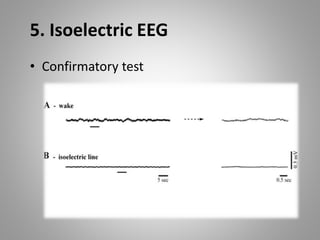
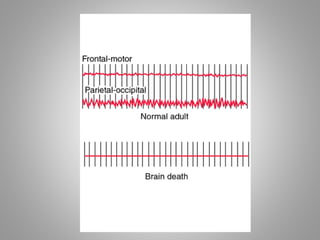
5. Isoelectric EEG
• Confirmatory test
• All the tests should be repeated after 24
hours with no change in results.
• Two schools of diagnosing death :
1. French and English school – similar to
Harvard
2. Austro-German school – includes Harvard
criteria and bilateral serial angiography of
internal carotid and vertebral artery criteria.
- a negative angiogram for more than 15
minutes proves death
DIAGNOSIS OF BRAINSTEM
DEATH
EXCLUSIONS
1. Patient may be under effect of drugs,
eg:- therapeutic overdoses.
2. Core temperature of body is below35oC,
hypothermia.
3. Severe metabolic or endocrine disturbances that
may lead to severe irreversible coma,
eg:- diabetes.
PRECONDITIONS OF DIAGNOSIS
• Patient must be deeply comatose
• Patient must be maintained on a ventilator
• Cause of the coma must be known
PERSONNEL WHO SHOULD PERFORM
THE TESTS
• Must be performed by 2 medical practitioners
• Doctors involved should be experts
• Transplant surgeons under no circumstances can perform
the test
• At least one of the doctors should be of consultant status,
junior doctors are not allowed
• Each doctor should perform the test twice
TESTS TO BE PERFORMED
• Before the tests, it is ensured that core
temperature of body is above 35oC
• Cranial nerves that pass through brain stem
are tested.
1. Pupils are fixed in diameter and do not respond to
changes in intensity of light
2. No corneal reflex
3. Vestibulo-ocular reflexes are absent (no ocular
movement after instillation of cold water into
outer ears)
4. No motor responses within the cranial nerve
distribution can be elicited by painful stimulation
5. No gag reflex
6. No respiratory movements occur when patient is
disconnected from ventilator (long enough to
ensure CO2 concentration rises above the
threshold to stimulate respiration)
• When two doctors have performed these
tests twice with negative results, the patient
is pronounced dead and a death certificate
can be issued.
Thank you…

Brain stem death

  • 1.
  • 2.
    BRAIN DEATH Its of3 types CORTICAL OR CEREBRAL DEATH BRAINSTEM DEATH WHOLE BRAIN DEATH
  • 3.
    BRAIN STEM DEATH •Brain stem death is a clinical syndrome defined by the absence of reflexes with pathways through the brain stem - the “stalk” of the brain, which connects the spinal cord to the mid-brain, cerebellum and cerebral hemispheres.
  • 4.
    • Loss ofvital centres that control respiration and of ARAS that retain consciousness ------> victim is irreversibly comatose and incapable of spontaneous breathing (apnoeic). • i.e. brainstem death is when a person no longer has any activity in their brainstem, and has permanently lost the potential for consciousness and the capacity to breathe.
  • 5.
    • Can beproduced by –Raised intra cranial pressure –Cerebral edema –Intracranial hemorrhage etc.
  • 6.
  • 7.
    PHILADELPHIA PROTOCOL (1969) MINNESOTACRITERIA (1971) HARVARD CRITERIA
  • 8.
  • 9.
    1. Unreceptivity andunresponsivity • Total unawareness to external stimuli and inner need • Complete unresponsiveness to even most intense painful stimuli
  • 10.
    2. No movements •No spontaneous muscular movements in response to stimuli such as: – Pain – Touch – Sound – Light - for atleast 1 hour
  • 11.
    3. Apnoea • Absenceof complete breathing for one hour • If patient is on ventilator, total absence of spontaneous breathing is established by turning off the respirator for 3 minutes and observing whether there is any effort from the subject to breathe spontaneously
  • 12.
    4. Absence ofelicitable reflexes • Pupils are fixed and dilated, does not respond to light • Ocular movement and blinking absent • No evidence of postural activity • Corneal and pharyngeal reflexes absent • Stretch tendon reflexes also lost
  • 13.
    5. Isoelectric EEG •Confirmatory test
  • 16.
    • All thetests should be repeated after 24 hours with no change in results.
  • 17.
    • Two schoolsof diagnosing death : 1. French and English school – similar to Harvard 2. Austro-German school – includes Harvard criteria and bilateral serial angiography of internal carotid and vertebral artery criteria. - a negative angiogram for more than 15 minutes proves death
  • 18.
    DIAGNOSIS OF BRAINSTEM DEATH EXCLUSIONS 1.Patient may be under effect of drugs, eg:- therapeutic overdoses. 2. Core temperature of body is below35oC, hypothermia. 3. Severe metabolic or endocrine disturbances that may lead to severe irreversible coma, eg:- diabetes.
  • 19.
    PRECONDITIONS OF DIAGNOSIS •Patient must be deeply comatose • Patient must be maintained on a ventilator • Cause of the coma must be known
  • 20.
    PERSONNEL WHO SHOULDPERFORM THE TESTS • Must be performed by 2 medical practitioners • Doctors involved should be experts • Transplant surgeons under no circumstances can perform the test • At least one of the doctors should be of consultant status, junior doctors are not allowed • Each doctor should perform the test twice
  • 21.
    TESTS TO BEPERFORMED • Before the tests, it is ensured that core temperature of body is above 35oC • Cranial nerves that pass through brain stem are tested.
  • 22.
    1. Pupils arefixed in diameter and do not respond to changes in intensity of light 2. No corneal reflex 3. Vestibulo-ocular reflexes are absent (no ocular movement after instillation of cold water into outer ears) 4. No motor responses within the cranial nerve distribution can be elicited by painful stimulation 5. No gag reflex 6. No respiratory movements occur when patient is disconnected from ventilator (long enough to ensure CO2 concentration rises above the threshold to stimulate respiration)
  • 23.
    • When twodoctors have performed these tests twice with negative results, the patient is pronounced dead and a death certificate can be issued.
  • 24.