KING GEORGE’S MEDICAL UNIVERSITY
KGMU COLLEGE OF NURSING
LUCKNOW, U.P , INDIA
SEMINAR
TOPIC: PROFESSIONAL ORGANISATIONS
AND
UNION SELF DEFENCE
Presented By
Amrita Singh
M.Sc.Nursing 1st Year
KGMU College Of Nursing
Lucknow
A professional organization, sometimes referred to as
a professional association or professional body, exists
to advance a particular profession, support the
interests of people working in that profession and
serve the public good. It facilitates innovation,
communication and connection.
INTRODUCTION
Professionals create organizations to work collectively on behalf of
issues that enhance their work and their involvement in communities,
ensure continued learning and competence, and use political action to
influence policymakers to support mission of organization. Professional
organizations offer a supportive way to learn leadership skills, to test
ideas, and to follow these ideas to completion. Nursing has a national
organization open to all graduate nurses, Indian nursing council, Trained
nurses association of India.
DEFINITION
“Professional association have been defined as groups of professional
values and who decide to join their colleagues to affect a change”.
-Poder-Wise (2007)
“The professional organisation is the one that provides a means
through which efforts can be channelised with authority because of the
numbers it represents”
-Hunt
OBJECTIVES
To understand the role of professional
organisations in empowering nurses in their
emerging professionalism.
Ø To discuss the functions of each professional
organisations
Ø To discuss importance of self assertiveness in
safeguarding our profession.
Ø To study the vast scope of collective
bargaining in nursing profession.
With the time there have been many professional organisations
established both at national and international levels. Some of
those professional organisations are as follows :
1. At Central Level
 Trained Nurses Association Of India (TNAI)
 International Code For Nurses (ICN)
 American Nurses Association (ANA)
 The Commonwealth Nurses Federation
2.At State Level
 The Student Nurses Association (SNA)
 The Nurses League Of Christian Medical Association
3.Others
 WHO
 Red Cross Society
Cont….
CENTRAL LEVEL
🙂International Council Of Nurses (ICN)
The International Council of Nurses is federation of
nonpolitical and self governing national associations
which seeks to attain high standards of nursing
service and nursing education ,to develop nursing as
profession and to safeguard the social and economic
welfare of nurses in their own countries.It was
founded in 1899 by Mrs . Bedford Fenwick in
cooperation with various nursing leaders from many
countries . ICN is the oldest international professional
organisation in health care field.
Headquarter- Geneva ,Switzerland.
OBJECTIVES
1. To promote the development of strong national nurses
association.
2. To assist national nurses association to improve the
standards of nursing and the competence of nurses.
3. To assist national nurses association to improve the status of
nurses within their countries.
4. .To serve as the authoritative voice for nurses and nursing .
FUNCTIONS
• To provide policy directions to fulfill the objectives of
ICN
• To establish categories of membership and determine
their right and obligation
.
• To act upon recommendations of the board directors
relating to admission and readmission of member
associations into ICN.
🙂American Nurses Association
(ANA)
The American Nurses Association (ANA)
is a to advance and protect the profession
of nursing. It started in 1896 as the Nurses
Associated Alumnae and was renamed the
American Nurses Association in 1911.The
purpose of ANA is to improve the quality
of nursing care.
FUNCTIONS
• Establish standards for care.
• Develop educational standard.
• Promote nursing research.
• Establish a professional code of ethics
• Overseas credentialising system.
• Protect the economic and general welfare of registered nurses.
• Assist with professional development of nurses by providing
containing educational program.
Cont….
* ANA standards of Professional performance
• To provide high quality care to patients for early recovery .
• Performance appraisal: Performance appraisal rates employees rates
the employee in terms of their performance.
• Quality education : It is to develop basic learning skils ,reading,writing,
arithmetic and life skills,necessary for the nurses to survive and improve
quality life.
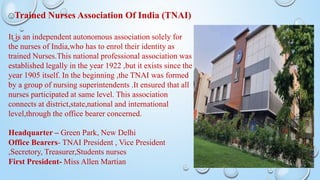
🙂Trained Nurses Association Of India (TNAI)
It is an independent autonomous association solely for
the nurses of India,who has to enrol their identity as
trained Nurses.This national professional association was
established legally in the year 1922 ,but it exists since the
year 1905 itself. In the beginning ,the TNAI was formed
by a group of nursing superintendents .It ensured that all
nurses participated at same level. This association
connects at district,state,national and international
level,through the office bearer concerned.
Headquarter – Green Park, New Delhi
Office Bearers- TNAI President , Vice President
,Secretory, Treasurer,Students nurses
First President- Miss Allen Martian
PHILOSPHY
• The TNAI believes that good health is a fundamental right
of every person and that is responsibility of health
profession including nursing,to provide the kind of health
care which will give each individual in society every
opportunity to achieve optimum health.
• It is the belief of the TNAI that each nurse is a member of the society and
is entitled to the same individual rights, privileges, and the goals of
physical, mental, economic and social development as are available to
other members of the society .
Cont….
OBJECTIVES
1. To uphold in every way dignity and honour of the nursing
profession and to promote a sense of ‘espirit de corps’.
2. To promote high standards of health care and nursing practice.
3. To advance professional,educational,economic and general
welfare of nnurses.
4. To Provide scholarships to eligible students; help them avail
study opportunity in India and Abroad
5. Too reward the best nurses in all categories every year by
providing the Florence Nightingale Award on May 12 in Delhi..
Cont….
• To establish functions,standards ,and qualifications for nursing practice .
• To enunciate standards of nursing service and nursing education and
implement these through appropriate channels.
• To establish a code of ethical conduct for practitioners.
• To stimulate and promote research designed to increase the knowledge on
which the practice of nursing is based
FUNCTIONS
• TNAI connect the student Nurses through Student Nurses Association
(SNA).
• To promote legislation and speak for nurses in regard to legislative actions.
• To promote and protect the economic welfare of nurses.
• To promote the general health and welfare of the public through all
association programs, relationships, and activities.
• To conduct in- service and continuing education.To publish a monthly
journal “The Nursing Journal Of India’.
Cont….
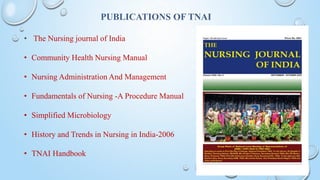
PUBLICATIONS OF TNAI
• The Nursing journal of India
• Community Health Nursing Manual
• Nursing Administration And Management
• Fundamentals of Nursing -A Procedure Manual
• Simplified Microbiology
• History and Trends in Nursing in India-2006
• TNAI Handbook
BENEFITS OF TNAI
• National level conferences seminars, and scientific sessions
• Low cost publications for nurses and students .
• Continuing education programme to update knowledge on various topics .
• Welfare Programmes.
• Research studies.
• Scholership of student members and student nurses
• Guest house at TNAI headquarters.
🙂Commonwealth Nurses Federation
The Commonwealth Nurses’Federation is one
of the 17 commonwealth -wide professional
foundations receiving grant from
commonwealth foundations.The secretariat of
the Federation was established in 1973 at Royal
Commonwealth Society ,London.On that date
,the number of member associates was 25, and
this number has increased now.
OBJECTIVES
The major objectives of the Federation are listed below:
1. To develop the nursing for the benefit of the community in
countries within the commonwealth.
2. To promote the advances of the nurses as profession. effect closer
links between national nurses association within the
commonwealth as a means of providing mutual help and support.
3. To make available expert advice and assistance.
4.To disseminate professional information for the benefit of the
nurses.
5.To encourage establishment of scholership.
6.To organise commonwealth nurses conferences from time to
time
7.To encourage establishment of national nurses association in
those
commonwealth countries where none exists
8.To co-operate with other commonwealth professional
associations.
Cont….
2.AT STATE LEVEL
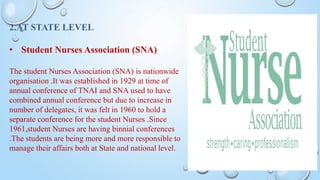
• Student Nurses Association (SNA)
The student Nurses Association (SNA) is nationwide
organisation .It was established in 1929 at time of
annual conference of TNAI and SNA used to have
combined annual conference but due to increase in
number of delegates, it was felt in 1960 to hold a
separate conference for the student Nurses .Since
1961,student Nurses are having binnial conferences
.The students are being more and more responsible to
manage their affairs both at State and national level.
OBJECTIVES
 To help students to uphold the dignity and the ideals of
the profession for which they are qualifying.
 To promote a corporate spirit among students for
common good.
 To furnish nurses in training with advice in their courses
for study leading upto professional qualifications in all
its different branches and aspects.

 To increase the social contact in order to help in the
world where they have finished training .
 To encourage both professional and recreational
,meetings,games and sports.
Cont….

FUNCTIONS
• Organisation of meetings and conferences .
• Maintenance of SNA diary.
• Conducting Exhibitions.
• Public speaking and writing.
• Project undertaking
 Propagation of nursing profession.
 Fund raising .
 Socio-cultural and recreational activities .
Cont….
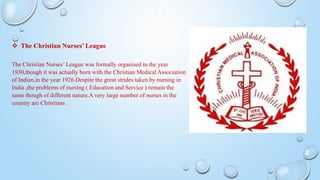
 The Christian Nurses’ League
The Christian Nurses’ League was formally organised in the year
1930,though it was actually born with the Christian Medical Association
of Indian,in the year 1926.Despite the great strides taken by nursing in
India ,the problems of nursing ( Education and Service ) remain the
same though of different nature.A very large number of nurses in the
country are Christians .
OBJECTIVES
1. To encourage and promote spiritual fellowship.
2. To secure the highest standards in Christian
Nursing Education through the Christian nurses’
schools
3. To promote the highest efficiency in Christian
Nursing Services.
4. To encourage the highest quality candidates to
choose nursing as a desirable nurses vocation.
FUNCTIONS
 Christian Nurses’ fellowship is promoted
through area conferences ,retreats ,rallies,prayer
meetings,social gatherings.
 Publication – “The Christian nurse” a
bimonthly publication of the league serves to
promote fellowship and communication with
one another in the country and abroad
 Profession advancements .
3 .OTHERS
World Health Organisation
(WHO)
WHO is the United Nations agency
established on 7th April 1948 connects
nations, partners and people to promote
health, keep the world safe and serve the
vulnerable .It has 6 regional offices and 150
field offices worldwide.The main objective
of WHO is attainment by all peoples of the
highest possible level of health.
Headquarter: Geneva,Switzerland
ROLE
 Providing leadership on matters critical to health and engaging in partnerships
where joint action is needed
 Shaping the research agenda and stimulating the generation, translation, and
dissemination of valuable knowledge.
 Setting norms and standards and promoting and monitoring their
implementation;
 Articulating ethical and evidence-based policy options;
 Providing technical support, catalysing change, and building
sustainable institutional capacity.
 Monitoring the health situation and assessing health trends.
 CRVS (civil registration and vital statistics) to provide
monitoring of vital events (birth, death, wedding, divorce).
Cont….
Red Cross Society
The International Red Cross 9th feb 1863 and Red
Crescent Movement 5th May 1919
a humanitarian movement with approximately 97
million volunteers, members and staff worldwide. It was
founded to protect human life and health, to ensure
respect for all human beings, and to prevent and alleviate
human suffering.
Headquarter : Geneva ,Switzerland
Indian Redcross society : New Delhi
PRINCIPLES
 Humanity
 Impartiality
 Nutrality
 Voluntary Service
 Unity
 Universality
FUNCTIONS
 To provide relief in times of disasters/emergencies
 Promote health and care of vulnerable people and
communities.
 Research activities on variety of health issues.
*UNIONS IN NURSING
Nurses' unions are unified organizations that represent a
specific group of nurses, such as those who work in a
certain hospital system or a particular state. Unions
advocate for nurses and protect their rights through
collective action and negotiations.
Some of very known unions for nurses are as follows:
Indian Nurses Association
Indian Nurses Association was founded on 31st
March ,2012 . The reason for the formation of
several newer nursing associations can traced back
to 2011. The death of Miss Beena Baby, a
Registered Nurse, who committed suicide due
staff bullying in a private hospital which had
illegal management norms was cited as the reason
for the formation of this association. The so-called
"bond system" executed by the Mumbai based
hospital was an indirect violation against Bonded
Labor System (Abolition) Act, 1976.
-However, nursing regulator in India the Indian Nursing Council could not
effectively intervene in matters relating to Nurses in the Service sector
because the INC act of 1947 did not have the required legal provisions.
Miss Baby's death triggered a public outcry resulting in a strike by 250
nurses.
- The most recent contribution of the organisation is the protest
organised against hospital managements in the state of Kerala and
government authorities for delay in implementing the
recommendations of Supreme Court of India. The protests was
followed by state level strikes organised by Indian Nurses Association
and United Nurses Association
Canadian Federation of Nurses Unions
(CFNU)
The National Federation of Nurses Unions (NFNU)
created on 1st may 1981and renamed as Canadian
Federation Of Nurses Union in 1999, is the voice of
nearly 250,000 unionized nurses and nursing students
across the country. They advocate for their members
and promote the nursing profession on the national
level, and they work to protect the quality of health
care for patient and universal public health care
system .
Queensland Nurses and Midwives' Union
The Queensland Nurses and Midwives' Union, officially
the Queensland Nurses and Midwives' Union of Employees,
(QNMU) is a trade union that
represents nurses and midwives in both the public and private
sectors of Queensland, Australia. It was formed on 8th
November 1921 under the name of the Australasian Trained
Nurses' Association (Queensland Branch) Union of
Employees.
California Nurses Association
Founded in 1903, the California Nurses
Association/National Nurses Organizing
Committee is a premiere organization of registered
nurses and one of the nation’s fastest growing
labor and professional organizations in the U.S.
with more than 100,000 members in hospitals,
clinics and home health agencies in all 50 states.
 Advantages and Disadvantages of Unions :-
 Advantages
 Ensure safe working conditions.
 Advocate for better pay.
 Ensures due process for discipline.
 Provides consistent standard for hiring promotion and termination.
 Investigates grievances .
 Disadvantages
 Union fees.
 Unpaid Strikes
 Not all members support all collective actions.
 Can protect nurses over patients.
BIBLIOGRAPHY
• Brar Kaur Navdeep , Rawat HC, “TEXTBOOK OF
ADVANCED NURSING PRACTICE” 1st edition, Jaypee
Brothers Medical Publishers Pvt Ltd. PageNo.41-57
• Clement .I. “MANAGEMENT OF NURSING SERVICES
AND EDUCATION”2nd edition; Reed Elsevier India Pvt.
Ltd. , page no.537-538
• Halstead A.Judith , “JONES AND BARLETT LEARNING”
,Ascend Learning Company Page no 108-109
• https://www.encyclopedia.com/education/encyclopedias-
almanacs-transcripts-and-maps/professional-organizations
Professional Organisations and Union

Professional Organisations and Union

  • 1.
    KING GEORGE’S MEDICALUNIVERSITY KGMU COLLEGE OF NURSING LUCKNOW, U.P , INDIA SEMINAR TOPIC: PROFESSIONAL ORGANISATIONS AND UNION SELF DEFENCE Presented By Amrita Singh M.Sc.Nursing 1st Year KGMU College Of Nursing Lucknow
  • 2.
    A professional organization,sometimes referred to as a professional association or professional body, exists to advance a particular profession, support the interests of people working in that profession and serve the public good. It facilitates innovation, communication and connection. INTRODUCTION
  • 3.
    Professionals create organizationsto work collectively on behalf of issues that enhance their work and their involvement in communities, ensure continued learning and competence, and use political action to influence policymakers to support mission of organization. Professional organizations offer a supportive way to learn leadership skills, to test ideas, and to follow these ideas to completion. Nursing has a national organization open to all graduate nurses, Indian nursing council, Trained nurses association of India.
  • 4.
    DEFINITION “Professional association havebeen defined as groups of professional values and who decide to join their colleagues to affect a change”. -Poder-Wise (2007) “The professional organisation is the one that provides a means through which efforts can be channelised with authority because of the numbers it represents” -Hunt
  • 5.
    OBJECTIVES To understand therole of professional organisations in empowering nurses in their emerging professionalism. Ø To discuss the functions of each professional organisations Ø To discuss importance of self assertiveness in safeguarding our profession. Ø To study the vast scope of collective bargaining in nursing profession.
  • 6.
    With the timethere have been many professional organisations established both at national and international levels. Some of those professional organisations are as follows : 1. At Central Level  Trained Nurses Association Of India (TNAI)  International Code For Nurses (ICN)  American Nurses Association (ANA)  The Commonwealth Nurses Federation
  • 7.
    2.At State Level The Student Nurses Association (SNA)  The Nurses League Of Christian Medical Association 3.Others  WHO  Red Cross Society Cont….
  • 8.
    CENTRAL LEVEL 🙂International CouncilOf Nurses (ICN) The International Council of Nurses is federation of nonpolitical and self governing national associations which seeks to attain high standards of nursing service and nursing education ,to develop nursing as profession and to safeguard the social and economic welfare of nurses in their own countries.It was founded in 1899 by Mrs . Bedford Fenwick in cooperation with various nursing leaders from many countries . ICN is the oldest international professional organisation in health care field. Headquarter- Geneva ,Switzerland.
  • 9.
    OBJECTIVES 1. To promotethe development of strong national nurses association. 2. To assist national nurses association to improve the standards of nursing and the competence of nurses. 3. To assist national nurses association to improve the status of nurses within their countries. 4. .To serve as the authoritative voice for nurses and nursing .
  • 10.
    FUNCTIONS • To providepolicy directions to fulfill the objectives of ICN • To establish categories of membership and determine their right and obligation . • To act upon recommendations of the board directors relating to admission and readmission of member associations into ICN.
  • 11.
    🙂American Nurses Association (ANA) TheAmerican Nurses Association (ANA) is a to advance and protect the profession of nursing. It started in 1896 as the Nurses Associated Alumnae and was renamed the American Nurses Association in 1911.The purpose of ANA is to improve the quality of nursing care. FUNCTIONS • Establish standards for care. • Develop educational standard.
  • 12.
    • Promote nursingresearch. • Establish a professional code of ethics • Overseas credentialising system. • Protect the economic and general welfare of registered nurses. • Assist with professional development of nurses by providing containing educational program. Cont….
  • 13.
    * ANA standardsof Professional performance • To provide high quality care to patients for early recovery . • Performance appraisal: Performance appraisal rates employees rates the employee in terms of their performance. • Quality education : It is to develop basic learning skils ,reading,writing, arithmetic and life skills,necessary for the nurses to survive and improve quality life.
  • 14.
    🙂Trained Nurses AssociationOf India (TNAI) It is an independent autonomous association solely for the nurses of India,who has to enrol their identity as trained Nurses.This national professional association was established legally in the year 1922 ,but it exists since the year 1905 itself. In the beginning ,the TNAI was formed by a group of nursing superintendents .It ensured that all nurses participated at same level. This association connects at district,state,national and international level,through the office bearer concerned. Headquarter – Green Park, New Delhi Office Bearers- TNAI President , Vice President ,Secretory, Treasurer,Students nurses First President- Miss Allen Martian
  • 15.
    PHILOSPHY • The TNAIbelieves that good health is a fundamental right of every person and that is responsibility of health profession including nursing,to provide the kind of health care which will give each individual in society every opportunity to achieve optimum health.
  • 16.
    • It isthe belief of the TNAI that each nurse is a member of the society and is entitled to the same individual rights, privileges, and the goals of physical, mental, economic and social development as are available to other members of the society . Cont….
  • 17.
    OBJECTIVES 1. To upholdin every way dignity and honour of the nursing profession and to promote a sense of ‘espirit de corps’. 2. To promote high standards of health care and nursing practice. 3. To advance professional,educational,economic and general welfare of nnurses.
  • 18.
    4. To Providescholarships to eligible students; help them avail study opportunity in India and Abroad 5. Too reward the best nurses in all categories every year by providing the Florence Nightingale Award on May 12 in Delhi.. Cont….
  • 19.
    • To establishfunctions,standards ,and qualifications for nursing practice . • To enunciate standards of nursing service and nursing education and implement these through appropriate channels. • To establish a code of ethical conduct for practitioners. • To stimulate and promote research designed to increase the knowledge on which the practice of nursing is based FUNCTIONS
  • 20.
    • TNAI connectthe student Nurses through Student Nurses Association (SNA). • To promote legislation and speak for nurses in regard to legislative actions. • To promote and protect the economic welfare of nurses. • To promote the general health and welfare of the public through all association programs, relationships, and activities. • To conduct in- service and continuing education.To publish a monthly journal “The Nursing Journal Of India’. Cont….
  • 21.
    PUBLICATIONS OF TNAI •The Nursing journal of India • Community Health Nursing Manual • Nursing Administration And Management • Fundamentals of Nursing -A Procedure Manual • Simplified Microbiology • History and Trends in Nursing in India-2006 • TNAI Handbook
  • 22.
    BENEFITS OF TNAI •National level conferences seminars, and scientific sessions • Low cost publications for nurses and students . • Continuing education programme to update knowledge on various topics . • Welfare Programmes. • Research studies. • Scholership of student members and student nurses • Guest house at TNAI headquarters.
  • 23.
    🙂Commonwealth Nurses Federation TheCommonwealth Nurses’Federation is one of the 17 commonwealth -wide professional foundations receiving grant from commonwealth foundations.The secretariat of the Federation was established in 1973 at Royal Commonwealth Society ,London.On that date ,the number of member associates was 25, and this number has increased now.
  • 24.
    OBJECTIVES The major objectivesof the Federation are listed below: 1. To develop the nursing for the benefit of the community in countries within the commonwealth. 2. To promote the advances of the nurses as profession. effect closer links between national nurses association within the commonwealth as a means of providing mutual help and support. 3. To make available expert advice and assistance.
  • 25.
    4.To disseminate professionalinformation for the benefit of the nurses. 5.To encourage establishment of scholership. 6.To organise commonwealth nurses conferences from time to time 7.To encourage establishment of national nurses association in those commonwealth countries where none exists 8.To co-operate with other commonwealth professional associations. Cont….
  • 26.
    2.AT STATE LEVEL •Student Nurses Association (SNA) The student Nurses Association (SNA) is nationwide organisation .It was established in 1929 at time of annual conference of TNAI and SNA used to have combined annual conference but due to increase in number of delegates, it was felt in 1960 to hold a separate conference for the student Nurses .Since 1961,student Nurses are having binnial conferences .The students are being more and more responsible to manage their affairs both at State and national level.
  • 27.
    OBJECTIVES  To helpstudents to uphold the dignity and the ideals of the profession for which they are qualifying.  To promote a corporate spirit among students for common good.  To furnish nurses in training with advice in their courses for study leading upto professional qualifications in all its different branches and aspects.
  • 28.
     To increasethe social contact in order to help in the world where they have finished training .  To encourage both professional and recreational ,meetings,games and sports. Cont….
  • 29.
    FUNCTIONS • Organisation ofmeetings and conferences . • Maintenance of SNA diary. • Conducting Exhibitions. • Public speaking and writing. • Project undertaking
  • 30.
     Propagation ofnursing profession.  Fund raising .  Socio-cultural and recreational activities . Cont….
  • 31.
     The ChristianNurses’ League The Christian Nurses’ League was formally organised in the year 1930,though it was actually born with the Christian Medical Association of Indian,in the year 1926.Despite the great strides taken by nursing in India ,the problems of nursing ( Education and Service ) remain the same though of different nature.A very large number of nurses in the country are Christians .
  • 32.
    OBJECTIVES 1. To encourageand promote spiritual fellowship. 2. To secure the highest standards in Christian Nursing Education through the Christian nurses’ schools 3. To promote the highest efficiency in Christian Nursing Services. 4. To encourage the highest quality candidates to choose nursing as a desirable nurses vocation.
  • 33.
    FUNCTIONS  Christian Nurses’fellowship is promoted through area conferences ,retreats ,rallies,prayer meetings,social gatherings.  Publication – “The Christian nurse” a bimonthly publication of the league serves to promote fellowship and communication with one another in the country and abroad  Profession advancements .
  • 34.
    3 .OTHERS World HealthOrganisation (WHO) WHO is the United Nations agency established on 7th April 1948 connects nations, partners and people to promote health, keep the world safe and serve the vulnerable .It has 6 regional offices and 150 field offices worldwide.The main objective of WHO is attainment by all peoples of the highest possible level of health. Headquarter: Geneva,Switzerland
  • 35.
    ROLE  Providing leadershipon matters critical to health and engaging in partnerships where joint action is needed  Shaping the research agenda and stimulating the generation, translation, and dissemination of valuable knowledge.  Setting norms and standards and promoting and monitoring their implementation;
  • 36.
     Articulating ethicaland evidence-based policy options;  Providing technical support, catalysing change, and building sustainable institutional capacity.  Monitoring the health situation and assessing health trends.  CRVS (civil registration and vital statistics) to provide monitoring of vital events (birth, death, wedding, divorce). Cont….
  • 37.
    Red Cross Society TheInternational Red Cross 9th feb 1863 and Red Crescent Movement 5th May 1919 a humanitarian movement with approximately 97 million volunteers, members and staff worldwide. It was founded to protect human life and health, to ensure respect for all human beings, and to prevent and alleviate human suffering. Headquarter : Geneva ,Switzerland Indian Redcross society : New Delhi
  • 38.
    PRINCIPLES  Humanity  Impartiality Nutrality  Voluntary Service  Unity  Universality FUNCTIONS  To provide relief in times of disasters/emergencies  Promote health and care of vulnerable people and communities.  Research activities on variety of health issues.
  • 39.
    *UNIONS IN NURSING Nurses'unions are unified organizations that represent a specific group of nurses, such as those who work in a certain hospital system or a particular state. Unions advocate for nurses and protect their rights through collective action and negotiations. Some of very known unions for nurses are as follows:
  • 40.
    Indian Nurses Association IndianNurses Association was founded on 31st March ,2012 . The reason for the formation of several newer nursing associations can traced back to 2011. The death of Miss Beena Baby, a Registered Nurse, who committed suicide due staff bullying in a private hospital which had illegal management norms was cited as the reason for the formation of this association. The so-called "bond system" executed by the Mumbai based hospital was an indirect violation against Bonded Labor System (Abolition) Act, 1976.
  • 41.
    -However, nursing regulatorin India the Indian Nursing Council could not effectively intervene in matters relating to Nurses in the Service sector because the INC act of 1947 did not have the required legal provisions. Miss Baby's death triggered a public outcry resulting in a strike by 250 nurses.
  • 42.
    - The mostrecent contribution of the organisation is the protest organised against hospital managements in the state of Kerala and government authorities for delay in implementing the recommendations of Supreme Court of India. The protests was followed by state level strikes organised by Indian Nurses Association and United Nurses Association
  • 43.
    Canadian Federation ofNurses Unions (CFNU) The National Federation of Nurses Unions (NFNU) created on 1st may 1981and renamed as Canadian Federation Of Nurses Union in 1999, is the voice of nearly 250,000 unionized nurses and nursing students across the country. They advocate for their members and promote the nursing profession on the national level, and they work to protect the quality of health care for patient and universal public health care system .
  • 44.
    Queensland Nurses andMidwives' Union The Queensland Nurses and Midwives' Union, officially the Queensland Nurses and Midwives' Union of Employees, (QNMU) is a trade union that represents nurses and midwives in both the public and private sectors of Queensland, Australia. It was formed on 8th November 1921 under the name of the Australasian Trained Nurses' Association (Queensland Branch) Union of Employees.
  • 45.
    California Nurses Association Foundedin 1903, the California Nurses Association/National Nurses Organizing Committee is a premiere organization of registered nurses and one of the nation’s fastest growing labor and professional organizations in the U.S. with more than 100,000 members in hospitals, clinics and home health agencies in all 50 states.
  • 46.
     Advantages andDisadvantages of Unions :-  Advantages  Ensure safe working conditions.  Advocate for better pay.  Ensures due process for discipline.  Provides consistent standard for hiring promotion and termination.  Investigates grievances .
  • 47.
     Disadvantages  Unionfees.  Unpaid Strikes  Not all members support all collective actions.  Can protect nurses over patients.
  • 48.
    BIBLIOGRAPHY • Brar KaurNavdeep , Rawat HC, “TEXTBOOK OF ADVANCED NURSING PRACTICE” 1st edition, Jaypee Brothers Medical Publishers Pvt Ltd. PageNo.41-57 • Clement .I. “MANAGEMENT OF NURSING SERVICES AND EDUCATION”2nd edition; Reed Elsevier India Pvt. Ltd. , page no.537-538 • Halstead A.Judith , “JONES AND BARLETT LEARNING” ,Ascend Learning Company Page no 108-109 • https://www.encyclopedia.com/education/encyclopedias- almanacs-transcripts-and-maps/professional-organizations