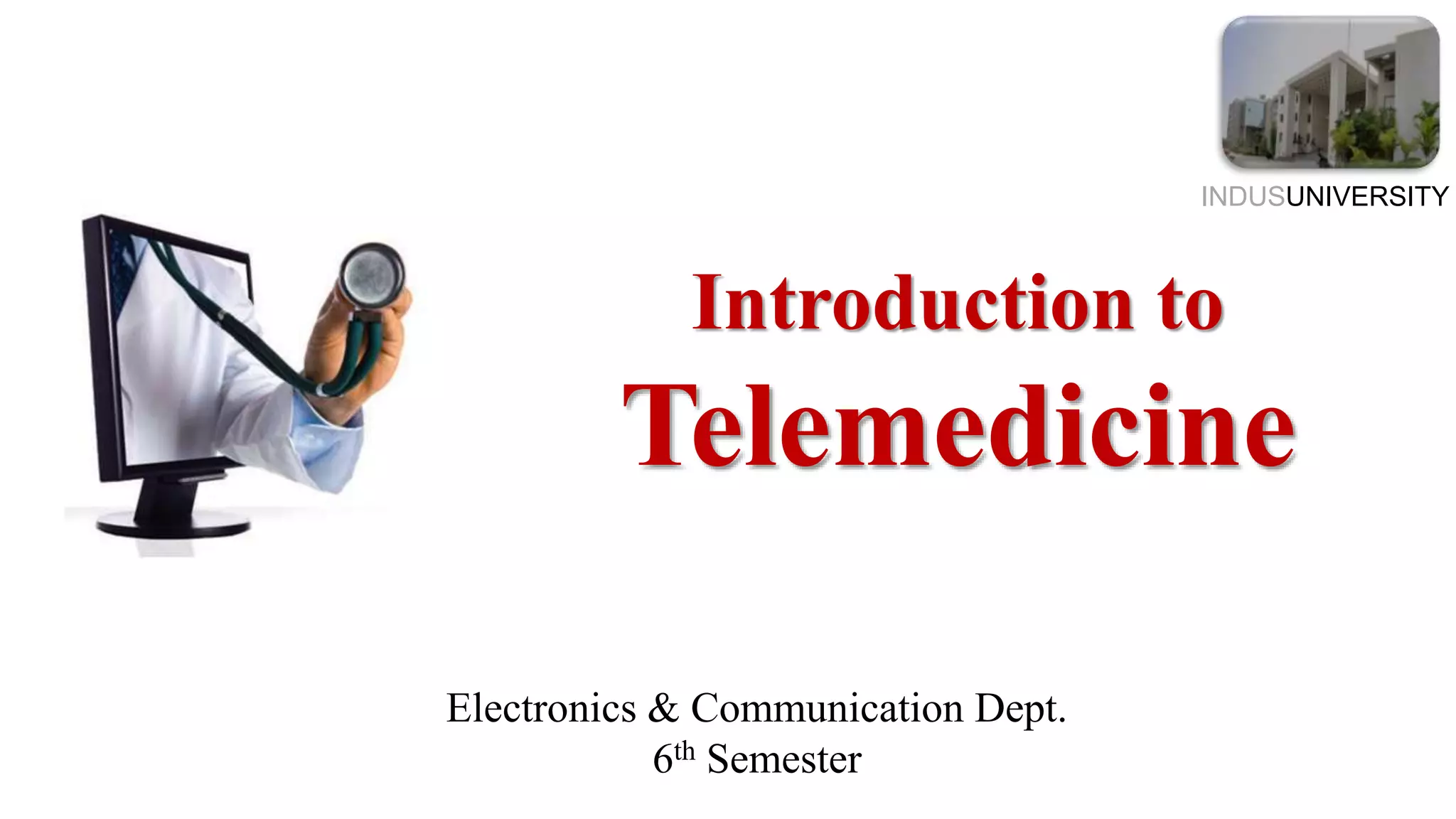
Introduction to
Telemedicine
INDUSUNIVERSITY
Electronics & Communication Dept.
6th Semester
2
Content
• Why Telemedicine ?
• History
• Types of telemedicine
• Which data can be transferred ?
• Benefits
• Applications
• Limitations to spread
• Telemedicine devices
• Future
11/14/2016
What is Telemedicine?
Telecommunication technology
+
Medicine
11/14/2016 3
What is Telemedicine?
The use of electronic information and
communication technologies to provide and
support health care when distance separates the
participants.
Telemedicine: A Guide to Assessing Telecommunications in Health Care,
Institute of Medicine, CA, 199611/14/2016 4
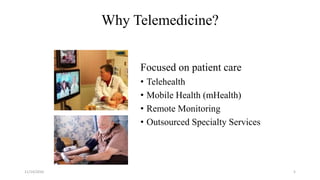
Focused on patient care
• Telehealth
• Mobile Health (mHealth)
• Remote Monitoring
• Outsourced Specialty Services
Why Telemedicine?
11/14/2016 5
History of Telemedicine
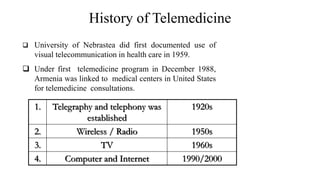
 University of Nebrastea did first documented use of
visual telecommunication in health care in 1959.
 Under first telemedicine program in December 1988,
Armenia was linked to medical centers in United States
for telemedicine consultations.
1. Telegraphy and telephony was
established
1920s
2. Wireless / Radio 1950s
3. TV 1960s
4. Computer and Internet 1990/2000
History of Telemedicine
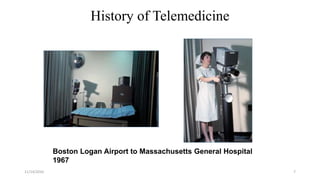
Boston Logan Airport to Massachusetts General Hospital
1967
11/14/2016 7
Types of Telemedicine
I. Store and forward
II. Interactive services
III. Remote monitoring
11/14/2016 8
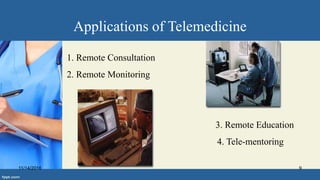
Applications of Telemedicine
1. Remote Consultation
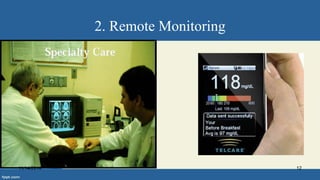
2. Remote Monitoring
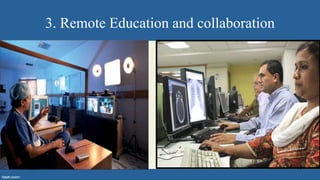
3. Remote Education
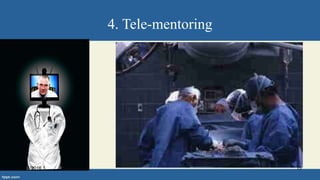
4. Tele-mentoring
11/14/2016 9
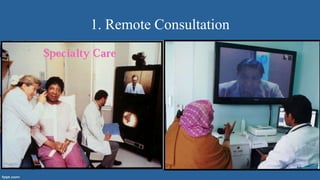
1. Remote Consultation
11/14/2016 10
11/14/2016 11
2. Remote Monitoring
11/14/2016 12
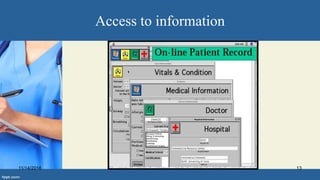
Access to information
11/14/2016 13
3. Remote Education and collaboration
11/14/2016 14
4. Tele-mentoring
11/14/2016 15
Applications
 Emergency Health Care
 Video Consulting
 Distance Leaning
 Medical education and the transfer of medical data.
 Medical care delivery, diagnosis, consultation and treatment at a distance.
 Nursing homes or retirement centers.
 Home monitoring for patients
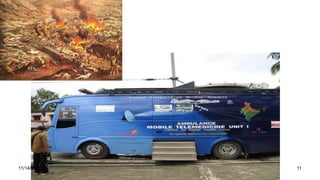
 Health care in the after of disasters.
Which Data Can be Transferred ?
 Basically four types of data are used in telemedicine.
• Text for patient notes, generally having a file of less than 10 KB.
• Audio – electronic stethoscope, with file size of around 10 KB.
• Still image X-rays which are still images having a size of around 1 MB.
• Video movie – ultrasound / patient visualization – movie images have a size
of 10 MB or more the patient can be seen by a doctor at a remote place using
cameras.
Benefits of Telemedicine
 Resource utilization
 Early intervention
 Avoids unnecessary transportation
 Community based care
 Medical education and research
 Cost saving
 Improved patient documentation
 Increased range of care and education.
Limitations to spread of telemedicine
 Poor patient – Doctor Relationships
 Patient Acceptance
 Fear of Technology
 Infrastructure
11/14/2016 19
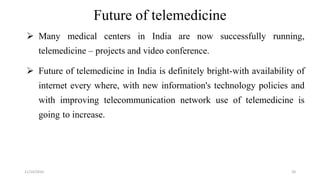
Future of telemedicine
 Many medical centers in India are now successfully running,
telemedicine – projects and video conference.
 Future of telemedicine in India is definitely bright-with availability of
internet every where, with new information's technology policies and
with improving telecommunication network use of telemedicine is
going to increase.
11/14/2016 20
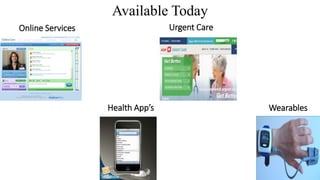
Available Today
Online Services
Health App’s
Urgent Care
Wearables
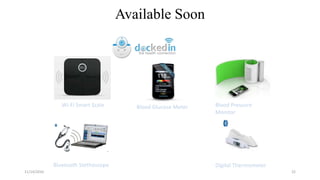
Wi-Fi Smart Scale Blood Pressure
Monitor
Bluetooth Stethoscope
Blood Glucose Meter
Digital Thermometer
Available Soon
11/14/2016 22
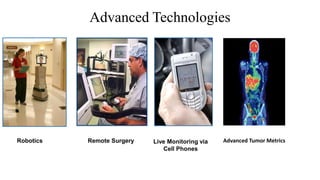
Advanced Technologies
Robotics Remote Surgery Live Monitoring via
Cell Phones
Advanced Tumor Metrics
Ami Goswami
IU1241090014
Electronics & Comm. Dept.
Indus University
Ahmedabad.
Vatsal Shah
IU1241090055
Electronics & Comm. Dept.
Indus University
Ahmedabad.
Presented by,
24
THANK YOU
11/14/2016 25

About Telemedicine in digital communication

  • 1.
  • 2.
    2 Content • Why Telemedicine? • History • Types of telemedicine • Which data can be transferred ? • Benefits • Applications • Limitations to spread • Telemedicine devices • Future 11/14/2016
  • 3.
    What is Telemedicine? Telecommunicationtechnology + Medicine 11/14/2016 3
  • 4.
    What is Telemedicine? Theuse of electronic information and communication technologies to provide and support health care when distance separates the participants. Telemedicine: A Guide to Assessing Telecommunications in Health Care, Institute of Medicine, CA, 199611/14/2016 4
  • 5.
    Focused on patientcare • Telehealth • Mobile Health (mHealth) • Remote Monitoring • Outsourced Specialty Services Why Telemedicine? 11/14/2016 5
  • 6.
    History of Telemedicine University of Nebrastea did first documented use of visual telecommunication in health care in 1959.  Under first telemedicine program in December 1988, Armenia was linked to medical centers in United States for telemedicine consultations. 1. Telegraphy and telephony was established 1920s 2. Wireless / Radio 1950s 3. TV 1960s 4. Computer and Internet 1990/2000
  • 7.
    History of Telemedicine BostonLogan Airport to Massachusetts General Hospital 1967 11/14/2016 7
  • 8.
    Types of Telemedicine I.Store and forward II. Interactive services III. Remote monitoring 11/14/2016 8
  • 9.
    Applications of Telemedicine 1.Remote Consultation 2. Remote Monitoring 3. Remote Education 4. Tele-mentoring 11/14/2016 9
  • 10.
  • 11.
  • 12.
  • 13.
  • 14.
    3. Remote Educationand collaboration 11/14/2016 14
  • 15.
  • 16.
    Applications  Emergency HealthCare  Video Consulting  Distance Leaning  Medical education and the transfer of medical data.  Medical care delivery, diagnosis, consultation and treatment at a distance.  Nursing homes or retirement centers.  Home monitoring for patients  Health care in the after of disasters.
  • 17.
    Which Data Canbe Transferred ?  Basically four types of data are used in telemedicine. • Text for patient notes, generally having a file of less than 10 KB. • Audio – electronic stethoscope, with file size of around 10 KB. • Still image X-rays which are still images having a size of around 1 MB. • Video movie – ultrasound / patient visualization – movie images have a size of 10 MB or more the patient can be seen by a doctor at a remote place using cameras.
  • 18.
    Benefits of Telemedicine Resource utilization  Early intervention  Avoids unnecessary transportation  Community based care  Medical education and research  Cost saving  Improved patient documentation  Increased range of care and education.
  • 19.
    Limitations to spreadof telemedicine  Poor patient – Doctor Relationships  Patient Acceptance  Fear of Technology  Infrastructure 11/14/2016 19
  • 20.
    Future of telemedicine Many medical centers in India are now successfully running, telemedicine – projects and video conference.  Future of telemedicine in India is definitely bright-with availability of internet every where, with new information's technology policies and with improving telecommunication network use of telemedicine is going to increase. 11/14/2016 20
  • 21.
    Available Today Online Services HealthApp’s Urgent Care Wearables
  • 22.
    Wi-Fi Smart ScaleBlood Pressure Monitor Bluetooth Stethoscope Blood Glucose Meter Digital Thermometer Available Soon 11/14/2016 22
  • 23.
    Advanced Technologies Robotics RemoteSurgery Live Monitoring via Cell Phones Advanced Tumor Metrics
  • 24.
    Ami Goswami IU1241090014 Electronics &Comm. Dept. Indus University Ahmedabad. Vatsal Shah IU1241090055 Electronics & Comm. Dept. Indus University Ahmedabad. Presented by, 24
  • 25.