
Teaching the Language System

BY:
SHEILA WIJAYANTI
@Sheila_Chei

ENGLISH EDUCATION DEPARTMENT
JEMBER UNIVERSITY
Teaching Specific Aspects of Language
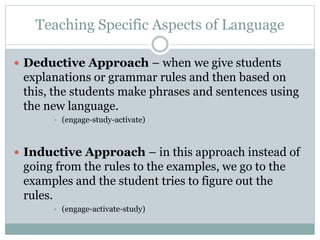
 Deductive Approach – when we give students

explanations or grammar rules and then based on
this, the students make phrases and sentences using
the new language.
• (engage-study-activate)

 Inductive Approach – in this approach instead of

going from the rules to the examples, we go to the
examples and the student tries to figure out the
rules.
• (engage-activate-study)
Explaining Meaning
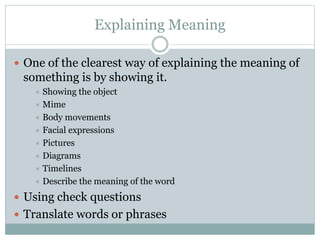
 One of the clearest way of explaining the meaning of

something is by showing it.
Showing the object
 Mime
 Body movements
 Facial expressions
 Pictures
 Diagrams
 Timelines
 Describe the meaning of the word


 Using check questions
 Translate words or phrases
Explaining Language Construction
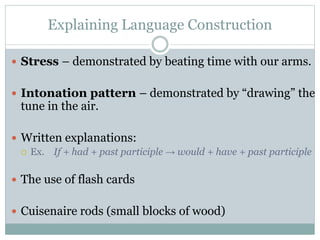
 Stress – demonstrated by beating time with our arms.
 Intonation pattern – demonstrated by “drawing” the

tune in the air.

 Written explanations:
 Ex. If + had + past participle → would + have + past participle

 The use of flash cards
 Cuisenaire rods (small blocks of wood)
Practice and Controlled Practice
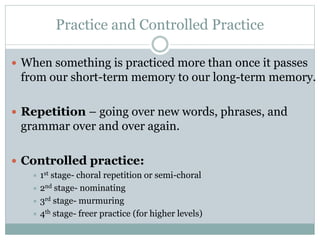
 When something is practiced more than once it passes

from our short-term memory to our long-term memory.
 Repetition – going over new words, phrases, and

grammar over and over again.
 Controlled practice:
 1st

stage- choral repetition or semi-choral
 2nd stage- nominating
 3rd stage- murmuring
 4th stage- freer practice (for higher levels)
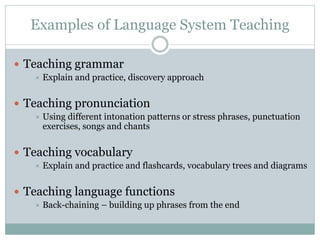
Examples of Language System Teaching
 Teaching grammar


Explain and practice, discovery approach

 Teaching pronunciation


Using different intonation patterns or stress phrases, punctuation
exercises, songs and chants

 Teaching vocabulary


Explain and practice and flashcards, vocabulary trees and diagrams

 Teaching language functions


Back-chaining – building up phrases from the end
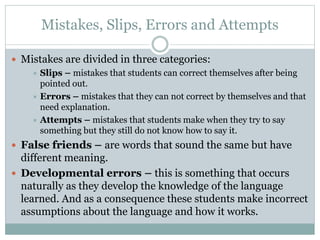
Mistakes, Slips, Errors and Attempts
 Mistakes are divided in three categories:
 Slips – mistakes that students can correct themselves after being
pointed out.
 Errors – mistakes that they can not correct by themselves and that
need explanation.
 Attempts – mistakes that students make when they try to say
something but they still do not know how to say it.
 False friends – are words that sound the same but have

different meaning.
 Developmental errors – this is something that occurs
naturally as they develop the knowledge of the language
learned. And as a consequence these students make incorrect
assumptions about the language and how it works.
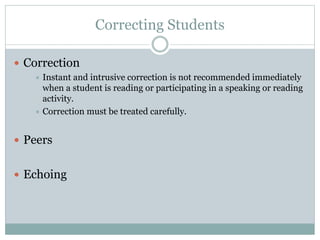
Correcting Students
 Correction
Instant and intrusive correction is not recommended immediately
when a student is reading or participating in a speaking or reading
activity.
 Correction must be treated carefully.


 Peers
 Echoing

TEFL - Teaching The Language System

  • 1.
    Teaching the LanguageSystem BY: SHEILA WIJAYANTI @Sheila_Chei ENGLISH EDUCATION DEPARTMENT JEMBER UNIVERSITY
  • 2.
    Teaching Specific Aspectsof Language  Deductive Approach – when we give students explanations or grammar rules and then based on this, the students make phrases and sentences using the new language. • (engage-study-activate)  Inductive Approach – in this approach instead of going from the rules to the examples, we go to the examples and the student tries to figure out the rules. • (engage-activate-study)
  • 3.
    Explaining Meaning  Oneof the clearest way of explaining the meaning of something is by showing it. Showing the object  Mime  Body movements  Facial expressions  Pictures  Diagrams  Timelines  Describe the meaning of the word   Using check questions  Translate words or phrases
  • 4.
    Explaining Language Construction Stress – demonstrated by beating time with our arms.  Intonation pattern – demonstrated by “drawing” the tune in the air.  Written explanations:  Ex. If + had + past participle → would + have + past participle  The use of flash cards  Cuisenaire rods (small blocks of wood)
  • 5.
    Practice and ControlledPractice  When something is practiced more than once it passes from our short-term memory to our long-term memory.  Repetition – going over new words, phrases, and grammar over and over again.  Controlled practice:  1st stage- choral repetition or semi-choral  2nd stage- nominating  3rd stage- murmuring  4th stage- freer practice (for higher levels)
  • 6.
    Examples of LanguageSystem Teaching  Teaching grammar  Explain and practice, discovery approach  Teaching pronunciation  Using different intonation patterns or stress phrases, punctuation exercises, songs and chants  Teaching vocabulary  Explain and practice and flashcards, vocabulary trees and diagrams  Teaching language functions  Back-chaining – building up phrases from the end
  • 7.
    Mistakes, Slips, Errorsand Attempts  Mistakes are divided in three categories:  Slips – mistakes that students can correct themselves after being pointed out.  Errors – mistakes that they can not correct by themselves and that need explanation.  Attempts – mistakes that students make when they try to say something but they still do not know how to say it.  False friends – are words that sound the same but have different meaning.  Developmental errors – this is something that occurs naturally as they develop the knowledge of the language learned. And as a consequence these students make incorrect assumptions about the language and how it works.
  • 8.
    Correcting Students  Correction Instantand intrusive correction is not recommended immediately when a student is reading or participating in a speaking or reading activity.  Correction must be treated carefully.   Peers  Echoing