Listening and
Speaking
Campusano Nicole
Canchignia Lorena
Galora Mishel
Guanoluisa Evelin
Mantilla Dayana
Contents of this template
What is listening ?
It is part of the four skills.
It is receptive skills. It involves: It uses:
Students respond to
the language instated
of produce it.
Making sense of the
meaningful sounds of
the language by
using context,
language and our
knowledge of world.
Understanding
spoken language.
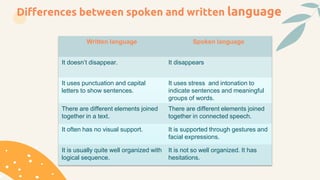
Differences between spoken and written language
Written language Spoken language
It doesn’t disappear. It disappears
It uses punctuation and capital
letters to show sentences.
It uses stress and intonation to
indicate sentences and meaningful
groups of words.
There are different elements joined
together in a text.
There are different elements joined
together in connected speech.
It often has no visual support. It is supported through gestures and
facial expressions.
It is usually quite well organized with
logical sequence.
It is not so well organized. It has
hesitations.
o It is generally less planned and less well structured than written language.
Spoken language
We say things as we
think of them.
We need to listen to
simply structured
messages.
why
To process
To
understand
In the time
that is
available.
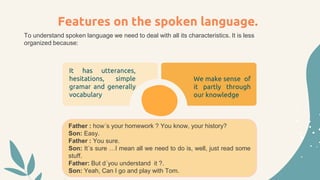
Features on the spoken language.
It has utterances,
hesitations, simple
gramar and generally
vocabulary
We make sense of
it partly through
our knowledge
To understand spoken language we need to deal with all its characteristics. It is less
organized because:
Father : how´s your homework ? You know, your history?
Son: Easy.
Father : You sure.
Son: It´s sure …I mean all we need to do is, well, just read some
stuff.
Father: But d´you understand it ?.
Son: Yeah, Can I go and play with Tom.
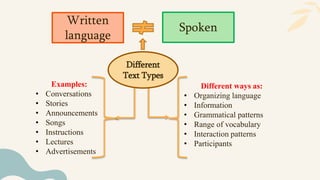
Written
language
Spoken
Examples:
• Conversations
• Stories
• Announcements
• Songs
• Instructions
• Lectures
• Advertisements
Different ways as:
• Organizing language
• Information
• Grammatical patterns
• Range of vocabulary
• Interaction patterns
• Participants
Different
Text Types
01 02
Range of
relevant text
types
Learning
Learning to listen involves
Understanding
Different speeds
of speech and
accents
Connected
speech
Ways to speak
Slowly with
pauses
Fast and few
pauses
Spoken language in which
words join together to form a
connected stream of sounds
• Word – sentence stress
• Linking sounds
• Words together
• Contracted forms
Features of connected
speech
Listening subskills
01
Listen for gist
Specific information
Detail or infer
attitude
extensively
intensively
Other ways of
listening
Key conocepts and the language teaching
classroom
This exposes
learners to a
range of accents
Pre – teaching
key words
Authentic
material
Many sources Recordings Listening texts
01 02 03
H
A
E
G
B
F
D
Four Language skils Productive skill Producing language
Receiving language
Speech to communicate
meaning
Word and sentence stress
Answer questions
Use intonation
Ask for clarification I would like to know….
Where do you LIVE?
BLACKbird / GREENhouse
Greet people How nice to meet you! / Pleased to meet you
Paraphrase
Hesitate
EXCEPT
Plan what we say
Use Language completely accurately
Correct form of grammar and vocabulary
TIME
I didn’t hesitate to ask my teacher something
Subskills
Grammar, vocabulary, functions
Features of connected speech
Text types
Oral fluency
Interactive strategies
Normal speed, hesitation, self correction
Keeping people interested
To communicate
meaning
Interactive
strategies
Gestures
Eye contact
Facial expressions
Movement
BODY LANGUAGE
to put the message across
more strongly and clearly
(e.g. “I mean…..”, “What I’m
trying to say is…”)
Clarifying the meaning
( e.g. “What do you think?”)
(e.g. “Yes, that’s right”)
Agreeing
To keep the interaction
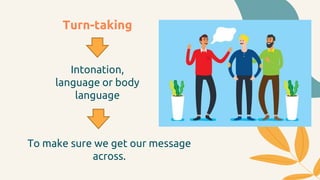
Turn-taking
Intonation,
language or body
language
To make sure we get our message
across.
Paraphrasing
The communication
cannot be or has not been
understood.
Use other words to
say the same thing
Speaking
The use of all the
features of
connected speech
Intonation, word and sentence stress, accurate
individual sounds, linking and contractions
Successful Oral Communication
Fluency
Accuracy
Appropriacy
Language Skills
E.g. taking part in conversations,
discussions or telephone calls.
Text TypesSpeaking
For example:
Buying sweets in a shop
Different speaking skills, functions, levels of formality,
amounts of speaking, amounts of interaction, structures
and vocabulary.
KEY CONCEPTS
Speaking involves
a range of
different subskills.
We can use
controlled
practice Fluency
activities
Pair and group
work increase the
opportunity for
communication
01
02
03
04
Information gap activities
• It involves learners in communication.
• Learners exchange information to find the answer.
• In fluency it is advisable not to correct learners
inmediately.
• In accruracy teacher corrects mistakes.
The activities in a speaking lesson involves:
• Lead-in (introduction)
• Practice activities
• Post-task activities: students evaluate their
performance.
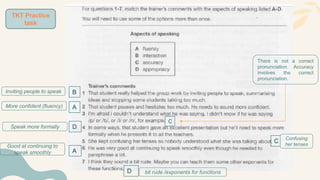
B
A
C
D
C
A
D
TKT Practice
task
Inviting people to speak
More confident (fluency)
There is not a correct
pronunciation. Accuracy
involves the correct
pronunciation.
Speak more formally
Confusing
her tensesGood at continuing to
speak smoothly
bit rude /exponents for functions
Bibliography
Spratt, M., Pulverness, A., & Williams, M. (2011). The TKT course (pp.43-50).
Ernst Klett Sprachen.
UNIVERSIDAD TÉCNICA DE AMBATO
FACULTAD DE CIENCIAS HUMANAS Y DE LA EDUCACIÓN
CARRERA DE PEDAGOGÍA DE LOS IDIOMAS NACIONALES Y
EXTRANJEROS
TEACHING KNOWLEDGE TEST – TKT 1
RUBRIC FOR TEAMWORK - POWER POINT PRESENTATION
Students’ name: Campusano, Canchignia, Galora, Guanoluisa, Mantilla
Date:

Unit 7- 8 (TKT)

  • 1.
    Listening and Speaking Campusano Nicole CanchigniaLorena Galora Mishel Guanoluisa Evelin Mantilla Dayana
  • 2.
    Contents of thistemplate What is listening ? It is part of the four skills. It is receptive skills. It involves: It uses: Students respond to the language instated of produce it. Making sense of the meaningful sounds of the language by using context, language and our knowledge of world. Understanding spoken language.
  • 3.
    Differences between spokenand written language Written language Spoken language It doesn’t disappear. It disappears It uses punctuation and capital letters to show sentences. It uses stress and intonation to indicate sentences and meaningful groups of words. There are different elements joined together in a text. There are different elements joined together in connected speech. It often has no visual support. It is supported through gestures and facial expressions. It is usually quite well organized with logical sequence. It is not so well organized. It has hesitations.
  • 4.
    o It isgenerally less planned and less well structured than written language. Spoken language We say things as we think of them. We need to listen to simply structured messages. why To process To understand In the time that is available.
  • 5.
    Features on thespoken language. It has utterances, hesitations, simple gramar and generally vocabulary We make sense of it partly through our knowledge To understand spoken language we need to deal with all its characteristics. It is less organized because: Father : how´s your homework ? You know, your history? Son: Easy. Father : You sure. Son: It´s sure …I mean all we need to do is, well, just read some stuff. Father: But d´you understand it ?. Son: Yeah, Can I go and play with Tom.
  • 6.
    Written language Spoken Examples: • Conversations • Stories •Announcements • Songs • Instructions • Lectures • Advertisements Different ways as: • Organizing language • Information • Grammatical patterns • Range of vocabulary • Interaction patterns • Participants Different Text Types
  • 7.
    01 02 Range of relevanttext types Learning Learning to listen involves Understanding Different speeds of speech and accents Connected speech
  • 8.
    Ways to speak Slowlywith pauses Fast and few pauses Spoken language in which words join together to form a connected stream of sounds
  • 9.
    • Word –sentence stress • Linking sounds • Words together • Contracted forms Features of connected speech
  • 10.
    Listening subskills 01 Listen forgist Specific information Detail or infer attitude extensively intensively Other ways of listening
  • 11.
    Key conocepts andthe language teaching classroom This exposes learners to a range of accents Pre – teaching key words Authentic material Many sources Recordings Listening texts 01 02 03
  • 12.
  • 13.
    Four Language skilsProductive skill Producing language Receiving language Speech to communicate meaning Word and sentence stress Answer questions Use intonation Ask for clarification I would like to know…. Where do you LIVE? BLACKbird / GREENhouse
  • 14.
    Greet people Hownice to meet you! / Pleased to meet you Paraphrase Hesitate EXCEPT Plan what we say Use Language completely accurately Correct form of grammar and vocabulary TIME I didn’t hesitate to ask my teacher something
  • 15.
  • 16.
    Oral fluency Interactive strategies Normalspeed, hesitation, self correction Keeping people interested To communicate meaning
  • 17.
  • 18.
    Gestures Eye contact Facial expressions Movement BODYLANGUAGE to put the message across more strongly and clearly
  • 19.
    (e.g. “I mean…..”,“What I’m trying to say is…”) Clarifying the meaning ( e.g. “What do you think?”)
  • 20.
    (e.g. “Yes, that’sright”) Agreeing To keep the interaction
  • 21.
    Turn-taking Intonation, language or body language Tomake sure we get our message across.
  • 22.
    Paraphrasing The communication cannot beor has not been understood. Use other words to say the same thing
  • 23.
    Speaking The use ofall the features of connected speech Intonation, word and sentence stress, accurate individual sounds, linking and contractions
  • 24.
  • 25.
    Language Skills E.g. takingpart in conversations, discussions or telephone calls. Text TypesSpeaking
  • 26.
    For example: Buying sweetsin a shop Different speaking skills, functions, levels of formality, amounts of speaking, amounts of interaction, structures and vocabulary.
  • 27.
    KEY CONCEPTS Speaking involves arange of different subskills. We can use controlled practice Fluency activities Pair and group work increase the opportunity for communication 01 02 03 04
  • 28.
    Information gap activities •It involves learners in communication. • Learners exchange information to find the answer. • In fluency it is advisable not to correct learners inmediately. • In accruracy teacher corrects mistakes. The activities in a speaking lesson involves: • Lead-in (introduction) • Practice activities • Post-task activities: students evaluate their performance.
  • 29.
    B A C D C A D TKT Practice task Inviting peopleto speak More confident (fluency) There is not a correct pronunciation. Accuracy involves the correct pronunciation. Speak more formally Confusing her tensesGood at continuing to speak smoothly bit rude /exponents for functions
  • 30.
    Bibliography Spratt, M., Pulverness,A., & Williams, M. (2011). The TKT course (pp.43-50). Ernst Klett Sprachen.
  • 31.
    UNIVERSIDAD TÉCNICA DEAMBATO FACULTAD DE CIENCIAS HUMANAS Y DE LA EDUCACIÓN CARRERA DE PEDAGOGÍA DE LOS IDIOMAS NACIONALES Y EXTRANJEROS TEACHING KNOWLEDGE TEST – TKT 1 RUBRIC FOR TEAMWORK - POWER POINT PRESENTATION Students’ name: Campusano, Canchignia, Galora, Guanoluisa, Mantilla Date: