Presented By:
Rahul Kumar
What Is Governance?
Governance
Way govt. works
Sharing of
information
Service delivery
E-Governance
E-Governance is the future of many countries who are
looking for corruption free country.
It is a two way communication protocol.
E-Governance is to reach the beneficiary and ensure that the
services intend to reach the desire individual has been met
with.
There should be an auto-response to support the essence of e-
governance, whereby the Government realizes the efficacy of
its governance.
According To World Bank
E-Government refers to the
Use of information technologies
That have the ability to transform relations with citizens,
businesses, and other arms of government .
 These technologies can serve better delivery of government
services to citizens.
Why E-Governance?
E-Government can transform
citizen service
provide access to information to empower citizens
enable their participation in government and enhance citizen
economic and social opportunities
so that they can make better lives, for themselves and for the
next generation.
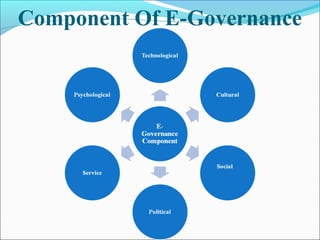
Component Of E-Governance
Technological Component
This relates to educate people who are in the bureaucratic
structure or outside its periphery regarding use of electronic
means to develop better connectivity within and with the
system. It requires use of computers
(a) in developing the data-base,
(b) in networking to facilitate the communication,
(c) in creating e- knowledge workers so as to increase their
potentiality. This focuses on “e” of electronic knowledge and
its proper utilization.
Social Component
The fundamental duty of any government is to educe a
society which is based on the principles of equality and
justice.
A society which is classless with no distinction between haves
and haves-not, where nobody is marginalized from the main
stream , and is committed to provide a respectful essence of
life to its people without any discrimination of cast or race
must be set up.
This is possible when people will be aware of their rights &
duties on the one hand, and know about the governmental
policies made for them on related issues on the other, hence a
vigilant society can be evolved where they can raise their
voices by questioning the governmental decisions.
Cultural Component
With the advent of the era of knowledge explosion there is a
need to reorient some of the value patterns without eroding
the fundamental normative structure of any social system.
The need to create value patterns conducive for e-
governance to operate focusing on work ethos therefore
cannot be denied. Thus to work out the ethical framework is
the key to move further by discarding obsolete set of values
that come in the way of potential utilization.
Political Component
The political system is essential aspect of governance.
It holds responsibility of rationalizing various operative
frameworks by enacting laws.
This helps to maintain & sustain the cohesive force that is
required by society to integrate its people and abide them to
follow a uniform policy to fulfill their targets.
Psychological Component
Developing required psyche so as to facilitate formation and
inculcation of right type of attitudes in the people is
prerequisite for efficiency.
Apart form this; readiness to connect to people, to listen to
their queries, to look for solutions, to improve communicative
skills etc. will be necessary elements for behavioral
modifications.
Service Component
The ultimate function of any welfare government is to serve.
As a provider of good services to its people it has to
assimilate the basic needs and also expectations of common
man in to the documentation of policy, which then has to be
implemented in the right spirit.
This develops a constant pressure on the government to
respond to public demands as this leads to the realization of
power they can exercise on government to maintain
impartiality, integrity and transparency in its functioning.
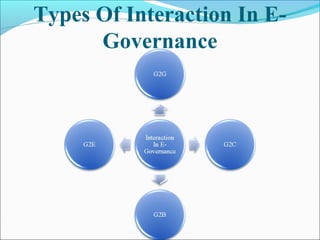
Types Of Interaction In E-
Governance
G2G
Information and Communications Technology is used not
only to restructure the governmental processes involved in
the functioning of government entities but also to increase the
flow of information and services within and between
different entities.
This kind of interaction is only within the sphere of
government and can be both horizontal i.e. between different
government agencies as well as between different functional
areas within an organization, or vertical i.e. between
national, provincial and local government agencies as well as
between different levels within an organization.
The primary objective is to increase efficiency, performance
and output.
G2C
An interface is created between the government and citizens
which enables the citizens to benefit from efficient delivery of
a large range of public services.
This expands the availability and accessibility of public
services on the one hand and improves the quality of services
on the other.
It gives citizens the choice of when to interact with the
government (e.g. 24 hours a day, 7 days a week), from where
to interact with the government (e.g. service centre,
unattended kiosk or from one’s home/workplace) and how to
interact with the government (e.g. through internet, fax,
telephone, email, face-to-face, etc).
The primary purpose is to make government, citizen-
G2B
E-Governance tools are used to aid the business community –
providers of goods and services – to seamlessly interact with
the government.
The objective is to cut red tape, save time, reduce
operational costs and to create a more transparent business
environment when dealing with the government.
The G2Binitiatives can be transactional, such as in licensing,
permits, procurement and revenue collection.
They can also be promotional and facilitative, such as in
trade, tourism and investment.
These measures help to provide a congenial environment to
businesses to enable them to perform more efficiently.
G2E
Government is by far the biggest employer and like any
organization, it has to interact with its employees on a
regular basis.
This interaction is a two-way process between the
organization and the employee.
Use of ICT tools helps in making these interactions fast and
efficient on the one hand and increase satisfaction levels of
employees on the other
Benefits Of E-Governance
Better access to information and quality services for
citizens.
Simplicity, efficiency and accountability in the
government.
Expanded reach of governance.
Challenges To E-Governance In
India
Lack of Integrated Services
Lack of Communication between different
Departments.
Lack of Key Persons
Population
Establishing Person Identities
Different Languages
Thank You

E governancee

  • 1.
  • 2.
    What Is Governance? Governance Waygovt. works Sharing of information Service delivery
  • 3.
    E-Governance E-Governance is thefuture of many countries who are looking for corruption free country. It is a two way communication protocol. E-Governance is to reach the beneficiary and ensure that the services intend to reach the desire individual has been met with. There should be an auto-response to support the essence of e- governance, whereby the Government realizes the efficacy of its governance.
  • 4.
    According To WorldBank E-Government refers to the Use of information technologies That have the ability to transform relations with citizens, businesses, and other arms of government .  These technologies can serve better delivery of government services to citizens.
  • 5.
    Why E-Governance? E-Government cantransform citizen service provide access to information to empower citizens enable their participation in government and enhance citizen economic and social opportunities so that they can make better lives, for themselves and for the next generation.
  • 6.
  • 7.
    Technological Component This relatesto educate people who are in the bureaucratic structure or outside its periphery regarding use of electronic means to develop better connectivity within and with the system. It requires use of computers (a) in developing the data-base, (b) in networking to facilitate the communication, (c) in creating e- knowledge workers so as to increase their potentiality. This focuses on “e” of electronic knowledge and its proper utilization.
  • 8.
    Social Component The fundamentalduty of any government is to educe a society which is based on the principles of equality and justice. A society which is classless with no distinction between haves and haves-not, where nobody is marginalized from the main stream , and is committed to provide a respectful essence of life to its people without any discrimination of cast or race must be set up. This is possible when people will be aware of their rights & duties on the one hand, and know about the governmental policies made for them on related issues on the other, hence a vigilant society can be evolved where they can raise their voices by questioning the governmental decisions.
  • 9.
    Cultural Component With theadvent of the era of knowledge explosion there is a need to reorient some of the value patterns without eroding the fundamental normative structure of any social system. The need to create value patterns conducive for e- governance to operate focusing on work ethos therefore cannot be denied. Thus to work out the ethical framework is the key to move further by discarding obsolete set of values that come in the way of potential utilization.
  • 10.
    Political Component The politicalsystem is essential aspect of governance. It holds responsibility of rationalizing various operative frameworks by enacting laws. This helps to maintain & sustain the cohesive force that is required by society to integrate its people and abide them to follow a uniform policy to fulfill their targets.
  • 11.
    Psychological Component Developing requiredpsyche so as to facilitate formation and inculcation of right type of attitudes in the people is prerequisite for efficiency. Apart form this; readiness to connect to people, to listen to their queries, to look for solutions, to improve communicative skills etc. will be necessary elements for behavioral modifications.
  • 12.
    Service Component The ultimatefunction of any welfare government is to serve. As a provider of good services to its people it has to assimilate the basic needs and also expectations of common man in to the documentation of policy, which then has to be implemented in the right spirit. This develops a constant pressure on the government to respond to public demands as this leads to the realization of power they can exercise on government to maintain impartiality, integrity and transparency in its functioning.
  • 13.
    Types Of InteractionIn E- Governance
  • 14.
    G2G Information and CommunicationsTechnology is used not only to restructure the governmental processes involved in the functioning of government entities but also to increase the flow of information and services within and between different entities. This kind of interaction is only within the sphere of government and can be both horizontal i.e. between different government agencies as well as between different functional areas within an organization, or vertical i.e. between national, provincial and local government agencies as well as between different levels within an organization. The primary objective is to increase efficiency, performance and output.
  • 15.
    G2C An interface iscreated between the government and citizens which enables the citizens to benefit from efficient delivery of a large range of public services. This expands the availability and accessibility of public services on the one hand and improves the quality of services on the other. It gives citizens the choice of when to interact with the government (e.g. 24 hours a day, 7 days a week), from where to interact with the government (e.g. service centre, unattended kiosk or from one’s home/workplace) and how to interact with the government (e.g. through internet, fax, telephone, email, face-to-face, etc). The primary purpose is to make government, citizen-
  • 16.
    G2B E-Governance tools areused to aid the business community – providers of goods and services – to seamlessly interact with the government. The objective is to cut red tape, save time, reduce operational costs and to create a more transparent business environment when dealing with the government. The G2Binitiatives can be transactional, such as in licensing, permits, procurement and revenue collection. They can also be promotional and facilitative, such as in trade, tourism and investment. These measures help to provide a congenial environment to businesses to enable them to perform more efficiently.
  • 17.
    G2E Government is byfar the biggest employer and like any organization, it has to interact with its employees on a regular basis. This interaction is a two-way process between the organization and the employee. Use of ICT tools helps in making these interactions fast and efficient on the one hand and increase satisfaction levels of employees on the other
  • 18.
    Benefits Of E-Governance Betteraccess to information and quality services for citizens. Simplicity, efficiency and accountability in the government. Expanded reach of governance.
  • 21.
    Challenges To E-GovernanceIn India Lack of Integrated Services Lack of Communication between different Departments. Lack of Key Persons Population Establishing Person Identities Different Languages
  • 22.