Presented by brahmareddy
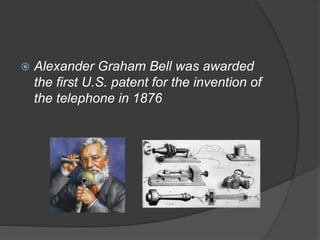
 Alexander Graham Bell was awarded
the first U.S. patent for the invention of
the telephone in 1876
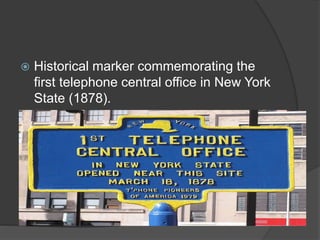
 Historical marker commemorating the
first telephone central office in New York
State (1878).
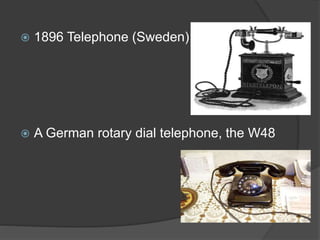
 1896 Telephone (Sweden)
 A German rotary dial telephone, the W48
History
 1667: Robert Hooke invented a string
telephone that conveyed sounds over an
extended wire by mechanical vibrations.
 1844: Innocenzo Manzetti first mooted
the idea of a "speaking telegraph"
(telephone).
 In 1924, public trials STARTED with
telephone connection on trains between
Berlin and Hamburg.
 Hand-held radio transceivers have been
available since the 1940s
The First Mobile Phone Call Was
Made 42 Years Ago Today
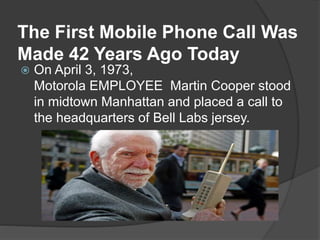
 On April 3, 1973,
Motorola EMPLOYEE Martin Cooper stood
in midtown Manhattan and placed a call to
the headquarters of Bell Labs jersey.
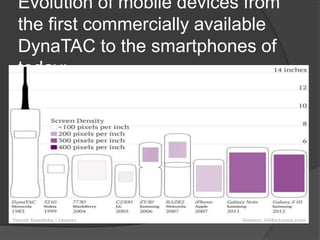
Evolution of mobile devices from
the first commercially available
DynaTAC to the smartphones of
today:
Generation
 Wireless communication is the transfer
of information over a distance without
the use of enhanced electrical
conductors or "wires”.
 When the context is clear, the term is
often shortened to "wireless"
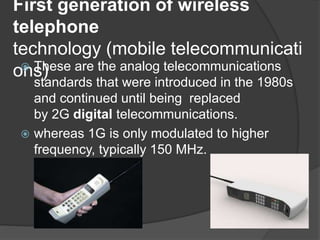
First generation of wireless
telephone
technology (mobile telecommunicati
ons) These are the analog telecommunications
standards that were introduced in the 1980s
and continued until being replaced
by 2G digital telecommunications.
 whereas 1G is only modulated to higher
frequency, typically 150 MHz.
SECOND GENARETION
 GSM is a digital cellular system. It was
originated in Finland Europe. However
now it is throughout the world.
 GSM accounts for 80% of total
mobile phone technologies market.
 Today in many advanced markets, the
general public prefers sending text
messages to placing voice calls.
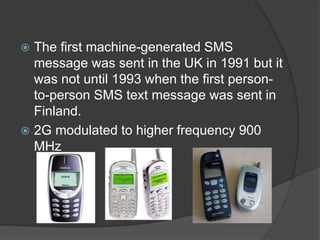
 The first machine-generated SMS
message was sent in the UK in 1991 but it
was not until 1993 when the first person-
to-person SMS text message was sent in
Finland.
 2G modulated to higher frequency 900
MHz
THIRD GENERATION
 3G finds APPLICATION in wireless
voice telephony, mobile Internet
ACCESS, fixed wireless Internet
access, video calls and mobile TV.
 3G telecommunication networks support
services that provide an information
transfer rate of at least 200 Kbit/s.
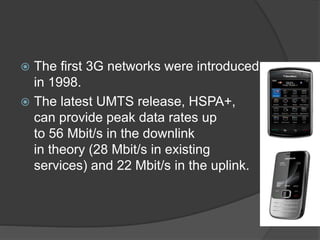
 The first 3G networks were introduced
in 1998.
 The latest UMTS release, HSPA+,
can provide peak data rates up
to 56 Mbit/s in the downlink
in theory (28 Mbit/s in existing
services) and 22 Mbit/s in the uplink.
FOURTH GENERATION
(4G)
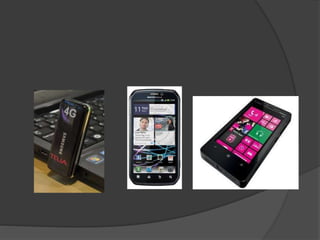
 4G refers to the fourth generation of
cellular wireless standards
 The expectation for the 4G technology
is basically the high quality audio/video
streaming over end to end Internet
Protocol
 Some of the companies trying 4G
communication at 100 Mbps for mobile
users and up to 1 Gbps over fixed stations.
 They planned on publicly launching their
first commercial wireless
network around2010
 Aircel in July 2014, launched 4G in four
circles Andhra Pradesh,
Assam, Bihar and Odisha
 Bharti Airtel 4G services are available
in Kolkata, Bangalore, Pune and Chandigar
h region
FIFTH GENERATION (5G)
 5G is a name used in some research
papers and projects to denote the next
major phase of mobile
telecommunications standards beyond
the upcoming 4G standards, which are
expected to be finalized between
approximately 2011 and 2013.
 The current trend of 5G technology
has a glowing future.
Innovation in telecommunication

Innovation in telecommunication

  • 1.
  • 2.
     Alexander GrahamBell was awarded the first U.S. patent for the invention of the telephone in 1876
  • 3.
     Historical markercommemorating the first telephone central office in New York State (1878).
  • 4.
     1896 Telephone(Sweden)  A German rotary dial telephone, the W48
  • 5.
    History  1667: RobertHooke invented a string telephone that conveyed sounds over an extended wire by mechanical vibrations.  1844: Innocenzo Manzetti first mooted the idea of a "speaking telegraph" (telephone).
  • 6.
     In 1924,public trials STARTED with telephone connection on trains between Berlin and Hamburg.  Hand-held radio transceivers have been available since the 1940s
  • 7.
    The First MobilePhone Call Was Made 42 Years Ago Today  On April 3, 1973, Motorola EMPLOYEE Martin Cooper stood in midtown Manhattan and placed a call to the headquarters of Bell Labs jersey.
  • 8.
    Evolution of mobiledevices from the first commercially available DynaTAC to the smartphones of today:
  • 9.
    Generation  Wireless communicationis the transfer of information over a distance without the use of enhanced electrical conductors or "wires”.  When the context is clear, the term is often shortened to "wireless"
  • 10.
    First generation ofwireless telephone technology (mobile telecommunicati ons) These are the analog telecommunications standards that were introduced in the 1980s and continued until being replaced by 2G digital telecommunications.  whereas 1G is only modulated to higher frequency, typically 150 MHz.
  • 11.
    SECOND GENARETION  GSMis a digital cellular system. It was originated in Finland Europe. However now it is throughout the world.  GSM accounts for 80% of total mobile phone technologies market.  Today in many advanced markets, the general public prefers sending text messages to placing voice calls.
  • 12.
     The firstmachine-generated SMS message was sent in the UK in 1991 but it was not until 1993 when the first person- to-person SMS text message was sent in Finland.  2G modulated to higher frequency 900 MHz
  • 13.
    THIRD GENERATION  3Gfinds APPLICATION in wireless voice telephony, mobile Internet ACCESS, fixed wireless Internet access, video calls and mobile TV.  3G telecommunication networks support services that provide an information transfer rate of at least 200 Kbit/s.
  • 14.
     The first3G networks were introduced in 1998.  The latest UMTS release, HSPA+, can provide peak data rates up to 56 Mbit/s in the downlink in theory (28 Mbit/s in existing services) and 22 Mbit/s in the uplink.
  • 15.
    FOURTH GENERATION (4G)  4Grefers to the fourth generation of cellular wireless standards  The expectation for the 4G technology is basically the high quality audio/video streaming over end to end Internet Protocol
  • 16.
     Some ofthe companies trying 4G communication at 100 Mbps for mobile users and up to 1 Gbps over fixed stations.  They planned on publicly launching their first commercial wireless network around2010  Aircel in July 2014, launched 4G in four circles Andhra Pradesh, Assam, Bihar and Odisha  Bharti Airtel 4G services are available in Kolkata, Bangalore, Pune and Chandigar h region
  • 18.
    FIFTH GENERATION (5G) 5G is a name used in some research papers and projects to denote the next major phase of mobile telecommunications standards beyond the upcoming 4G standards, which are expected to be finalized between approximately 2011 and 2013.  The current trend of 5G technology has a glowing future.