Presentation on FASTag
BY- RAHUL KUMAR
History of Electronic toll collection
 In 1959, Nobel Economics Prize winner William Vickrey proposed a system of electronic tolling in
which each vehicle was equipped with a transponder.
 The transponder’s personalised signal was picked up as the vehicle passed through an
intersection and relayed to a central computer, which calculated the charge according to the
intersection and time of day, and added it to the vehicle’s bill.
 In 1970s, free flow tolling was successfully tested with vehicles equipped with transponders at
undersides and readers located under the surface of the highways.
 Electronic toll collection technology was first introduced in Bergen, Norway in 1986, operating
together with traditional toll booths.
 The world’s first completely unaided full-speed electronic tolling system was introduced in 1991
at Trondheim.
 In 1995, Portugal became the first country to apply a single, universal system to all tolls in the
country.
 In 2005, Santiago, Chile became the world’s first city with 100 per cent full-speed electronic
tolling with transponders in a system of several urban freeways.
 In 2007, United Arab Emirates (UAE) implemented a similar road toll collection in Dubai.
Technologies used in an electronic toll
collection system
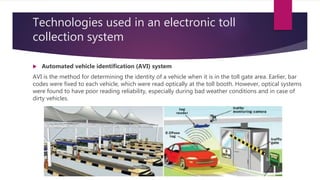
 Automated vehicle identification (AVI) system
AVI is the method for determining the identity of a vehicle when it is in the toll gate area. Earlier, bar
codes were fixed to each vehicle, which were read optically at the toll booth. However, optical systems
were found to have poor reading reliability, especially during bad weather conditions and in case of
dirty vehicles.
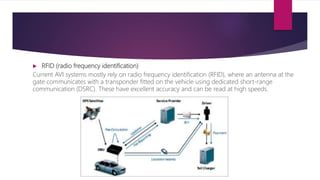
 RFID (radio frequency identification)
Current AVI systems mostly rely on radio frequency identification (RFID), where an antenna at the
gate communicates with a transponder fitted on the vehicle using dedicated short-range
communication (DSRC). These have excellent accuracy and can be read at high speeds.
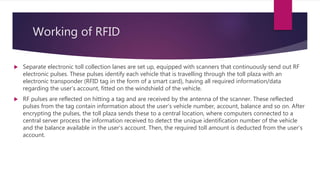
Working of RFID
 Separate electronic toll collection lanes are set up, equipped with scanners that continuously send out RF
electronic pulses. These pulses identify each vehicle that is travelling through the toll plaza with an
electronic transponder (RFID tag in the form of a smart card), having all required information/data
regarding the user’s account, fitted on the windshield of the vehicle.
 RF pulses are reflected on hitting a tag and are received by the antenna of the scanner. These reflected
pulses from the tag contain information about the user’s vehicle number, account, balance and so on. After
encrypting the pulses, the toll plaza sends these to a central location, where computers connected to a
central server process the information received to detect the unique identification number of the vehicle
and the balance available in the user’s account. Then, the required toll amount is deducted from the user’s
account.
Fastag
 FASTag device, which comes under the National Electronic Toll Collection (NETC) program, is designed to
employ Radio Frequency Identification (RFID) technology to make toll payments directly while the
vehicle is in motion. FASTag (RFID Tag) will be affixed on the windscreen of the vehicle and enable a
customer to make the toll payments directly from their account which is linked to FASTag.
 According to the Ministry of Road Transport & Highways, FASTags will become mandatory for all
vehicles from December 1, 2019. But this deadline is extended to December 15, 2019.
This system is introduced by the government of India under the National Highway Authority of India.
This system is implemented at all the Highway Toll Plazas across India (650+ approximately).
National Payments Corporation of India (NPCI) has developed the National Electronic Toll Collection
(NETC) program to meet the electronic tolling requirements of the Indian market.
How a FASTag works
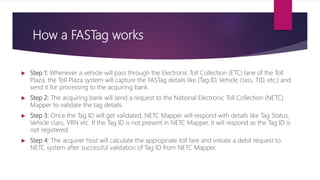
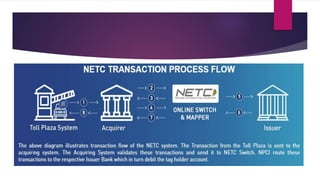
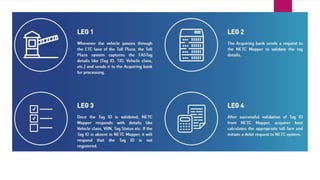
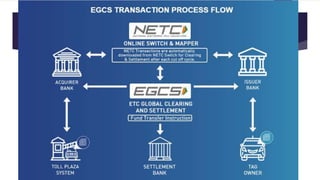
 Step 1: Whenever a vehicle will pass through the Electronic Toll Collection (ETC) lane of the Toll
Plaza, the Toll Plaza system will capture the FASTag details like (Tag ID, Vehicle class, TID, etc.) and
send it for processing to the acquiring bank.
 Step 2: The acquiring bank will send a request to the National Electronic Toll Collection (NETC)
Mapper to validate the tag details.
 Step 3: Once the Tag ID will get validated, NETC Mapper will respond with details like Tag Status,
Vehicle class, VRN etc. If the Tag ID is not present in NETC Mapper, it will respond as the Tag ID is
not registered.
 Step 4: The acquirer host will calculate the appropriate toll fare and initiate a debit request to
NETC system after successful validation of Tag ID from NETC Mapper.
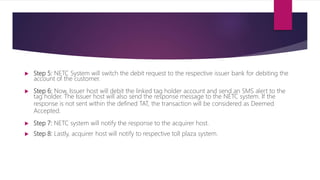
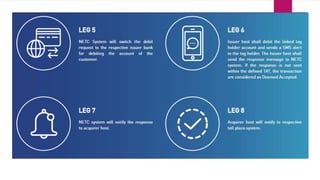
 Step 5: NETC System will switch the debit request to the respective issuer bank for debiting the
account of the customer.
 Step 6: Now, Issuer host will debit the linked tag holder account and send an SMS alert to the
tag holder. The Issuer host will also send the response message to the NETC system. If the
response is not sent within the defined TAT, the transaction will be considered as Deemed
Accepted.
 Step 7: NETC system will notify the response to the acquirer host.
 Step 8: Lastly, acquirer host will notify to respective toll plaza system.
Key features and functionalities of NETC
Objectives of NETC
 FASTag will help to reduce the waiting time at the plaza
 Accommodating the increasing traffic without additional lanes
 Eliminating the acceleration and idling, harmful vehicular emissions and air using FASTag
 Reducing congestion around plazas
 Pollution reduction
 To save fuel for the future which will also help to reduce the operating cost of the vehicles
 To provide customers the flexibility of paying their plaza bill’s with RFID Tag
 Reduce cash handling which aids in enhanced audit control by centralising user accounts
 Enhancing data collection, information such as vehicle count of the day
How to get a FASTag?
Currently issued by 23 certified banks, including payments bank, small finance
banks, and co-operative banks. The tags sold by banks are, however, not ‘bank-
neutral’, which means a FASTag bought from one bank can be recharged through
that particular bank only and not via other banks. However, tags sold/distributed by
NHAI are bank-neutral, and one can use any bank account to recharge/top up the
amount in the tag.
You can also get them from select toll plazas, RTOs, petrol pumps, and also from
online platforms, such as Paytm.
https://fastag.brokerage-free.in/article/fastag/fastag-vehicle-classification-by-npci-
nhai-ihmcl
Advantages of FASTag
 Convenience to Drivers/Consumers
 Taming Corruption
 Safer and More Secure Payment System
 Protection Against Crime and Mishaps
 All-round Savings
 Saves Manpower Cost
Disadvantages of FASTag Technology
 System or Network failure
 Technical Glitches
 Cards Safety
 Ownership issues
 https://www.myayan.com/advantages-and-disadvantages-of-fastag
FASTags Journey
 The system was initially set up as a pilot project in 2014 on the stretch of the Golden
Quadrilateral between Ahmedabad and Mumbai.
 The system was implemented on the Delhi - Mumbai arm of the Quadrilateral on 4 November 2014.
 In July 2015, toll plazas on the Chennai - Bangalore stretch of the Golden Quadrilateral started
accepting FASTag payments
 By April 2016, FASTag was rolled out to 247 toll plazas on national highways across India,
representing 70% of all toll plazas in the country at the time
 By 23 November 2016, 347 fee plazas out of 366 on national highways across the country accept
FASTag payments
 On 1 October 2017, the NHAI launched a FASTag lane in all 370 toll plazas under its ambit.
 On 8 November 2017, it was followed up by making FASTag mandatory on all new vehicles sold
in India after December 2017.
 On 19 October 2019, it was announced that FASTag will be mandatory on all National Highways
from 1st of December 2019 and non-FASTag users will be charged double the toll.
 During November, Hyderabad airport launches FASTag Car Park facility.
 On 15 December 2019, FASTag will become mandatory according to Mr. Nitin Gadkari, the current
Minister of Road Transport & Highways
Reference
 https://www.npci.org.in/sites/all/themes/npcl/images/PDF/NETC_Tag_Marks_Specific
ations_v1_1.pdf
 https://fastag.brokerage-free.in/article/fastag/fastag-vehicle-classification-by-npci-
nhai-ihmcl
 https://www.myayan.com/advantages-and-disadvantages-of-fastag
Thank You

Presentation on Fastag

  • 1.
  • 2.
    History of Electronictoll collection  In 1959, Nobel Economics Prize winner William Vickrey proposed a system of electronic tolling in which each vehicle was equipped with a transponder.  The transponder’s personalised signal was picked up as the vehicle passed through an intersection and relayed to a central computer, which calculated the charge according to the intersection and time of day, and added it to the vehicle’s bill.  In 1970s, free flow tolling was successfully tested with vehicles equipped with transponders at undersides and readers located under the surface of the highways.  Electronic toll collection technology was first introduced in Bergen, Norway in 1986, operating together with traditional toll booths.
  • 3.
     The world’sfirst completely unaided full-speed electronic tolling system was introduced in 1991 at Trondheim.  In 1995, Portugal became the first country to apply a single, universal system to all tolls in the country.  In 2005, Santiago, Chile became the world’s first city with 100 per cent full-speed electronic tolling with transponders in a system of several urban freeways.  In 2007, United Arab Emirates (UAE) implemented a similar road toll collection in Dubai.
  • 4.
    Technologies used inan electronic toll collection system  Automated vehicle identification (AVI) system AVI is the method for determining the identity of a vehicle when it is in the toll gate area. Earlier, bar codes were fixed to each vehicle, which were read optically at the toll booth. However, optical systems were found to have poor reading reliability, especially during bad weather conditions and in case of dirty vehicles.
  • 5.
     RFID (radiofrequency identification) Current AVI systems mostly rely on radio frequency identification (RFID), where an antenna at the gate communicates with a transponder fitted on the vehicle using dedicated short-range communication (DSRC). These have excellent accuracy and can be read at high speeds.
  • 6.
    Working of RFID Separate electronic toll collection lanes are set up, equipped with scanners that continuously send out RF electronic pulses. These pulses identify each vehicle that is travelling through the toll plaza with an electronic transponder (RFID tag in the form of a smart card), having all required information/data regarding the user’s account, fitted on the windshield of the vehicle.  RF pulses are reflected on hitting a tag and are received by the antenna of the scanner. These reflected pulses from the tag contain information about the user’s vehicle number, account, balance and so on. After encrypting the pulses, the toll plaza sends these to a central location, where computers connected to a central server process the information received to detect the unique identification number of the vehicle and the balance available in the user’s account. Then, the required toll amount is deducted from the user’s account.
  • 7.
    Fastag  FASTag device,which comes under the National Electronic Toll Collection (NETC) program, is designed to employ Radio Frequency Identification (RFID) technology to make toll payments directly while the vehicle is in motion. FASTag (RFID Tag) will be affixed on the windscreen of the vehicle and enable a customer to make the toll payments directly from their account which is linked to FASTag.  According to the Ministry of Road Transport & Highways, FASTags will become mandatory for all vehicles from December 1, 2019. But this deadline is extended to December 15, 2019.
  • 8.
    This system isintroduced by the government of India under the National Highway Authority of India. This system is implemented at all the Highway Toll Plazas across India (650+ approximately). National Payments Corporation of India (NPCI) has developed the National Electronic Toll Collection (NETC) program to meet the electronic tolling requirements of the Indian market.
  • 9.
    How a FASTagworks  Step 1: Whenever a vehicle will pass through the Electronic Toll Collection (ETC) lane of the Toll Plaza, the Toll Plaza system will capture the FASTag details like (Tag ID, Vehicle class, TID, etc.) and send it for processing to the acquiring bank.  Step 2: The acquiring bank will send a request to the National Electronic Toll Collection (NETC) Mapper to validate the tag details.  Step 3: Once the Tag ID will get validated, NETC Mapper will respond with details like Tag Status, Vehicle class, VRN etc. If the Tag ID is not present in NETC Mapper, it will respond as the Tag ID is not registered.  Step 4: The acquirer host will calculate the appropriate toll fare and initiate a debit request to NETC system after successful validation of Tag ID from NETC Mapper.
  • 10.
     Step 5:NETC System will switch the debit request to the respective issuer bank for debiting the account of the customer.  Step 6: Now, Issuer host will debit the linked tag holder account and send an SMS alert to the tag holder. The Issuer host will also send the response message to the NETC system. If the response is not sent within the defined TAT, the transaction will be considered as Deemed Accepted.  Step 7: NETC system will notify the response to the acquirer host.  Step 8: Lastly, acquirer host will notify to respective toll plaza system.
  • 11.
    Key features andfunctionalities of NETC
  • 16.
    Objectives of NETC FASTag will help to reduce the waiting time at the plaza  Accommodating the increasing traffic without additional lanes  Eliminating the acceleration and idling, harmful vehicular emissions and air using FASTag  Reducing congestion around plazas  Pollution reduction  To save fuel for the future which will also help to reduce the operating cost of the vehicles  To provide customers the flexibility of paying their plaza bill’s with RFID Tag  Reduce cash handling which aids in enhanced audit control by centralising user accounts  Enhancing data collection, information such as vehicle count of the day
  • 17.
    How to geta FASTag? Currently issued by 23 certified banks, including payments bank, small finance banks, and co-operative banks. The tags sold by banks are, however, not ‘bank- neutral’, which means a FASTag bought from one bank can be recharged through that particular bank only and not via other banks. However, tags sold/distributed by NHAI are bank-neutral, and one can use any bank account to recharge/top up the amount in the tag. You can also get them from select toll plazas, RTOs, petrol pumps, and also from online platforms, such as Paytm. https://fastag.brokerage-free.in/article/fastag/fastag-vehicle-classification-by-npci- nhai-ihmcl
  • 18.
    Advantages of FASTag Convenience to Drivers/Consumers  Taming Corruption  Safer and More Secure Payment System  Protection Against Crime and Mishaps  All-round Savings  Saves Manpower Cost
  • 19.
    Disadvantages of FASTagTechnology  System or Network failure  Technical Glitches  Cards Safety  Ownership issues  https://www.myayan.com/advantages-and-disadvantages-of-fastag
  • 20.
    FASTags Journey  Thesystem was initially set up as a pilot project in 2014 on the stretch of the Golden Quadrilateral between Ahmedabad and Mumbai.  The system was implemented on the Delhi - Mumbai arm of the Quadrilateral on 4 November 2014.  In July 2015, toll plazas on the Chennai - Bangalore stretch of the Golden Quadrilateral started accepting FASTag payments  By April 2016, FASTag was rolled out to 247 toll plazas on national highways across India, representing 70% of all toll plazas in the country at the time  By 23 November 2016, 347 fee plazas out of 366 on national highways across the country accept FASTag payments  On 1 October 2017, the NHAI launched a FASTag lane in all 370 toll plazas under its ambit.
  • 21.
     On 8November 2017, it was followed up by making FASTag mandatory on all new vehicles sold in India after December 2017.  On 19 October 2019, it was announced that FASTag will be mandatory on all National Highways from 1st of December 2019 and non-FASTag users will be charged double the toll.  During November, Hyderabad airport launches FASTag Car Park facility.  On 15 December 2019, FASTag will become mandatory according to Mr. Nitin Gadkari, the current Minister of Road Transport & Highways
  • 22.
  • 23.