DETERMINANTS OF WORKING CAPITAL
• PRESENTED BY-
SADIQUE ALI
ENROLLMENT NO-A165386
• SUBMITTED TO-
Dr. Syed Khaja Safiuddin
ASSISTANT PROFESSOR
WORKING CAPITAL
The capital which is needed for the regular operation
of business is called working capital.
1- for the purchase of raw materials
2- for the payment of wages
3- payment of rent and of other expenses
Working capital is kept in the form of cash,
debtors, raw materials inventory, stock of finished
goods, bills receivable etc.
DETERMINANTS OF WORKING CAPITAL
Size Of Business
Nature Of Business
Storage Period
Credit Period
Seasonal Requirement
Potential Growth Or Expansion Of Business
Changes In Price Level
Dividend Policy
Working Capital Cycle
Operating Efficiency
OTHER FACTORS
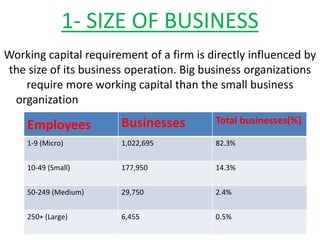
1- SIZE OF BUSINESS
Working capital requirement of a firm is directly influenced by
the size of its business operation. Big business organizations
require more working capital than the small business
organization
Employees Businesses Total businesses(%)
1-9 (Micro) 1,022,695 82.3%
10-49 (Small) 177,950 14.3%
50-249 (Medium) 29,750 2.4%
250+ (Large) 6,455 0.5%
2- NATURE OF BUSINESS
Working capital requirement depends also upon the
nature of business carried by the firm.
Normally, manufacturing industries
and trading organizations need more working capital
than in the service business organizations.
A service sector does not require any
amount of stock of goods. But in the manufacturing
or trading firm, credit sales and advance related
transactions are in large amount.
3- STORAGE PERIOD
Time needed for keeping the stock in store is called
storage period.
The amount of working capital is influenced by
the storage period.
If storage period is high
A firm should keep more quantity of goods in store
and hence requires more working capital.
if the storage Period is less ,
then more stock of goods must be held in store as
work-in-progress.
4- CREDIT PERIOD
The credit period is the number of days that a
customer is allowed to wait before paying an invoice.
Thus, a longer credit period equates to a larger
investment in receivables.
1-Longer credit period requires more investment in
debtors and hence more working capital is needed
But, the firm which allows less credit period to
customers needs less working capital.
5-SEASONAL REQUIREMENT
In Seasonal Business , Working Capital Is Most
Important Requirement.
Such business organizations have to buy raw
material in bulk during the Season to ensure an
uninterrupted flow and process them during the
SHORT Period.
Thus, a huge amount is blocked
in the form of raw material inventories which gives
rise to more working capital requirements.
6- POTENTIAL GROWTH
Growth potential is an organization's future ability
to generate larger profits, expand its workforce and
increase production.
If the business is to be extended in future, more
working capital is required.
WHICH IS IN FOR TWO SHAPE
1- BUSINESS WEALTH
2- BUSINESS IMAGE
More amount of working capital is required to meet
the expansion need of business.
7- CHANGES IN PRICE LEVEL
Change In Price Level Also Affects The Working
Capital Requirements.
1- The Rise In Price Will Require The Firm To
Maintain Large Amount Of Working Capital
2- When Decrease In The Price Will Require The
Firm, It Is Needed Decreasing The Working Capital Of
Business
8- DIVIDEND POLICY
Dividend policy is the set of guidelines a company
uses to decide how much of its earnings it will pay out
to shareholders.
A desire to maintain an established dividend policy
may affect working capital.
The need for working capital can be met
with the retained earning.
If a firm retains more profit and distributes
lower amount of dividend, it needs less working
capital.
9- WORKING CAPITAL CYCLE
The working capital cycle (WCC) is the amount of time
it takes to turn the net current assets and current
liabilities into cash.
When the working capital cycle of a firm is long,
it will require larger amount of working capital.
But, if working capital cycle is short, it will need
less working capital.
10- OPERATIONAL EFFICIENCY
Operational efficiency is the capability to deliver
products or services to its customers in the most
effective manner.
 The operating efficiency of a firm also affects
the firm's need of working capital.
The operating efficiency of the firm results in
optimum utilization of assets.
The optimum utilization of assets in turn results in
more fund release for working capital
11- OTHER FACTORS
GOVERNMENT POLICIES
DEPRICIATION POLICY
INVENTORY POLICY
CREDIT POLICY OF RBI
Determinants of working capital

Determinants of working capital

  • 1.
    DETERMINANTS OF WORKINGCAPITAL • PRESENTED BY- SADIQUE ALI ENROLLMENT NO-A165386 • SUBMITTED TO- Dr. Syed Khaja Safiuddin ASSISTANT PROFESSOR
  • 2.
    WORKING CAPITAL The capitalwhich is needed for the regular operation of business is called working capital. 1- for the purchase of raw materials 2- for the payment of wages 3- payment of rent and of other expenses Working capital is kept in the form of cash, debtors, raw materials inventory, stock of finished goods, bills receivable etc.
  • 3.
    DETERMINANTS OF WORKINGCAPITAL Size Of Business Nature Of Business Storage Period Credit Period Seasonal Requirement Potential Growth Or Expansion Of Business Changes In Price Level Dividend Policy Working Capital Cycle Operating Efficiency OTHER FACTORS
  • 4.
    1- SIZE OFBUSINESS Working capital requirement of a firm is directly influenced by the size of its business operation. Big business organizations require more working capital than the small business organization Employees Businesses Total businesses(%) 1-9 (Micro) 1,022,695 82.3% 10-49 (Small) 177,950 14.3% 50-249 (Medium) 29,750 2.4% 250+ (Large) 6,455 0.5%
  • 5.
    2- NATURE OFBUSINESS Working capital requirement depends also upon the nature of business carried by the firm. Normally, manufacturing industries and trading organizations need more working capital than in the service business organizations. A service sector does not require any amount of stock of goods. But in the manufacturing or trading firm, credit sales and advance related transactions are in large amount.
  • 6.
    3- STORAGE PERIOD Timeneeded for keeping the stock in store is called storage period. The amount of working capital is influenced by the storage period. If storage period is high A firm should keep more quantity of goods in store and hence requires more working capital. if the storage Period is less , then more stock of goods must be held in store as work-in-progress.
  • 7.
    4- CREDIT PERIOD Thecredit period is the number of days that a customer is allowed to wait before paying an invoice. Thus, a longer credit period equates to a larger investment in receivables. 1-Longer credit period requires more investment in debtors and hence more working capital is needed But, the firm which allows less credit period to customers needs less working capital.
  • 8.
    5-SEASONAL REQUIREMENT In SeasonalBusiness , Working Capital Is Most Important Requirement. Such business organizations have to buy raw material in bulk during the Season to ensure an uninterrupted flow and process them during the SHORT Period. Thus, a huge amount is blocked in the form of raw material inventories which gives rise to more working capital requirements.
  • 9.
    6- POTENTIAL GROWTH Growthpotential is an organization's future ability to generate larger profits, expand its workforce and increase production. If the business is to be extended in future, more working capital is required. WHICH IS IN FOR TWO SHAPE 1- BUSINESS WEALTH 2- BUSINESS IMAGE More amount of working capital is required to meet the expansion need of business.
  • 10.
    7- CHANGES INPRICE LEVEL Change In Price Level Also Affects The Working Capital Requirements. 1- The Rise In Price Will Require The Firm To Maintain Large Amount Of Working Capital 2- When Decrease In The Price Will Require The Firm, It Is Needed Decreasing The Working Capital Of Business
  • 11.
    8- DIVIDEND POLICY Dividendpolicy is the set of guidelines a company uses to decide how much of its earnings it will pay out to shareholders. A desire to maintain an established dividend policy may affect working capital. The need for working capital can be met with the retained earning. If a firm retains more profit and distributes lower amount of dividend, it needs less working capital.
  • 12.
    9- WORKING CAPITALCYCLE The working capital cycle (WCC) is the amount of time it takes to turn the net current assets and current liabilities into cash. When the working capital cycle of a firm is long, it will require larger amount of working capital. But, if working capital cycle is short, it will need less working capital.
  • 13.
    10- OPERATIONAL EFFICIENCY Operationalefficiency is the capability to deliver products or services to its customers in the most effective manner.  The operating efficiency of a firm also affects the firm's need of working capital. The operating efficiency of the firm results in optimum utilization of assets. The optimum utilization of assets in turn results in more fund release for working capital
  • 14.
    11- OTHER FACTORS GOVERNMENTPOLICIES DEPRICIATION POLICY INVENTORY POLICY CREDIT POLICY OF RBI