Technical Textiles – Roundup 2020
COURSE TITLE: HIGH PERFORMANCE FIBRES
COURSE CODE : TS-207
SUBMITTED TO : Ms. SARAH JAVEED
SUBMITTED BY:
 AREEBA FATIMA (TS-002)
Technical Textiles
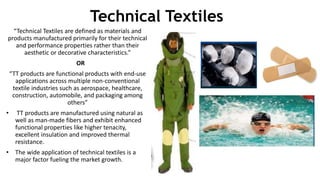
“Technical Textiles are defined as materials and
products manufactured primarily for their technical
and performance properties rather than their
aesthetic or decorative characteristics.”
OR
“TT products are functional products with end-use
applications across multiple non-conventional
textile industries such as aerospace, healthcare,
construction, automobile, and packaging among
others”
• TT products are manufactured using natural as
well as man-made fibers and exhibit enhanced
functional properties like higher tenacity,
excellent insulation and improved thermal
resistance.
• The wide application of technical textiles is a
major factor fueling the market growth.
Global Market Outlook –
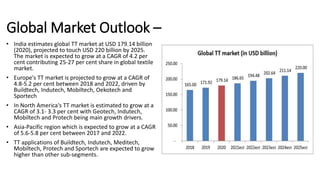
• India estimates global TT market at USD 179.14 billion
(2020), projected to touch USD 220 billion by 2025.
The market is expected to grow at a CAGR of 4.2 per
cent contributing 25-27 per cent share in global textile
market.
• Europe's TT market is projected to grow at a CAGR of
4.8-5.2 per cent between 2018 and 2022, driven by
Buildtech, Indutech, Mobiltech, Oekotech and
Sportech
• In North America's TT market is estimated to grow at a
CAGR of 3.1- 3.3 per cent with Geotech, Indutech,
Mobiltech and Protech being main growth drivers.
• Asia-Pacific region which is expected to grow at a CAGR
of 5.6-5.8 per cent between 2017 and 2022.
• TT applications of Buildtech, Indutech, Meditech,
Mobiltech, Protech and Sportech are expected to grow
higher than other sub-segments.
Future Market
Insights –
"The global anti-microbial wipes market is to
witness a surge in demand and expected to
surpass USD 7 billion by the end of 2020,
growing at a CAGR of 10 per cent between
2020 and 2030. North America and Europe
are expected to dominate this market over
this period and South Asia will emerge as a
lucrative market."
SEGMENTS OF TECHNICAL TEXTILES
INDUTECH :
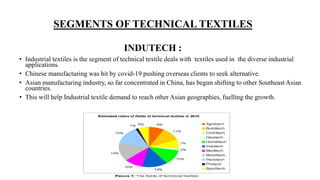
• Industrial textiles is the segment of technical textile deals with textiles used in the diverse industrial
applications.
• Chinese manufacturing was hit by covid-19 pushing overseas clients to seek alternative.
• Asian manufacturing industry, so far concentrated in China, has begun shifting to other Southeast Asian
countries.
• This will help Industrial textile demand to reach other Asian geographies, fuelling the growth.
MEDITECH :
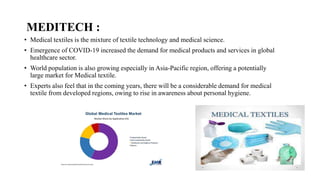
• Medical textiles is the mixture of textile technology and medical science.
• Emergence of COVID-19 increased the demand for medical products and services in global
healthcare sector.
• World population is also growing especially in Asia-Pacific region, offering a potentially
large market for Medical textile.
• Experts also feel that in the coming years, there will be a considerable demand for medical
textile from developed regions, owing to rise in awareness about personal hygiene.
BUILDTECH :
• Buildtech textiles include the composite materials and textiles used in the construction of
permanent as well as temporary building structures.
• An Oxford report forecast the global need for infrastructure investment to reach USD 94
trillion by 2040.
• Asia, hosting highest developing populations, alone has the largest overall need, requiring
just over 50 per cent of global investment in infrastructure
• Improving infrastructure in developing economies due to increase in spends and increasing
awareness and usage of products like architectural membrane etc. will aid Buildtech growth.
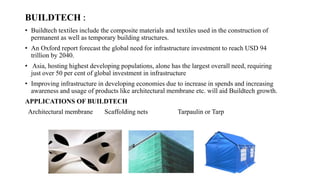
APPLICATIONS OF BUILDTECH
Architectural membrane Scaffolding nets Tarpaulin or Tarp
MOBILTECH :
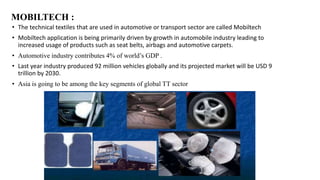
• The technical textiles that are used in automotive or transport sector are called Mobiltech
• Mobiltech application is being primarily driven by growth in automobile industry leading to
increased usage of products such as seat belts, airbags and automotive carpets.
• Automotive industry contributes 4% of world’s GDP .
• Last year industry produced 92 million vehicles globally and its projected market will be USD 9
trillion by 2030.
• Asia is going to be among the key segments of global TT sector
PROTECH :
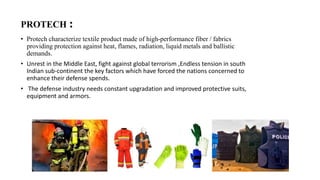
• Protech characterize textile product made of high-performance fiber / fabrics
providing protection against heat, flames, radiation, liquid metals and ballistic
demands.
• Unrest in the Middle East, fight against global terrorism ,Endless tension in south
Indian sub-continent the key factors which have forced the nations concerned to
enhance their defense spends.
• The defense industry needs constant upgradation and improved protective suits,
equipment and armors.
SPORTECH :
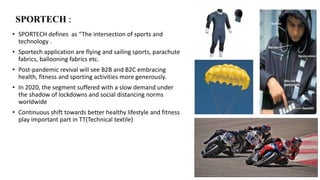
• SPORTECH defines as “The intersection of sports and
technology .
• Sportech application are flying and sailing sports, parachute
fabrics, ballooning fabrics etc.
• Post-pandemic revival will see B2B and B2C embracing
health, fitness and sporting activities more generously.
• In 2020, the segment suffered with a slow demand under
the shadow of lockdowns and social distancing norms
worldwide
• Continuous shift towards better healthy lifestyle and fitness
play important part in TT(Technical textile)
INDIA'S TT SECTOR:
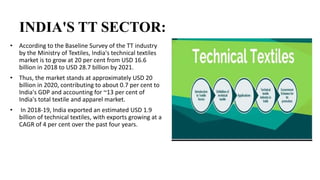
• According to the Baseline Survey of the TT industry
by the Ministry of Textiles, India's technical textiles
market is to grow at 20 per cent from USD 16.6
billion in 2018 to USD 28.7 billion by 2021.
• Thus, the market stands at approximately USD 20
billion in 2020, contributing to about 0.7 per cent to
India's GDP and accounting for ~13 per cent of
India's total textile and apparel market.
• In 2018-19, India exported an estimated USD 1.9
billion of technical textiles, with exports growing at a
CAGR of 4 per cent over the past four years.
TT During COVID-19 and its
impact on economy
• During COVID-19 crisis in 2020, TT ended up helping
Indian economy in an unexpected way. Unknowingly, it
became even more relevant during the pandemic crisis
when global manufacturing went into an indefinite
pause and India could neither export nor import critical
medical equipment including N95 face masks and
protective gears due to complete lockdown.
• Being entirely import-dependent for PPE kits India was
in no position to meet domestic demand for these
products. India's manufacturing output of these items
was nothing in March 2020 but within 60 days it was
producing 2.5 lakh PPE kits per day, catapulting to the
position of second largest manufacturer after China.
• India is now producing 4.5 lakh PPE kits and over 1.5
crore masks a day. This capability transformation
established the importance of India's TT sector .
OPPORTUNITY GALORE:
The tasks for the Indian technical textile sector includes:
• Production of necessary equipment's for the medical staff.
• Manufacturing of PPE kits on a large scale.
• Delivery of masks continuously for a long time.
• Storage facilities in cold houses for vaccines.
If India’s TT sector can live up to this delivery expectation its
arrival at world stage is going to be noticeably loud.
GOVERNMENT POLICIES AND SUPPORT:
• The Cabinet Committee on economic affairs approved the
establishment of National Technical Textile Mission.
• Government allowed 100% FDI(Foreign Direct
Investment) under automatic route.
• Government also established integrated textile parks,
eight centres of excellence and Amended Technology
Upgradation Fund Scheme.
• Government has also planned the extensive use of TT
products in several projects including health, road,
railway, urban development etc.
• Government trying to create a special fund of USD 13
million for R&D (research and development) in TT sector.
FUTURE OUTLOOK -
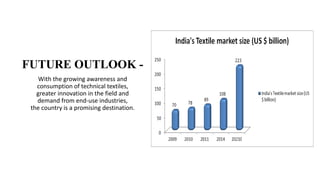
With the growing awareness and
consumption of technical textiles,
greater innovation in the field and
demand from end-use industries,
the country is a promising destination.
THANK YOU

Technical Textiles

  • 1.
  • 2.
    COURSE TITLE: HIGHPERFORMANCE FIBRES COURSE CODE : TS-207 SUBMITTED TO : Ms. SARAH JAVEED SUBMITTED BY:  AREEBA FATIMA (TS-002)
  • 3.
    Technical Textiles “Technical Textilesare defined as materials and products manufactured primarily for their technical and performance properties rather than their aesthetic or decorative characteristics.” OR “TT products are functional products with end-use applications across multiple non-conventional textile industries such as aerospace, healthcare, construction, automobile, and packaging among others” • TT products are manufactured using natural as well as man-made fibers and exhibit enhanced functional properties like higher tenacity, excellent insulation and improved thermal resistance. • The wide application of technical textiles is a major factor fueling the market growth.
  • 4.
    Global Market Outlook– • India estimates global TT market at USD 179.14 billion (2020), projected to touch USD 220 billion by 2025. The market is expected to grow at a CAGR of 4.2 per cent contributing 25-27 per cent share in global textile market. • Europe's TT market is projected to grow at a CAGR of 4.8-5.2 per cent between 2018 and 2022, driven by Buildtech, Indutech, Mobiltech, Oekotech and Sportech • In North America's TT market is estimated to grow at a CAGR of 3.1- 3.3 per cent with Geotech, Indutech, Mobiltech and Protech being main growth drivers. • Asia-Pacific region which is expected to grow at a CAGR of 5.6-5.8 per cent between 2017 and 2022. • TT applications of Buildtech, Indutech, Meditech, Mobiltech, Protech and Sportech are expected to grow higher than other sub-segments.
  • 5.
    Future Market Insights – "Theglobal anti-microbial wipes market is to witness a surge in demand and expected to surpass USD 7 billion by the end of 2020, growing at a CAGR of 10 per cent between 2020 and 2030. North America and Europe are expected to dominate this market over this period and South Asia will emerge as a lucrative market."
  • 6.
    SEGMENTS OF TECHNICALTEXTILES INDUTECH : • Industrial textiles is the segment of technical textile deals with textiles used in the diverse industrial applications. • Chinese manufacturing was hit by covid-19 pushing overseas clients to seek alternative. • Asian manufacturing industry, so far concentrated in China, has begun shifting to other Southeast Asian countries. • This will help Industrial textile demand to reach other Asian geographies, fuelling the growth.
  • 7.
    MEDITECH : • Medicaltextiles is the mixture of textile technology and medical science. • Emergence of COVID-19 increased the demand for medical products and services in global healthcare sector. • World population is also growing especially in Asia-Pacific region, offering a potentially large market for Medical textile. • Experts also feel that in the coming years, there will be a considerable demand for medical textile from developed regions, owing to rise in awareness about personal hygiene.
  • 8.
    BUILDTECH : • Buildtechtextiles include the composite materials and textiles used in the construction of permanent as well as temporary building structures. • An Oxford report forecast the global need for infrastructure investment to reach USD 94 trillion by 2040. • Asia, hosting highest developing populations, alone has the largest overall need, requiring just over 50 per cent of global investment in infrastructure • Improving infrastructure in developing economies due to increase in spends and increasing awareness and usage of products like architectural membrane etc. will aid Buildtech growth. APPLICATIONS OF BUILDTECH Architectural membrane Scaffolding nets Tarpaulin or Tarp
  • 9.
    MOBILTECH : • Thetechnical textiles that are used in automotive or transport sector are called Mobiltech • Mobiltech application is being primarily driven by growth in automobile industry leading to increased usage of products such as seat belts, airbags and automotive carpets. • Automotive industry contributes 4% of world’s GDP . • Last year industry produced 92 million vehicles globally and its projected market will be USD 9 trillion by 2030. • Asia is going to be among the key segments of global TT sector
  • 10.
    PROTECH : • Protechcharacterize textile product made of high-performance fiber / fabrics providing protection against heat, flames, radiation, liquid metals and ballistic demands. • Unrest in the Middle East, fight against global terrorism ,Endless tension in south Indian sub-continent the key factors which have forced the nations concerned to enhance their defense spends. • The defense industry needs constant upgradation and improved protective suits, equipment and armors.
  • 11.
    SPORTECH : • SPORTECHdefines as “The intersection of sports and technology . • Sportech application are flying and sailing sports, parachute fabrics, ballooning fabrics etc. • Post-pandemic revival will see B2B and B2C embracing health, fitness and sporting activities more generously. • In 2020, the segment suffered with a slow demand under the shadow of lockdowns and social distancing norms worldwide • Continuous shift towards better healthy lifestyle and fitness play important part in TT(Technical textile)
  • 12.
    INDIA'S TT SECTOR: •According to the Baseline Survey of the TT industry by the Ministry of Textiles, India's technical textiles market is to grow at 20 per cent from USD 16.6 billion in 2018 to USD 28.7 billion by 2021. • Thus, the market stands at approximately USD 20 billion in 2020, contributing to about 0.7 per cent to India's GDP and accounting for ~13 per cent of India's total textile and apparel market. • In 2018-19, India exported an estimated USD 1.9 billion of technical textiles, with exports growing at a CAGR of 4 per cent over the past four years.
  • 13.
    TT During COVID-19and its impact on economy • During COVID-19 crisis in 2020, TT ended up helping Indian economy in an unexpected way. Unknowingly, it became even more relevant during the pandemic crisis when global manufacturing went into an indefinite pause and India could neither export nor import critical medical equipment including N95 face masks and protective gears due to complete lockdown. • Being entirely import-dependent for PPE kits India was in no position to meet domestic demand for these products. India's manufacturing output of these items was nothing in March 2020 but within 60 days it was producing 2.5 lakh PPE kits per day, catapulting to the position of second largest manufacturer after China. • India is now producing 4.5 lakh PPE kits and over 1.5 crore masks a day. This capability transformation established the importance of India's TT sector .
  • 14.
    OPPORTUNITY GALORE: The tasksfor the Indian technical textile sector includes: • Production of necessary equipment's for the medical staff. • Manufacturing of PPE kits on a large scale. • Delivery of masks continuously for a long time. • Storage facilities in cold houses for vaccines. If India’s TT sector can live up to this delivery expectation its arrival at world stage is going to be noticeably loud.
  • 15.
    GOVERNMENT POLICIES ANDSUPPORT: • The Cabinet Committee on economic affairs approved the establishment of National Technical Textile Mission. • Government allowed 100% FDI(Foreign Direct Investment) under automatic route. • Government also established integrated textile parks, eight centres of excellence and Amended Technology Upgradation Fund Scheme. • Government has also planned the extensive use of TT products in several projects including health, road, railway, urban development etc. • Government trying to create a special fund of USD 13 million for R&D (research and development) in TT sector.
  • 16.
    FUTURE OUTLOOK - Withthe growing awareness and consumption of technical textiles, greater innovation in the field and demand from end-use industries, the country is a promising destination.
  • 17.