JANUARY/FEBRUARY 2008


                                             THE ARCHITECTURAL RESOURCE FOR DESIGNING WITH FABRIC


                                                             SU STA I N A B L E FA BRI C 1 0 1
                                                             First in an on-going series of
                                                             in-depth reports on an essential topic
                                                             Wrapping up energy waste
                                                             in Melbourne
                                                             AIA Learning Units
                                                             Green roof basics


  Subscribe at www.fabricarchitecture.info


0108FA_cv1-p15.indd
0108FA-CV1.indd   8   Sec1:cv1                                                              1/15/08   1:49:04 PM
                                                                                                      9:55:19 AM
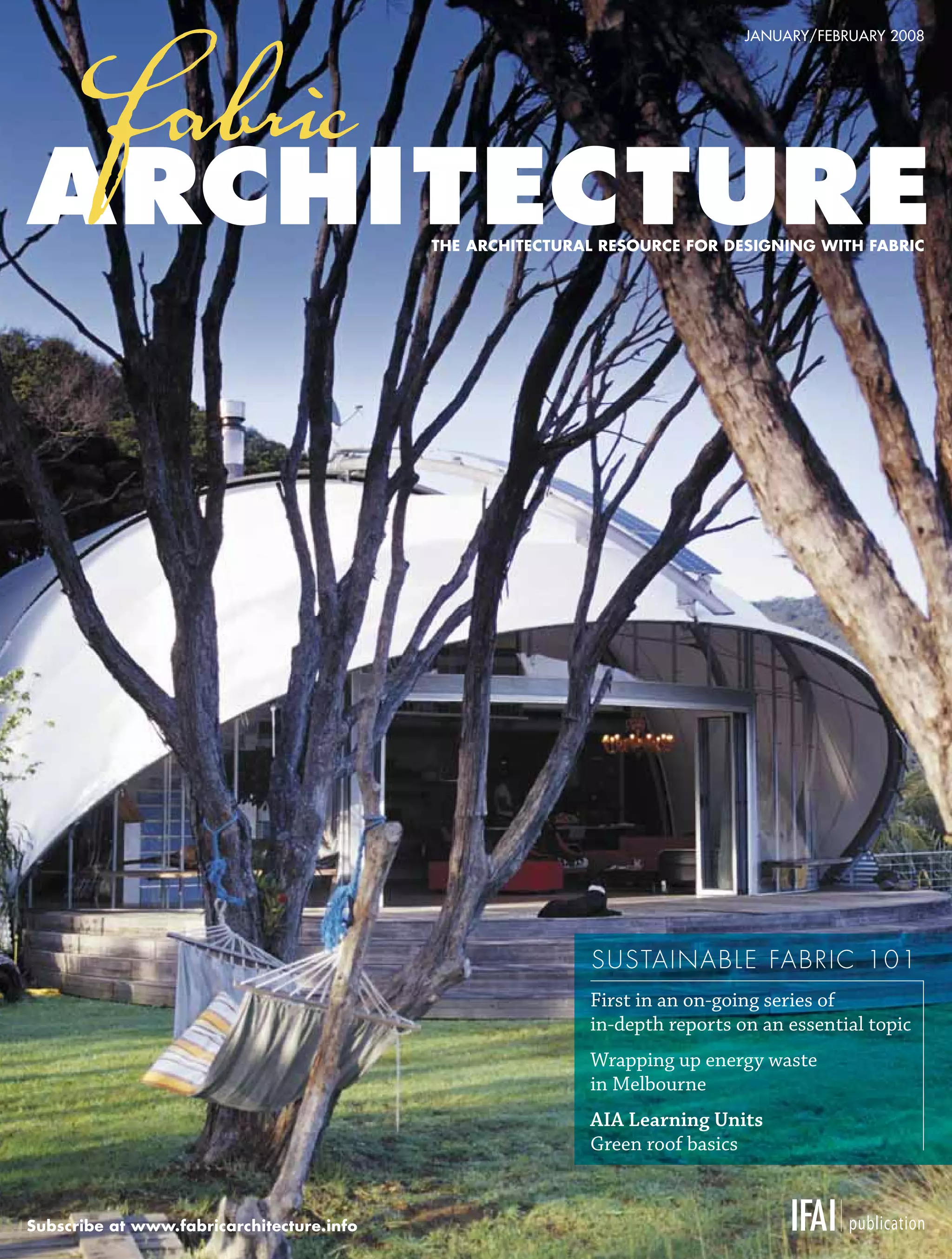
KNOCK IT OUT OF THE PARK
                                                                with Sunbrella ®.
          Season after season, the awnings at the St. Louis Cardinals’ awesome new Busch
          Stadium will welcome crowds thanks to Sunbrella® performance fabrics. With
          Sunbrella you get stunning colors that are permanently embedded into the very
          fiber of the fabric. This unique Sunbrella process provides vibrant colors and
          designs that are guaranteed to last five years in any weather. After all, Sunbrella
          has been the leader in quality fabrics for decades.

          For a winning season every year, specify Sunbrella fabric on your next awning
          project. It will mean less worry for your customers and ultimately less hassle
          for you. For more information on our variety
          of styles and colors, contact your Glen Raven
          sales representative or visit sunbrella.com.


                                                                                      www.sunbrella.com


                         Sunbrella® and               are registered trademarks of Glen Raven, Inc. Location courtesy of
                         the St. Louis Cardinals. Awning installation by Lawrence Fabric Structures, Inc., St. Louis, MO.


0108FA_cv1-p15.indd   Sec1:cv2                                                                                              1/15/08   1:49:12 PM
0108FA_cv1-p15.indd   Sec1:1   1/15/08   1:49:17 PM
0108FA_cv1-p15.indd   Sec1:2   1/15/08   1:49:19 PM
FABRIC ARCHITECTURE
                                                                                               VOLUME 20 NUMBER 1


         SUSTAINABLE FABRIC 101
         This issue begins an ongoing focus on the topic of sustainable
         design using fabric. This year, we will examine the subject from
         many points of view in an effort to bring you the latest industry
         information, technical data, and resources to help you address
         this most important (in light of recent global warming concerns,
         some would say essential) issue facing designers and society
         today. This issue opens the topic discussion, subsequent issues will
         address new materials and technologies, regionalism, educational
         programs, and practice (see “First word” on page 6.)


         36 Living lightly on the land
                 Fabric’s sustainable future may help
                 lead design forward.
                 BY Mason Riddle


         40 Wrapping it up
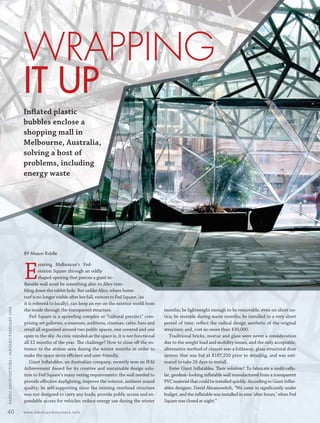
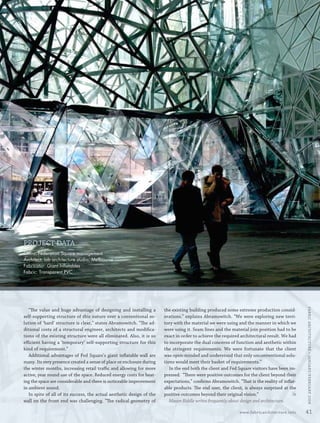
                 Inflated plastic bubbles enclose a shopping mall in
                 Melbourne, Australia solving a host of problems,
                 including energy waste.
                 BY Mason Riddle


         42 Noble endeavour                                                     ON THE
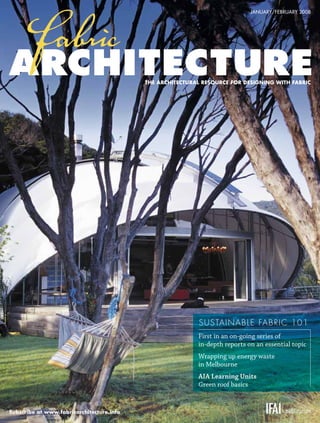
                 Expressive canopy crowns a New Zealand home.
                 BY Shelby Gonzalez
                                                                                COVER
                 COVER DESIGN BY Cathleen Rose
                 PHOTO COURTESY Structurflex
                                                                                                                               FABRIC ARCHI TECTURE • JANUARY/FEBRUARY 2008


         PORTFOLIO
         32 The best of 2007
                 Every year we bring you the award winners of the
                 International Achievement Awards. In this issue,
                 the structures category winners.


                                                                                              www.fabricarchitecture.info      3


0108FA_cv1-p15.indd   Sec1:3                                                                                         1/15/08     1:49:23 PM
FABRIC ARCHITECTURE
                                                 VOLUME 20 NUMBER 1


                                                                                      20      46                                                                  8

                                                 EXPERTISE                                   PRACTICE                                                         FOUNDATION
                                                 16 DESIGN | Energy                          22 ENVIRONMENT | Wind                                            6       FIRST WORD
                                                    Let the sun (not) shine in                  A mighty wind
                                                     A new report presents hard evidence          Textiles are applied to revolutionize                       8       SAMPLES
                                                     for the benefits of awnings in helping        hurricane protection systems.                                       The latest examples of new work,
                                                     provide more sustainable housing.            BY Sonja Hegman                                                     exhibitions, conferences and design
                                                     BY John Carmody, Kerry Haglund                                                                                   from around the world.
                                                     and Yu Joe Huang                        46 MATERIALS | Hospital fabrics
                                                                                                Keeping it clean
                                                 20 COMMENTARY | Trend watch                                                                                  14 REPORT | Las Vegas
                                                                                                  From waiting rooms to surgical suites
                                                    See the light                                 hospital purchasers look for fabrics
                                                                                                                                                                 Fabric Structures 2007 Symposium
                                                     New technologies bring light —               that protect and promote health.                                    What was said, what the future holds.
                                                     and the message — to fabric.                 BY Katherine Carlson                                                BY Bruce N. Wright
                                                     BY Lou Dzierzak
                                                                                             52 PRACTICE | Acoustics                                          59 AD INDEX
                                                 26 CONTINUING EDUCATION |                      Clear sound, clean design
                                                    Green roofs                                   Fabric reflectors make their debut at
                                                                                                                                                              60 SKETCHES | Design camp
                                                    Seeing green up top                           the new London Royal Festival Hall.
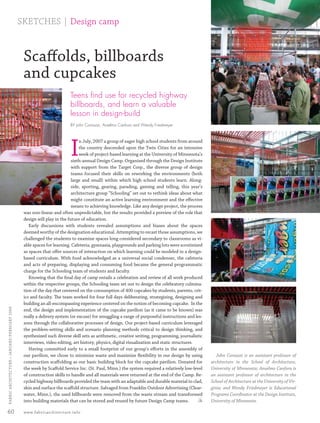
                                                                                                  BY Zackery Belanger                                            Scaffolds, billboards and cupcakes
                                                     A green roof primer.
                                                     BY Bruce Dvorak and                                                                                              Teens find use for recycled billboards,
                                                                                             56 RE | Vision                                                           and learn a valuable lesson in
                                                     Marcus de la fleur
  FABRIC ARCHI TECTURE • JANUARY/FEBRUARY 2008


                                                                                                Plane Geometry                                                        design-build.
                                                 31 CONTINUING EDUCATION |                        A San Antonio elementary school                                     BY John Comazzi, Anselmo Canfora
                                                    Self test/reporting form                      improves the educational experience                                 and Wendy Friedmeyer
                                                                                                  by adding a new canopy.

                                                                                             58 NEW PRODUCTS |
                                                                                                Sustainable/eco-friendly

                                                                                              Fabric Architecture (ISSN 1045-0483), Volume 20, Issue 1 is published bi-monthly by Industrial Fabrics Association
                                                   COMING NEXT ISSUE:                         International, 1801 County Road B W, Roseville, MN 55113-4061. Periodicals Postage Paid at Minneapolis, MN and at
                                                                                              additional mailing offices. Postmaster send address changes to Fabric Architecture, 1801 County Road B W, Roseville, MN
                                                   New materials and new technologies         55113-4061. Return undeliverable Canadian addresses to Station A, PO Box 54, Windsor, ON N9A 6J5.
                                                   for sustainable design. We explore a       Subscription inquiries, orders and changes contact: Sue Smeed, Assistant Circulation Manager, Fabric Architecture,
                                                   number of new products and processes       1801 County Road B W, Roseville, MN 55113-4061, Phone 800 225 4324 or +1 651 222 2508, fax +1 651 631 9334
                                                   to help you sort out what’s what.          e-mail: subscriptions@ifai.com. 1-year USA $39, Canada and Mexico $49, all other countries $69, payable in U.S.
                                                                                              funds (includes air mail postage). Reprints: call 800 385 9402, rdgrimes@ifai.com. Back Issues: call 800 207 0729,
                                                                                              smdamico@ifai.com, www.bookstore.ifai.com.


       4                                         www.fabricarchitecture.info


0108FA_cv1-p15.indd                                         Sec1:4                                                                                                                                                      1/15/08   2:26:54 PM
0108FA_cv1-p15.indd   Sec1:5   1/15/08   1:49:59 PM
FIRST WORD

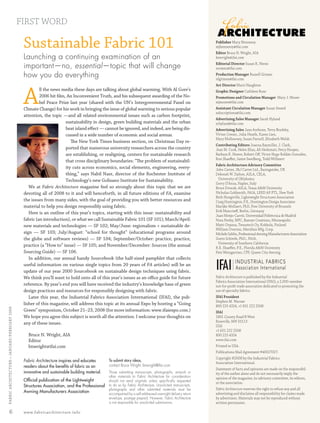
                                                  Sustainable Fabric 101                                                                                      Publisher Mary Hennessy
                                                                                                                                                              mjhennessy@ifai.com
                                                                                                                                                              Editor Bruce N. Wright, AIA
                                                  Launching a continuing examination of an                                                                    bnwright@ifai.com

                                                  important—no, essential—topic that will change                                                              Editorial Director Susan R. Niemi
                                                                                                                                                              srniemi@ifai.com
                                                  how you do everything                                                                                       Production Manager Russell Grimes
                                                                                                                                                              rdgrimes@ifai.com
                                                                                                                                                              Art Director Marti Naughton


                                                  A
                                                           ll the news media these days are talking about global warming. With Al Gore’s                      Graphic Designer Cathleen Rose
                                                           2006 hit film, An Inconvenient Truth, and his subsequent awarding of the No-                        Promotions and Circulation Manager Mary J. Moore
                                                           bel Peace Prize last year (shared with the UN’s Intergovernmental Panel on                         mjmoore@ifai.com
                                                  Climate Change) for his work in bringing the issue of global warming to serious popular                     Assistant Circulation Manager Susan Smeed
                                                                                                                                                              subscriptions@ifai.com
                                                  attention, the topic —and all related environmental issues such as carbon footprint,
                                                                                                                                                              Advertising Sales Manager Sarah Hyland
                                                                        sustainability in design, green building materials and the urban                      schyland@ifai.com
                                                                        heat island effect — cannot be ignored, and indeed, are being dis-                     Advertising Sales Jane Anthone, Terry Brodsky,
                                                                        cussed in a wide number of economic and social arenas.                                Vivian Cowan, Julia Heath, Karen Lien,
                                                                                                                                                              Mary Mullowney, Susan Parnell, Elizabeth Welsh
                                                                           The New York Times business section, on Christmas Day re-
                                                                                                                                                              Contributing Editors Joanna Baymiller, J. Clark,
                                                                        ported that numerous university researchers across the country                        Jean M. Cook, Helen Elias, Ali Heshmati, Percy Hooper,
                                                                        are establishing, or realigning, centers for sustainable research                     Barbara K. Hower, Robert Off, Víctor Hugo Roldán Gonzáles,
                                                                                                                                                              Ron Shaeffer, Jamie Swedberg, Todd Willmert
                                                                        that cross disciplinary boundaries: “The problem of sustainabil-
                                                                                                                                                              Fabric Architecture Advisory Committee
                                                                        ity cuts across economics, social elements, engineering, every-                       John Carter, J&J Carter Ltd., Basingstoke, UK
                                                                        thing,” says Nabil Nasr, director of the Rochester Institute of                       Deborah W. Dalton, ASLA, CELA,
                                                                        Technology’s new Golisano Institute for Sustainability.                                University of Oklahoma
                                                                                                                                                              Gerry D’Anza, Naples, Italy
                                                     We at Fabric Architecture magazine feel so strongly about this topic that we are                         Bruce Dvorak, ASLA, Texas A&M University
                                                  devoting all of 2008 to it and will henceforth, in all future editions of FA, examine                       Nicholas Goldsmith, FAIA, LEED AP FTL, New York
                                                                                                                                                              Beth Hungiville, Lightweight Structures Association
                                                  the issues from many sides, with the goal of providing you with better resources and                        Craig Huntington, P.E., Huntington Design Associates
                                                  material to help you design responsibly using fabric.                                                       Marijke Mollaert, PhD, Free University of Brussels
                                                                                                                                                              Erik Moncrieff, Berlin, Germany
                                                     Here is an outline of this year’s topics, starting with this issue: sustainability and
                                                                                                                                                              Juan Monjo-Carrió, Universidad Politécnica de Madrid
                                                  fabric (an introduction), or what we call Sustainable Fabric 101 (SF 101); March/April:                     Nora Norby, MFC, Banner Creations, Minneapolis
                                                  new materials and technologies — SF 102; May/June: regionalism + sustainable de-                            Matti Orpana, Tensotech Oy, Kokkola, Finland
                                                                                                                                                              William Overton, Meridian Mfg. Corp.
                                                  sign — SF 103; July/August: “school for thought” (educational programs around                               Michele Sahlin, Professional Awning Manufacturers Association
                                                  the globe and software reviews) — SF 104; September/October: practice, practice,                            Goetz Schierle, PhD., FAIA,
                                                                                                                                                               University of Southern California
                                                  practice (a “How to” issue) — SF 105; and November/December: Sources (the annual                            R.E. Shaeffer, P.E., Florida A&M University
                                                  Sourcing Guide) — SF 106.                                                                                   Pete Weingartner, CPP, Queen City Awning
                                                     In addition, our annual handy Sourcebook (the half-sized pamphlet that collects
                                                  useful information on various single topics from 20 years of FA articles) will be an
                                                  update of our year 2000 Sourcebook on sustainable design techniques using fabric.
                                                  We think you’ll want to hold onto all of this year’s issues as an office guide for future                     Fabric Architecture is published by the Industrial
                                                                                                                                                              Fabrics Association International (IFAI), a 2,000-member
                                                  reference. By year’s end you will have received the industry’s knowledge base of green                      not-for-profit trade association dedicated to promoting the
                                                  design practices and resources for responsibly designing with fabric.                                       use of specialty fabrics.
                                                     Later this year, the Industrial Fabrics Association International (IFAI), the pub-                       IFAI President
                                                                                                                                                              Stephen M. Warner
                                                  lisher of this magazine, will address this topic at its annual Expo by hosting a “Going                     800 225 4324, +1 651 222 2508
  FABRIC ARCHI TECTURE • JANUARY/FEBRUARY 2008


                                                  Green” symposium, October 21–23, 2008 (for more information: www.ifaiexpo.com.)                             IFAI
                                                  We hope you agree this subject is worth all the attention. I welcome your thoughts on                       1801 County Road B West
                                                  any of these issues.                                                                                        Roseville, MN 55113
                                                                                                                                                              USA
                                                                                                                                                              +1 651 222 2508
                                                    Bruce N. Wright, AIA                                                                                      800 225 4324
                                                    Editor                                                                                                    www.ifai.com
                                                    bnwright@ifai.com                                                                                         Printed in USA.
                                                                                                                                                              Publications Mail Agreement #40027027.
                                                                                                                                                              Copyright ©2008 by the Industrial Fabrics
                                                  Fabric Architecture inspires and educates       To submit story ideas,
                                                                                                                                                              Association International.
                                                  readers about the benefits of fabric as an       contact Bruce Wright, bnwright@ifai.com
                                                                                                                                                              Statement of facts and opinions are made on the responsibil-
                                                  innovative and sustainable building material.   Those submitting manuscripts, photographs, artwork or       ity of the author alone and do not necessarily imply the
                                                                                                  other materials to Fabric Architecture for consideration    opinion of the magazine, its advisory committee, its editors,
                                                  Official publication of the Lightweight          should not send originals unless specifically requested
                                                                                                                                                              or the association.
                                                  Structures Association, and the Professional    to do so by Fabric Architecture. Unsolicited manuscripts,
                                                                                                  photographs and other submitted materials must be           Fabric Architecture reserves the right to refuse any and all
                                                  Awning Manufacturers Association                accompanied by a self-addressed overnight delivery return   advertising and disclaims all responsibility for claims made
                                                                                                  envelope, postage prepaid. However, Fabric Architecture     by advertisers. Materials may not be reproduced without
                                                                                                  is not responsible for unsolicited submissions.             written permission.

       6                                          www.fabricarchitecture.info


0108FA_cv1-p15.indd                                            Sec1:6                                                                                                                                         1/15/08         1:49:59 PM
eye catching / breath taking


                         Birdair custom tensioned membrane structures, cable systems,
                                         and lightweight building structures
                                       expert design/build services, for projects large and small

                               progressive technical methods, premium fabrics and integrated solutions

                                         U.S.-based specialty company with global resources

                               Award-winning projects in tensile architecture await you


                                                         800-622-2246
                                                       www.birdair.com
                                                     Email: sales@birdair.com
                                            50 years of timeless innovation

0108FA_cv1-p15.indd   Sec1:7                                                                             1/15/08   1:50:01 PM
SAMPLES


                                                                                                              Ultra-green
                                                                                                              Sustainable prefab debuts at West Coast Green

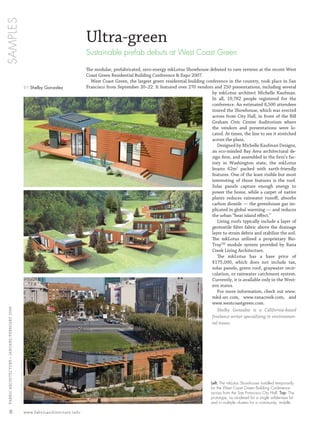
                                                                                                              The modular, prefabricated, zero-energy mkLotus Showhouse debuted to rave reviews at the recent West
                                                                                                              Coast Green Residential Building Conference & Expo 2007.
                                                                                                                West Coast Green, the largest green residential building conference in the country, took place in San
                                                                                BY Shelby Gonzalez            Francisco from September 20–22. It featured over 270 vendors and 250 presentations, including several
                                                                                                                                                                            by mkLotus architect Michelle Kaufman.
                                                                                                                                                                            In all, 10,782 people registered for the
                                                                                                                                                                            conference. An estimated 8,500 attendees
                                                                                                                                                                            toured the Showhouse, which was erected
                                                                                                                                                                            across from City Hall, in front of the Bill
                                                                                                                                                                            Graham Civic Center Auditorium where
                                                                                                                                                                            the vendors and presentations were lo-
                                                                                                                                                                            cated. At times, the line to see it stretched
                                                                                                                                                                            across the plaza.
                                                                                                                                                                               Designed by Michelle Kaufman Designs,
                                                                                                                                                                            an eco-minded Bay Area architectural de-
                                                                                                                                                                            sign firm, and assembled in the firm’s fac-
                                                                                                                                                                            tory in Washington state, the mkLotus
                                                                                                                                                                            boasts 62m2 packed with earth-friendly
                                                                                                                                                                            features. One of the least visible but most
                                                                                                                                                                            interesting of those features is the roof.
                                                                                                                                                                            Solar panels capture enough energy to
                                                                                                                                                                            power the home, while a carpet of native
                                                                                                                                                                            plants reduces rainwater runoff, absorbs
                                                                                                                                                                            carbon dioxide — the greenhouse gas im-
                                                                                                                                                                            plicated in global warming — and reduces
                                                                                                                                                                            the urban “heat island effect.”
                                                                                                                                                                               Living roofs typically include a layer of
                                                                                                                                                                            geotextile filter fabric above the drainage
                                                                                                                                                                            layer to strain debris and stabilize the soil.
                                                                                                                                                                            The mkLotus utilized a proprietary Bio-
                                                                                                                                                                            TrayTM module system provided by Rana
                                                                                                                                                                            Creek Living Architecture.
                                                                                                                                                                               The mkLotus has a base price of
                                                                                                                                                                            $175,000, which does not include tax,
                                                                                                                                                                            solar panels, green roof, graywater recir-
                                                                                                                                                                            culation, or rainwater catchment system.
                                                                                                                                                                            Currently, it is available only in the West-
                                                                                                                                                                            ern states.
                                                                                                                                                                               For more information, check out www.
                                                                                                                                                                            mkd-arc.com, www.ranacreek.com, and
                                                                                                                                                                            www.westcoastgreen.com.
  FABRIC ARCHI TECTURE • JANUARY/FEBRUARY 2008


                                                                                                                                                                               Shelby Gonzalez is a California-based
                                                                                                                                                                            freelance writer specializing in environmen-
                                                                                                                                                                            tal issues.
                                                 ALL IMAGES: WEST COAST GREEN


                                                                                                                                                                              Left: The mkLotus Showhouse installed temporarily
                                                                                                                                                                              for the West Coast Green Building Conference
                                                                                                                                                                              across from the San Francisco City Hall. Top: The
                                                                                                                                                                              prototype, as rendered for a single wilderness lot
                                                                                                                                                                              and in multiple clusters for a community, middle.

       8                                                                        www.fabricarchitecture.info


0108FA_cv1-p15.indd                                                                        Sec1:8                                                                                                                           1/15/08   1:50:01 PM
Wouldn’t it be nice to have an architectural fabric
                                                                                                beautiful enough to herald its arrival?
                                                                                                GORE™ TENARA® has redefined architectural fabric, so you can
                                                                                                create stunning outdoor designs that capture and filter light like no
                                                                                                other building material. Tenara lets in up to 40% more natural light
                                                                                                and folds or drapes like real fabric. Plus, with its unique, high-strength
                                                                                                expanded PTFE fiber technology, Tenara won’t fail under repeated
                                                                                                folding and flexing, and is weldable using any standard equipment—
                                                                                                so you can transform any space into a useful work of art.


       From the inventors of GORE-TEX TM fabric and outerwear, W.L. Gore & Associates
       has over 30 years of proven product and market experience in the textiles industry.
       15 YEAR GUARANTEE                                     gore.com/tenaraaf                  Tel: +1.800.276.8451

       GORE, GORE-TEX, Tenara and designs are trademarks of W.L. Gore & Associates, Inc. ©2007 W.L. Gore & Associates, Inc.


0108FA_cv1-p15.indd      Sec1:9                                                                                                                                1/15/08   1:50:48 PM
SAMPLES

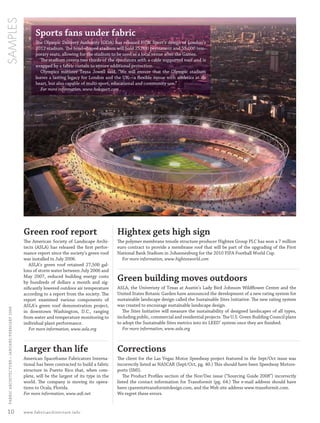
                                                       Sports fans under fabric
                                                       The Olympic Delivery Authority (ODA) has released HOK Sport’s design of London’s
                                                       2012 stadium. The bowl-shaped stadium will hold 25,000 permanent and 55,000 tem-
                                                       porary seats, allowing for the stadium to be used as a local venue after the Games.
                                                          The stadium covers two thirds of the spectators with a cable supported roof and is
                                                       wrapped by a fabric curtain to ensure additional protection.
                                                          Olympics minister Tessa Jowell said, “We will ensure that the Olympic stadium
                                                       leaves a lasting legacy for London and the UK—a flexible venue with athletics at its
                                                       heart, but also capable of multi-sport, educational and community use.”
                                                          For more information, www.hoksport.com


                                                 Green roof report                               Hightex gets high sign
                                                 The American Society of Landscape Archi-        The polymer membrane tensile structure producer Hightex Group PLC has won a 7 million
                                                 tects (ASLA) has released the first perfor-      euro contract to provide a membrane roof that will be part of the upgrading of the First
                                                 mance report since the society’s green roof     National Bank Stadium in Johannesburg for the 2010 FIFA Football World Cup.
                                                 was installed in July 2006.                       For more information, www.hightexworld.com
                                                    ASLA’s green roof retained 27,500 gal-
                                                 lons of storm water between July 2006 and
                                                 May 2007, reduced building energy costs
                                                 by hundreds of dollars a month and sig-
                                                                                                 Green building moves outdoors
                                                 nificantly lowered outdoor air temperature       ASLA, the Univeristy of Texas at Austin’s Lady Bird Johnson Wildflower Center and the
                                                 according to a report from the society. The     United States Botanic Garden have announced the development of a new rating system for
                                                 report examined various components of           sustainable landscape design called the Sustainable Sites Initiative. The new rating system
                                                 ASLA’s green roof demonstration project,        was created to encourage sustainable landscape design.
  FABRIC ARCHI TECTURE • JANUARY/FEBRUARY 2008


                                                 in downtown Washington, D.C., ranging              The Sites Initiative will measure the sustainability of designed landscapes of all types,
                                                 from water and temperature monitoring to        including public, commercial and residential projects. The U.S. Green Building Council plans
                                                 individual plant performance.                   to adopt the Sustainable Sites metrics into its LEED® system once they are finished.
                                                    For more information, www.asla.org              For more information, www.asla.org


                                                 Larger than life                                Corrections
                                                 American Spaceframe Fabricators Interna-        The client for the Las Vegas Motor Speedway project featured in the Sept/Oct issue was
                                                 tional has been contracted to build a fabric    incorrectly listed as NASCAR (Sept/Oct, pg. 40.) This should have been Speedway Motors-
                                                 structure in Puerto Rico that, when com-        ports (SMI).
                                                 plete, will be the largest of its type in the      The Product Profiles section of the Nov/Dec issue (“Sourcing Guide 2008”) incorrectly
                                                 world. The company is moving its opera-         listed the contact information for Transformit (pg. 64.) The e-mail address should have
                                                 tions to Ocala, Florida.                        been cparent@transformitdesign.com, and the Web site address www.transformit.com.
                                                 For more information, www.asfi.net               We regret these errors.


 10                                              www.fabricarchitecture.info


0108FA_cv1-p15.indd                                          Sec1:10                                                                                                                    1/15/08   1:50:49 PM
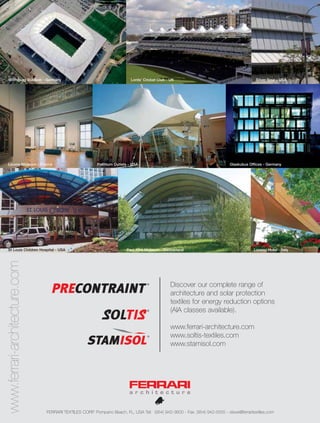
Wolfsburg Stadium - Germany                                             Lords' Cricket Club - UK                                     Silver Spur - USA


 Louvre Museum - France                                 Premium Outlets - USA                                            Glaskubus Offices - Germany


 St Louis Children Hospital - USA                                      Paul Klee Museum - Switzerland                                Lorenzi Hotel - Italy
 www.ferrari-architecture.com


                                                                                               Discover our complete range of
                                                                                               architecture and solar protection
                                                                                               textiles for energy reduction options
                                                                                                                                                                    FABRIC ARCHI TECTURE • JANUARY/FEBRUARY 2008


                                                                                               (AIA classes available).

                                                                                               www.ferrari-architecture.com
                                                                                               www.soltis-textiles.com
                                                                                               www.stamisol.com


                                FERRARI TEXTILES CORP. Pompano Beach, FL, USA Tel: (954) 942-3600 - Fax: (954) 942-5555 - steve@ferraritextiles.com
                                                                                                                               www.fabricarchitecture.info          11


0108FA_cv1-p15.indd             Sec1:11                                                                                                                   1/15/08     1:50:52 PM
SAMPLES
                                                 Off the grid                                                                                       Conferences
                                                 A recent design probe from Philips called Off the grid: Sustainable Habitat 2020 is ex-            Winnipeg, Canada 16–18 May 2008
                                                 ploring the possibility of using sensitive textile skins on buildings to create energy inde-      “Fabric Formwork for Architectural
                                                 pendent structures.                                                                               Structures”
                                                   The probe explores the integration of electronics and bio chemical functionalities into         The first international conference explor-
                                                 the inert material of the built environment. This future habitat shifts from the current state    ing recent developments in flexible fabric
                                                                                                   where the building surfaces are benign in-      formworks for concrete structures will fo-
                                                                                                   ert materials only used for construction        cus on new architectural forms, hear invit-
                                                                                                   and shielding purposes, to sensitive func-      ed speakers from numerous countries and
                                                                                                   tional skins that are alive and act as mem-     hold workshop demonstrations.
                                                                                                   branes to harness energy. A membrane              For more information,
                                                                                                   creates a strong link between the interior        www.umanitoba.ca/architecture/ffc/
                                                                                                   and exterior of the habitat, used as a trans-
                                                                                                   porter of air, water and light, taking build-   Turin, Italy 1–2 July 2008
                                                                                                   ings off the grid.                               “Architex”
                                                                                                      For more information,                        As part of the international gathering cel-
                                                                                                      www.design.philips.com                       ebrating Turin World Design Capital 2008,
                                                                                                                                                   Architex brings professionals together
                                                                                                                                                   from the textile industries with architects
                                                                                                                                                   and designers. Tied also with the XXIII
                                                                                                                                                   World Congress of Architecture, this ex-
                                                                                                                                                   hibition and symposium will examine the
                                                                                                                                                   latest developments for textiles, including
                                                                                                                                                   phase change materials, reflecting and lu-
                                                                                                                                                   minescent fabrics, color, and architectural
                                                                                                                                                   components for fabric structures.
                                                                                                                                                      For more information,
                                                                                                                                                      http://architextorino.com/index.php?eng FA
  FABRIC ARCHI TECTURE • JANUARY/FEBRUARY 2008


 12                                              www.fabricarchitecture.info


0108FA_cv1-p15.indd                                          Sec1:12                                                                                                                       1/15/08   1:50:53 PM
Bernburg
                                Dessau
                                Köthen


                                Hochschule Anhalt (FH)
                                Anhalt University of Applied Sciences


0108FA_cv1-p15.indd   Sec1:13                              1/15/08      1:50:59 PM
REPORT | Las Vegas


                                                  Fabric Structures
                                                  discussed at symposium

                                                                                             T
                                                  BY Bruce N. Wright                                 his past year’s Fabric Structures symposium—held the day
                                                                                                     before IFAI Expo in Las Vegas, Oct. 2, 2007—focused on a
                                                                                                     single theme that had everyone abuzz: the future and im-
                                                                                             portance of sustainable practices in business. The day-long session
                                                                                             opened with a rousing call to action by noted architect and expert
                                                                                             on sustainable design Lance Hosey, AIA, LEED AP, partner in what
                                                                                             is perhaps the leading sustainability consulting design firm in the
                                                                                             world, William McDonough & Partners. Hosey touched on all the
                                                                                             key issues that all designers (indeed, all businesses) must address
                                                                                             in the near future: adapting existing materials to a more sustain-
                                                                                             able position, embracing aesthetics as part of successful sustain-
                                                                                             able designs (not ignoring aesthetics as early practitioners often
                                                                                                                    did during environmentalism’s beginnings in
                                                                                                                    the 1970s), and integrating sustainable con-
                                                  “Designs can utilize new                                          cepts into today’s built environment so that
                                                  technologies, such as LED lighting                                these new sustainable-driven forms actually
                                                                                                                    enhance a building’s performance.
                                                  and integrated photovoltaics, to                                     Hosey made the trenchant observation that much of sustainabil-
                                                                                                                    ity practice today is doing old things better. He notes that many of
                                                  increase a building’s efficiency and                                the earlier environmental movement’s concepts—recycling plastics,
                                                                                                                    rainwater collection for reuse, minimizing biomass impact on eco-
                                                  minimize its negative impact on                                   systems, etc.—was right minded, just not resolved in sustainable
                                                                                                                    ways so that each concept could contribute to the greater health of
                                                  the environment, while providing                                  the world. He also admitted that much of what was done in the ’70s
                                                                                                                    was ugly. “It doesn’t have to look this way,” he says. “Aesthetics are
                                                  a delightful, enriching setting.”                                 not ‘icing on the cake’ but integral with design.” However, he warned
                                                                                                                    designers that sustainable designs need to accommodate the unique
                                                  —Cindy Thompson, Transformit
                                                                                                                    circumstances of each building—only styles that are appropriate to
                                                                                             a region should be used—and that across-the-board, cookie-cutter designs slapped down
                                                                                             without regard to local history or styles will not in the end be sustainable.
                                                                                                Hosey was followed by Cindy Thompson, president of Transformit, and
  FABRIC ARCHI TECTURE • JANUARY/FEBRUARY 2008


                                                                                             a partner in the new collaborative The Fabric Alliance, a sustainability-
                                                                                             focused research group that promotes the use of fabrics and fabric struc-
                                                                                             ture technology as a sustainable method. Thompson emphasized interior
                                                                                             applications, how they can contribute to sustainable efforts, and how
                                                                                             important it is to “design for delight.” Designs can utilize new technolo-
                                                                                             gies, such as LED lighting and integrated photovoltaics, to increase
                                                                                             a building’s efficiency and minimize its negative im-
                                                                                             pact on the environment, while providing
                                                                                             a delightful, enriching setting.
                                                                                                Architect Douglas Kozel discussed
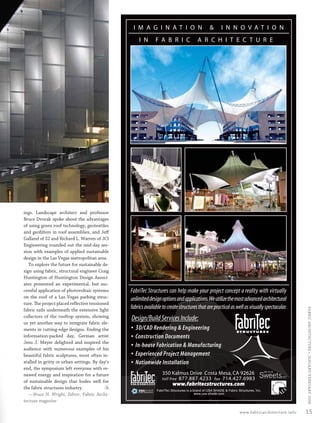
                                                  Right: Fabric sculptor Jens J. Meyer       several modest but highly sophis-
                                                  inspired and delighted attendees at the    ticated designs for office buildings
                                                  Fabric Structures 2007 symposium held      in the Madison, Wisconsin area, all
                                                  in Las Vegas, last October. Opposite,
                                                  above: Naturally integrated shade fins by   naturally integrating fabric shade
                                                  KEE Architects, Madison, Wisconsin.        fins on the south sides of the build-

 14                                               www.fabricarchitecture.info


0108FA_cv1-p15.indd                                            Sec1:14                                                                                                               1/15/08   2:35:41 PM
I M A G I N AT I O N                         &       I N N O V AT I O N
                                                              I N      FA B R I C                 A R C H I T E C T U R E


         ings. Landscape architect and professor
         Bruce Dvorak spoke about the advantages
         of using green roof technology, geotextiles
         and geofilters in roof assemblies, and Jeff
         Galland of S2 and Richard L. Warren of JCI
         Engineering rounded out the mid-day ses-
         sion with examples of applied sustainable
         design in the Las Vegas metropolitan area.
            To explore the future for sustainable de-
         sign using fabric, structural engineer Craig
         Huntington of Huntington Design Associ-
         ates presented an experimental, but suc-
         cessful application of photovoltaic systems     FabriTec Structures can help make your project concept a reality with virtually
         on the roof of a Las Vegas parking struc-       unlimited design options and applications.We utilize the most advanced architectural
         ture. The project placed reflective tensioned
                                                         fabrics available to create structures that are practical as well as visually spectacular.
                                                                                                                                                                FABRIC ARCHI TECTURE • JANUARY/FEBRUARY 2008


         fabric sails underneath the extensive light
         collectors of the rooftop system, showing
                                                         Design/Build Services Include:
         us yet another way to integrate fabric ele-
         ments in cutting-edge designs. Ending the       •   3D/CAD Rendering & Engineering
         information-packed day, German artist           •   Construction Documents
         Jens J. Meyer delighted and inspired the
                                                         •   In-house Fabrication & Manufacturing
         audience with numerous examples of his
         beautiful fabric sculptures, most often in-     •   Experienced Project Management
         stalled in gritty or urban settings. By day’s   •   Nationwide Installation
         end, the symposium left everyone with re-
         newed energy and inspiration for a future                         350 Kalmus Drive Costa Mesa, CA 92626
                                                                           toll free 877.887.4233 fax 714.427.6983
         of sustainable design that bodes well for
                                                   F                              www.fabritecstructures.com
         the fabric structures industry.            A
                                                                        FabriTec Structures is a brand of USA SHADE & Fabric Structures, Inc.
            —Bruce N. Wright, Editor, Fabric Archi-                                               www.usa-shade.com

         tecture magazine

                                                                                                                              www.fabricarchitecture.info       15


0108FA_cv1-p15.indd   Sec1:15                                                                                                                         1/15/08     1:51:06 PM
DESIGN | Energy


                                                  Let the sun (not) shine in
                                                  A new report presents hard evidence for the benefits of awnings
                                                  in helping provide more sustainable housing

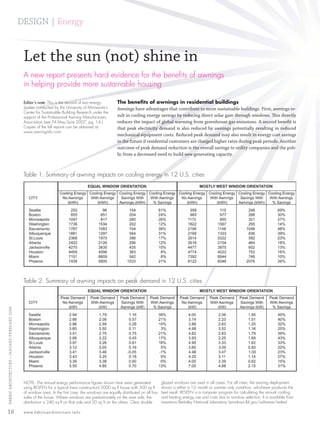
                                                  Editor’s note: This is the second of two energy         The benefits of awnings in residential buildings
                                                  studies conducted by the University of Minnesota’s      Awnings have advantages that contribute to more sustainable buildings. First, awnings re-
                                                  Center for Sustainable Building Research under the
                                                  support of the Professional Awning Manufacturers        sult in cooling energy savings by reducing direct solar gain through windows. This directly
                                                  Association (see FA May/June 2007, pg. 14.)             reduces the impact of global warming from greenhouse gas emissions. A second benefit is
                                                  Copies of the full reports can be obtained at:          that peak electricity demand is also reduced by awnings potentially resulting in reduced
                                                  www.awninginfo.com.
                                                                                                          mechanical equipment costs. Reduced peak demand may also result in energy cost savings
                                                                                                          in the future if residential customers are charged higher rates during peak periods. Another
                                                                                                          outcome of peak demand reduction is the overall savings to utility companies and the pub-
                                                                                                          lic from a decreased need to build new generating capacity.


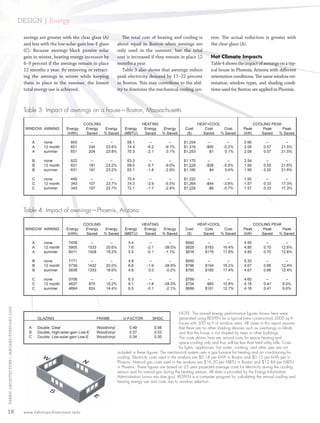
                                                  Table 1: Summary of awning impacts on cooling energy in 12 U.S. cities


                                                  Table 2: Summary of awning impacts on peak demand in 12 U.S. cities
  FABRIC ARCHI TECTURE • JANUARY/FEBRUARY 2008
                  TURE


                                                  NOTE: The annual energy performance figures shown here were generated                glazed windows are used in all cases. For all cities, the awning deployment
                                                  using RESFEN for a typical (new construction) 2000 sq ft house with 300 sq ft       shown is either a 12- month or summer only condition, whichever produces the
                                                  of window area. In the first case, the windows are equally distributed on all four   best result. RESFEN is a computer program for calculating the annual cooling
                                                  sides of the house. Where windows are predominately on the west side, the           and heating energy use and costs due to window selection. It is available from
                                                  distribution is 240 sq ft on that side and 20 sq ft on the others. Clear double     Lawrence Berkeley National Laboratory (windows.lbl.gov/software/resfen)

 16                                               www.fabricarchitecture.info


0108FA_p16-p25.indd                                             Sec2:16                                                                                                                                         1/15/08   1:31:22 PM
Cooling energy savings and                        predominantly cold climate (Boston) and a     ing and whether the awnings are in place 12
         peak demand reduction                             predominantly hot climate (Phoenix). Win-     months per year or only in the summer.
         Tables 1 and 2 show the impact of aw-             dow types shown are clear double glazing,        For a house with windows equally dis-
         nings on reducing cooling energy and peak         high-solar-gain low-E glazing, and low-so-    tributed on the four sides, Table 3 shows
         demand in 12 U.S. cities with different cli-       lar-gain low-E glazing. Shading conditions    the annual heating and cooling energy use
         mates. The cities are listed starting with        include: no shading, awnings deployed 12      and the peak electricity demand for each
         the lowest cooling energy use (Seattle) up        months a year, and awnings deployed in        combination of glazing and shading condi-
         to the highest (Phoenix). For each city,          the summer only.                              tion. Table 3 also shows the impact on the
         results are shown for two typical houses.                                                       total cost of heating and cooling. In each
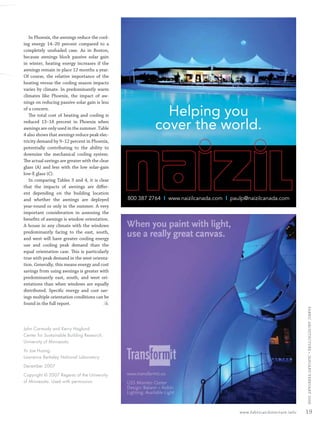
         The first house has windows equally dis-           Cold Climate Impacts                          case, the table shows the percent savings
         tributed on all four orientations while the       Table 3 shows the impact of awnings on a      compared to the unshaded condition.
         second house has 80 percent of the win-           typical house in Boston, Massachusetts, a        As shown in Table 3, the awnings reduce
         dows facing west (the case with the high-         predominantly cold climate. The impact var-   the cooling energy 23–24 percent compared
         est cooling energy use from heat gain).           ies depending on the type of window glaz-     to a completely unshaded case. The actual
         The results in Tables 1 and 2 represent the
         best case for savings when awnings are ap-
         plied to clear double-glazed windows and
         operated seasonally (details appear in the
         full report).
            Table 1 shows cooling energy savings in
         all cities for all orientations, while Table 2
         shows peak demand savings in most cit-
         ies. In all cases, the cooling energy and
         peak demand savings from awnings are
         greater in the house with predominately
         west-facing windows. The highest percent-
         age savings do not necessarily produce the
         highest actual savings. This occurs because
         some of the warmer cities with lower per-
         centage savings have greater actual cool-
         ing energy and peak demand savings than
         colder climate cities with higher percentage
                                                                                                                                                         FABRIC ARCHI TECTURE • JANUAR


         savings and lower actual savings. Surpris-
         ingly, there can be little or no peak demand
         savings from awnings in some hot, humid
         cities. This is due to climatic variations that
         influence whether peak demand is driven
         more by solar gain through windows or by
         factors such as temperature and humidity.
         It is important to remember that these re-
                                                                                                                                                                                JANUARY/FEBRUARY 2008


         sults are for a 2000 sq ft house and should
         be interpolated for larger houses. In addi-
         tion, the energy prices may rise in the fu-
         ture increasing the savings and shortening
         the payback for investing in awnings.
            Tables 3 and 4 show more extensive set
         of impacts from awnings for two cities: a

                                                                                                                       www.fabricarchitecture.info       17


0108FA_p16-p25.indd   Sec2:17                                                                                                                  1/15/08     1:31:32 PM
DESIGN | Energy

                                                  savings are greater with the clear glass (A)      The total cost of heating and cooling is               tem. The actual reduction is greater with
                                                  and less with the low-solar-gain low-E glass   about equal in Boston when awnings are                    the clear glass (A).
                                                  (C). Because awnings block passive solar       only used in the summer, but the total
                                                  gain in winter, heating energy increases by    cost is increased if they remain in place 12              Hot Climate Impacts
                                                  6–9 percent if the awnings remain in place     months a year.                                            Table 4 shows the impact of awnings on a typ-
                                                  12 months a year. By removing or retract-         Table 3 also shows that awnings reduce                 ical house in Phoenix, Arizona with different
                                                  ing the awnings in winter while keeping        peak electricity demand by 17–22 percent                  orientation conditions. The same window ori-
                                                  them in place in the summer, the lowest        in Boston. This may contribute to the abil-               entation, window types, and shading condi-
                                                  total energy use is achieved.                  ity to downsize the mechanical cooling sys-               tions used for Boston are applied in Phoenix.


                                                  Table 3: Impact of awnings on a house—Boston, Massachusetts


                                                  Table 4: Impact of awnings—Phoenix, Arizona
  FABRIC ARCHI TECTURE • JANUARY/FEBRUARY 2008


                                                                                                                                         NOTE: The annual energy performance figures shown here were
                                                                                                                                         generated using RESFEN for a typical (new construction) 2000 sq ft
                                  EBRUARY


                                                                                                                                         house with 300 sq ft of window area. All cases in this report assume
                                                                                                                                         that there are no other shading devices such as overhangs or blinds
                                                                                                                                         and that the house is not shaded by trees or other buildings.
                                                                                                                                         The costs shown here are annual costs for space heating and
                                                                                                                                         space cooling only and thus will be less than total utility bills. Costs
                                                                                                                                         for lights, appliances, hot water, cooking, and other uses are not
                                                                                                 included in these figures. The mechanical system uses a gas furnace for heating and air conditioning for
                                                                                                 cooling. Electricity costs used in the analysis are $0.18 per kWh in Boston and $0.12 per kWh per in
                                                                                                 Phoenix. Natural gas costs used in the analysis are $16.20 per MBTU in Boston and $12.84 per MBTU
                                                                                                 in Phoenix. These figures are based on 25 year projected average costs for electricity during the cooling
                                                                                                 season and for natural gas during the heating season. All data is provided by the Energy Information
                                                                                                 Administration (www.eia.doe.gov). RESFEN is a computer program for calculating the annual cooling and
                                                                                                 heating energy use and costs due to window selection.


 18                                               www.fabricarchitecture.info


0108FA_p16-p25.indd                                           Sec2:18                                                                                                                                       1/15/08   1:31:33 PM
In Phoenix, the awnings reduce the cool-
         ing energy 14–20 percent compared to a
         completely unshaded case. As in Boston,
         because awnings block passive solar gain
         in winter, heating energy increases if the
         awnings remain in place 12 months a year.
         Of course, the relative importance of the
         heating versus the cooling season impacts
         varies by climate. In predominantly warm
         climates like Phoenix, the impact of aw-
         nings on reducing passive solar gain is less
         of a concern.
            The total cost of heating and cooling is                 Helping you
         reduced 13–18 percent in Phoenix when
         awnings are only used in the summer. Table
         4 also shows that awnings reduce peak elec-
                                                                   cover the world.
         tricity demand by 9–12 percent in Phoenix,
         potentially contributing to the ability to
         downsize the mechanical cooling system.
         The actual savings are greater with the clear
         glass (A) and less with the low solar-gain
         low-E glass (C).
            In comparing Tables 3 and 4, it is clear
         that the impacts of awnings are differ-
         ent depending on the building location
         and whether the awnings are deployed            800 387 2764 I www.naizilcanada.com I paulp@naizilcanada.com
         year-round or only in the summer. A very
         important consideration in assessing the
         benefits of awnings is window orientation.
         A house in any climate with the windows
         predominantly facing to the east, south,
         and west will have greater cooling energy
         use and cooling peak demand than the
         equal orientation case. This is particularly
         true with peak demand in the west orienta-
         tion. Generally, this means energy and cost
         savings from using awnings is greater with
         predominantly east, south, and west ori-
         entations than when windows are equally
         distributed. Specific energy and cost sav-
         ings multiple orientation conditions can be
         found in the full report.                 FA
                                                                                                                                   FABRIC ARCHI TECTURE • JANUARY/FEBRUARY 2008


         John Carmody and Kerry Haglund
         Center for Sustainable Building Research,
         University of Minnesota

         Yu Joe Huang
         Lawrence Berkeley National Laboratory

         December 2007

         Copyright © 2007 Regents of the University
         of Minnesota. Used with permission.


                                                                                                  www.fabricarchitecture.info      19


0108FA_p16-p25.indd   Sec2:19                                                                                            1/15/08     1:31:36 PM
COMMENTARY | Trend watch


                                                  See the light
                                                  New technologies bring light—
                                                  and the message—to fabric


                                                  BY Lou Dzierzak


                                                  B
                                                          usinesses operate on a 24-hour clock today. Capturing the attention of customers
                                                          once the sun goes down requires ingenuity, creativity and staying abreast of new
                                                          technologies. Since commerce after dark is too big of a market to ignore, new cutting
                                                  edge technologies are offering new solutions to traditional backlit fabrics.
                                                     Oracal USA, Black Creek, GA recently introduced two vinyl film products certified by Cee-
                                                  Lite LLC that use the company’s cutting edge LEC (light-emitting capacitor) technology.
                                                  CeeLite LEC panels can turn any surface into a light source. The paper-thin LEC panels
                                                  do not generate heat and require very little power for illumination. CeeLite panels use a
                                                  LEC structure with Sylvania phosphors placed between a series of electrodes. Powered by
                                                  AC voltage, the electricity generates a changing field within the phosphors that causes the
                                                  phosphors to emit light.
                                                     Craig Campbell, product applications manager at ORACAL sees tremendous opportu-
                                                  nities ahead, “The growth potential is truly immeasurable. By providing the only CeeLite-
                                                  certified inkjet media that is currently available, our Orajet Series 3880 is generating


                                                  “Using the combination of these technologies has
                                                  allowed graphic providers to think outside the box and
                                                  put illuminated images where never thought possible.”
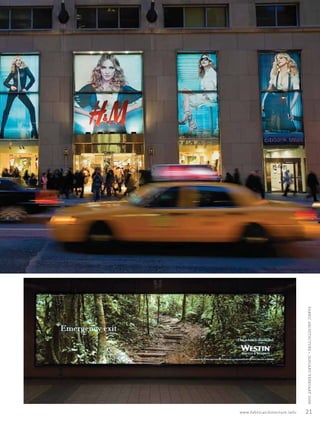
                                                                                                                                                       Top: CeeLite LEC panels were used to create a gi-
                                                  Craig Campbell, product applications manager ORACAL                                                  ant 160m2 interactive display illuminating five two-
                                                                                                                                                       story high images of Madonna to produce a fully
                                                                                                                                                       interactive fashion show that lights up New York’s
                                                                                                                                                       Fifth Avenue. Opposite, below: CeeLite technology
                                                  interest on a global scale. Projects using the combination of these technologies has al-             also was used on indoor billboards in the Grand
  FABRIC ARCHI TECTURE • JANUARY/FEBRUARY 2008


                                                  lowed graphic providers to think outside the box and put illuminated images where never              Central Station subway for Westin Hotels.
                                                  thought possible.”
                                                    Blue Ocean Worldwide, a creative services and production firm in New York, NY
                                                    has used CeeLite technology to create illuminated Absolut Vodka bus vehicle wraps, sig-
                                                  nage for the Washington Redskin’s Fedex Field and indoor billboards for the Westin Hotels
                                                  on display in New York’s Grand Central Station subway.
                                                    David Stadler, ceo of Blue Ocean states, “I truly believe this product will completely             CONTACTS
                                                  change the industry. It’s such a versatile product that can do so many things.” Blue Ocean           Herculite Products Inc.
                                                  uses litho, screen or digital printing to apply graphics. Limitations are few but include ad-        www.herculite.com
                                                  dressing size limitations if seams are needed.                                                       Oracal
                                                    Stadler often has to calm overly enthusiastic customers after they see CeeLite presented.          www.oracal.com
                                                  “Once that is panel on, people’s minds take off and they have lots of ideas. You have to              CeeLite
                                                  sometimes slow them down a little bit.”
                                                                                                                                                 FA    www.ceelite.com
                                                    Lou Dzierzak is a freelance writer/editor who covers technical topics on a regular basis for nu-   Blue Ocean Worldwide
                                                  merous trade journals.                                                                               www. blueoceanworldwide.com

 20                                               www.fabricarchitecture.info


0108FA_p16-p25.indd                                            Sec2:20                                                                                                                               1/15/08   1:31:38 PM
FABRIC ARCHI TECTURE • JANUARY/FEBRUARY 2008


                                www.fabricarchitecture.info      21


0108FA_p16-p25.indd   Sec2:21                          1/15/08     1:31:41 PM
ENVIRONMENT | Wind


                                                                                                                                 A mighty
                                                                                                                                 wind
                                                                                                                                 Textiles are applied to
                                                                                                                                 revolutionize the capacity
                                                                                                                                 of hurricane protection
                                                                                                                                 systems

                                                                                                                                            BY Sonja Hegman


                                                                                                                                 T
                                                                                                                                           he hurricane barrier/protection in-
                                                                                                                                           dustry started about 50 years ago.
                                                                                                                                           Initially, only wood planks were
                                                                                                                                  used to board up windows, and the more
                                                                                                                                  well-to-do homeowner used wood shutters
                                                                                                                                  with iron clasps to keep out the elements.
                                                                                                                                  “Now, wood shutters are commonly used
                                                                                                                                  for decoration,” says Dennis Grubb, found-
                                                                                                                                  er of Wave Guide Technologies in Jackson-
                                                                                                                                  ville, Fla.
                                                                                                                                    As technology marched forward, alumi-
                                                                                                                            num became the popular choice for protection,
                                                                                Grubb said, but it was cumbersome and expensive. Aluminum was generally used as a
                                                                                manual shutter that had to be closed using a fastener. Eventually, aluminum was replaced
                                                                                with roll down products [that were] originally developed and used in Europe, Grubb says.
                                                                                “They were used to control heat loss or heat gain. In World War II, roll downs were used
                                                                                as security.”
                                                                                   The roll-down technology was brought to the U.S. about 20 years ago, and it was devel-
                                                                                oped and sold—in either motorized or manual form—as a hurricane protection product.
                                                                                But, Grubb says, these products were still expensive. “About five years ago, I decided that
                                                                                needed to change,” he said.
  FABRIC ARCHI TECTURE • JANUARY/FEBRUARY 2008


                                                                                   So Grubb developed a product that was more affordable and easier to deploy that used
                                                                                industrial fabrics: the Clearlar system, which is designed to custom fit to the window using
                                                                                an aluminum mounting system that works manually or motorized. Made from an industri-
                                                                                al/military grade of super reinforced polymer-based fabric, Clearlar is coated with multiple
                                                                                layers of an ultraviolet- and mildew-resistant PVC coating material. It is certified by the
                                                                                National Accreditation & Management Institute Inc. for installation in any hurricane prone
                                                                                area, as it complies with the state of Florida’s hurricane protection building codes. When
                                                                                tested by the state of Florida, Grubb claims that Clearlar withstood winds of 330km/hr; it’s
                                                                                guaranteed up to wind speeds of 282km/hr by Grubb’s company. “It has never failed me on
                                                                                a test,” he says.

                                                                                Fending off flying debris
                                                                                Though Dr. Patrick Hook’s company doesn’t manufacture products specifically for hurri-
                                                                                cane protection, Auxetix Ltd. has developed preventive fabrics that stretch and can contain
                                                                                flying debris. As managing director of the company in Witheridge, Devon, England, U.K.,

 22                                               www.fabricarchitecture.info


0108FA_p16-p25.indd                                          Sec2:22                                                                                                     1/15/08   1:31:45 PM
Hook played a part in creating ZetixTM
         blast-mitigation fabrics designed to be used
         in any environment where it is necessary
         to ameliorate the effects of high-pressure
         blasts. These blasts could arise from terror-
         ist strikes, mineshaft disasters, or natural
         events such as hurricanes or typhoons.
            The fabrics are made from fibers com-
         posed of elastomeric cores around which
         high-strength fibers have been helically-
         wrapped. When these fibers are stretched,
         they deform into a spiral shape, according
         to Hook. This causes a large number of
         pores to open up across the fabric’s surface
         when the material is stretched. The cre-
         ation of extra surface area in this manner
                                                          WAVE GUIDE TECHNOLOGIES


         also makes the material thicker and wider.
            The working principle is that the Zetix
         materials are anchored above and below a
         window or other opening that needs pro-
         tection. When a blast front hits the mate-
         rial, it stretches into a curved shape. “This
         opens the pores and allows the blast to
         pass through without damaging the fabric,”
         Hook says. Any flying debris, however, is
         caught by the high-strength wrapping fi-
         bers. “This is extremely significant, as it is
         airborne fragments of glass and metal that
         cause 80–90% of deaths and serious inju-
         ries in a blast-related event.”
            One of the most important factors with
         the Zetix fabrics, however, is that they
         are multiple-use materials—conventional
         blast-films and safety curtains no longer
         provide any protection once they have been
         deployed, Hook notes.
            Tests performed by the British govern-
         ment involving large quantities of high
         explosives have shown that an excellent
                                                                                                                                                                                         FABRIC ARCHI TECTURE • JANUARY/FEBRUARY 2008


         degree of protection is provided by Zetix
         fabrics, Hook says.
            “The tests were done using large quantities
         of high explosives which showed an excellent
         degree of protection,” he explains. “They con-
         tinue to provide this protection, even after
         being subjected to substantial blasts. Con-
         sequently, they would provide excellent de-
         fenses for buildings in hurricane zones where
         sustained protection is necessary.”

         Rolling right along
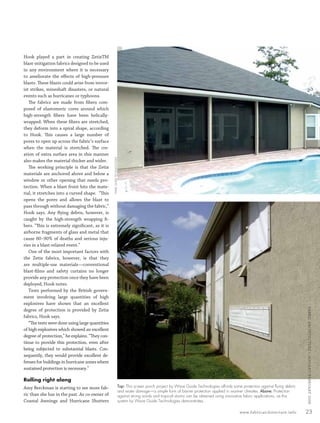
         Amy Berckman is starting to see more fab-                            Top: This screen porch project by Wave Guide Technologies affords some protection against flying debris
                                                                              and water damage—a simple form of barrier protection applied in warmer climates. Above: Protection
         ric than she has in the past. As co-owner of                         against strong winds and tropical storms can be obtained using innovative fabric applications, as this
         Coastal Awnings and Hurricane Shutters                               system by Wave Guide Technologies demonstrates.

                                                                                                                                                    www.fabricarchitecture.info          23


0108FA_p16-p25.indd   Sec2:23                                                                                                                                                  1/15/08     1:31:53 PM
ENVIRONMENT | Wind
                                                 CARIBBEAN AWNING PRODUCTION CO.
                                                 AUXETIX LTD.


                                                                                                                                                       in Morehead City, N.C., Berckman says hurricane protection was
                                                                                                                                                       always a part of her business plan. She’s following in Grubb’s foot-
                                                                                                                                                       steps by offering fabric-based high wind and hurricane protection.
                                                                                                                                                       Her company offers fabric barriers made out of a trampoline-type
                                                                                                                                                       material, and has for the past seven years. A combination of fabric
                                                                                                                                                       and roll shutter might be used, based upon the customer’s request.
                                                                                                                                                          Although North Carolina’s coastline is prone to hurricane ac-
                                                                                                                                                       tivity, the awareness of different products isn’t always obvious,
                                                                                                                                                       she observes.
                                                                                                                                                          “If people don’t see [hurricane protection products], they don’t
                                                                                                                                                       know there are options,” she says.
                                                                                                                                                          Caribbean Awning Production Co. Ltd. manufactures two types
  FABRIC ARCHI TECTURE • JANUARY/FEBRUARY 2008


                                                                                                                                                       of shutters for hurricane protection. In 1998, the company ex-
                                                                                                                                                       panded its operations from awnings to indoor treatments and hur-
                                                                                                                                                       ricane/security shutters, says Paula Calderon, managing director of
                                                                                                                                                       the St. Lucia-based firm. The company has spent large amounts of
                                                                                                                                                       money promoting and educating the general public in the Eastern
                                                                                                  Top: In the Carribbean, rolling shutters and         Caribbean about hurricane shutters over the past nine years.
                                                                                                  the more traditional wooden shutters often are          Calderon recommends rolling shutters and accordion shutters.
                                                                                                  combined defenses that soften the blow of West
                                                                                                  Indies’ notorius “Hurricane Alley.” Above: Some-     “While we can offer storm panels and bahama shutters, we do not
                                                                                                  day, Auxetix Ltd.’s Zetix blast-mitigation fabrics   feel that these are as practical as the rolling and accordion shut-
                                                                                                  (originally designed for bomb blasts) may be used    ters,” she explains. Rolling shutters are designed to allow the blade
                                                                                                  to thwart the impact of dangerous weather condi-
                                                                                                  tions as well. Left: A special weave—composed        to roll up inside its hood capacity. The result is a clean and attrac-
                                                                                                  of elastomeric cores around which high-strength      tive look, an important consideration for a home’s or business’ ex-
                                                                                                  fibers have been helically wrapped—causes the         terior appearance.
                                                                                                  Zetix fabric to deform into a curved shape when
                                                                                                  impacted. The pores open and allow the blast to         Aluminium slats are filled with either foam or extra hard resin—
                                                                                                  pass through without damaging the fabric.            or extruded aluminium for tougher applications. The blades are

 24                                                                         www.fabricarchitecture.info


0108FA_p16-p25.indd                                                                    Sec2:24                                                                                                                          1/15/08   1:31:57 PM
vented to allow in air and light. The shut-      homes built in the islands—the poor con-         portant for professionals in the building
         ters can be motorized with a manual over-        struction of houses; the lack of understand-     industry to re-examine the way homes are
         ride system in the event of power failure.       ing of the products and their uses, and the      constructed and designed, Calderon says,
            Accordion shutters are manually oper-         discrepancy of the architects’ fancy designs     “taking into full consideration the cus-
         ated. Every shutter comes with its own           with the practical aspects of building for the   tomers’ needs.”                            FA
         high-security locking device, “a sure nui-       use and installation of shutters.                   Sonja Hegman is a freelance writer based in
         sance to any prowler as well,” Calderon             “Customers have to make a choice be-          St. Paul, Minn.
         says. “After hurricane Ivan hit the island       tween the fancy architecture and the pro-
         of Grenada, there was a sudden hunger for        tection of property, family and business,”
         hurricane/security shutters, both for the        Calderon says. “The lack of education about
                                                                                                           SOURCES
         protection of homes and businesses and           these shutters in the region among archi-        Auxetix Ltd., Devon, England, UK
         the security against looting,” Calderon          tects, contractors and builders, as well as      www.auxetix.com
         adds. This brought a wider appreciation          banks and insurance companies, is hinder-        Awnair Adjustable Awnings, Belleview, Fla.
         and understanding of the products her            ing the protection of homes.”                    +1 352 347 7240
         company provides.                                   Banks and insurance companies, she
            For Larry Batz, manager of Awnair Ad-         observes, should encourage the placement         Caribbean Awning Production Co. Ltd.,
                                                                                                           St. Lucia
         justable Awnings in Belleview, Fla., hurri-      of shutters in homes because the shut-
                                                                                                           www.caribbeanawning.netfirms.com
         cane barriers became a necessary product         ters protect their investments. “Shutters
         for his company three years ago. Before          should be incorporated in the design of          Coastal Awnings & Hurricane Shutters,
         that, Awnair sold only awnings.                  buildings, and this is far from the case in      Morehead City, N.C.
                                                                                                           crystalcoastalawnings.com
            Awnair sells three main panels as hurri-      the region,” she says.
         cane protectors: clear, aluminum and steel.         With the change in weather patterns           Wave Guide Technologies,
         Like Caribbean Awning, Batz sells roll-          and the prediction of increased hurricane        Jacksonville, Fla.
         down shutters, accordion shutters (that          activity over the next 10 years, it is im-       www.clearviewus.com
         are permanently mounted on a building,
         in clear or aluminum), and storm shutters
         (that look primarily like decorative shut-
         ters). Ease of use is important because the
         many retirees that live in the area need to
         be able to deploy the products—or make it
         easy for a neighbor to do so.
            When Hurricane Charley hit in 2004,
         Batz says that it didn’t affect his area of
         Florida much because it’s in the middle of
         the state; but Hurricane Frances, which
         hit that same year, knocked out power to
         Batz’s business for nine days.

         Windfall
         So far this year, hurricane barriers have ac-
         counted for 30 to 40 percent of Batz’s sales,
         compared to last year’s 20%. “A lot of it has
                                                                                                                                                              FABRIC ARCHI TECTURE • JANUARY/FEBRUARY 2008


         to do with the storm season,” Batz said. “Last
         year we had only one [tropical] storm.”
            Amy Berckman also says that a “signifi-
         cant percentage” of her company’s sales
         come from hurricane barriers. Awnings
         and blinds represented Caribbean Awning’s
         largest earnings until Hurricane Ivan in
         2004, Calderon says. After that, sales of
         shutters increased from 22–63% in 2006,
         with 32% representing exports to the other
         Caribbean islands.
            Caribbean Awning’s greatest profits are
         generated from the awnings and blinds in-
         dustry, Calderon adds. The shutter industry
         poses problems with the different styles of

                                                                                                                          www.fabricarchitecture.info         25


0108FA_p16-p25.indd   Sec2:25                                                                                                                       1/15/08     1:32:01 PM
CONTINUING EDUCATION | Green roofs


                                                                             Seeing green up top
                                                                              BY Bruce Dvorak and Marcus de la fleur


                                                                             G
                                                                                       reen roof technology has come a long way from sod houses and grassed, meadow-like roofs grazed by
                                                                                       goats or sheep. It is rapidly moving forward with all expectations of transforming the way urban ecology
                                                                                       is legislated, designed, and maintained across the country. Architects and engineers are running toward
                                                                             an understanding and mastery of this “green” design tool, a multi-disciplinary field centered within the realm of
                                                                             landscape architecture. With a basic understanding of this emerging culture, designers not only can participate in
                                                                             this rising market, they can help shape it and take the lead.

                                                                             Green roof technology
                                                                             The phrase “green roof technology” is a term broad in meaning that includes many types of greened roofs, the
                                                                             products used to create them, and design techniques available to construct them. Broad categories place blurred
  FABRIC ARCHI TECTURE • JANUARY/FEBRUARY 2008


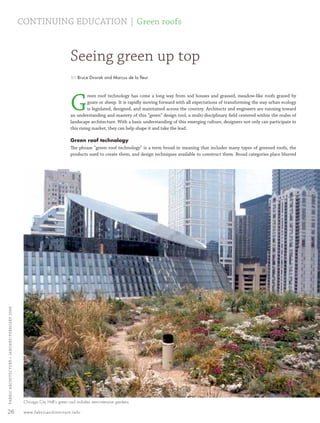
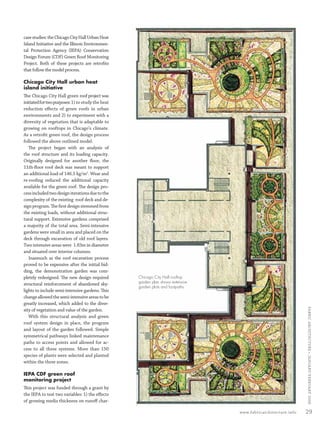
                                                  Chicago City Hall’s green roof includes semi-intensive gardens.

 26                                               www.fabricarchitecture.info


0108FA_p26-p35.indd                                             Sec3:26                                                                                                                   1/15/08   1:09:58 PM
lines between three types of greened roof systems, which include extensive, intensive, and
         semi-intensive systems. The extensive system falls at one end of the spectrum and is
         most frequently referred to as a green roof, living roof, or “eco-roof.” These systems are
         thin in profile, between 50 to 102mm thick, weigh 49 to 122 kg/m2, are least diverse in
         vegetation, and are not likely to demand much design time. Though they can do much to
         absorb rainwater, they rarely require much direct design effort from landscape architects,
         other than a competent understanding of their vegetative needs and ecological benefits.
         Even if they lie low in profile, they can provide significant contributions to the design of
         sustainable projects and can effectively address improvements to urban ecology and wild-
         life corridor creation. It would be the landscape architect’s role to integrate these indirect
         design applications.
            At the other end of the spectrum lies the intensive green roof system. The intensive
         system includes public or private roof gardens. The roof garden is where landscape archi-
         tects can make significant direct contributions to buildings by the transformation of bare
         roofs into beautiful and functional space. Where the green roof is a thin profile, roof gar-
         dens can be lushly planted with trees, shrubs, and perennials in as little as 152 to 457mm of
         growing medium, at only 381kg/m2. In comparison, 457mm of topsoil might weigh 586kg/
         m2. Though green roofs require little maintenance and no irrigation, roof gardens need as
         much care as gardens at grade. The selection of vegetation and source of irrigation water can
         make significant differences in the degree that they are self sustaining. Intensive systems
         are typically placed on flat roof decks. Extensive and semi-intensive systems, however, can
         be placed on either flat roofs or on roofs with slopes up to 30 degrees.

         Urban ecology and natural processes
         Green roofs can do much for urban ecology, in part because they replicate natural processes.
         Green roofs mimic the natural water cycle as moisture falls, is slowed and intercepted by
         vegetation, absorbed into the growing medium, used by plants, and transpired back into
         the atmosphere, as it moves slowly through the sub-grade and drainage system. On an an-          AIA/Fabric Architecture
         nual basis, green roofs can reduce stormwater runoff from rooftops up to 70 percent. Com-         Continuing Education
         munities across the globe take advantage of these benefits, give credit for reductions in         To earn one AIA/CES Learning
         stormwater detention, and save money on downsized conveyance systems.                            Unit, read this article; then
            Just as plants intercept solar radiation on the ground, so also do green roofs intercept
                                                                                                          answer the questions on page
         solar radiation and cool the air at the surface of the green roof. Green roofs can cool the
                                                                                                          31 and follow the instructions for
                                                                                                                                                        FABRIC ARCHI TECTURE • JANUARY/FEBRUARY 2008


         surface by up to 50 percent and actually cool the air temperature just above plants between
         two to three degrees. Heating and ventilating (HVAC) systems can be scaled back to accom-
                                                                                                          reporting.
         modate the lower air temperature at intake valves.                                               Learning objectives
            Green roofs also score points within the Leadership in Energy & Environmental Design          After reading the article
         (LEED) rating system. They are included because of their stormwater benefits and insulat-         you will be able to:
         ing nature, which help keep heating costs down and allow for the downsizing of cooling sys-      1.Explain the importance of
         tems. Green roofs also provide for lush views, extend the life of a roof, and provide bird and
                                                                                                            proper, regular cleaning to
         butterfly habitat. Additional benefits include an increase in property values and a reduction
                                                                                                            the life-span of a fabric
         in the urban heat island effect.
                                                                                                            structure or awning.
         Model green roof design process                                                                  2.List the available options for
            A green roof system may be designed as a retrofit to an existing building or a new installa-     fabric maintenance.
         tion to a planned building. Both options require nearly the same principal design processes.     3.Describe alternative for fabric
            The model design process begins with the selection of and inclusion of an interdisciplin-       protective coatings.
         ary design team. All green roof system benefits, whether ecological, aesthetic, or economic,

                                                                                                                    www.fabricarchitecture.info         27


0108FA_p26-p35.indd   Sec3:27                                                                                                                 1/15/08     1:10:03 PM
CONTINUING EDUCATION|Green roofs

                                                  can be applied effectively only if the design
                                                  team starts working and thinking about
                                                  the installation from the beginning of the
                                                  project. Treating the green roof as an after-
                                                  thought translates into lost opportunities
                                                  and increased costs.
                                                     The design team typically consists of
                                                  architects, landscape architects, and struc-
                                                  tural and mechanical engineers. Architects
                                                  and mechanical engineers are required to
                                                  design and certify drawings that consist
                                                  of design elements or modifications to
                                                  waterproofing, parapets, and utility rout-
                                                  ing. Structural engineers design and stamp
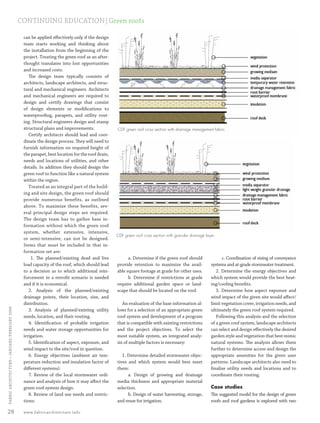
                                                  structural plans and improvements.               CDF green roof cross section with drainage management fabric.
                                                     Certify architects should lead and coor-
                                                  dinate the design process. They will need to
                                                  furnish information on required height of
                                                  the parapet, best location for the roof drain,
                                                  needs and locations of utilities, and other
                                                  details. In addition they should design the
                                                  green roof to function like a natural system
                                                  within the region.
                                                     Treated as an integral part of the build-
                                                  ing and site design, the green roof should
                                                  provide numerous benefits, as outlined
                                                  above. To maximize these benefits, sev-
                                                  eral principal design steps are required.
                                                  The design team has to gather base in-
                                                  formation without which the green roof
                                                  system, whether extensive, intensive,
                                                                                                   CDF green roof cross section with granular drainage layer.
                                                  or semi-intensive, can not be designed.
                                                  Items that must be included in that in-
                                                  formation set are:
                                                      1. The planned/existing dead and live              a. Determine if the green roof should                  c. Coordination of sizing of conveyance
                                                  load capacity of the roof, which should lead     provide retention to maximize the avail-               systems and at-grade stormwater treatment.
                                                  to a decision as to which additional rein-       able square footage at grade for other uses.              2. Determine the energy objectives and
                                                  forcement in a retrofit scenario is needed              b. Determine if restrictions at grade            which system would provide the best heat-
                                                  and if it is economical.                         require additional garden space or land-               ing/cooling benefits.
                                                     2. Analysis of the planned/existing           scape that should be located on the roof.                 3. Determine how aspect exposure and
                                                  drainage points, their location, size, and                                                              wind impact of the given site would affect/
                                                  distribution.                                       An evaluation of the base information al-           limit vegetation cover, irrigation needs, and
  FABRIC ARCHI TECTURE • JANUARY/FEBRUARY 2008


                                                     3. Analysis of planned/existing utility       lows for a selection of an appropriate green           ultimately the green roof system required.
                                                  needs, location, and their routing.              roof system and development of a program                  Following this analysis and the selection
                                                     4. Identification of probable irrigation       that is compatible with existing restrictions          of a green roof system, landscape architects
                                                  needs and water storage opportunities for        and the project objectives. To select the              can select and design effectively the desired
                                                  irrigation.                                      most suitable system, an integrated analy-             garden style and vegetation that best mimic
                                                     5. Identification of aspect, exposure, and     sis of multiple factors is necessary:                  natural systems. The analysis allows them
                                                  wind impact to the site/roof in question.                                                               further to determine access and design the
                                                     6. Energy objectives (ambient air tem-           1. Determine detailed stormwater objec-             appropriate amenities for the given user
                                                  perature reduction and insulation factor of      tives and which system would best meet                 patterns. Landscape architects also need to
                                                  different systems).                               them:                                                  finalize utility needs and locations and to
                                                     7. Review of the local stormwater ordi-             a. Design of growing and drainage                coordinate their routing.
                                                  nance and analysis of how it may affect the       media thickness and appropriate material
                                                  green roof system design.                        selection.                                             Case studies
                                                     8. Review of land use needs and restric-            b. Design of water harvesting, storage,          The suggested model for the design of green
                                                  tions:                                           and reuse for irrigation.                              roofs and roof gardens is explored with two

 28                                               www.fabricarchitecture.info


0108FA_p26-p35.indd                                           Sec3:28                                                                                                                             1/15/08   1:10:05 PM
case studies: the Chicago City Hall Urban Heat
         Island Initiative and the Illinois Environmen-
         tal Protection Agency (IEPA) Conservation
         Design Forum (CDF) Green Roof Monitoring
         Project. Both of these projects are retrofits
         that follow the model process.

         Chicago City Hall urban heat
         island initiative
         The Chicago City Hall green roof project was
         initiated for two purposes: 1) to study the heat
         reduction effects of green roofs in urban
         environments and 2) to experiment with a
         diversity of vegetation that is adaptable to
         growing on rooftops in Chicago’s climate.
         As a retrofit green roof, the design process
         followed the above outlined model.
            The project began with an analysis of
         the roof structure and its loading capacity.
         Originally designed for another floor, the
         11th-floor roof deck was meant to support
         an additional load of 146.5 kg/m2. Wear and
         re-roofing reduced the additional capacity
         available for the green roof. The design pro-
         cess included two design iterations due to the
         complexity of the existing roof deck and de-
         sign program. The first design stemmed from
         the existing loads, without additional struc-
         tural support. Extensive gardens comprised
         a majority of the total area. Semi-intensive
         gardens were small in area and placed on the
         deck through excavation of old roof layers.
         Two intensive areas were 1.83m in diameter
         and situated over interior columns.
            Inasmuch as the roof excavation process
         proved to be expensive after the initial bid-
         ding, the demonstration garden was com-
         pletely redesigned. The new design required        Chicago City Hall rooftop
                                                            garden plan shows extensive
         structural reinforcement of abandoned sky-
                                                            garden plots and footpaths.
         lights to include semi-intensive gardens. This
         change allowed the semi-intensive areas to be
         greatly increased, which added to the diver-
                                                                                                                           FABRIC ARCHI TECTURE • JANUARY/FEBRUARY 2008


         sity of vegetation and value of the garden.
            With this structural analysis and green
         roof system design in place, the program
         and layout of the garden followed. Simple
         symmetrical pathways linked maintenance
         paths to access points and allowed for ac-
         cess to all three systems. More than 150
         species of plants were selected and planted
         within the three zones.

         IEPA CDF green roof
         monitoring project
         This project was funded through a grant by
         the IEPA to test two variables: 1) the effects
         of growing media thickness on runoff char-

                                                                                          www.fabricarchitecture.info      29


0108FA_p26-p35.indd   Sec3:29                                                                                    1/15/08     1:10:06 PM
Conservation Design Forum’s own
                                                  roof-monitoring project, where
                                                  several different drainage systems
                                                  are being tested.


                                                 acteristics and 2) the runoff characteristics     304.8mm profile to monitor runoff charac-           participants and leaders of the emerging cul-
                                                 of different drainage management systems.         teristics of thicker systems.                     ture of green roof technology.             FA
                                                    The project site is located at Conservation                                                        Bruce Dvorak, ASLA, is assisstant profes-
                                                 Design Forum’s offices in Elmhurst, Ill. The       Conclusion                                        sor of landscape architecture at Texas A&M
                                                 building has three roofs, all with different      Green roof technology is finding its way into      University with expertise in green roof design
                                                 structural characteristics. One roof accom-      the growing market for “green” and sustain-       and is a former associate of Conservation De-
                                                 modates an additional 83 to 97.6kg/m2.           able design. Its benefits such as improved         sign Forum, under whose aegis this report was
                                                 Another roof was rebuilt to accommodate          stormwater management, urban ecologi-             produced.
                                                 a roof garden at 488.2kg/m2. The third roof      cal enhancement, urban heat island reduc-            Marcus de la fleur is an associate with Con-
                                                 couldn’t accommodate additional loading          tion, and energy conservation, make it an         servation Design Forum.
  FABRIC ARCHI TECTURE • JANUARY/FEBRUARY 2008


                                                 but was replaced with an ultra-light green       attractive tool for designers, developers,
                                                                                                                                                    EDITOR’S NOTE: This paper was first published in FA in
                                                 roof system at 44kg/m2.                          and legislators. Landscape architects could       the July/Aug 2004 issue.
                                                    The design followed the structural load-      shape and lead this rising market with an
                                                 ing. Panels were created which hydrologi-        understanding of this technology and the
                                                 cally separate segments of the green roof,       design process. It is their role to assure that   RESOURCES
                                                                                                                                                    Bruce D. Dvorak, ASLA
                                                 each of which has a different drainage            a green roof system is an integral part of the
                                                                                                                                                    Texas A&M University
                                                 system, including drainage boards, reten-        design process from the very beginning, and
                                                                                                                                                    bdvorak@archmail.tamu.edu
                                                 tion boards, lightweight gravel, and modu-       not added as an afterthought. Landscape
                                                                                                                                                    +1 979 458 0628
                                                 lar systems. These drainage designs were         architects should maximize the green roof
                                                 tested at 51mm and 76.2mm thicknesses            system benefits and associated cost savings
                                                                                                                                                    Conservation Design Forum
                                                 of growing media. Monitoring equipment           through a thorough design process that leads      www.cdfinc.com
                                                 records both the volume and rate of rain-        to full integration into the building and site
                                                 water runoff. Vegetation was held consis-         design. Following the proper design process,      Green Building Council
                                                 tent among the extensive panels. A roof          landscape architects can assure successful        (Administrators of the LEED rating system)
                                                 garden was designed with a 203.2mm- to           green roof system design and be successful        www.usgbc.org

 30                                              www.fabricarchitecture.info


0108FA_p26-p35.indd                                           Sec3:30                                                                                                                                 1/15/08   1:10:11 PM
test/reporting |CONTINUING EDUCATION

                                  AIA/Fabric Architecture Continuing Education Self Test

            INSTRUCTIONS                                            3. Intensive systems can be placed on                8. An effective green roof information
            1. Read the article “Seeing green up top,”                 either flat roofs or roofs with slopes                set would include review of the local
               (pg.26).                                                reaching 30 degrees?                                 stormwater ordinance?
            2. Read the questions, then fill in the answers             T       F                                            T      F
               below each question.
            3. Fill out the AIA/CES education report-               4. Green roofs can reduce the rooftop                9. In the Case Study for the Chicago City
               ing form (below) or download the form at                runoff of stormwater by up to?                        Hall, one of the prime objectives of the
               www.fabricarchitecture.info and follow the              A. 30% B. 50% C. 70% D. 90%                          green roof system installed was:
               instructions for reporting to receive one AIA                                                                A. Changing the City’s public perception
               learning unit.                                       5. Green roofs can cool the surface of                  of the government B. Adding diversity
                                                                       roofs by up to 50 percent and cool the               to the plant population C. Reducing the
            QUESTIONS                                                  air temperature above plants. This                   effects of heat islands D. None of the
            1. Extensive type green roofs                              reduction can also help reduce HVAC                  above
               include what of the following                           loads.
               defining elements?                                       T      F                                          10. The cost of a green roof
               A. A relatively thick profile (152–                                                                          system should:
               457mm) B. A thin                                     6. Green roofs provide stormwater and                  A. Have an impact on the decision to
               profile (50–102mm) C. Diverse vegeta-                    insulating benefits. These benefits may               select between alternatives of green roof
               tion mix D. Limited vegetation mix E. B                 also include which of the following?                system B. Have no impact on the deci-
               & D only F. All of the above                            A. Extended life of a roof B. Reduced               sion to select between alternatives C.
                                                                       heat island effect C. Increased property            Be taken in combination with analysis of
            2. The authors’ definition of an intensive                  values D. All of the above                          stormwater objectives D. Impact the heat
               roof system includes a 152–457mm                                                                            reduction effects of green roofs in urban
               layer of growing medium?                             7. When designing a green roof system,                 environments
               T       F                                               a plan should include which of the fol-
                                                                       lowing?
                                                                       A. Stormwater objectives B. Dead & live
                                                                       loads of the roof C. A vegetation plan
                                                                       D. All of the above


              AIA/Fabric Architecture Reporting Form
              (Use to report learning unit for this article only)
              AIA Provider #G455—Program #FA0108
              Program title: “Seeing green up top” Fabric Architecture JANUARY/FEBRUARY 2008, pp. 26–30.
              Directions: Circle the answer for each question above. A minimum score of 70% is required to earn credit.
              Participant information required:

              Last name:                                              First name:                                          Middle initial or name:
              Firm name:
              Address:                                                                            City:                        State:                  Zip:
                                                                                                                                                                              FABRIC ARCHI TECTURE • JANUARY/FEBRUARY 2008


              Tel:                                                    Fax:                                     E-mail:
              AIA I.D. number:                                                                                 Completion date (M/D/Y)             /          /
              I hearby certify that the above information is true and accurate to the best of my knowledge and that I have complied with the AIA
              Continuing Education Guidelines in the submission of this credit.

              Signature:                                                                                                             Date:
              Check one: ❏ $10 payment enclosed. (Make check payable to IFAI and mail with a copy of this form to: IFAI, SDS-12-2108,
              PO Box 86, Minneapolis, MN 55486 02108.
              Charge my: ❏ Visa ❏ American Express ❏ Mastercard ❏ Discover                            Card #

              Card holder’s name:                                                                              Card holder’s i.d.#                                  *
              *(Am.Ex: 4 digit # on front of card/Visa, MC, Discover: 3 digit #on back of card)

              Signature:                                                                                                             Exp. date:
              Mail or fax this form to IFAI/Fabric Architecture, 1801 West County Rd. B, Roseville, MN 55113, Fax +1 651 631 9334.
              Do not send to AIA. Note: checks are sent to a different address. Accounting code: 45200.130.1.1310

                                                                                                                                             www.fabricarchitecture.info      31


0108FA_p26-p35.indd     Sec3:31                                                                                                                                     1/15/08     1:10:16 PM
PORTFOLIO

                                                                                2007 International
                                                 Tensile structures, under 930m2 (10,000 sq. ft.)


                                                                                                                             Ã Outstanding Achievement Award
                                                                                                                             Performance venue
                                                                                                                             Lima, Peru
                                                                                                                             Commercial Industrial Delta S.A.
                                                                                                                             Lima, Peru
                                                                                                                             This is a scene for culture and art, situated in Alameda del Rio Park,
                                                                                                                             neighboring the Government Palace. Proposed by Lima’s Town
                                                                                                                             Council, it is part of the “Amusement and Culture Area,” along the
                                                                                                                             Rimac River. The scene’s base is a circular platform, over which a
                                                                                                                             covering with posts, cables and membranes has been designed. The
                                                                                                                             primary challenge was to convey a variety of feelings to the users,
                                                                                                                             achieved here through the lightness of this building, the shape of
                                                                                                                             the membranes, and the rhythm with which they were organized.
                                                                                                                             The result is fairly fluid, with coverings resembling sails’ movements,
                                                                                                                             harmonizing with the flow of the river.
                                                                                                                             Fabrication: Commercial Industrial Delta S.A.
                                                                                                                             Fabric: Flexilona 2000 by Sansuy


                                                 Ã Award of Excellence
  FABRIC ARCHI TECTURE • JANUARY/FEBRUARY 2008


                                                 “Tempo”, roundpoint landmark
                                                 Husnes, Norway
                                                 LEAD Inc.
                                                 Husnes, Kvinnherad, Norway                                                  Ã Outstanding Achievement Award
                                                 This 10m-tall installation is a monument marking the history of an          Performance arena
                                                 aluminum manufacturing plant, as well as an engaging piece of public        Beilun district, Zhejiang, PRC
                                                 art. The high-tech installation is a combination of two complementary
                                                 structural systems. The tensile fabric structure stabilizes the system in   Beijing N & L Fabric Technology
                                                 a static equilibrium and becomes a projection screen for the sunlight.      Beijing, PRC
                                                 During the dark winter hours, 216 LED lights illuminate the screen.         A small-scale membrane structure in the city plaza, the purpose of
                                                 Architect: LEAD Inc.                                                        this project is to glorify this scenic spot and to meet the needs for
                                                 Engineer: Leicht Bau Kunst                                                  performances and parties. The project, situated in the Beilun district
                                                 Fabrication: Textile Bau GmbH                                               of Ningbo, Zhejiang province, China, is a structure with a unique look
                                                 Project Manager: Sør-Norge Aluminium AS                                     and delicate nodes and components.
                                                 Installation: Textile Bau GmbH and LEAD Inc.                                Fabrication: Beijing N & L Fabric Technology
                                                 Fabric: Tenara by W. L. Gore & Assoc. Inc.                                  Fabric: FGT 250 by Chukoh Chemical Industries Ltd.

 32                                              www.fabricarchitecture.info


0108FA_p26-p35.indd                                           Sec3:32                                                                                                                           1/15/08   1:10:22 PM
Achievement Awards
         Tensile structures, 930–2,790m2 (10,000–30,000 sq. ft.)


                                                                                   Ã Outstanding Achievement Award
                                                                                   Covered walkway, O2 dome
                                                                                   Greenwich, United Kingdom
                                                                                   Architen Landrell Assoc. Ltd.
                                                                                   Monmouthshire, United Kingdom
                                                                                   A covered walkway leading from the Queen Elizabeth II Pier to the
                                                                                   newly refurbished O2 (formerly the Millennium Dome), this 150m
                                                                                   walkway is created from PVC-coated polyester, tensioned over a
                                                                                   curved steel frame to form a weatherproof entrance for VIP guests.
                                                                                   Two additional inverted umbrella canopies are located on the pier,
                                                                                   as well as three further inverted cone canopies on the bank side. An
                                                                                   interactive system lights the walkway in an array of vibrant colors,
                                                                                   using the latest color-changing LED and control systems.
                                                                                   Architect: Barr Gazetas
                                                                                   Engineer: Tony Hogg Designs
                                                                                   Fabrication: Architen Landrell Assoc. Ltd.
                                                                                   Subcontractor: Metafab Solutions
                                                                                   Fabric: PVC-coated polyester from Ferrari S.A.


         Ã Award of Excellence
         Grand Pavilion, Royal Melbourne Show Ground
                                                                                                                                                                FABRIC ARCHI TECTURE • JANUARY/FEBRUARY 2008


         Melbourne, Victoria, Australia
         Oasis Tension Structures (Aust.) Pty. Ltd.
         Braeside, Victoria, Australia
         Among the new facilities at the Royal Melbourne Show Ground
                                                                                   Ã Outstanding Achievement Award
         in the State of Victoria is the Grand Pavilion, a year-round facility     Shopping center cover
         for sports, exhibitions and formal functions. It is a large tensile-      Lima, Peru
         membrane structure; a flat concrete slab almost 100m2 forms the            Commercial Industrial Delta S.A.
         base. Soaring over that area is a tensioned membrane roof made            Lima, Peru
         of long-life synthetic fabric. Inclined masts transfer wind from the      This covering extends over three corridors and four squares in a
         surface network of cables to perimeter foundations, via high-strength     shopping center in Lima, Peru, to protect customers in the corridors
         steel stay cables. While the perimeter wall blocks winter’s cold winds,   and shops against rain, UV rays, strong winds and dust. The carrying
         summer’s heat is shed from the structure by natural convection of hot     structure is a tri-articulated triangular porch resting diagonally over
         air through each of the six central masts.                                each corridor’s module on the first-floor roof. Four vertical poles hold
         Architect: Darryl Jackson Pty. Ltd.                                       the 5m-diameter rings and support the carrying structure, which is
         Engineer: Tensys Engineers Pty. Ltd.                                      designed to be easily moved after the building is enlarged.
         Fabrication: Atkins Fabrication (Australia) Pty. Ltd.                     Fabrication: Commercial Industrial Delta S.A.
         Fabric: FR1000, PVDF from Gale Pacific Ltd.                                Fabric: Flexilona 2000 E by Sansuy

                                                                                                                            www.fabricarchitecture.info         33


0108FA_p26-p35.indd   Sec3:33                                                                                                                         1/15/08     1:10:31 PM
Tensile structures, more than 2,790m2 (30,000 sq. ft.)
 PORTFOLIO


                                                                                                                         Ã Outstanding Achievement Award
                                                                                                                         Kuwait Stadium
                                                                                                                         Safat, Kuwait
                                                                                                                         Birdair Inc., Amherst, N.Y., United States
                                                                                                                         Kuwait Stadium, formally known as Jaber Al-Ahmad International
                                                                                                                         Stadium, is a 64,000-seat football (soccer) stadium in Safat, Kuwait.
                                                                                                                         The client requested a unique design that made a statement for the
                                                                                                                         stadium, while providing exceptional comfort and shading for seating.
                                                                                                                         The stadium design features an extremely large, single-cable net
                                                                                                                         structure. This structure integrates a steel ring design that creates an
                                                                                                                         appearance of pillowed fabric. The resulting tensile-fabric membrane
                                                                                                                         roofing structure resembles a series of sand dunes, echoing the
                                                                                                                         country’s surrounding natural environment.
                                                                                                                         Architect: Weidleplan Consulting GmbH
                                                                                                                         Engineer: Schlaich Bergermann und Partner GBR
                                                                                                                         Fabricator: Birdair Inc.
                                                                                                                         Fabric: Sheerfill II


                                                 Ã Award of Excellence
                                                 Sydney Wildlife World
                                                 Sydney, Australia
                                                 UFS Australasia Pty Ltd.,
                                                 Kingscliff, New South Wales, Australia
                                                 Sydney Wildlife World is a new attraction showcasing Australia’s
                                                 unique flora and fauna in the heart of Darling Harbour, Sydney,
                                                 Australia. Local and international guests can experience an up-
                                                 close encounter with Australia’s bizarre flora and fauna. Visitors
                                                 weave through this natural attraction via air-conditioned walkways
                                                 separated only by glass panels, creating an all-weather facility. The
                                                 transparency of the Zoomesh allows for the animals to encounter the     Ã Outstanding Achievement Award
  FABRIC ARCHI TECTURE • JANUARY/FEBRUARY 2008


                                                 day-to-day climatic variations, so tourists can observe them in their   Foshan Stadium
                                                 natural habitats.                                                       Foshan City, China
                                                 Architect: Misho & Assoc., and RIHS Architects                          Beijing N & L Fabric Technology Co. Ltd., Beijing, China
                                                 Engineer: Wade Consulting; S2 Corp.                                     Foshan Stadium, a large cable-membrane structure, is the landmark
                                                 Fabrication: Fabric Shelter Systems                                     of Foshan city. The stadium has a total membrane area of around
                                                 Subcontractor: Steel Structures Australia                               71,000m2, and membrane coverage of approximately 53,420m2. Its
                                                 Material Selection: Misho & Assoc. and RIHS Architects                  roofing structure is composed of 40 membrane units, with an area
                                                 Fabric: Zoomesh from Koch-Otto York; Ferrari 10025 by Ferrari           of 901m2 each. The overlaid design of the membrane fully utilizes
                                                 Textiles Corp. from Innova                                              the entire bearing capacity of the structure’s foundation with great
                                                                                                                         mechanical efficiency.
                                                                                                                         Architect: GMP
                                                                                                                         Engineer: Architectural Design Research Institute, Institute of
                                                                                                                         Technology of South China and Beijing N & L Fabric Technology Co. Ltd.
                                                                                                                         Design: Architectural Design Research Institute, ITSC, and Beijing N
                                                                                                                         & L Fabric Technology
                                                                                                                         Fabrication: Beijing N & L Fabric Technology
                                                                                                                         Fabric: Précontraint 1302T2 from Ferrari S.A.
                                                                                                                                                                                             FA

 34                                              www.fabricarchitecture.info


0108FA_p26-p35.indd                                          Sec3:34                                                                                                                        1/15/08   1:10:48 PMIAA08-FG
Create.
                                                                                     Enter.
                                                                                     Inspire.
                                                                                     Enter by July 15, 2008


                        The International Achievement Awards unveil new
                       design achievements and technically superb work.

               Your project could be next!
                   Winners receive extensive media coverage. Entries will be on
       display to over 8,000 participants at the IFAI Expo 2008 in Charlotte, N.C.

           For more information contact Christine Malmgren at 800 225 4324,
       +1 651 225 6926; e-mail cmmalmgren@ifai.com, or visit www.ifai.com.


0108FA_p26-p35.indd
IAA08-FG_FP.indd 1    Sec3:35                                                                                 11/13/07 11:55:26 AM PM
                                                                                                                1/15/08    1:11:14
Living lightly
                                                                             on the
  FABRIC ARCHI TECTURE • JANUARY/FEBRUARY 2008


 36                                              www.fabricarchitecture.info


0108FA_p36-p51.indd                                         Sec4:36                1/15/08   2:04:06 PM
land
                                I
                                     t hasn’t always been this way for fabric.
         Fabric’s sustainable        That is, being the messenger — if not
         future may help             the message — for a more sustainable
                                     future. In the past, designers who used
         lead design            tensile fabrics were not nearly so concerned
                                — or impressed — with its modest carbon
         forward                footprint, minimal post-construction refuse,
                                daylighting and water-harvesting capabilities,
         BY Mason Riddle
                                and relative ease and low-cost of replacement.
                                While fabric’s daylighting potential was always
                                a no-brainer, its unique position to contribute
                                significantly to a more sustainable built envi-
                                ronment, both micro and macro is still under-
                                appreciated but growing.
                                   Enter the 21st century, with its acute global issues of over-popu-
                                lation, loss of natural habitat, carbon emissions and pollution of
                                all kinds — in a nutshell the specter of diminishing resources and
                                climate change. Today, heeding the clarion call of environmental
                                sustainability many architects and designers agree that fabric struc-
                                                                                                          FABRIC ARCHI TECTURE • JANUARY/FEBRUARY 2008


                                tures have an important role to play in creating an eco-friendly fu-
                                ture. Fabric structures, permanent and temporary, large and small
                                are rising up across the international landscape like exotic mush-
                                rooms (and sometimes as colorful) on a forest floor.
                                   Examples include Herzog + de Meuron’s retina red 2006 World
                                Cup Allianz Arena in Berlin made from recyclable ETFE; the here-
                                today-gone-tomorrow temporary Adidas Arena that provided com-
                                fort for 10,000 fans at the same event; a public artwork in Husnes,
                                Norway, made of aluminum struts and PTFE fabric, designed by Ali
                                Heshmati of LEAD Inc.; and closer to home Pittsburgh’s David L.
                                Lawrence Convention Center designed by Rafael Vinoly Architects,
                                a Gold-LEED structure which in 2003 was ranked as the largest
                                “green” building in the world.
                                   To better understand fabric’s potential I consulted with Larry
                                Medlin, professor and director of the School of Architecture at the

                                                                       www.fabricarchitecture.info        37


0108FA_p36-p51.indd   Sec4:37                                                                   1/15/08     2:04:27 PM
“                                                “We have an obligation to solve
                                                 this. We must find ways to reduce
                                                 the carbon footprint, reduce fuel
                                                 consumption in both fabricating
                                                 materials and shipping them to a
                                                 site. There are light-weight materials
                                                 such as inflatables, tensile fabrics
                                                 and cable that use far less materials
                                                 — and energy resources.”

                                                 Nicholas Goldsmith, senior principal FTL
                                                 Design Engineering Studio

                                                 University of Arizona; his colleague, Jason
                                                 Vollen, a leader in the school’s Emerging
                                                                                                   “Living lightly on the land is a key
                                                                                                   principle of sustainability, and fabric
                                                                                                   allows for that more effectively than
                                                                                                   almost any other material.”

                                                                                                   Thomas Fisher, dean, University of
                                                                                                   Minnesota College of Design


                                                                                                      Goldsmith notes tepees and Bedouin
                                                                                                   tents as ancient solutions to problems of
                                                                                                                                                   “Fabric’s multiple capabilities — from
                                                                                                                                                   catching water, trellising plants,
                                                                                                                                                   daylighting, and providing shade
                                                                                                                                                   for cooling — are being looked at
                                                                                                                                                   seriously. Fabric can contribute to
                                                                                                                                                   a regenerative landscape. This is
                                                                                                                                                   important. It can’t be overlooked.”

                                                                                                                                                   R. Larry Medlin, director School of
                                                                                                                                                   Architecture, University of Arizona, Tucson


                                                                                                                                                   — shading windows from the sun can pro-
                                                                                                                                                   vide huge savings when cooling a building.
                                                 Material Technologies area; Nicholas Gold-        sustainable structures. “We need to recon-      Brise soleils, fabric canopies and curtain
                                                 smith, FAIA LEED AP and senior principal          sider these structures in solving our cur-      wall cladding systems, made from silicone
                                                 of FTL Design Engineering Studio, New             rent problems,” he states. “Societies have      glass fabrics, have huge potential.”
                                                 York City; Thomas Fisher, Dean of the Col-        had long relationships with lightweight            Issues? There are many. With regard to
                                                 lege of Design at the University of Min-          structures; there is no reason why we can       sustainability, one is the fabrication pro-
                                                 nesota; and David Abramowitch, of Giant           not revisit these ideas. One question is how    cess and actual material make-up of a ten-
                                                 Inflatables in Melbourne, Australia.               can fabric structures be used in relation-      sile fabric. How fabrics are made and coated
                                                    All agree: the future for fabrics is bright.   ship to different climates.”                     to withstand the elements and whether
                                                 Particularly if designer and client can re-          Vollen concurs. “Fabric is an important      they are recyclable needs to be scrutinized.
                                                 align and expand their ideas of what consti-      player in the future of sustainable living.     “We need to look at the full cycle of the life
                                                 tutes a viable building or structure. Accord-     As systems become more complex, differ-          of the material,” explains Goldsmith. “We
                                                 ing to Fisher, “Living lightly on the land is     ent uses and types of fabrics will emerge,”     need to perform a ‘cradle to grave analysis’
                                                 a key principle of sustainability, and fabric     he says. “Like 3-D woven fabrics, and lay-      to really determine fabric viability in terms
                                                 allows for that more effectively than almost       ered building skins, that is, building skins    of sustainability.”
                                                 any other material.”                              made of multiple, lighter layers that shade        Fisher agrees. “The issues of sustainabil-
                                                    To anyone in the industry, it is no se-        intermediate spaces (between indoor and         ity have more to do with the source — how
                                                 cret that building construction negatively        outdoor) and create livable micro-climates      the material is made, what resources it re-
                                                 impacts global and environmental condi-           that allow for larger living areas with re-     quires, what carbon is released into the at-
  FABRIC ARCHI TECTURE • JANUARY/FEBRUARY 2008


                                                 tions on a grand scale. Tons upon tons of         duced conditioned space.”                       mosphere by its manufacture and its ship-
                                                 materials from every construction site con-          Incorporating fabric components into         ping to site,” he states. “We also need to
                                                 tribute to the scale of the carbon footprint,     a building is also one path for satisfying      understand the life of the material — how
                                                 whether it is how these materials are man-        LEED requirements. It can be a compo-           long will it last and future uses,
                                                 ufactured, the cost of transporting them to       nent in a passive solar system, contribute      beyond its current use.”
                                                 a site, or the plethora of post-construction      to increased daylighting in buildings, be          In short, manufac-
                                                 refuse that needs to be disposed.                 the tensile structure for renewable energy      turers and sup-
                                                     “We have an obligation to solve this,”        sources such as photovoltaic panels and         pliers     must
                                                 states Goldsmith. “We must find ways to            provide shade to keep buildings cool in hot     identify where,
                                                 reduce the carbon footprint, reduce fuel          climates. Fabric can also reduce light pollu-   by whom, and
                                                 consumption in both fabricating materials         tion. Goldsmith cites the rediscovered use      under what con-
                                                 and shipping them to a site. There are light-     of window shades and canopies as impor-         ditions fabrics are
                                                 weight materials such as inflatables, tensile      tant passive solar systems. “Window cano-       manufactured. They also
                                                 fabrics and cable that use far less materials     pies have been forgotten in a big way,” says    need to provide informa-
                                                 — and energy resources.”                          Goldsmith. “But there seems to be a rebirth     tion on the product’s carbon

 38                                              www.fabricarchitecture.info


0108FA_p36-p51.indd                                           Sec4:38                                                                                                                       1/15/08   2:04:38 PM
“Fabric is an important player in the future of sustainable
         living. As systems become more complex, different uses
         and types of fabrics will emerge, like 3-D woven fabrics
         and layered building skins that create livable micro-
         climates that allow for larger living areas with reduced
         conditioned space.”

         Jason Vollen, team leader in the University of Arizona School
         of Architecture’s Emerging Material Technologies center


         footprint and if and how it can be recycled.
         “If they don’t have these answers,” says Gold-
                                                                                  Fabric’s future will be to offer temporary shelter
                                                                                  to increasingly mobile societies. “Such structures are
                                                                                  incredibly efficient in manufacture and can be designed
                                                                                  to be energy efficient. The continued development of new
                                                                                  materials that are strong, light and easy to manipulate,
                                                                                  and have the advantage of relatively low-tech construction
                                                                                  methods, will inform the structures with greater meaning in
                                                                                  the sustainable, sensitive future.”

                                                                                  David Abramowitch of Giant Inflatables, Melbourne, Australia


                                                          the lifetime; and/or making biodegradable
                                                          fabric that returns to the earth and can be
                                                                                                         in manufacture and
                                                                                                         can be designed to
                                                                                                                                                ”
         smith, “they should be losing customers.”        replaced cheaply and easily.                   be energy efficient,”
            Another consideration is that prefabri-          All of Vollen’s projects address sustain-   he states. “The con-
         cated structures made from tensile, engi-        ability (www.binarydesignstudio.com). “We      tinued development
         neered fabrics require more upfront de-          design to take advantage of thermal flows,      of new materials that are
         sign and detailing than traditional, brick       drafting, high insulation and properly         strong, light and easy to manipu-
         and mortar structures. All issues and            tuned shading devices, ones that delicately    late, and have the advantage of relatively
         components need to be fleshed out prior          touch the ground and so forth,” he says.       low-tech construction methods, will in-
         to actual construction, which increases          “Unfortunately most sustainable work is        form the structures with greater meaning
         initial costs.                                   limited by budget.”                            in the sustainable, sensitive future.”
            With regard to LEED certification, Med-           Medlin asserts that society is suddenly        What about aesthetics? Can fabric be a
         lin underscores that it is not just about de-    — and finally — ready to consider solu-         sustainable, functional solution and still
         signing a structure but about “totally figur-     tions to environmental problems. “Fabric’s     encompass a variety of successful aes-
         ing it out — ahead of time.” He notes that       multiple capabilities from catching water,     thetic strategies? Most fabric structures
         not all architects are well versed in work-      trellising plants, daylighting, and provid-    seem to follow a curving and arching de-
         ing with fabric. For example, steeper roofs      ing shade for cooling, are being looked at     sign template. Is this all there is? “Most
         are required to shed snow in cold climates.      seriously,” he says. “Fabric can contribute    importantly, sustainable architecture
         “One hurdle is to integrate hardscape ele-       to a regenerative landscape. This is impor-    must develop into a recognizable typology
         ments into the fabric structure,” says Med-      tant. It can’t be overlooked.” Medlin also     so the public can put the image with the
                                                                                                                                                             FABRIC ARCHI TECTURE • JANUARY/FEBRUARY 2008


         lin. “It requires some finesse and skill to do    explains that using fabric structures is one   content,” explains Vollen. “Without this,
         this. It also requires a more sophisticated      way to bring the indoor outside, as in the     sustainable building will remain second-
         design process than sticking stucco to box-      Edith Ball Center, a project that required     ary. Every movement in architecture has
         es.” Also, adapting fabric to building code      re-conceptualizing with a more innovative      an associated typology; sustainability has
         requirements may make fabric prohibitive-        approach. Instead of being enclosed, the       been so much about performance, rather
         ly expensive for more common uses, resi-         Center’s three community pools — lap,          than form, that it has remained on the
         dential for example.                             therapy and swimming — are under a dy-         outside as a formal movement.”
            Although fabric structures can be more        namic, open fabric system that can be ad-         For Abramowitch, “The real challenge is
         expensive and time consuming to design           justed to season and climate.                  not in the creation of such a solution but
         then traditional structures, for Medlin             Abramowitch, who recently designed          in the education of the ‘end user’ that such
         these considerations ultimately yield long-      a huge, removable inflatable wall (IFAI         technology is mature enough to meet re-
         term sustainable benefits. Vollen corrobo-        award-winning project, see page? ) envi-       quirements for function and aesthetic.” A
                                                                                                                                                      F
         rates this by identifying two approaches to      sions fabric’s future as offering temporary        Mason Riddle writes frequently on design and
         fabric’s sustainability: manufacturing fab-      shelter to increasingly mobile societies.      architecture. Her piece on the Las Vegas Motor
         ric so durable that it needs no replacing for    “Such structures are incredibly efficient        Speedway appeared in the Sept/Oct issue.

                                                                                                                        www.fabricarchitecture.info          39


0108FA_p36-p51.indd   Sec4:39                                                                                                                      1/15/08     2:04:43 PM
WRAPPING
                                                 IT UP
                                                 Inflated plastic
                                                 bubbles enclose a
                                                 shopping mall in
                                                 Melbourne, Australia,
                                                 solving a host of
                                                 problems, including
                                                 energy waste


                                                 BY Mason Riddle


                                                 E
                                                          ntering Melbourne’s Fed-
                                                          eration Square through an oddly
                                                          shaped opening that pierces a giant in-
                                                 flatable wall must be something akin to Alice tum-
                                                 bling down the rabbit hole. But unlike Alice, where home
                                                 turf is no longer visible after her fall, visitors to Fed Square, (as
                                                 it is referred to locally), can keep an eye on the exterior world from
  FABRIC ARCHI TECTURE • JANUARY/FEBRUARY 2008


                                                 the inside through the transparent structure.                            months; be lightweight enough to be removable, even on short no-
                                                     Fed Square is a sprawling complex or “cultural precinct” com-        tice; be storable during warm months; be installed in a very short
                                                 prising art galleries, a museum, auditoria, cinemas, cafes, bars and     period of time; reflect the radical design aesthetic of the original
                                                 retail all organized around two public spaces, one covered and one       structure; and, cost no more than $30,000.
                                                 open to the sky. As civic-minded as the space is, it is not functional      Traditional bricks, mortar and glass were never a consideration
                                                 all 12 months of the year. The challenge? How to close off the en-        due to the weight load and mobility issues, and the only acceptable,
                                                 trance to the atrium area during the winter months in order to           alternative method of closure was a foldaway, glass structural door
                                                 make the space more efficient and user-friendly.                           system that was bid at $187,250 prior to detailing, and was esti-
                                                     Giant Inflatables, an Australian company, recently won an IFAI        mated to take 26 days to install.
                                                 Achievement Award for its creative and sustainable design solu-             Enter Giant Inflatables. Their solution? To fabricate a multi-cellu-
                                                 tion to Fed Square’s many vexing requirements: the wall needed to        lar, geodesic-looking inflatable wall manufactured from a transparent
                                                 provide effective daylighting; improve the interior, ambient sound        PVC material that could be installed quickly. According to Giant Inflat-
                                                 quality; be self-supporting since the existing overhead structure        ables designer, David Abramowitch, “We came in significantly under
                                                 was not designed to carry any loads; provide public access and ex-       budget, and the inflatable was installed in nine ‘after hours,’ when Fed
                                                 pandable access for vehicles; reduce energy use during the winter        Square was closed at night.”

 40                                              www.fabricarchitecture.info


0108FA_p36-p51.indd                                          Sec4:40                                                                                                                        1/15/08   2:04:46 PM
PROJECT DATA
         Client: Federation Square management
         Architect: lab architecture studio, Melbourne
         Fabricator: Giant Inflatables
         Fabric: Transparent PVC


                                                                                                                                                         FABRIC ARCHI TECTURE • JANUARY/FEBRUARY 2008


            “The value and huge advantage of designing and installing a          the existing building produced some extreme production consid-
         self-supporting structure of this nature over a conventional so-        erations,” explains Abramowitch. “We were exploring new terri-
         lution of ‘hard’ structure is clear,” states Abramowitch. “The ad-      tory with the material we were using and the manner in which we
         ditional costs of a structural engineer, architects and modifica-        were using it. Seam lines and the material join position had to be
         tions of the existing structure were all eliminated. Also, it is so     exact in order to achieve the required architectural result. We had
         efficient having a ‘temporary’ self-supporting structure for this         to incorporate the dual concerns of function and aesthetic within
         kind of requirement.”                                                   the stringent requirements. We were fortunate that the client
            Additional advantages of Fed Square’s giant inflatable wall are       was open-minded and understood that only unconventional solu-
         many. Its very presence created a sense of place or enclosure during    tions would meet their basket of requirements.”
         the winter months, increasing retail traffic and allowing for more           In the end both the client and Fed Square visitors have been im-
         active, year round use of the space. Reduced energy costs for heat-     pressed. “There were positive outcomes for the client beyond their
         ing the space are considerable and there is noticeable improvement      expectations,” confirms Abramowitch. “That is the reality of inflat-
         in ambient sound.                                                       able products. The end user, the client, is always surprised at the
            In spite of all of its success, the actual aesthetic design of the   positive outcomes beyond their original vision.”                 FA
         wall on the front end was challenging. “The radical geometry of            Mason Riddle writes frequently about design and architecture.

                                                                                                                       www.fabricarchitecture.info       41


0108FA_p36-p51.indd   Sec4:41                                                                                                                  1/15/08     2:05:24 PM
FABRIC ARCHI TECTURE • JANUARY/FEBRUARY 2008


 42                                              www.fabricarchitecture.info


0108FA_p36-p51.indd                                         Sec4:42            1/15/08   2:05:30 PM
Noble
                                endeavour
                                Expressive canopy crowns a
                                New Zealand home
                                BY Shelby Gonzalez
                                PHOTOS COURTESY Structurflex


                                                                                               FABRIC ARCHI TECTURE • JANUARY/FEBRUARY 2008


                                                              www.fabricarchitecture.info      43


0108FA_p36-p51.indd   Sec4:43                                                        1/15/08     2:05:43 PM
T
                                                                                   he canopy that crowns Noble House on New Zea-
                                                                                   land’s Great Barrier Island invites poetic compari-
                                                                                   sons — a wind-carved dune, a sea-polished shell,
                                                                                   a gull in swooping flight — but its form was born
                                                                       strictly from function.
                                                                          Designed and now inhabited by architect Greg Noble
                                                                       of GeorgiGregg Ltd., the 186m2 Noble House overlooks a
                                                                       beach at the mouth of a tidal estuary on large but sparsely
                                                                       inhabited Great Barrier Island. Native bush surrounds it.
                                                                       The site presented a laundry list of challenges. “Severe expo-
                                                                       sure to wind and salt spray,” says Murray Higgs, managing
                                                                       director of fabric engineering and design firm Structurflex
                                                                       NZ, the company that engineered the tensile membrane
  FABRIC ARCHI TECTURE • JANUARY/FEBRUARY 2008


                                                                       canopy. “No road access across the estuary. No public sup-
                                                                       ply of electricity, water or gas. Sometimes impassable with high tides or storms.”
                                                                          To top it all off, during the time the house was being built (January-November 2003), the site had no phone
                                                                       links or cell phone reception.
                                                                          Despite its fantastical appearance, the canopy was an eminently practical choice for the demanding site. A German-
                                                                       made PV/PES membrane, the fabric roof is lightweight, rolls into a small bundle for easy transportation, is able to with-
                                                                       stand the stresses of wind, water and salt, and allows a high level of diffused sunlight into the house.
                                                                          “The membrane’s ability to tension-fit was also of assistance,” says Higgs, “in meeting the compound curves of
                                                                       the building’s hemispherical form and as a monolithic covering without problematic joints or openings.”
                                                                          According to Higgs, the most difficult part of the project with regards to the membrane structure was prefabri-
                                                                       cating the structural steel frame. The frame included large spans rolled to both constant radial curves and elliptical
                                                                       curves, all fabricated to the tight tolerances necessary to ensure problem-free assembly.
                                                                          This difficult task was fulfilled “brilliantly” (says Higgs) by ACME Engineering of Wellington, with the support of
                                                                       Auckland-based firms D.J. Shilton and Compusoft, specializing in structural and membrane engineering, respec-
                                                                       tively. The frame cost $130,000 and took three weeks to assemble.

 44                                              www.fabricarchitecture.info


0108FA_p36-p51.indd                                         Sec4:44                                                                                                                        1/15/08   2:05:44 PM
PROJECT DATA
                                                                                   Client/architect: Greg Noble, GeorgiGregg Ltd.
                                                                                   Structural engineering: D.J. Shilton
                                                                                   Cutting software/calculations: ACME Engineering
                                                                                   Membrane engineering: CompuSoft
                                                                                   Fabrication: Structureflex, Auckland, NZ
                                                                                   Fabric: FR 1000 PV/PES membrane by Mehler Texnologies
                                                                                   Photos: Courtesy Structurflex


                                                                                                                                                           FABRIC ARCHI TECTURE • JANUARY/FEBRUARY 2008


            Local builders Offshore Homes Ltd. built the conventional lower portion of the house. Structurflex designed the
         building and made arrangements for local engineers, products, and services from its office in the UK, where the
         company was based at the time. “Our arrival on site coincided with the building’s arrival on the island by barge.”
            The barge was only the beginning of the transportation process. “Unloading it, getting it to the beach and across
         the sand dunes and tidal estuary to the site was a feat of local ingenuity. Better still was leading the site operation
         through a two-or three-week period of total disbelief that any three-dimensional form could result from a bundle of
         steel and a sack of ‘tent’ cloth,” says Higgs.
            The membrane cost $110,000, including all fittings and structural steel hold-downs. Installation took four
         days and went off “without a hitch or a ripple or a seam out of place,” said Higgs, “thanks to Harry Klein and
         Structurflex Auckland.”
            “To see the rise of the first self-supporting steel ribs,” he continued, “and finally to see the membrane being ten-
         sioned to such an expressive dynamic — this was by far the best bit of the project.”
                                                                                                                              FA
            Shelby Gonzalez is a U.S.-based freelance writer specializing in environmental issues.

                                                                                                                          www.fabricarchitecture.info      45


0108FA_p36-p51.indd   Sec4:45                                                                                                                    1/15/08     2:06:08 PM
MATERIALS | Hospital fabrics


                                                                                Keeping it clean
                                                                                From waiting rooms to surgical suites and beyond,
                                                                                hospital purchasers look for fabrics to assist in
                                                                                protecting and promoting health

                                                                                BY Katherine Carlson


                                                                                A
                                                                                         t North Memorial Medical Center, a Level 1 trauma center in Robbinsdale, Minn.,
                                                                                         value analysis teams meet routinely to evaluate new health-care products suggest-
                                                                                         ed by clinicians or distributors. Project administrator Ann Roberge, who purchases
                                                                                textiles, lists firm criteria for fabrics used in the hospital’s furnishings.
                                                                                   “We want to create a home-like environment for patients, and first impressions are im-
                                                                                portant,” she says. “We want fabrics that are cleanable, durable and fire retardant. Lately,
                                                                                we’re interested in environmental aspects of products. When products are fire retardant
                                                                                or antimicrobial, we want those qualities not applied, but integrated into the fabric.”
                                                                                   North Memorial uses no fabric window treatments or wall coverings, since cleaning
                                                                                them can be problematic and time-intensive. Roberge prefers upholstery fabrics that ex-
                                                                                ceed the base durability level (60,000 double-rubs) at 100,000 double-rubs. Because reno-
                                                                                vation of the 518-bed facility takes place in stages, textile colors, patterns and styles must
                                                                                be consistently available.
                                                                                   Different hospital settings require different fabric properties. In waiting areas, preoc-
                                                                                cupied families spill coffee or soda, and stain resistance is key. In patient rooms, soothing
                                                                                colors and textures, cleanability and antimicrobial properties rise to the top of the list. In
                                                                                a surgical suite, stringent infection control, one-use disposable products and comfortable
                                                                                staff work wear might be the priorities.
                                                                                             “Price is only one factor we take into account,” says Richard Mencel, director of
                                                                                                               materials management at North Memorial. Mencel suggests
                                                                                                                                   that in institutions like hospitals that
                                                                                                                                                       never close, durable is
  FABRIC ARCHI TECTURE • JANUARY/FEBRUARY 2008


 46                                               www.fabricarchitecture.info


0108FA_p36-p51.indd                                          Sec4:46                                                                                                      1/15/08   2:06:23 PM
beautiful. “In offices, people use furnish-
         ings eight hours a day,” he says. “In a hos-
         pital, we use them 24 hours a day.”

         Cutting a swath
         Competition among health-care providers,
         whether hospitals, managed-care clinics,
         specialty offices or long-term care facili-
         ties, stimulates an ongoing search for in-
         novation: high-tech equipment, new drugs
         and treatments, stylish interiors and prod-
         ucts that speed healing, hurt less, protect
         more or just feel better.
            Fabric innovations could trigger a quiet
         revolution in health-related products and
         furnishings. Imagine, for example, linens
         that prevent infection, eliminate odors or
         reduce pressure sores; staff wearing masks
         that resist viral infection and durable uniforms that don’t irritate skin; furnishings that          Top: Fabrics that look great and perform well in
                                                                                                              hard-use environments could become popular for
         welcome visitors but not their germs or spills; and disposable plastics created, used and
                                                                                                              home use. Opposite: Different hospital settings re-
         incinerated without toxic chemical emissions.                                                        quire different fabric properties. In waiting areas,
            This healthy vision can’t occur too soon: In 2004, the most recent year for which the U.S.        where preoccupied families spill coffee or soda,
                                                                                                              stain resistance is key.
         Centers for Disease Control and Prevention (CDC) has figures, 16% of the United States’
         Gross Domestic Product was spent on health care—$1.9 trillion or $6,280 per person.
            Fabric products aren’t a big-ticket item in the whopping health-care budget; still, health
         facilities are a consistent and lucrative market. Novation, an Irving, Texas, contracting
         company with 11,500 members in health-related group purchasing organizations (GPOs),
         helped buy a record $31.6 billion in supplies, devices, drugs and services in 2006.
            New textile products could both succeed in the marketplace and leverage big health-care
         savings by helping to reduce costs associated with hospital-acquired infections, furnishing
         replacement, waste management and housekeeping.

         Cleaning up
         Every surface in a hospital, clinic or long-term care facility gets cleaned—over and over
         again. Walls, carpets, floors, linens, scrubs, towels, chairs and surfaces collect germs, and
         patients already depleted, stressed or fragile can’t fight off infection. According to the CDC,
         20–30% of those admitted to hospitals already have an infection. Two million patients each
         year get a hospital-acquired infection (HAI), costing the health-care system an estimated
         $30.5 billion. It gets worse. The CDC estimates that 70% of HAI bacteria are resistant to
                                                                                                                                                                        FABRIC ARCHI TECTURE • JANUARY/FEBRUARY 2008


         one or more of the drugs used to treat them. That’s a good reason why material distributors
         selling to health care voice “a recurring demand for products that provide antimicrobial
         protection,” according to Fred Schecter, vice president of Sommers Plastic Products, Clif-
         ton, N.J.
            In the antimicrobial fabric world, it’s good to be silver. Silver is a naturally occurring ele-
         ment with three impacts on microbes: disrupting cell metabolism, respiration and reproduc-
         tion. Bacteria, mold and mildew aren’t happy in the presence of silver, so fabrics with applied
         or integrated silver resist odors, breakdown and bacteria growth. The only open question is
         whether bacteria can become resistant to silver and develop into untreatable “super-bugs.”
            Sommers has partnered with AgION® Technologies Inc., Wakefield, Mass., to introduce
         AgUARDIAN™ interior design materials with silver-based antimicrobial compounds incor-
         porated into vinyl, plastic and polyurethane fabrics. “We are excited that [Sommers has]
         incorporated our antimicrobial technology into the products and materials used to furnish
         and decorate doctors’ offices and waiting rooms, nursing homes, ambulatory and acute-care
         facilities,” says Ladd Greeno, president and CEO of AgION.

                                                                                                                                www.fabricarchitecture.info             47


0108FA_p36-p51.indd   Sec4:47                                                                                                                                 1/15/08     2:06:32 PM
MATERIALS | Hospital fabrics

                                                                                                                                                            Other manufacturers of silver-based fab-
                                                                                                                                                         ric or products include SmartSilver™ from
                                                                                                                                                         NanoHorizons Inc., State College, Pa.; Sil-
                                                                                                                                                         vertec, a fabric application, from AccuMED
                                                                                                                                                         Technologies, Buffalo, N.Y.; Silverlon® wound
                                                                                                                                                         dressings, Cardwell Medical Inc., Marietta,
                                                                                                                                                         Ga.; and Silver3 mattress coverings, Gaymar
                                                                                                                                                         Industries Inc., Orchard Park, N.Y.
                                                                                                                                                            Silver isn’t the only antimicrobial op-
                                                                                                                                                         tion. Milliken & Company, LaGrange, Ga.,
                                                                                                                                                         recently introduced BioSmart™, antimicro-
                                                                                                                                                         bial technology based upon chlorine bleach.
                                                                                                                                                         Other fabrics earn points for being resistant
                                                                                                                                                         to bleach fading and discoloration, allowing
                                                                                                                                                         health-care facilities to use this cheap and
                                                                                                                                                         plentiful disinfectant.

                                                                                                                                                         Creating an environment
                                                                                                                                                         A fabric’s environmental impact—during
                                                                                                                                                         production, throughout its life and after
                                                                                                                                                         its disposal—is increasingly important to
                                                                                                                                                         architects and designers, according to Cliff
                                                                                                                                                         Goldman, president of Carnegie Fabrics
                                                                                                                                                         Inc., Rockville Centre, N.Y. Carnegie devel-
                                                                                                                                                         ops fabrics for wall coverings, upholstery,
                                                                                                                                                         cubicles, windows and custom applications.
                                                                                                                                                            Design considerations still dominate
                                                                                                                                                         Carnegie’s fabrics, and Goldman never for-
                                                                                                                                                         gets that good looks and functionality rule.
                                                                                                                                                         “Health-care end users are looking to create
                                                                                                                                                         a style and ambience, much like the hospi-
                                                                                                                                                         tality industry,” Goldman says. “In health
                                                                                                                                                         settings, textiles have to meet certain basic
                                                                                                                                                         criteria. They must be flame retardant, du-
                                                                                                                                                         rable, cleanable, stain resistant and able to
                                                                                                                                                         stand up to high-temperature washing and
                                                                                                                                                         bleach.” Designers creating a great look for
                                                                                                                                                         healthy spaces want functional, attractive
                                                                                                                                                         and, increasingly, “green” fabrics.
                                                                                                                                                            “The health-care industry has really wo-
                                                                                                                                                         ken up to the fact that products made with
                                                                                                                                                         toxic components aren’t always good for
  FABRIC ARCHI TECTURE • JANUARY/FEBRUARY 2008


                                                                                                                                                         patients,” Goldman says. He cites a growing
                                                                                                                                                         trend among hospitals moving away from
                                                                                                                                                         vinyl manufactured with polyvinyl chlorides
                                                                                                                                                         (PVCs). When incinerated, PVCs can produce
                                                                                                                                                         dioxins, a group of known cancer-causing
                                                                                                                                                         chemicals, but disposal isn’t the only prob-
                                                                                                                                                         lem. Manufacture of fabrics with hazardous
                                                                                                                                                         chemicals can expose already sick patients as
                                                                                                                                                         the chemicals migrate into the air.
                                                                        In health settings, textiles must be flame retardant, durable, cleanable and         Carnegie’s Surface iQ wall coverings are
                                                                        stain resistant. At the same time, there is a growing trend among hospitals to
                                                                        move away from vinyl manufactured with PVCs.                                     PVC-free, use only water-based inks and
                                                                                                                                                         coatings, exceed Type II vinyl performance
                                                                                                                                                         criteria, and earn Leadership in Energy and
                                                                                                                                                         Environmental Design (LEED) points. Sur-
                                                                                                                                                         face iQ was one of Building Magazine’s “Ed-

 48                                               www.fabricarchitecture.info


0108FA_p36-p51.indd                                          Sec4:48                                                                                                                             1/15/08   2:06:38 PM
itor’s Choice: Top Product Picks” in 2007. The company’s Xorel wall
         covering is rugged, cleanable, fade resistant, stain resistant, certified
         as in compliance with air-quality emission limits and won’t support
         the growth of mold or bacteria.
            This isn’t the same as being antimicrobial. Goldman is wary of
         fabrics with antimicrobial claims, and he isn’t alone. Kaiser Perma-
         nente, Oakland, Calif., the largest not-for-profit health plan with
         8.7 million members, issued a December 2006 memo with this bot-
         tom line: “Review of current scientific literature reveals no evidence
         that environmental surface finishes or fabrics containing antimi-
         crobials assist in preventing infections.”
            “I’d beware of inflated claims,” Goldman says. Good staff hygiene
         and effective housekeeping are proven methods of reducing infec-
         tion. Goldman predicts that health-care facilities will be exploring
         green fabrics and cleaning solutions, rather than germ-killing fur-              Surface iQ from Carnegie Fabrics was one of Building magazine’s “Editor’s
                                                                                          Choice: Top Product Picks” in 2007 for environmentally friendly wallcovering.
         nishings, in the future.

         Getting covered and comfy                                                        Along with performance, PGI focuses on comfort. “Often, single-use
         When a fabric’s main function is to protect an emergency room                    garments are worn for an extended period,” Marin says. “The fabric
         nurse from exposure to blood or body fluids, meeting safety stan-                 needs to allow users to perform their duties in comfort. Our fabrics
         dards is job one. “Performance is critical in our products,” says Fer-           are soft, flexible and breathable, even those synthetics that usually
         nando Marin, senior global director of medical business for Poly-                feel stiff. We make fabrics that are rugged without losing the benefit
         mer Group Inc. (PGI), Charlotte, N.C.                                            of comfort.”
           The wide range of single-use products developed from PGI fabrics                  PGI’s newest fabric, MediSoft® Ultra™, possesses all the comfort
         includes drapes, gowns, protective wear and wound-care fabrics.                  features, while exceeding the Association of the Advancement of


            Our Mission
            The mission of the Lightweight Structures Association is to promote the use
            and growth of lightweight structures and to represent the interests and
            concerns of the lightweight structures industry in the Americas.


                                                                                               Lightweight
                                                                                               Structures
                                                                                               Association
                                                                                                                                                                             FABRIC ARCHI TECTURE • JANUARY/FEBRUARY 2008


           LSA is dedicated to our members' success.
           ƒ    Increase the use of lightweight structures by increasing general
                awareness and by influencing the design, engineering and
                academic communities.
           ƒ    Identify issues of common concern to members and to industry
                and take a proactive role in seeking solutions for those concerns.
           ƒ    Seek relationships with other organizations serving this industry.

            For more information please contact us:
            Phone: +1 651 225 6952 or 800 209 1810
            E-mail: blhungiville@ifai.com • www.lightweightstructures-ifai.com

                                                                                                                                      www.fabricarchitecture.info            49


0108FA_p36-p51.indd   Sec4:49                                                                                                                                      1/15/08     2:06:50 PM
MATERIALS | Hospital fabrics

                                                                                                                                                               Medical Instrumentation gown and drape
                                                                                                                                                               industry standards. The fabric is produced
                                                                                                                                                               at PGI’s plant in Suzhou, China, a new
                                                                                                                                                               state-of-the-art facility with meticulous
                                                                                                                                                               standards of cleanliness, according to
                                                                                                                                                               Marin. PGI has seen steady growth in both
                                                                                                                                                               the health-care and industrial markets,
                                                                                                                                                               and Marin sees potential for the fabric in
                                                                                                                                                               other applications: homeland security, law
                                                                                                                                                               enforcement and industries where a single-
                                                                                                                                                               use garment sees many hours of use.
                                                                                                                                                                  “We’re looking at ways to improve our
                                                                                                                                                               fabrics, seeking advances in existing raw
                                                                                                                                                               materials and exploring biodegradable ma-
                                                                                                                                                               terials,” Marin says. “We’re also trying to
                                                                                                                                                               reduce the weight, so products are more
                                                                                                                                                               comfortable”—and can be shipped and
                                                                                                                                                               stored economically.
                                                  Silver-based fabrics like SmartSilver™ are being used in health-care facilities to resist odors, breakdown
                                                  and bacteria growth.                                                                                            For patient-care products, comfort may
                                                                                                                                                               dictate how compliant people are—and
                                                                                                                                                               how well they heal. AccuMED Technolo-
                                                                                                                                                               gies Inc., Buffalo, N.Y., offers a patented
                                                                                                                                                               material, Breathe-O-Prene®, used in or-
                                                                                                                                                               thopedic braces, sleep apnea head gear, leg
                                                                                                                                                               bags, back supports, fetal monitoring and
                                                                                                                                                               other applications. According to AccuMED
                                                                                                                                                               marketing manager Julie Sentiff, Breathe-
                                                                                                                                                               O-Prene supports the user with superior
                                                                                                                                                               moisture wicking and breathability, but
                                                                                                                                                               is also latex- and adhesive-free, reducing
                                                                                                                                                               skin irritation.
                                                                                                                                                                  The European Pressure Ulcer Advisory
                                                                                                                                                               Panel estimated that pressure sores affect
                                                                                                                                                               approximately 7% of adult hospital patients
                                                                                                                                                               and 17% of long-term care residents. Pres-
                                                       • Provide energy savings                                                                                sure sores are related to immobility, diet and
                                                                                                                                                               skin irritation. Fabric products that breathe,
                                                       • Protect historic windows and masonry
                                                                                                                                                               wick moisture or prevent irritation could be a
                                                         from the elements                                                                                     growth market as the U.S. population ages.
                                                       • Enhance the building facade by introducing
                                                                                                                                                               Recognizing opportunities
                                                         color and shape
                                                                                                                                                               Back at North Memorial, the value analysis
                                                       • Create outdoor eating and living spaces
  FABRIC ARCHI TECTURE • JANUARY/FEBRUARY 2008


                                                                                                                                                               teams assess new products for purchase.
                                                       • Are affordable                                                                                        Scientists (and medicine is a science) want
                                                                                                                                                               data, and claims of health benefits for in-
                                                                                                                                                               novative fabrics must be backed up with
                                                                                                                                                               credible studies.
                                                                                                                                                                  Other health-care trends that offer op-
                                                                                                                                                               portunities for fabric innovation include:
                                                                                                                                                                  • Increased focus on hospital-acquired in-
                                                                                                                                                               fections, which now must be reported in 15
                                                      Get more facts at                                                                                        states and soon may be mandated in more.
                                                      www.awninginfo.com                                                                                       Fabrics and products that are attractive,
                                                                                                                                                               easy to clean, non-irritating and resist mi-
                                                                                                                                                               crobes, as well as single-use items that are
                                                                                                                                                               protective and comfortable, could become
                                                                                                                                                               more interesting to health purchasers.

 50                                               www.fabricarchitecture.info


0108FA_p36-p51.indd                                             Sec4:50                                                                                                                                 1/15/08   2:06:56 PM
• Competition among health-care pro-          COLOR
         viders, spurring redesign of facilities to
                                                          ME CALM
         make them more comfortable, stylish
         and functional.                                  Calming fabric
            • Demographic changes in the population       colors, patterns and
         and the proliferation of senior-care services,
                                                          textures create an
         such as long-term care, assisted living, se-
         nior day care and home health care. Fabric       ambiance much
         products for these markets with features         desired in health-
         comparable to those for hospitals and clin-      care settings,
         ics make sense for elder-care facilities.        from surgery
            • Environmental awareness, with more
                                                          waiting rooms to
         purchasers examining product life cycles,
         regulatory burdens, impacts on patients          newborn intensive
         and waste disposal costs. For example,           care to psych units.
         Hospitals for a Healthy Environment, a           Ever since a 1985
         partnership between the American Hospi-
                                                          study that showed that
         tal Association and the EPA, set a goal of
                                                          a specific color, Baker-
         50% waste reduction by 2010.
            • Attention to the disabled, who are living   Miller pink, reduced
         longer because of improvements in health         aggression among prison
         care, including veterans with severe inju-       inmates and patients in
         ries returning from Iraq and Afghanistan.
                                                          mental-health institutions,
         Clean, comfortable, single-use and non-ir-
         ritating fabrics and products are used daily     designers have been seeking a look
         by the disabled.                                 that soothes and subdues the stressed.
            • More complex and sophisticated pur-           The Luscher Color Test was devised by
         chasing, including improved data manage-         psychologist Max Luscher in 1969, and it has been a marketing
         ment, procurement “playbooks” that guide
                                                          and advertising staple ever since. (Take the test at www.viewzone.com/
         staff looking for products and teams like
         North Memorial’s scrutinizing the benefits        luscher.html.) When the book “Color Me Beautiful” by Carole Jackson
         of new products.                                 overtook office romance as a hot topic among women, “spring, summer,
            North Memorial’s Roberge predicts an-         fall and winter” shades were claimed to influence, enhance and generate
         other trend for fabrics that look great and      emotional well-being.
         perform well in hard-use health-care envi-
                                                            Selecting colors to calm isn’t easy, especially in international markets,
         ronments. “People will be using these fab-
         rics in their own homes,” she says. “They’re     where colors may connote different meanings. In general, blue is thought
         designed to make people feel better.” F      A   to reduce mental excitability, signify trustworthy characteristics and suggest
            Katherine Carlson is a freelance writer and   cleanliness, most likely for its associations with water. However, green is
         editor based in St. Paul, Minn.                  considered cooling, healthy and natural in western cultures, but has vary-
                                                          ing vibes in France, China and the Middle East. Muted or dulled colors
         SOURCES
                                                          are calming, reduce stress and expand space, according to Expression
                                                                                                                                                    FABRIC ARCHI TECTURE • JANUARY/FEBRUARY 2008


         AccuMED Technologies, Buffalo, N.Y.
                                                          Décor, Los Angeles, Calif.
         www.accumedtech.com
                                                            Louise Russell, a designer working with Carnegie Fabrics Inc., Rockville
         AgION Technologies Inc., Wakefield, Mass.
                                                          Centre, N.Y., touts her new Fresh Air fabric collection as possessing such
         www.agion-tech.com
                                                          healing powers. A proponent of vibrational medicine, Russell sees her
         Carnegie Fabrics Inc., Rockville Centre, N.Y.
                                                          fabrics as “emitting an energetic field that … would help to bring harmony
         www.carnegiefabrics.com
                                                          within yourself.” She worked with serene nature photographs to develop
         North Memorial Medical Center, Rob-
                                                          the seven Fresh Air patterns, seeking a visual way to stimulate healing
         binsdale, Minn.
         www.northmemorial.com                            vibrations in clinical spaces.
                                                            “Everything in the universe is mere vibration,” Russell says. “I’m creating
         Polymer Group Inc. (PGI), Charlotte, N.C.
         www.polymergroupinc.com                          a product that will influence the environment and that will have an influ-
                                                          ence on the individuals within the environment.” It’s one new option for
         Sommers Plastic Products, Clifton, N.J.
         www.sommers.com                                  health-care facilities seeking to color their patients’ world.
                                                                                                                 www.fabricarchitecture.info        51


0108FA_p36-p51.indd   Sec4:51                                                                                                             1/15/08     2:06:58 PM
PRACTICE | Acoustics
  FABRIC ARCHI T ECTURE • JANUARY/FEBRUARY 2008


 52                                                www.fabricarchitecture.info


0108FA_p52-cv4.indd                                           Sec5:52            1/15/08   1:37:39 PM
Clear sound,
                                clean design
                                Fabric reflectors make their debut at the
                                reopening of London’s Royal Festival Hall

                                BY Zackery Belanger


                                T
                                        he Royal Festival Hall (RFH) opened on London’s South
                                        Bank in 1951 as a part of the Festival of Britain. On the heels
                                        of the devastation brought to the city by World War II, the
                                Festival was a showcase for modern design, a spirit of rebuilding,
                                and progress into the second half of the 20th century. Unfortunate-
                                ly, from the outset RFH suffered from poor acoustics. The original
                                design overestimated the hall’s ability to support sound energy and
                                added multiple sound-absorbing and grounding features — from
                                the lightweight wooden panels which grace the hall’s side walls to
                                the projective geometry of its stage — resulting in an environment
                                in which cross-stage musician communication was difficult and re-
                                verberation was less than inspiring.
                                   More than 50 years later, a long awaited renovation was launched
                                with a design team consisting of RFH and SouthBank Centre lead-
                                ership, Allies and Morrison, architects; Carr and Angier, theater
                                consultants; Max Fordham, mechanical services; and Kirkegaard
                                Associates, architectural acoustics consultants.
                                   The renovation was complete in June 2007 and celebrated with
                                a public opening after more than a two-year shut down. Work to
                                the hall’s interior was extensive, with removal, alteration, and re-
                                placement of nearly every surface in the room. Changes to the hall’s
                                visual character were subtle and meant to update, but maintain the
                                vision of the original modern design.
                                   A key detriment to the hall’s original acoustics was its above-
                                stage acoustic canopy: a triple monolith of wooden blades span-
                                ning nearly the entire width of the space. With the exception of
                                                                                                            FABRIC ARCHI T ECTURE • JANUARY/FEBRUARY 2008


                                one narrow strip on each, the blades were angled to direct energy
                                into the sound absorbing audience. This diverted scarce energy
                                from musician ears and closed off the volume above the canopy,
                                stopping it from becoming energized — something important for
                                the reverberation needed for orchestral music. A complete replace-
                                ment of this canopy was undertaken, and instead of resorting to
                                the acoustics industry standard of arrays of small, hard reflectors,
                                the design team looked for a new approach, ultimately replacing the
                                three wooden reflector blades with three stretched fabric blades.
                                   Monolithic hard canopies, such as in the original hall, tend to
                                stifle concert halls, and arrays with voids can cause interference
                                problems which are perceived as overly bright to discerning listen-
                                ers. Fabric turns out to be a viable alternative solution to this chal-
                                lenging balancing act, as long as its properties are carefully tuned
                                to the needs of the room. The large, continuous fabric blades are

                                                                       www.fabricarchitecture.info          53


0108FA_p52-cv4.indd   Sec5:53                                                                     1/15/08     1:37:41 PM
PRACTICE | Acoustics


                                                                              Section through performance hall.


                                                                                                                                                          reminiscent of the original wooden blades, but are reshaped to pro-
                                                                                                                                                          vide continuous reflection coverage to musicians as well as audi-
                                                                                                                                                          ence members. Geometrically speaking, this approach would cut off
                                                                                                                                                          the upper volume just as the old canopy did, but the carefully-tuned
                                                                                                                                                          weight and air permeability of the fabric allows middle and low fre-
                                                 ALL IMAGES: KIRKEGAARD ASSOCIATES


                                                                                                                                                          quency sound to travel straight through to the volume above.
                                                                                                                                                             Many acoustic fabrics have been developed to maximize sound
                                                                                                                                                          absorption, or to maximize transmission, but the world of critical
                                                                                                                                                          concert hall acoustics has been largely devoid of fabrics which are
                                                                                                                                                          designed to maintain a balance of absorption, transmission, and
  FABRIC ARCHI TECTURE • JANUARY/FEBRUARY 2008


                                                                                                                                                          reflection. The fabric was developed by Kirkegaard Associates with
                                                                                                                                                          the help of James Watson and the College of Textiles at North
                                                                                                                                                          Carolina State University (NCSU), from an idea born primarily of
                                                                                                         positive experiences at the Benedict music tent in Aspen, Colorado, and even memories of a temporary reflector of
                                                                                                         canvas duck above stage at New York City’s Carnegie Hall, probably originally meant as a cover for a hole once cut
                                                                                                         in the ceiling.
                                                                                                            The first round of development was, in fact, based on a standard 18 oz. sample of canvas duck, which proved the
                                                                                                         most promising in rounds of testing of off-the-shelf fabric. Canvas was not a viable final choice, however, because
                                                                                                         of its lack of flame resistance and its tendency to sag over time.
                                                                                                            Flame resistance was of concern from the beginning. Allies and Morrison were drawn to the potential of Nomex
                                                                                                         fiber—an inherently flame retardant synthetic fiber manufactured by DuPont—and initial fabric prototypes from
                                                                                                         NCSU confirmed the visual and tactile appeal of the material. Although Nomex tends to discolor when exposed to
                                                                                                         UV light, the lack of any natural light within Festival Hall allayed any concerns. Getting the right weight and air
                                                                                                         permeability was a bigger challenge, the solution to which took many iterations of custom fabric woven by NCSU.
                                                                                                         Each of the iterations was followed by a long string of Kirkegaard-performed acoustic tests for absorption, reflec-

 54                                                                           www.fabricarchitecture.info


0108FA_p52-cv4.indd                                                                        Sec5:54                                                                                                                       1/15/08   1:37:43 PM
tion, and transmission. At two crucial steps in the development, full-scale mockups were conducted, complete with
         live orchestras, within the pre-shutdown hall.
            Using the information learned through the development process, the final fabric for RFH was woven and finished
         by British weavers John Heathcoat & Company, who used a calendering (high temperature pressing) process to re-
         duce its off-the-loom air permeability to acceptable levels. A stain treatment process was applied to combat soiling
         in the coming years.
                                                                                                                                                                  FABRIC ARCHI TECTURE • JANUARY/FEBRUARY 2008


            RFH is used as both an orchestral venue and amplified venue, so the fabric blades are tiltable and retractable
         (see section above, opposite) to optimize their position for amplified events, as well as to tune the hall for a
         variety of acoustic performances. The material is beautifully backlit and, with its natural off white color, is well
         suited for use as a projection screen when needed.
            On a cautionary note, fabrics have a tendency to resonate like a drum when stretched too tightly, so installation pro-
         ceeded with a minimum of tension, just enough to maintain the desired reflector geometry.
            Initial reactions to the performance of RFH are very positive, and while it is difficult to completely separate the
         contributions of individual elements such as the new fabric canopy, every indicator points to its success at its in-
         tended goals: improvement of musician communication on stage, pleasant reflections to musicians and audience,
         and increase of reverberation time. As audiences enjoy the obvious improvements brought by the renovation, RFH
         managers and musicians are hard at work learning its new character, and honing their skills to take full advantage
         of what the hall has to offer. As such a prominent part of the hall, the Nomex fabric reflector will be given every
         chance to prove itself as a viable acoustic element for years to come.
                                                                                                                                    FA
            Zackery Belanger, is part of the Room Acoustics Group at Kirkegaard Associates, Chicago, and takes a particular interest in
         innovative geometry and materials.

                                                                                                                                 www.fabricarchitecture.info      55


0108FA_p52-cv4.indd   Sec5:55                                                                                                                           1/15/08     1:38:03 PM
RE | Vision


                                                  Plane geometry
                                                  A San Antonio elementary school
                                                  improves the educational experience
                                                  by adding a new canopy


                                                  F
                                                          or health and safety reasons, the independent San Antonio,
                                                          Texas, school district needed to provide sun and rain protec-
                                                          tion for the children waiting to board school buses at Sky
                                                  Harbor Elementary. Looking for all the world like a row of giant         AFTER
                                                  folded paper airplanes, this new canopy not only provides protec-
                                                  tion it lends a bit of whimsy to the entry promenade, and one would
                                                  like to think that children begin their school day with a more joyful
                                                  demeanor after passing under the canopy.
                                                     Designed by G H
                                                  Cox, of The Chism
                                                  Co., after a sugges-
                                                  tion by the school’s
                                                  architects Pflueger
                                                  Associates of San
                                                  Antonio, the Sky
                                                  Harbor canopy is
                                                  a series of plane
                                                  geometric prisms
                                                                                                           BEFORE
                                                  meant to imply the sails of sailboats in allusion to the school’s ma-
                                                  rine-themed name. “The entry was the brainchild of two young ar-
                                                  chitecture interns working at Pfleuger Associates,” say Cox. “They
                                                  came up with the idea of sails. I helped them figure out how to con-
                                                  struct it.”
                                                     What may look simple in execution is actually a bit of subtle shape
                                                  manipulation. Each “sail” form is in fact irregular with one side of
                                                  the prism taller than the other, creating a steeper angle at the back.
                                                  Fabric is attached to the pipe framing in three panels per sail —
                                                  front, back and end — using a staple-in method made popular by
                                                  Steel Stitch. Cox drew up the forms in CorelDRAW in scale working
                                                  back and forth between three-dimensional forms and plan to fit the
  FABRIC ARCHI TECTURE • JANUARY/FEBRUARY 2008


                                                  superstructure onto the existing steel columns the architects had
                                                  already designed and had in place. Pflueger’s designs for the school
                                                  were part of a recent complete renovation of a dark, 1980s-era el-
                                                  ementary school that was a monolithic concrete pile rammed into
                                                  a hillside with few windows and little natural light. Now inside and
                                                  outside are significantly lighter, if even metaphorically.
                                                     “The project was fun to work on,” says Cox, “and the client is very
                                                  satisfied.” —BNW                                                     FA


                                                  PROJECT DATA
                                                  Client: Independent School District, San Antonio, Texas
                                                  Architect: Pflueger Associates Architects, San Antonio                            This page facilitated by
                                                  Fabricator: The Chism Co.; project designer G H Cox
                                                  Fabric: Ferrari 502

                                                                                                                                   www.awninginfo.com
 56                                               www.fabricarchitecture.info


0108FA_p52-cv4.indd                                           Sec5:56                                                                              1/15/08    2:36:46 PM
                                                                                                                                                                       1107FA_B
INTRODUCTORY OFFER —
          Subscribe today and Save!
      WHY YOUR GREEN PLAN SHOULD INCLUDE FABRIC:
      • Energy savings while maintaining a proper balance of heat, cooling and light
      • Adaptive climate control potential for new and existing buildings over time
      • Increasing productivity & comfort through spatially flexible environments


     2 years for the price of 1
      ❑ $69        $39 / 2 Years U.S.A.

      ❑ $99        $49 / 2 Years Canada/Mexico               (U.S. funds)


      ❑ $129 $69 / 2 Years Other Int’l             (U.S. funds)


      Please print.

      Name ________________________________________________________________________
      Company _____________________________________________________________________

      Address_______________________________________________________________________
                                                                                                              Whether you like
      City _______________________ State _____________ Zip ____________________________                       your information
      Phone ______________________ Fax _____________________________________________

      ❑ Bill me
                                                                                                              in print or online—
                                                                            Fax: +1 651-631-9334
      ❑ Check Enclosed $________________
                                                                            Mail: IFAI, SDS-12-2108,
      ❑ Credit Card Payment        ❍ Visa ❍ Master Card
                                                                                   PO Box 86,                 Fabric Architecture
                                   ❍ Amex   ❍ Discover                             Minneapolis, MN
      Card Number: ______________________________________
      Expire Date: ________________________________________
                                                                                   55486-2108
                                                                            Offer ends Dec. 31, 2008.
                                                                                                              has the latest
                                                                            Please allow 4-6 weeks for
      Card Holder Name: _________________________________
      Signature: _______________________ Date: _____________
                                                                            shipment of first issue. Offer
                                                                            valid for new subscribers only.
                                                                                                              information on
                                                                                                              using fabric for
           TITLE check one):                  PRIMARY BUSINESS check one):
           ❑ Architect                         ❑ Architectural or interior design firm                         sustainability.
           ❑ Designer                          ❑ Landscape architectural firm
           ❑ Landscape architect               ❑ Contracting or development firm
           ❑ Contractor/developer              ❑ School/library/association/publication
                                                                                                              www.fabricarchitecture.info


0108FA_p52-cv4.indd
1107FA_B1G2subform.indd
                      Sec5:57
                          1                                                                                                       1/15/08
                                                                                                                                  1/11/08   1:38:32 PM
                                                                                                                                            9:38:26 AM
NEW PRODUCTS| Sustainable/eco-friendly

                                                  ❶ Intelligence to go
                                                  Victor Innovatex offers Eco Intelligent® Polyester fabrics that are Cradle to Cradle™ Gold
                                                  certified from McDonough Braungart Design Chemistry (MBDC). The fabrics are safely
                                                  and perpetually recyclable and are produced with 100% renewable energy. The fabric is
                                                  manufactured as antimony-free polyester and uses fully optimized dyes and chemicals. The
                                                  products are free of chlorine and PBTs.
                                                    For more information, www.victor-innovatex.com.                                                ❶

                                                  ❷ Green fabrics                                                                                      ❸
                                                  3P InkJet Textiles AG offers a full line of eco-friendly value fabrics for inkjet printing. The
                                                  textiles contain no heavy metals, PVC resins, phthalates or fungicides. Made of 100% poly-
                                                  ester, the fabrics have an excellent print-performance ratio, universality for various subli-
                                                  mation, solvent and UV-curable inks and eco-friendliness, and can be used for soft signage,
                                                  flags and banners, displays and interior design. Value textiles are produced according to the
                                                  environmental management system EN ISO 14001 and the quality management standard
                                                  EN ISO 9001.
                                                    For more information, www.3p-inktextiles.com.

                                                  ❸ Mesh functions
                                                  Mesh systems by Cambridge Architectural offer form, function and economy in one
                                                  design. System applications include façade, space sculpting,corporate branding, secu-
                                                  rity & safety, solar, ventilation and landscape interiors.
                                                    A façade system visually differentiates a building exterior while a space sculpting system
                                                  defines space within open interior or exterior areas. Corporate branding systems present
                                                  and showcase corporate identity. The primary function of security & safety systems is to
                                                  provide aesthetically pleasing methods of protection for people and property, such as fall
                                                  protection, security, wind abatement and blast mitigation. Solar systems shade sun and re-
                                                  duce light pollution, and ventilation systems facilitate airflow. Landscape interior systems
                                                  broadly feature metal fabric within expansive interiors.
                                                    For more information, www.cambridgearchitectural.com.

                                                  ❹ Shhhhhhh
                                                  A series of high-performance, low-density, nonwoven acoustic absorbers called Thinsulate™
                                                  Compressible (TC) Series High Performance Acoustic Insulation is available from 3M. The
                                                  acoustic absorbers are recommended for novel designs in traditional applications because
                                                  they are cavity-filling, compressible and comfortable.
                                                    Components made with the TC Series compress readily, improving acoustic perfor-
                                                  mance. Also, the designer is able to overcome typical sound package design restraints,
                                                  such as clearance or tolerance, using a single component. The nonwoven absorbers
                                                  offer half the density and a 25% better noise reduction coefficient (NRC) at an
  FABRIC ARCHI TECTURE • JANUARY/FEBRUARY 2008


                                                  economical price.
                                                    For more information, www.thinsulate.com.

                                                  ❺ PVC-free fabrics                                                                                        ❹
                                                  Decoprint© from DHJ International offers a wide range of versatile coated
                                                  textile fabrics for both the indoor and short-term outdoor markets. The fabrics
                                                  offer a range of features for digital inkjet printers (solvent, eco                                        ❺
                                                  solvent and UV curable) and transfer printers (dye sublimation)
                                                  aimed at meeting the rigorous demands of the sign and advertis-
                                                  ing industry. Decoprint uses no PVC resins in its coatings, and has
                                                  launched two new “green” products, which are formaldehye free
                                                  (Skin FF and High Drop FF) for the indoor market. The company
                                                  also offers a new lightweight non-PVC-coated media for the out-
                                                  door market (Crystal).
                                                     For more information, www.decoprint.eu.                       FA

 58                                               www.fabricarchitecture.info


0108FA_p52-cv4.indd                                           Sec5:58                                                                                      1/15/08   1:38:33 PM
ADVERTISER INDEX
                                                                When you contact an advertiser in this issue, please tell them that you saw their ad
                                                                in Fabric Architecture. For advertising rates and information call Sarah Hyland at 800
                                                                319 3349. Please note that many of our advertisers are members of IFAI divisions,
                                                                which are described below.


         The advertisers highlighted in color                   Air Structures American Technologies                       W.L. Gore & Associates Inc.
         are exhibitors at IFAI Expo 2008.                      800 247 2534                                               800 276 8451
                                                                www.asati.com . . . . . . . . . . . . . . . . . . . .25    www.gore.com/tenaraaf . . . . . . . . . . . . . . .9
         Plan to attend and visit their booths.                 Member of LSA                                              Member of LSA, PAMA
         October 21–23, 2008 Charlotte
         Convention Center, Charlotte, NC.                      John Boyle & Co. Inc.                                      Graboplan USA Inc.
         For more information on IFAI Expo                      800 438 1061                                               +1 716 853 1170
         2008, please visit www.ifaiexpo.                       orders.johnboyle.com . . . . . . . . . . . . . . . Cv4     www.graboplanusa.com . . . . . . . . . . . . . .12
         com or contact Exhibit & Registration                  Member of LSA, PAMA
         Coordinator Tracie Coopet at                                                                                      Hightex Americas LLC
         +1 651 222 2508; or email:                             Birdair, Inc.                                              www.hightexworld.com . . . . . . . . . . . . . . . .5
                                                                800 622 2246
         tkcoopet@ifai.com
                                                                www.birdair.com . . . . . . . . . . . . . . . . . . . .7   Mehler Texnologies
                                                                Member of LSA                                              www.mehler-texnologies.com. . . . . . . . . . .13
                                                                                                                           Member of LSA, PAMA
                                                                Dazian Fabrics LLC
                                                                877 232 9426                                               Naizil
                                                                www.dazian.com . . . . . . . . . . . . . . . . . . .17     800 387 2764
                                                                                                                           www.naizilcanada.com . . . . . . . . . . . . . . .19
                                                                FabriTec Structures                                        Member of LSA, PAMA
                                                                877 887 4233
                                                                www.fabritecstructures.com . . . . . . . . . . . .15       Saint-Gobain Performance Plastics
         The overall mission of this association is to pro-
         mote the use and growth of lightweight structures
                                                                Member of LSA                                              800 451 6101
         and to represent the interests and concerns of the                                                                www.sheerfill.com . . . . . . . . . . . . . . . . . . .2
         lightweight structures industry in the Americas. LSA   Ferrari Textiles                                           Member of LSA
         strives to continue to educate the design commu-
         nity on the use of lightweight structures.             +1 954 942 3600
                                                                www.ferrari-architecture.com . . . . . . . . . . .11       Structurflex LLC
         For more information about LSA contact Beth
         Hungiville, Managing Director, +1 651 225
                                                                Member of LSA, PAMA                                        +1 816 889 9000
         6952, or e-mail blhungiville@ifai.com                                                                             www.structurflex.com . . . . . . . . . . . . . . . Cv3
                                                                Glen Raven Custom Fabrics
                                                                                                                                                                                                FABRIC ARCHI TECTURE • JANUARY/FEBRUARY 2008


                                                                www.sunbrella.com. . . . . . . . . . . . . . . Cv2, 1      Transformit
                                                                Member of PAMA                                             www.transformit.us. . . . . . . . . . . . . . . . . .19
                                                                                                                           Member of LSA
         PAMA's mission statement is to establish PAMA
         and its members as the preferred first source for
         awning and awning related products and ser-
         vices to end users. PAMA provides educational
         programs to advance the awning industry, identi-
         fies issues of concern and seeks solutions, and
         provides a central source for the dissemination of
         information.

         For more information about PAMA contact
         Michelle Sahlin, Managing Director, +1 651
         225 6948, or e-mail mesahlin@ifai.com

                                                                                                                                                www.fabricarchitecture.info                     59


0108FA_p52-cv4.indd    Sec5:59                                                                                                                                                        1/15/08     2:28:57 PM
SKETCHES | Design camp


                                                  Scaffolds, billboards
                                                  and cupcakes
                                                                           Teens find use for recycled highway
                                                                           billboards, and learn a valuable
                                                                           lesson in design-build
                                                                           BY John Comazzi, Anselmo Canfora and Wendy Friedmeyer


                                                                           I
                                                                                n July, 2007 a group of eager high school students from around
                                                                                the country descended upon the Twin Cities for an intensive
                                                                                week of project-based learning at the University of Minnesota’s
                                                                            sixth-annual Design Camp. Organized through the Design Institute
                                                                            with support from the Target Corp., the diverse group of design
                                                                            teams focused their skills on reworking the environments (both
                                                                            large and small) within which high school students learn. Along-
                                                                            side, sporting, gearing, parading, gaming and telling, this year’s
                                                                            architecture group “Schooling” set out to rethink ideas about what
                                                                            might constitute an active learning environment and the effective
                                                                            means to achieving knowledge. Like any design project, the process
                                                  was non-linear and often unpredictable, but the results provided a preview of the role that
                                                  design will play in the future of education.
                                                     Early discussions with students revealed assumptions and biases about the spaces
                                                  deemed worthy of the designation educational. Attempting to recast those assumptions, we
                                                  challenged the students to examine spaces long considered secondary to classrooms as vi-
                                                  able spaces for learning. Cafeteria, gymnasia, playgrounds and parking lots were scrutinized
                                                  as spaces that offer sources of interaction on which learning could be modeled in a design-
                                                  based curriculum. With food acknowledged as a universal social condenser, the cafeteria
                                                  and acts of preparing, displaying and consuming food became the general programmatic
                                                  charge for the Schooling team of students and faculty.
                                                     Knowing that the final day of camp entails a celebration and review of all work produced
                                                  within the respective groups, the Schooling team set out to design the celebratory culmina-
                                                  tion of the day that centered on the consumption of 400 cupcakes by students, parents, crit-
                                                  ics and faculty. The team worked for four full days deliberating, strategizing, designing and
                                                  building an all-encompassing experience centered on the notion of becoming cupcake. In the
  FABRIC ARCHI TECTURE • JANUARY/FEBRUARY 2008


                                                  end, the design and implementation of the cupcake pavilion (as it came to be known) was
                                                  really a delivery system (or excuse) for smuggling a range of purposeful instructions and les-
                                                  sons through the collaborative processes of design. Our project-based curriculum leveraged
                                                  the problem-setting skills and scenario planning methods critical to design thinking, and
                                                  synthesized such diverse skill sets as arithmetic, creative writing, programming, journalistic
                                                  interviews, video editing, art history, physics, digital visualization and static structures.
                                                     Having committed early to a small footprint of our group’s efforts in the assembly of
                                                  our pavilion, we chose to minimize waste and maximize flexibility in our design by using               John Comazzi is an assistant professor of
                                                  construction scaffolding as our basic building block for the cupcake pavilion. Donated for          architecture in the School of Architecture,
                                                  the week by Scaffold Service Inc. (St. Paul, Minn.) the system required a relatively low-level      University of Minnesota; Anselmo Canfora is
                                                  of construction skills to handle and all materials were returned at the end of the Camp. Re-       an assistant professor of architecture in the
                                                  cycled highway billboards provided the team with an adaptable and durable material to clad,        School of Architecture at the University of Vir-
                                                  skin and surface the scaffold structure. Salvaged from Franklin Outdoor Advertising (Clear-         ginia; and Wendy Friedmeyer is Educational
                                                  water, Minn.), the used billboards were removed from the waste stream and transformed              Programs Coordinator at the Design Institute,
                                                  into building materials that can be stored and reused by future Design Camp teams.            FA   University of Minnesota.

 60                                               www.fabricarchitecture.info


0108FA_p52-cv4.indd                                           Sec5:60                                                                                                                           1/15/08   1:39:03 PM
Engineering | Tensile Fabric | ETFE Systems | Structural Steel | Build

        101 Central Park Drive      140 Walnut Street
        Private Bag 93-113          Suite 201
        Henderson, Auckland         Kansas City, Missouri 64106
        New Zealand                 United States of America
        Tel +649 837 2350           Tel +1 816 889 9000
        Fax +649 837 2354           Fax +1 816 889 9003

        Auckland     Kansas City   Dubai   Kuala Lumpur                         w w w. s t ru c t u r f l e x . c o m


0108FA_p52-cv4.indd   Sec5:cv3
Structureflex_FAad.indd   1                                                                                    1/15/08   2:29:30 PM
                                                                                                                         2:19:34
Main Street®, a Fire Marshal’s friend, is also America’s favorite fabric for awnings and

              canopies. Main Street combines uptown style with outstanding resilience and value.

              Available in a stunning selection of colors, this acrylic coated polyester features a

              very durable surface to enhance its good looks and provide superior resistance to

              dirt, mildew and abrasion. Main Street is easy to fabricate, heat sealable and

              ideal for graphics. What’s more, its inherent flame retardance* endures through

              rain and sun. You can shop for Main Street at orders.JohnBoyle.com or at any

              John Boyle and Company location.


              A Fire Marshal’s Friend

                                        *Flame Retardant to the standards of the California State
                                        Fire Marshal, F-121.8; CPAI-84 (top, sidewall, flooring);
                                        NFPA-701-99TM2; MVSS-302; ASTM-E-84, Class A.


    Distribution Centers: California (800) 786-7604, (800) 786-7607, (800) 841-0555 • Colorado (800) 786-7609 • Florida (800) 432-5321, (800) 786-7605 • Georgia (800) 786-7606, (800) 699-9336
    Illinois (800) 786-7608 • Missouri (800) 786-7603, (800) 325-7092 • New Jersey (800) 786-7602, (800) 544-3675 • North Carolina (800) 438-1061 • Ohio (800) 786-7601 • Pennsylvania (800) 245-4840
    Rhode Island (800) 556-7254 • Texas (800) 786-7610, (800) 221-1038 • Canada: Trican Corp. (800) 387-2851 • Mexico: Tunali Tec, Morelos 777-362-0636, Jalisco 333-657-3660,
    www.tunalitec.com • www.astrup.com • www.johnboyle.com

    Distributors: Vaughan Brothers, Inc., Portland, OR (503) 233-1771 • George N. Jackson, Ltd., Winnipeg, MB, Canada (204) 786-3821 • Orli, Guadalajara, Mexico 33-3268-0400


0108FA_p52-cv4.indd       Sec5:cv4                                                                                                                                                       1/15/08        1:39:10 PM

fabric architecture

  • 1.
    JANUARY/FEBRUARY 2008 THE ARCHITECTURAL RESOURCE FOR DESIGNING WITH FABRIC SU STA I N A B L E FA BRI C 1 0 1 First in an on-going series of in-depth reports on an essential topic Wrapping up energy waste in Melbourne AIA Learning Units Green roof basics Subscribe at www.fabricarchitecture.info 0108FA_cv1-p15.indd 0108FA-CV1.indd 8 Sec1:cv1 1/15/08 1:49:04 PM 9:55:19 AM
  • 2.
    KNOCK IT OUTOF THE PARK with Sunbrella ®. Season after season, the awnings at the St. Louis Cardinals’ awesome new Busch Stadium will welcome crowds thanks to Sunbrella® performance fabrics. With Sunbrella you get stunning colors that are permanently embedded into the very fiber of the fabric. This unique Sunbrella process provides vibrant colors and designs that are guaranteed to last five years in any weather. After all, Sunbrella has been the leader in quality fabrics for decades. For a winning season every year, specify Sunbrella fabric on your next awning project. It will mean less worry for your customers and ultimately less hassle for you. For more information on our variety of styles and colors, contact your Glen Raven sales representative or visit sunbrella.com. www.sunbrella.com Sunbrella® and are registered trademarks of Glen Raven, Inc. Location courtesy of the St. Louis Cardinals. Awning installation by Lawrence Fabric Structures, Inc., St. Louis, MO. 0108FA_cv1-p15.indd Sec1:cv2 1/15/08 1:49:12 PM
  • 3.
    0108FA_cv1-p15.indd Sec1:1 1/15/08 1:49:17 PM
  • 4.
    0108FA_cv1-p15.indd Sec1:2 1/15/08 1:49:19 PM
  • 5.
    FABRIC ARCHITECTURE VOLUME 20 NUMBER 1 SUSTAINABLE FABRIC 101 This issue begins an ongoing focus on the topic of sustainable design using fabric. This year, we will examine the subject from many points of view in an effort to bring you the latest industry information, technical data, and resources to help you address this most important (in light of recent global warming concerns, some would say essential) issue facing designers and society today. This issue opens the topic discussion, subsequent issues will address new materials and technologies, regionalism, educational programs, and practice (see “First word” on page 6.) 36 Living lightly on the land Fabric’s sustainable future may help lead design forward. BY Mason Riddle 40 Wrapping it up Inflated plastic bubbles enclose a shopping mall in Melbourne, Australia solving a host of problems, including energy waste. BY Mason Riddle 42 Noble endeavour ON THE Expressive canopy crowns a New Zealand home. BY Shelby Gonzalez COVER COVER DESIGN BY Cathleen Rose PHOTO COURTESY Structurflex FABRIC ARCHI TECTURE • JANUARY/FEBRUARY 2008 PORTFOLIO 32 The best of 2007 Every year we bring you the award winners of the International Achievement Awards. In this issue, the structures category winners. www.fabricarchitecture.info 3 0108FA_cv1-p15.indd Sec1:3 1/15/08 1:49:23 PM
  • 6.
    FABRIC ARCHITECTURE VOLUME 20 NUMBER 1 20 46 8 EXPERTISE PRACTICE FOUNDATION 16 DESIGN | Energy 22 ENVIRONMENT | Wind 6 FIRST WORD Let the sun (not) shine in A mighty wind A new report presents hard evidence Textiles are applied to revolutionize 8 SAMPLES for the benefits of awnings in helping hurricane protection systems. The latest examples of new work, provide more sustainable housing. BY Sonja Hegman exhibitions, conferences and design BY John Carmody, Kerry Haglund from around the world. and Yu Joe Huang 46 MATERIALS | Hospital fabrics Keeping it clean 20 COMMENTARY | Trend watch 14 REPORT | Las Vegas From waiting rooms to surgical suites See the light hospital purchasers look for fabrics Fabric Structures 2007 Symposium New technologies bring light — that protect and promote health. What was said, what the future holds. and the message — to fabric. BY Katherine Carlson BY Bruce N. Wright BY Lou Dzierzak 52 PRACTICE | Acoustics 59 AD INDEX 26 CONTINUING EDUCATION | Clear sound, clean design Green roofs Fabric reflectors make their debut at 60 SKETCHES | Design camp Seeing green up top the new London Royal Festival Hall. BY Zackery Belanger Scaffolds, billboards and cupcakes A green roof primer. BY Bruce Dvorak and Teens find use for recycled billboards, 56 RE | Vision and learn a valuable lesson in Marcus de la fleur FABRIC ARCHI TECTURE • JANUARY/FEBRUARY 2008 Plane Geometry design-build. 31 CONTINUING EDUCATION | A San Antonio elementary school BY John Comazzi, Anselmo Canfora Self test/reporting form improves the educational experience and Wendy Friedmeyer by adding a new canopy. 58 NEW PRODUCTS | Sustainable/eco-friendly Fabric Architecture (ISSN 1045-0483), Volume 20, Issue 1 is published bi-monthly by Industrial Fabrics Association COMING NEXT ISSUE: International, 1801 County Road B W, Roseville, MN 55113-4061. Periodicals Postage Paid at Minneapolis, MN and at additional mailing offices. Postmaster send address changes to Fabric Architecture, 1801 County Road B W, Roseville, MN New materials and new technologies 55113-4061. Return undeliverable Canadian addresses to Station A, PO Box 54, Windsor, ON N9A 6J5. for sustainable design. We explore a Subscription inquiries, orders and changes contact: Sue Smeed, Assistant Circulation Manager, Fabric Architecture, number of new products and processes 1801 County Road B W, Roseville, MN 55113-4061, Phone 800 225 4324 or +1 651 222 2508, fax +1 651 631 9334 to help you sort out what’s what. e-mail: subscriptions@ifai.com. 1-year USA $39, Canada and Mexico $49, all other countries $69, payable in U.S. funds (includes air mail postage). Reprints: call 800 385 9402, rdgrimes@ifai.com. Back Issues: call 800 207 0729, smdamico@ifai.com, www.bookstore.ifai.com. 4 www.fabricarchitecture.info 0108FA_cv1-p15.indd Sec1:4 1/15/08 2:26:54 PM
  • 7.
    0108FA_cv1-p15.indd Sec1:5 1/15/08 1:49:59 PM
  • 8.
    FIRST WORD Sustainable Fabric 101 Publisher Mary Hennessy mjhennessy@ifai.com Editor Bruce N. Wright, AIA Launching a continuing examination of an bnwright@ifai.com important—no, essential—topic that will change Editorial Director Susan R. Niemi srniemi@ifai.com how you do everything Production Manager Russell Grimes rdgrimes@ifai.com Art Director Marti Naughton A ll the news media these days are talking about global warming. With Al Gore’s Graphic Designer Cathleen Rose 2006 hit film, An Inconvenient Truth, and his subsequent awarding of the No- Promotions and Circulation Manager Mary J. Moore bel Peace Prize last year (shared with the UN’s Intergovernmental Panel on mjmoore@ifai.com Climate Change) for his work in bringing the issue of global warming to serious popular Assistant Circulation Manager Susan Smeed subscriptions@ifai.com attention, the topic —and all related environmental issues such as carbon footprint, Advertising Sales Manager Sarah Hyland sustainability in design, green building materials and the urban schyland@ifai.com heat island effect — cannot be ignored, and indeed, are being dis- Advertising Sales Jane Anthone, Terry Brodsky, cussed in a wide number of economic and social arenas. Vivian Cowan, Julia Heath, Karen Lien, Mary Mullowney, Susan Parnell, Elizabeth Welsh The New York Times business section, on Christmas Day re- Contributing Editors Joanna Baymiller, J. Clark, ported that numerous university researchers across the country Jean M. Cook, Helen Elias, Ali Heshmati, Percy Hooper, are establishing, or realigning, centers for sustainable research Barbara K. Hower, Robert Off, Víctor Hugo Roldán Gonzáles, Ron Shaeffer, Jamie Swedberg, Todd Willmert that cross disciplinary boundaries: “The problem of sustainabil- Fabric Architecture Advisory Committee ity cuts across economics, social elements, engineering, every- John Carter, J&J Carter Ltd., Basingstoke, UK thing,” says Nabil Nasr, director of the Rochester Institute of Deborah W. Dalton, ASLA, CELA, Technology’s new Golisano Institute for Sustainability. University of Oklahoma Gerry D’Anza, Naples, Italy We at Fabric Architecture magazine feel so strongly about this topic that we are Bruce Dvorak, ASLA, Texas A&M University devoting all of 2008 to it and will henceforth, in all future editions of FA, examine Nicholas Goldsmith, FAIA, LEED AP FTL, New York Beth Hungiville, Lightweight Structures Association the issues from many sides, with the goal of providing you with better resources and Craig Huntington, P.E., Huntington Design Associates material to help you design responsibly using fabric. Marijke Mollaert, PhD, Free University of Brussels Erik Moncrieff, Berlin, Germany Here is an outline of this year’s topics, starting with this issue: sustainability and Juan Monjo-Carrió, Universidad Politécnica de Madrid fabric (an introduction), or what we call Sustainable Fabric 101 (SF 101); March/April: Nora Norby, MFC, Banner Creations, Minneapolis new materials and technologies — SF 102; May/June: regionalism + sustainable de- Matti Orpana, Tensotech Oy, Kokkola, Finland William Overton, Meridian Mfg. Corp. sign — SF 103; July/August: “school for thought” (educational programs around Michele Sahlin, Professional Awning Manufacturers Association the globe and software reviews) — SF 104; September/October: practice, practice, Goetz Schierle, PhD., FAIA, University of Southern California practice (a “How to” issue) — SF 105; and November/December: Sources (the annual R.E. Shaeffer, P.E., Florida A&M University Sourcing Guide) — SF 106. Pete Weingartner, CPP, Queen City Awning In addition, our annual handy Sourcebook (the half-sized pamphlet that collects useful information on various single topics from 20 years of FA articles) will be an update of our year 2000 Sourcebook on sustainable design techniques using fabric. We think you’ll want to hold onto all of this year’s issues as an office guide for future Fabric Architecture is published by the Industrial Fabrics Association International (IFAI), a 2,000-member reference. By year’s end you will have received the industry’s knowledge base of green not-for-profit trade association dedicated to promoting the design practices and resources for responsibly designing with fabric. use of specialty fabrics. Later this year, the Industrial Fabrics Association International (IFAI), the pub- IFAI President Stephen M. Warner lisher of this magazine, will address this topic at its annual Expo by hosting a “Going 800 225 4324, +1 651 222 2508 FABRIC ARCHI TECTURE • JANUARY/FEBRUARY 2008 Green” symposium, October 21–23, 2008 (for more information: www.ifaiexpo.com.) IFAI We hope you agree this subject is worth all the attention. I welcome your thoughts on 1801 County Road B West any of these issues. Roseville, MN 55113 USA +1 651 222 2508 Bruce N. Wright, AIA 800 225 4324 Editor www.ifai.com bnwright@ifai.com Printed in USA. Publications Mail Agreement #40027027. Copyright ©2008 by the Industrial Fabrics Fabric Architecture inspires and educates To submit story ideas, Association International. readers about the benefits of fabric as an contact Bruce Wright, bnwright@ifai.com Statement of facts and opinions are made on the responsibil- innovative and sustainable building material. Those submitting manuscripts, photographs, artwork or ity of the author alone and do not necessarily imply the other materials to Fabric Architecture for consideration opinion of the magazine, its advisory committee, its editors, Official publication of the Lightweight should not send originals unless specifically requested or the association. Structures Association, and the Professional to do so by Fabric Architecture. Unsolicited manuscripts, photographs and other submitted materials must be Fabric Architecture reserves the right to refuse any and all Awning Manufacturers Association accompanied by a self-addressed overnight delivery return advertising and disclaims all responsibility for claims made envelope, postage prepaid. However, Fabric Architecture by advertisers. Materials may not be reproduced without is not responsible for unsolicited submissions. written permission. 6 www.fabricarchitecture.info 0108FA_cv1-p15.indd Sec1:6 1/15/08 1:49:59 PM
  • 9.
    eye catching /breath taking Birdair custom tensioned membrane structures, cable systems, and lightweight building structures expert design/build services, for projects large and small progressive technical methods, premium fabrics and integrated solutions U.S.-based specialty company with global resources Award-winning projects in tensile architecture await you 800-622-2246 www.birdair.com Email: sales@birdair.com 50 years of timeless innovation 0108FA_cv1-p15.indd Sec1:7 1/15/08 1:50:01 PM
  • 10.
    SAMPLES Ultra-green Sustainable prefab debuts at West Coast Green The modular, prefabricated, zero-energy mkLotus Showhouse debuted to rave reviews at the recent West Coast Green Residential Building Conference & Expo 2007. West Coast Green, the largest green residential building conference in the country, took place in San BY Shelby Gonzalez Francisco from September 20–22. It featured over 270 vendors and 250 presentations, including several by mkLotus architect Michelle Kaufman. In all, 10,782 people registered for the conference. An estimated 8,500 attendees toured the Showhouse, which was erected across from City Hall, in front of the Bill Graham Civic Center Auditorium where the vendors and presentations were lo- cated. At times, the line to see it stretched across the plaza. Designed by Michelle Kaufman Designs, an eco-minded Bay Area architectural de- sign firm, and assembled in the firm’s fac- tory in Washington state, the mkLotus boasts 62m2 packed with earth-friendly features. One of the least visible but most interesting of those features is the roof. Solar panels capture enough energy to power the home, while a carpet of native plants reduces rainwater runoff, absorbs carbon dioxide — the greenhouse gas im- plicated in global warming — and reduces the urban “heat island effect.” Living roofs typically include a layer of geotextile filter fabric above the drainage layer to strain debris and stabilize the soil. The mkLotus utilized a proprietary Bio- TrayTM module system provided by Rana Creek Living Architecture. The mkLotus has a base price of $175,000, which does not include tax, solar panels, green roof, graywater recir- culation, or rainwater catchment system. Currently, it is available only in the West- ern states. For more information, check out www. mkd-arc.com, www.ranacreek.com, and www.westcoastgreen.com. FABRIC ARCHI TECTURE • JANUARY/FEBRUARY 2008 Shelby Gonzalez is a California-based freelance writer specializing in environmen- tal issues. ALL IMAGES: WEST COAST GREEN Left: The mkLotus Showhouse installed temporarily for the West Coast Green Building Conference across from the San Francisco City Hall. Top: The prototype, as rendered for a single wilderness lot and in multiple clusters for a community, middle. 8 www.fabricarchitecture.info 0108FA_cv1-p15.indd Sec1:8 1/15/08 1:50:01 PM
  • 11.
    Wouldn’t it benice to have an architectural fabric beautiful enough to herald its arrival? GORE™ TENARA® has redefined architectural fabric, so you can create stunning outdoor designs that capture and filter light like no other building material. Tenara lets in up to 40% more natural light and folds or drapes like real fabric. Plus, with its unique, high-strength expanded PTFE fiber technology, Tenara won’t fail under repeated folding and flexing, and is weldable using any standard equipment— so you can transform any space into a useful work of art. From the inventors of GORE-TEX TM fabric and outerwear, W.L. Gore & Associates has over 30 years of proven product and market experience in the textiles industry. 15 YEAR GUARANTEE gore.com/tenaraaf Tel: +1.800.276.8451 GORE, GORE-TEX, Tenara and designs are trademarks of W.L. Gore & Associates, Inc. ©2007 W.L. Gore & Associates, Inc. 0108FA_cv1-p15.indd Sec1:9 1/15/08 1:50:48 PM
  • 12.
    SAMPLES Sports fans under fabric The Olympic Delivery Authority (ODA) has released HOK Sport’s design of London’s 2012 stadium. The bowl-shaped stadium will hold 25,000 permanent and 55,000 tem- porary seats, allowing for the stadium to be used as a local venue after the Games. The stadium covers two thirds of the spectators with a cable supported roof and is wrapped by a fabric curtain to ensure additional protection. Olympics minister Tessa Jowell said, “We will ensure that the Olympic stadium leaves a lasting legacy for London and the UK—a flexible venue with athletics at its heart, but also capable of multi-sport, educational and community use.” For more information, www.hoksport.com Green roof report Hightex gets high sign The American Society of Landscape Archi- The polymer membrane tensile structure producer Hightex Group PLC has won a 7 million tects (ASLA) has released the first perfor- euro contract to provide a membrane roof that will be part of the upgrading of the First mance report since the society’s green roof National Bank Stadium in Johannesburg for the 2010 FIFA Football World Cup. was installed in July 2006. For more information, www.hightexworld.com ASLA’s green roof retained 27,500 gal- lons of storm water between July 2006 and May 2007, reduced building energy costs by hundreds of dollars a month and sig- Green building moves outdoors nificantly lowered outdoor air temperature ASLA, the Univeristy of Texas at Austin’s Lady Bird Johnson Wildflower Center and the according to a report from the society. The United States Botanic Garden have announced the development of a new rating system for report examined various components of sustainable landscape design called the Sustainable Sites Initiative. The new rating system ASLA’s green roof demonstration project, was created to encourage sustainable landscape design. FABRIC ARCHI TECTURE • JANUARY/FEBRUARY 2008 in downtown Washington, D.C., ranging The Sites Initiative will measure the sustainability of designed landscapes of all types, from water and temperature monitoring to including public, commercial and residential projects. The U.S. Green Building Council plans individual plant performance. to adopt the Sustainable Sites metrics into its LEED® system once they are finished. For more information, www.asla.org For more information, www.asla.org Larger than life Corrections American Spaceframe Fabricators Interna- The client for the Las Vegas Motor Speedway project featured in the Sept/Oct issue was tional has been contracted to build a fabric incorrectly listed as NASCAR (Sept/Oct, pg. 40.) This should have been Speedway Motors- structure in Puerto Rico that, when com- ports (SMI). plete, will be the largest of its type in the The Product Profiles section of the Nov/Dec issue (“Sourcing Guide 2008”) incorrectly world. The company is moving its opera- listed the contact information for Transformit (pg. 64.) The e-mail address should have tions to Ocala, Florida. been cparent@transformitdesign.com, and the Web site address www.transformit.com. For more information, www.asfi.net We regret these errors. 10 www.fabricarchitecture.info 0108FA_cv1-p15.indd Sec1:10 1/15/08 1:50:49 PM
  • 13.
    Wolfsburg Stadium -Germany Lords' Cricket Club - UK Silver Spur - USA Louvre Museum - France Premium Outlets - USA Glaskubus Offices - Germany St Louis Children Hospital - USA Paul Klee Museum - Switzerland Lorenzi Hotel - Italy www.ferrari-architecture.com Discover our complete range of architecture and solar protection textiles for energy reduction options FABRIC ARCHI TECTURE • JANUARY/FEBRUARY 2008 (AIA classes available). www.ferrari-architecture.com www.soltis-textiles.com www.stamisol.com FERRARI TEXTILES CORP. Pompano Beach, FL, USA Tel: (954) 942-3600 - Fax: (954) 942-5555 - steve@ferraritextiles.com www.fabricarchitecture.info 11 0108FA_cv1-p15.indd Sec1:11 1/15/08 1:50:52 PM
  • 14.
    SAMPLES Off the grid Conferences A recent design probe from Philips called Off the grid: Sustainable Habitat 2020 is ex- Winnipeg, Canada 16–18 May 2008 ploring the possibility of using sensitive textile skins on buildings to create energy inde- “Fabric Formwork for Architectural pendent structures. Structures” The probe explores the integration of electronics and bio chemical functionalities into The first international conference explor- the inert material of the built environment. This future habitat shifts from the current state ing recent developments in flexible fabric where the building surfaces are benign in- formworks for concrete structures will fo- ert materials only used for construction cus on new architectural forms, hear invit- and shielding purposes, to sensitive func- ed speakers from numerous countries and tional skins that are alive and act as mem- hold workshop demonstrations. branes to harness energy. A membrane For more information, creates a strong link between the interior www.umanitoba.ca/architecture/ffc/ and exterior of the habitat, used as a trans- porter of air, water and light, taking build- Turin, Italy 1–2 July 2008 ings off the grid. “Architex” For more information, As part of the international gathering cel- www.design.philips.com ebrating Turin World Design Capital 2008, Architex brings professionals together from the textile industries with architects and designers. Tied also with the XXIII World Congress of Architecture, this ex- hibition and symposium will examine the latest developments for textiles, including phase change materials, reflecting and lu- minescent fabrics, color, and architectural components for fabric structures. For more information, http://architextorino.com/index.php?eng FA FABRIC ARCHI TECTURE • JANUARY/FEBRUARY 2008 12 www.fabricarchitecture.info 0108FA_cv1-p15.indd Sec1:12 1/15/08 1:50:53 PM
  • 15.
    Bernburg Dessau Köthen Hochschule Anhalt (FH) Anhalt University of Applied Sciences 0108FA_cv1-p15.indd Sec1:13 1/15/08 1:50:59 PM
  • 16.
    REPORT | LasVegas Fabric Structures discussed at symposium T BY Bruce N. Wright his past year’s Fabric Structures symposium—held the day before IFAI Expo in Las Vegas, Oct. 2, 2007—focused on a single theme that had everyone abuzz: the future and im- portance of sustainable practices in business. The day-long session opened with a rousing call to action by noted architect and expert on sustainable design Lance Hosey, AIA, LEED AP, partner in what is perhaps the leading sustainability consulting design firm in the world, William McDonough & Partners. Hosey touched on all the key issues that all designers (indeed, all businesses) must address in the near future: adapting existing materials to a more sustain- able position, embracing aesthetics as part of successful sustain- able designs (not ignoring aesthetics as early practitioners often did during environmentalism’s beginnings in the 1970s), and integrating sustainable con- “Designs can utilize new cepts into today’s built environment so that technologies, such as LED lighting these new sustainable-driven forms actually enhance a building’s performance. and integrated photovoltaics, to Hosey made the trenchant observation that much of sustainabil- ity practice today is doing old things better. He notes that many of increase a building’s efficiency and the earlier environmental movement’s concepts—recycling plastics, rainwater collection for reuse, minimizing biomass impact on eco- minimize its negative impact on systems, etc.—was right minded, just not resolved in sustainable ways so that each concept could contribute to the greater health of the environment, while providing the world. He also admitted that much of what was done in the ’70s was ugly. “It doesn’t have to look this way,” he says. “Aesthetics are a delightful, enriching setting.” not ‘icing on the cake’ but integral with design.” However, he warned designers that sustainable designs need to accommodate the unique —Cindy Thompson, Transformit circumstances of each building—only styles that are appropriate to a region should be used—and that across-the-board, cookie-cutter designs slapped down without regard to local history or styles will not in the end be sustainable. Hosey was followed by Cindy Thompson, president of Transformit, and FABRIC ARCHI TECTURE • JANUARY/FEBRUARY 2008 a partner in the new collaborative The Fabric Alliance, a sustainability- focused research group that promotes the use of fabrics and fabric struc- ture technology as a sustainable method. Thompson emphasized interior applications, how they can contribute to sustainable efforts, and how important it is to “design for delight.” Designs can utilize new technolo- gies, such as LED lighting and integrated photovoltaics, to increase a building’s efficiency and minimize its negative im- pact on the environment, while providing a delightful, enriching setting. Architect Douglas Kozel discussed Right: Fabric sculptor Jens J. Meyer several modest but highly sophis- inspired and delighted attendees at the ticated designs for office buildings Fabric Structures 2007 symposium held in the Madison, Wisconsin area, all in Las Vegas, last October. Opposite, above: Naturally integrated shade fins by naturally integrating fabric shade KEE Architects, Madison, Wisconsin. fins on the south sides of the build- 14 www.fabricarchitecture.info 0108FA_cv1-p15.indd Sec1:14 1/15/08 2:35:41 PM
  • 17.
    I M AG I N AT I O N & I N N O V AT I O N I N FA B R I C A R C H I T E C T U R E ings. Landscape architect and professor Bruce Dvorak spoke about the advantages of using green roof technology, geotextiles and geofilters in roof assemblies, and Jeff Galland of S2 and Richard L. Warren of JCI Engineering rounded out the mid-day ses- sion with examples of applied sustainable design in the Las Vegas metropolitan area. To explore the future for sustainable de- sign using fabric, structural engineer Craig Huntington of Huntington Design Associ- ates presented an experimental, but suc- cessful application of photovoltaic systems FabriTec Structures can help make your project concept a reality with virtually on the roof of a Las Vegas parking struc- unlimited design options and applications.We utilize the most advanced architectural ture. The project placed reflective tensioned fabrics available to create structures that are practical as well as visually spectacular. FABRIC ARCHI TECTURE • JANUARY/FEBRUARY 2008 fabric sails underneath the extensive light collectors of the rooftop system, showing Design/Build Services Include: us yet another way to integrate fabric ele- ments in cutting-edge designs. Ending the • 3D/CAD Rendering & Engineering information-packed day, German artist • Construction Documents Jens J. Meyer delighted and inspired the • In-house Fabrication & Manufacturing audience with numerous examples of his beautiful fabric sculptures, most often in- • Experienced Project Management stalled in gritty or urban settings. By day’s • Nationwide Installation end, the symposium left everyone with re- newed energy and inspiration for a future 350 Kalmus Drive Costa Mesa, CA 92626 toll free 877.887.4233 fax 714.427.6983 of sustainable design that bodes well for F www.fabritecstructures.com the fabric structures industry. A FabriTec Structures is a brand of USA SHADE & Fabric Structures, Inc. —Bruce N. Wright, Editor, Fabric Archi- www.usa-shade.com tecture magazine www.fabricarchitecture.info 15 0108FA_cv1-p15.indd Sec1:15 1/15/08 1:51:06 PM
  • 18.
    DESIGN | Energy Let the sun (not) shine in A new report presents hard evidence for the benefits of awnings in helping provide more sustainable housing Editor’s note: This is the second of two energy The benefits of awnings in residential buildings studies conducted by the University of Minnesota’s Awnings have advantages that contribute to more sustainable buildings. First, awnings re- Center for Sustainable Building Research under the support of the Professional Awning Manufacturers sult in cooling energy savings by reducing direct solar gain through windows. This directly Association (see FA May/June 2007, pg. 14.) reduces the impact of global warming from greenhouse gas emissions. A second benefit is Copies of the full reports can be obtained at: that peak electricity demand is also reduced by awnings potentially resulting in reduced www.awninginfo.com. mechanical equipment costs. Reduced peak demand may also result in energy cost savings in the future if residential customers are charged higher rates during peak periods. Another outcome of peak demand reduction is the overall savings to utility companies and the pub- lic from a decreased need to build new generating capacity. Table 1: Summary of awning impacts on cooling energy in 12 U.S. cities Table 2: Summary of awning impacts on peak demand in 12 U.S. cities FABRIC ARCHI TECTURE • JANUARY/FEBRUARY 2008 TURE NOTE: The annual energy performance figures shown here were generated glazed windows are used in all cases. For all cities, the awning deployment using RESFEN for a typical (new construction) 2000 sq ft house with 300 sq ft shown is either a 12- month or summer only condition, whichever produces the of window area. In the first case, the windows are equally distributed on all four best result. RESFEN is a computer program for calculating the annual cooling sides of the house. Where windows are predominately on the west side, the and heating energy use and costs due to window selection. It is available from distribution is 240 sq ft on that side and 20 sq ft on the others. Clear double Lawrence Berkeley National Laboratory (windows.lbl.gov/software/resfen) 16 www.fabricarchitecture.info 0108FA_p16-p25.indd Sec2:16 1/15/08 1:31:22 PM
  • 19.
    Cooling energy savingsand predominantly cold climate (Boston) and a ing and whether the awnings are in place 12 peak demand reduction predominantly hot climate (Phoenix). Win- months per year or only in the summer. Tables 1 and 2 show the impact of aw- dow types shown are clear double glazing, For a house with windows equally dis- nings on reducing cooling energy and peak high-solar-gain low-E glazing, and low-so- tributed on the four sides, Table 3 shows demand in 12 U.S. cities with different cli- lar-gain low-E glazing. Shading conditions the annual heating and cooling energy use mates. The cities are listed starting with include: no shading, awnings deployed 12 and the peak electricity demand for each the lowest cooling energy use (Seattle) up months a year, and awnings deployed in combination of glazing and shading condi- to the highest (Phoenix). For each city, the summer only. tion. Table 3 also shows the impact on the results are shown for two typical houses. total cost of heating and cooling. In each The first house has windows equally dis- Cold Climate Impacts case, the table shows the percent savings tributed on all four orientations while the Table 3 shows the impact of awnings on a compared to the unshaded condition. second house has 80 percent of the win- typical house in Boston, Massachusetts, a As shown in Table 3, the awnings reduce dows facing west (the case with the high- predominantly cold climate. The impact var- the cooling energy 23–24 percent compared est cooling energy use from heat gain). ies depending on the type of window glaz- to a completely unshaded case. The actual The results in Tables 1 and 2 represent the best case for savings when awnings are ap- plied to clear double-glazed windows and operated seasonally (details appear in the full report). Table 1 shows cooling energy savings in all cities for all orientations, while Table 2 shows peak demand savings in most cit- ies. In all cases, the cooling energy and peak demand savings from awnings are greater in the house with predominately west-facing windows. The highest percent- age savings do not necessarily produce the highest actual savings. This occurs because some of the warmer cities with lower per- centage savings have greater actual cool- ing energy and peak demand savings than colder climate cities with higher percentage FABRIC ARCHI TECTURE • JANUAR savings and lower actual savings. Surpris- ingly, there can be little or no peak demand savings from awnings in some hot, humid cities. This is due to climatic variations that influence whether peak demand is driven more by solar gain through windows or by factors such as temperature and humidity. It is important to remember that these re- JANUARY/FEBRUARY 2008 sults are for a 2000 sq ft house and should be interpolated for larger houses. In addi- tion, the energy prices may rise in the fu- ture increasing the savings and shortening the payback for investing in awnings. Tables 3 and 4 show more extensive set of impacts from awnings for two cities: a www.fabricarchitecture.info 17 0108FA_p16-p25.indd Sec2:17 1/15/08 1:31:32 PM
  • 20.
    DESIGN | Energy savings are greater with the clear glass (A) The total cost of heating and cooling is tem. The actual reduction is greater with and less with the low-solar-gain low-E glass about equal in Boston when awnings are the clear glass (A). (C). Because awnings block passive solar only used in the summer, but the total gain in winter, heating energy increases by cost is increased if they remain in place 12 Hot Climate Impacts 6–9 percent if the awnings remain in place months a year. Table 4 shows the impact of awnings on a typ- 12 months a year. By removing or retract- Table 3 also shows that awnings reduce ical house in Phoenix, Arizona with different ing the awnings in winter while keeping peak electricity demand by 17–22 percent orientation conditions. The same window ori- them in place in the summer, the lowest in Boston. This may contribute to the abil- entation, window types, and shading condi- total energy use is achieved. ity to downsize the mechanical cooling sys- tions used for Boston are applied in Phoenix. Table 3: Impact of awnings on a house—Boston, Massachusetts Table 4: Impact of awnings—Phoenix, Arizona FABRIC ARCHI TECTURE • JANUARY/FEBRUARY 2008 NOTE: The annual energy performance figures shown here were generated using RESFEN for a typical (new construction) 2000 sq ft EBRUARY house with 300 sq ft of window area. All cases in this report assume that there are no other shading devices such as overhangs or blinds and that the house is not shaded by trees or other buildings. The costs shown here are annual costs for space heating and space cooling only and thus will be less than total utility bills. Costs for lights, appliances, hot water, cooking, and other uses are not included in these figures. The mechanical system uses a gas furnace for heating and air conditioning for cooling. Electricity costs used in the analysis are $0.18 per kWh in Boston and $0.12 per kWh per in Phoenix. Natural gas costs used in the analysis are $16.20 per MBTU in Boston and $12.84 per MBTU in Phoenix. These figures are based on 25 year projected average costs for electricity during the cooling season and for natural gas during the heating season. All data is provided by the Energy Information Administration (www.eia.doe.gov). RESFEN is a computer program for calculating the annual cooling and heating energy use and costs due to window selection. 18 www.fabricarchitecture.info 0108FA_p16-p25.indd Sec2:18 1/15/08 1:31:33 PM
  • 21.
    In Phoenix, theawnings reduce the cool- ing energy 14–20 percent compared to a completely unshaded case. As in Boston, because awnings block passive solar gain in winter, heating energy increases if the awnings remain in place 12 months a year. Of course, the relative importance of the heating versus the cooling season impacts varies by climate. In predominantly warm climates like Phoenix, the impact of aw- nings on reducing passive solar gain is less of a concern. The total cost of heating and cooling is Helping you reduced 13–18 percent in Phoenix when awnings are only used in the summer. Table 4 also shows that awnings reduce peak elec- cover the world. tricity demand by 9–12 percent in Phoenix, potentially contributing to the ability to downsize the mechanical cooling system. The actual savings are greater with the clear glass (A) and less with the low solar-gain low-E glass (C). In comparing Tables 3 and 4, it is clear that the impacts of awnings are differ- ent depending on the building location and whether the awnings are deployed 800 387 2764 I www.naizilcanada.com I paulp@naizilcanada.com year-round or only in the summer. A very important consideration in assessing the benefits of awnings is window orientation. A house in any climate with the windows predominantly facing to the east, south, and west will have greater cooling energy use and cooling peak demand than the equal orientation case. This is particularly true with peak demand in the west orienta- tion. Generally, this means energy and cost savings from using awnings is greater with predominantly east, south, and west ori- entations than when windows are equally distributed. Specific energy and cost sav- ings multiple orientation conditions can be found in the full report. FA FABRIC ARCHI TECTURE • JANUARY/FEBRUARY 2008 John Carmody and Kerry Haglund Center for Sustainable Building Research, University of Minnesota Yu Joe Huang Lawrence Berkeley National Laboratory December 2007 Copyright © 2007 Regents of the University of Minnesota. Used with permission. www.fabricarchitecture.info 19 0108FA_p16-p25.indd Sec2:19 1/15/08 1:31:36 PM
  • 22.
    COMMENTARY | Trendwatch See the light New technologies bring light— and the message—to fabric BY Lou Dzierzak B usinesses operate on a 24-hour clock today. Capturing the attention of customers once the sun goes down requires ingenuity, creativity and staying abreast of new technologies. Since commerce after dark is too big of a market to ignore, new cutting edge technologies are offering new solutions to traditional backlit fabrics. Oracal USA, Black Creek, GA recently introduced two vinyl film products certified by Cee- Lite LLC that use the company’s cutting edge LEC (light-emitting capacitor) technology. CeeLite LEC panels can turn any surface into a light source. The paper-thin LEC panels do not generate heat and require very little power for illumination. CeeLite panels use a LEC structure with Sylvania phosphors placed between a series of electrodes. Powered by AC voltage, the electricity generates a changing field within the phosphors that causes the phosphors to emit light. Craig Campbell, product applications manager at ORACAL sees tremendous opportu- nities ahead, “The growth potential is truly immeasurable. By providing the only CeeLite- certified inkjet media that is currently available, our Orajet Series 3880 is generating “Using the combination of these technologies has allowed graphic providers to think outside the box and put illuminated images where never thought possible.” Top: CeeLite LEC panels were used to create a gi- Craig Campbell, product applications manager ORACAL ant 160m2 interactive display illuminating five two- story high images of Madonna to produce a fully interactive fashion show that lights up New York’s Fifth Avenue. Opposite, below: CeeLite technology interest on a global scale. Projects using the combination of these technologies has al- also was used on indoor billboards in the Grand FABRIC ARCHI TECTURE • JANUARY/FEBRUARY 2008 lowed graphic providers to think outside the box and put illuminated images where never Central Station subway for Westin Hotels. thought possible.” Blue Ocean Worldwide, a creative services and production firm in New York, NY has used CeeLite technology to create illuminated Absolut Vodka bus vehicle wraps, sig- nage for the Washington Redskin’s Fedex Field and indoor billboards for the Westin Hotels on display in New York’s Grand Central Station subway. David Stadler, ceo of Blue Ocean states, “I truly believe this product will completely CONTACTS change the industry. It’s such a versatile product that can do so many things.” Blue Ocean Herculite Products Inc. uses litho, screen or digital printing to apply graphics. Limitations are few but include ad- www.herculite.com dressing size limitations if seams are needed. Oracal Stadler often has to calm overly enthusiastic customers after they see CeeLite presented. www.oracal.com “Once that is panel on, people’s minds take off and they have lots of ideas. You have to CeeLite sometimes slow them down a little bit.” FA www.ceelite.com Lou Dzierzak is a freelance writer/editor who covers technical topics on a regular basis for nu- Blue Ocean Worldwide merous trade journals. www. blueoceanworldwide.com 20 www.fabricarchitecture.info 0108FA_p16-p25.indd Sec2:20 1/15/08 1:31:38 PM
  • 23.
    FABRIC ARCHI TECTURE• JANUARY/FEBRUARY 2008 www.fabricarchitecture.info 21 0108FA_p16-p25.indd Sec2:21 1/15/08 1:31:41 PM
  • 24.
    ENVIRONMENT | Wind A mighty wind Textiles are applied to revolutionize the capacity of hurricane protection systems BY Sonja Hegman T he hurricane barrier/protection in- dustry started about 50 years ago. Initially, only wood planks were used to board up windows, and the more well-to-do homeowner used wood shutters with iron clasps to keep out the elements. “Now, wood shutters are commonly used for decoration,” says Dennis Grubb, found- er of Wave Guide Technologies in Jackson- ville, Fla. As technology marched forward, alumi- num became the popular choice for protection, Grubb said, but it was cumbersome and expensive. Aluminum was generally used as a manual shutter that had to be closed using a fastener. Eventually, aluminum was replaced with roll down products [that were] originally developed and used in Europe, Grubb says. “They were used to control heat loss or heat gain. In World War II, roll downs were used as security.” The roll-down technology was brought to the U.S. about 20 years ago, and it was devel- oped and sold—in either motorized or manual form—as a hurricane protection product. But, Grubb says, these products were still expensive. “About five years ago, I decided that needed to change,” he said. FABRIC ARCHI TECTURE • JANUARY/FEBRUARY 2008 So Grubb developed a product that was more affordable and easier to deploy that used industrial fabrics: the Clearlar system, which is designed to custom fit to the window using an aluminum mounting system that works manually or motorized. Made from an industri- al/military grade of super reinforced polymer-based fabric, Clearlar is coated with multiple layers of an ultraviolet- and mildew-resistant PVC coating material. It is certified by the National Accreditation & Management Institute Inc. for installation in any hurricane prone area, as it complies with the state of Florida’s hurricane protection building codes. When tested by the state of Florida, Grubb claims that Clearlar withstood winds of 330km/hr; it’s guaranteed up to wind speeds of 282km/hr by Grubb’s company. “It has never failed me on a test,” he says. Fending off flying debris Though Dr. Patrick Hook’s company doesn’t manufacture products specifically for hurri- cane protection, Auxetix Ltd. has developed preventive fabrics that stretch and can contain flying debris. As managing director of the company in Witheridge, Devon, England, U.K., 22 www.fabricarchitecture.info 0108FA_p16-p25.indd Sec2:22 1/15/08 1:31:45 PM
  • 25.
    Hook played apart in creating ZetixTM blast-mitigation fabrics designed to be used in any environment where it is necessary to ameliorate the effects of high-pressure blasts. These blasts could arise from terror- ist strikes, mineshaft disasters, or natural events such as hurricanes or typhoons. The fabrics are made from fibers com- posed of elastomeric cores around which high-strength fibers have been helically- wrapped. When these fibers are stretched, they deform into a spiral shape, according to Hook. This causes a large number of pores to open up across the fabric’s surface when the material is stretched. The cre- ation of extra surface area in this manner WAVE GUIDE TECHNOLOGIES also makes the material thicker and wider. The working principle is that the Zetix materials are anchored above and below a window or other opening that needs pro- tection. When a blast front hits the mate- rial, it stretches into a curved shape. “This opens the pores and allows the blast to pass through without damaging the fabric,” Hook says. Any flying debris, however, is caught by the high-strength wrapping fi- bers. “This is extremely significant, as it is airborne fragments of glass and metal that cause 80–90% of deaths and serious inju- ries in a blast-related event.” One of the most important factors with the Zetix fabrics, however, is that they are multiple-use materials—conventional blast-films and safety curtains no longer provide any protection once they have been deployed, Hook notes. Tests performed by the British govern- ment involving large quantities of high explosives have shown that an excellent FABRIC ARCHI TECTURE • JANUARY/FEBRUARY 2008 degree of protection is provided by Zetix fabrics, Hook says. “The tests were done using large quantities of high explosives which showed an excellent degree of protection,” he explains. “They con- tinue to provide this protection, even after being subjected to substantial blasts. Con- sequently, they would provide excellent de- fenses for buildings in hurricane zones where sustained protection is necessary.” Rolling right along Amy Berckman is starting to see more fab- Top: This screen porch project by Wave Guide Technologies affords some protection against flying debris and water damage—a simple form of barrier protection applied in warmer climates. Above: Protection ric than she has in the past. As co-owner of against strong winds and tropical storms can be obtained using innovative fabric applications, as this Coastal Awnings and Hurricane Shutters system by Wave Guide Technologies demonstrates. www.fabricarchitecture.info 23 0108FA_p16-p25.indd Sec2:23 1/15/08 1:31:53 PM
  • 26.
    ENVIRONMENT | Wind CARIBBEAN AWNING PRODUCTION CO. AUXETIX LTD. in Morehead City, N.C., Berckman says hurricane protection was always a part of her business plan. She’s following in Grubb’s foot- steps by offering fabric-based high wind and hurricane protection. Her company offers fabric barriers made out of a trampoline-type material, and has for the past seven years. A combination of fabric and roll shutter might be used, based upon the customer’s request. Although North Carolina’s coastline is prone to hurricane ac- tivity, the awareness of different products isn’t always obvious, she observes. “If people don’t see [hurricane protection products], they don’t know there are options,” she says. Caribbean Awning Production Co. Ltd. manufactures two types FABRIC ARCHI TECTURE • JANUARY/FEBRUARY 2008 of shutters for hurricane protection. In 1998, the company ex- panded its operations from awnings to indoor treatments and hur- ricane/security shutters, says Paula Calderon, managing director of the St. Lucia-based firm. The company has spent large amounts of money promoting and educating the general public in the Eastern Top: In the Carribbean, rolling shutters and Caribbean about hurricane shutters over the past nine years. the more traditional wooden shutters often are Calderon recommends rolling shutters and accordion shutters. combined defenses that soften the blow of West Indies’ notorius “Hurricane Alley.” Above: Some- “While we can offer storm panels and bahama shutters, we do not day, Auxetix Ltd.’s Zetix blast-mitigation fabrics feel that these are as practical as the rolling and accordion shut- (originally designed for bomb blasts) may be used ters,” she explains. Rolling shutters are designed to allow the blade to thwart the impact of dangerous weather condi- tions as well. Left: A special weave—composed to roll up inside its hood capacity. The result is a clean and attrac- of elastomeric cores around which high-strength tive look, an important consideration for a home’s or business’ ex- fibers have been helically wrapped—causes the terior appearance. Zetix fabric to deform into a curved shape when impacted. The pores open and allow the blast to Aluminium slats are filled with either foam or extra hard resin— pass through without damaging the fabric. or extruded aluminium for tougher applications. The blades are 24 www.fabricarchitecture.info 0108FA_p16-p25.indd Sec2:24 1/15/08 1:31:57 PM
  • 27.
    vented to allowin air and light. The shut- homes built in the islands—the poor con- portant for professionals in the building ters can be motorized with a manual over- struction of houses; the lack of understand- industry to re-examine the way homes are ride system in the event of power failure. ing of the products and their uses, and the constructed and designed, Calderon says, Accordion shutters are manually oper- discrepancy of the architects’ fancy designs “taking into full consideration the cus- ated. Every shutter comes with its own with the practical aspects of building for the tomers’ needs.” FA high-security locking device, “a sure nui- use and installation of shutters. Sonja Hegman is a freelance writer based in sance to any prowler as well,” Calderon “Customers have to make a choice be- St. Paul, Minn. says. “After hurricane Ivan hit the island tween the fancy architecture and the pro- of Grenada, there was a sudden hunger for tection of property, family and business,” hurricane/security shutters, both for the Calderon says. “The lack of education about SOURCES protection of homes and businesses and these shutters in the region among archi- Auxetix Ltd., Devon, England, UK the security against looting,” Calderon tects, contractors and builders, as well as www.auxetix.com adds. This brought a wider appreciation banks and insurance companies, is hinder- Awnair Adjustable Awnings, Belleview, Fla. and understanding of the products her ing the protection of homes.” +1 352 347 7240 company provides. Banks and insurance companies, she For Larry Batz, manager of Awnair Ad- observes, should encourage the placement Caribbean Awning Production Co. Ltd., St. Lucia justable Awnings in Belleview, Fla., hurri- of shutters in homes because the shut- www.caribbeanawning.netfirms.com cane barriers became a necessary product ters protect their investments. “Shutters for his company three years ago. Before should be incorporated in the design of Coastal Awnings & Hurricane Shutters, that, Awnair sold only awnings. buildings, and this is far from the case in Morehead City, N.C. crystalcoastalawnings.com Awnair sells three main panels as hurri- the region,” she says. cane protectors: clear, aluminum and steel. With the change in weather patterns Wave Guide Technologies, Like Caribbean Awning, Batz sells roll- and the prediction of increased hurricane Jacksonville, Fla. down shutters, accordion shutters (that activity over the next 10 years, it is im- www.clearviewus.com are permanently mounted on a building, in clear or aluminum), and storm shutters (that look primarily like decorative shut- ters). Ease of use is important because the many retirees that live in the area need to be able to deploy the products—or make it easy for a neighbor to do so. When Hurricane Charley hit in 2004, Batz says that it didn’t affect his area of Florida much because it’s in the middle of the state; but Hurricane Frances, which hit that same year, knocked out power to Batz’s business for nine days. Windfall So far this year, hurricane barriers have ac- counted for 30 to 40 percent of Batz’s sales, compared to last year’s 20%. “A lot of it has FABRIC ARCHI TECTURE • JANUARY/FEBRUARY 2008 to do with the storm season,” Batz said. “Last year we had only one [tropical] storm.” Amy Berckman also says that a “signifi- cant percentage” of her company’s sales come from hurricane barriers. Awnings and blinds represented Caribbean Awning’s largest earnings until Hurricane Ivan in 2004, Calderon says. After that, sales of shutters increased from 22–63% in 2006, with 32% representing exports to the other Caribbean islands. Caribbean Awning’s greatest profits are generated from the awnings and blinds in- dustry, Calderon adds. The shutter industry poses problems with the different styles of www.fabricarchitecture.info 25 0108FA_p16-p25.indd Sec2:25 1/15/08 1:32:01 PM
  • 28.
    CONTINUING EDUCATION |Green roofs Seeing green up top BY Bruce Dvorak and Marcus de la fleur G reen roof technology has come a long way from sod houses and grassed, meadow-like roofs grazed by goats or sheep. It is rapidly moving forward with all expectations of transforming the way urban ecology is legislated, designed, and maintained across the country. Architects and engineers are running toward an understanding and mastery of this “green” design tool, a multi-disciplinary field centered within the realm of landscape architecture. With a basic understanding of this emerging culture, designers not only can participate in this rising market, they can help shape it and take the lead. Green roof technology The phrase “green roof technology” is a term broad in meaning that includes many types of greened roofs, the products used to create them, and design techniques available to construct them. Broad categories place blurred FABRIC ARCHI TECTURE • JANUARY/FEBRUARY 2008 Chicago City Hall’s green roof includes semi-intensive gardens. 26 www.fabricarchitecture.info 0108FA_p26-p35.indd Sec3:26 1/15/08 1:09:58 PM
  • 29.
    lines between threetypes of greened roof systems, which include extensive, intensive, and semi-intensive systems. The extensive system falls at one end of the spectrum and is most frequently referred to as a green roof, living roof, or “eco-roof.” These systems are thin in profile, between 50 to 102mm thick, weigh 49 to 122 kg/m2, are least diverse in vegetation, and are not likely to demand much design time. Though they can do much to absorb rainwater, they rarely require much direct design effort from landscape architects, other than a competent understanding of their vegetative needs and ecological benefits. Even if they lie low in profile, they can provide significant contributions to the design of sustainable projects and can effectively address improvements to urban ecology and wild- life corridor creation. It would be the landscape architect’s role to integrate these indirect design applications. At the other end of the spectrum lies the intensive green roof system. The intensive system includes public or private roof gardens. The roof garden is where landscape archi- tects can make significant direct contributions to buildings by the transformation of bare roofs into beautiful and functional space. Where the green roof is a thin profile, roof gar- dens can be lushly planted with trees, shrubs, and perennials in as little as 152 to 457mm of growing medium, at only 381kg/m2. In comparison, 457mm of topsoil might weigh 586kg/ m2. Though green roofs require little maintenance and no irrigation, roof gardens need as much care as gardens at grade. The selection of vegetation and source of irrigation water can make significant differences in the degree that they are self sustaining. Intensive systems are typically placed on flat roof decks. Extensive and semi-intensive systems, however, can be placed on either flat roofs or on roofs with slopes up to 30 degrees. Urban ecology and natural processes Green roofs can do much for urban ecology, in part because they replicate natural processes. Green roofs mimic the natural water cycle as moisture falls, is slowed and intercepted by vegetation, absorbed into the growing medium, used by plants, and transpired back into the atmosphere, as it moves slowly through the sub-grade and drainage system. On an an- AIA/Fabric Architecture nual basis, green roofs can reduce stormwater runoff from rooftops up to 70 percent. Com- Continuing Education munities across the globe take advantage of these benefits, give credit for reductions in To earn one AIA/CES Learning stormwater detention, and save money on downsized conveyance systems. Unit, read this article; then Just as plants intercept solar radiation on the ground, so also do green roofs intercept answer the questions on page solar radiation and cool the air at the surface of the green roof. Green roofs can cool the 31 and follow the instructions for FABRIC ARCHI TECTURE • JANUARY/FEBRUARY 2008 surface by up to 50 percent and actually cool the air temperature just above plants between two to three degrees. Heating and ventilating (HVAC) systems can be scaled back to accom- reporting. modate the lower air temperature at intake valves. Learning objectives Green roofs also score points within the Leadership in Energy & Environmental Design After reading the article (LEED) rating system. They are included because of their stormwater benefits and insulat- you will be able to: ing nature, which help keep heating costs down and allow for the downsizing of cooling sys- 1.Explain the importance of tems. Green roofs also provide for lush views, extend the life of a roof, and provide bird and proper, regular cleaning to butterfly habitat. Additional benefits include an increase in property values and a reduction the life-span of a fabric in the urban heat island effect. structure or awning. Model green roof design process 2.List the available options for A green roof system may be designed as a retrofit to an existing building or a new installa- fabric maintenance. tion to a planned building. Both options require nearly the same principal design processes. 3.Describe alternative for fabric The model design process begins with the selection of and inclusion of an interdisciplin- protective coatings. ary design team. All green roof system benefits, whether ecological, aesthetic, or economic, www.fabricarchitecture.info 27 0108FA_p26-p35.indd Sec3:27 1/15/08 1:10:03 PM
  • 30.
    CONTINUING EDUCATION|Green roofs can be applied effectively only if the design team starts working and thinking about the installation from the beginning of the project. Treating the green roof as an after- thought translates into lost opportunities and increased costs. The design team typically consists of architects, landscape architects, and struc- tural and mechanical engineers. Architects and mechanical engineers are required to design and certify drawings that consist of design elements or modifications to waterproofing, parapets, and utility rout- ing. Structural engineers design and stamp structural plans and improvements. CDF green roof cross section with drainage management fabric. Certify architects should lead and coor- dinate the design process. They will need to furnish information on required height of the parapet, best location for the roof drain, needs and locations of utilities, and other details. In addition they should design the green roof to function like a natural system within the region. Treated as an integral part of the build- ing and site design, the green roof should provide numerous benefits, as outlined above. To maximize these benefits, sev- eral principal design steps are required. The design team has to gather base in- formation without which the green roof system, whether extensive, intensive, CDF green roof cross section with granular drainage layer. or semi-intensive, can not be designed. Items that must be included in that in- formation set are: 1. The planned/existing dead and live a. Determine if the green roof should c. Coordination of sizing of conveyance load capacity of the roof, which should lead provide retention to maximize the avail- systems and at-grade stormwater treatment. to a decision as to which additional rein- able square footage at grade for other uses. 2. Determine the energy objectives and forcement in a retrofit scenario is needed b. Determine if restrictions at grade which system would provide the best heat- and if it is economical. require additional garden space or land- ing/cooling benefits. 2. Analysis of the planned/existing scape that should be located on the roof. 3. Determine how aspect exposure and drainage points, their location, size, and wind impact of the given site would affect/ distribution. An evaluation of the base information al- limit vegetation cover, irrigation needs, and FABRIC ARCHI TECTURE • JANUARY/FEBRUARY 2008 3. Analysis of planned/existing utility lows for a selection of an appropriate green ultimately the green roof system required. needs, location, and their routing. roof system and development of a program Following this analysis and the selection 4. Identification of probable irrigation that is compatible with existing restrictions of a green roof system, landscape architects needs and water storage opportunities for and the project objectives. To select the can select and design effectively the desired irrigation. most suitable system, an integrated analy- garden style and vegetation that best mimic 5. Identification of aspect, exposure, and sis of multiple factors is necessary: natural systems. The analysis allows them wind impact to the site/roof in question. further to determine access and design the 6. Energy objectives (ambient air tem- 1. Determine detailed stormwater objec- appropriate amenities for the given user perature reduction and insulation factor of tives and which system would best meet patterns. Landscape architects also need to different systems). them: finalize utility needs and locations and to 7. Review of the local stormwater ordi- a. Design of growing and drainage coordinate their routing. nance and analysis of how it may affect the media thickness and appropriate material green roof system design. selection. Case studies 8. Review of land use needs and restric- b. Design of water harvesting, storage, The suggested model for the design of green tions: and reuse for irrigation. roofs and roof gardens is explored with two 28 www.fabricarchitecture.info 0108FA_p26-p35.indd Sec3:28 1/15/08 1:10:05 PM
  • 31.
    case studies: theChicago City Hall Urban Heat Island Initiative and the Illinois Environmen- tal Protection Agency (IEPA) Conservation Design Forum (CDF) Green Roof Monitoring Project. Both of these projects are retrofits that follow the model process. Chicago City Hall urban heat island initiative The Chicago City Hall green roof project was initiated for two purposes: 1) to study the heat reduction effects of green roofs in urban environments and 2) to experiment with a diversity of vegetation that is adaptable to growing on rooftops in Chicago’s climate. As a retrofit green roof, the design process followed the above outlined model. The project began with an analysis of the roof structure and its loading capacity. Originally designed for another floor, the 11th-floor roof deck was meant to support an additional load of 146.5 kg/m2. Wear and re-roofing reduced the additional capacity available for the green roof. The design pro- cess included two design iterations due to the complexity of the existing roof deck and de- sign program. The first design stemmed from the existing loads, without additional struc- tural support. Extensive gardens comprised a majority of the total area. Semi-intensive gardens were small in area and placed on the deck through excavation of old roof layers. Two intensive areas were 1.83m in diameter and situated over interior columns. Inasmuch as the roof excavation process proved to be expensive after the initial bid- ding, the demonstration garden was com- pletely redesigned. The new design required Chicago City Hall rooftop garden plan shows extensive structural reinforcement of abandoned sky- garden plots and footpaths. lights to include semi-intensive gardens. This change allowed the semi-intensive areas to be greatly increased, which added to the diver- FABRIC ARCHI TECTURE • JANUARY/FEBRUARY 2008 sity of vegetation and value of the garden. With this structural analysis and green roof system design in place, the program and layout of the garden followed. Simple symmetrical pathways linked maintenance paths to access points and allowed for ac- cess to all three systems. More than 150 species of plants were selected and planted within the three zones. IEPA CDF green roof monitoring project This project was funded through a grant by the IEPA to test two variables: 1) the effects of growing media thickness on runoff char- www.fabricarchitecture.info 29 0108FA_p26-p35.indd Sec3:29 1/15/08 1:10:06 PM
  • 32.
    Conservation Design Forum’sown roof-monitoring project, where several different drainage systems are being tested. acteristics and 2) the runoff characteristics 304.8mm profile to monitor runoff charac- participants and leaders of the emerging cul- of different drainage management systems. teristics of thicker systems. ture of green roof technology. FA The project site is located at Conservation Bruce Dvorak, ASLA, is assisstant profes- Design Forum’s offices in Elmhurst, Ill. The Conclusion sor of landscape architecture at Texas A&M building has three roofs, all with different Green roof technology is finding its way into University with expertise in green roof design structural characteristics. One roof accom- the growing market for “green” and sustain- and is a former associate of Conservation De- modates an additional 83 to 97.6kg/m2. able design. Its benefits such as improved sign Forum, under whose aegis this report was Another roof was rebuilt to accommodate stormwater management, urban ecologi- produced. a roof garden at 488.2kg/m2. The third roof cal enhancement, urban heat island reduc- Marcus de la fleur is an associate with Con- couldn’t accommodate additional loading tion, and energy conservation, make it an servation Design Forum. FABRIC ARCHI TECTURE • JANUARY/FEBRUARY 2008 but was replaced with an ultra-light green attractive tool for designers, developers, EDITOR’S NOTE: This paper was first published in FA in roof system at 44kg/m2. and legislators. Landscape architects could the July/Aug 2004 issue. The design followed the structural load- shape and lead this rising market with an ing. Panels were created which hydrologi- understanding of this technology and the cally separate segments of the green roof, design process. It is their role to assure that RESOURCES Bruce D. Dvorak, ASLA each of which has a different drainage a green roof system is an integral part of the Texas A&M University system, including drainage boards, reten- design process from the very beginning, and bdvorak@archmail.tamu.edu tion boards, lightweight gravel, and modu- not added as an afterthought. Landscape +1 979 458 0628 lar systems. These drainage designs were architects should maximize the green roof tested at 51mm and 76.2mm thicknesses system benefits and associated cost savings Conservation Design Forum of growing media. Monitoring equipment through a thorough design process that leads www.cdfinc.com records both the volume and rate of rain- to full integration into the building and site water runoff. Vegetation was held consis- design. Following the proper design process, Green Building Council tent among the extensive panels. A roof landscape architects can assure successful (Administrators of the LEED rating system) garden was designed with a 203.2mm- to green roof system design and be successful www.usgbc.org 30 www.fabricarchitecture.info 0108FA_p26-p35.indd Sec3:30 1/15/08 1:10:11 PM
  • 33.
    test/reporting |CONTINUING EDUCATION AIA/Fabric Architecture Continuing Education Self Test INSTRUCTIONS 3. Intensive systems can be placed on 8. An effective green roof information 1. Read the article “Seeing green up top,” either flat roofs or roofs with slopes set would include review of the local (pg.26). reaching 30 degrees? stormwater ordinance? 2. Read the questions, then fill in the answers T F T F below each question. 3. Fill out the AIA/CES education report- 4. Green roofs can reduce the rooftop 9. In the Case Study for the Chicago City ing form (below) or download the form at runoff of stormwater by up to? Hall, one of the prime objectives of the www.fabricarchitecture.info and follow the A. 30% B. 50% C. 70% D. 90% green roof system installed was: instructions for reporting to receive one AIA A. Changing the City’s public perception learning unit. 5. Green roofs can cool the surface of of the government B. Adding diversity roofs by up to 50 percent and cool the to the plant population C. Reducing the QUESTIONS air temperature above plants. This effects of heat islands D. None of the 1. Extensive type green roofs reduction can also help reduce HVAC above include what of the following loads. defining elements? T F 10. The cost of a green roof A. A relatively thick profile (152– system should: 457mm) B. A thin 6. Green roofs provide stormwater and A. Have an impact on the decision to profile (50–102mm) C. Diverse vegeta- insulating benefits. These benefits may select between alternatives of green roof tion mix D. Limited vegetation mix E. B also include which of the following? system B. Have no impact on the deci- & D only F. All of the above A. Extended life of a roof B. Reduced sion to select between alternatives C. heat island effect C. Increased property Be taken in combination with analysis of 2. The authors’ definition of an intensive values D. All of the above stormwater objectives D. Impact the heat roof system includes a 152–457mm reduction effects of green roofs in urban layer of growing medium? 7. When designing a green roof system, environments T F a plan should include which of the fol- lowing? A. Stormwater objectives B. Dead & live loads of the roof C. A vegetation plan D. All of the above AIA/Fabric Architecture Reporting Form (Use to report learning unit for this article only) AIA Provider #G455—Program #FA0108 Program title: “Seeing green up top” Fabric Architecture JANUARY/FEBRUARY 2008, pp. 26–30. Directions: Circle the answer for each question above. A minimum score of 70% is required to earn credit. Participant information required: Last name: First name: Middle initial or name: Firm name: Address: City: State: Zip: FABRIC ARCHI TECTURE • JANUARY/FEBRUARY 2008 Tel: Fax: E-mail: AIA I.D. number: Completion date (M/D/Y) / / I hearby certify that the above information is true and accurate to the best of my knowledge and that I have complied with the AIA Continuing Education Guidelines in the submission of this credit. Signature: Date: Check one: ❏ $10 payment enclosed. (Make check payable to IFAI and mail with a copy of this form to: IFAI, SDS-12-2108, PO Box 86, Minneapolis, MN 55486 02108. Charge my: ❏ Visa ❏ American Express ❏ Mastercard ❏ Discover Card # Card holder’s name: Card holder’s i.d.# * *(Am.Ex: 4 digit # on front of card/Visa, MC, Discover: 3 digit #on back of card) Signature: Exp. date: Mail or fax this form to IFAI/Fabric Architecture, 1801 West County Rd. B, Roseville, MN 55113, Fax +1 651 631 9334. Do not send to AIA. Note: checks are sent to a different address. Accounting code: 45200.130.1.1310 www.fabricarchitecture.info 31 0108FA_p26-p35.indd Sec3:31 1/15/08 1:10:16 PM
  • 34.
    PORTFOLIO 2007 International Tensile structures, under 930m2 (10,000 sq. ft.) à Outstanding Achievement Award Performance venue Lima, Peru Commercial Industrial Delta S.A. Lima, Peru This is a scene for culture and art, situated in Alameda del Rio Park, neighboring the Government Palace. Proposed by Lima’s Town Council, it is part of the “Amusement and Culture Area,” along the Rimac River. The scene’s base is a circular platform, over which a covering with posts, cables and membranes has been designed. The primary challenge was to convey a variety of feelings to the users, achieved here through the lightness of this building, the shape of the membranes, and the rhythm with which they were organized. The result is fairly fluid, with coverings resembling sails’ movements, harmonizing with the flow of the river. Fabrication: Commercial Industrial Delta S.A. Fabric: Flexilona 2000 by Sansuy à Award of Excellence FABRIC ARCHI TECTURE • JANUARY/FEBRUARY 2008 “Tempo”, roundpoint landmark Husnes, Norway LEAD Inc. Husnes, Kvinnherad, Norway à Outstanding Achievement Award This 10m-tall installation is a monument marking the history of an Performance arena aluminum manufacturing plant, as well as an engaging piece of public Beilun district, Zhejiang, PRC art. The high-tech installation is a combination of two complementary structural systems. The tensile fabric structure stabilizes the system in Beijing N & L Fabric Technology a static equilibrium and becomes a projection screen for the sunlight. Beijing, PRC During the dark winter hours, 216 LED lights illuminate the screen. A small-scale membrane structure in the city plaza, the purpose of Architect: LEAD Inc. this project is to glorify this scenic spot and to meet the needs for Engineer: Leicht Bau Kunst performances and parties. The project, situated in the Beilun district Fabrication: Textile Bau GmbH of Ningbo, Zhejiang province, China, is a structure with a unique look Project Manager: Sør-Norge Aluminium AS and delicate nodes and components. Installation: Textile Bau GmbH and LEAD Inc. Fabrication: Beijing N & L Fabric Technology Fabric: Tenara by W. L. Gore & Assoc. Inc. Fabric: FGT 250 by Chukoh Chemical Industries Ltd. 32 www.fabricarchitecture.info 0108FA_p26-p35.indd Sec3:32 1/15/08 1:10:22 PM
  • 35.
    Achievement Awards Tensile structures, 930–2,790m2 (10,000–30,000 sq. ft.) à Outstanding Achievement Award Covered walkway, O2 dome Greenwich, United Kingdom Architen Landrell Assoc. Ltd. Monmouthshire, United Kingdom A covered walkway leading from the Queen Elizabeth II Pier to the newly refurbished O2 (formerly the Millennium Dome), this 150m walkway is created from PVC-coated polyester, tensioned over a curved steel frame to form a weatherproof entrance for VIP guests. Two additional inverted umbrella canopies are located on the pier, as well as three further inverted cone canopies on the bank side. An interactive system lights the walkway in an array of vibrant colors, using the latest color-changing LED and control systems. Architect: Barr Gazetas Engineer: Tony Hogg Designs Fabrication: Architen Landrell Assoc. Ltd. Subcontractor: Metafab Solutions Fabric: PVC-coated polyester from Ferrari S.A. à Award of Excellence Grand Pavilion, Royal Melbourne Show Ground FABRIC ARCHI TECTURE • JANUARY/FEBRUARY 2008 Melbourne, Victoria, Australia Oasis Tension Structures (Aust.) Pty. Ltd. Braeside, Victoria, Australia Among the new facilities at the Royal Melbourne Show Ground à Outstanding Achievement Award in the State of Victoria is the Grand Pavilion, a year-round facility Shopping center cover for sports, exhibitions and formal functions. It is a large tensile- Lima, Peru membrane structure; a flat concrete slab almost 100m2 forms the Commercial Industrial Delta S.A. base. Soaring over that area is a tensioned membrane roof made Lima, Peru of long-life synthetic fabric. Inclined masts transfer wind from the This covering extends over three corridors and four squares in a surface network of cables to perimeter foundations, via high-strength shopping center in Lima, Peru, to protect customers in the corridors steel stay cables. While the perimeter wall blocks winter’s cold winds, and shops against rain, UV rays, strong winds and dust. The carrying summer’s heat is shed from the structure by natural convection of hot structure is a tri-articulated triangular porch resting diagonally over air through each of the six central masts. each corridor’s module on the first-floor roof. Four vertical poles hold Architect: Darryl Jackson Pty. Ltd. the 5m-diameter rings and support the carrying structure, which is Engineer: Tensys Engineers Pty. Ltd. designed to be easily moved after the building is enlarged. Fabrication: Atkins Fabrication (Australia) Pty. Ltd. Fabrication: Commercial Industrial Delta S.A. Fabric: FR1000, PVDF from Gale Pacific Ltd. Fabric: Flexilona 2000 E by Sansuy www.fabricarchitecture.info 33 0108FA_p26-p35.indd Sec3:33 1/15/08 1:10:31 PM
  • 36.
    Tensile structures, morethan 2,790m2 (30,000 sq. ft.) PORTFOLIO à Outstanding Achievement Award Kuwait Stadium Safat, Kuwait Birdair Inc., Amherst, N.Y., United States Kuwait Stadium, formally known as Jaber Al-Ahmad International Stadium, is a 64,000-seat football (soccer) stadium in Safat, Kuwait. The client requested a unique design that made a statement for the stadium, while providing exceptional comfort and shading for seating. The stadium design features an extremely large, single-cable net structure. This structure integrates a steel ring design that creates an appearance of pillowed fabric. The resulting tensile-fabric membrane roofing structure resembles a series of sand dunes, echoing the country’s surrounding natural environment. Architect: Weidleplan Consulting GmbH Engineer: Schlaich Bergermann und Partner GBR Fabricator: Birdair Inc. Fabric: Sheerfill II à Award of Excellence Sydney Wildlife World Sydney, Australia UFS Australasia Pty Ltd., Kingscliff, New South Wales, Australia Sydney Wildlife World is a new attraction showcasing Australia’s unique flora and fauna in the heart of Darling Harbour, Sydney, Australia. Local and international guests can experience an up- close encounter with Australia’s bizarre flora and fauna. Visitors weave through this natural attraction via air-conditioned walkways separated only by glass panels, creating an all-weather facility. The transparency of the Zoomesh allows for the animals to encounter the à Outstanding Achievement Award FABRIC ARCHI TECTURE • JANUARY/FEBRUARY 2008 day-to-day climatic variations, so tourists can observe them in their Foshan Stadium natural habitats. Foshan City, China Architect: Misho & Assoc., and RIHS Architects Beijing N & L Fabric Technology Co. Ltd., Beijing, China Engineer: Wade Consulting; S2 Corp. Foshan Stadium, a large cable-membrane structure, is the landmark Fabrication: Fabric Shelter Systems of Foshan city. The stadium has a total membrane area of around Subcontractor: Steel Structures Australia 71,000m2, and membrane coverage of approximately 53,420m2. Its Material Selection: Misho & Assoc. and RIHS Architects roofing structure is composed of 40 membrane units, with an area Fabric: Zoomesh from Koch-Otto York; Ferrari 10025 by Ferrari of 901m2 each. The overlaid design of the membrane fully utilizes Textiles Corp. from Innova the entire bearing capacity of the structure’s foundation with great mechanical efficiency. Architect: GMP Engineer: Architectural Design Research Institute, Institute of Technology of South China and Beijing N & L Fabric Technology Co. Ltd. Design: Architectural Design Research Institute, ITSC, and Beijing N & L Fabric Technology Fabrication: Beijing N & L Fabric Technology Fabric: Précontraint 1302T2 from Ferrari S.A. FA 34 www.fabricarchitecture.info 0108FA_p26-p35.indd Sec3:34 1/15/08 1:10:48 PMIAA08-FG
  • 37.
    Create. Enter. Inspire. Enter by July 15, 2008 The International Achievement Awards unveil new design achievements and technically superb work. Your project could be next! Winners receive extensive media coverage. Entries will be on display to over 8,000 participants at the IFAI Expo 2008 in Charlotte, N.C. For more information contact Christine Malmgren at 800 225 4324, +1 651 225 6926; e-mail cmmalmgren@ifai.com, or visit www.ifai.com. 0108FA_p26-p35.indd IAA08-FG_FP.indd 1 Sec3:35 11/13/07 11:55:26 AM PM 1/15/08 1:11:14
  • 38.
    Living lightly on the FABRIC ARCHI TECTURE • JANUARY/FEBRUARY 2008 36 www.fabricarchitecture.info 0108FA_p36-p51.indd Sec4:36 1/15/08 2:04:06 PM
  • 39.
    land I t hasn’t always been this way for fabric. Fabric’s sustainable That is, being the messenger — if not future may help the message — for a more sustainable future. In the past, designers who used lead design tensile fabrics were not nearly so concerned — or impressed — with its modest carbon forward footprint, minimal post-construction refuse, daylighting and water-harvesting capabilities, BY Mason Riddle and relative ease and low-cost of replacement. While fabric’s daylighting potential was always a no-brainer, its unique position to contribute significantly to a more sustainable built envi- ronment, both micro and macro is still under- appreciated but growing. Enter the 21st century, with its acute global issues of over-popu- lation, loss of natural habitat, carbon emissions and pollution of all kinds — in a nutshell the specter of diminishing resources and climate change. Today, heeding the clarion call of environmental sustainability many architects and designers agree that fabric struc- FABRIC ARCHI TECTURE • JANUARY/FEBRUARY 2008 tures have an important role to play in creating an eco-friendly fu- ture. Fabric structures, permanent and temporary, large and small are rising up across the international landscape like exotic mush- rooms (and sometimes as colorful) on a forest floor. Examples include Herzog + de Meuron’s retina red 2006 World Cup Allianz Arena in Berlin made from recyclable ETFE; the here- today-gone-tomorrow temporary Adidas Arena that provided com- fort for 10,000 fans at the same event; a public artwork in Husnes, Norway, made of aluminum struts and PTFE fabric, designed by Ali Heshmati of LEAD Inc.; and closer to home Pittsburgh’s David L. Lawrence Convention Center designed by Rafael Vinoly Architects, a Gold-LEED structure which in 2003 was ranked as the largest “green” building in the world. To better understand fabric’s potential I consulted with Larry Medlin, professor and director of the School of Architecture at the www.fabricarchitecture.info 37 0108FA_p36-p51.indd Sec4:37 1/15/08 2:04:27 PM
  • 40.
    “We have an obligation to solve this. We must find ways to reduce the carbon footprint, reduce fuel consumption in both fabricating materials and shipping them to a site. There are light-weight materials such as inflatables, tensile fabrics and cable that use far less materials — and energy resources.” Nicholas Goldsmith, senior principal FTL Design Engineering Studio University of Arizona; his colleague, Jason Vollen, a leader in the school’s Emerging “Living lightly on the land is a key principle of sustainability, and fabric allows for that more effectively than almost any other material.” Thomas Fisher, dean, University of Minnesota College of Design Goldsmith notes tepees and Bedouin tents as ancient solutions to problems of “Fabric’s multiple capabilities — from catching water, trellising plants, daylighting, and providing shade for cooling — are being looked at seriously. Fabric can contribute to a regenerative landscape. This is important. It can’t be overlooked.” R. Larry Medlin, director School of Architecture, University of Arizona, Tucson — shading windows from the sun can pro- vide huge savings when cooling a building. Material Technologies area; Nicholas Gold- sustainable structures. “We need to recon- Brise soleils, fabric canopies and curtain smith, FAIA LEED AP and senior principal sider these structures in solving our cur- wall cladding systems, made from silicone of FTL Design Engineering Studio, New rent problems,” he states. “Societies have glass fabrics, have huge potential.” York City; Thomas Fisher, Dean of the Col- had long relationships with lightweight Issues? There are many. With regard to lege of Design at the University of Min- structures; there is no reason why we can sustainability, one is the fabrication pro- nesota; and David Abramowitch, of Giant not revisit these ideas. One question is how cess and actual material make-up of a ten- Inflatables in Melbourne, Australia. can fabric structures be used in relation- sile fabric. How fabrics are made and coated All agree: the future for fabrics is bright. ship to different climates.” to withstand the elements and whether Particularly if designer and client can re- Vollen concurs. “Fabric is an important they are recyclable needs to be scrutinized. align and expand their ideas of what consti- player in the future of sustainable living. “We need to look at the full cycle of the life tutes a viable building or structure. Accord- As systems become more complex, differ- of the material,” explains Goldsmith. “We ing to Fisher, “Living lightly on the land is ent uses and types of fabrics will emerge,” need to perform a ‘cradle to grave analysis’ a key principle of sustainability, and fabric he says. “Like 3-D woven fabrics, and lay- to really determine fabric viability in terms allows for that more effectively than almost ered building skins, that is, building skins of sustainability.” any other material.” made of multiple, lighter layers that shade Fisher agrees. “The issues of sustainabil- To anyone in the industry, it is no se- intermediate spaces (between indoor and ity have more to do with the source — how cret that building construction negatively outdoor) and create livable micro-climates the material is made, what resources it re- impacts global and environmental condi- that allow for larger living areas with re- quires, what carbon is released into the at- FABRIC ARCHI TECTURE • JANUARY/FEBRUARY 2008 tions on a grand scale. Tons upon tons of duced conditioned space.” mosphere by its manufacture and its ship- materials from every construction site con- Incorporating fabric components into ping to site,” he states. “We also need to tribute to the scale of the carbon footprint, a building is also one path for satisfying understand the life of the material — how whether it is how these materials are man- LEED requirements. It can be a compo- long will it last and future uses, ufactured, the cost of transporting them to nent in a passive solar system, contribute beyond its current use.” a site, or the plethora of post-construction to increased daylighting in buildings, be In short, manufac- refuse that needs to be disposed. the tensile structure for renewable energy turers and sup- “We have an obligation to solve this,” sources such as photovoltaic panels and pliers must states Goldsmith. “We must find ways to provide shade to keep buildings cool in hot identify where, reduce the carbon footprint, reduce fuel climates. Fabric can also reduce light pollu- by whom, and consumption in both fabricating materials tion. Goldsmith cites the rediscovered use under what con- and shipping them to a site. There are light- of window shades and canopies as impor- ditions fabrics are weight materials such as inflatables, tensile tant passive solar systems. “Window cano- manufactured. They also fabrics and cable that use far less materials pies have been forgotten in a big way,” says need to provide informa- — and energy resources.” Goldsmith. “But there seems to be a rebirth tion on the product’s carbon 38 www.fabricarchitecture.info 0108FA_p36-p51.indd Sec4:38 1/15/08 2:04:38 PM
  • 41.
    “Fabric is animportant player in the future of sustainable living. As systems become more complex, different uses and types of fabrics will emerge, like 3-D woven fabrics and layered building skins that create livable micro- climates that allow for larger living areas with reduced conditioned space.” Jason Vollen, team leader in the University of Arizona School of Architecture’s Emerging Material Technologies center footprint and if and how it can be recycled. “If they don’t have these answers,” says Gold- Fabric’s future will be to offer temporary shelter to increasingly mobile societies. “Such structures are incredibly efficient in manufacture and can be designed to be energy efficient. The continued development of new materials that are strong, light and easy to manipulate, and have the advantage of relatively low-tech construction methods, will inform the structures with greater meaning in the sustainable, sensitive future.” David Abramowitch of Giant Inflatables, Melbourne, Australia the lifetime; and/or making biodegradable fabric that returns to the earth and can be in manufacture and can be designed to ” smith, “they should be losing customers.” replaced cheaply and easily. be energy efficient,” Another consideration is that prefabri- All of Vollen’s projects address sustain- he states. “The con- cated structures made from tensile, engi- ability (www.binarydesignstudio.com). “We tinued development neered fabrics require more upfront de- design to take advantage of thermal flows, of new materials that are sign and detailing than traditional, brick drafting, high insulation and properly strong, light and easy to manipu- and mortar structures. All issues and tuned shading devices, ones that delicately late, and have the advantage of relatively components need to be fleshed out prior touch the ground and so forth,” he says. low-tech construction methods, will in- to actual construction, which increases “Unfortunately most sustainable work is form the structures with greater meaning initial costs. limited by budget.” in the sustainable, sensitive future.” With regard to LEED certification, Med- Medlin asserts that society is suddenly What about aesthetics? Can fabric be a lin underscores that it is not just about de- — and finally — ready to consider solu- sustainable, functional solution and still signing a structure but about “totally figur- tions to environmental problems. “Fabric’s encompass a variety of successful aes- ing it out — ahead of time.” He notes that multiple capabilities from catching water, thetic strategies? Most fabric structures not all architects are well versed in work- trellising plants, daylighting, and provid- seem to follow a curving and arching de- ing with fabric. For example, steeper roofs ing shade for cooling, are being looked at sign template. Is this all there is? “Most are required to shed snow in cold climates. seriously,” he says. “Fabric can contribute importantly, sustainable architecture “One hurdle is to integrate hardscape ele- to a regenerative landscape. This is impor- must develop into a recognizable typology ments into the fabric structure,” says Med- tant. It can’t be overlooked.” Medlin also so the public can put the image with the FABRIC ARCHI TECTURE • JANUARY/FEBRUARY 2008 lin. “It requires some finesse and skill to do explains that using fabric structures is one content,” explains Vollen. “Without this, this. It also requires a more sophisticated way to bring the indoor outside, as in the sustainable building will remain second- design process than sticking stucco to box- Edith Ball Center, a project that required ary. Every movement in architecture has es.” Also, adapting fabric to building code re-conceptualizing with a more innovative an associated typology; sustainability has requirements may make fabric prohibitive- approach. Instead of being enclosed, the been so much about performance, rather ly expensive for more common uses, resi- Center’s three community pools — lap, than form, that it has remained on the dential for example. therapy and swimming — are under a dy- outside as a formal movement.” Although fabric structures can be more namic, open fabric system that can be ad- For Abramowitch, “The real challenge is expensive and time consuming to design justed to season and climate. not in the creation of such a solution but then traditional structures, for Medlin Abramowitch, who recently designed in the education of the ‘end user’ that such these considerations ultimately yield long- a huge, removable inflatable wall (IFAI technology is mature enough to meet re- term sustainable benefits. Vollen corrobo- award-winning project, see page? ) envi- quirements for function and aesthetic.” A F rates this by identifying two approaches to sions fabric’s future as offering temporary Mason Riddle writes frequently on design and fabric’s sustainability: manufacturing fab- shelter to increasingly mobile societies. architecture. Her piece on the Las Vegas Motor ric so durable that it needs no replacing for “Such structures are incredibly efficient Speedway appeared in the Sept/Oct issue. www.fabricarchitecture.info 39 0108FA_p36-p51.indd Sec4:39 1/15/08 2:04:43 PM
  • 42.
    WRAPPING IT UP Inflated plastic bubbles enclose a shopping mall in Melbourne, Australia, solving a host of problems, including energy waste BY Mason Riddle E ntering Melbourne’s Fed- eration Square through an oddly shaped opening that pierces a giant in- flatable wall must be something akin to Alice tum- bling down the rabbit hole. But unlike Alice, where home turf is no longer visible after her fall, visitors to Fed Square, (as it is referred to locally), can keep an eye on the exterior world from FABRIC ARCHI TECTURE • JANUARY/FEBRUARY 2008 the inside through the transparent structure. months; be lightweight enough to be removable, even on short no- Fed Square is a sprawling complex or “cultural precinct” com- tice; be storable during warm months; be installed in a very short prising art galleries, a museum, auditoria, cinemas, cafes, bars and period of time; reflect the radical design aesthetic of the original retail all organized around two public spaces, one covered and one structure; and, cost no more than $30,000. open to the sky. As civic-minded as the space is, it is not functional Traditional bricks, mortar and glass were never a consideration all 12 months of the year. The challenge? How to close off the en- due to the weight load and mobility issues, and the only acceptable, trance to the atrium area during the winter months in order to alternative method of closure was a foldaway, glass structural door make the space more efficient and user-friendly. system that was bid at $187,250 prior to detailing, and was esti- Giant Inflatables, an Australian company, recently won an IFAI mated to take 26 days to install. Achievement Award for its creative and sustainable design solu- Enter Giant Inflatables. Their solution? To fabricate a multi-cellu- tion to Fed Square’s many vexing requirements: the wall needed to lar, geodesic-looking inflatable wall manufactured from a transparent provide effective daylighting; improve the interior, ambient sound PVC material that could be installed quickly. According to Giant Inflat- quality; be self-supporting since the existing overhead structure ables designer, David Abramowitch, “We came in significantly under was not designed to carry any loads; provide public access and ex- budget, and the inflatable was installed in nine ‘after hours,’ when Fed pandable access for vehicles; reduce energy use during the winter Square was closed at night.” 40 www.fabricarchitecture.info 0108FA_p36-p51.indd Sec4:40 1/15/08 2:04:46 PM
  • 43.
    PROJECT DATA Client: Federation Square management Architect: lab architecture studio, Melbourne Fabricator: Giant Inflatables Fabric: Transparent PVC FABRIC ARCHI TECTURE • JANUARY/FEBRUARY 2008 “The value and huge advantage of designing and installing a the existing building produced some extreme production consid- self-supporting structure of this nature over a conventional so- erations,” explains Abramowitch. “We were exploring new terri- lution of ‘hard’ structure is clear,” states Abramowitch. “The ad- tory with the material we were using and the manner in which we ditional costs of a structural engineer, architects and modifica- were using it. Seam lines and the material join position had to be tions of the existing structure were all eliminated. Also, it is so exact in order to achieve the required architectural result. We had efficient having a ‘temporary’ self-supporting structure for this to incorporate the dual concerns of function and aesthetic within kind of requirement.” the stringent requirements. We were fortunate that the client Additional advantages of Fed Square’s giant inflatable wall are was open-minded and understood that only unconventional solu- many. Its very presence created a sense of place or enclosure during tions would meet their basket of requirements.” the winter months, increasing retail traffic and allowing for more In the end both the client and Fed Square visitors have been im- active, year round use of the space. Reduced energy costs for heat- pressed. “There were positive outcomes for the client beyond their ing the space are considerable and there is noticeable improvement expectations,” confirms Abramowitch. “That is the reality of inflat- in ambient sound. able products. The end user, the client, is always surprised at the In spite of all of its success, the actual aesthetic design of the positive outcomes beyond their original vision.” FA wall on the front end was challenging. “The radical geometry of Mason Riddle writes frequently about design and architecture. www.fabricarchitecture.info 41 0108FA_p36-p51.indd Sec4:41 1/15/08 2:05:24 PM
  • 44.
    FABRIC ARCHI TECTURE• JANUARY/FEBRUARY 2008 42 www.fabricarchitecture.info 0108FA_p36-p51.indd Sec4:42 1/15/08 2:05:30 PM
  • 45.
    Noble endeavour Expressive canopy crowns a New Zealand home BY Shelby Gonzalez PHOTOS COURTESY Structurflex FABRIC ARCHI TECTURE • JANUARY/FEBRUARY 2008 www.fabricarchitecture.info 43 0108FA_p36-p51.indd Sec4:43 1/15/08 2:05:43 PM
  • 46.
    T he canopy that crowns Noble House on New Zea- land’s Great Barrier Island invites poetic compari- sons — a wind-carved dune, a sea-polished shell, a gull in swooping flight — but its form was born strictly from function. Designed and now inhabited by architect Greg Noble of GeorgiGregg Ltd., the 186m2 Noble House overlooks a beach at the mouth of a tidal estuary on large but sparsely inhabited Great Barrier Island. Native bush surrounds it. The site presented a laundry list of challenges. “Severe expo- sure to wind and salt spray,” says Murray Higgs, managing director of fabric engineering and design firm Structurflex NZ, the company that engineered the tensile membrane FABRIC ARCHI TECTURE • JANUARY/FEBRUARY 2008 canopy. “No road access across the estuary. No public sup- ply of electricity, water or gas. Sometimes impassable with high tides or storms.” To top it all off, during the time the house was being built (January-November 2003), the site had no phone links or cell phone reception. Despite its fantastical appearance, the canopy was an eminently practical choice for the demanding site. A German- made PV/PES membrane, the fabric roof is lightweight, rolls into a small bundle for easy transportation, is able to with- stand the stresses of wind, water and salt, and allows a high level of diffused sunlight into the house. “The membrane’s ability to tension-fit was also of assistance,” says Higgs, “in meeting the compound curves of the building’s hemispherical form and as a monolithic covering without problematic joints or openings.” According to Higgs, the most difficult part of the project with regards to the membrane structure was prefabri- cating the structural steel frame. The frame included large spans rolled to both constant radial curves and elliptical curves, all fabricated to the tight tolerances necessary to ensure problem-free assembly. This difficult task was fulfilled “brilliantly” (says Higgs) by ACME Engineering of Wellington, with the support of Auckland-based firms D.J. Shilton and Compusoft, specializing in structural and membrane engineering, respec- tively. The frame cost $130,000 and took three weeks to assemble. 44 www.fabricarchitecture.info 0108FA_p36-p51.indd Sec4:44 1/15/08 2:05:44 PM
  • 47.
    PROJECT DATA Client/architect: Greg Noble, GeorgiGregg Ltd. Structural engineering: D.J. Shilton Cutting software/calculations: ACME Engineering Membrane engineering: CompuSoft Fabrication: Structureflex, Auckland, NZ Fabric: FR 1000 PV/PES membrane by Mehler Texnologies Photos: Courtesy Structurflex FABRIC ARCHI TECTURE • JANUARY/FEBRUARY 2008 Local builders Offshore Homes Ltd. built the conventional lower portion of the house. Structurflex designed the building and made arrangements for local engineers, products, and services from its office in the UK, where the company was based at the time. “Our arrival on site coincided with the building’s arrival on the island by barge.” The barge was only the beginning of the transportation process. “Unloading it, getting it to the beach and across the sand dunes and tidal estuary to the site was a feat of local ingenuity. Better still was leading the site operation through a two-or three-week period of total disbelief that any three-dimensional form could result from a bundle of steel and a sack of ‘tent’ cloth,” says Higgs. The membrane cost $110,000, including all fittings and structural steel hold-downs. Installation took four days and went off “without a hitch or a ripple or a seam out of place,” said Higgs, “thanks to Harry Klein and Structurflex Auckland.” “To see the rise of the first self-supporting steel ribs,” he continued, “and finally to see the membrane being ten- sioned to such an expressive dynamic — this was by far the best bit of the project.” FA Shelby Gonzalez is a U.S.-based freelance writer specializing in environmental issues. www.fabricarchitecture.info 45 0108FA_p36-p51.indd Sec4:45 1/15/08 2:06:08 PM
  • 48.
    MATERIALS | Hospitalfabrics Keeping it clean From waiting rooms to surgical suites and beyond, hospital purchasers look for fabrics to assist in protecting and promoting health BY Katherine Carlson A t North Memorial Medical Center, a Level 1 trauma center in Robbinsdale, Minn., value analysis teams meet routinely to evaluate new health-care products suggest- ed by clinicians or distributors. Project administrator Ann Roberge, who purchases textiles, lists firm criteria for fabrics used in the hospital’s furnishings. “We want to create a home-like environment for patients, and first impressions are im- portant,” she says. “We want fabrics that are cleanable, durable and fire retardant. Lately, we’re interested in environmental aspects of products. When products are fire retardant or antimicrobial, we want those qualities not applied, but integrated into the fabric.” North Memorial uses no fabric window treatments or wall coverings, since cleaning them can be problematic and time-intensive. Roberge prefers upholstery fabrics that ex- ceed the base durability level (60,000 double-rubs) at 100,000 double-rubs. Because reno- vation of the 518-bed facility takes place in stages, textile colors, patterns and styles must be consistently available. Different hospital settings require different fabric properties. In waiting areas, preoc- cupied families spill coffee or soda, and stain resistance is key. In patient rooms, soothing colors and textures, cleanability and antimicrobial properties rise to the top of the list. In a surgical suite, stringent infection control, one-use disposable products and comfortable staff work wear might be the priorities. “Price is only one factor we take into account,” says Richard Mencel, director of materials management at North Memorial. Mencel suggests that in institutions like hospitals that never close, durable is FABRIC ARCHI TECTURE • JANUARY/FEBRUARY 2008 46 www.fabricarchitecture.info 0108FA_p36-p51.indd Sec4:46 1/15/08 2:06:23 PM
  • 49.
    beautiful. “In offices,people use furnish- ings eight hours a day,” he says. “In a hos- pital, we use them 24 hours a day.” Cutting a swath Competition among health-care providers, whether hospitals, managed-care clinics, specialty offices or long-term care facili- ties, stimulates an ongoing search for in- novation: high-tech equipment, new drugs and treatments, stylish interiors and prod- ucts that speed healing, hurt less, protect more or just feel better. Fabric innovations could trigger a quiet revolution in health-related products and furnishings. Imagine, for example, linens that prevent infection, eliminate odors or reduce pressure sores; staff wearing masks that resist viral infection and durable uniforms that don’t irritate skin; furnishings that Top: Fabrics that look great and perform well in hard-use environments could become popular for welcome visitors but not their germs or spills; and disposable plastics created, used and home use. Opposite: Different hospital settings re- incinerated without toxic chemical emissions. quire different fabric properties. In waiting areas, This healthy vision can’t occur too soon: In 2004, the most recent year for which the U.S. where preoccupied families spill coffee or soda, stain resistance is key. Centers for Disease Control and Prevention (CDC) has figures, 16% of the United States’ Gross Domestic Product was spent on health care—$1.9 trillion or $6,280 per person. Fabric products aren’t a big-ticket item in the whopping health-care budget; still, health facilities are a consistent and lucrative market. Novation, an Irving, Texas, contracting company with 11,500 members in health-related group purchasing organizations (GPOs), helped buy a record $31.6 billion in supplies, devices, drugs and services in 2006. New textile products could both succeed in the marketplace and leverage big health-care savings by helping to reduce costs associated with hospital-acquired infections, furnishing replacement, waste management and housekeeping. Cleaning up Every surface in a hospital, clinic or long-term care facility gets cleaned—over and over again. Walls, carpets, floors, linens, scrubs, towels, chairs and surfaces collect germs, and patients already depleted, stressed or fragile can’t fight off infection. According to the CDC, 20–30% of those admitted to hospitals already have an infection. Two million patients each year get a hospital-acquired infection (HAI), costing the health-care system an estimated $30.5 billion. It gets worse. The CDC estimates that 70% of HAI bacteria are resistant to FABRIC ARCHI TECTURE • JANUARY/FEBRUARY 2008 one or more of the drugs used to treat them. That’s a good reason why material distributors selling to health care voice “a recurring demand for products that provide antimicrobial protection,” according to Fred Schecter, vice president of Sommers Plastic Products, Clif- ton, N.J. In the antimicrobial fabric world, it’s good to be silver. Silver is a naturally occurring ele- ment with three impacts on microbes: disrupting cell metabolism, respiration and reproduc- tion. Bacteria, mold and mildew aren’t happy in the presence of silver, so fabrics with applied or integrated silver resist odors, breakdown and bacteria growth. The only open question is whether bacteria can become resistant to silver and develop into untreatable “super-bugs.” Sommers has partnered with AgION® Technologies Inc., Wakefield, Mass., to introduce AgUARDIAN™ interior design materials with silver-based antimicrobial compounds incor- porated into vinyl, plastic and polyurethane fabrics. “We are excited that [Sommers has] incorporated our antimicrobial technology into the products and materials used to furnish and decorate doctors’ offices and waiting rooms, nursing homes, ambulatory and acute-care facilities,” says Ladd Greeno, president and CEO of AgION. www.fabricarchitecture.info 47 0108FA_p36-p51.indd Sec4:47 1/15/08 2:06:32 PM
  • 50.
    MATERIALS | Hospitalfabrics Other manufacturers of silver-based fab- ric or products include SmartSilver™ from NanoHorizons Inc., State College, Pa.; Sil- vertec, a fabric application, from AccuMED Technologies, Buffalo, N.Y.; Silverlon® wound dressings, Cardwell Medical Inc., Marietta, Ga.; and Silver3 mattress coverings, Gaymar Industries Inc., Orchard Park, N.Y. Silver isn’t the only antimicrobial op- tion. Milliken & Company, LaGrange, Ga., recently introduced BioSmart™, antimicro- bial technology based upon chlorine bleach. Other fabrics earn points for being resistant to bleach fading and discoloration, allowing health-care facilities to use this cheap and plentiful disinfectant. Creating an environment A fabric’s environmental impact—during production, throughout its life and after its disposal—is increasingly important to architects and designers, according to Cliff Goldman, president of Carnegie Fabrics Inc., Rockville Centre, N.Y. Carnegie devel- ops fabrics for wall coverings, upholstery, cubicles, windows and custom applications. Design considerations still dominate Carnegie’s fabrics, and Goldman never for- gets that good looks and functionality rule. “Health-care end users are looking to create a style and ambience, much like the hospi- tality industry,” Goldman says. “In health settings, textiles have to meet certain basic criteria. They must be flame retardant, du- rable, cleanable, stain resistant and able to stand up to high-temperature washing and bleach.” Designers creating a great look for healthy spaces want functional, attractive and, increasingly, “green” fabrics. “The health-care industry has really wo- ken up to the fact that products made with toxic components aren’t always good for FABRIC ARCHI TECTURE • JANUARY/FEBRUARY 2008 patients,” Goldman says. He cites a growing trend among hospitals moving away from vinyl manufactured with polyvinyl chlorides (PVCs). When incinerated, PVCs can produce dioxins, a group of known cancer-causing chemicals, but disposal isn’t the only prob- lem. Manufacture of fabrics with hazardous chemicals can expose already sick patients as the chemicals migrate into the air. In health settings, textiles must be flame retardant, durable, cleanable and Carnegie’s Surface iQ wall coverings are stain resistant. At the same time, there is a growing trend among hospitals to move away from vinyl manufactured with PVCs. PVC-free, use only water-based inks and coatings, exceed Type II vinyl performance criteria, and earn Leadership in Energy and Environmental Design (LEED) points. Sur- face iQ was one of Building Magazine’s “Ed- 48 www.fabricarchitecture.info 0108FA_p36-p51.indd Sec4:48 1/15/08 2:06:38 PM
  • 51.
    itor’s Choice: TopProduct Picks” in 2007. The company’s Xorel wall covering is rugged, cleanable, fade resistant, stain resistant, certified as in compliance with air-quality emission limits and won’t support the growth of mold or bacteria. This isn’t the same as being antimicrobial. Goldman is wary of fabrics with antimicrobial claims, and he isn’t alone. Kaiser Perma- nente, Oakland, Calif., the largest not-for-profit health plan with 8.7 million members, issued a December 2006 memo with this bot- tom line: “Review of current scientific literature reveals no evidence that environmental surface finishes or fabrics containing antimi- crobials assist in preventing infections.” “I’d beware of inflated claims,” Goldman says. Good staff hygiene and effective housekeeping are proven methods of reducing infec- tion. Goldman predicts that health-care facilities will be exploring green fabrics and cleaning solutions, rather than germ-killing fur- Surface iQ from Carnegie Fabrics was one of Building magazine’s “Editor’s Choice: Top Product Picks” in 2007 for environmentally friendly wallcovering. nishings, in the future. Getting covered and comfy Along with performance, PGI focuses on comfort. “Often, single-use When a fabric’s main function is to protect an emergency room garments are worn for an extended period,” Marin says. “The fabric nurse from exposure to blood or body fluids, meeting safety stan- needs to allow users to perform their duties in comfort. Our fabrics dards is job one. “Performance is critical in our products,” says Fer- are soft, flexible and breathable, even those synthetics that usually nando Marin, senior global director of medical business for Poly- feel stiff. We make fabrics that are rugged without losing the benefit mer Group Inc. (PGI), Charlotte, N.C. of comfort.” The wide range of single-use products developed from PGI fabrics PGI’s newest fabric, MediSoft® Ultra™, possesses all the comfort includes drapes, gowns, protective wear and wound-care fabrics. features, while exceeding the Association of the Advancement of Our Mission The mission of the Lightweight Structures Association is to promote the use and growth of lightweight structures and to represent the interests and concerns of the lightweight structures industry in the Americas. Lightweight Structures Association FABRIC ARCHI TECTURE • JANUARY/FEBRUARY 2008 LSA is dedicated to our members' success. ƒ Increase the use of lightweight structures by increasing general awareness and by influencing the design, engineering and academic communities. ƒ Identify issues of common concern to members and to industry and take a proactive role in seeking solutions for those concerns. ƒ Seek relationships with other organizations serving this industry. For more information please contact us: Phone: +1 651 225 6952 or 800 209 1810 E-mail: blhungiville@ifai.com • www.lightweightstructures-ifai.com www.fabricarchitecture.info 49 0108FA_p36-p51.indd Sec4:49 1/15/08 2:06:50 PM
  • 52.
    MATERIALS | Hospitalfabrics Medical Instrumentation gown and drape industry standards. The fabric is produced at PGI’s plant in Suzhou, China, a new state-of-the-art facility with meticulous standards of cleanliness, according to Marin. PGI has seen steady growth in both the health-care and industrial markets, and Marin sees potential for the fabric in other applications: homeland security, law enforcement and industries where a single- use garment sees many hours of use. “We’re looking at ways to improve our fabrics, seeking advances in existing raw materials and exploring biodegradable ma- terials,” Marin says. “We’re also trying to reduce the weight, so products are more comfortable”—and can be shipped and stored economically. Silver-based fabrics like SmartSilver™ are being used in health-care facilities to resist odors, breakdown and bacteria growth. For patient-care products, comfort may dictate how compliant people are—and how well they heal. AccuMED Technolo- gies Inc., Buffalo, N.Y., offers a patented material, Breathe-O-Prene®, used in or- thopedic braces, sleep apnea head gear, leg bags, back supports, fetal monitoring and other applications. According to AccuMED marketing manager Julie Sentiff, Breathe- O-Prene supports the user with superior moisture wicking and breathability, but is also latex- and adhesive-free, reducing skin irritation. The European Pressure Ulcer Advisory Panel estimated that pressure sores affect approximately 7% of adult hospital patients and 17% of long-term care residents. Pres- • Provide energy savings sure sores are related to immobility, diet and skin irritation. Fabric products that breathe, • Protect historic windows and masonry wick moisture or prevent irritation could be a from the elements growth market as the U.S. population ages. • Enhance the building facade by introducing Recognizing opportunities color and shape Back at North Memorial, the value analysis • Create outdoor eating and living spaces FABRIC ARCHI TECTURE • JANUARY/FEBRUARY 2008 teams assess new products for purchase. • Are affordable Scientists (and medicine is a science) want data, and claims of health benefits for in- novative fabrics must be backed up with credible studies. Other health-care trends that offer op- portunities for fabric innovation include: • Increased focus on hospital-acquired in- fections, which now must be reported in 15 Get more facts at states and soon may be mandated in more. www.awninginfo.com Fabrics and products that are attractive, easy to clean, non-irritating and resist mi- crobes, as well as single-use items that are protective and comfortable, could become more interesting to health purchasers. 50 www.fabricarchitecture.info 0108FA_p36-p51.indd Sec4:50 1/15/08 2:06:56 PM
  • 53.
    • Competition amonghealth-care pro- COLOR viders, spurring redesign of facilities to ME CALM make them more comfortable, stylish and functional. Calming fabric • Demographic changes in the population colors, patterns and and the proliferation of senior-care services, textures create an such as long-term care, assisted living, se- nior day care and home health care. Fabric ambiance much products for these markets with features desired in health- comparable to those for hospitals and clin- care settings, ics make sense for elder-care facilities. from surgery • Environmental awareness, with more waiting rooms to purchasers examining product life cycles, regulatory burdens, impacts on patients newborn intensive and waste disposal costs. For example, care to psych units. Hospitals for a Healthy Environment, a Ever since a 1985 partnership between the American Hospi- study that showed that tal Association and the EPA, set a goal of a specific color, Baker- 50% waste reduction by 2010. • Attention to the disabled, who are living Miller pink, reduced longer because of improvements in health aggression among prison care, including veterans with severe inju- inmates and patients in ries returning from Iraq and Afghanistan. mental-health institutions, Clean, comfortable, single-use and non-ir- ritating fabrics and products are used daily designers have been seeking a look by the disabled. that soothes and subdues the stressed. • More complex and sophisticated pur- The Luscher Color Test was devised by chasing, including improved data manage- psychologist Max Luscher in 1969, and it has been a marketing ment, procurement “playbooks” that guide and advertising staple ever since. (Take the test at www.viewzone.com/ staff looking for products and teams like North Memorial’s scrutinizing the benefits luscher.html.) When the book “Color Me Beautiful” by Carole Jackson of new products. overtook office romance as a hot topic among women, “spring, summer, North Memorial’s Roberge predicts an- fall and winter” shades were claimed to influence, enhance and generate other trend for fabrics that look great and emotional well-being. perform well in hard-use health-care envi- Selecting colors to calm isn’t easy, especially in international markets, ronments. “People will be using these fab- rics in their own homes,” she says. “They’re where colors may connote different meanings. In general, blue is thought designed to make people feel better.” F A to reduce mental excitability, signify trustworthy characteristics and suggest Katherine Carlson is a freelance writer and cleanliness, most likely for its associations with water. However, green is editor based in St. Paul, Minn. considered cooling, healthy and natural in western cultures, but has vary- ing vibes in France, China and the Middle East. Muted or dulled colors SOURCES are calming, reduce stress and expand space, according to Expression FABRIC ARCHI TECTURE • JANUARY/FEBRUARY 2008 AccuMED Technologies, Buffalo, N.Y. Décor, Los Angeles, Calif. www.accumedtech.com Louise Russell, a designer working with Carnegie Fabrics Inc., Rockville AgION Technologies Inc., Wakefield, Mass. Centre, N.Y., touts her new Fresh Air fabric collection as possessing such www.agion-tech.com healing powers. A proponent of vibrational medicine, Russell sees her Carnegie Fabrics Inc., Rockville Centre, N.Y. fabrics as “emitting an energetic field that … would help to bring harmony www.carnegiefabrics.com within yourself.” She worked with serene nature photographs to develop North Memorial Medical Center, Rob- the seven Fresh Air patterns, seeking a visual way to stimulate healing binsdale, Minn. www.northmemorial.com vibrations in clinical spaces. “Everything in the universe is mere vibration,” Russell says. “I’m creating Polymer Group Inc. (PGI), Charlotte, N.C. www.polymergroupinc.com a product that will influence the environment and that will have an influ- ence on the individuals within the environment.” It’s one new option for Sommers Plastic Products, Clifton, N.J. www.sommers.com health-care facilities seeking to color their patients’ world. www.fabricarchitecture.info 51 0108FA_p36-p51.indd Sec4:51 1/15/08 2:06:58 PM
  • 54.
    PRACTICE | Acoustics FABRIC ARCHI T ECTURE • JANUARY/FEBRUARY 2008 52 www.fabricarchitecture.info 0108FA_p52-cv4.indd Sec5:52 1/15/08 1:37:39 PM
  • 55.
    Clear sound, clean design Fabric reflectors make their debut at the reopening of London’s Royal Festival Hall BY Zackery Belanger T he Royal Festival Hall (RFH) opened on London’s South Bank in 1951 as a part of the Festival of Britain. On the heels of the devastation brought to the city by World War II, the Festival was a showcase for modern design, a spirit of rebuilding, and progress into the second half of the 20th century. Unfortunate- ly, from the outset RFH suffered from poor acoustics. The original design overestimated the hall’s ability to support sound energy and added multiple sound-absorbing and grounding features — from the lightweight wooden panels which grace the hall’s side walls to the projective geometry of its stage — resulting in an environment in which cross-stage musician communication was difficult and re- verberation was less than inspiring. More than 50 years later, a long awaited renovation was launched with a design team consisting of RFH and SouthBank Centre lead- ership, Allies and Morrison, architects; Carr and Angier, theater consultants; Max Fordham, mechanical services; and Kirkegaard Associates, architectural acoustics consultants. The renovation was complete in June 2007 and celebrated with a public opening after more than a two-year shut down. Work to the hall’s interior was extensive, with removal, alteration, and re- placement of nearly every surface in the room. Changes to the hall’s visual character were subtle and meant to update, but maintain the vision of the original modern design. A key detriment to the hall’s original acoustics was its above- stage acoustic canopy: a triple monolith of wooden blades span- ning nearly the entire width of the space. With the exception of FABRIC ARCHI T ECTURE • JANUARY/FEBRUARY 2008 one narrow strip on each, the blades were angled to direct energy into the sound absorbing audience. This diverted scarce energy from musician ears and closed off the volume above the canopy, stopping it from becoming energized — something important for the reverberation needed for orchestral music. A complete replace- ment of this canopy was undertaken, and instead of resorting to the acoustics industry standard of arrays of small, hard reflectors, the design team looked for a new approach, ultimately replacing the three wooden reflector blades with three stretched fabric blades. Monolithic hard canopies, such as in the original hall, tend to stifle concert halls, and arrays with voids can cause interference problems which are perceived as overly bright to discerning listen- ers. Fabric turns out to be a viable alternative solution to this chal- lenging balancing act, as long as its properties are carefully tuned to the needs of the room. The large, continuous fabric blades are www.fabricarchitecture.info 53 0108FA_p52-cv4.indd Sec5:53 1/15/08 1:37:41 PM
  • 56.
    PRACTICE | Acoustics Section through performance hall. reminiscent of the original wooden blades, but are reshaped to pro- vide continuous reflection coverage to musicians as well as audi- ence members. Geometrically speaking, this approach would cut off the upper volume just as the old canopy did, but the carefully-tuned weight and air permeability of the fabric allows middle and low fre- ALL IMAGES: KIRKEGAARD ASSOCIATES quency sound to travel straight through to the volume above. Many acoustic fabrics have been developed to maximize sound absorption, or to maximize transmission, but the world of critical concert hall acoustics has been largely devoid of fabrics which are designed to maintain a balance of absorption, transmission, and FABRIC ARCHI TECTURE • JANUARY/FEBRUARY 2008 reflection. The fabric was developed by Kirkegaard Associates with the help of James Watson and the College of Textiles at North Carolina State University (NCSU), from an idea born primarily of positive experiences at the Benedict music tent in Aspen, Colorado, and even memories of a temporary reflector of canvas duck above stage at New York City’s Carnegie Hall, probably originally meant as a cover for a hole once cut in the ceiling. The first round of development was, in fact, based on a standard 18 oz. sample of canvas duck, which proved the most promising in rounds of testing of off-the-shelf fabric. Canvas was not a viable final choice, however, because of its lack of flame resistance and its tendency to sag over time. Flame resistance was of concern from the beginning. Allies and Morrison were drawn to the potential of Nomex fiber—an inherently flame retardant synthetic fiber manufactured by DuPont—and initial fabric prototypes from NCSU confirmed the visual and tactile appeal of the material. Although Nomex tends to discolor when exposed to UV light, the lack of any natural light within Festival Hall allayed any concerns. Getting the right weight and air permeability was a bigger challenge, the solution to which took many iterations of custom fabric woven by NCSU. Each of the iterations was followed by a long string of Kirkegaard-performed acoustic tests for absorption, reflec- 54 www.fabricarchitecture.info 0108FA_p52-cv4.indd Sec5:54 1/15/08 1:37:43 PM
  • 57.
    tion, and transmission.At two crucial steps in the development, full-scale mockups were conducted, complete with live orchestras, within the pre-shutdown hall. Using the information learned through the development process, the final fabric for RFH was woven and finished by British weavers John Heathcoat & Company, who used a calendering (high temperature pressing) process to re- duce its off-the-loom air permeability to acceptable levels. A stain treatment process was applied to combat soiling in the coming years. FABRIC ARCHI TECTURE • JANUARY/FEBRUARY 2008 RFH is used as both an orchestral venue and amplified venue, so the fabric blades are tiltable and retractable (see section above, opposite) to optimize their position for amplified events, as well as to tune the hall for a variety of acoustic performances. The material is beautifully backlit and, with its natural off white color, is well suited for use as a projection screen when needed. On a cautionary note, fabrics have a tendency to resonate like a drum when stretched too tightly, so installation pro- ceeded with a minimum of tension, just enough to maintain the desired reflector geometry. Initial reactions to the performance of RFH are very positive, and while it is difficult to completely separate the contributions of individual elements such as the new fabric canopy, every indicator points to its success at its in- tended goals: improvement of musician communication on stage, pleasant reflections to musicians and audience, and increase of reverberation time. As audiences enjoy the obvious improvements brought by the renovation, RFH managers and musicians are hard at work learning its new character, and honing their skills to take full advantage of what the hall has to offer. As such a prominent part of the hall, the Nomex fabric reflector will be given every chance to prove itself as a viable acoustic element for years to come. FA Zackery Belanger, is part of the Room Acoustics Group at Kirkegaard Associates, Chicago, and takes a particular interest in innovative geometry and materials. www.fabricarchitecture.info 55 0108FA_p52-cv4.indd Sec5:55 1/15/08 1:38:03 PM
  • 58.
    RE | Vision Plane geometry A San Antonio elementary school improves the educational experience by adding a new canopy F or health and safety reasons, the independent San Antonio, Texas, school district needed to provide sun and rain protec- tion for the children waiting to board school buses at Sky Harbor Elementary. Looking for all the world like a row of giant AFTER folded paper airplanes, this new canopy not only provides protec- tion it lends a bit of whimsy to the entry promenade, and one would like to think that children begin their school day with a more joyful demeanor after passing under the canopy. Designed by G H Cox, of The Chism Co., after a sugges- tion by the school’s architects Pflueger Associates of San Antonio, the Sky Harbor canopy is a series of plane geometric prisms BEFORE meant to imply the sails of sailboats in allusion to the school’s ma- rine-themed name. “The entry was the brainchild of two young ar- chitecture interns working at Pfleuger Associates,” say Cox. “They came up with the idea of sails. I helped them figure out how to con- struct it.” What may look simple in execution is actually a bit of subtle shape manipulation. Each “sail” form is in fact irregular with one side of the prism taller than the other, creating a steeper angle at the back. Fabric is attached to the pipe framing in three panels per sail — front, back and end — using a staple-in method made popular by Steel Stitch. Cox drew up the forms in CorelDRAW in scale working back and forth between three-dimensional forms and plan to fit the FABRIC ARCHI TECTURE • JANUARY/FEBRUARY 2008 superstructure onto the existing steel columns the architects had already designed and had in place. Pflueger’s designs for the school were part of a recent complete renovation of a dark, 1980s-era el- ementary school that was a monolithic concrete pile rammed into a hillside with few windows and little natural light. Now inside and outside are significantly lighter, if even metaphorically. “The project was fun to work on,” says Cox, “and the client is very satisfied.” —BNW FA PROJECT DATA Client: Independent School District, San Antonio, Texas Architect: Pflueger Associates Architects, San Antonio This page facilitated by Fabricator: The Chism Co.; project designer G H Cox Fabric: Ferrari 502 www.awninginfo.com 56 www.fabricarchitecture.info 0108FA_p52-cv4.indd Sec5:56 1/15/08 2:36:46 PM 1107FA_B
  • 59.
    INTRODUCTORY OFFER — Subscribe today and Save! WHY YOUR GREEN PLAN SHOULD INCLUDE FABRIC: • Energy savings while maintaining a proper balance of heat, cooling and light • Adaptive climate control potential for new and existing buildings over time • Increasing productivity & comfort through spatially flexible environments 2 years for the price of 1 ❑ $69 $39 / 2 Years U.S.A. ❑ $99 $49 / 2 Years Canada/Mexico (U.S. funds) ❑ $129 $69 / 2 Years Other Int’l (U.S. funds) Please print. Name ________________________________________________________________________ Company _____________________________________________________________________ Address_______________________________________________________________________ Whether you like City _______________________ State _____________ Zip ____________________________ your information Phone ______________________ Fax _____________________________________________ ❑ Bill me in print or online— Fax: +1 651-631-9334 ❑ Check Enclosed $________________ Mail: IFAI, SDS-12-2108, ❑ Credit Card Payment ❍ Visa ❍ Master Card PO Box 86, Fabric Architecture ❍ Amex ❍ Discover Minneapolis, MN Card Number: ______________________________________ Expire Date: ________________________________________ 55486-2108 Offer ends Dec. 31, 2008. has the latest Please allow 4-6 weeks for Card Holder Name: _________________________________ Signature: _______________________ Date: _____________ shipment of first issue. Offer valid for new subscribers only. information on using fabric for TITLE check one): PRIMARY BUSINESS check one): ❑ Architect ❑ Architectural or interior design firm sustainability. ❑ Designer ❑ Landscape architectural firm ❑ Landscape architect ❑ Contracting or development firm ❑ Contractor/developer ❑ School/library/association/publication www.fabricarchitecture.info 0108FA_p52-cv4.indd 1107FA_B1G2subform.indd Sec5:57 1 1/15/08 1/11/08 1:38:32 PM 9:38:26 AM
  • 60.
    NEW PRODUCTS| Sustainable/eco-friendly ❶ Intelligence to go Victor Innovatex offers Eco Intelligent® Polyester fabrics that are Cradle to Cradle™ Gold certified from McDonough Braungart Design Chemistry (MBDC). The fabrics are safely and perpetually recyclable and are produced with 100% renewable energy. The fabric is manufactured as antimony-free polyester and uses fully optimized dyes and chemicals. The products are free of chlorine and PBTs. For more information, www.victor-innovatex.com. ❶ ❷ Green fabrics ❸ 3P InkJet Textiles AG offers a full line of eco-friendly value fabrics for inkjet printing. The textiles contain no heavy metals, PVC resins, phthalates or fungicides. Made of 100% poly- ester, the fabrics have an excellent print-performance ratio, universality for various subli- mation, solvent and UV-curable inks and eco-friendliness, and can be used for soft signage, flags and banners, displays and interior design. Value textiles are produced according to the environmental management system EN ISO 14001 and the quality management standard EN ISO 9001. For more information, www.3p-inktextiles.com. ❸ Mesh functions Mesh systems by Cambridge Architectural offer form, function and economy in one design. System applications include façade, space sculpting,corporate branding, secu- rity & safety, solar, ventilation and landscape interiors. A façade system visually differentiates a building exterior while a space sculpting system defines space within open interior or exterior areas. Corporate branding systems present and showcase corporate identity. The primary function of security & safety systems is to provide aesthetically pleasing methods of protection for people and property, such as fall protection, security, wind abatement and blast mitigation. Solar systems shade sun and re- duce light pollution, and ventilation systems facilitate airflow. Landscape interior systems broadly feature metal fabric within expansive interiors. For more information, www.cambridgearchitectural.com. ❹ Shhhhhhh A series of high-performance, low-density, nonwoven acoustic absorbers called Thinsulate™ Compressible (TC) Series High Performance Acoustic Insulation is available from 3M. The acoustic absorbers are recommended for novel designs in traditional applications because they are cavity-filling, compressible and comfortable. Components made with the TC Series compress readily, improving acoustic perfor- mance. Also, the designer is able to overcome typical sound package design restraints, such as clearance or tolerance, using a single component. The nonwoven absorbers offer half the density and a 25% better noise reduction coefficient (NRC) at an FABRIC ARCHI TECTURE • JANUARY/FEBRUARY 2008 economical price. For more information, www.thinsulate.com. ❺ PVC-free fabrics ❹ Decoprint© from DHJ International offers a wide range of versatile coated textile fabrics for both the indoor and short-term outdoor markets. The fabrics offer a range of features for digital inkjet printers (solvent, eco ❺ solvent and UV curable) and transfer printers (dye sublimation) aimed at meeting the rigorous demands of the sign and advertis- ing industry. Decoprint uses no PVC resins in its coatings, and has launched two new “green” products, which are formaldehye free (Skin FF and High Drop FF) for the indoor market. The company also offers a new lightweight non-PVC-coated media for the out- door market (Crystal). For more information, www.decoprint.eu. FA 58 www.fabricarchitecture.info 0108FA_p52-cv4.indd Sec5:58 1/15/08 1:38:33 PM
  • 61.
    ADVERTISER INDEX When you contact an advertiser in this issue, please tell them that you saw their ad in Fabric Architecture. For advertising rates and information call Sarah Hyland at 800 319 3349. Please note that many of our advertisers are members of IFAI divisions, which are described below. The advertisers highlighted in color Air Structures American Technologies W.L. Gore & Associates Inc. are exhibitors at IFAI Expo 2008. 800 247 2534 800 276 8451 www.asati.com . . . . . . . . . . . . . . . . . . . .25 www.gore.com/tenaraaf . . . . . . . . . . . . . . .9 Plan to attend and visit their booths. Member of LSA Member of LSA, PAMA October 21–23, 2008 Charlotte Convention Center, Charlotte, NC. John Boyle & Co. Inc. Graboplan USA Inc. For more information on IFAI Expo 800 438 1061 +1 716 853 1170 2008, please visit www.ifaiexpo. orders.johnboyle.com . . . . . . . . . . . . . . . Cv4 www.graboplanusa.com . . . . . . . . . . . . . .12 com or contact Exhibit & Registration Member of LSA, PAMA Coordinator Tracie Coopet at Hightex Americas LLC +1 651 222 2508; or email: Birdair, Inc. www.hightexworld.com . . . . . . . . . . . . . . . .5 800 622 2246 tkcoopet@ifai.com www.birdair.com . . . . . . . . . . . . . . . . . . . .7 Mehler Texnologies Member of LSA www.mehler-texnologies.com. . . . . . . . . . .13 Member of LSA, PAMA Dazian Fabrics LLC 877 232 9426 Naizil www.dazian.com . . . . . . . . . . . . . . . . . . .17 800 387 2764 www.naizilcanada.com . . . . . . . . . . . . . . .19 FabriTec Structures Member of LSA, PAMA 877 887 4233 www.fabritecstructures.com . . . . . . . . . . . .15 Saint-Gobain Performance Plastics The overall mission of this association is to pro- mote the use and growth of lightweight structures Member of LSA 800 451 6101 and to represent the interests and concerns of the www.sheerfill.com . . . . . . . . . . . . . . . . . . .2 lightweight structures industry in the Americas. LSA Ferrari Textiles Member of LSA strives to continue to educate the design commu- nity on the use of lightweight structures. +1 954 942 3600 www.ferrari-architecture.com . . . . . . . . . . .11 Structurflex LLC For more information about LSA contact Beth Hungiville, Managing Director, +1 651 225 Member of LSA, PAMA +1 816 889 9000 6952, or e-mail blhungiville@ifai.com www.structurflex.com . . . . . . . . . . . . . . . Cv3 Glen Raven Custom Fabrics FABRIC ARCHI TECTURE • JANUARY/FEBRUARY 2008 www.sunbrella.com. . . . . . . . . . . . . . . Cv2, 1 Transformit Member of PAMA www.transformit.us. . . . . . . . . . . . . . . . . .19 Member of LSA PAMA's mission statement is to establish PAMA and its members as the preferred first source for awning and awning related products and ser- vices to end users. PAMA provides educational programs to advance the awning industry, identi- fies issues of concern and seeks solutions, and provides a central source for the dissemination of information. For more information about PAMA contact Michelle Sahlin, Managing Director, +1 651 225 6948, or e-mail mesahlin@ifai.com www.fabricarchitecture.info 59 0108FA_p52-cv4.indd Sec5:59 1/15/08 2:28:57 PM
  • 62.
    SKETCHES | Designcamp Scaffolds, billboards and cupcakes Teens find use for recycled highway billboards, and learn a valuable lesson in design-build BY John Comazzi, Anselmo Canfora and Wendy Friedmeyer I n July, 2007 a group of eager high school students from around the country descended upon the Twin Cities for an intensive week of project-based learning at the University of Minnesota’s sixth-annual Design Camp. Organized through the Design Institute with support from the Target Corp., the diverse group of design teams focused their skills on reworking the environments (both large and small) within which high school students learn. Along- side, sporting, gearing, parading, gaming and telling, this year’s architecture group “Schooling” set out to rethink ideas about what might constitute an active learning environment and the effective means to achieving knowledge. Like any design project, the process was non-linear and often unpredictable, but the results provided a preview of the role that design will play in the future of education. Early discussions with students revealed assumptions and biases about the spaces deemed worthy of the designation educational. Attempting to recast those assumptions, we challenged the students to examine spaces long considered secondary to classrooms as vi- able spaces for learning. Cafeteria, gymnasia, playgrounds and parking lots were scrutinized as spaces that offer sources of interaction on which learning could be modeled in a design- based curriculum. With food acknowledged as a universal social condenser, the cafeteria and acts of preparing, displaying and consuming food became the general programmatic charge for the Schooling team of students and faculty. Knowing that the final day of camp entails a celebration and review of all work produced within the respective groups, the Schooling team set out to design the celebratory culmina- tion of the day that centered on the consumption of 400 cupcakes by students, parents, crit- ics and faculty. The team worked for four full days deliberating, strategizing, designing and building an all-encompassing experience centered on the notion of becoming cupcake. In the FABRIC ARCHI TECTURE • JANUARY/FEBRUARY 2008 end, the design and implementation of the cupcake pavilion (as it came to be known) was really a delivery system (or excuse) for smuggling a range of purposeful instructions and les- sons through the collaborative processes of design. Our project-based curriculum leveraged the problem-setting skills and scenario planning methods critical to design thinking, and synthesized such diverse skill sets as arithmetic, creative writing, programming, journalistic interviews, video editing, art history, physics, digital visualization and static structures. Having committed early to a small footprint of our group’s efforts in the assembly of our pavilion, we chose to minimize waste and maximize flexibility in our design by using John Comazzi is an assistant professor of construction scaffolding as our basic building block for the cupcake pavilion. Donated for architecture in the School of Architecture, the week by Scaffold Service Inc. (St. Paul, Minn.) the system required a relatively low-level University of Minnesota; Anselmo Canfora is of construction skills to handle and all materials were returned at the end of the Camp. Re- an assistant professor of architecture in the cycled highway billboards provided the team with an adaptable and durable material to clad, School of Architecture at the University of Vir- skin and surface the scaffold structure. Salvaged from Franklin Outdoor Advertising (Clear- ginia; and Wendy Friedmeyer is Educational water, Minn.), the used billboards were removed from the waste stream and transformed Programs Coordinator at the Design Institute, into building materials that can be stored and reused by future Design Camp teams. FA University of Minnesota. 60 www.fabricarchitecture.info 0108FA_p52-cv4.indd Sec5:60 1/15/08 1:39:03 PM
  • 63.
    Engineering | TensileFabric | ETFE Systems | Structural Steel | Build 101 Central Park Drive 140 Walnut Street Private Bag 93-113 Suite 201 Henderson, Auckland Kansas City, Missouri 64106 New Zealand United States of America Tel +649 837 2350 Tel +1 816 889 9000 Fax +649 837 2354 Fax +1 816 889 9003 Auckland Kansas City Dubai Kuala Lumpur w w w. s t ru c t u r f l e x . c o m 0108FA_p52-cv4.indd Sec5:cv3 Structureflex_FAad.indd 1 1/15/08 2:29:30 PM 2:19:34
  • 64.
    Main Street®, aFire Marshal’s friend, is also America’s favorite fabric for awnings and canopies. Main Street combines uptown style with outstanding resilience and value. Available in a stunning selection of colors, this acrylic coated polyester features a very durable surface to enhance its good looks and provide superior resistance to dirt, mildew and abrasion. Main Street is easy to fabricate, heat sealable and ideal for graphics. What’s more, its inherent flame retardance* endures through rain and sun. You can shop for Main Street at orders.JohnBoyle.com or at any John Boyle and Company location. A Fire Marshal’s Friend *Flame Retardant to the standards of the California State Fire Marshal, F-121.8; CPAI-84 (top, sidewall, flooring); NFPA-701-99TM2; MVSS-302; ASTM-E-84, Class A. Distribution Centers: California (800) 786-7604, (800) 786-7607, (800) 841-0555 • Colorado (800) 786-7609 • Florida (800) 432-5321, (800) 786-7605 • Georgia (800) 786-7606, (800) 699-9336 Illinois (800) 786-7608 • Missouri (800) 786-7603, (800) 325-7092 • New Jersey (800) 786-7602, (800) 544-3675 • North Carolina (800) 438-1061 • Ohio (800) 786-7601 • Pennsylvania (800) 245-4840 Rhode Island (800) 556-7254 • Texas (800) 786-7610, (800) 221-1038 • Canada: Trican Corp. (800) 387-2851 • Mexico: Tunali Tec, Morelos 777-362-0636, Jalisco 333-657-3660, www.tunalitec.com • www.astrup.com • www.johnboyle.com Distributors: Vaughan Brothers, Inc., Portland, OR (503) 233-1771 • George N. Jackson, Ltd., Winnipeg, MB, Canada (204) 786-3821 • Orli, Guadalajara, Mexico 33-3268-0400 0108FA_p52-cv4.indd Sec5:cv4 1/15/08 1:39:10 PM