Tech Topic: Privacy By: David Chait,  Steven Gonzalez, Travis Lopez, Kristen Magno, Steven Osaki
What is Computer Privacy? The ability to control what information one reveals about oneself, and to control who can access that information.
Summary History and cases of privacy Current legislation Future potential concerns and threats Tips on how to protect yourself
DIGITAL U: A Loss of Privacy?  http://www.youtube.com/watch?v=W31Xy2wp7wc VIDEO
Whose privacy is at risk?
Everyone Is At Risk Applicants Students Individuals Engaged with Large Firms The Unsuspecting Public
Applicants Harvard’s student database was hacked exposing over 10,000 applicants from 2007 This information was placed on Bittorrent
Students Our information has been made widely available within our own institutions, and at times is vulnerable to loss. University of Texas at Austin – McCombs School of Business was compromised on April 24, 2006 placing 197,000 people at risk In May of 2006, the Texas Student Loan Corporation lost the records of 1.7 million borrowers.
Individuals Engaged with Large Firms Stanford suffers a theft of 72,000 records relating to employees hired prior to September of 2007. Ernst and Young loses a laptop containing thousands of IBM employee Records On May 22,2006 The Department of Veterans Affairs reports the theft of 28,600,000 records (All vets discharged between 1975 and 2006).  The information was stolen from an employee’s home computer A federal Judge has ordered restitution over 20 million dollars due to this attack
The Unsuspecting Public Data Aggregation - The warehousing, repackaging, and resale of information about us. ChoicePoint loses information about 145,000 individuals with which it has no business relationship.
Legislation & Beyond
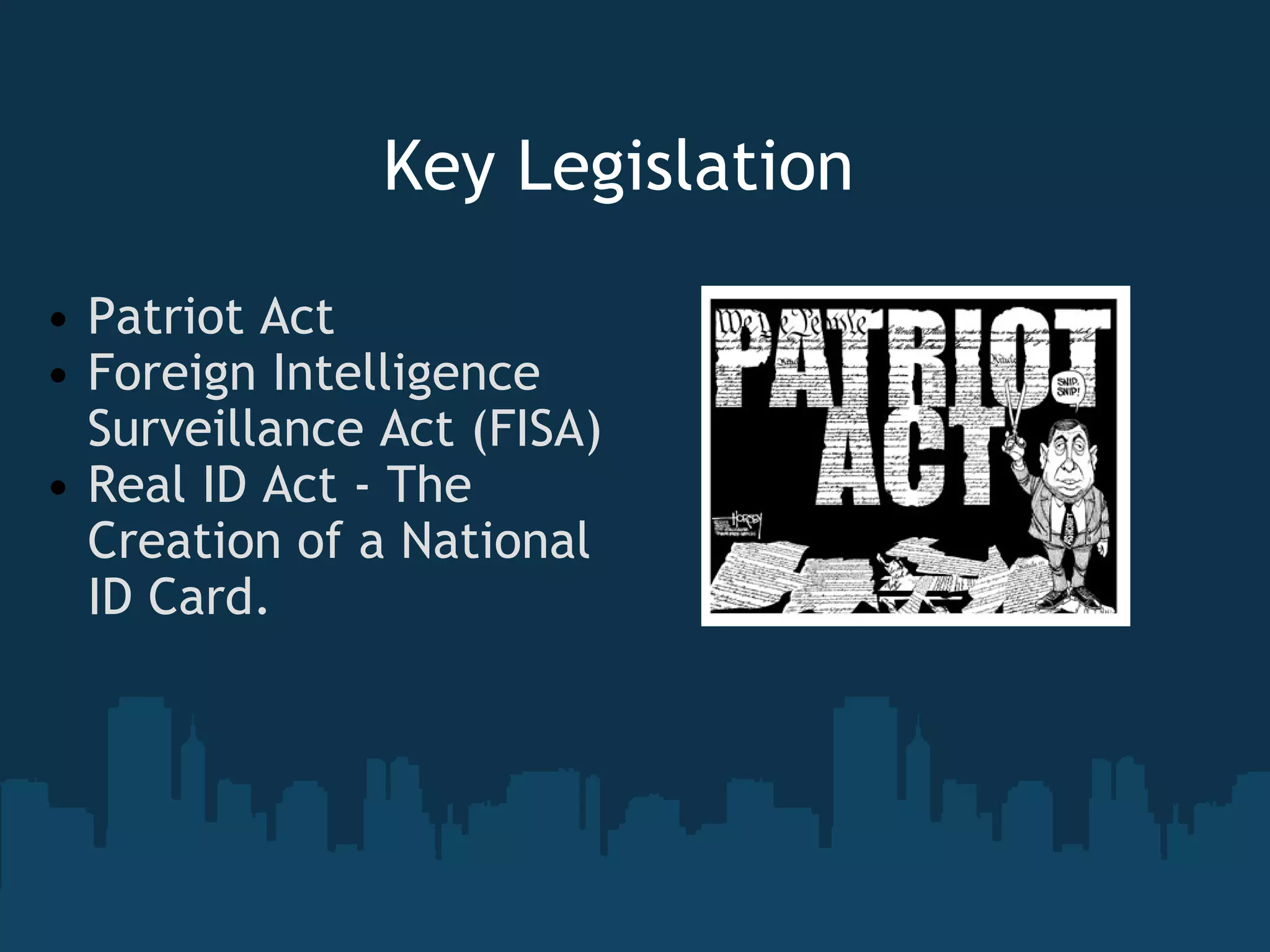
Key Legislation  Patriot Act Foreign Intelligence Surveillance Act (FISA) Real ID Act - The Creation of a National ID Card. 
Surveillance Technology     ECHELON  Used by the United States National Security Agency (NSA) to intercept and process international communications through satellites System is able to intercept messages over the internet messages over the internet System can also use orbiting satellites to monitor signals anywhere on the earth’s surface MAIN PURPOSE: to extract information and intelligence illicitly from millions of messages every day, across the globe NSA and allies have worked to limit/prevent privacy of international telecommunications The Echelon system has abilities to eavesdrop on everyday communications and to watch everything that is being said and done in the world
Advertising Technologies Technologies  Cookies Pixels Web Bugs Spyware Implications Building Profiles of everyone.  Understanding everyone's interests. Tracking your movement all around the web.   Overall...knowing what you do, when you do it, what you like, who you know, and what your opinion is on certain topics is very sensitive information. 
Privacy / Civil Liberty Organizations Electronic Frontier Foundation (EFF.org) American Civil Liberties Union (ACLU) Electronic Privacy Information Center (EPIC)  Privacy Coalition     Advice: Be aware of the services you use and the data you provide to each of them. Be informed of the latest privacy battles happening in the media and understand that everything you do online is archived forever! 
Potential Concerns and Threats
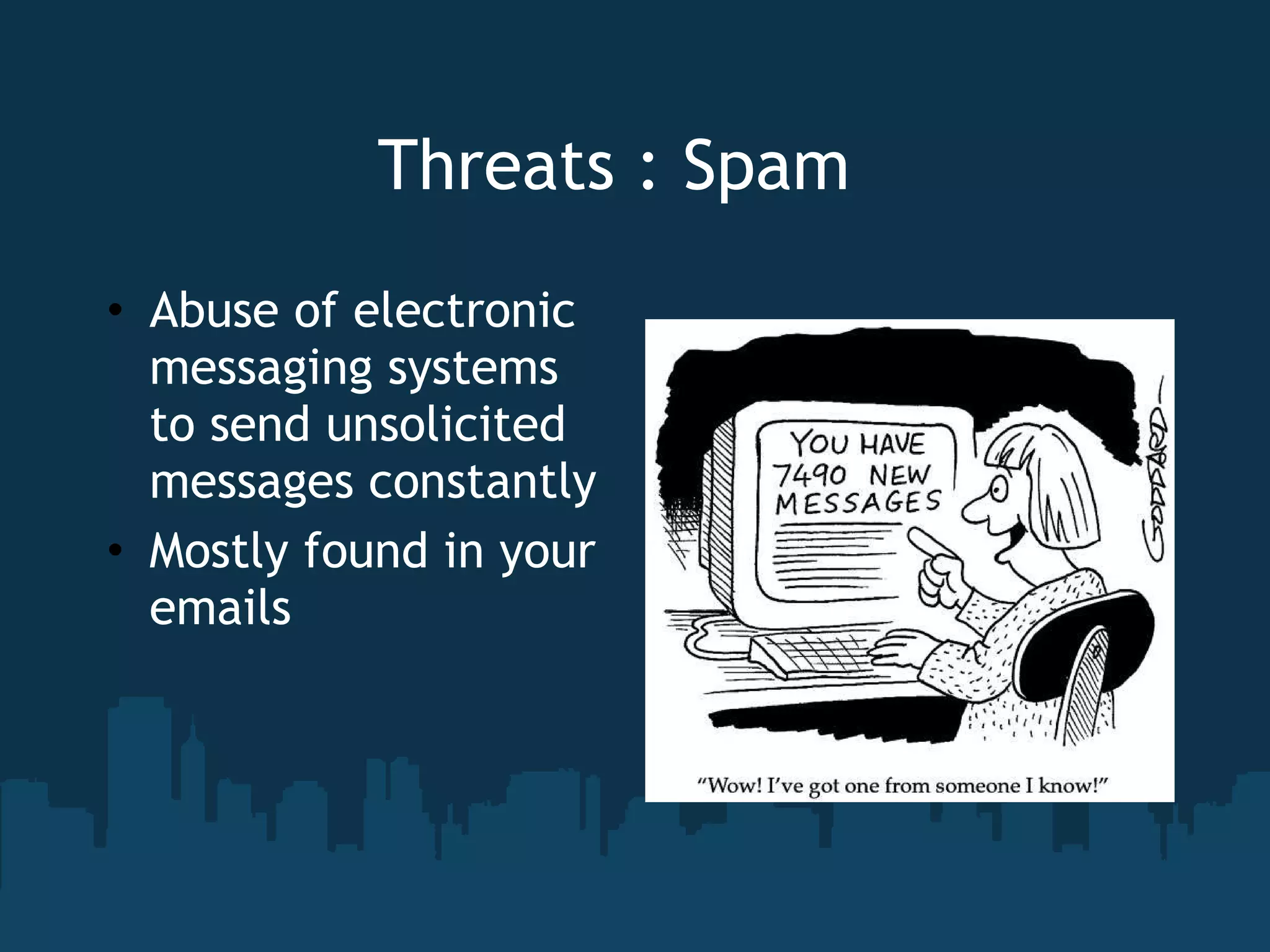
Threats : Spam Abuse of electronic messaging systems to send unsolicited messages constantly Mostly found in your emails
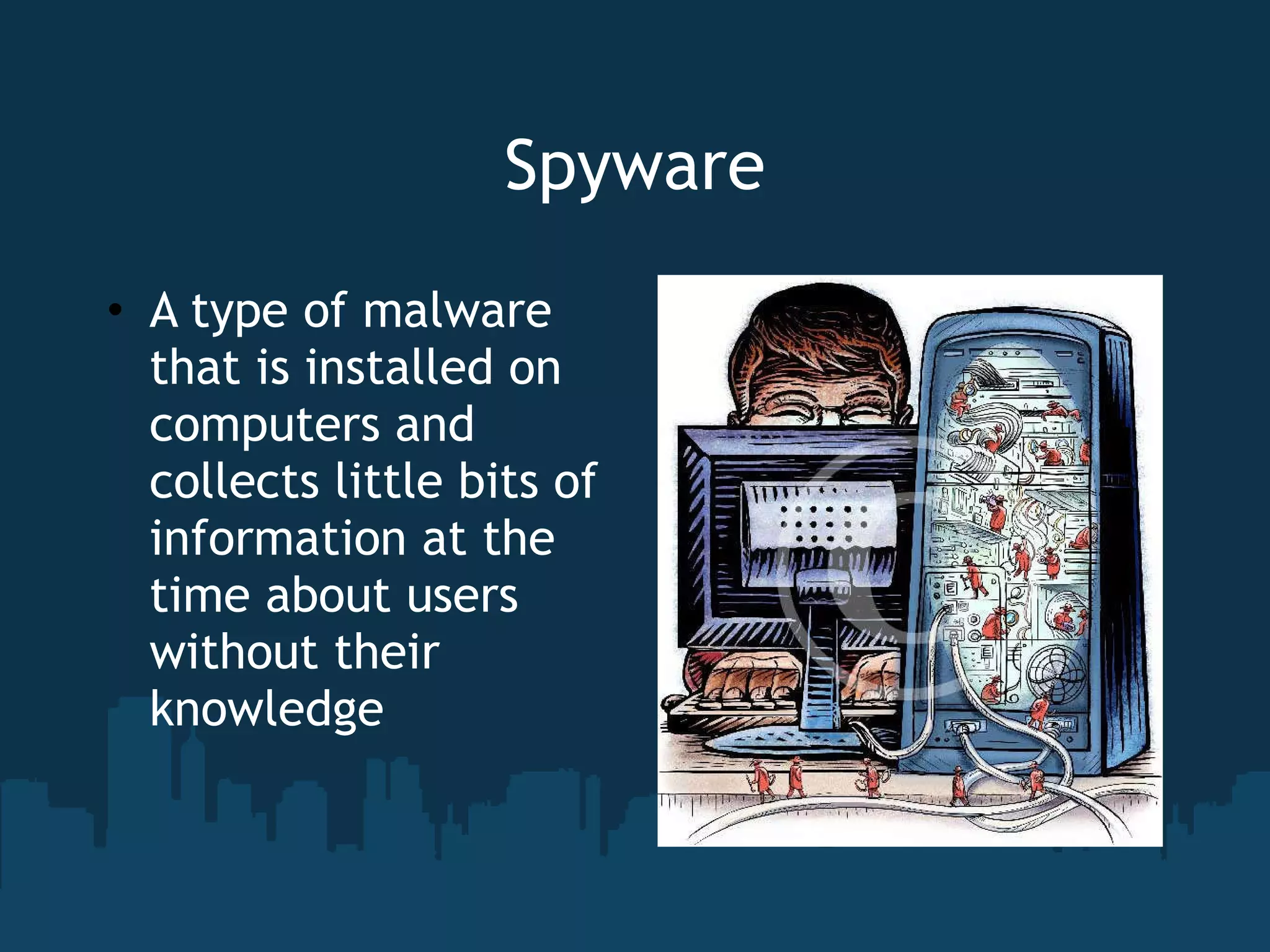
Spyware A type of malware that is installed on computers and collects little bits of information at the time about users without their knowledge
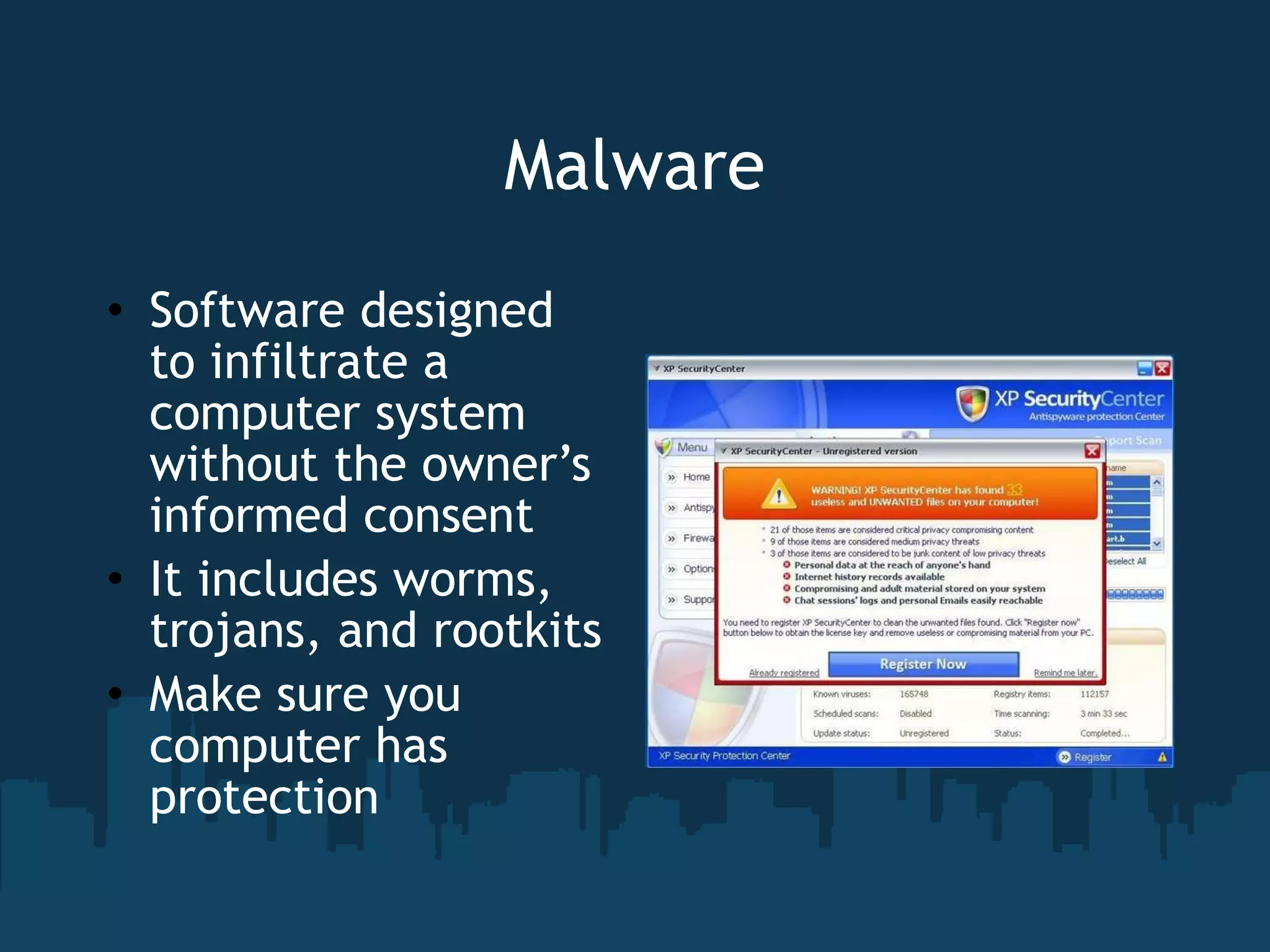
Malware Software designed to infiltrate a computer system without the owner’s informed consent It includes worms, trojans, and rootkits Make sure you computer has protection
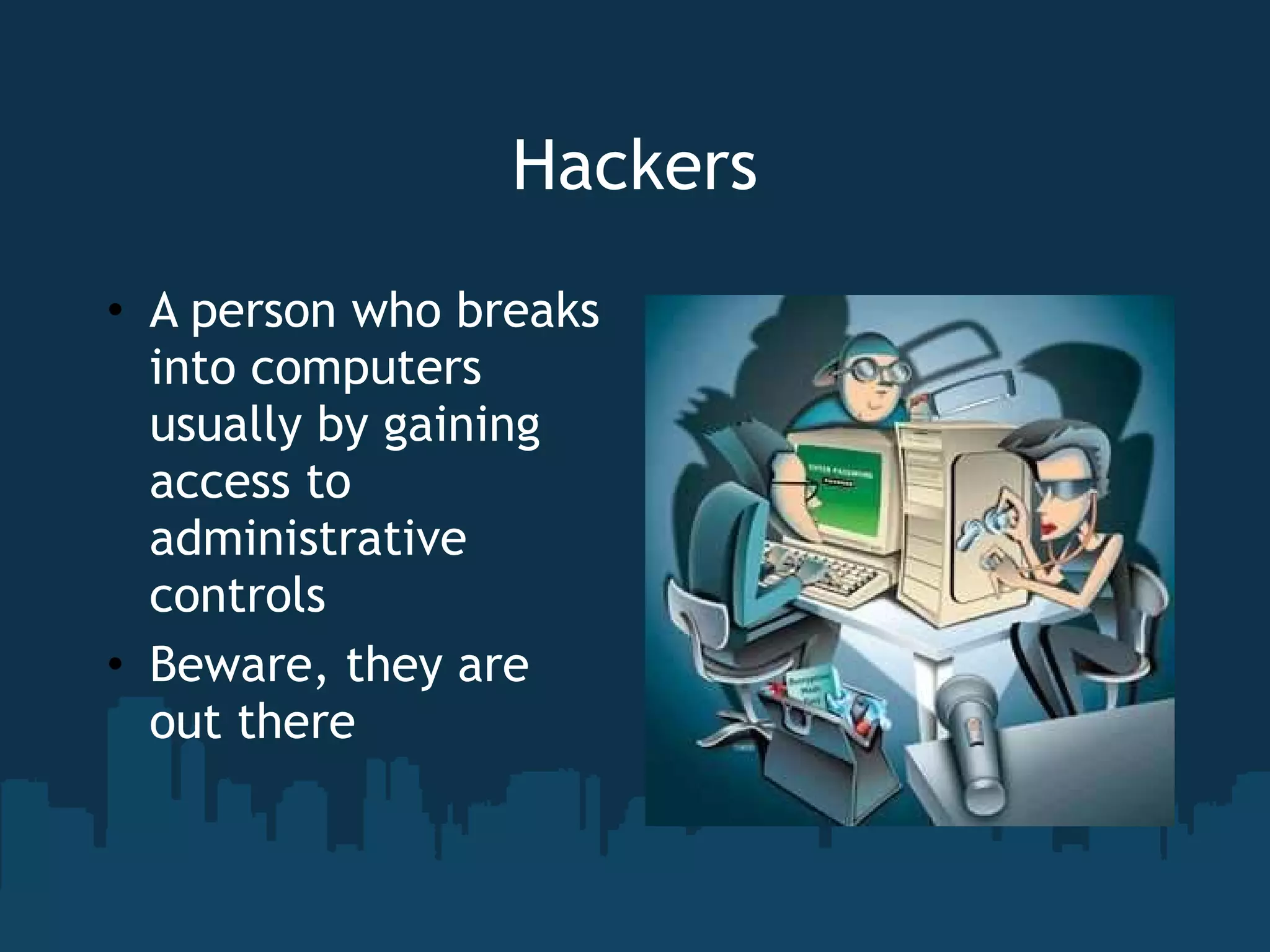
Hackers A person who breaks into computers usually by gaining access to administrative controls Beware, they are out there
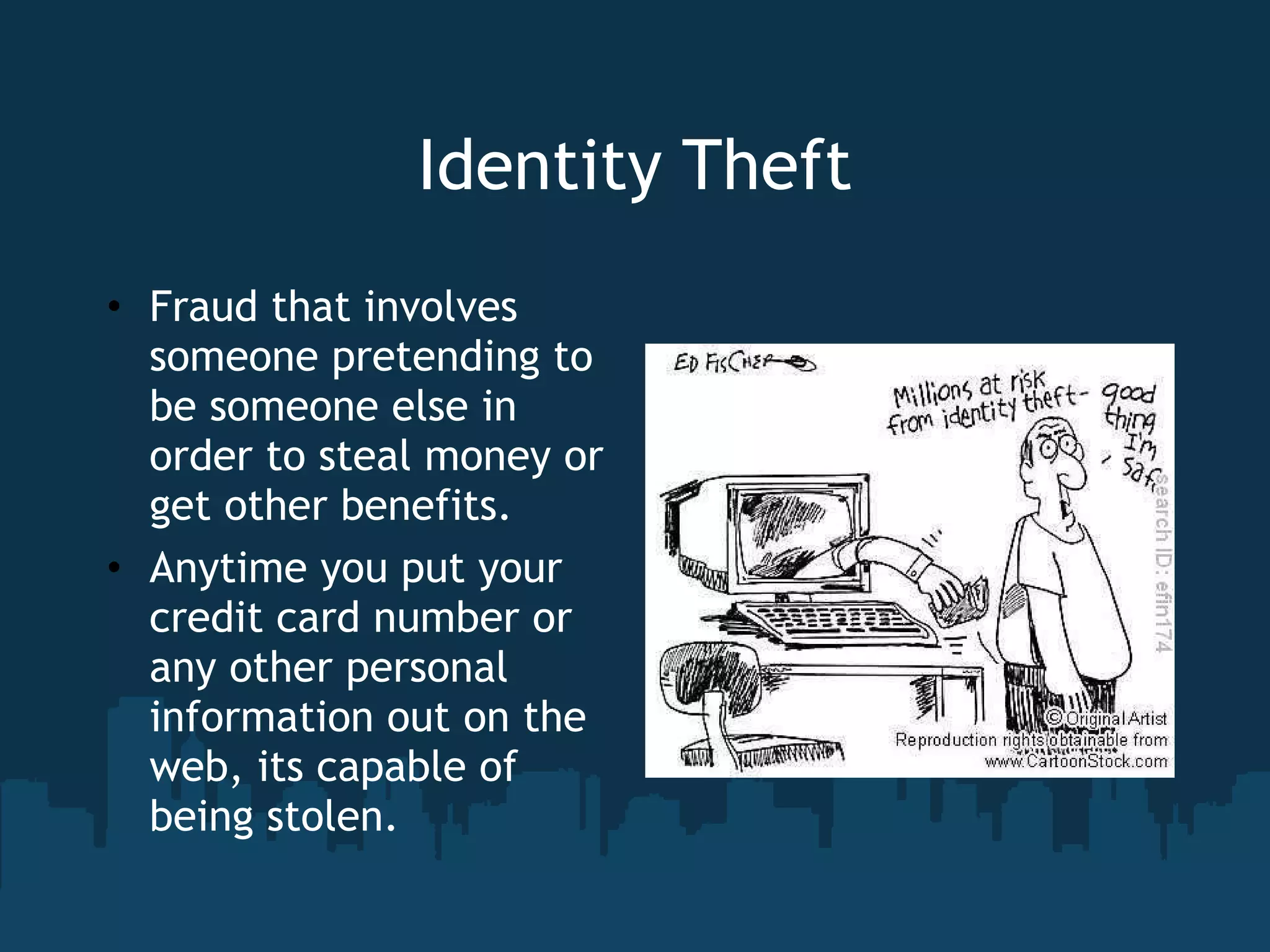
Identity Theft Fraud that involves someone pretending to be someone else in order to steal money or get other benefits. Anytime you put your credit card number or any other personal information out on the web, its capable of being stolen.
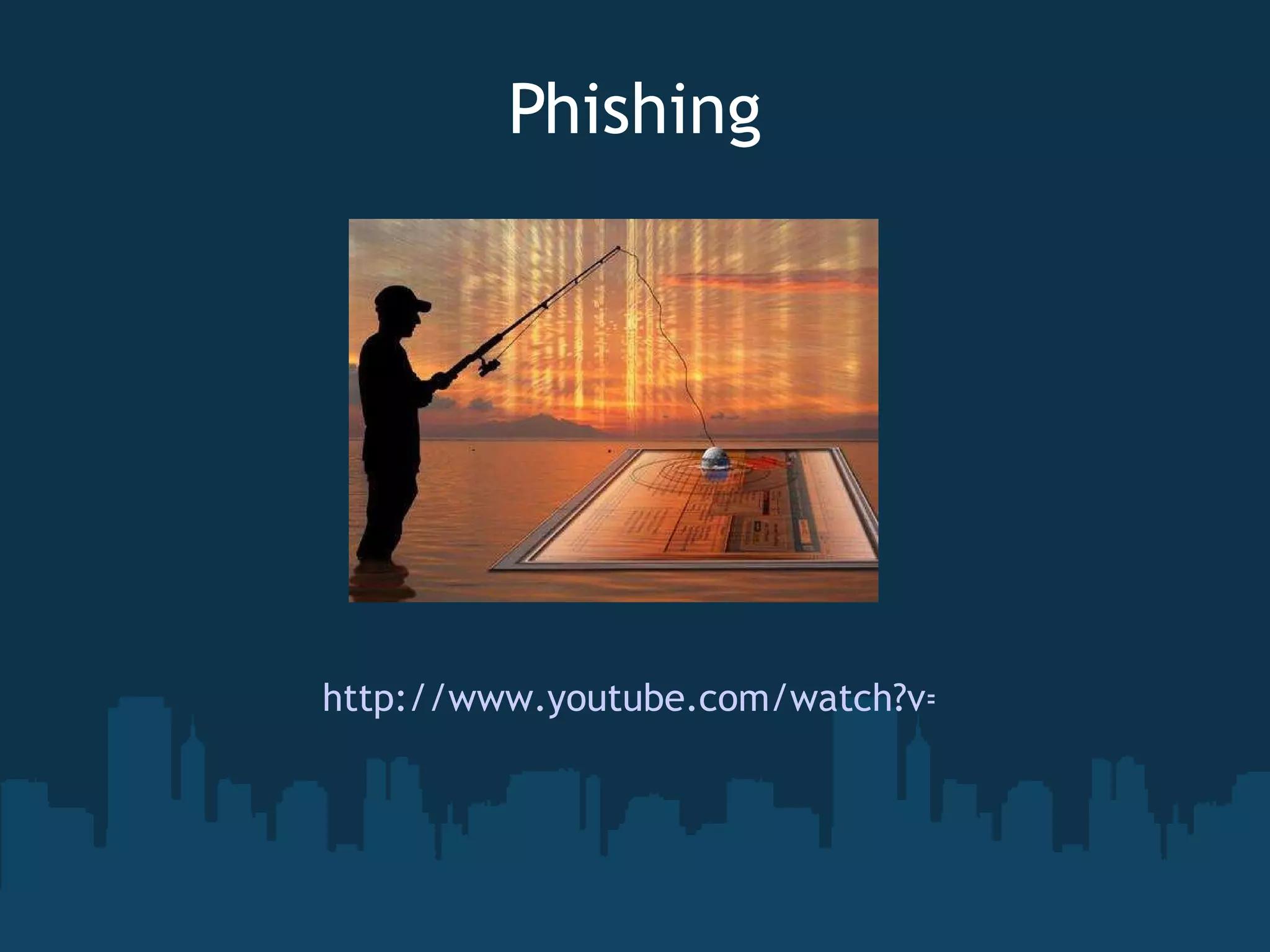
Phishing http://www.youtube.com/watch?v=sqRZGhiHGxg
Phishing Scams   http://www.youtube.com/watch?v=sqRZGhiHGxg VIDEO
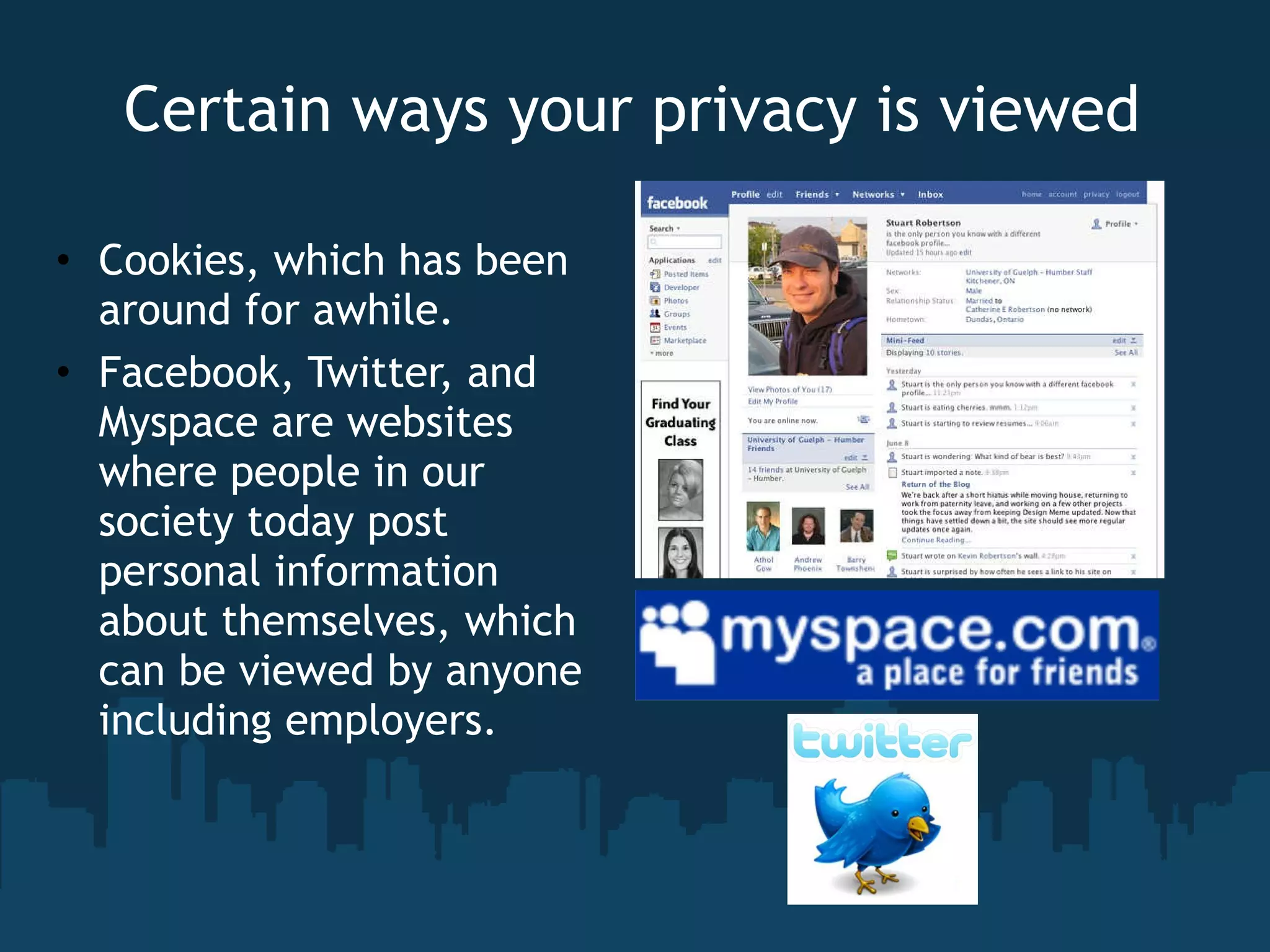
Certain ways your privacy is viewed Cookies, which has been around for awhile. Facebook, Twitter, and Myspace are websites where people in our society today post personal information about themselves, which can be viewed by anyone including employers.
Tips on How to Protect Yourself
Software Anti-virus (AVG) Anti-spyware (Lavasoft Ad-aware) Firewall (ZoneAlarm) P2P (PeerBlock) http://epic.org/privacy/tools.html
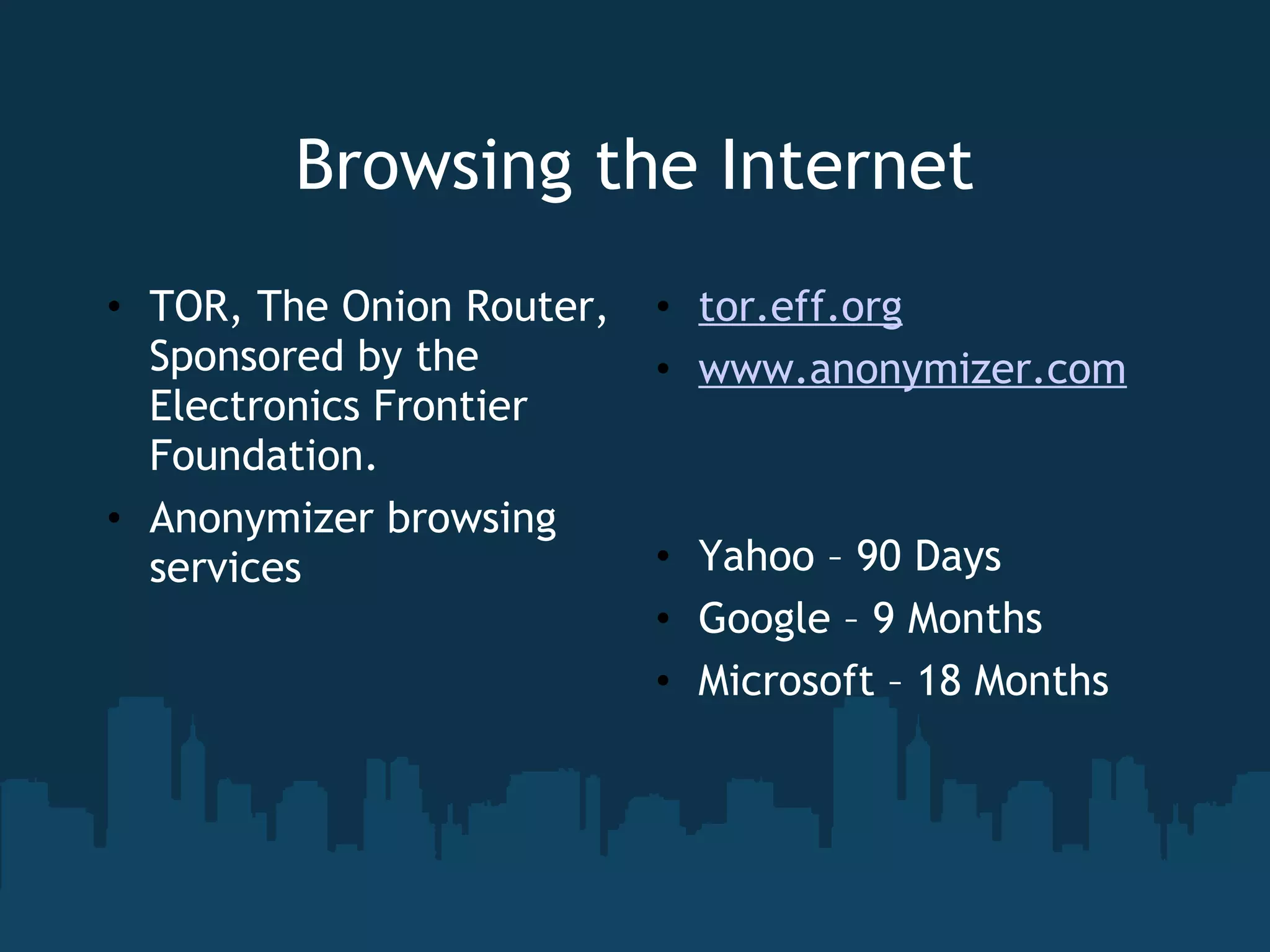
The Browser Security/Privacy Add-ons (Cookie Management) Website Security HTTPS and Padlock Privacy Policies Privacy Seals (TRUSTe)
Protecting your E-mail Use different e-mails for different web activities.  Free webmail services (Hushmail, Mailvault, S-mail) Pretty Good Privacy (PGP)
Browsing the Internet TOR, The Onion Router, Sponsored by the Electronics Frontier Foundation. Anonymizer browsing services tor.eff.org www.anonymizer.com Yahoo – 90 Days Google – 9 Months Microsoft – 18 Months
Summary History and cases of privacy Current legislation Future potential concerns and threats Tips on how to protect yourself
http://www.youtube.com/watch?v=R7yfV6RzE30 VIDEO
WORKS CITED LIST www.idsafe.us http://news.cnet.com/8301-10789_3-9893174-57.html http://www.computerworld.com/s/article/110813/Breach_at_Univ._of_Texas_Austin_exposes_data_on_197_000_people http://www.consumeraffairs.com/news04/2006/06/student_loan_loss.html http://www.securitymanagement.com/news/stanford-university-laptop-stolen-72-000-risk-identity-theft http://www.theregister.co.uk/2006/03/15/ernstyoung_ibm_laptop/ http://www.networkworld.com/news/2006/060606-active-duty-troop-information-part-of.html?nwwpkg=slideshows http://www.msnbc.msn.com/id/6979897/

Tech Topic Privacy

  • 1.
    Tech Topic: PrivacyBy: David Chait, Steven Gonzalez, Travis Lopez, Kristen Magno, Steven Osaki
  • 2.
    What is ComputerPrivacy? The ability to control what information one reveals about oneself, and to control who can access that information.
  • 3.
    Summary History andcases of privacy Current legislation Future potential concerns and threats Tips on how to protect yourself
  • 4.
    DIGITAL U: ALoss of Privacy? http://www.youtube.com/watch?v=W31Xy2wp7wc VIDEO
  • 5.
  • 6.
    Everyone Is AtRisk Applicants Students Individuals Engaged with Large Firms The Unsuspecting Public
  • 7.
    Applicants Harvard’s studentdatabase was hacked exposing over 10,000 applicants from 2007 This information was placed on Bittorrent
  • 8.
    Students Our informationhas been made widely available within our own institutions, and at times is vulnerable to loss. University of Texas at Austin – McCombs School of Business was compromised on April 24, 2006 placing 197,000 people at risk In May of 2006, the Texas Student Loan Corporation lost the records of 1.7 million borrowers.
  • 9.
    Individuals Engaged withLarge Firms Stanford suffers a theft of 72,000 records relating to employees hired prior to September of 2007. Ernst and Young loses a laptop containing thousands of IBM employee Records On May 22,2006 The Department of Veterans Affairs reports the theft of 28,600,000 records (All vets discharged between 1975 and 2006). The information was stolen from an employee’s home computer A federal Judge has ordered restitution over 20 million dollars due to this attack
  • 10.
    The Unsuspecting PublicData Aggregation - The warehousing, repackaging, and resale of information about us. ChoicePoint loses information about 145,000 individuals with which it has no business relationship.
  • 11.
  • 12.
    Key Legislation Patriot Act Foreign Intelligence Surveillance Act (FISA) Real ID Act - The Creation of a National ID Card. 
  • 13.
    Surveillance Technology    ECHELON  Used by the United States National Security Agency (NSA) to intercept and process international communications through satellites System is able to intercept messages over the internet messages over the internet System can also use orbiting satellites to monitor signals anywhere on the earth’s surface MAIN PURPOSE: to extract information and intelligence illicitly from millions of messages every day, across the globe NSA and allies have worked to limit/prevent privacy of international telecommunications The Echelon system has abilities to eavesdrop on everyday communications and to watch everything that is being said and done in the world
  • 14.
    Advertising Technologies Technologies Cookies Pixels Web Bugs Spyware Implications Building Profiles of everyone.  Understanding everyone's interests. Tracking your movement all around the web.   Overall...knowing what you do, when you do it, what you like, who you know, and what your opinion is on certain topics is very sensitive information. 
  • 15.
    Privacy / CivilLiberty Organizations Electronic Frontier Foundation (EFF.org) American Civil Liberties Union (ACLU) Electronic Privacy Information Center (EPIC) Privacy Coalition     Advice: Be aware of the services you use and the data you provide to each of them. Be informed of the latest privacy battles happening in the media and understand that everything you do online is archived forever! 
  • 16.
  • 17.
    Threats : SpamAbuse of electronic messaging systems to send unsolicited messages constantly Mostly found in your emails
  • 18.
    Spyware A typeof malware that is installed on computers and collects little bits of information at the time about users without their knowledge
  • 19.
    Malware Software designedto infiltrate a computer system without the owner’s informed consent It includes worms, trojans, and rootkits Make sure you computer has protection
  • 20.
    Hackers A personwho breaks into computers usually by gaining access to administrative controls Beware, they are out there
  • 21.
    Identity Theft Fraudthat involves someone pretending to be someone else in order to steal money or get other benefits. Anytime you put your credit card number or any other personal information out on the web, its capable of being stolen.
  • 22.
  • 23.
    Phishing Scams  http://www.youtube.com/watch?v=sqRZGhiHGxg VIDEO
  • 24.
    Certain ways yourprivacy is viewed Cookies, which has been around for awhile. Facebook, Twitter, and Myspace are websites where people in our society today post personal information about themselves, which can be viewed by anyone including employers.
  • 25.
    Tips on Howto Protect Yourself
  • 26.
    Software Anti-virus (AVG)Anti-spyware (Lavasoft Ad-aware) Firewall (ZoneAlarm) P2P (PeerBlock) http://epic.org/privacy/tools.html
  • 27.
    The Browser Security/PrivacyAdd-ons (Cookie Management) Website Security HTTPS and Padlock Privacy Policies Privacy Seals (TRUSTe)
  • 28.
    Protecting your E-mailUse different e-mails for different web activities. Free webmail services (Hushmail, Mailvault, S-mail) Pretty Good Privacy (PGP)
  • 29.
    Browsing the InternetTOR, The Onion Router, Sponsored by the Electronics Frontier Foundation. Anonymizer browsing services tor.eff.org www.anonymizer.com Yahoo – 90 Days Google – 9 Months Microsoft – 18 Months
  • 30.
    Summary History andcases of privacy Current legislation Future potential concerns and threats Tips on how to protect yourself
  • 31.
  • 32.
    WORKS CITED LISTwww.idsafe.us http://news.cnet.com/8301-10789_3-9893174-57.html http://www.computerworld.com/s/article/110813/Breach_at_Univ._of_Texas_Austin_exposes_data_on_197_000_people http://www.consumeraffairs.com/news04/2006/06/student_loan_loss.html http://www.securitymanagement.com/news/stanford-university-laptop-stolen-72-000-risk-identity-theft http://www.theregister.co.uk/2006/03/15/ernstyoung_ibm_laptop/ http://www.networkworld.com/news/2006/060606-active-duty-troop-information-part-of.html?nwwpkg=slideshows http://www.msnbc.msn.com/id/6979897/

Editor's Notes

  • #3 SOURCE: /www.idsafe.us
  • #5 SOURCE:
  • #8 http://news.cnet.com/8301-10789_3-9893174-57.html
  • #9 http://www.computerworld.com/s/article/110813/Breach_at_Univ._of_Texas_Austin_exposes_data_on_197_000_people http://www.consumeraffairs.com/news04/2006/06/student_loan_loss.html
  • #10 http://www.securitymanagement.com/news/stanford-university-laptop-stolen-72-000-risk-identity-theft http://www.theregister.co.uk/2006/03/15/ernstyoung_ibm_laptop/ http://www.networkworld.com/news/2006/060606-active-duty-troop-information-part-of.html?nwwpkg=slideshows
  • #11 http://www.msnbc.msn.com/id/6979897/
  • #13 Picture: http://www.acluutah.org/Images/03fall_4.jpg Case and point is that Michael McConnell, Director of National Intelligence, is "leading the way for the US government to have unfettered warrant-less access to citizen's search histories, emails, and other online activities. As Ryan Singel, the author of a recent article in Wired, reported that "the NSA was able to devise legislation by the strong-armed passage of the Protect America Act which was an amendment to FISA (Foreign Intelligence Surveillance Act). " As Singel puts it, "This legislation single-handedly allowed for the NSA to turn GMail servers and AT&T switches into de-facto arms of the surveillance industrial complex without any court oversight." There are obvious reasons on why citizens should be concerned over this type of warrant-less access to personal, private information.
  • #32 http://www.youtube.com/watch?v=R7yfV6RzE30