Industrial Design Problem_1
To establish an efficient Pilot Plant Design to convert waste plastic to Fuel (energy).
TOPIC
Submitted By:~
Mohit Rouniyar
Mukul Anand
Team Name:~ SPARX
Contents
 Introduction
 Plastics Analysis
 Pre-treatment Process
 Process Flow Diagram
 Catalyst Analysis
 Pyrolysis Reactor
 Stimulation on Hysys
 Material/Energy Balance
 Economics Analysis
 References
Waste Plastics To Fuel
Introduction
 Plastics are synthetic organic materials produced by polymerization.
Waste plastics are one of the resources for fuel production because of its high heat of
combustion.
Plastics Type are Thermosetting, Thermoplastics,
Elastomer.
 Most content of plastics are Polyethylene,
Polystyrene, Polypropylene, PVC, other.
Waste Plastics Analysis
Plastics and Petroleum derived fuels are Hydrocarbon
Plastics content longer carbon chains
Following Chart are comparison for calorific value of Petroleum products and Plastics
Material Calorific value (MJ/kg)
Polyethylene 46.3
Polypropylene 46.4
Polystyrene 41.4
Polyvinyl chloride 18.0
Coal 24.3
Liquefied Petroleum Gas 46.1
Petrol 44.0
Kerosene 43.4
Diesel 43.0
Heavy Fuel oil 41.1
Light Fuel oil 41.9
Block Diagram
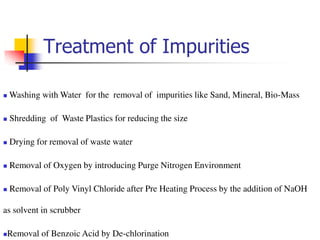
Treatment of Impurities
 Washing with Water for the removal of impurities like Sand, Mineral, Bio-Mass
 Shredding of Waste Plastics for reducing the size
 Drying for removal of waste water
 Removal of Oxygen by introducing Purge Nitrogen Environment
 Removal of Poly Vinyl Chloride after Pre Heating Process by the addition of NaOH
as solvent in scrubber
Removal of Benzoic Acid by De-chlorination
Pre Treatment Process
CATALYST ANALYSIS
Amorphous Almuino - Silicate is proposed
Meso - Structure having relatively low surface area
Pore size and Volume
Low Acid strength as compared to Zeolites.
Shows great activity on cracking of PP
Liquid fuel conversion is about 86%
The residual level is <8 wt % at 500°C.
Contd…
YIELD(w
t%
FEED)
ZSM-5 USY MOR SAHA Silicates
PS PVC PS PVC PS PVC PS PVC PS PVC
Gases 4.25 30.64 3.84 28.11 1.85 31.07 0.72 30.29 0.05 34.49
Styrene 67.52 n.d 61.54 n.d 58.52 n.d 75.45 n.d 72.12 n.d
Other
Aromatics
21.39 n.d 16.6 - 31.22 n.d 15.57 - 22.52 .
HCl n.d 54.52 n.d 55.87 n.d 55.52 n.d 55.45 n.d 56.2
Residue 6.84 14.81 18.02 16.02 8.41 13.41 8.26 14.26 5.31 9.31
 n.d: Not Detectable
Stimulation Analysis
The composition of raw material (plastics) is PE:40%, PP: 40%, and PS: 20%.
Material balance of all streams are in steady state condition,
Vapors behave as ideal-gas and liquids behave as ideal-solution,
No accumulation of mass, and reaction only takes place inside the reactor, .
Enthalpy balance is based on the first law of thermodynamics
Work done on the system by its surrounding are zero.
Energy and Material balance data have been extracted from HYSYS 3.2 simulation
Process Flow Diagram
Overall Process Flow Diagram
Pyrolysis Reactor
Fluidized Bed Reactor
Proposed Material of Composition Stainless Steel
Addition of Duramunium and Mangnese
PROCESS HEATING RATE RESIDENCE
TIME
TEMPERATURE(°C) TARGET
PRODUCTS
SLOW
CARBONIZATION
VERY LOW DAYS 450-600 CHARCOAL
SLOW PYROLYSIS 10-100K/MIN 10-60 min 450-600 Gas, Oil, Char
FAST PYROLYSIS Upto 1000k/s 0.5-5s 550-650 Gas, oil, (char)
FLASH PYROLYSIS Upto 10000k/s <1 s 450-900 Gas, oil, (char)
Design of Pyrolysis Reactor
Product Analysis
Yield(w/w%) Polyethylene Polypropylene Polystyrene
Cracking
Temperature
450°C 450°C 320°C
Gases 18.3 15.7 4
Liquids 81.7 84.2 93
Char >1 >0.25 3
Dominant Products
PE is n-alkenes,1-alkenes
PP is Cyclo-hexane
PS is Styrene
Chemical Reaction
Material Balances
Energy Balances
Economic Analysis
Type of Equipment Cost in USD($)
Storage Tank 1,713,600
Conveyor 977,300
Distillation Column 226,400
Total Estimation Cost 3,349,100
References
 Wikipedia
 Google
 A text book on Chemical Reaction Engg by Octave Levenspiel
 A text book of Chemical Technology by Dryden’s
 Thesis paper on pyrolysis done by Feng Gao and many more.
…THANK S
?
Query
Robust Design

Team sparxbbd copy

  • 1.
    Industrial Design Problem_1 Toestablish an efficient Pilot Plant Design to convert waste plastic to Fuel (energy). TOPIC Submitted By:~ Mohit Rouniyar Mukul Anand Team Name:~ SPARX
  • 2.
    Contents  Introduction  PlasticsAnalysis  Pre-treatment Process  Process Flow Diagram  Catalyst Analysis  Pyrolysis Reactor  Stimulation on Hysys  Material/Energy Balance  Economics Analysis  References
  • 3.
  • 4.
    Introduction  Plastics aresynthetic organic materials produced by polymerization. Waste plastics are one of the resources for fuel production because of its high heat of combustion. Plastics Type are Thermosetting, Thermoplastics, Elastomer.  Most content of plastics are Polyethylene, Polystyrene, Polypropylene, PVC, other.
  • 5.
    Waste Plastics Analysis Plasticsand Petroleum derived fuels are Hydrocarbon Plastics content longer carbon chains Following Chart are comparison for calorific value of Petroleum products and Plastics Material Calorific value (MJ/kg) Polyethylene 46.3 Polypropylene 46.4 Polystyrene 41.4 Polyvinyl chloride 18.0 Coal 24.3 Liquefied Petroleum Gas 46.1 Petrol 44.0 Kerosene 43.4 Diesel 43.0 Heavy Fuel oil 41.1 Light Fuel oil 41.9
  • 6.
  • 7.
    Treatment of Impurities Washing with Water for the removal of impurities like Sand, Mineral, Bio-Mass  Shredding of Waste Plastics for reducing the size  Drying for removal of waste water  Removal of Oxygen by introducing Purge Nitrogen Environment  Removal of Poly Vinyl Chloride after Pre Heating Process by the addition of NaOH as solvent in scrubber Removal of Benzoic Acid by De-chlorination
  • 8.
  • 9.
    CATALYST ANALYSIS Amorphous Almuino- Silicate is proposed Meso - Structure having relatively low surface area Pore size and Volume Low Acid strength as compared to Zeolites. Shows great activity on cracking of PP Liquid fuel conversion is about 86% The residual level is <8 wt % at 500°C.
  • 10.
    Contd… YIELD(w t% FEED) ZSM-5 USY MORSAHA Silicates PS PVC PS PVC PS PVC PS PVC PS PVC Gases 4.25 30.64 3.84 28.11 1.85 31.07 0.72 30.29 0.05 34.49 Styrene 67.52 n.d 61.54 n.d 58.52 n.d 75.45 n.d 72.12 n.d Other Aromatics 21.39 n.d 16.6 - 31.22 n.d 15.57 - 22.52 . HCl n.d 54.52 n.d 55.87 n.d 55.52 n.d 55.45 n.d 56.2 Residue 6.84 14.81 18.02 16.02 8.41 13.41 8.26 14.26 5.31 9.31  n.d: Not Detectable
  • 11.
    Stimulation Analysis The compositionof raw material (plastics) is PE:40%, PP: 40%, and PS: 20%. Material balance of all streams are in steady state condition, Vapors behave as ideal-gas and liquids behave as ideal-solution, No accumulation of mass, and reaction only takes place inside the reactor, . Enthalpy balance is based on the first law of thermodynamics Work done on the system by its surrounding are zero. Energy and Material balance data have been extracted from HYSYS 3.2 simulation
  • 12.
  • 13.
  • 14.
    Pyrolysis Reactor Fluidized BedReactor Proposed Material of Composition Stainless Steel Addition of Duramunium and Mangnese PROCESS HEATING RATE RESIDENCE TIME TEMPERATURE(°C) TARGET PRODUCTS SLOW CARBONIZATION VERY LOW DAYS 450-600 CHARCOAL SLOW PYROLYSIS 10-100K/MIN 10-60 min 450-600 Gas, Oil, Char FAST PYROLYSIS Upto 1000k/s 0.5-5s 550-650 Gas, oil, (char) FLASH PYROLYSIS Upto 10000k/s <1 s 450-900 Gas, oil, (char)
  • 15.
  • 16.
    Product Analysis Yield(w/w%) PolyethylenePolypropylene Polystyrene Cracking Temperature 450°C 450°C 320°C Gases 18.3 15.7 4 Liquids 81.7 84.2 93 Char >1 >0.25 3 Dominant Products PE is n-alkenes,1-alkenes PP is Cyclo-hexane PS is Styrene
  • 17.
  • 18.
  • 19.
  • 20.
    Economic Analysis Type ofEquipment Cost in USD($) Storage Tank 1,713,600 Conveyor 977,300 Distillation Column 226,400 Total Estimation Cost 3,349,100
  • 21.
    References  Wikipedia  Google A text book on Chemical Reaction Engg by Octave Levenspiel  A text book of Chemical Technology by Dryden’s  Thesis paper on pyrolysis done by Feng Gao and many more.
  • 22.
  • 23.