+
Kathleen Scott Cramer
Yvonne Brennan
Dara Reasor
Eric Clark
MG420 Business Policy PowerPoint
Presentation
Innovative
Chester Inc.
Global Ethical
On-Time
+
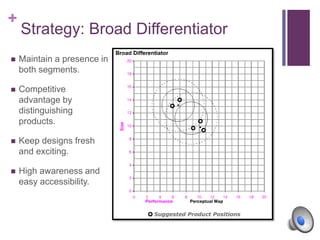
Strategy: Broad Differentiator
 Maintain a presence in
both segments.
 Competitive
advantage by
distinguishing
products.
 Keep designs fresh
and exciting.
 High awareness and
easy accessibility.
+
Mission
 Premium products for
the industry.
 Our brands withstand
the test of time.
 Our stakeholders are
customers,
stockholders,
management, and
employees.
+
Vision
 Global leaders in providing
reliable, sustainable,
American made products.
 Dedicated to building
lasting relationships with
our customers.
 Commitment to quality
management and
excellence.
+
Research and Development
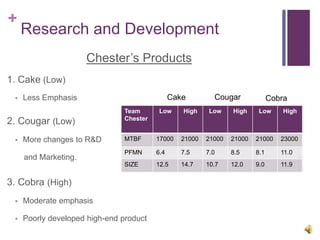
1. Cake (Low)
 Less Emphasis
2. Cougar (Low)
 More changes to R&D
and Marketing.
3. Cobra (High)
 Moderate emphasis
 Poorly developed high-end product
Team
Chester
Low High Low High Low High
MTBF 17000 21000 21000 21000 21000 23000
PFMN 6.4 7.5 7.0 8.5 8.1 11.0
SIZE 12.5 14.7 10.7 12.0 9.0 11.9
Cake Cougar Cobra
Chester’s Products
+
R&D: Perceptual Map
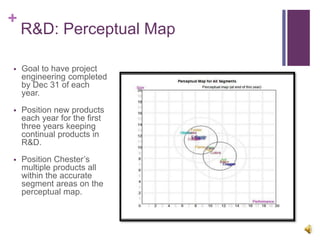
 Goal to have project
engineering completed
by Dec 31 of each
year.
 Position new products
each year for the first
three years keeping
continual products in
R&D.
 Position Chester’s
multiple products all
within the accurate
segment areas on the
perceptual map.
+
Marketing
 Our goal is to obtain largest
market share in the competing
segment.
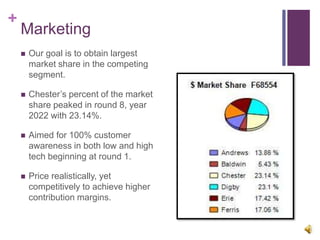
 Chester’s percent of the market
share peaked in round 8, year
2022 with 23.14%.
 Aimed for 100% customer
awareness in both low and high
tech beginning at round 1.
 Price realistically, yet
competitively to achieve higher
contribution margins.
+
Production
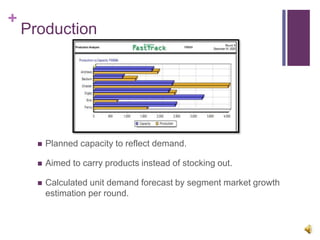
 Planned capacity to reflect demand.
 Aimed to carry products instead of stocking out.
 Calculated unit demand forecast by segment market growth
estimation per round.
+
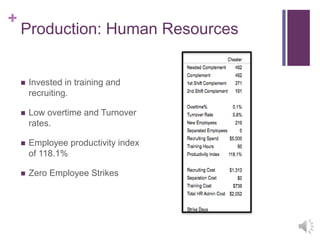
Production: Human Resources
 Invested in training and
recruiting.
 Low overtime and Turnover
rates.
 Employee productivity index
of 118.1%
 Zero Employee Strikes
+
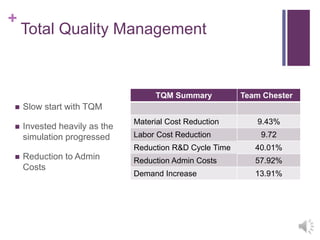
Total Quality Management
 Slow start with TQM
 Invested heavily as the
simulation progressed
 Reduction to Admin
Costs
TQM Summary Team Chester
Material Cost Reduction 9.43%
Labor Cost Reduction 9.72
Reduction R&D Cycle Time 40.01%
Reduction Admin Costs 57.92%
Demand Increase 13.91%
+
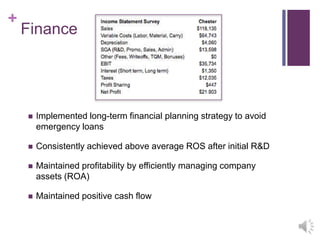
Finance
 Implemented long-term financial planning strategy to avoid
emergency loans
 Consistently achieved above average ROS after initial R&D
 Maintained profitability by efficiently managing company
assets (ROA)
 Maintained positive cash flow
+
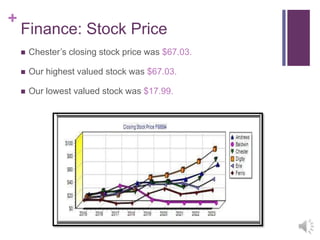
Finance: Stock Price
 Chester’s closing stock price was $67.03.
 Our highest valued stock was $67.03.
 Our lowest valued stock was $17.99.
+
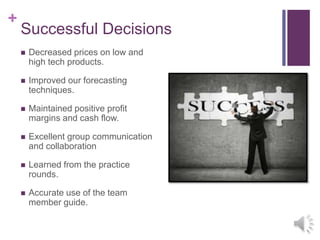
Successful Decisions
 Decreased prices on low and
high tech products.
 Improved our forecasting
techniques.
 Maintained positive profit
margins and cash flow.
 Excellent group communication
and collaboration
 Learned from the practice
rounds.
 Accurate use of the team
member guide.
+
Unsuccessful Decisions
 Did not accurately forecast
sales in the beginning
stages
 Did not utilize Total Quality
Management (TQM)
initiatives effectively.
 Launched a total of 3
products: Cake, Cobra,
Cougar
 Plant utilization not
maximized to full potential
+
Lessons Learned
 How the decisions of one
business unit affects the
others
 Better awareness of how
competition drives decision
making
 Implemented strategic
thinking
 Develop additional products
in R&D
+
Conclusion
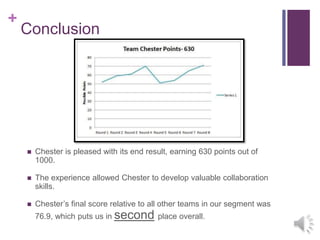
 Chester is pleased with its end result, earning 630 points out of
1000.
 The experience allowed Chester to develop valuable collaboration
skills.
 Chester’s final score relative to all other teams in our segment was
76.9, which puts us in second place overall.

Team chester design 2 yb copy

  • 1.
    + Kathleen Scott Cramer YvonneBrennan Dara Reasor Eric Clark MG420 Business Policy PowerPoint Presentation Innovative Chester Inc. Global Ethical On-Time
  • 2.
    + Strategy: Broad Differentiator Maintain a presence in both segments.  Competitive advantage by distinguishing products.  Keep designs fresh and exciting.  High awareness and easy accessibility.
  • 3.
    + Mission  Premium productsfor the industry.  Our brands withstand the test of time.  Our stakeholders are customers, stockholders, management, and employees.
  • 4.
    + Vision  Global leadersin providing reliable, sustainable, American made products.  Dedicated to building lasting relationships with our customers.  Commitment to quality management and excellence.
  • 5.
    + Research and Development 1.Cake (Low)  Less Emphasis 2. Cougar (Low)  More changes to R&D and Marketing. 3. Cobra (High)  Moderate emphasis  Poorly developed high-end product Team Chester Low High Low High Low High MTBF 17000 21000 21000 21000 21000 23000 PFMN 6.4 7.5 7.0 8.5 8.1 11.0 SIZE 12.5 14.7 10.7 12.0 9.0 11.9 Cake Cougar Cobra Chester’s Products
  • 6.
    + R&D: Perceptual Map Goal to have project engineering completed by Dec 31 of each year.  Position new products each year for the first three years keeping continual products in R&D.  Position Chester’s multiple products all within the accurate segment areas on the perceptual map.
  • 7.
    + Marketing  Our goalis to obtain largest market share in the competing segment.  Chester’s percent of the market share peaked in round 8, year 2022 with 23.14%.  Aimed for 100% customer awareness in both low and high tech beginning at round 1.  Price realistically, yet competitively to achieve higher contribution margins.
  • 8.
    + Production  Planned capacityto reflect demand.  Aimed to carry products instead of stocking out.  Calculated unit demand forecast by segment market growth estimation per round.
  • 9.
    + Production: Human Resources Invested in training and recruiting.  Low overtime and Turnover rates.  Employee productivity index of 118.1%  Zero Employee Strikes
  • 10.
    + Total Quality Management Slow start with TQM  Invested heavily as the simulation progressed  Reduction to Admin Costs TQM Summary Team Chester Material Cost Reduction 9.43% Labor Cost Reduction 9.72 Reduction R&D Cycle Time 40.01% Reduction Admin Costs 57.92% Demand Increase 13.91%
  • 11.
    + Finance  Implemented long-termfinancial planning strategy to avoid emergency loans  Consistently achieved above average ROS after initial R&D  Maintained profitability by efficiently managing company assets (ROA)  Maintained positive cash flow
  • 12.
    + Finance: Stock Price Chester’s closing stock price was $67.03.  Our highest valued stock was $67.03.  Our lowest valued stock was $17.99.
  • 13.
    + Successful Decisions  Decreasedprices on low and high tech products.  Improved our forecasting techniques.  Maintained positive profit margins and cash flow.  Excellent group communication and collaboration  Learned from the practice rounds.  Accurate use of the team member guide.
  • 14.
    + Unsuccessful Decisions  Didnot accurately forecast sales in the beginning stages  Did not utilize Total Quality Management (TQM) initiatives effectively.  Launched a total of 3 products: Cake, Cobra, Cougar  Plant utilization not maximized to full potential
  • 15.
    + Lessons Learned  Howthe decisions of one business unit affects the others  Better awareness of how competition drives decision making  Implemented strategic thinking  Develop additional products in R&D
  • 16.
    + Conclusion  Chester ispleased with its end result, earning 630 points out of 1000.  The experience allowed Chester to develop valuable collaboration skills.  Chester’s final score relative to all other teams in our segment was 76.9, which puts us in second place overall.

Editor's Notes

  • #2 LOOK AT NOTES FOR EXTRA SPEAKING POINTS!!! Slides 1-4: Eric Slides 5-8: Kathy Slides 9-12: Yvonne Slides 13-16: Dara Hello and thank you for viewing Chester INCs’ Capsim Final PowerPoint presentation. Please allow me to introduce Chester INCs’ team members: Kathleen Scott Cramer, Yvonne Brennan, Dara Reasor, and Eric Clark. Our presentation is designed to guide you through our Capsim business scenario results. This presentation narrated by all Chester INC team members includes: Our strategy, our mission, our vision, research and development performance, marketing performance, production performance, total quality management project performance, financial performance, successful decisions, unsuccessful decisions, lessons learned, and finally Chester INCs overall performance compared to other teams in our segment.
  • #3 TACTICS: Research & Development: We will keep our existing product line, and introduce at least one more line, maintaining a presence in both segments. Our goal is to offer customers products that match their ideal criteria for positioning, age, and reliability. Marketing: Our company will spend aggressively in promotion and sales in both segments. We want every customer to know about our superb designs, and we want to make our products easy for customers to find. We will price at a premium. Production: We will grow capacity to meet the demand that we generate. After our products are well positioned, we will investigate modest increases in automation levels to improve margins, but never at the expense of our ability to reposition products and keep up with segments as they move across the perceptual map. Finance: We will finance our investments primarily through stock issues and cash from operations, supplementing with bond offerings on an as needed basis. When our cash position allows, we will establish a dividend policy and begin to retire stock. We are somewhat adverse to debt, and prefer to avoid interest payments. We expect to keep assets/equity (leverage) between 1.5 and 2.0.
  • #5 Next Kathy will discuss R&D, marketing, and production results.
  • #6 The goal in Research & Development is to make a product(s) that customers want and works with Marketing to make sure the products meet customer's expectations. Our team started with the initial low-tech product CAKE, then we introduced a high tech product COBRA and another low-tech product COUGAR. As the demand for the older low-tech product CAKE waned, COUGAR'S expectations were to fill that low-tech gap. COUGAR actually became a stronger product so we focused more on R&D, Production, and Marketing throughout the competition on this product. Our high-tech product COBRA was doing very well after it was introduced. Due to low production and not utilizing cutting edge R&D techniques COBRA became a poorly developed high-end product
  • #7 The Research & Development department invents new products or changes specifications for existing products. In keeping up with customer preferences Research and Development must reposition products continuously, while also keeping them within the moving segment circles on the Perceptual Map. The Perceptual Map is an invaluable tool for companies to track their products and those of their competitors. Any changes to the size and performance of a product will reposition it on the Perceptual Map. At the end of every year by Dec 31st the goal is to have each project completed. New products that are introduced in each segment must be correctly positioned using Price, Age, MTFB, Size, and Performance. Low tech products and high tech products both have the same criteria, but places a different emphasis on each criteria - Price, Age, Reliability, and Ideal Position. It is the adjustments made to this criteria that will show the product(s) movement or drift on the Perceptual Map. This movement will allow a company to better evaluate where it stands in the marketplace and also benchmark it against its competitors. High tech customers demand cutting edge technology, while low tech customers focus on a product's price and reliability. Team Chester's goal was to have all of our products positioned accurately in the segments areas on the Perceptual Map.  
  • #8 I’d like to take out the last two bullet points and use them in the narrative as follows: Our marketing strategy was to aim for 100% customer awareness in both the low and high tech products. We kept promotional and sales budgets relatively even throughout the competition. This strategy helped Team Chester to attain 23.14% of the market in year 2022 by round 8, which was the majority of the market share. We also achieved 100% customer awareness of all products and 100% customer accessibility with our low-tech products CAKE and COUGAR. This helped our products gain 16% each of the low tech market shares, which was the largest share of all low-tech products. Even though our customer accessibility for our high tech product was 87% we still accumulated a market share of 14.4% of the high tech market. In keeping our products priced realistically, yet competitively throughout the competition, this strategy helped us to achieve higher contribution margins. Team Chester’s ultimate goal was to obtain the largest market share in the competing segment.  
  • #9 Team Chester's strategy for production was to have the capacity to produce products for customer demand and to avoid stockouts and excess inventory. In round 8 we did not have enough capacity to produce. Investing more in automation would have helped bring down labor costs. Our second shift and overtime for COUGAR and COBRA was at 100% and we still had excess inventory. Forecasting more accurately in Marketing would have allowed for a better production schedule. Overall, Team Chester stayed competitive with our products and had the second to highest overall profits in the final round of the competition calculating unit demand forecasts by segment growth. We also did very well with our plant utilization staying under the 180% threshold at 171.71%, which was the highest of all our competitors.
  • #10 Notes: EPI – is a measure of how productive an employee is being by the amount of their output. In order to keep our EPI high, we maintained 80 training hours and $5000 in recruiting expenses throughout the simulations. We proudly state that there were zero employee strikes.
  • #11 Started out very poorly with zero additions to TQM. We didn’t completely understand the effects that investing in TQM and Sustainability would have in the long term. Began to invest aggressively in TQM initiatives once we saw the positive reduction in material/labor costs. As you can see, where we saw the greatest benefit from our investments was in the reduction of our admin costs.
  • #12 One goal enough cash flow that we would not have to take out emergency loans. Any ideas for other things to say? The slide seems to say it all.
  • #13 Team Chester completed the simulation with a AAA S&P Rating, which is the highest S&P rating. As you can see our stock value increased substantially during the period of the simulation. Occasionally we issued stock to raise capital.
  • #14 Team Chester’s Successful Decisions: By decreasing prices on low and high tech products slowly throughout the simulation, we were able to increase sales producing more assets/cash on hand. By improving our forecasting techniques to the sales forecasting method listed in the Capsim team member guide, we were able to encountered less stock-outs and kept any additional inventory on hand for next year’s sales, which we quickly learned we wanted to do instead of being penalized for stocking out Over the years Team Chester was able to maintain positive profit margins and cash flow. We never dipped into the negative or needed to take out emergency loans to help our cash position The four members of our group met weekly and efficiently made decisions we felt were best for team Chester’s sensor products in the market. The 3 practice rounds we had at the beginning of the semester gave us an excellent outlook on how the rounds would go throughout the remaining time in the course. This was an effective tool to our achievements in Capsim By utilizing the team member guide given to us at the beginning of the semester we were able to make informed decisions to effectively boost team Chester to success.
  • #15 Our Unsuccessful Decisions: In the beginning of the simulation we attempted our own calculations of forecasting and how many units may be sold in the next year. It wasn’t until we began to utilize the forecasting guide that we began to show more accurate forecasting skills in our calculations. 2. Team Chester did not invest initially in Total Quality Management (TQM) as we were unaware of the actual benefits we would receive from it. Originally, we decided to try to preserve our cash-on-hand instead of spending it. As the simulation progressed, we began to see the great value in investing in TQM. We believe if we had invested in TQM sooner, our numbers would reflect higher on labor cost reduction, material cost reduction and admin cost reduction. 3. Part of Broad Differentiator strategy was to continuously create new products throughout the entire simulation. Team Chester deviated slightly from that aspect of the Broad Differentiator strategy by only creating two new products for a total of three products: Cake, Cobra and Cougar. 4. Write Words for plant utilization
  • #16 Our lessons learned: First off, by furthering our understanding of how the decisions of one business unit affects the others was our number one lesson learned. By understanding more thoroughly that having too much equity can work against team Chester, we were able to readjust our expenditures throughout the remaining simulation years. Also, improved forecasting skills greatly benefitted the effects of our other business lines. Secondly, by obtaining a greater awareness of how competition drives decision making, we were able to make adjustments to our low and high segment pricing. Using comparative pricing to other relative sensors in the market enabled us to establish a better selling price in the coming year. Also, if Team Chester had implemented strategic thinking earlier in the simulation, we would have not focused primarily on our cash position. Instead we would have looked at our total enterprise along with the competitive landscape and have been able to develop the business strategy that would have the greatest chance for success. Finally, if we had developed additional products in R&D in rounds 6 or 7 to stay in line with our broad differentiator strategy, we would have increased sales revenue and total profitability.
  • #17 In conclusion, Team Chester is extremely pleased with our outcome of the simulation, earning a total of 630 points out of 1000 possible points. Now that our time in the simulation is over, we are able to reflect on the value of Team Chester’s abilities to develop valuable collaboration skills. Chester’s final score, relative to all other teams in our segment was 76.9, which lands us in second place overall.