Running head: CAPSIM ANALYSIS: FERRIS 1
CAPSIM Analysis: Ferris
Priscilla Gonzalez, Howard Hehrer, Cori Porasik, Nikita Motkur, Neha Noonemunthala
Barney Barnett School of Business - Florida Southern College
CAPSIM ANALYSIS: FERRIS 2
Contents
Team Organization.............................................................................................................. 3
Production & Finance ..................................................................................................... 3
Product Manager............................................................................................................. 3
Segment Manager ........................................................................................................... 3
Human Resource Manager/Secretary.............................................................................. 4
Competitive Intelligence Officer .................................................................................... 4
Mission Statement............................................................................................................... 5
Business-Level Strategy...................................................................................................... 5
Competitor Analysis ....................................................................................................... 6
Andrews – Broad Cost Leader.................................................................................... 6
Baldwin – Low Performer........................................................................................... 6
Chester – Cost Leader with Product Life Cycle Focus............................................... 7
Digby – Aggressive Growth ....................................................................................... 8
Erie – Niche Differentiator ......................................................................................... 9
Capacity Analysis ......................................................................................................... 11
Traditional Segment.................................................................................................. 11
Low End Segment..................................................................................................... 11
High End Segment .................................................................................................... 12
Performance Segment ............................................................................................... 13
Size Segment............................................................................................................. 14
Material Cost Analysis...................................................................................................... 15
Labor Cost Analysis.......................................................................................................... 17
Implementation Analysis .................................................................................................. 19
Round 6......................................................................................................................... 19
Round 7......................................................................................................................... 19
Round 8 and Performance Criteria................................................................................ 20
Table of Figures ................................................................................................................ 22
CAPSIM ANALYSIS: FERRIS 3
Team Organization
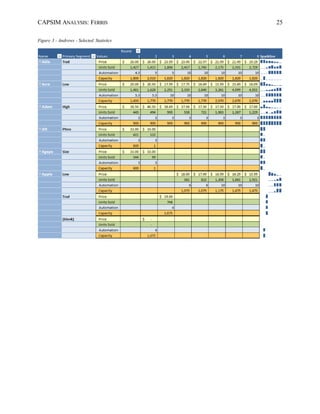
For this section, please reference Figure 2 - Team Organization.
Production & Finance
Howie Hehrer performed the role of CFO as a Functional Manager, whose job was to
optimize the efficiency of the assigned function and to coordinate strategy across functional
boundaries. As a functional manager, he assumed responsibility for the overall performance of
several departments, including Research & Development (R&D), Marketing, Production, and
Finance. Functional Managers are the authority for all rules that apply to their area.
Product Manager
Neha Noonemunthala filled the role of R&D Product manager. Product Managers are
responsible for highly specific projects that develop new competitive advantages. Neha answered
critical questions like “is the product positioned correctly on the perceptual map?”, “Does the
project have sufficient capacity to meet current and future demand?”, “In marketing, is the price
acceptable to the target demographic?”, and “Considering the expected demand for the segment
and the number of competing products, is the sales forecast appropriate?”.
Segment Manager
Nikita Motkur served as Segment Manager. Segment Managers are strategists, and Nikita
answered questions including “Will new products enter or leave the segment this year?”, “Is
there too much production capacity in the segment (could lead to price competition)?”, “Is there
too little production capacity in the segment (could lead to a margin opportunity)?”, “How does
the company's distribution system (Sales Budget and Accessibility chart on each Courier
Segment Analysis) compare with competitors?”, “What is the margin potential of this segment?”,
CAPSIM ANALYSIS: FERRIS 4
“What should be done to gain competitive advantage for the segment?”, and “What will
competitors do next year in this segment? In two years?”.
Human Resource Manager/Secretary
Cori Porasik served as Human Resource Manager. The Human Resource Manager was
accountable for the follow questions: “Is Ferris following all necessary guidelines presented in
our mission statement?”, “Is Ferris following all necessary guidelines indicated by our
competitors output as highlight in the rounds Capstone Courier?”, “As a company are we making
decisions in a timely manner? If not, Human Resource Manager provides a solution to make
decisions in a timely manner.”, “Are we following along on our own conditions report in an
appropriate manner as to have successful growth for our company?”, and “Are our final
decisions correlating with our mission statement?”.
Competitive Intelligence Officer
Priscilla Gonzalez filled the role of Competitive Intelligence Officer. The Competitive
Intelligence Officer's task was to look at the market through the lens of the competition. She
studied the Courier and answered questions related to the competition like: “What segments
matter most to them?”, “What are they doing to achieve competitive advantage?”, “What will
they do with their product line next year? In two years?”, “Is our company a threat to the
competition?”, “What could the competition do that is not in our company's interest?”, and “How
can our company influence the competition to do what we want?”.
CAPSIM ANALYSIS: FERRIS 5
Mission Statement
Premium products for the industry: our brand withstands the test of time. Ferris’ mission
is to bring success and quality to our stakeholders. Our company provides our stakeholders with
quality and effectiveness. Our stakeholders are customers, stockholders, management and
employees. Our products offer excellent design, and generate high accessibility and awareness
within their industries.
Business-Level Strategy
Ferris is seeking to establish flexibility and diversify its risk structure through the
implementation of a broad differentiator strategy. Ferris aims to attack costs through atomization
of equipment, efficiency in scheduling, effective deployment of TQM techniques, and
maximization of plant production capacities. Through effective product positioning and
economies of scale, Ferris will become a market share leader of the sensor industry.
CAPSIM ANALYSIS: FERRIS 6
Competitor Analysis
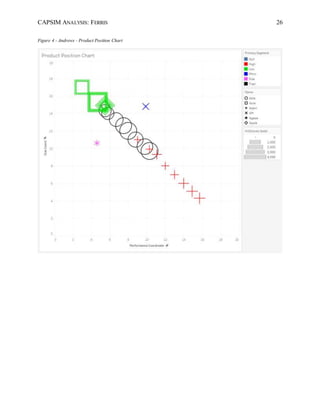
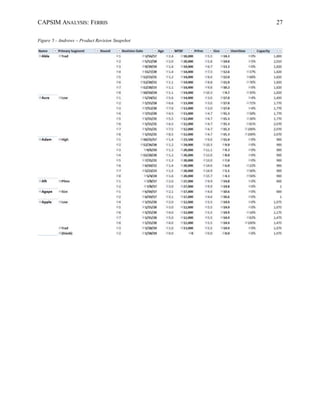
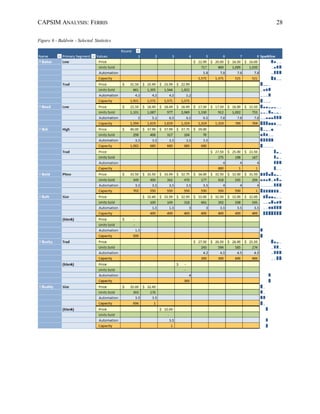
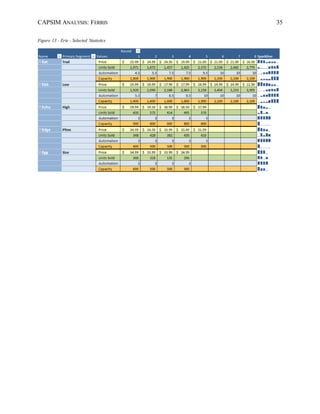
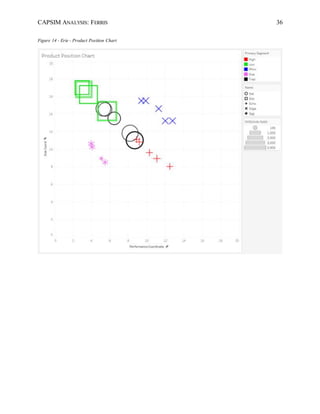
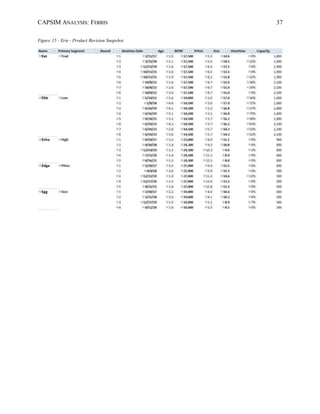
The following analysis are supplemented by the Product Revision Snapshot, Product
Position Graph, and Products: Selected Statistics figures relevant to each competitor, available in
the table of figures.
Andrews – Broad Cost Leader
In round three, Andrews chose to abandon the performance and size categories - this
allowed them to focus exclusively on the high-end, traditional, and low-end segments which fall
on the same fine-cut line. Andrew’s pricing strategy was fairly consistent, and avoided any major
price fluctuation which were omnipresent on low-performing teams. Andrews ran an efficient
operation, regularly scheduling second shifts and directing dollars away from capital-intensive
plant purchases and toward HR and automation. By attacking these variable costs, Andrews
strengthened margins in all products - notably low-end and traditional. By the end of the game,
Andrews had the lowest overall contribution margin of 55%. Most revenue was generated by
significant market share in the low-end segment, to which it sold nearly 7,000 units in round 8,
good for 33% market share. This large market share is impressive considering the intense
competition within the low-end industry, and can be chiefly attributed to Andrew’s introduction
of the low-end Apple product in 4 (originally marketed as Traditional in round 3). All told,
Andrews always maintained positive profits in each round. Its cumulative profits of
$121,080,919 in round 8 were third most overall, and significant opportunities for future growth
are available via re-introduction of products to the size and performance segments.
Baldwin – Low Performer
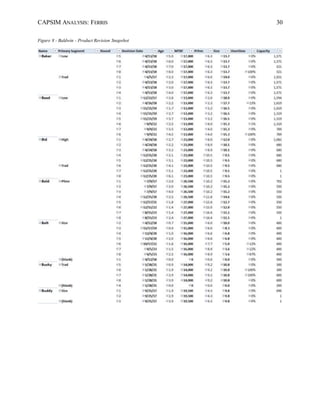
Baldwin suffered from a disjointed strategy and consistently unsound decisions, and
never established a natural ‘feel’ for the game. While successful teams made decisions that built
CAPSIM ANALYSIS: FERRIS 7
on each other, Baldwin failed to establish strategic rhythm. Baldwin regularly sold less than 80%
of its net production each month, which resulted in high inventory costs and a corresponding loss
of revenue. Poor forecasting plagued Baldwin in a way that cannot be understated, as on average
it only sold 73% of all units produced – far and away the worst rate in the game, and 10% lower
than the next poorest performer (Erie).
Like Ferris, Baldwin struggled to keep products on pace with positioning requirements.
This led to the antiquation of a traditional product to low-end in round five (Baker), and the
antiquation of a high-end product to traditional in round six (Bid). Baldwin compounded these
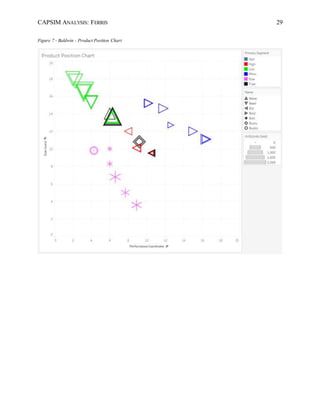
issues by erratically positioning products away from a segment’s fine-cut line: three times
products were positioned outside of any segment’s fine-cut circle, and none of these occurrences
happened during a transitional period. Evidence of this curious positioning can be seen in Figure
7 - Baldwin - Product Position Chart. net All told, Baldwin managed to produce profit in only
once, in round seven. Its cumulative losses amounted to $25,638,538 at the end of the simulation.
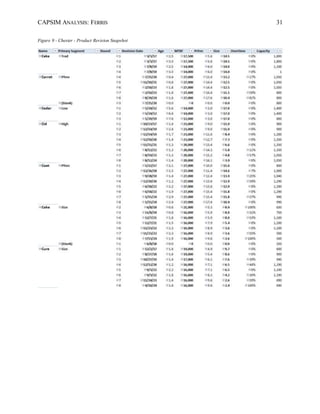
Chester – Cost Leader with Product Life Cycle Focus
Chester chose to abandon the low and traditional segments in rounds 4 and 5,
respectively, to focus on higher growth segments of size, performance, and high-end. Chester’s
financing activity reveals that it could have financed the high costs of R&D associated with such
a decision through bond and stock issuances, so it is assumed that Chester abandoned these
markets because of their low growth rates and oversaturation. Chester was able to remain
dexterous, and subsequently kept pace with the taxing revision requirements of the high-end
market through restraint in automation and effective use of TQM.
Chester’s strategy sets up well for the future, as its portfolio consists two products within
the fine cut of the performance and the fine cut of the size categories, and an impressive
CAPSIM ANALYSIS: FERRIS 8
performer serving the high-end segment: all markets experiencing growth. Ferris and Digby
utilized automation of low-end and traditional products in the early rounds to lower variable cost
and create large reserves for new product development and plant purchases - had Chester done
the same it might have been able to keep both products instead of selling off, and might have
even challenged Digby for top performance. All the same, Chester ‘figured it out’ by the end of
the game and generated ever-increasing revenues. After sustaining cumulative profits between
$800,000 and $3,000,000 in rounds 1-5, their investment in the size and performance categories
generated cumulative profits of $21m, $39m, and $85m in rounds 6-8.
Digby – Aggressive Growth
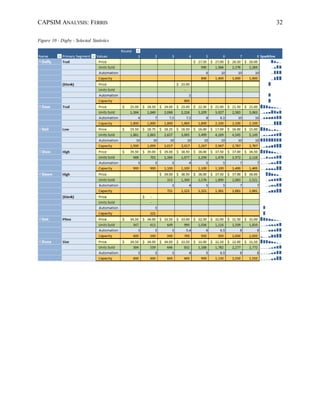
Digby dominated this simulation, capturing large amounts of market share, maintaining
significant margins, and capturing dominant market share in almost every market. Digby took
big risks, but made impeccable positioning and new-product development decisions. Digby paid
close attention to each segment’s preferred product age, positioning, quality, and price, ideally
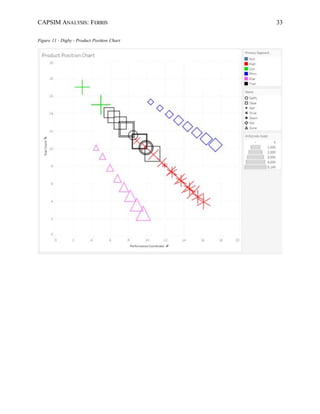
serving each and ‘figuring out’ the game from round one. One example of Digby’s precision can
be seen Figure 11 - Digby - Product Position Chart, in which the low-end Dell product is clearly
only revised 1 time over the entirety of the game. Digby recognized age, ideal spot, and quality
as insignificant buying decisions when compared to price, so it wasted little energy on revising
low-end products. All revisions fall directly on the fine-cut line for all products, and Digby
maintained a price/size gap (while still straddling the fine-cut line) when it carried two products
in the same market (e.g. Dixie/Doom in the high end segment and Daffy/Daze in the traditional
segment). This allowed Digby to ‘soak up’ customers from not one but two deep wells of
prospective customers in a given market - the primary (and possibly only) reason a new product
should be introduced to a new industry. Digby spent just enough on marketing and sales to
CAPSIM ANALYSIS: FERRIS 9
maximize exposure and accessibility, which supplied consistent access to nearly 100% of each
customer base. It utilized an effective pricing strategy that always reduced the price of each
product by $0.50 each round.
Digby new exactly where to position its products, where to price them, and how to lower
variable costs. Their most important achievement, however, was their superior forecasting
abilities. While most teams varied wildly in their overall percentage of sold inventory, Digby
always sold more than 93% of all inventory and only stocked out overall one time. They
averaged 96% sale of all on-hand inventory, which is almost perfect considering 100% is
equivalent to a stock out, which represents money left on the table.
Digby did everything correctly. It maximized exposure to customer bases, offered
correctly positioned products, attacked variable costs, and drove significant returns to scale.
Digby ended the game with ridiculous levels of net revenue, with cumulative profits of
317,220,334 by game’s end: nearly twice that of second-place finisher Ferris.
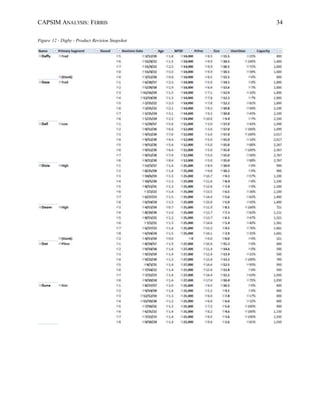
Erie – Niche Differentiator
Erie chose to transition from broad differentiator at game start, to niche differentiator at
game end. Erie abandoned the size market in round five, and then abandoned the performance
and high-end markets in round six. Erie appeared to struggle with product size and performance
repositioning efforts, which could have contributed to abandonment of the aforementioned
markets. Typically, niche strategies should target high-growth markets to achieve large relative
returns and a lofty ROI. Curiously, Erie abandoned the three markets that best fit these criteria.
Erie’s strategy can be categorized as highly conservative.
In electing to abandon the risks associated with new product development and product
revisions native to premium markets, Erie was able to generate consistent returns by steadily
CAPSIM ANALYSIS: FERRIS 10
attacking marginal costs associated with products in low-risk traditional and low-end markets
(automation slowly increased to 10 in both markets by round 6). One area in which Erie could
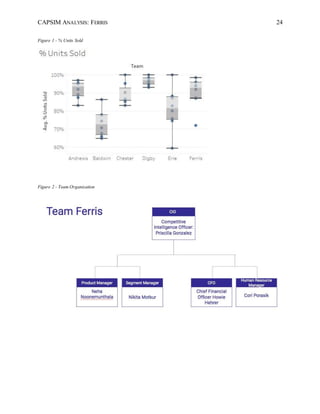
have improved was forecasting: Erie stocked out entirely once and also turned in the single-worst
percentage of inventory sold figure for one round in the entire game at 59%. You can see this
erraticism in
CAPSIM ANALYSIS: FERRIS 11
Figure 1 - % Units Sold. It’s average percentage of inventory sold hovered just below
82%, second worst in the game. Erie suffered negative profits and the emergency loan only once,
and generated $38,816,905 in cumulative profit by the end of the simulation. Erie’s strategy may
be the least sustainable in the future, as they have focused all of their resources on overcrowded,
low-growth markets.
CAPSIM ANALYSIS: FERRIS 12
Capacity Analysis
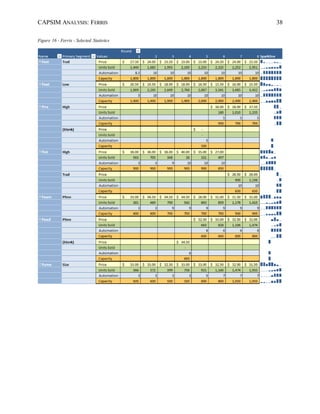
For the following analysis, please make reference to Figure 16 - Ferris - Selected
Statistics.
Traditional Segment
Fast. The capacity of Fast product was introduced and remained constant at 1800 for all
the rounds 1-8 since its plant utilization averaged over a 106% for all the rounds.
Fist. We planned to transition Fist product into Traditional Market by Round 7 since it
was performing low in the high-end market segment. By end of Round 6, traditional segment
was already getting saturated with 12,418 units sold out of industry’s demand of 13,633 units.
Ferris forecasted to produce 900 units for Fist and 2299 units for Fast in Round 7 with Capacities
at 1800 and 650 respectively in order to meet the industry’s next round demand of 14,942 units.
Low End Segment
Feat. Feat is the low end segment product which was introduced with a capacity of 1400
in round 1 with an automation of 5. Ferris focused on increasing the automation to reduce the
variable costs, therefore maxed out on the automation to 10 in round 2.
The capacity of Feat was analyzed based on the forecasted values and units sold for each
round. During the execution of round 2 decisions, Ferris failed to observe the need for additional
capacity for its next round though its plant utilization was at 160%. Due to this, Ferris was able
produce only 2,800 against the actual forecasted value of 3,000 units. Observing this flaw, in
Round 3, we bought additional capacity, increasing our capacity to 1,900 which subsequently
helped to produce the forecasted units for future rounds.
Considering the segment growth rate gradually increasing in Rounds 5 and 6, we
increased the capacity in round 6 by 100. It was interesting to observe that though the segment
CAPSIM ANALYSIS: FERRIS 13
growth rate reduced from 12.5 % (Round 6) to 11.8% (Round 7), the demand for our products
stocked out in round 6, 7 respectively. Observing the increase in demand for Feat product, we
increased its capacity further to 2,400 to target a plant utilization of 198% in round 8 by
producing 3908 units.
In rounds 1-7, feat was one among the first three competitors in low-end segment holding
a consistent market share of 19-21%. Feat product was able to meet the customer demand in four
rounds – 3,4,5,8 and stocked out in rounds 1,2,6,7 with an average plant utilization of 164%. By
end of round 8, there were seven main products competing in the low end segment. They were
Acre, Apple, Baker, Bead, Dell, Ebb, Feat with capacities of 2,070, 1,475, 521, 769, 2,767, 2100,
2400 respectively with Feat having a market share of 16%.
High End Segment
Fist. During initial rounds, Fist was introduced with capacity of 900. Aiming to produce
high sales and low variable costs, Ferris increased the automation to 9 and 10 in rounds 2, 3
subsequently. Though Fist achieved good sales in rounds 1 and 2, it was not profitable in further
rounds since the revised product for round 3 did not come out until Round 5, which produced
losses for Rounds 3, 4, 5. In order to reduce the additional costs that will be incurred by leftover
inventory, Ferris minimized production in rounds 4 and 5.
Most of the product utilization was under 100%, however ,Ferris did not want to sell off
the capacity given that its automation was high as 10 and selling off the capacity would give only
75% of the original value. The decision was taken to transition the Fist product traditional
segment and sold out 150 units of capacity.
Fire. In order to achieve the broad differentiator strategy, a new product was introduced
in the high segment i.e. Fire. Fire was able to produce sales for 1,235 units with its capacity of
CAPSIM ANALYSIS: FERRIS 14
700 by the end of Round 8 with a plant utilization of 184%. It received a market share 15%
within 3 rounds of execution. Ferris learned from the mistakes it made with Fist, and paired a
reduction in automation with increased investment in TQM to create manageable revision dates.
In this way, Fire was not “swallowed up” by revisions and can be expected to perform well in
future years.
Performance Segment
Foam. Foam was introduced with initial capacity of 600 in round 1. The capacity of
Foam was increased by 100 due to anticipated segment growth rate of 23.5% for round 3 and
increased automation to 9 to decrease the variable costs. The forecasting for Foam was done
conservatively in the initial rounds from 1 -5, showing the stocked out units in round 2, 3, 5. By
the end of round 5, Foam stocked out with 14 % market share. Though the anticipated growth
rate for round 6 was 16.1%, it was interesting to observe that 6 of 7 products in the performance
segment stocked out in Round 6. This indicated customer’s demand for performance is
increasing significantly. We bought additional capacity in Round 7 to produce products
aggressively for round 8. Foam product stocked out even after significantly produced 1,415
units.
In preparation for the anticipated 20% segment growth rate for round 5, Ferris introduced
another performance product (Food) with high MTBF of 27,000 in Round 4. Given that
performance segment had a high growth, all of the forecasted units stocked out in all the rounds.
In what became a missed opportunity in light of the stock outs, Ferris still managed to establish a
strong presence and market share through the deployment of two performance products in the
growth segment’s fine cut. Ferris’ collective market share in the Performance segment ended at
CAPSIM ANALYSIS: FERRIS 15
37% - higher than closest competitor Chester and dominant performer Digby’s performance
products.
Size Segment
Fume. Fume competed under Size segment. The product was introduced at the capacity
of 600 in round 1. Though very few products were produced in initial rounds, inventory was left
over and plant utilization was 60-68% during the initial rounds. In order to avoid inventory carry
cost and effectively utilize the plant, Ferris sold 100% capacity in Round 3. However, the
product was appealing to the customers and the market was woefully underserved, allowing the
product to stock out in Round 3. Due to stock outs, the anticipated product sales went to the
competitors ,reducing the market share to 13%. Having recognized the issue, Ferris started to
increase its forecast and aggressively produced products from round 4. In order to keep up with
the high customer demand, the capacity was increased to 800 in round 5 and 1050 in round 7.
From Rounds 4 - 8, Fume’s market share gradually increased from 13% to 25%. By the end of
round 8, Fume was able to sell 1935 units with 184% plant utilization and holding the second
largest market share in size segment of 25 %. Ferris should have purchased more plant and
produced more Fume, or introduced a second product to the size market because of the consistent
stock-outs; forecasting failures are to blame for this missed opportunity. In fact, Ferris did invest
in the R&D for a second size product, but decided to cancel it as it would not be ready to sell
until round 8 and the single round of income was not enough to justify the major capital
investment required by new plant and automation.
CAPSIM ANALYSIS: FERRIS 16
Material Cost Analysis
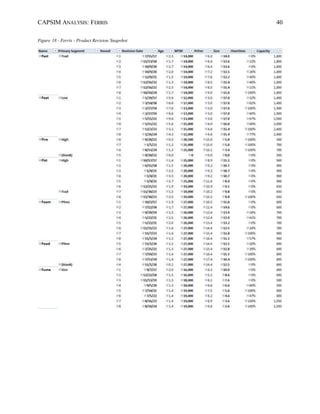
For this section, please make reference to Figure 18 - Ferris - Product Revision Snapshot;
Figure 24 - Material Cost - Traditional, Low-End, Performance; and Figure 25 - Material Cost -
Size, High-End.
Ferris had consistently invested in R&D to improve quality and reduce material costs,
which could provide them higher profit margins and serve as a competitive advantage over its
competitors. It invested a total of $32,655,000 through the rounds 1-8 for an average of
$4,082,000 per round. Most of the material costs were driven from the performance segment,
which had more emphasis laid on MTBF (Mean Time Before Failure) of 43%. Performance
products Foam and Food maintained the highest MTBF of all products, 27,000, over the course
of the simulation. This level of MTBF was selected because quality and performance were of key
interest to the performance buying segment. MTBF was also important to size and high-end
segments, where MTBFs of 21,000 and 19,000 were deployed – figures at the high end of each
segment’s respective acceptable range. Low-end and traditional segment products place little
importance on MTBF, so lower material cost of quality was generated for these segments.
Given that there are two products introduced performance segments (Foam and Food)
with emphasis on reliability, Ferris needed to reduce the material costs considerably to receive
higher margins. From Round 5, Ferris invested in TQM initiatives such as CCE (Concurrent
Engineering) /6 Sigma Training, UNEP Green Program, Vendor/JIT (Just in Time [Inventory]),
Vendor/JIT (Just in Time [Inventory]), and GEMI TQEM Sustainability to reduce the material
costs. It invested $4,000 total ($1,500 in Round 5, $1,500 in Round 6, and $1,000 in Round 7)
which reduced total material costs by 11.8% by the end of Round 8.
CAPSIM ANALYSIS: FERRIS 17
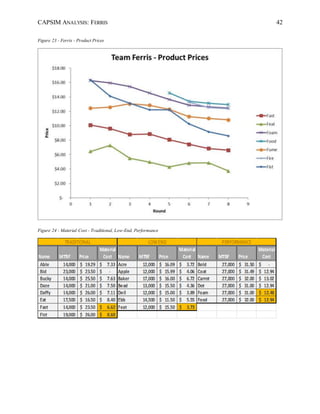
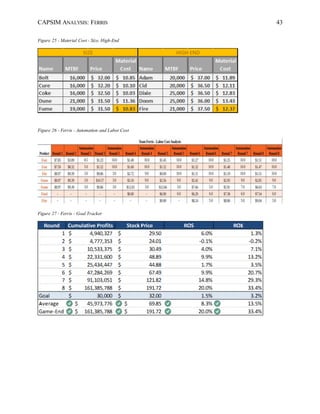
A comparative analysis of material costs by end of Round 8 shows that Fast has the
lowest material cost of $6.62 and Fist has the highest material cost of $8.60 among all the
products in the traditional segment. Feat was barely behind a cent with Acre, offering second
lowest material cost in the low-end segment. In the Performance segment, Foam has the lowest
material cost of $12.48 whereas Food maintained a moderate material cost of $12.94. Below
table shows the same. Fume and Fire maintained a moderate material cost of $10.83 and $12.37
in their respective segments. Again, please reference Figure 18 - Ferris - Product Revision
Snapshot; Figure 24 - Material Cost - Traditional, Low-End, Performance; and Figure 25 -
Material Cost - Size, High-End for a comprehensive review.
CAPSIM ANALYSIS: FERRIS 18
Labor Cost Analysis
For this section, please make reference to Figure 26 - Ferris - Automation and Labor
Cost.
Ferris did a good job in reducing the overall labor costs. Ferris identified the importance
of automation well ahead in the game, which helped a great deal in reducing the labor costs.
Automation means using machines to produce products. By using machines, the labor
cost is cut down. As automation rating increases, labor costs decreases. Automation levels are
given a scale of 1.0 to 10.0. Where 1.0 is the lowest automation, 10.0 the highest. As automation
levels increase, the number of labor hours required to produce each unit falls. At an automation
rating of 1.0, labor costs are highest. At a rating of 10.0, labor costs fall about 90%. Each
additional point of automation decreases labor costs approximately 10%. We also need to
understand that though Automation reduces the labor cost, automation itself costs a considerable
amount.
When it comes to updating the product in R&D, if there is a major update on the product,
the machines will also have to be updated to make the upgraded product which will result in
longer duration to get the product out into the market.
Labor cost is directly proportionate to the capacity of the plant and automation. The
capacity reflects the number of sensors that can be produced each year with an eight-hour shift.
The company can schedule a second eight-hour shift, which allows the company to manufacture
up to twice first shift capacity, however second shift labor costs are 50% higher than first shift.
Labor costs increase each year because of the Annual Raise in labor’s contract.
In Round 3, Ferris fully automated the Fast and Feat products which helped in drastically
reducing labor costs associated with production. For the Foam product the labor cost in Round 3
CAPSIM ANALYSIS: FERRIS 19
was $10.57 with an automation of 3.0. Ferris increased Foam automation to 9.0 for Round 4 and
the labor cost reduced considerably to $3.10, and it kept decreasing through the rounds. Please
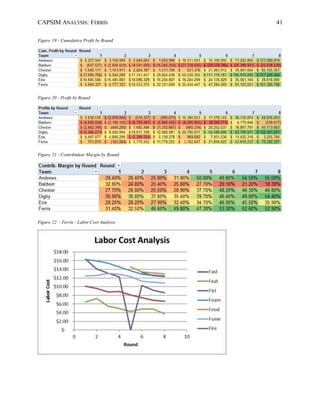
reference Figure 22 - Ferris - Labor Cost Analysis for a comprehensive review of rounds 1-8.
This expanded Ferris’ contribution margin and began to provide sustainable profits moving
forward.
Furthermore, the lower labor costs of some products allowed Ferris to balance the total
overall labor costs of its products, since all the products were not fully automated.
CAPSIM ANALYSIS: FERRIS 20
Implementation Analysis
Ferris’ implementation strategy was carried out by the team as a whole. We did have two
members in specific who geared our new product implementation plans. These two members
were Nikita Motkur (Segment Manager) and Howie Hehrer (Functional Finance Manager).
During our implementation plan Cori Porasik, Neha Noonemunthala and Priscilla Gonzalez were
keep an oversight over reaching our Success metrics and keep our pricing range for each one of
our products.
Round 6
In Round 6, one big difference that set us apart from our competition was our
introduction of our new High End segment product Fire. Our goal for this product was to
introduce it and penetrate the market at an optimal ideal spot on the industry’s perceptual map.
During Round 6 we did reach a 3% market share for Fire as an introduction product in a highly
competitive market (biggest competitor being Digby).
While we continued to gain market share and improve our customer accessibility and
awareness percentages, we were able to price our product at a higher price than the market
originally wanted. In comparison to Fist (our 1st high end product) we wanted to differentiate the
price range between both products. As we continued throughout Round 7 and Round 8 Ferris
was able to continue our sliding price scale between Fist and Fire, keeping Fire in the primary
position to penetrate the high end market and allowing Fist to slowly transition into our
Traditional segment. A detailed implementation plan for Round 6 is highlighted in Appendix V.
Round 7
For Round 7 our main objective was to hit our final success metric which was ROS. In
order to hit this metric, our final implementation was to buy back market shares. During our
CAPSIM ANALYSIS: FERRIS 21
implementation process we also gained a huge increase in our stock price by increasing it from
Round 6 to Round 7 by $54.33. During this round we were finally able to gain a small increase
for our Fist product that had been continuously struggling throughout Round 4-6.
With a 6% market share portion we were able to reposition the product in a new segment
without committing to discontinuing the product. By doing so, it allowed for Fist to strengthen
customer accessibility and awareness. Round 7 also made our team highly aware of the
consequences of stocking out. We stocked out 4 out of 7 of our overall products. With this result
we were able to finalize our analysis for Round 8 and help implement the correct forecasting for
our product production and the relatively pricing position for each product.
Round 8 and Performance Criteria
In the final round, Ferris was able to withstand the moves of some competitors. Due to
the high rising profits and maximizations of one specific competitor (Digby) we realize we
would need to indirectly compete against Digby and defend our current position in the market
against the rising competitors. Through Round 8 our team took the analysis and perspective of
the competition that this was not the final round for the business even though it was the final
round in the simulation. We applied this perspective and did not sell off or buy Plant and
Equipment. We did hold a conservative pricing position for all products. This allowed for us to
optimize our automation levels and plant utilizations.In Round 8 we fully shifted our Fire
product from the High End segment to the Traditional segment. This allowed for company to
hold a Sustainable Competitive Advantage (SCA) within the Traditional segment. Having said
that, we wanted to reserve a spot as the 2nd highest competitor in the industry of sensors. Using
these small changes consistent over 4 rounds (Round 5-8) we were able to increase 4 out of the 5
success metrics we had as a team. By end of Round 8, Team Ferris had an ROS of 20.0%, ROA
CAPSIM ANALYSIS: FERRIS 22
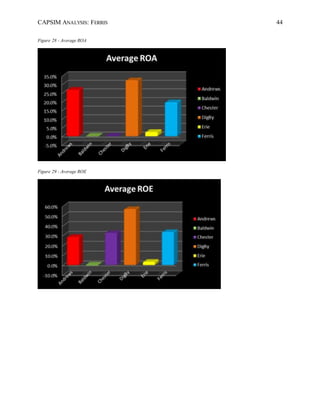
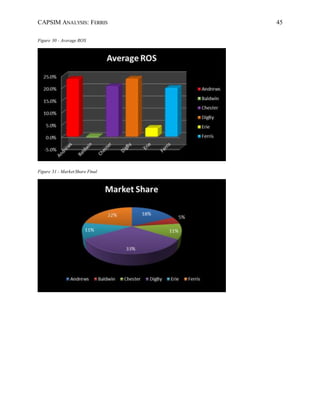
of 19.6%, ROE of 1.7 with an overall market share of 22.5 % and Stock Price of $191.72. Please
reference Figure 28 - Average ROA; Figure 29 - Average ROE; Figure 30 - Average ROS; and
Figure 31 - Market Share Final for a comprehensive overview of the metrics. Ultimately, we
were able to complete and exceed our expectations for our success metrics through these key
implementations. Please reference Figure 27 - Ferris - Goal Tracker to view the goal metrics.
CAPSIM ANALYSIS: FERRIS 23
Table of Figures
Figure 1 - % Units Sold ................................................................................................................ 23
Figure 2 - Team Organization....................................................................................................... 23
Figure 3 - Andrews - Selected Statistics ....................................................................................... 24
Figure 4 - Andrews - Product Position Chart................................................................................ 25
Figure 5 - Andrews – Product Revision Snapshot ........................................................................ 26
Figure 6 - Baldwin - Selected Statistics........................................................................................ 27
Figure 7 - Baldwin - Product Position Chart ................................................................................ 28
Figure 8 - Baldwin - Product Revision Snapshot.......................................................................... 29
Figure 9 - Chester - Product Revision Snapshot........................................................................... 30
Figure 10 - Digby - Selected Statistics ......................................................................................... 31
Figure 11 - Digby - Product Position Chart .................................................................................. 32
Figure 12 - Digby - Product Revision Snapshot ........................................................................... 33
Figure 13 - Erie - Selected Statistics............................................................................................. 34
Figure 14 - Erie - Product Position Chart ..................................................................................... 35
Figure 15 - Erie - Product Revision Snapshot .............................................................................. 36
Figure 16 - Ferris - Selected Statistics .......................................................................................... 37
Figure 17 - Ferris - Product Position Chart................................................................................... 38
Figure 18 - Ferris - Product Revision Snapshot............................................................................ 39
Figure 19 - Cumulative Profit by Round ...................................................................................... 40
Figure 20 - Profit by Round .......................................................................................................... 40
Figure 21 - Contribution Margin by Round .................................................................................. 40
Figure 22 - Ferris - Labor Cost Analysis ..................................................................................... 40
Figure 23 - Ferris - Product Prices................................................................................................ 41
Figure 24 - Material Cost - Traditional, Low-End, Performance ................................................. 41
Figure 25 - Material Cost - Size, High-End.................................................................................. 42
Figure 26 - Ferris - Automation and Labor Cost .......................................................................... 42
Figure 27 - Ferris - Goal Tracker.................................................................................................. 42
Figure 28 - Average ROA............................................................................................................. 43
Figure 29 - Average ROE ............................................................................................................. 43
Figure 30 - Average ROS.............................................................................................................. 44
Figure 31 - Market Share Final..................................................................................................... 44
CAPSIM ANALYSIS: FERRIS 24
Figure 1 - % Units Sold
Figure 2 - Team Organization
CAPSIM ANALYSIS: FERRIS 25
Figure 3 - Andrews - Selected Statistics
CAPSIM ANALYSIS: FERRIS 26
Figure 4 - Andrews - Product Position Chart
CAPSIM ANALYSIS: FERRIS 27
Figure 5 - Andrews – Product Revision Snapshot
CAPSIM ANALYSIS: FERRIS 28
Figure 6 - Baldwin - Selected Statistics
CAPSIM ANALYSIS: FERRIS 29
Figure 7 - Baldwin - Product Position Chart
CAPSIM ANALYSIS: FERRIS 30
Figure 8 - Baldwin - Product Revision Snapshot
CAPSIM ANALYSIS: FERRIS 31
Figure 9 - Chester - Product Revision Snapshot
CAPSIM ANALYSIS: FERRIS 32
Figure 10 - Digby - Selected Statistics
CAPSIM ANALYSIS: FERRIS 33
Figure 11 - Digby - Product Position Chart
CAPSIM ANALYSIS: FERRIS 34
Figure 12 - Digby - Product Revision Snapshot
CAPSIM ANALYSIS: FERRIS 35
Figure 13 - Erie - Selected Statistics
CAPSIM ANALYSIS: FERRIS 36
Figure 14 - Erie - Product Position Chart
CAPSIM ANALYSIS: FERRIS 37
Figure 15 - Erie - Product Revision Snapshot
CAPSIM ANALYSIS: FERRIS 38
Figure 16 - Ferris - Selected Statistics
CAPSIM ANALYSIS: FERRIS 39
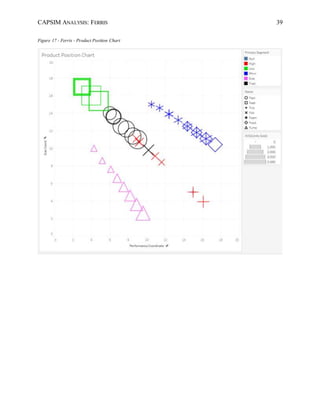
Figure 17 - Ferris - Product Position Chart
CAPSIM ANALYSIS: FERRIS 40
Figure 18 - Ferris - Product Revision Snapshot
CAPSIM ANALYSIS: FERRIS 41
Figure 19 - Cumulative Profit by Round
Figure 20 - Profit by Round
Figure 21 - Contribution Margin by Round
Figure 22 - Ferris - Labor Cost Analysis
CAPSIM ANALYSIS: FERRIS 42
Figure 23 - Ferris - Product Prices
Figure 24 - Material Cost - Traditional, Low-End, Performance
CAPSIM ANALYSIS: FERRIS 43
Figure 25 - Material Cost - Size, High-End
Figure 26 - Ferris - Automation and Labor Cost
Figure 27 - Ferris - Goal Tracker
CAPSIM ANALYSIS: FERRIS 44
Figure 28 - Average ROA
Figure 29 - Average ROE
CAPSIM ANALYSIS: FERRIS 45
Figure 30 - Average ROS
Figure 31 - MarketShare Final

CAPSIM-Final-Paper_FINAL

  • 1.
    Running head: CAPSIMANALYSIS: FERRIS 1 CAPSIM Analysis: Ferris Priscilla Gonzalez, Howard Hehrer, Cori Porasik, Nikita Motkur, Neha Noonemunthala Barney Barnett School of Business - Florida Southern College
  • 2.
    CAPSIM ANALYSIS: FERRIS2 Contents Team Organization.............................................................................................................. 3 Production & Finance ..................................................................................................... 3 Product Manager............................................................................................................. 3 Segment Manager ........................................................................................................... 3 Human Resource Manager/Secretary.............................................................................. 4 Competitive Intelligence Officer .................................................................................... 4 Mission Statement............................................................................................................... 5 Business-Level Strategy...................................................................................................... 5 Competitor Analysis ....................................................................................................... 6 Andrews – Broad Cost Leader.................................................................................... 6 Baldwin – Low Performer........................................................................................... 6 Chester – Cost Leader with Product Life Cycle Focus............................................... 7 Digby – Aggressive Growth ....................................................................................... 8 Erie – Niche Differentiator ......................................................................................... 9 Capacity Analysis ......................................................................................................... 11 Traditional Segment.................................................................................................. 11 Low End Segment..................................................................................................... 11 High End Segment .................................................................................................... 12 Performance Segment ............................................................................................... 13 Size Segment............................................................................................................. 14 Material Cost Analysis...................................................................................................... 15 Labor Cost Analysis.......................................................................................................... 17 Implementation Analysis .................................................................................................. 19 Round 6......................................................................................................................... 19 Round 7......................................................................................................................... 19 Round 8 and Performance Criteria................................................................................ 20 Table of Figures ................................................................................................................ 22
  • 3.
    CAPSIM ANALYSIS: FERRIS3 Team Organization For this section, please reference Figure 2 - Team Organization. Production & Finance Howie Hehrer performed the role of CFO as a Functional Manager, whose job was to optimize the efficiency of the assigned function and to coordinate strategy across functional boundaries. As a functional manager, he assumed responsibility for the overall performance of several departments, including Research & Development (R&D), Marketing, Production, and Finance. Functional Managers are the authority for all rules that apply to their area. Product Manager Neha Noonemunthala filled the role of R&D Product manager. Product Managers are responsible for highly specific projects that develop new competitive advantages. Neha answered critical questions like “is the product positioned correctly on the perceptual map?”, “Does the project have sufficient capacity to meet current and future demand?”, “In marketing, is the price acceptable to the target demographic?”, and “Considering the expected demand for the segment and the number of competing products, is the sales forecast appropriate?”. Segment Manager Nikita Motkur served as Segment Manager. Segment Managers are strategists, and Nikita answered questions including “Will new products enter or leave the segment this year?”, “Is there too much production capacity in the segment (could lead to price competition)?”, “Is there too little production capacity in the segment (could lead to a margin opportunity)?”, “How does the company's distribution system (Sales Budget and Accessibility chart on each Courier Segment Analysis) compare with competitors?”, “What is the margin potential of this segment?”,
  • 4.
    CAPSIM ANALYSIS: FERRIS4 “What should be done to gain competitive advantage for the segment?”, and “What will competitors do next year in this segment? In two years?”. Human Resource Manager/Secretary Cori Porasik served as Human Resource Manager. The Human Resource Manager was accountable for the follow questions: “Is Ferris following all necessary guidelines presented in our mission statement?”, “Is Ferris following all necessary guidelines indicated by our competitors output as highlight in the rounds Capstone Courier?”, “As a company are we making decisions in a timely manner? If not, Human Resource Manager provides a solution to make decisions in a timely manner.”, “Are we following along on our own conditions report in an appropriate manner as to have successful growth for our company?”, and “Are our final decisions correlating with our mission statement?”. Competitive Intelligence Officer Priscilla Gonzalez filled the role of Competitive Intelligence Officer. The Competitive Intelligence Officer's task was to look at the market through the lens of the competition. She studied the Courier and answered questions related to the competition like: “What segments matter most to them?”, “What are they doing to achieve competitive advantage?”, “What will they do with their product line next year? In two years?”, “Is our company a threat to the competition?”, “What could the competition do that is not in our company's interest?”, and “How can our company influence the competition to do what we want?”.
  • 5.
    CAPSIM ANALYSIS: FERRIS5 Mission Statement Premium products for the industry: our brand withstands the test of time. Ferris’ mission is to bring success and quality to our stakeholders. Our company provides our stakeholders with quality and effectiveness. Our stakeholders are customers, stockholders, management and employees. Our products offer excellent design, and generate high accessibility and awareness within their industries. Business-Level Strategy Ferris is seeking to establish flexibility and diversify its risk structure through the implementation of a broad differentiator strategy. Ferris aims to attack costs through atomization of equipment, efficiency in scheduling, effective deployment of TQM techniques, and maximization of plant production capacities. Through effective product positioning and economies of scale, Ferris will become a market share leader of the sensor industry.
  • 6.
    CAPSIM ANALYSIS: FERRIS6 Competitor Analysis The following analysis are supplemented by the Product Revision Snapshot, Product Position Graph, and Products: Selected Statistics figures relevant to each competitor, available in the table of figures. Andrews – Broad Cost Leader In round three, Andrews chose to abandon the performance and size categories - this allowed them to focus exclusively on the high-end, traditional, and low-end segments which fall on the same fine-cut line. Andrew’s pricing strategy was fairly consistent, and avoided any major price fluctuation which were omnipresent on low-performing teams. Andrews ran an efficient operation, regularly scheduling second shifts and directing dollars away from capital-intensive plant purchases and toward HR and automation. By attacking these variable costs, Andrews strengthened margins in all products - notably low-end and traditional. By the end of the game, Andrews had the lowest overall contribution margin of 55%. Most revenue was generated by significant market share in the low-end segment, to which it sold nearly 7,000 units in round 8, good for 33% market share. This large market share is impressive considering the intense competition within the low-end industry, and can be chiefly attributed to Andrew’s introduction of the low-end Apple product in 4 (originally marketed as Traditional in round 3). All told, Andrews always maintained positive profits in each round. Its cumulative profits of $121,080,919 in round 8 were third most overall, and significant opportunities for future growth are available via re-introduction of products to the size and performance segments. Baldwin – Low Performer Baldwin suffered from a disjointed strategy and consistently unsound decisions, and never established a natural ‘feel’ for the game. While successful teams made decisions that built
  • 7.
    CAPSIM ANALYSIS: FERRIS7 on each other, Baldwin failed to establish strategic rhythm. Baldwin regularly sold less than 80% of its net production each month, which resulted in high inventory costs and a corresponding loss of revenue. Poor forecasting plagued Baldwin in a way that cannot be understated, as on average it only sold 73% of all units produced – far and away the worst rate in the game, and 10% lower than the next poorest performer (Erie). Like Ferris, Baldwin struggled to keep products on pace with positioning requirements. This led to the antiquation of a traditional product to low-end in round five (Baker), and the antiquation of a high-end product to traditional in round six (Bid). Baldwin compounded these issues by erratically positioning products away from a segment’s fine-cut line: three times products were positioned outside of any segment’s fine-cut circle, and none of these occurrences happened during a transitional period. Evidence of this curious positioning can be seen in Figure 7 - Baldwin - Product Position Chart. net All told, Baldwin managed to produce profit in only once, in round seven. Its cumulative losses amounted to $25,638,538 at the end of the simulation. Chester – Cost Leader with Product Life Cycle Focus Chester chose to abandon the low and traditional segments in rounds 4 and 5, respectively, to focus on higher growth segments of size, performance, and high-end. Chester’s financing activity reveals that it could have financed the high costs of R&D associated with such a decision through bond and stock issuances, so it is assumed that Chester abandoned these markets because of their low growth rates and oversaturation. Chester was able to remain dexterous, and subsequently kept pace with the taxing revision requirements of the high-end market through restraint in automation and effective use of TQM. Chester’s strategy sets up well for the future, as its portfolio consists two products within the fine cut of the performance and the fine cut of the size categories, and an impressive
  • 8.
    CAPSIM ANALYSIS: FERRIS8 performer serving the high-end segment: all markets experiencing growth. Ferris and Digby utilized automation of low-end and traditional products in the early rounds to lower variable cost and create large reserves for new product development and plant purchases - had Chester done the same it might have been able to keep both products instead of selling off, and might have even challenged Digby for top performance. All the same, Chester ‘figured it out’ by the end of the game and generated ever-increasing revenues. After sustaining cumulative profits between $800,000 and $3,000,000 in rounds 1-5, their investment in the size and performance categories generated cumulative profits of $21m, $39m, and $85m in rounds 6-8. Digby – Aggressive Growth Digby dominated this simulation, capturing large amounts of market share, maintaining significant margins, and capturing dominant market share in almost every market. Digby took big risks, but made impeccable positioning and new-product development decisions. Digby paid close attention to each segment’s preferred product age, positioning, quality, and price, ideally serving each and ‘figuring out’ the game from round one. One example of Digby’s precision can be seen Figure 11 - Digby - Product Position Chart, in which the low-end Dell product is clearly only revised 1 time over the entirety of the game. Digby recognized age, ideal spot, and quality as insignificant buying decisions when compared to price, so it wasted little energy on revising low-end products. All revisions fall directly on the fine-cut line for all products, and Digby maintained a price/size gap (while still straddling the fine-cut line) when it carried two products in the same market (e.g. Dixie/Doom in the high end segment and Daffy/Daze in the traditional segment). This allowed Digby to ‘soak up’ customers from not one but two deep wells of prospective customers in a given market - the primary (and possibly only) reason a new product should be introduced to a new industry. Digby spent just enough on marketing and sales to
  • 9.
    CAPSIM ANALYSIS: FERRIS9 maximize exposure and accessibility, which supplied consistent access to nearly 100% of each customer base. It utilized an effective pricing strategy that always reduced the price of each product by $0.50 each round. Digby new exactly where to position its products, where to price them, and how to lower variable costs. Their most important achievement, however, was their superior forecasting abilities. While most teams varied wildly in their overall percentage of sold inventory, Digby always sold more than 93% of all inventory and only stocked out overall one time. They averaged 96% sale of all on-hand inventory, which is almost perfect considering 100% is equivalent to a stock out, which represents money left on the table. Digby did everything correctly. It maximized exposure to customer bases, offered correctly positioned products, attacked variable costs, and drove significant returns to scale. Digby ended the game with ridiculous levels of net revenue, with cumulative profits of 317,220,334 by game’s end: nearly twice that of second-place finisher Ferris. Erie – Niche Differentiator Erie chose to transition from broad differentiator at game start, to niche differentiator at game end. Erie abandoned the size market in round five, and then abandoned the performance and high-end markets in round six. Erie appeared to struggle with product size and performance repositioning efforts, which could have contributed to abandonment of the aforementioned markets. Typically, niche strategies should target high-growth markets to achieve large relative returns and a lofty ROI. Curiously, Erie abandoned the three markets that best fit these criteria. Erie’s strategy can be categorized as highly conservative. In electing to abandon the risks associated with new product development and product revisions native to premium markets, Erie was able to generate consistent returns by steadily
  • 10.
    CAPSIM ANALYSIS: FERRIS10 attacking marginal costs associated with products in low-risk traditional and low-end markets (automation slowly increased to 10 in both markets by round 6). One area in which Erie could have improved was forecasting: Erie stocked out entirely once and also turned in the single-worst percentage of inventory sold figure for one round in the entire game at 59%. You can see this erraticism in
  • 11.
    CAPSIM ANALYSIS: FERRIS11 Figure 1 - % Units Sold. It’s average percentage of inventory sold hovered just below 82%, second worst in the game. Erie suffered negative profits and the emergency loan only once, and generated $38,816,905 in cumulative profit by the end of the simulation. Erie’s strategy may be the least sustainable in the future, as they have focused all of their resources on overcrowded, low-growth markets.
  • 12.
    CAPSIM ANALYSIS: FERRIS12 Capacity Analysis For the following analysis, please make reference to Figure 16 - Ferris - Selected Statistics. Traditional Segment Fast. The capacity of Fast product was introduced and remained constant at 1800 for all the rounds 1-8 since its plant utilization averaged over a 106% for all the rounds. Fist. We planned to transition Fist product into Traditional Market by Round 7 since it was performing low in the high-end market segment. By end of Round 6, traditional segment was already getting saturated with 12,418 units sold out of industry’s demand of 13,633 units. Ferris forecasted to produce 900 units for Fist and 2299 units for Fast in Round 7 with Capacities at 1800 and 650 respectively in order to meet the industry’s next round demand of 14,942 units. Low End Segment Feat. Feat is the low end segment product which was introduced with a capacity of 1400 in round 1 with an automation of 5. Ferris focused on increasing the automation to reduce the variable costs, therefore maxed out on the automation to 10 in round 2. The capacity of Feat was analyzed based on the forecasted values and units sold for each round. During the execution of round 2 decisions, Ferris failed to observe the need for additional capacity for its next round though its plant utilization was at 160%. Due to this, Ferris was able produce only 2,800 against the actual forecasted value of 3,000 units. Observing this flaw, in Round 3, we bought additional capacity, increasing our capacity to 1,900 which subsequently helped to produce the forecasted units for future rounds. Considering the segment growth rate gradually increasing in Rounds 5 and 6, we increased the capacity in round 6 by 100. It was interesting to observe that though the segment
  • 13.
    CAPSIM ANALYSIS: FERRIS13 growth rate reduced from 12.5 % (Round 6) to 11.8% (Round 7), the demand for our products stocked out in round 6, 7 respectively. Observing the increase in demand for Feat product, we increased its capacity further to 2,400 to target a plant utilization of 198% in round 8 by producing 3908 units. In rounds 1-7, feat was one among the first three competitors in low-end segment holding a consistent market share of 19-21%. Feat product was able to meet the customer demand in four rounds – 3,4,5,8 and stocked out in rounds 1,2,6,7 with an average plant utilization of 164%. By end of round 8, there were seven main products competing in the low end segment. They were Acre, Apple, Baker, Bead, Dell, Ebb, Feat with capacities of 2,070, 1,475, 521, 769, 2,767, 2100, 2400 respectively with Feat having a market share of 16%. High End Segment Fist. During initial rounds, Fist was introduced with capacity of 900. Aiming to produce high sales and low variable costs, Ferris increased the automation to 9 and 10 in rounds 2, 3 subsequently. Though Fist achieved good sales in rounds 1 and 2, it was not profitable in further rounds since the revised product for round 3 did not come out until Round 5, which produced losses for Rounds 3, 4, 5. In order to reduce the additional costs that will be incurred by leftover inventory, Ferris minimized production in rounds 4 and 5. Most of the product utilization was under 100%, however ,Ferris did not want to sell off the capacity given that its automation was high as 10 and selling off the capacity would give only 75% of the original value. The decision was taken to transition the Fist product traditional segment and sold out 150 units of capacity. Fire. In order to achieve the broad differentiator strategy, a new product was introduced in the high segment i.e. Fire. Fire was able to produce sales for 1,235 units with its capacity of
  • 14.
    CAPSIM ANALYSIS: FERRIS14 700 by the end of Round 8 with a plant utilization of 184%. It received a market share 15% within 3 rounds of execution. Ferris learned from the mistakes it made with Fist, and paired a reduction in automation with increased investment in TQM to create manageable revision dates. In this way, Fire was not “swallowed up” by revisions and can be expected to perform well in future years. Performance Segment Foam. Foam was introduced with initial capacity of 600 in round 1. The capacity of Foam was increased by 100 due to anticipated segment growth rate of 23.5% for round 3 and increased automation to 9 to decrease the variable costs. The forecasting for Foam was done conservatively in the initial rounds from 1 -5, showing the stocked out units in round 2, 3, 5. By the end of round 5, Foam stocked out with 14 % market share. Though the anticipated growth rate for round 6 was 16.1%, it was interesting to observe that 6 of 7 products in the performance segment stocked out in Round 6. This indicated customer’s demand for performance is increasing significantly. We bought additional capacity in Round 7 to produce products aggressively for round 8. Foam product stocked out even after significantly produced 1,415 units. In preparation for the anticipated 20% segment growth rate for round 5, Ferris introduced another performance product (Food) with high MTBF of 27,000 in Round 4. Given that performance segment had a high growth, all of the forecasted units stocked out in all the rounds. In what became a missed opportunity in light of the stock outs, Ferris still managed to establish a strong presence and market share through the deployment of two performance products in the growth segment’s fine cut. Ferris’ collective market share in the Performance segment ended at
  • 15.
    CAPSIM ANALYSIS: FERRIS15 37% - higher than closest competitor Chester and dominant performer Digby’s performance products. Size Segment Fume. Fume competed under Size segment. The product was introduced at the capacity of 600 in round 1. Though very few products were produced in initial rounds, inventory was left over and plant utilization was 60-68% during the initial rounds. In order to avoid inventory carry cost and effectively utilize the plant, Ferris sold 100% capacity in Round 3. However, the product was appealing to the customers and the market was woefully underserved, allowing the product to stock out in Round 3. Due to stock outs, the anticipated product sales went to the competitors ,reducing the market share to 13%. Having recognized the issue, Ferris started to increase its forecast and aggressively produced products from round 4. In order to keep up with the high customer demand, the capacity was increased to 800 in round 5 and 1050 in round 7. From Rounds 4 - 8, Fume’s market share gradually increased from 13% to 25%. By the end of round 8, Fume was able to sell 1935 units with 184% plant utilization and holding the second largest market share in size segment of 25 %. Ferris should have purchased more plant and produced more Fume, or introduced a second product to the size market because of the consistent stock-outs; forecasting failures are to blame for this missed opportunity. In fact, Ferris did invest in the R&D for a second size product, but decided to cancel it as it would not be ready to sell until round 8 and the single round of income was not enough to justify the major capital investment required by new plant and automation.
  • 16.
    CAPSIM ANALYSIS: FERRIS16 Material Cost Analysis For this section, please make reference to Figure 18 - Ferris - Product Revision Snapshot; Figure 24 - Material Cost - Traditional, Low-End, Performance; and Figure 25 - Material Cost - Size, High-End. Ferris had consistently invested in R&D to improve quality and reduce material costs, which could provide them higher profit margins and serve as a competitive advantage over its competitors. It invested a total of $32,655,000 through the rounds 1-8 for an average of $4,082,000 per round. Most of the material costs were driven from the performance segment, which had more emphasis laid on MTBF (Mean Time Before Failure) of 43%. Performance products Foam and Food maintained the highest MTBF of all products, 27,000, over the course of the simulation. This level of MTBF was selected because quality and performance were of key interest to the performance buying segment. MTBF was also important to size and high-end segments, where MTBFs of 21,000 and 19,000 were deployed – figures at the high end of each segment’s respective acceptable range. Low-end and traditional segment products place little importance on MTBF, so lower material cost of quality was generated for these segments. Given that there are two products introduced performance segments (Foam and Food) with emphasis on reliability, Ferris needed to reduce the material costs considerably to receive higher margins. From Round 5, Ferris invested in TQM initiatives such as CCE (Concurrent Engineering) /6 Sigma Training, UNEP Green Program, Vendor/JIT (Just in Time [Inventory]), Vendor/JIT (Just in Time [Inventory]), and GEMI TQEM Sustainability to reduce the material costs. It invested $4,000 total ($1,500 in Round 5, $1,500 in Round 6, and $1,000 in Round 7) which reduced total material costs by 11.8% by the end of Round 8.
  • 17.
    CAPSIM ANALYSIS: FERRIS17 A comparative analysis of material costs by end of Round 8 shows that Fast has the lowest material cost of $6.62 and Fist has the highest material cost of $8.60 among all the products in the traditional segment. Feat was barely behind a cent with Acre, offering second lowest material cost in the low-end segment. In the Performance segment, Foam has the lowest material cost of $12.48 whereas Food maintained a moderate material cost of $12.94. Below table shows the same. Fume and Fire maintained a moderate material cost of $10.83 and $12.37 in their respective segments. Again, please reference Figure 18 - Ferris - Product Revision Snapshot; Figure 24 - Material Cost - Traditional, Low-End, Performance; and Figure 25 - Material Cost - Size, High-End for a comprehensive review.
  • 18.
    CAPSIM ANALYSIS: FERRIS18 Labor Cost Analysis For this section, please make reference to Figure 26 - Ferris - Automation and Labor Cost. Ferris did a good job in reducing the overall labor costs. Ferris identified the importance of automation well ahead in the game, which helped a great deal in reducing the labor costs. Automation means using machines to produce products. By using machines, the labor cost is cut down. As automation rating increases, labor costs decreases. Automation levels are given a scale of 1.0 to 10.0. Where 1.0 is the lowest automation, 10.0 the highest. As automation levels increase, the number of labor hours required to produce each unit falls. At an automation rating of 1.0, labor costs are highest. At a rating of 10.0, labor costs fall about 90%. Each additional point of automation decreases labor costs approximately 10%. We also need to understand that though Automation reduces the labor cost, automation itself costs a considerable amount. When it comes to updating the product in R&D, if there is a major update on the product, the machines will also have to be updated to make the upgraded product which will result in longer duration to get the product out into the market. Labor cost is directly proportionate to the capacity of the plant and automation. The capacity reflects the number of sensors that can be produced each year with an eight-hour shift. The company can schedule a second eight-hour shift, which allows the company to manufacture up to twice first shift capacity, however second shift labor costs are 50% higher than first shift. Labor costs increase each year because of the Annual Raise in labor’s contract. In Round 3, Ferris fully automated the Fast and Feat products which helped in drastically reducing labor costs associated with production. For the Foam product the labor cost in Round 3
  • 19.
    CAPSIM ANALYSIS: FERRIS19 was $10.57 with an automation of 3.0. Ferris increased Foam automation to 9.0 for Round 4 and the labor cost reduced considerably to $3.10, and it kept decreasing through the rounds. Please reference Figure 22 - Ferris - Labor Cost Analysis for a comprehensive review of rounds 1-8. This expanded Ferris’ contribution margin and began to provide sustainable profits moving forward. Furthermore, the lower labor costs of some products allowed Ferris to balance the total overall labor costs of its products, since all the products were not fully automated.
  • 20.
    CAPSIM ANALYSIS: FERRIS20 Implementation Analysis Ferris’ implementation strategy was carried out by the team as a whole. We did have two members in specific who geared our new product implementation plans. These two members were Nikita Motkur (Segment Manager) and Howie Hehrer (Functional Finance Manager). During our implementation plan Cori Porasik, Neha Noonemunthala and Priscilla Gonzalez were keep an oversight over reaching our Success metrics and keep our pricing range for each one of our products. Round 6 In Round 6, one big difference that set us apart from our competition was our introduction of our new High End segment product Fire. Our goal for this product was to introduce it and penetrate the market at an optimal ideal spot on the industry’s perceptual map. During Round 6 we did reach a 3% market share for Fire as an introduction product in a highly competitive market (biggest competitor being Digby). While we continued to gain market share and improve our customer accessibility and awareness percentages, we were able to price our product at a higher price than the market originally wanted. In comparison to Fist (our 1st high end product) we wanted to differentiate the price range between both products. As we continued throughout Round 7 and Round 8 Ferris was able to continue our sliding price scale between Fist and Fire, keeping Fire in the primary position to penetrate the high end market and allowing Fist to slowly transition into our Traditional segment. A detailed implementation plan for Round 6 is highlighted in Appendix V. Round 7 For Round 7 our main objective was to hit our final success metric which was ROS. In order to hit this metric, our final implementation was to buy back market shares. During our
  • 21.
    CAPSIM ANALYSIS: FERRIS21 implementation process we also gained a huge increase in our stock price by increasing it from Round 6 to Round 7 by $54.33. During this round we were finally able to gain a small increase for our Fist product that had been continuously struggling throughout Round 4-6. With a 6% market share portion we were able to reposition the product in a new segment without committing to discontinuing the product. By doing so, it allowed for Fist to strengthen customer accessibility and awareness. Round 7 also made our team highly aware of the consequences of stocking out. We stocked out 4 out of 7 of our overall products. With this result we were able to finalize our analysis for Round 8 and help implement the correct forecasting for our product production and the relatively pricing position for each product. Round 8 and Performance Criteria In the final round, Ferris was able to withstand the moves of some competitors. Due to the high rising profits and maximizations of one specific competitor (Digby) we realize we would need to indirectly compete against Digby and defend our current position in the market against the rising competitors. Through Round 8 our team took the analysis and perspective of the competition that this was not the final round for the business even though it was the final round in the simulation. We applied this perspective and did not sell off or buy Plant and Equipment. We did hold a conservative pricing position for all products. This allowed for us to optimize our automation levels and plant utilizations.In Round 8 we fully shifted our Fire product from the High End segment to the Traditional segment. This allowed for company to hold a Sustainable Competitive Advantage (SCA) within the Traditional segment. Having said that, we wanted to reserve a spot as the 2nd highest competitor in the industry of sensors. Using these small changes consistent over 4 rounds (Round 5-8) we were able to increase 4 out of the 5 success metrics we had as a team. By end of Round 8, Team Ferris had an ROS of 20.0%, ROA
  • 22.
    CAPSIM ANALYSIS: FERRIS22 of 19.6%, ROE of 1.7 with an overall market share of 22.5 % and Stock Price of $191.72. Please reference Figure 28 - Average ROA; Figure 29 - Average ROE; Figure 30 - Average ROS; and Figure 31 - Market Share Final for a comprehensive overview of the metrics. Ultimately, we were able to complete and exceed our expectations for our success metrics through these key implementations. Please reference Figure 27 - Ferris - Goal Tracker to view the goal metrics.
  • 23.
    CAPSIM ANALYSIS: FERRIS23 Table of Figures Figure 1 - % Units Sold ................................................................................................................ 23 Figure 2 - Team Organization....................................................................................................... 23 Figure 3 - Andrews - Selected Statistics ....................................................................................... 24 Figure 4 - Andrews - Product Position Chart................................................................................ 25 Figure 5 - Andrews – Product Revision Snapshot ........................................................................ 26 Figure 6 - Baldwin - Selected Statistics........................................................................................ 27 Figure 7 - Baldwin - Product Position Chart ................................................................................ 28 Figure 8 - Baldwin - Product Revision Snapshot.......................................................................... 29 Figure 9 - Chester - Product Revision Snapshot........................................................................... 30 Figure 10 - Digby - Selected Statistics ......................................................................................... 31 Figure 11 - Digby - Product Position Chart .................................................................................. 32 Figure 12 - Digby - Product Revision Snapshot ........................................................................... 33 Figure 13 - Erie - Selected Statistics............................................................................................. 34 Figure 14 - Erie - Product Position Chart ..................................................................................... 35 Figure 15 - Erie - Product Revision Snapshot .............................................................................. 36 Figure 16 - Ferris - Selected Statistics .......................................................................................... 37 Figure 17 - Ferris - Product Position Chart................................................................................... 38 Figure 18 - Ferris - Product Revision Snapshot............................................................................ 39 Figure 19 - Cumulative Profit by Round ...................................................................................... 40 Figure 20 - Profit by Round .......................................................................................................... 40 Figure 21 - Contribution Margin by Round .................................................................................. 40 Figure 22 - Ferris - Labor Cost Analysis ..................................................................................... 40 Figure 23 - Ferris - Product Prices................................................................................................ 41 Figure 24 - Material Cost - Traditional, Low-End, Performance ................................................. 41 Figure 25 - Material Cost - Size, High-End.................................................................................. 42 Figure 26 - Ferris - Automation and Labor Cost .......................................................................... 42 Figure 27 - Ferris - Goal Tracker.................................................................................................. 42 Figure 28 - Average ROA............................................................................................................. 43 Figure 29 - Average ROE ............................................................................................................. 43 Figure 30 - Average ROS.............................................................................................................. 44 Figure 31 - Market Share Final..................................................................................................... 44
  • 24.
    CAPSIM ANALYSIS: FERRIS24 Figure 1 - % Units Sold Figure 2 - Team Organization
  • 25.
    CAPSIM ANALYSIS: FERRIS25 Figure 3 - Andrews - Selected Statistics
  • 26.
    CAPSIM ANALYSIS: FERRIS26 Figure 4 - Andrews - Product Position Chart
  • 27.
    CAPSIM ANALYSIS: FERRIS27 Figure 5 - Andrews – Product Revision Snapshot
  • 28.
    CAPSIM ANALYSIS: FERRIS28 Figure 6 - Baldwin - Selected Statistics
  • 29.
    CAPSIM ANALYSIS: FERRIS29 Figure 7 - Baldwin - Product Position Chart
  • 30.
    CAPSIM ANALYSIS: FERRIS30 Figure 8 - Baldwin - Product Revision Snapshot
  • 31.
    CAPSIM ANALYSIS: FERRIS31 Figure 9 - Chester - Product Revision Snapshot
  • 32.
    CAPSIM ANALYSIS: FERRIS32 Figure 10 - Digby - Selected Statistics
  • 33.
    CAPSIM ANALYSIS: FERRIS33 Figure 11 - Digby - Product Position Chart
  • 34.
    CAPSIM ANALYSIS: FERRIS34 Figure 12 - Digby - Product Revision Snapshot
  • 35.
    CAPSIM ANALYSIS: FERRIS35 Figure 13 - Erie - Selected Statistics
  • 36.
    CAPSIM ANALYSIS: FERRIS36 Figure 14 - Erie - Product Position Chart
  • 37.
    CAPSIM ANALYSIS: FERRIS37 Figure 15 - Erie - Product Revision Snapshot
  • 38.
    CAPSIM ANALYSIS: FERRIS38 Figure 16 - Ferris - Selected Statistics
  • 39.
    CAPSIM ANALYSIS: FERRIS39 Figure 17 - Ferris - Product Position Chart
  • 40.
    CAPSIM ANALYSIS: FERRIS40 Figure 18 - Ferris - Product Revision Snapshot
  • 41.
    CAPSIM ANALYSIS: FERRIS41 Figure 19 - Cumulative Profit by Round Figure 20 - Profit by Round Figure 21 - Contribution Margin by Round Figure 22 - Ferris - Labor Cost Analysis
  • 42.
    CAPSIM ANALYSIS: FERRIS42 Figure 23 - Ferris - Product Prices Figure 24 - Material Cost - Traditional, Low-End, Performance
  • 43.
    CAPSIM ANALYSIS: FERRIS43 Figure 25 - Material Cost - Size, High-End Figure 26 - Ferris - Automation and Labor Cost Figure 27 - Ferris - Goal Tracker
  • 44.
    CAPSIM ANALYSIS: FERRIS44 Figure 28 - Average ROA Figure 29 - Average ROE
  • 45.
    CAPSIM ANALYSIS: FERRIS45 Figure 30 - Average ROS Figure 31 - MarketShare Final